
What Is Protocol Testing and How Teams Run It
Protocol testing checks that systems follow a protocol’s structure, sequence, timing, errors and recovery, not merely that a service is up.
The popular advice to send a valid request and check the status code leaves out the exchanges that tend to surprise teams: a retry after a lost response, an older client negotiating capabilities, or a session whose credentials expire halfway through checkout. A green happy-path suite tells you those cases worked under the conditions you tested. It doesn’t establish that every supported client can communicate correctly, or that your production-derived test traffic is safe to replay.
What a Protocol Test Must Record
Protocol testing verifies communication behavior against defined rules. Those rules describe what a message contains, when a system may send it, how its peer should respond, and what happens when the exchange goes wrong.
Think of a spoken-language assessment. Knowing the vocabulary isn’t enough. Word order, pauses, turn-taking, and responses to interruptions also matter. Likewise, a server can answer a health check while mishandling a handshake, accepting a message in the wrong state, or failing to recover after a connection closes.
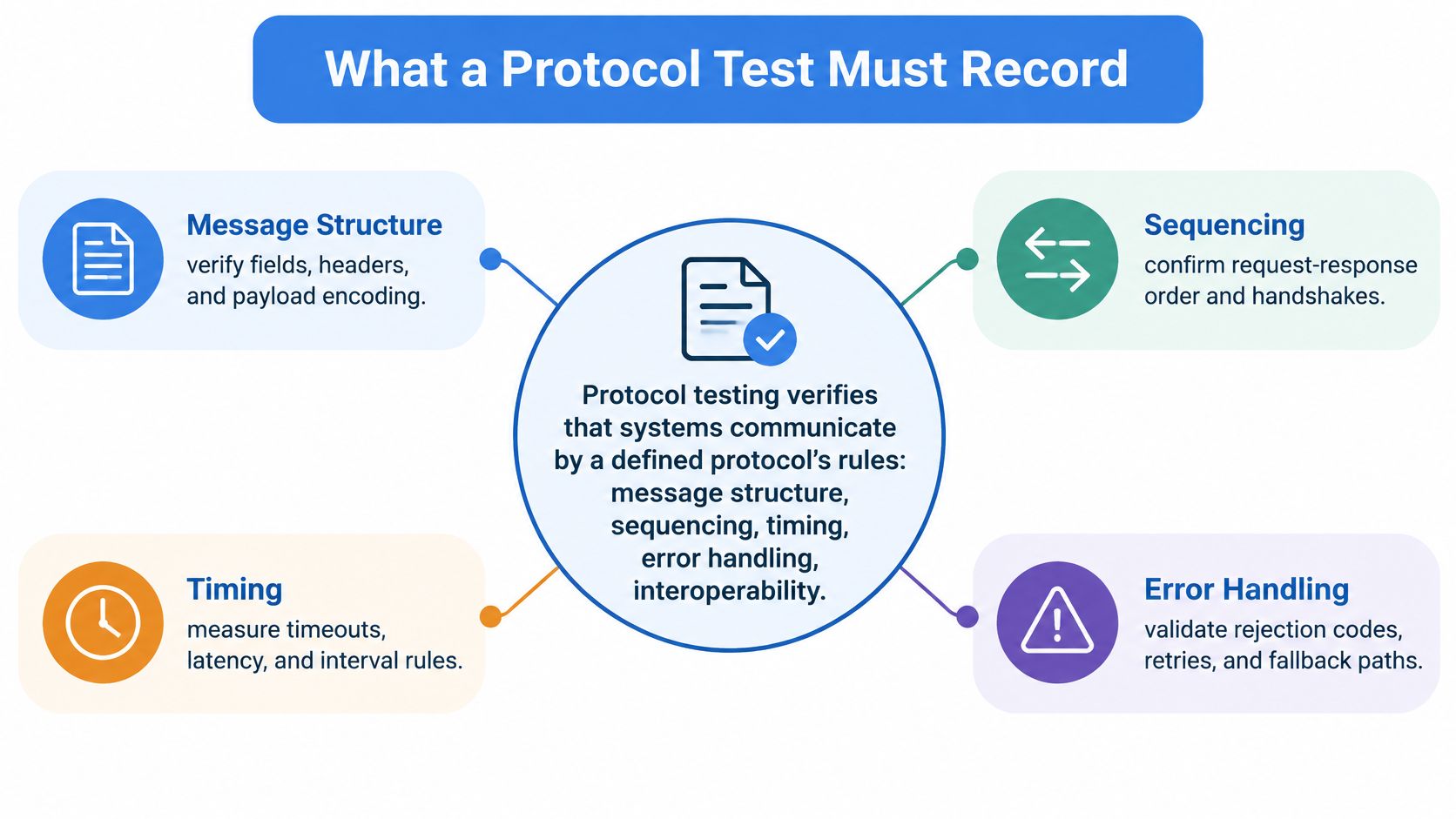
Make the exchange reproducible
The documentation tradition matters here. The history of ANSI/IEEE 829 records its first publication in 1983, its revision in 1998, and its eight documentation types: test plan, test-design specification, test-case specification, test-procedure specification, test-item transmittal report, test log, test-incident report, and test-summary report.
You don’t need separate documents for every small API check. You do need their underlying discipline: distinguish the plan, the executable procedure, the evidence, and the final judgment. Otherwise, a teammate can’t tell whether a failure came from the implementation, the environment, or an unstated assumption.
What every protocol test case must record
| Field | What to write down | Example of a fail |
|---|---|---|
| Stimulus | Exact request, frame or packet, including version and options | Vague instruction to send a valid request with no bytes or headers |
| Preconditions | Protocol state and peer capability before the send | Case run from the wrong connection or auth state |
| Permitted response | Status, error code, fields and next state that may occur | Unexpected error code or transition accepted as success |
| Timing bound | Timeout, retry delay or allowed gap | Hung client accepted because the suite never waited |
| Verdict rule | Pass, fail and inconclusive conditions | Operator judgment with no expected outcome |
Write a case someone else can execute
Say you’re testing a request made with an expired credential. Record the request headers and payload, how the credential became expired, the expected rejection, and whether the connection should remain usable afterward. Set the timing bound from the relevant contract rather than choosing a convenient sleep interval.
Then describe what makes the result inconclusive. If the authentication service is unavailable, you haven’t necessarily demonstrated the expired-credential behavior. Reporting that run as a pass would conceal missing evidence.
The same record works across HTTP, TCP, TLS, messaging, and application APIs, although the observation point changes. For TLS, the interesting evidence may be handshake messages and alerts; for messaging, it may be acknowledgments and delivery state.
Practical rule: A protocol test isn’t reproducible until another engineer can reconstruct both the message and the state in which it was sent.
That gives a useful answer to “what is protocol testing?” in everyday engineering terms: it’s a test of a conversation, with an explicit record of what each participant was allowed to do.
Why Late Protocol Bugs Cost More
A protocol defect discovered after deployment rarely involves only changing a parser. Engineers may also need to reconstruct an affected session, identify incompatible clients, reconcile application state, and coordinate a rollback.
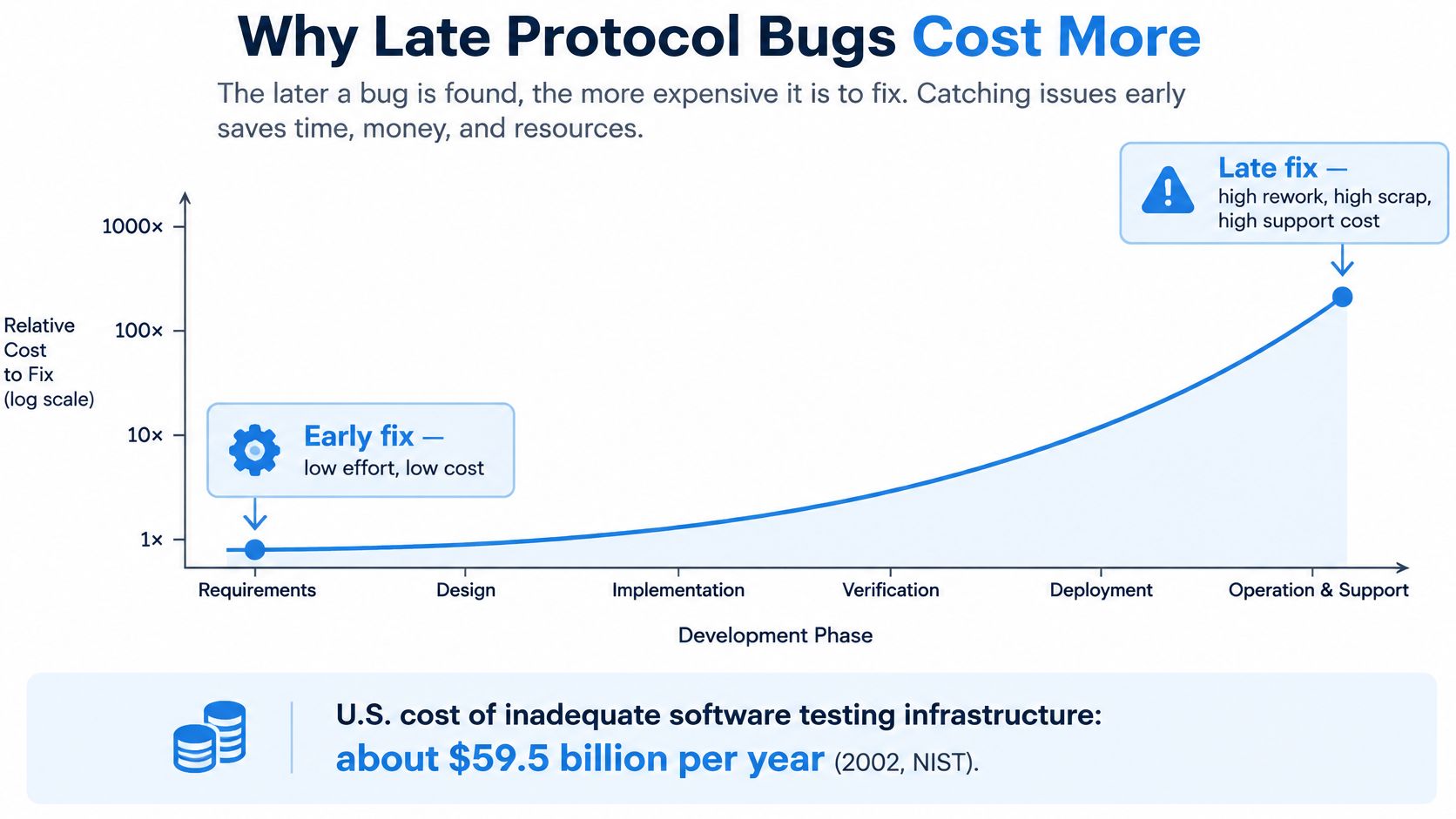
The historical defect-cost model summarized by ContextQA places correction at 1x during design, about 6.5x during implementation, 15x during testing, and 60–100x after release. These are relative values from a cost model, not a forecast of your team’s next incident bill.
Relative cost of fixing a software defect
| When found | Relative cost | What it means for protocol work |
|---|---|---|
| Design | 1x | Specify message, state and error rules before code |
| Implementation | About 6.5x | Catch format and state bugs while building |
| Testing | 15x | Still cheaper than production for timeout and retry bugs |
| After release | 60–100x | Auth, compatibility and sequence bugs hit users |
The practical lesson is to move uncertainty earlier. If nobody has decided whether a client may retry an interrupted operation, developers can’t reliably implement it and testers can’t reliably judge it.
Spend on complete exchanges
Unit tests can establish that a serializer produces the intended object or that an authentication function rejects a credential. They may never exercise the gap between a server committing a change and a client receiving its response. That’s where a retry can turn an apparently successful operation into a duplicate side effect.
Consider a checkout service whose response disappears after the order is committed. The client can’t distinguish that outcome from a request that never arrived. Your test should establish what happens when the client repeats the operation, including which identifier it reuses and what the server returns.
Protocol-testing effort belongs around these boundaries:
- Authentication: Exercise expiry and refresh during an active conversation.
- Serialization: Check the actual wire representation, not just in-memory values.
- Timeouts: Observe cancellation and cleanup, not merely a timeout exception.
- Retries: Verify the resulting operation and state after interrupted exchanges.
- Compatibility: Keep supported consumers in the release decision.
Don’t assign every unresolved issue a literal multiplier. Use the cost curve to challenge release decisions that defer uncertain communication behavior until users encounter it.
Representative replay can help expose sequence-dependent problems before release, but it isn’t a replacement for specification-derived cases. Captured traffic shows what clients did during the capture window. It won’t necessarily include a malformed message, an unusual recovery path, or a supported client that happened to be inactive.
The Main Kinds of Protocol Tests
Conformance asks whether an implementation meets a specification. Interoperability asks whether independent implementations communicate and complete useful operations. Passing the former increases confidence in the latter, but doesn’t prove it.
The ITU guidance on conformance and interoperability makes that distinction and describes the role of ISO/IEC 9646 in protocol conformance methodology. The difference affects your test environment: a simulated peer can precisely exercise requirements, while a real peer can expose assumptions your simulator shares with your implementation.
Choose tests by the question they answer
Suppose your implementation accepts an optional capability exactly as your team interprets the specification. Another implementation may advertise a different combination of options or recover differently from an incomplete message. Your scripted suite can remain green while the pair fails during negotiation.
Protocol test kinds and what each proves
| Kind | Question it answers | Typical stimulus | What it misses |
|---|---|---|---|
| Conformance | Does this build meet the spec? | Scripted cases from a test system simulating the peer | Ambiguous spec text and real peer quirks |
| Interoperability | Do independent builds complete real operations? | A second implementation and mixed capabilities | Requirements that no peer in the lab exercises |
| Negative or falsification | Where does the build deviate or omit a rule? | Malformed, duplicate, early-close and boundary input | Happy-path meaning and version drift |
| Performance | Do rules hold under delay and load? | Concurrent, delayed and high-volume exchanges | Spec correctness at low volume |
| Security | Do boundaries reject hostile input? | Bad auth, unexpected parameters, injection-shaped payloads | Ordinary functional sequencing |
| Compatibility | Do supported versions still work together? | Old and new clients, deprecated fields, negotiation | Brand-new behavior with no old client |
These categories overlap. A malformed frame sent during heavy load is both a negative case and a performance scenario. Label the requirement you’re evaluating so a busy test run doesn’t become an impressive traffic graph without a meaningful verdict.
Combine controlled peers with realistic sessions
Use a simulated peer when you need precise control over ordering, message contents, and faults. It can deliberately stop during a handshake or advertise an unsupported option without depending on another product to behave badly.
Use an independent implementation when you need evidence about actual compatibility. Exercise capability combinations rather than only the defaults. A lab containing identical clients with identical settings can’t reveal many negotiation disagreements.
For a service receiving production-like HTTP traffic, combine specification cases with sanitized multi-step sessions and controlled fault injection. Keep the workload stable when comparing builds, and observe operation completion, protocol errors, timing, retries, and resulting state.
A test category describes the question you’re asking, not a guarantee that every failure in that category has been covered.
That distinction helps teams assign ownership. Protocol engineers can maintain normative cases, application teams can define meaningful outcomes, and operations engineers can reproduce delays and disconnects. None of those roles can substitute for the others by adding more requests to a single happy-path script.
When Passing Tests Still Break Clients
A newest-version suite can pass while supported clients fail. The requests may still parse, yet an existing response field may mean something different or a previously accepted operation may now require an additional precondition.
Aspire Systems’ discussion of testing trends identifies full-lifecycle API validation, including contracts, backward compatibility, and production monitoring, as a 2025 direction. The useful engineering response is a release gate, not merely another schema validator.
Define compatibility before approving changes
Treat a change as breaking when it removes a field supported clients send, changes the meaning of an existing code, tightens a promised timing allowance, or stops negotiating a supported version. Check those changes against a client-server compatibility matrix and consumer-driven expectations.
- Supported versions: Name the client and server combinations you promise to maintain.
- Deprecated fields: Keep exercising them until their consumers leave the supported population.
- Additive changes: Verify that older clients can ignore unfamiliar fields where the contract permits them.
- Semantic assertions: Check what a response means to the consumer, not just whether it matches a schema.
Protocol correctness and application correctness aren’t identical. A correctly encoded response can still describe the wrong business outcome. For schema-heavy APIs, this distinction also guides GraphQL testing: validating the shape doesn’t establish that a supported consumer can still complete its workflow.
Require safe traces as well as faithful traces
Production-derived sessions add another release gate. The GoReplay guide to masking and anonymization distinguishes format-preserving masking from anonymization intended to prevent association with an individual. A substituted identifier can remain linkable even when it no longer looks like the original.
Classify direct identifiers, quasi-identifiers, secrets, and neutral fields before storing a capture. Test whether unusual combinations remain unique, whether plausible auxiliary information enables linkage, and whether deterministic substitutions can be reversed.
At the same time, preserve relationships needed by the test. Rewriting a customer identifier differently in related requests can destroy the workflow you’re trying to exercise.
Accept a transformed trace only when it satisfies both behavioral fidelity and re-identification resistance.
Transform sensitive values before storage. Remove unsuitable requests, redirect the retained sample to an isolated target, and disable external side effects. A status-code comparison can’t establish any of those safety properties.
The release decision therefore needs explicit answers: which supported versions were exercised, and which captured fields passed privacy review before anyone saved the workload?
Cases Metrics and Tools in Practice
A checkout replay starts with a misleading success: the TCP connection opens and the server responds. The operation can still fail because the cookie has expired, a token must come from an earlier response, or the captured cart identifier doesn’t exist on the target.
Case A, a session-dependent checkout. Obtain target-valid credentials, map dynamic identifiers, and assert that the cart reaches its expected final state. A connection groups network exchanges; it doesn’t represent a user or repair application identity.
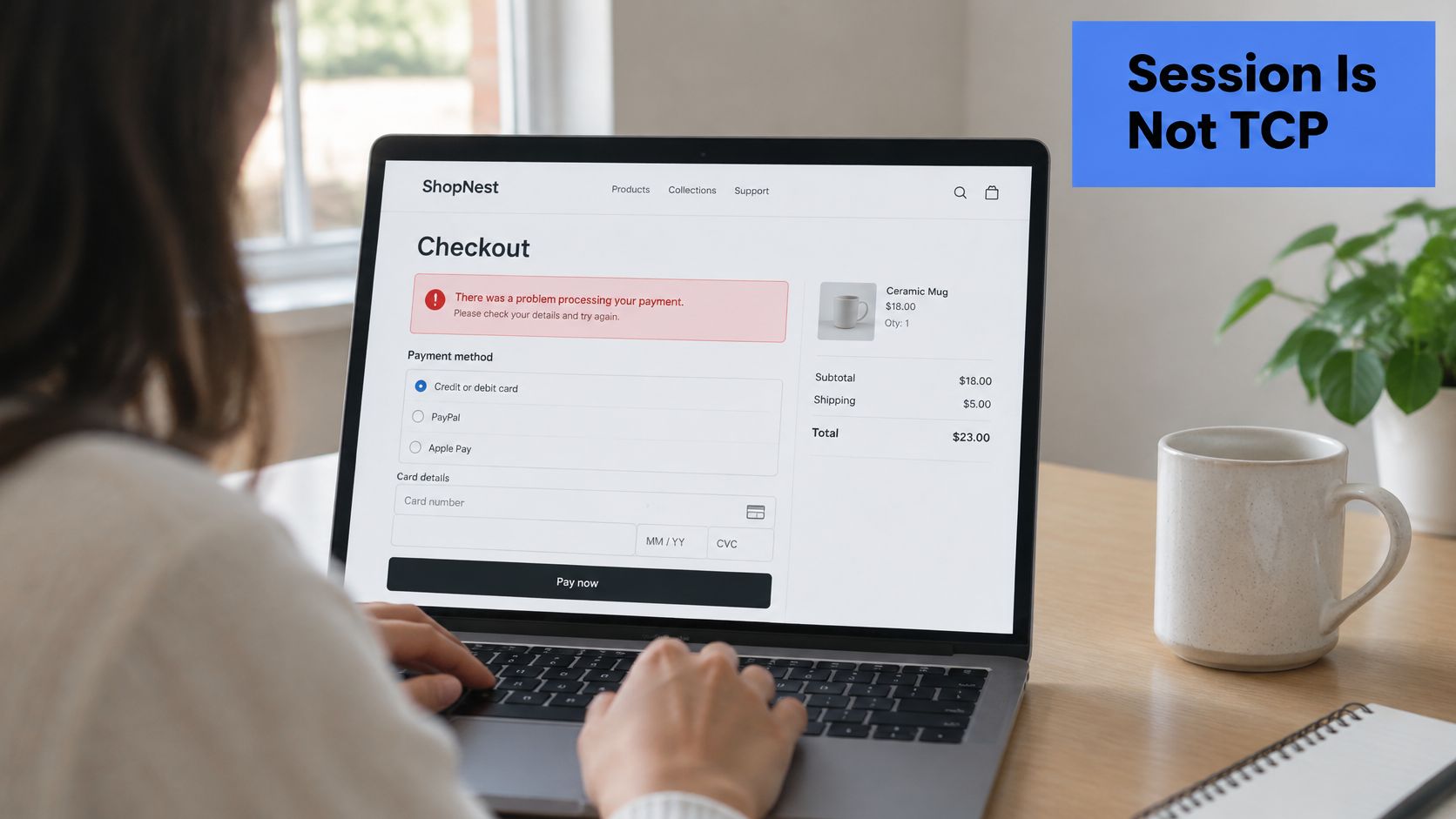
Case B, an interrupted operation. Replay a POST, close the connection prematurely, or submit a boundary-sized body. Define the expected error class and recovery behavior before running the case. A rejection with the wrong error body, an orphaned operation, or a duplicate order should fail even if the status looks plausible.
Use migration evidence to choose the scoreboard
Case C, an infrastructure migration. ResDiary used GoReplay to validate infrastructure requirements for its move from RackSpace to Azure and successfully migrated its UK and Australia regions. That provides a concrete example of using actual traffic to evaluate a prospective environment rather than treating a scripted throughput target as the whole migration test.
Lewis at ResDiary described the outcome:
“Using GoReplay, we were able to accurately estimate our infrastructure requirements and highlight the flaws in our prospective setup.”
Score a migration workload by what the service accomplished, not merely how many requests the replay process sent.
Metrics that show a protocol exchange worked
| Metric | Healthy reading | Hidden failure |
|---|---|---|
| Completion rate | User-level operation finishes, not only a response | Connection or HTTP success while checkout or login never finished |
| Protocol error class | Expected code for that negative or fault case | Wrong error body counted as pass |
| Latency | Within the timing bound at the replay speed you chose | Timeouts retried until a late success |
| Retries | No duplicate side effect | Second POST creates a second order |
| State divergence | Target state matches expected after the sequence | Response matches while the database does not |
Sahil at videologygroup.com described soak-testing new and old service versions and comparing their metrics to discover bugs. Make that comparison fair by holding the captured workload, initial state, and replay settings constant.
Automate evidence, not assumptions
According to Quality Magazine’s reporting of TestRail’s Software Testing and Quality Report, in 2025, 86% of organizations with strong automation and CI/CD pipelines reported faster releases, while 71% reported fewer production defects. Those findings provide context for pipeline integration, not proof that an automated suite covers protocol behavior.
Choose tools by observation point: Wireshark for packet-level evidence, an API runner for specification cases, and a load generator for scripted concurrency. Preserve failed-case artifacts so engineers can inspect the exchange instead of rerunning a large workload and hoping the same symptom appears.
How to Design and Run a Safe Protocol Test
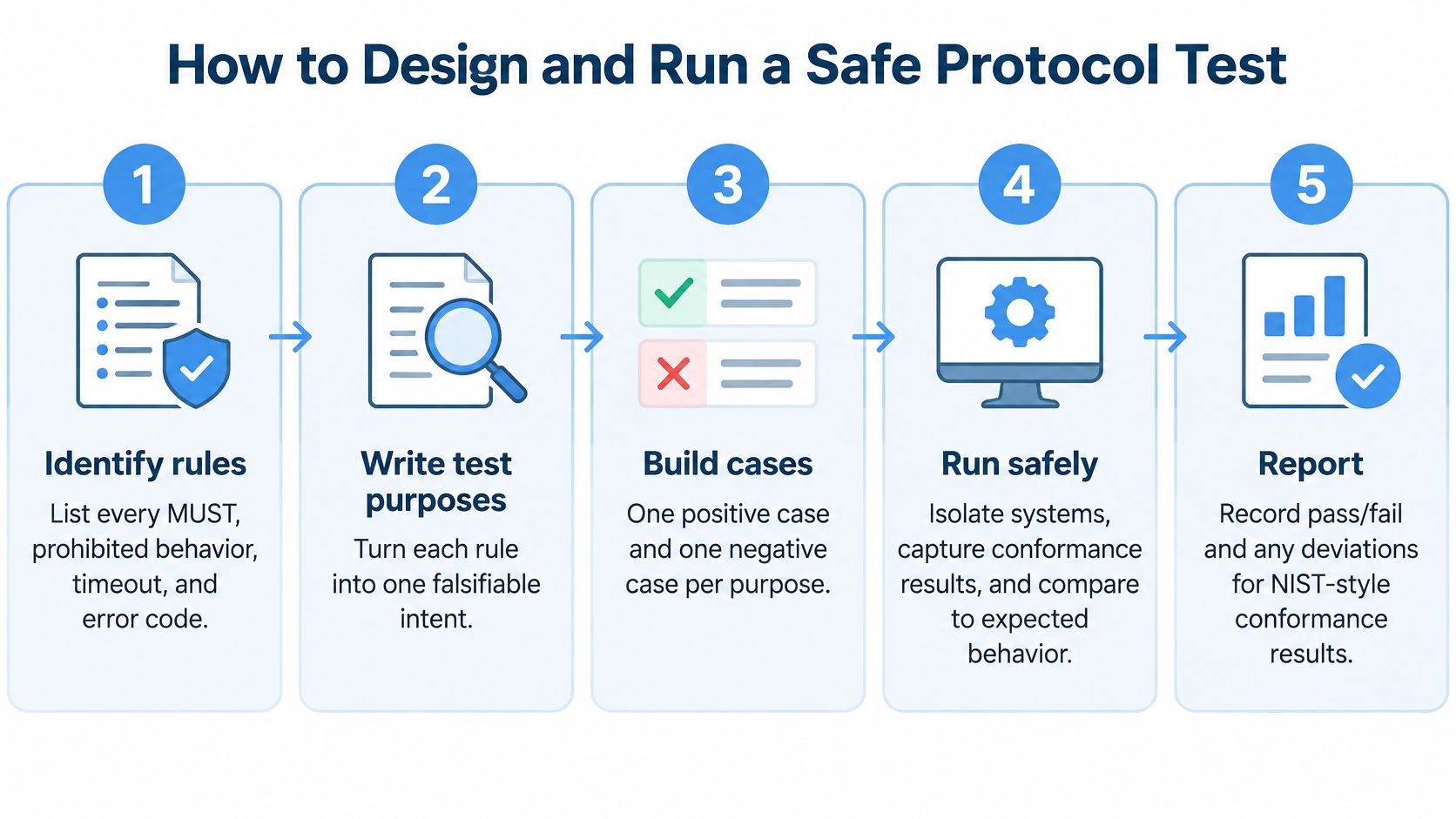
A safe protocol test begins with a requirement that could be disproved. For every MUST, prohibited behavior, timeout, and error code, write a test purpose describing what observation would demonstrate a deviation. A suite that only exercises valid inputs can pass while version drift, negative paths, and ordering violations go unobserved, so the definition of done has to include the failing cases too.
NIST’s conformance-testing guidance emphasizes objective, reproducible, unambiguous, and accurate results. Apply that discipline through a requirement-to-test mapping, with positive and negative cases wherever applicable.
If a specification prohibits a message before negotiation completes, test its acceptance after negotiation and its rejection before negotiation. Record the stimulus, starting state, observed output, timing, and verdict for each case. When a requirement leaves the expected behavior ambiguous, resolve that ambiguity in the specification before adding a permissive assertion.
Prepare the environment before capturing
Set the version matrix and field classifications before touching production traffic. Assign an owner to the replay target, its outbound network policy, and the test artifacts. Decide where sanitized captures will live and who may inspect them. A replay target that can still reach a real payment gateway or mail provider is an incident waiting for a schedule, so outbound restrictions belong in the environment design itself.
GoReplay’s Open Source edition provides HTTP capture and replay, request filtering, rewriting, middleware, and a command-line interface. Those capabilities support a replay procedure, and your assertions and environment controls determine whether the procedure establishes correctness.
Use the testing-environment setup guide to prepare the capture and destination arrangement, then run the workload through the stages below.
Run a controlled replay
-
Choose a plaintext capture point. Capture HTTP after TLS termination, where the protocol messages you need are visible. Record only the requests required for the experiment and measure capture overhead. If you are collecting encrypted bytes an HTTP replay workflow cannot interpret, stop and move the capture point.
-
Filter and rewrite before retaining the sample. Remove unsuitable operations and transform sensitive values before storage. Rewrite routing information for an isolated target, and disable payment, email, and partner side effects through stubs, sandbox integrations, and outbound restrictions. A changed hostname alone leaves those side effects intact.
-
Repair application identity. Obtain credentials valid in the target environment and map cookies, tokens, and dynamic identifiers consistently. A keep-alive connection won’t refresh an expired token or create a missing cart. When a later request consumes a value from an earlier response, extract the target’s value rather than reusing the production one.
-
Establish dependent state. Seed the records that retained requests require, or replay their setup operations under controlled ordering. Request scheduling does not preserve business dependencies by itself. A checkout submitted before its cart exists tells you little about the change under evaluation.
-
Replay the same workload deliberately. Begin with settings suited to a behavioral comparison, and increase replay speed only when asking a capacity question. Record the setting with the results, and keep baseline and candidate runs comparable in their initial data and configuration.
-
Compare the complete outcome. Evaluate status, payload, latency, retries, and application state against the case record. Normalize nondeterministic fields, such as generated identifiers, through explicit mapping rules. Ignoring every differing field to produce a clean report hides real divergence.
Judge the run, then preserve the evidence
A finished replay shows the replay process completed. Correctness comes from the comparison, so separate unexpected protocol behavior from test-fixture failures. A missing seeded account, for example, should trigger fixture investigation before anyone draws a compatibility verdict. Preserve enough sanitized evidence to rerun a failed sequence independently, including transformation rules and target configuration.
Treat the safety checks as part of the verdict. HTTP replay alone won’t establish TCP or TLS conformance, and a realistic workload won’t automatically contain the adversarial inputs your requirements demand. Both gaps belong on the case list beside the replay results.
For a first experiment this week, choose an existing production path and a change expected to preserve its behavior, such as a configuration move. Define the expected outcome, prepare an isolated target, and compare baseline and candidate runs using the same sanitized sample. Stop immediately if secrets remain exposed or the target can trigger real external actions.
GoReplay captures live HTTP requests and replays them against isolated test services, so you can evaluate real interaction sequences alongside specification-based tests. Visit GoReplay to set up a filtered, rewritten workload for a supported client path, then compare responses and application state before approving the change.