
Shadow Testing with Production HTTP Traffic
Shadow testing sends a copy of live requests to a candidate service while users continue to receive responses from production. GoReplay captures HTTP traffic on the host and replays it to your test environment.
For live shadowing, capture plaintext HTTP after TLS termination and use an isolated target with test data and production side effects disabled.
sudo gor --input-raw :8080 --output-http="http://staging.example.com"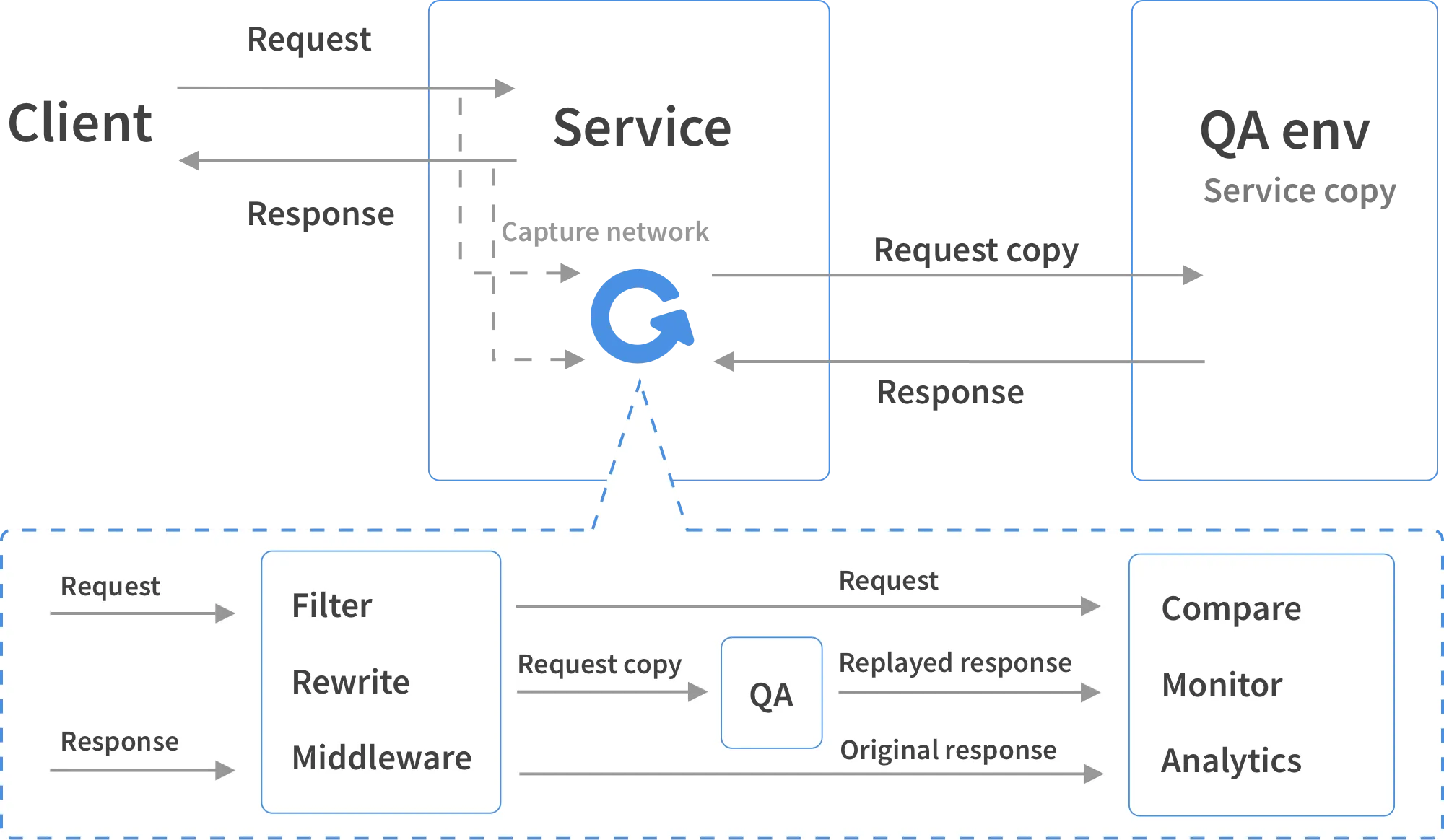
What GoReplay adds to a shadow test
Exercise migrations, service rewrites, or configuration changes with requests your application actually receives. Keep scripted tests for new behavior that has no production traffic yet.
Mirror live HTTP requests
Copy requests from the application host to a candidate service. Production continues to serve the original requests; the candidate responses are not sent back to users.
Record now, replay later
Save a capture to a file and replay it after preparing your test environment. Use the same captured workload when comparing builds or investigating a regression.
Compare the behavior that matters
Enable response tracking and use middleware or your analysis tooling to compare status codes, payloads, and latency. Define the differences that should fail your test.
Start with a controlled replay
Recording first gives you time to inspect the capture and prepare the candidate before sending it traffic. Stop capture with Ctrl+C after collecting the sample you need.
-
1. Prepare the candidate and select the traffic
Use a separate database and test credentials. Disable real payments, emails, and other downstream actions. Start with endpoints you have verified are safe to replay; even a GET endpoint can have side effects.
Use request filtering to choose endpoints and middleware to remove sensitive fields before recording. The examples below filter by method only.
-
2. Record a sample on the plaintext HTTP port
sudo gor --input-raw :8080 --http-allow-method GET --output-file requests.gor --output-file-appendUse a new filename for each sample.
--output-file-appendkeeps the capture in that file instead of numbered chunks. Inspect and protect it. For an HTTPS application, follow the TLS capture setup to find the correct port. Raw capture on port 443 cannot read encrypted request bodies. -
3. Replay the sample and inspect the candidate
gor --input-file requests.gor --output-http="http://staging.example.com"Check candidate errors, latency, resource use, and application behavior. If it uses different credentials or generated IDs, configure request rewriting or token mapping in middleware before expanding the replay.
The shadow testing guide covers live mirroring and response tracking. To increase the load from a recorded sample, continue with load testing with production traffic.
Decide what counts as a regression
Replay supplies the workload; your test needs an acceptance rule. A response with status 200 can still contain the wrong result. Compare the fields relevant to the change and normalize values that are expected to differ, such as timestamps or generated IDs.
For paired response analysis, enable --input-raw-track-response
and --output-http-track-response when capturing and
replaying. GoReplay middleware
can receive origin and replayed responses. Correlate them by request ID and implement
the comparison your application needs; they can arrive asynchronously.
Matching captured requests is evidence about that workload. It does not cover every possible input, guarantee a safe release, or replace tests for new features.
Shadow testing questions
What is shadow testing?
Shadow testing, also called traffic shadowing or dark traffic testing, sends a copy of production requests to a candidate service while production continues to answer users. It lets you observe how an existing workload behaves on a new build or configuration before routing users to it.
Will shadow testing affect production?
GoReplay captures traffic without acting as an inline proxy, but capture and replay still consume CPU, memory, and network capacity. Measure overhead on the capture host. Isolate the candidate’s databases and downstream services so replayed requests cannot trigger production writes, payments, or notifications.
Can GoReplay capture HTTPS traffic?
Raw packet capture does not decrypt TLS. Capture plaintext HTTP on the application side of your TLS terminator, such as the upstream port behind a reverse proxy. GoReplay can replay those requests to an HTTPS target. If that plaintext capture point is unavailable, plan a different capture setup.
Does replay automatically prove that responses match?
No. Sending the requests is only one part of the test. Enable origin and replay response tracking when your comparison needs both, then compare the fields relevant to the change. Account for timestamps, generated IDs, authentication tokens, and differences in test data. A successful HTTP response alone does not establish correct behavior.
How do I handle sensitive or stateful requests?
Use request filters, rewriting, and middleware to select traffic, remove sensitive fields, and map authentication tokens to the test environment. Review saved captures as well as outgoing requests. Method filtering alone does not remove secrets or guarantee that an endpoint has no side effects.
How is GoReplay different from AWS VPC Traffic Mirroring?
VPC Traffic Mirroring copies network packets to a monitoring target. GoReplay’s HTTP replay workflow sends application requests to a candidate HTTP service. Packet mirroring can supply captured traffic, but it does not by itself configure the candidate’s data, replay HTTP requests, or compare application responses.
Try a shadow test with your HTTP traffic
Start with the open-source capture and replay workflow. Explore GoReplay PRO if your deployment needs S3 storage, session-aware replay, or commercial support.