
Mastering GraphQL Testing a Developer’s Guide

Your GraphQL API can return 200 OK and still be broken in all the ways that matter.
A resolver can overfetch. A nested query can explode into an N+1 problem. A mutation can pass in staging, then fail when real clients send variable combinations your tests never covered. Security checks can look fine until someone probes introspection through an HTTP method or content type your team never thought to test.
That’s why graphql testing has to be broader than “does this query work.” The useful approach is layered. Start with cheap checks close to the schema and resolver code. Move up into integration tests that validate how types and data sources behave together. Add end-to-end coverage that treats the API like a hostile and realistic client would. Then finish with performance validation under traffic patterns that look like production, not a toy benchmark script.
The GraphQL Testing Mindset From Schema to Unit Tests
Request-level tests are often the first choice because they feel realistic. The problem is that they’re expensive to debug. When a large query fails, you still have to figure out whether the fault lives in schema design, argument parsing, resolver logic, authorization rules, or a downstream dependency.
A better mental model is a testing pyramid. Put the cheapest, fastest checks at the bottom. Push broader tests upward. That keeps the feedback loop tight and makes failures easier to localize.
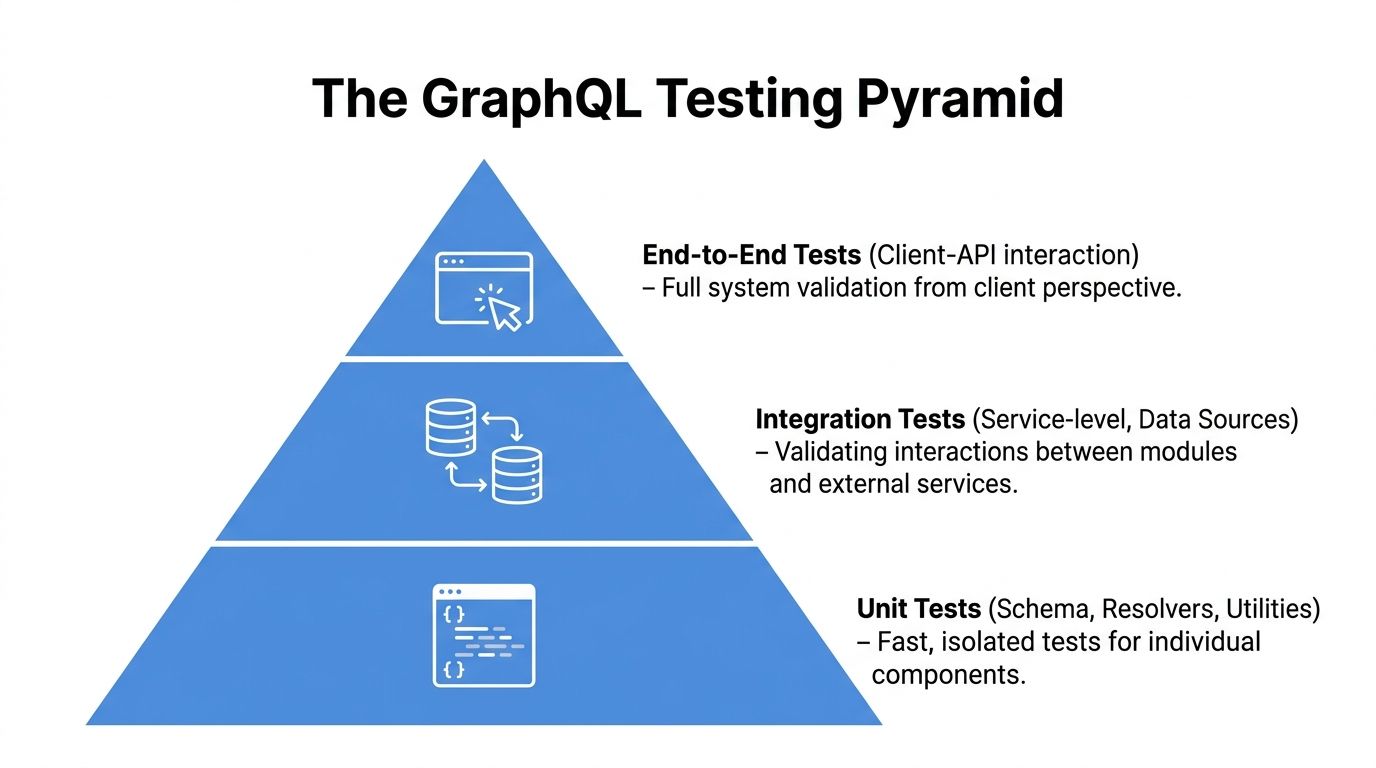
GraphQL makes that discipline even more important because a single query can request multiple levels of nested data, which makes test coverage harder than it looks. The Katalon guide on testing complex nested GraphQL responses with snapshot testing and mock data captures the core issue well. The graph is flexible for clients, but that flexibility expands the number of meaningful test paths.
Lint the schema before you test behavior
Schema linting catches a class of problems before runtime ever enters the picture. It won’t tell you whether a business rule is correct, but it will tell you whether your contract is drifting into something inconsistent and hard to consume.
Focus schema checks on a few practical areas:
- Naming consistency: Enforce conventions for types, enums, inputs, and mutations so the API stays predictable.
- Nullability discipline: Review nullable fields aggressively. Many production surprises come from a field that was left nullable “for now” and then breaks client assumptions later.
- Deprecation hygiene: Mark old fields intentionally and fail builds when deprecated fields linger without ownership.
- Input clarity: Prefer explicit input types over long mutation argument lists. They’re easier to validate and easier to evolve.
Practical rule: If the schema is confusing to your own team, tests won’t save you. They’ll only lock confusion into CI.
A linted schema also improves downstream tests. Resolver unit tests become simpler when type boundaries are explicit and arguments are shaped consistently.
Unit test resolvers as plain functions
Resolvers are easiest to trust when you stop treating them like magic GraphQL components and start testing them as ordinary functions. For most resolver unit tests, the GraphQL server doesn’t need to exist at all.
That means isolating four things:
- Arguments coming from the query or mutation
- Context such as auth, loaders, and service clients
- Parent values for nested resolvers
- Business logic utilities called by the resolver
A good resolver unit test usually asks one narrow question. Does this resolver reject unauthorized access? Does it map service output into the schema shape correctly? Does it transform nulls and defaults the way the contract expects?
Use mocks carefully
Mocking is necessary, but bad mocks create false confidence. For unit tests, mock only at the boundary you’re trying to isolate. If a resolver depends on a pricing service, mock that service. Don’t also mock internal helpers unless they’re irrelevant to the behavior under test.
Mock data should also look like something your production API would see. Teams often underinvest here. In practice, realistic scenarios such as authentication, product search, cart operations, and checkout flows give you much better coverage of nested and batched query behavior than toy fixtures do.
A quick heuristic helps:
| Test target | Keep real | Mock |
|---|---|---|
| Pure utility | Function logic | Nothing |
| Resolver authorization | Resolver branching | External services |
| Response mapping | Parent object and transform logic | Database or API client |
| Error handling | Resolver control flow | Downstream failures |
Unit tests won’t catch every issue. They’re not supposed to. Their job is to fail fast, cheaply, and precisely. When that base is solid, everything above it becomes less noisy and more trustworthy.
Integration Testing for Connected Components
The most useful integration tests in GraphQL don’t start with “which query should I write?” They start with “which type is risky enough that I need to verify all of its fields behave together?”
That shift matters. Testing by query shape often leaves holes because clients can combine fields in ways your predefined test documents never cover. Testing per type is more effective. The daily.dev article on per-type integration testing for GraphQL field coverage and N+1 detection makes the case directly, including the practical advice to generate at least two records so you can see whether fetching multiple items triggers inefficient resolver behavior.
Think in types, not canned documents
A useful analogy is database testing. You wouldn’t validate a table only through one favorite report. You’d inspect the table’s constraints, joins, and access patterns. GraphQL types deserve the same treatment.
For a Product type, that usually means validating combinations such as:
- scalar fields plus nested relationships
- fields with authorization checks
- computed fields that call internal services
- list fields that rely on batching or loaders
The “at least two records” rule is simple but powerful. A single object often hides N+1 issues because there’s no repeated lookup pattern. Multiple records force resolvers to prove they batch correctly.
Test the type the way clients will stress it, not the way your first demo query happened to fetch it.
Build a small in-memory test server
Integration tests should exercise the GraphQL execution path without dragging the whole platform into the room. A lightweight in-memory server is usually enough. Keep the schema real. Keep middleware real where it affects execution. Replace external dependencies with controlled fakes or mocks.
A practical setup looks like this:
- Real schema assembly: Use the actual type definitions and resolver map.
- Real context factory: Include auth parsing, loader construction, and request metadata.
- Mocked database client: Return deterministic records.
- Mocked third-party APIs: Simulate failure and latency conditions without depending on live services.
This style gives you confidence that resolvers, middleware, and execution all cooperate correctly, while keeping failures debuggable. If you want a broader testing discipline around service interaction, these integration testing best practices line up well with how GraphQL services behave in real systems.
What works and what doesn’t
A lot of teams overmock integration tests until they’re barely integration tests anymore. That usually misses contract drift between resolvers and data sources.
What tends to work better:
- Use realistic fixture graphs: A user with no orders and a user with several orders expose very different behavior.
- Assert on shape and semantics: Don’t only snapshot the whole response. Also assert on specific fields that represent business rules.
- Track query behavior indirectly: Even if you don’t wire in full database query assertions, make sure tests reveal repeated backend calls when fetching multiple records.
What usually doesn’t work:
- Single-record fixtures everywhere
- One giant “happy path” query per type
- Testing only top-level fields while ignoring nested resolvers
- Live external dependencies in the default integration suite
Mocking external services is especially important for repeatability. Testing against production-like dependencies has value later, but your core integration suite should run often and deterministically.
End-to-End Testing for Real-World Scenarios
A release goes out. Basic queries pass, integration tests are green, and the mobile client still fails after login because a cookie flag changed, a nested authorization rule blocks one field, and the endpoint accepts a GET introspection request that should have been rejected. That is the gap end-to-end testing is supposed to close.

End-to-end GraphQL tests should exercise the system the way clients and attackers hit it. That means real HTTP transport, auth middleware, persisted state, caching behavior, and request validation. It also means accepting that E2E tests are slower and more brittle than unit or integration tests. The trade-off is worth it because they catch failures that lower-level tests cannot see together.
Build scenarios around workflows, not isolated operations
Single-operation tests have value, but they rarely reflect production behavior. A login mutation passing does not prove much by itself. A better scenario logs in, reads profile data, updates preferences, fetches the same object again, and verifies both the stored change and the fields the current user is allowed to see.
That style exposes the bugs that matter in practice:
- Authentication transitions: anonymous requests, valid sessions, expired sessions, and refresh flows
- Write then read behavior: a mutation succeeds, then a follow-up query proves the system stored the right state
- Permission edges: the operation works for one role and fails cleanly for another
- Repeated operation documents with different variables: clients reuse queries heavily, so tests should too
Keep these tests tied to user stories and business rules. If a checkout flow depends on inventory, discount eligibility, and region-specific tax fields, the E2E test should reflect that chain instead of checking each field in isolation.
Include transport and security checks in the same suite
Security failures in GraphQL often look like ordinary request handling mistakes. A server accepts the wrong method. Middleware parses an unexpected content type. Query depth limits work for one code path and not another. Treating those as a separate concern leaves holes.
A useful E2E suite checks happy paths and refusal paths. Both matter. The API should return data for allowed operations and reject dangerous request shapes in predictable ways.
Tests worth keeping in the default E2E suite include:
- Depth and complexity rejection: overly expensive queries fail before execution
- Field-level authorization: a parent object resolves, but restricted fields stay blocked
- Method and content-type enforcement: unsupported transports get rejected consistently
- Malformed and oversized requests: invalid documents fail cleanly without leaking internals
An API that passes happy-path tests but accepts dangerous request shapes is still under-tested.
For teams that want a deeper walkthrough of security-focused GraphQL validation, this embedded discussion is worth reviewing before you finalize your suite:
Test introspection bypasses on purpose
Disabling introspection in production is common. Verifying only the obvious __schema request is not enough.
PortSwigger’s guidance on GraphQL introspection attacks and bypass vectors shows why simplistic filters fail. In practice, teams often block one request format and leave another path open through GET handling, alternate body parsers, or brittle string matching.
Good E2E coverage tries multiple variants:
- Alternative HTTP methods: especially GET if the endpoint is expected to allow only specific transports
- Non-JSON POST bodies: to catch middleware differences
- Whitespace and formatting changes: because parser behavior matters more than visual matching
- Aliases and query structure variations: to expose regex-based blocking rules
These cases are easy to skip because they feel like specialist security work. They are also the kind of checks that uncover embarrassing production gaps.
Keep assertions strict enough to diagnose failures
Broad snapshots age badly in E2E suites. They fail for the wrong reasons and hide the actual one. Assert on the parts of the exchange that tell you what broke.
| E2E target | Assert |
|---|---|
| Auth flow | HTTP status, GraphQL errors, session or token-bound access |
| Mutation flow | response fields, persisted side effects, follow-up read behavior |
| Security rejection | explicit denial, no protected data returned, stable error shape |
| Transport handling | method rules, content-type rules, parser behavior |
One more practical step helps a lot. Capture successful production requests, sanitize them, and replay the same workflows in a staging environment. That gives E2E testing much better coverage than hand-picked examples and sets up the higher-confidence strategy of replaying production traffic for realistic load testing.
The result is a testing layer that reflects how GraphQL systems fail. Not at the schema boundary alone. At the point where transport, auth, execution, and client behavior meet.
Performance Testing with Real Production Traffic
A release can look clean in staging and still fall over within minutes of rollout. The usual pattern is familiar. The schema passed validation, the integration suite stayed green, and the load test hit a few known queries at a steady rate. Production then adds the traffic you did not model: old mobile clients, bursty retries after timeouts, expensive field combinations, and authenticated requests that miss every cache.
That gap matters more in GraphQL than in many REST systems because the hot path is not a single endpoint. It is the combination of operation shape, variable values, resolver fan-out, authorization checks, and downstream behavior. A synthetic script can prove that selected queries are fast. It rarely proves that the system stays healthy under the request mix your users generate.
Synthetic traffic versus replayed traffic
Use both, but use them for different jobs.
| Approach | Strength | Weakness |
|---|---|---|
| Synthetic scripts | Fast to create for known queries and easy to run in CI | Usually too clean. They miss odd query shapes, burst patterns, and client-version drift |
| Replayed production traffic | Mirrors real operation mix, timing, and edge-case inputs | Needs capture, masking, routing controls, and a staging environment that can absorb realistic load |
Synthetic tests still earn their place. They are good for capacity baselines, resolver regressions, and targeted experiments such as “what happens if this list field returns 10x more rows?” The problem starts when teams treat that baseline as proof of production readiness.
Why replayed traffic finds the failures that matter
Real traffic exposes combinations that nobody writes by hand. That is the point.
In practice, replay catches a few classes of problems again and again:
- Query mix drift: clients on different release versions ask for different fields and nesting levels
- Resolver fan-out under realistic shapes: a query that looks harmless at the top level can explode into expensive downstream calls
- Auth and session behavior: expired tokens, retries, and partial client failures change the load profile
- Cache miss patterns: synthetic tests often hit warm paths more consistently than production does
- Unexpected expensive fields: one neglected resolver can dominate latency once enough clients request it
For GraphQL, replay is the closest thing to a final exam. Instead of guessing which operations deserve heavy load, you run the traffic your system already serves. Teams that want to replay production traffic for realistic load testing usually find value fast, especially before schema changes, resolver rewrites, or infrastructure migrations.
Make replay safe enough to trust
Replay can also mislead you if the setup is sloppy. Copying packets into staging is not enough.
Use a controlled process:
- Mask secrets and personal data before replay: preserve request structure and cardinality, not sensitive values
- Route traffic only to non-production targets: realistic load should never risk user-facing systems
- Keep the replay corpus stable between builds: comparing the same traffic set makes regressions easier to spot
- Measure downstream systems with the API: database pools, search clusters, and internal services often fail before GraphQL itself does
- Include security-relevant requests in the corpus: introspection attempts, alias-heavy queries, and malformed payloads belong in performance validation too, because defenses can become bottlenecks under load
That last point gets missed. Security checks are part of the execution path. If introspection blocking, query cost analysis, persisted query enforcement, or parser hardening adds too much overhead, production traffic will expose it. Replaying sanitized real requests lets you test performance and abuse resistance together, which is closer to how public GraphQL APIs get stressed.
The strongest setup I have seen uses synthetic load early, then replayed production traffic as the release gate that answers the fundamental question: does this version still behave under the messy request patterns users send every day?
Automating Quality with CI/CD Integration
A testing strategy only matters if it runs consistently. Otherwise it becomes a set of good intentions and a stale wiki page.
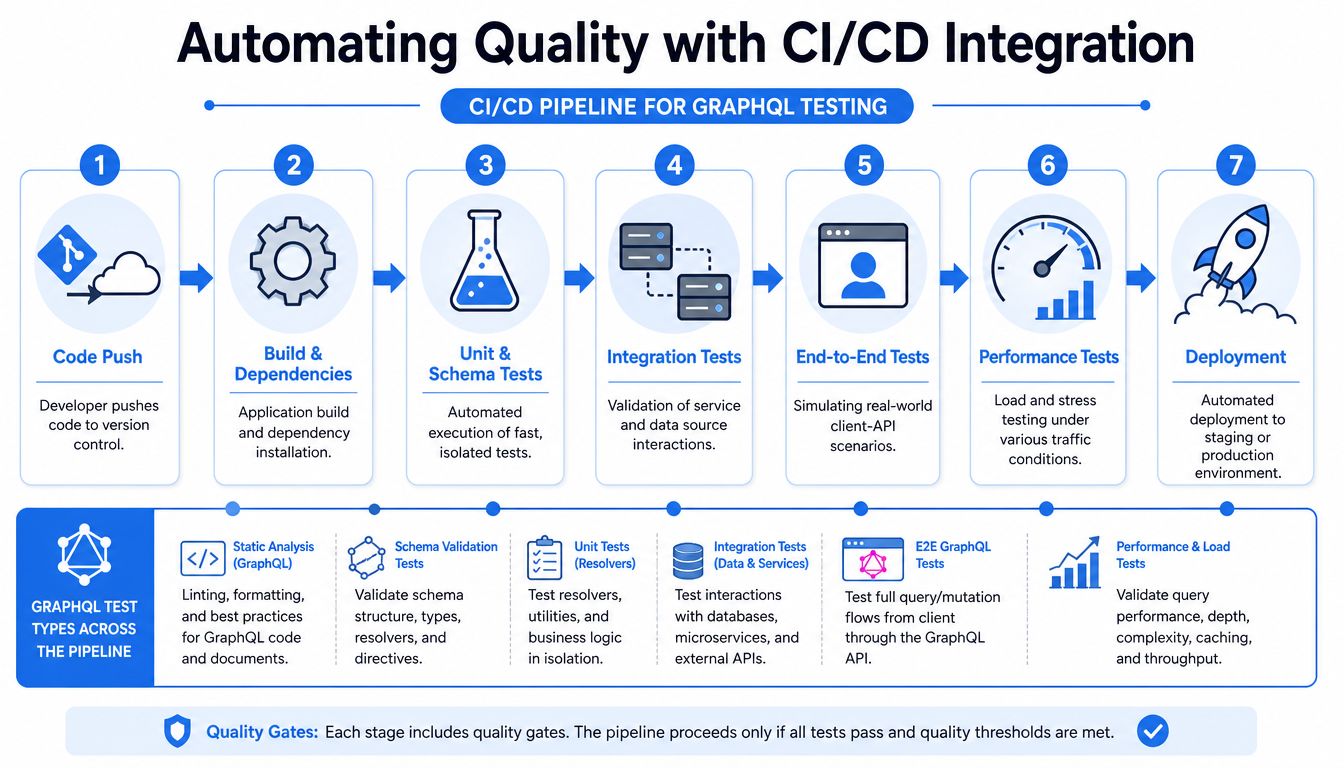
The practical shape of CI for graphql testing is a pipeline that narrows quickly on cheap failures, then expands into slower confidence checks. Fast tests should block bad commits early. Broader tests should validate release candidates under conditions that look close to production.
Put each test in the right pipeline stage
The easiest way to slow a team down is to run everything on every commit. The easier mistake is the opposite one. Teams defer meaningful tests until late stages and then wonder why fixes are expensive.
A balanced pipeline usually looks like this:
-
Code push and build Compile, install dependencies, and fail immediately on broken packaging or schema generation.
-
Unit and schema tests Run resolver units, utility tests, and schema linting first. These should return results quickly enough that developers treat failures as part of normal coding, not as a deployment event.
-
Integration tests Start the in-memory or ephemeral test server, execute per-type checks, and validate interactions among resolvers, loaders, and mocked dependencies.
-
End-to-end tests Run only after the earlier layers are green. Focus on critical workflows and security gates, not every possible variation.
-
Performance validation Use this on release branches, staging deployments, or controlled pre-production environments rather than every small commit.
The weak point is resolver realism
A lot of CI pipelines look complete on paper but still miss resolver failures because their test data is too shallow. The Escape analysis on custom test data for GraphQL API testing highlights the pain point directly: 74% of GraphQL API failures in CI stem from untested resolver logic under realistic data payloads, while mainstream open-source tools don’t support dynamic resource ID injection for resolver validation.
That matches what many teams run into. Resolver logic often depends on data shape, ownership relationships, and IDs that are valid in one environment but meaningless in another. If your CI tests only use static mocks, they can miss bugs in actual lookup and authorization paths.
A few mitigations work well:
- Seed deterministic datasets: Keep fixtures rich enough to exercise ownership, nested associations, and authorization boundaries.
- Separate mock-heavy and data-aware suites: Fast feedback still matters, but some checks need realistic records.
- Create ephemeral environments for release validation: They cost more, but they catch issues static fixtures can’t.
- Preserve failing payloads from prior incidents: Past production bugs often make the best future CI test cases.
Turn the pipeline into a feedback loop
The strongest CI setups don’t just run tests. They learn from incidents.
When a production issue appears, ask where that bug should have been caught. Then add the narrowest, cheapest test that would have blocked it. If it was a resolver branch, add a unit test. If it was a type interaction, add an integration test. If it involved transport, auth, or security enforcement, add or tighten an E2E case. If only real traffic exposed it, feed that pattern into performance validation.
That’s how graphql testing matures. Not by collecting more tools, but by improving the placement and realism of the checks you already depend on.
Key Takeaways for Bulletproof GraphQL APIs
Reliable graphql testing is layered work. Unit tests keep resolver logic honest. Integration tests prove types, loaders, and data sources cooperate correctly. End-to-end tests validate user flows and catch security failures that happy-path checks miss. Performance validation under replayed traffic tells you whether the system is ready for the requests users send.
A short checklist helps keep the strategy grounded:
- Start at the schema: Lint for consistency, nullability, and deprecation discipline.
- Test resolvers in isolation: Treat them like functions, not framework magic.
- Validate by type: Per-type integration tests uncover coverage gaps and N+1 behavior earlier.
- Promote security into E2E: Depth limits, transport restrictions, field-level authorization, and introspection bypass testing belong in the main suite.
- Use realistic traffic before release: Synthetic load is useful, but replayed production patterns are a stronger final test.
- Automate the whole stack: CI should run the right tests at the right time, with realistic enough data to expose resolver bugs.
Teams don’t get bulletproof GraphQL APIs from one perfect test suite. They get there by stacking focused checks that each catch a different failure mode.
If you want the highest-confidence final gate before deployment, GoReplay is worth a close look. It lets teams capture and replay real HTTP traffic against test environments, which is one of the most practical ways to validate GraphQL behavior under production-like conditions without gambling on production itself.