
Data Masking and Anonymization: How They Differ
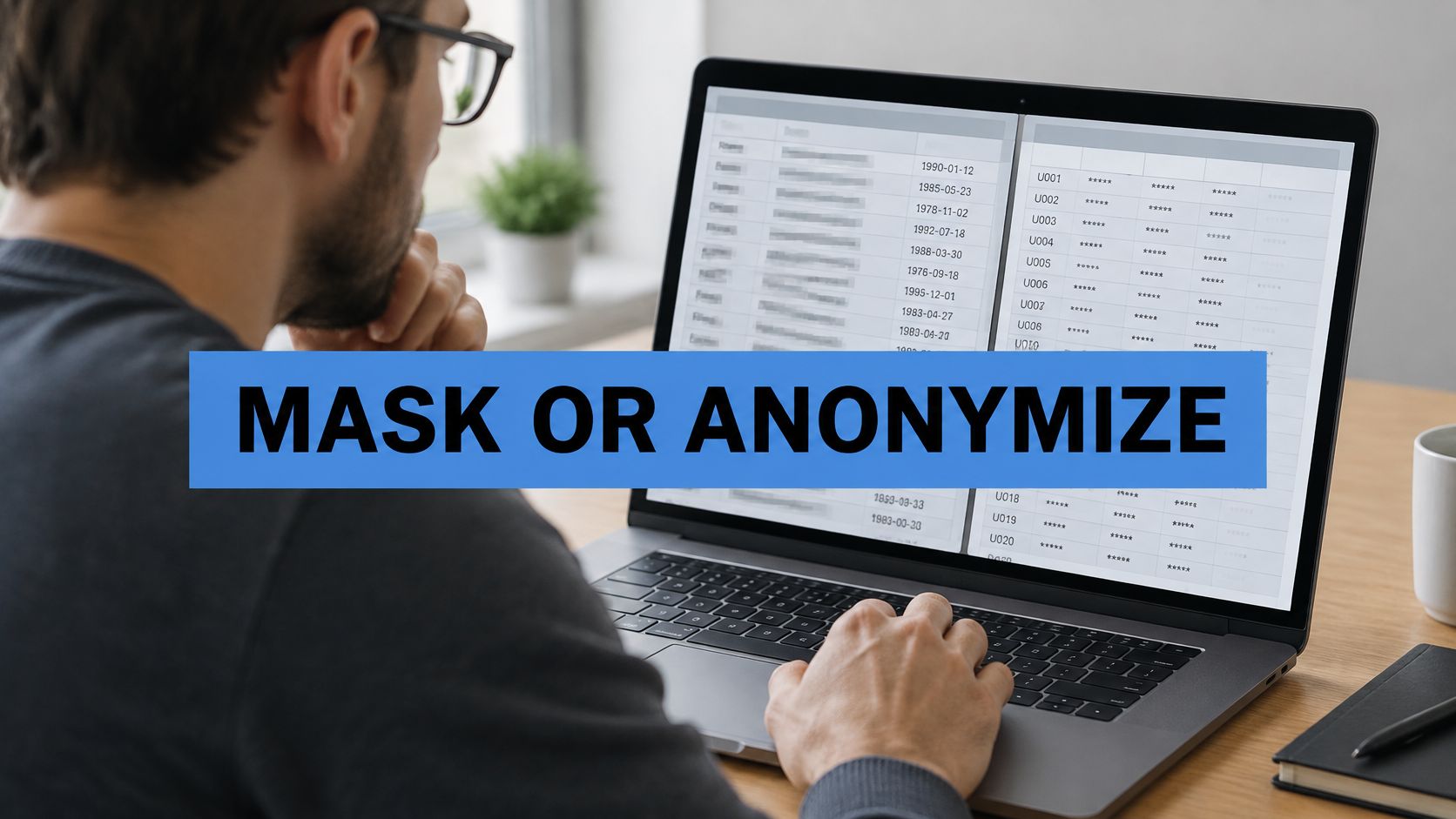
You captured three hours of production traffic, ran a script that swapped every email address for a fake one, and dropped the archive in a shared bucket so the team could replay it locally. The regression suite passes. The emails look fake. It feels finished.
It isn’t. Removing a name doesn’t remove the person. The pattern of requests one user makes, the minute they make them, the city the requests come from, and the rare endpoint they hit on the way to checkout can pin an individual down as effectively as an email address.
What separates data masking and anonymization isn’t the transformation you apply. It’s whether anyone holding the output, plus a second dataset they can get their hands on, can still work out who is inside it. That’s a measurable question, and it turns a cleanup step into a test you can pass or fail.
Masking and Anonymization at a Glance
A developer copies a production database into staging to debug a checkout bug. The tables look right: order volume, timestamps, retry counts, the odd malformed row. Then she opens the customers table and finds live email addresses, phone numbers, and card tokens sitting in a database protected by a shared password. This is the moment teams reach for a masking script, and the moment to be precise about what that script will and will not achieve.
Data masking changes or hides specific sensitive fields so the copy still looks realistic and the application still works, while the values no longer expose the person behind them. Anonymization transforms a dataset so that no individual is reasonably identifiable, even when the data is combined with other information. Pseudonymization sits between the two: identifiers are replaced consistently, so records still link together across tables and sessions, but the direct identifier is gone.
Of the three, masking inspires the most confidence, because its results are the easiest to see. Fake names in a staging table look like proof the job is done. That confidence measures perception, not outcome. A masked record can still identify someone when the surviving fields are joined against a second dataset, and nothing in the masking script warns you when that is true. Treat the output as a claim to verify, not a finished result.
Data masking, pseudonymization and anonymization compared
| Question | Data masking | Pseudonymization | Anonymization |
|---|---|---|---|
| What it changes | Specific sensitive fields such as names, emails or card numbers | Direct identifiers replaced by consistent tokens | The whole dataset so no individual is reasonably identifiable |
| Reversible? | Yes, if a key or token vault exists; no for simple redaction | Yes, with the mapping key | Should not be; irreversible by design |
| Still personal data? | Often yes, when quasi-identifiers such as dates or locations remain | Yes | No, if identification is not reasonably likely |
| Keeps data format? | Usually yes, when format-preserving methods are used | Often yes, with format-preserving tokens | Often no, because values are generalized or removed |
| Typical use | Non-production test environments and support copies | Test journeys that must link records across tables | Public datasets, research and analytics sharing |
| Legal status under UK GDPR | Masked data stays personal data | Pseudonymised data stays personal data | Properly anonymised data falls outside the regulation |
Rule of thumb: masking protects fields, anonymization protects people. A test copy usually needs masking plus a privacy check, not masking instead of one.
Why Masked Data Can Still Identify People
Take a hospital appointment letter. Black out the name with a marker and the page still carries a postcode, a date of birth, and a clinic that handles one rare condition. Anyone who knows those three facts about one person has just identified the patient. The redaction did nothing except make the letter look safe.
The medical letter is the everyday version of a problem that shows up in every HTTP archive:
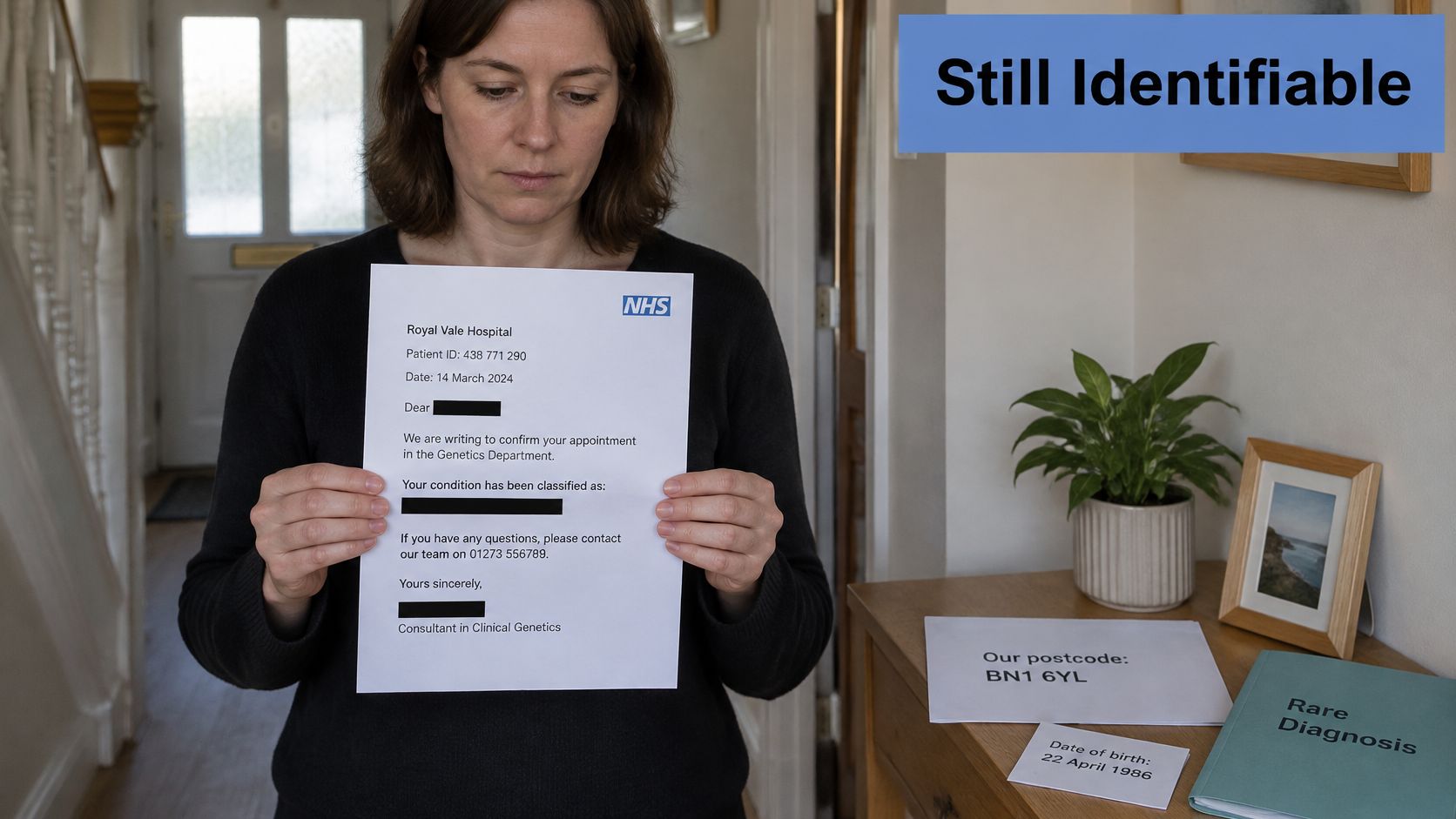
The UK Information Commissioner’s Office guidance on anonymisation draws exactly this line. Masking removes or suppresses direct identifiers, but it does not prevent linkage through quasi-identifiers such as timestamps, IP-derived geography, user-agent combinations, rare URLs, or unique request sequences. The regulator states outright that masking alone is not an effective anonymization technique.
What leaks through a masked HTTP trace
Say your rewrite rule replaces account_id=8842190 with account_id=user_a91f everywhere it appears. The identifier is gone. What remains is the shape of one person’s session: a burst of calls to an admin endpoint that only 0.2% of traffic touches, at 14:07, from one city, on an unusual user agent, in a fixed order. That combination is unique inside a three hour capture, and it doesn’t need the account ID to be useful. Anyone with the trace and a plausible auxiliary feed, a support ticket export, a marketing list with signup timestamps, can work backwards to a small candidate set.
Consistent pseudonyms make this worse before they make it better. A stable token keeps a multi-step checkout replayable because every request in the session carries the same value. It also hands an attacker a free join key across the entire corpus, and across any other dataset that reused the same mapping.
A session that is reproducible is a session that is linkable. Decide which of those you need before you pick a token scheme.
The ICO’s answer isn’t to delete more fields. It’s to combine masking with generalization and randomization, then assess whether identification remains reasonably likely. In a replay pipeline that means transforming direct identifiers before anything hits storage, coarsening exact timestamps and locations, suppressing records whose combination of attributes is unique, and testing linkage against realistic auxiliary data. Where the corpus feeds payment or account systems, the surrounding controls matter just as much: practical security controls for financial institutions is a useful reference for the storage, access, and retention side of the problem.
Masking Techniques and What Each One Preserves
Seven techniques cover nearly everything you’ll do to a test corpus. Each buys privacy by giving up a specific property, so pick by the property your test can’t live without rather than by which technique sounds strictest.
Masking techniques, examples and reversibility
| Technique | What it does | Example | Reversible? | Best for |
|---|---|---|---|---|
| Substitution | Replaces values with realistic fake ones | Jane Doe becomes Maria Lopez | No, unless the mapping is kept | Forms and profile pages |
| Shuffling | Reorders values within a column | Customer postcodes move between rows | No | Realistic value distributions |
| Nulling or redaction | Removes the value entirely | Card number set to null | No | Fields no test reads |
| Generalization | Reduces precision | 2024-03-14T09:41:22Z becomes 2024-03-14 | No | Quasi-identifiers such as dates and locations |
| Deterministic tokenization | Same input always gives the same token | user_4821 becomes usr_7c1e9a every time | Yes, through a keyed vault | Repeatable user journeys |
| Format-preserving encryption | Encrypts while keeping length and character set | A 16-digit card-shaped number stays 16 digits | Yes, with the key | Validation logic that checks format |
| Synthetic generation | Creates new records from distribution rules | Generated orders matching order-value ranges | Not applicable | Load and performance tests |
Choose by the property the test must keep
Four properties drive the decision, and they pull in different directions.
- Field format: a validator that rejects anything but a 16-digit Luhn-valid number needs card-shaped values. Format-preserving encryption gives you that. A null or a random string breaks the check and hides a real defect.
- Referential integrity: when
orders.customer_idmust still join tocustomers.id, you need deterministic output. Random substitution turns every join into a miss and every assertion into noise. - Value distributions: a performance test needs the same spread of order values and the same long tail of rare statuses. Shuffling keeps the distribution intact while severing which person owns which row.
- Repeatable journeys: replay needs the same token to appear at step one and step nine of a session. Deterministic tokens deliver it, at the cost of linkability, which is why the mapping key belongs in an access-controlled vault rather than a
.envfile next to the corpus.
Format-preserving encryption is the one people misread. It keeps a card-shaped number valid for checksum logic while still requiring the key to reverse, so it protects the value without breaking the validation path. It is not anonymization, and a leaked key turns it back into plaintext.
The subtler failure is the field you didn’t touch. A test that reads customer_email to render a receipt seems to justify leaving the actual address in place. It doesn’t. Any field retained at production fidelity is an exposure, and “the test needs it” is a reason to substitute, not a reason to skip.
Choosing the Right Approach for Each Test Type
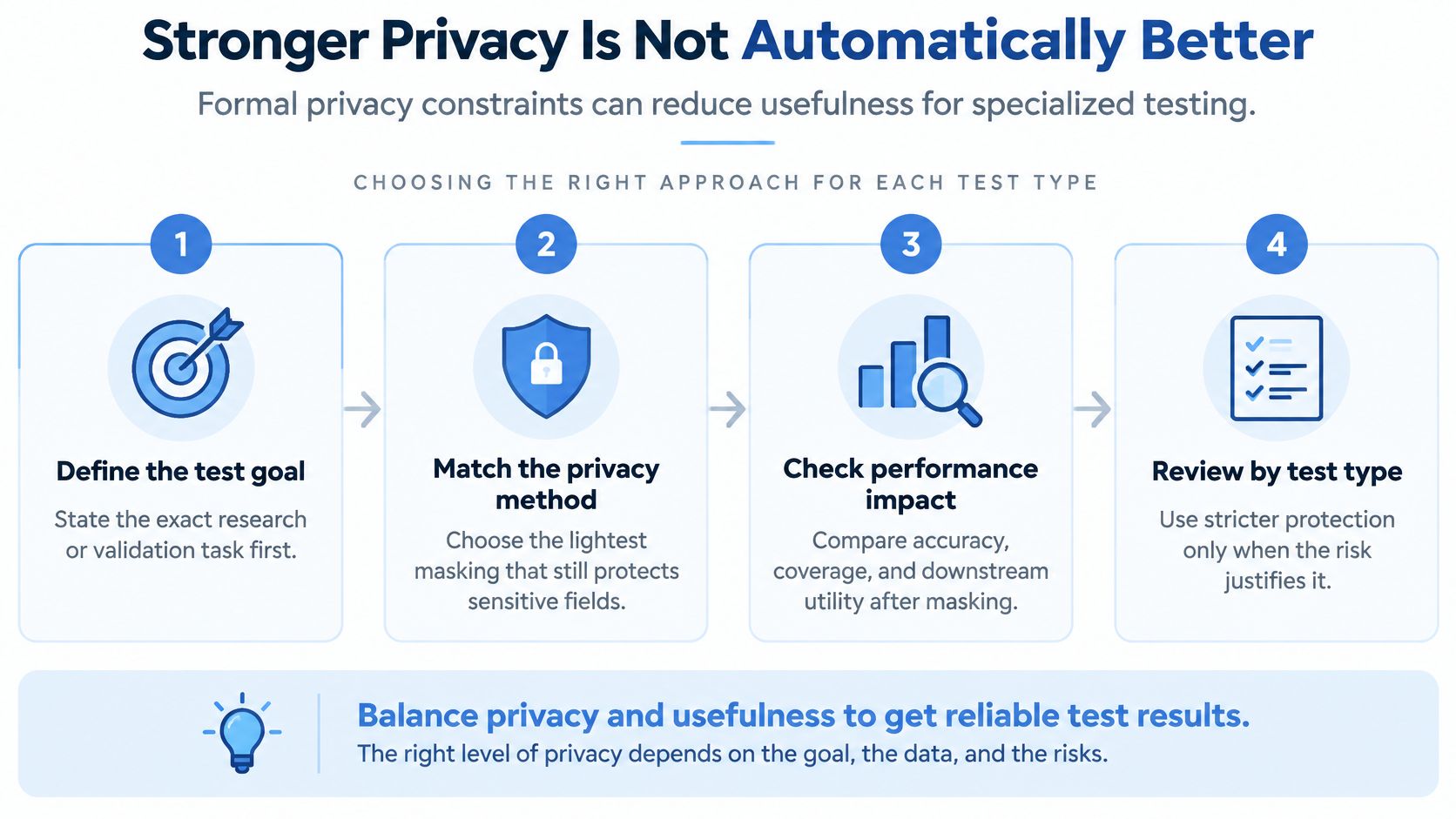
Treating stronger privacy as automatically better testing is the most expensive assumption in this area. It leads teams to over-sanitize a corpus and then wonder why the suite goes green on code that breaks in production. Masked data sits on two measurable axes at once: disclosure risk on one side, utility loss on the other. A sound approach tracks both numbers.
Research on privacy constraints and downstream performance finds that formal privacy constraints can materially degrade results on specialized, domain-specific datasets, while benchmarks built on general-purpose data tend to overstate outcomes. The mechanism is easy to observe in practice. Over-generalizing a quasi-identifier can strip out exactly the signal a test relies on.
Where over-masking breaks the test
Say a fraud rule fires only when three conditions line up inside one session: a failed auth, a retry within forty seconds, and a mismatch between billing country and IP geography. Generalize timestamps to the day and coarsen location to the country, and that sequence can no longer occur in the sample. The regression suite passes, the rule looks healthy, and the defect ships on the next release. Nothing flagged it, because nothing measured whether the masked traffic could still exercise the logic.
The same corpus can fail the test and still leak. A deterministic user token survives day-level timestamps and country-level locations unchanged, so one person’s sessions stay chained end to end and remain linkable to an outside identifier. Utility drops while disclosure risk stays put, the worst outcome on both axes.
The question to ask instead
“Is this data private?” is the wrong test. The answerable one is narrower: is the data still fit for this specific objective, and can we show that quantitatively? Fitness means comparing defect detection, latency distributions, error-code frequencies, session flows, and boundary-case coverage between the masked sample and the source. Safety means counting unique quasi-identifier combinations and checking whether consistent pseudonyms still join one person’s requests across sessions.
| Test objective | Recommended approach | Main risk to check |
|---|---|---|
| Functional and regression tests | Field-level masking with consistent tokens | Formats or validations broken by masking |
| Load and performance tests | Synthetic or shuffled data at realistic volumes | Unrealistic cache hit rates and query patterns |
| Replay of captured HTTP traffic | Masking plus generalization and rare-record suppression | Linkage through unique request sequences |
| Analytics or research sharing | Anonymization with aggregation or synthetic data | Excessive information loss |
| Debugging one production defect | Restricted environment with masking and short retention | Retention outlasting the investigation |
Write the trade-off down as a privacy-utility budget. Name the fields that must keep production fidelity because a test asserts on them. Name what loss is acceptable in the rest. Name the risk threshold the team will not cross, whether that is a maximum share of unique quasi-identifier combinations or a hard rule about rare sessions. A budget in a document beats a rule of thumb in someone’s head.
Synthetic data has a place, but treat it as the last option rather than the first. Generated records reproduce the distribution you described to the generator, and they remove precisely the odd correlations and rare sequences that make real traffic valuable for regression work. If you use it, hold it to the same fitness and re-identification checks as masked production data.
How to Mask Production HTTP Traffic for Replay
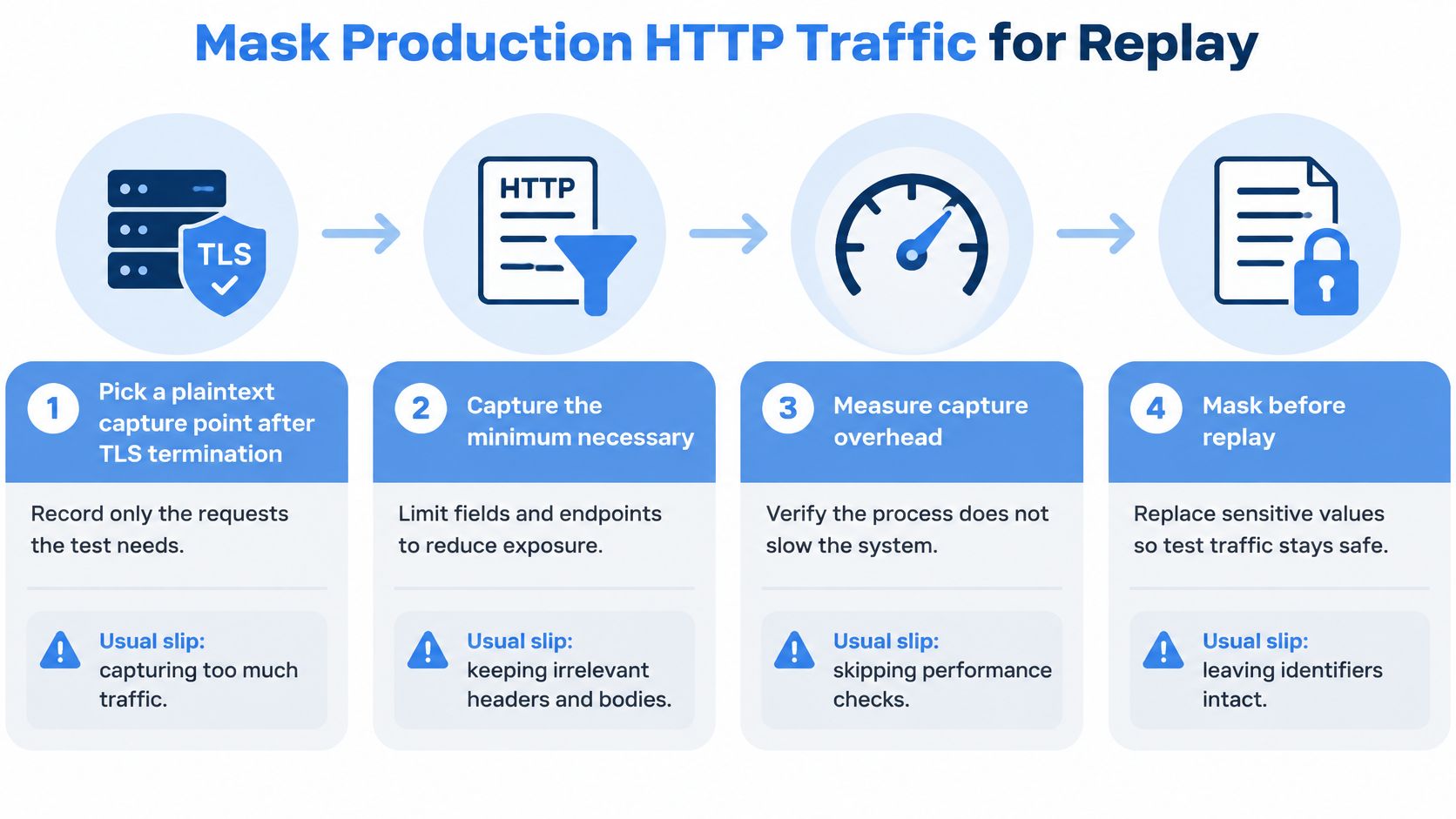
Masking has to happen inside the capture pipeline, at the stage where each class of data first appears. A step done late means the sensitive data already touched disk, and scrubbing a stored file afterwards leaves the original sitting in backups and logs.
- Pick a plaintext capture point after TLS termination, record only the requests the test needs, and measure capture overhead before going live. GoReplay’s capture workflow starts the same way: a suitable plaintext point, only the requests needed, and an overhead measurement before rollout. The usual slip is storing raw captures and assuming TLS protects them later; once decrypted for replay, they are readable files.
- Drop unsuitable requests, then point the sample at an isolated target with external side effects disabled. Remove requests carrying credentials or payment data, and any calls to services unrelated to the test. The second step of GoReplay’s workflow covers this: filter out what does not belong and rewrite the sample for an isolated target whose external side effects are controlled. The slip is replaying into a staging environment that still sends emails or charges cards.
- Mask direct identifiers in headers, cookies, query strings, and bodies before anything reaches disk. Authorization headers, session cookies,
X-User-Id, and JSON fields likeemailall carry identity, and body-only masking leaves most of it in place. GoReplay includes data masking in its pro version. The techniques involved are covered in more depth in this guide to protecting sensitive data during traffic capture. - Generalize timestamps to the hour or day, coarsen locations, and suppress records whose quasi-identifier combination is unique. This is the step that turns a masked trace into something defensible: names are gone by step three, but a request sequence only one customer could have produced still points at that customer. The slip is keeping exact millisecond times because an assertion compares them, which preserves the uniqueness you were trying to remove.
- Replace stable session and user identifiers with keyed tokens, and keep the re-identification key in a separate, access-restricted vault. Keyed tokens let you audit a specific replay later, while an attacker holding only the corpus cannot reverse them. Consistent pseudonyms still link every request in a session to one actor, so the token buys auditability, not anonymity. The slip is storing the mapping alongside the corpus, often as a convenience CSV that outlives the test.
- Scan the corpus for secrets, credentials, payment data, and personal identifiers, then log every transformation applied. The log is what lets a reviewer reproduce the corpus from source and explain what changed and why. Skipping it means nobody can answer “was this field masked?” three months later.
When a sample leaves your environment, for a vendor, a support case, or an outsourced QA team, the bar rises. Anyone sending traffic to the GoReplay team is asked to meet it: the inquiry form tells users to leave out credentials and production request data. Apply that rule to every shared archive.
How to Test Whether Masked Data Holds Up
NIST SP 800-188 frames de-identification as a measurable disclosure-risk problem. Define the intended use and the threat model first, choose techniques against that model, then measure the result with re-identification studies and stated performance levels. A one-time preprocessing step with no measurement fails that standard.
Run the checks below against a real sample, not a small hand-picked one.

- Classify every field as a direct identifier, a quasi-identifier, a secret, or neutral. This catches the
X-Device-Fingerprintheader nobody thought about, and the free-text field that carries a name inside a support note. - Measure uniqueness per quasi-identifier combination and flag the records that appear exactly once. A single unique row is a person, and it survives every field-level mask you applied.
- Run a linkage test by joining the masked trace with a realistic auxiliary dataset, a customer export with signup timestamps, a public dataset of geographies, a support ticket log. This is the check that catches what field-level masking misses.
- Attempt reversal of every deterministic substitution using the material an attacker would plausibly hold. Uniqueness in the token space, predictable inputs, an accessible mapping, each is a path back to the original.
- Scan the corpus for credentials, bearer tokens, payment data, and personal identifiers. Automated secret scanning catches the API key pasted into a test header four months ago.
- Compare functional outcomes against source traffic on status codes, latency distribution, error frequency, and session flows. This is the utility half of the test, and it’s the one teams skip.
The release gate
Make the outcome binary. Zero successful identity recoveries in a defined red-team sample, bounded uniqueness for quasi-identifiers measured against a threshold you wrote down, and zero secrets found by automated scanning. Any failure is a no-go, and the fix goes back into the pipeline rather than into a manual patch of the archive.
For teams that want the mechanics in one place, session-aware replay and the matching debugger are exactly how you compare a replayed response against expected behavior, request by request.
Rerun the gate whenever the schema changes, a new endpoint appears, or a new external dataset becomes available. Each of those events can reopen a risk you already closed, because disclosure risk depends on what other information exists in the world, not only on what’s in your corpus.
Confirm Your Masking Plan Before Release
Approve a masked corpus only when the gate passes and the data owner has signed off on the threat model. That sign-off is a short list, and all five items must be present.
- Threat model and test objective written down: who the plausible attacker is, what auxiliary data they’d hold, and what the corpus is for.
- Uniqueness and linkage results recorded: the measured numbers, not a note saying “reviewed”.
- Re-identification key outside the test environment: in a vault with its own access list, not in the same bucket as the corpus.
- Retention with an end date: a date on which the corpus is deleted, and an owner who does the deleting.
- Access logging on the corpus: who downloaded it, when, and why.
Each item maps to a wider set of test data management best practices that keep a staging corpus both usable and defensible.
A masking plan isn’t finished when the corpus is created. Schema changes add fields nobody classified, and new external datasets make old quasi-identifier combinations more identifying than they were. The gate reruns after each change, which is a five-minute job if you automated the checks and an unwelcome surprise if you didn’t.
The verdict rule is simple. Any failed check is a no-go, and all five passing items are a go. Nothing in between.
For this week, pick one objective from the decision table, mask a small sample in an isolated environment, and run the full gate against it. Scale to the larger corpus only after that sample passes.
Masking rules only earn trust when you can prove what they remove and what they leave behind. GoReplay captures live HTTP traffic and rewrites headers, cookies, URLs, and selected body fields before a request is stored or replayed, so a corpus keeps its realistic shape without keeping the identities attached to it. The debugging and reproduction features let you inspect a captured request, replay a filtered sample, and compare the target response with expected behavior, which is how you confirm the mask didn’t break the test. Visit GoReplay to see how capture, masking, and session-aware replay fit into one pipeline.