
Edge Case Testing: A Practical Guide to Finding Defects
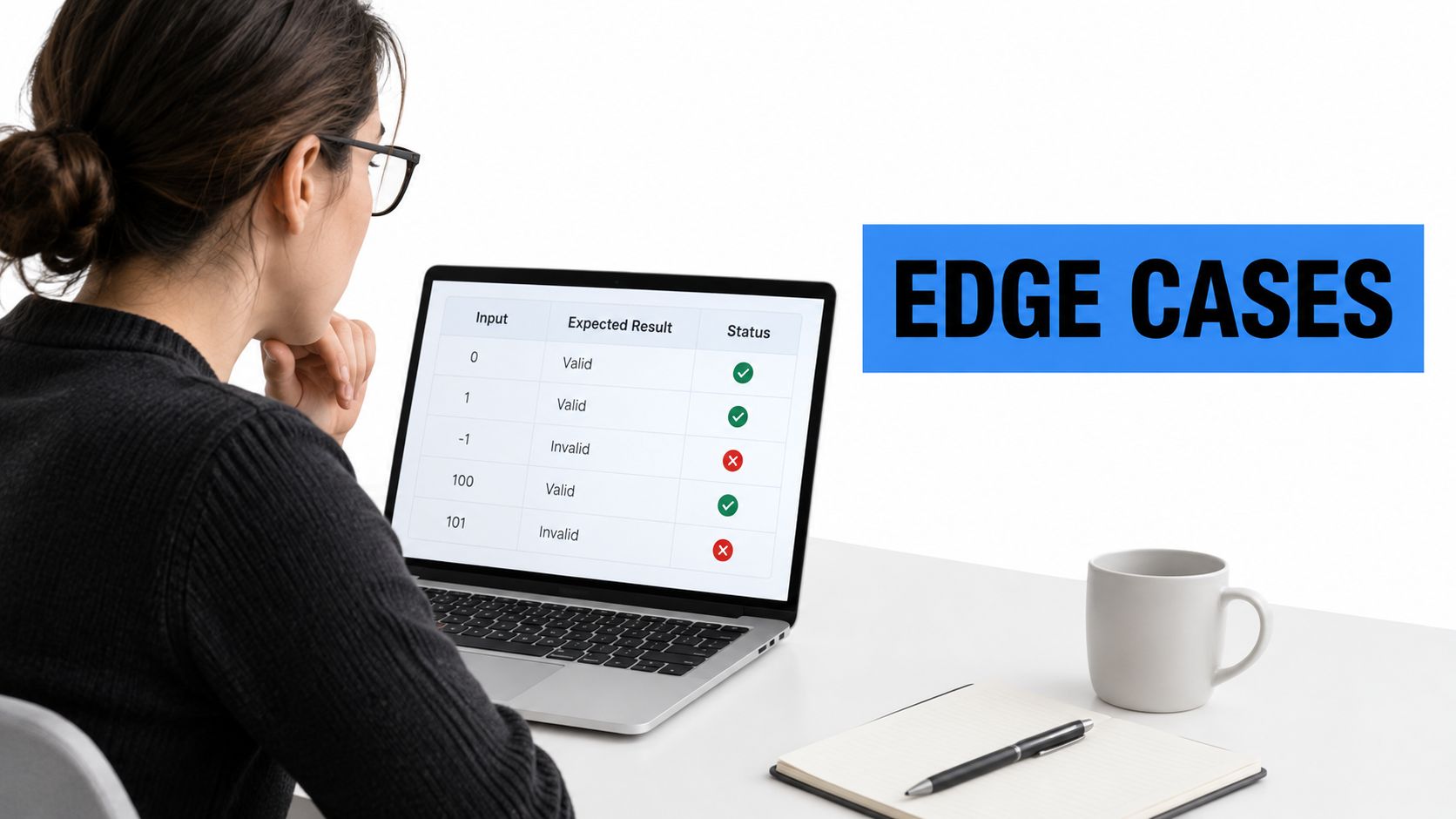
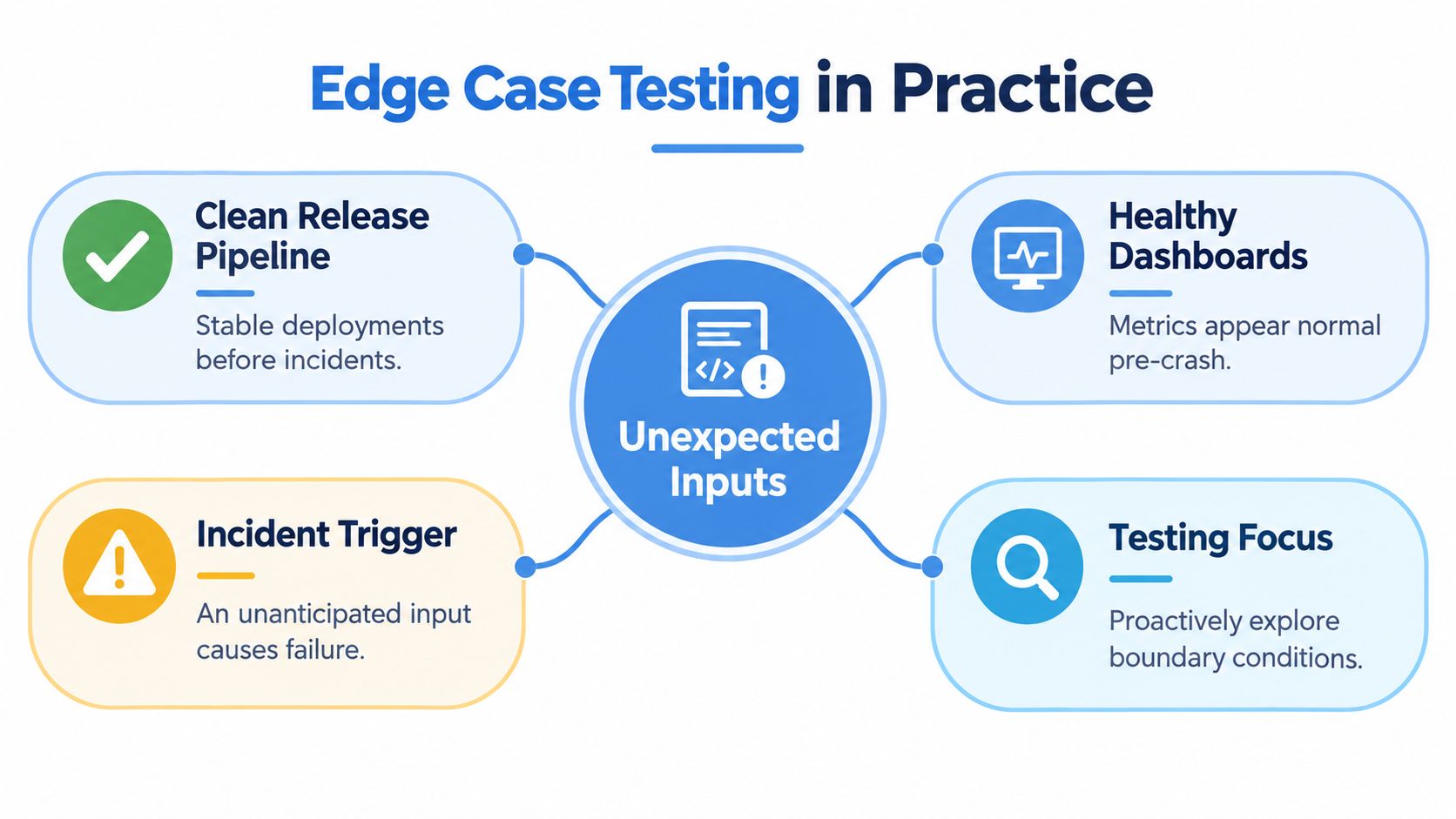
Your release pipeline is green, the staging checkout works, and the dashboards look healthy. Then a customer retries a stalled purchase after their promo code expires, and support asks why the order history doesn’t match the payment record. Nothing in the release checks exercised that sequence.
That’s the gap edge case testing should close. The useful work isn’t inventing increasingly strange inputs. It’s combining realistic workflows with deliberate changes at the boundaries your ordinary tests leave untouched.
What Edge Case Testing Actually Means in Practice
Edge case testing is the disciplined examination of input limits, unusual state transitions, and interactions between conditions. A useful test identifies the condition, establishes the required starting state, and checks an explicit outcome. Without that outcome, you’ve produced unusual traffic, not a reliable test.
A checkout workflow makes the distinction concrete. Accepting a valid promo code is ordinary functional coverage. Testing the code at its expiration boundary, retrying after payment authorization, or updating the cart concurrently with checkout probes assumptions that the ordinary path doesn’t challenge.
Recognize the different kinds of edges
- Boundary values sit at a limit or immediately around it. For checkout, consider an empty cart, the maximum permitted promo-code length, or an amount at the application’s supported limit.
- Rare state transitions involve a change at an inconvenient moment. A promotion expires after the customer sees the total but before they submit payment. The test must establish which price the application should honor.
- Interaction edges combine conditions that seem harmless independently. A retry arrives while another request changes the cart, for example. The concern isn’t merely whether both requests return successfully, but whether the final order remains consistent.
Separate the objective from the technique
Exploratory testing is a way to investigate behavior and refine questions while testing. Monkey testing applies uncontrolled or loosely controlled actions. Fuzzing generates or mutates inputs to challenge an interface. Any of these can uncover an edge case, but none substitutes for deciding which risks matter and what correct behavior means.
Edge cases can also be valid. A request at the supported payload limit should work if that’s the contract. Rejecting everything unusual is not a sign of good engineering, and a negative-test suite alone won’t establish that valid extremes are supported.
Practical rule: Write down what must remain true before generating unusual inputs.
For checkout, that might mean preserving the accepted total, preventing duplicate payment effects, or rejecting stale cart versions without losing the customer’s work. Those are proposed contracts to confirm with the product and engineering owners, not assumptions to bury inside test code.
Why Edge Cases Break Systems More Often Than Core Paths
The heading describes a testing concern, not a universal failure-rate ranking. The strongest evidence here concerns how many factors trigger faults, not whether every system has more edge-path failures than core-path failures.
In NIST’s analysis of FDA medical-device recall data, approximately 65% of identified faults involved a single factor, while 96% involved either a single factor or a two-factor interaction; a separate web-server example attributed roughly 40% of failures to a single parameter value and nearly 90% to three or fewer parameters, according to NIST’s analysis of fault-triggering interactions. These are findings from particular datasets, not a guarantee about your service.
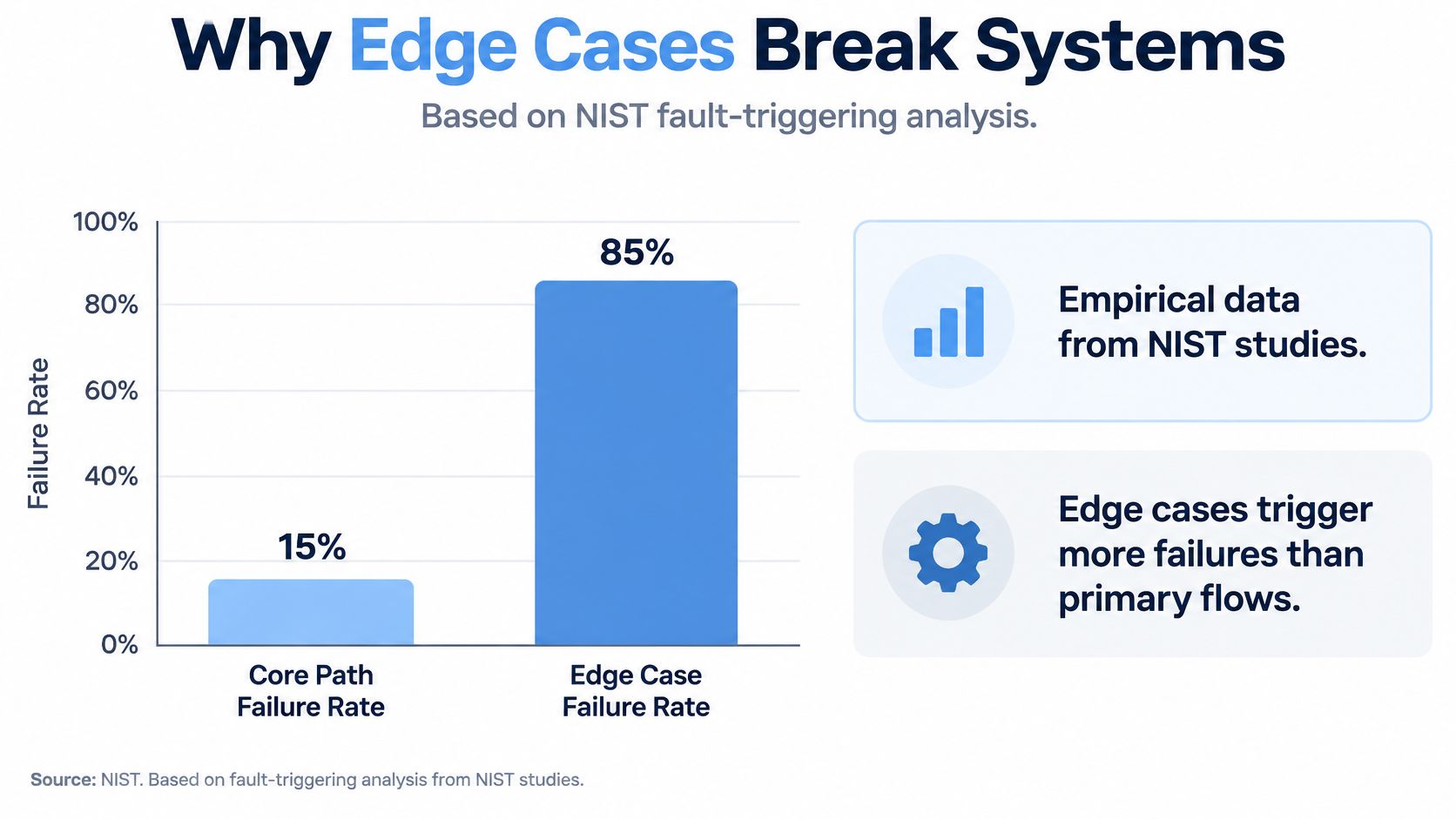
Treat this illustration as conceptual, not as a sourced core-path-versus-edge-case comparison. NIST’s cited findings don’t establish that split.
Prioritize influential conditions, not elaborate stories
The practical implication is narrower and more useful than “test every strange combination.” Start by identifying variables that change a decision: payload length, authentication state, request method, configuration setting, or dependency timing. Exercise their meaningful values individually before expanding the combinations.
For an HTTP service, a filename crossing a length restriction is worth investigating without adding a network outage, a role change, and a resource-exhaustion event. Combining everything immediately makes failures harder to explain. You won’t know which condition mattered or whether the test setup created an impossible state.
| Testing choice | Practical consequence |
|---|---|
| Change an influential value in a realistic request | A failure has a clear initial explanation |
| Combine selected parameter partitions | Interaction coverage becomes deliberate |
| Change every condition simultaneously | Diagnosis becomes harder and realism needs scrutiny |
The evidence supports risk-focused interaction testing, not exhaustive enumeration. Pairwise coverage is a sensible starting investment when parameters interact, but it isn’t proof that higher-order failures don’t exist.
A defensible stopping point therefore depends on the service. For reversible display behavior, modest interaction coverage may be acceptable. For authorization or irreversible business operations, require deeper review of the remaining combinations and document what hasn’t been tested.
How to Identify and Prioritize the Edge Cases That Matter
Start with evidence your team already owns. A backlog of hypothetical oddities is less useful than a shortlist tied to actual workflows, disputed requirements, and code that enforces limits.
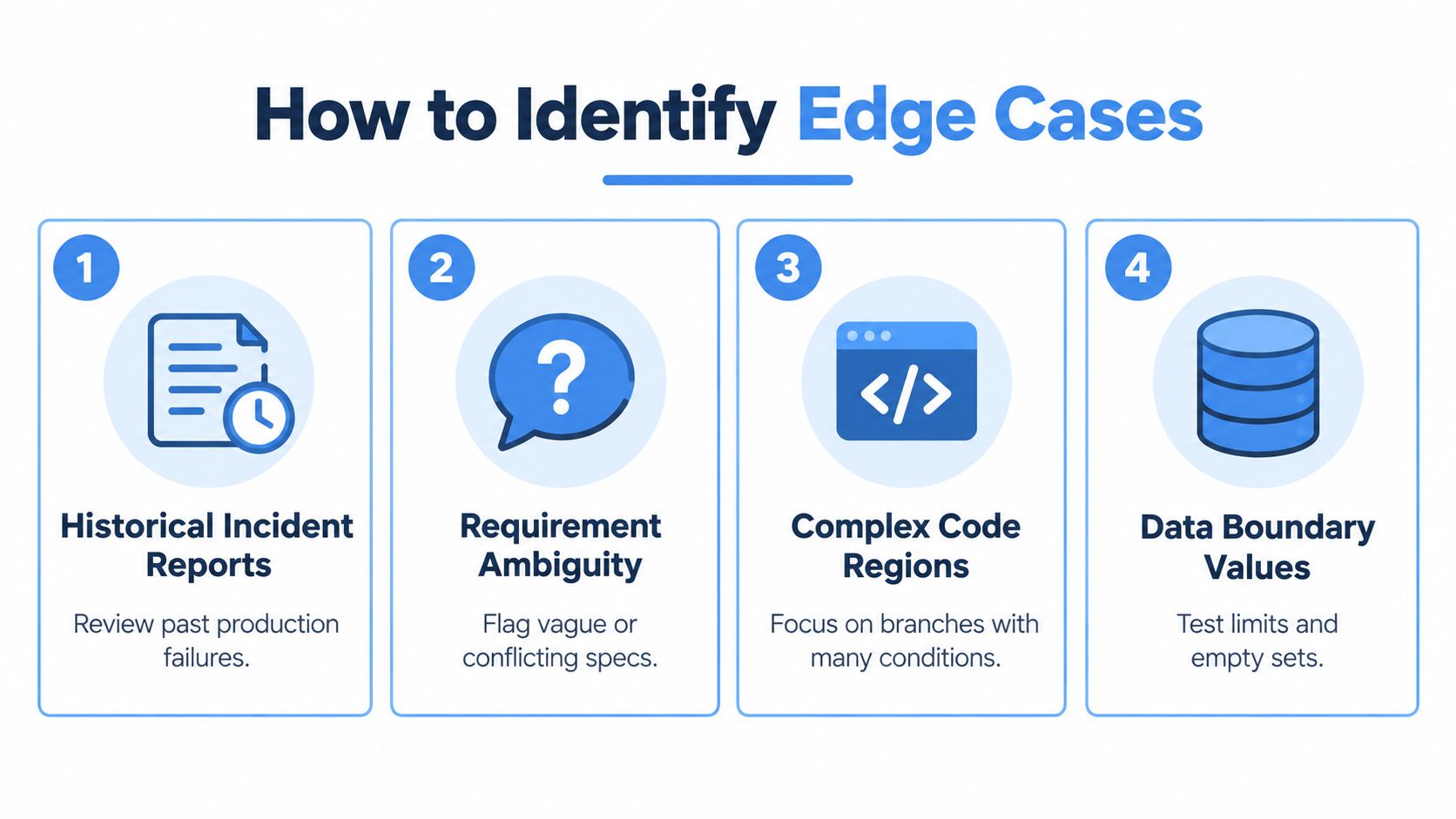
Mine the places where assumptions are visible
- Incident history: Ask what condition the original regression test omitted. Extract the relevant request sequence and preconditions rather than copying the incident’s entire environment.
- Requirement ambiguity: Search for words such as maximum, expired, duplicate, optional, and eventually. Ask who decides the outcome when these rules overlap.
- Limit-handling code: Review validation, parsing, retry policies, arithmetic conversions, and resource acquisition. Ask what happens when the operation reaches or crosses its configured restriction.
- Production observations: Filter permitted telemetry for rejected requests, repeated operations, unusual payload shapes, and interrupted sessions. Record the conditions without placing sensitive request contents into tickets.
Use exploratory charters to investigate the gaps between those sources. A useful charter might ask whether a customer can recover from an interrupted checkout without changing the accepted order. “Try to break checkout” gives the tester much less direction.
When converting findings into executable cases, use a setup-action-outcome format. SourceX’s How To Identify Quality Assurance Examples With is a related resource for that exercise; keep your own service contract authoritative. A software testing scenarios guide can also support the move from a broad risk to a concrete workflow.
Rank candidates without pretending the score is precise
| Dimension | Question to answer |
|---|---|
| Observed frequency | Does permitted telemetry show this condition, and could collection filters hide it? |
| Blast radius | Could failure expose data, corrupt state, or block an important workflow? |
| Reproduction difficulty | Should the team preserve the environment or sequence before it disappears? |
Don’t let low observed frequency automatically demote a serious authorization risk. Likewise, difficult reproduction is a reason to preserve evidence, not proof that a bug deserves release-blocking priority.
Systematic selection has empirical support: NIST pilot projects reported approximately 20% lower testing costs and 20%–50% better test coverage using combinatorial testing, as described in its combinatorial testing research bulletin. Treat those results as evidence for the method, not a forecast for your backlog.
Assign each shortlisted case an owner, expected result, and reason for priority. Refresh the list when contracts, configurations, or workflows change.
Four Techniques That Catch Different Kinds of Edge Cases
Choose the technique by the uncertainty you’re trying to resolve. A carefully selected boundary test may answer a limit question more directly than a large generated suite, while a parser investigation needs different inputs from a stateful checkout investigation.
Edge Case Techniques Compared
| Technique | Best Targets | Effort | Replay-Friendly? |
|---|---|---|---|
| Boundary-value analysis | Validation thresholds and limit handling | Low setup when limits are explicit | Yes, through targeted field mutations |
| Pairwise combinatorial testing | Interactions between parameter partitions | Moderate modeling effort | Yes, with session constraints |
| Property-based testing | Invariants across diverse generated inputs | Substantial oracle design | Yes, when replay outcomes are observable |
| Fuzzing | Parsers, decoders, malformed input handling | Depends on harness and triage | Selectively, often below the workflow layer |
Boundary-value analysis fits questions such as whether the service and gateway agree on a payload restriction. Use explicit examples with clear expected acceptance or rejection. It won’t, by itself, resolve interactions with authentication or workflow state.
For pairwise testing, model meaningful partitions rather than arbitrary raw values. Request method, user role, payload category, and feature-flag state might be candidates. Constrain impossible combinations so the generator doesn’t waste runs on setups your application cannot reach.
Generate inputs only after defining the oracle
Property-based testing asks whether a rule remains true across generated cases. For a cart mutation, that rule might concern preservation of unrelated items or explicit rejection of stale updates. The rule must come from the contract, not from whatever the current implementation happens to return.
An empirical study of 426 Python programs using Hypothesis found that each property-based test detected approximately 50 times as many mutations as the average unit test, with certain property categories finding mutations at rates more than 19 times higher than other categories, according to the study of property-based test effectiveness. Mutation detection in that study isn’t equivalent to a production defect-reduction forecast.
Fuzzing is the better fit when the question concerns malformed structures or parser resilience. A workflow-level replay harness may be too high-level for deliberately broken framing; use a protocol-appropriate harness rather than assuming an HTTP client will transmit malformed bytes unchanged.
A generator proposes cases. The oracle determines whether their behavior is wrong.
For ordinary HTTP contract work, start with boundaries and selected combinations, then expand through properties. Move fuzzing earlier when parser risk dominates. If you’re assessing engineers’ testing judgment, use a bounded exercise about those choices rather than rewarding test volume; nexus IT group’s fair take-home and live coding tips is a related hiring resource.
Building a Replay-Based Edge Case Pipeline With GoReplay
Treat captured traffic as a workflow seed, not a finished edge-case suite. Replay preserves examples of what users did; a separate mutation and verification layer should explore what those users might do near the contract’s limits.
Separate traffic transport from test intelligence
Use this architecture: capture → mask → mutate → replay → diff → persist. Keep the responsibilities separate so you can tell whether a failure originated in the application, the transformation, or the environment.
- Capture a permitted traffic window: Select relevant routes and sessions. Preserve enough ordering and correlation information to reconstruct the workflow.
- Mask before broader storage or access: Replace personal data, credentials, and business identifiers under an explicit retention and access policy.
- Mutate a copy: Keep the sanitized seed unchanged, and attach a mutation manifest to each derivative.
- Replay into isolation: Route writes to test dependencies, prevent outbound business effects, and reset or provision fixture state.
- Compare meaningful outcomes: Check contract-level responses and resulting state.
- Persist confirmed failures: Save the minimum reproducible case and its setup instructions.
Use the testing-environment setup guide to establish the capture and replay configuration appropriate to your installation. Keep capture and replay invocations separate in the runbook so operators can review the source, destination, and storage policy before execution.
Preserve behavior through masking and mutation
Consistent identifier mapping matters. If related requests refer to the same cart, masking should preserve that relationship without preserving the production identifier. Authentication needs test credentials with the intended privileges, not copied live tokens.
Masking can also erase the condition you’re investigating. Replacing a boundary-sized value with a short placeholder invalidates that test. Record the relevant length, encoding, equality relationships, and expiry relationships as assertions about the transformed fixture.
For mutation selection, follow NIST’s boundary-value guidance: exercise partition boundaries, the smallest representable values on either side, zero where applicable, and specified output extremes. Apply that model to body sizes, header thresholds, empty query parameters, and timeout settings rather than choosing arbitrary unusual values.
Response diffing needs an allowlist of intentional normalization, such as nondeterministic identifiers or timestamps. Don’t normalize business totals, authorization decisions, or error details merely because they make comparisons noisy.
Concurrency requires explicit scheduling and state checks. A replayed sequence doesn’t automatically reproduce the original overlap, and response equality won’t reveal every lost update.
Finally, persist the sanitized session, mutation description, random seed where applicable, fixture version, dependency settings, and expected outcome. A saved request without its starting state isn’t a deterministic regression test.
Metrics That Actually Tell You Whether Edge Cases Are Covered
Code coverage is necessary context, not a complete edge-case metric. Executing a validation branch doesn’t establish that the supported extreme, the rejected extreme, and the relevant workflow state were all checked.
Complementary methods matter too. In a 16-problem HumanEval study, property-based and example-based tests each detected 68.75% of bugs independently, while their combination reached 81.25%, according to the study of generated property-based tests. That’s evidence for blending approaches in the studied setting, not a universal target for a replay dashboard.
Measure the declared test space
Instrument the harness with tags for input partition, starting state, transition, failure mode, and session pattern. Store whether the case merely executed or actually checked its expected outcome. Those are different events.
| Metric | Operational definition |
|---|---|
| Boundary-value hit rate | Selected boundary conditions executed and asserted against the declared inventory |
| Pairwise interaction coverage | Valid modeled value-pairs exercised with required preconditions |
| Replay-failure recapture rate | Confirmed replay defects preserved as reproducible regression fixtures |
| Time-to-first-edge-case | Elapsed time from a declared change or investigation start to a confirmed edge-case finding |
Define denominators explicitly. If the inventory excludes authentication transitions, a strong boundary hit rate says nothing about them. Report unknown, not modeled, and accepted risk separately from passed cases.
Time-to-first-edge-case is a diagnostic measure, not a productivity quota. A short interval might indicate useful targeting or a weak build. A long interval might indicate strong implementation, an ineffective oracle, or an unrepresentative fixture.
Watch for replay drift
Compare the current corpus with its declared coverage inventory rather than only with its previous request count. A refresh can remove a rare session pattern even while adding more traffic overall.
Keep a curated edge corpus alongside refreshed production-derived samples. Don’t let routine traffic replacement delete hard-won regression knowledge.
Flag missing partition tags, vanished workflow transitions, changed mutation distributions, and cases that no longer reach their intended preconditions. Track environmental failures separately from product failures so broken fixtures don’t look like newly discovered defects.
The useful dashboard answers a specific question: which important conditions remain unverified for this change? A single coverage percentage can’t answer it.
Common Pitfalls and a Practical Checklist to Start This Week
The expensive mistakes aren’t limited to missing tests. Teams can spend substantial effort running cases that don’t reach the intended state, accepting generated assertions nobody reviewed, or preserving failures that nobody can reproduce later.
Replace activity with explicit decisions
Chasing exotic scenarios first leaves known contract limits unexamined. Finish the relevant boundary inventory before investing in elaborate combinations, unless a specific incident justifies the detour.
Trusting generated expectations turns implementation behavior into an accidental specification. Require human review when tests concern authorization, financial calculations, destructive operations, concurrency, or recovery. Classify each failure as a contract violation, invalid test assumption, environment problem, or unresolved requirement.
Replaying without masking makes test infrastructure another location for sensitive information. Repeatedly deriving new fixtures from old replay output creates a different problem: the suite can become detached from both the original session and the current contract. Keep fixture lineage and transformation history visible.
Use a sprint-sized checklist
- Select a critical workflow: Choose a path with a clear owner and observable business outcome.
- Gather candidate edges: Review incident evidence, ambiguous requirements, limit-handling code, and permitted telemetry.
- Choose complementary techniques: Pair explicit boundary examples with constrained interaction generation for the initial investigation.
- Approve the fixture policy: Confirm masking rules, access restrictions, retention, and isolated destinations before capture.
- Verify the transformation: Demonstrate that sanitization preserves the condition each case is meant to test.
- Instrument the harness: Record partitions, preconditions, assertions, and failure classifications.
- Review and retain findings: Turn confirmed failures into reproducible fixtures and assign unresolved contracts to a decision-maker.
Keep the release discussion grounded in consequences. Explain which harmful outcomes the team checked, which remain uncertain, and what operational mitigation exists for the accepted gaps. Don’t promise that an expanding suite eliminates all surprises.
A useful first sprint ends with a trustworthy testing loop, not an impressive test count. The team should be able to explain why each selected case matters, show that it reaches the intended condition, and rerun a confirmed failure without reconstructing the investigation.
GoReplay offers an open-source way to capture live HTTP traffic and replay it into testing environments, providing realistic seeds alongside handcrafted fixtures and generated cases. Visit GoReplay to set up an isolated replay workflow, then add targeted mutations and contract assertions around a critical service path.