
Ad Hoc Testing: A Practical Guide for Developers

It’s 4 PM on a Friday. A production workflow has just crashed, but the formal test suite doesn’t cover the exact sequence that triggered it. The team needs an answer now, so a tester starts changing inputs, refreshing pages, interrupting requests, and following whatever clue looks suspicious.
That activity may look unplanned from the outside, but effective ad hoc testing isn’t random clicking. It’s a focused use of tester intuition, product knowledge, and realistic behavior to expose defects that predefined checks can miss. The trade-off is clear: ad hoc sessions move quickly, but their results are difficult to reproduce unless the team captures useful notes and converts important findings into durable tests.
What Is Ad Hoc Testing
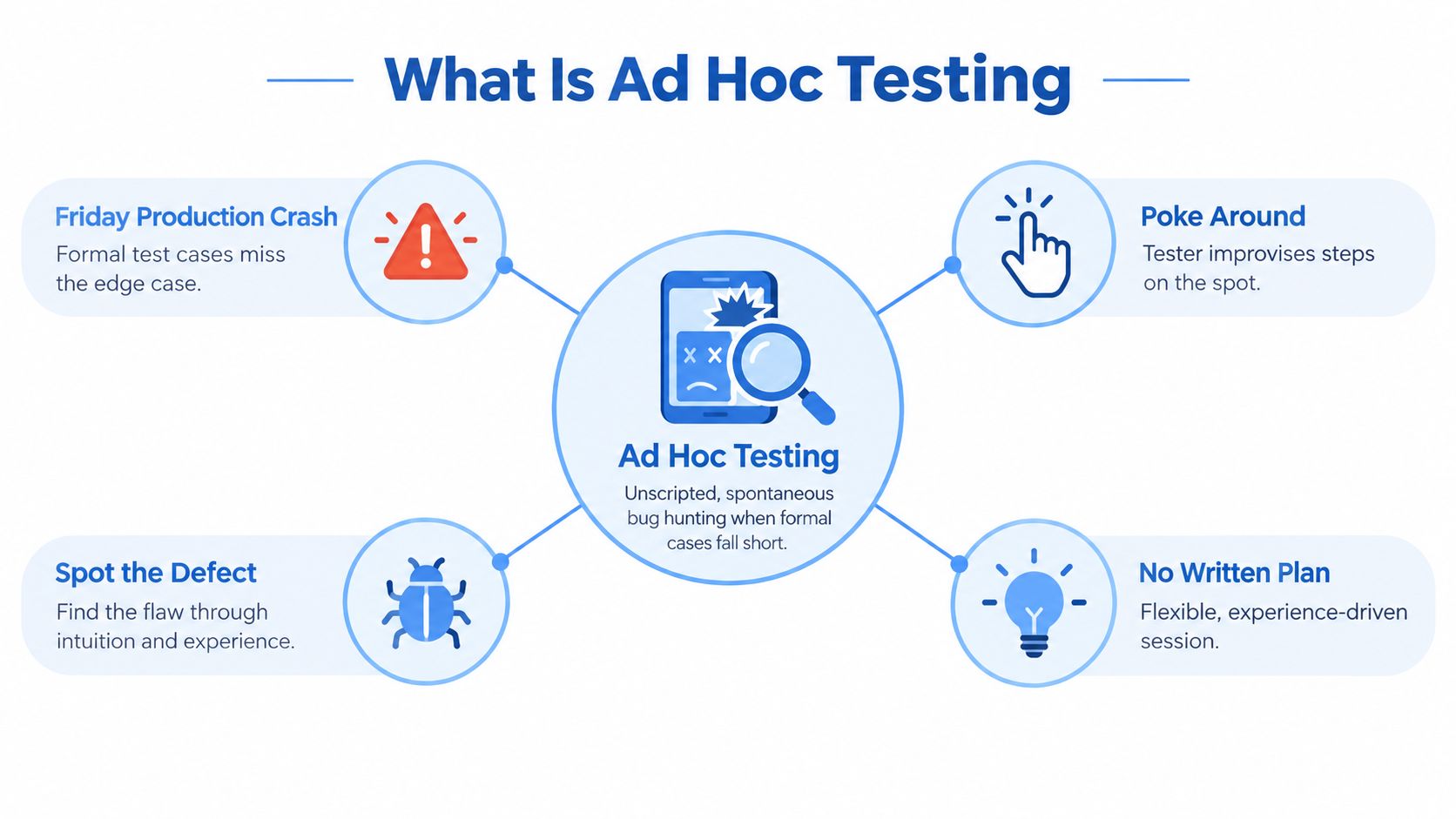
Ad hoc testing is an informal software testing approach performed without predefined test cases, formal test plans, or planned documentation. The tester explores the application, tries unusual inputs, changes the order of actions, and follows anomalies as they appear. Its technical value comes from finding defects in edge conditions and unexpected sequences that scripted regression may not anticipate, as described in this practical comparison of ad hoc and exploratory testing.
The Friday production crash is a useful example. A checkout test may cover a successful payment, a declined card, and a timeout. It may not cover a user refreshing the page while the payment provider is responding, switching browser tabs during a redirect, or submitting the same action after a stale session has expired. An experienced tester probes those seams because they understand where state, timing, and user behavior tend to collide.
Why experienced testers use it
Ad hoc testing became recognized in software testing literature through work associated with James Bach and exploratory testing. A cited 1988 reference in Testing Computer Software described the idea of continuing to run new tests as they occur to the tester after formal planning stops, helping establish the terminology and its role in rapid defect discovery (historical reference).
The method isn’t unprofessional because it lacks a script. It becomes weak when the tester has no risk focus, doesn’t record what happened, or treats every click as equally valuable. A strong session starts with a reason, such as a recent code change, a defect-prone workflow, unusual input, or a production behavior the team can’t yet explain.
Practical rule: Use intuition to choose the next probe, but use evidence to decide whether the result matters.
Ad hoc tests are generally expected to run only once unless they uncover a defect. That one-off nature distinguishes them from repeatable scripted tests, while also creating their main operational risk. If the tester finds a failure but can’t explain the state, inputs, and sequence that produced it, the team may lose the value of the discovery.
Ad Hoc vs Exploratory vs Scripted Testing
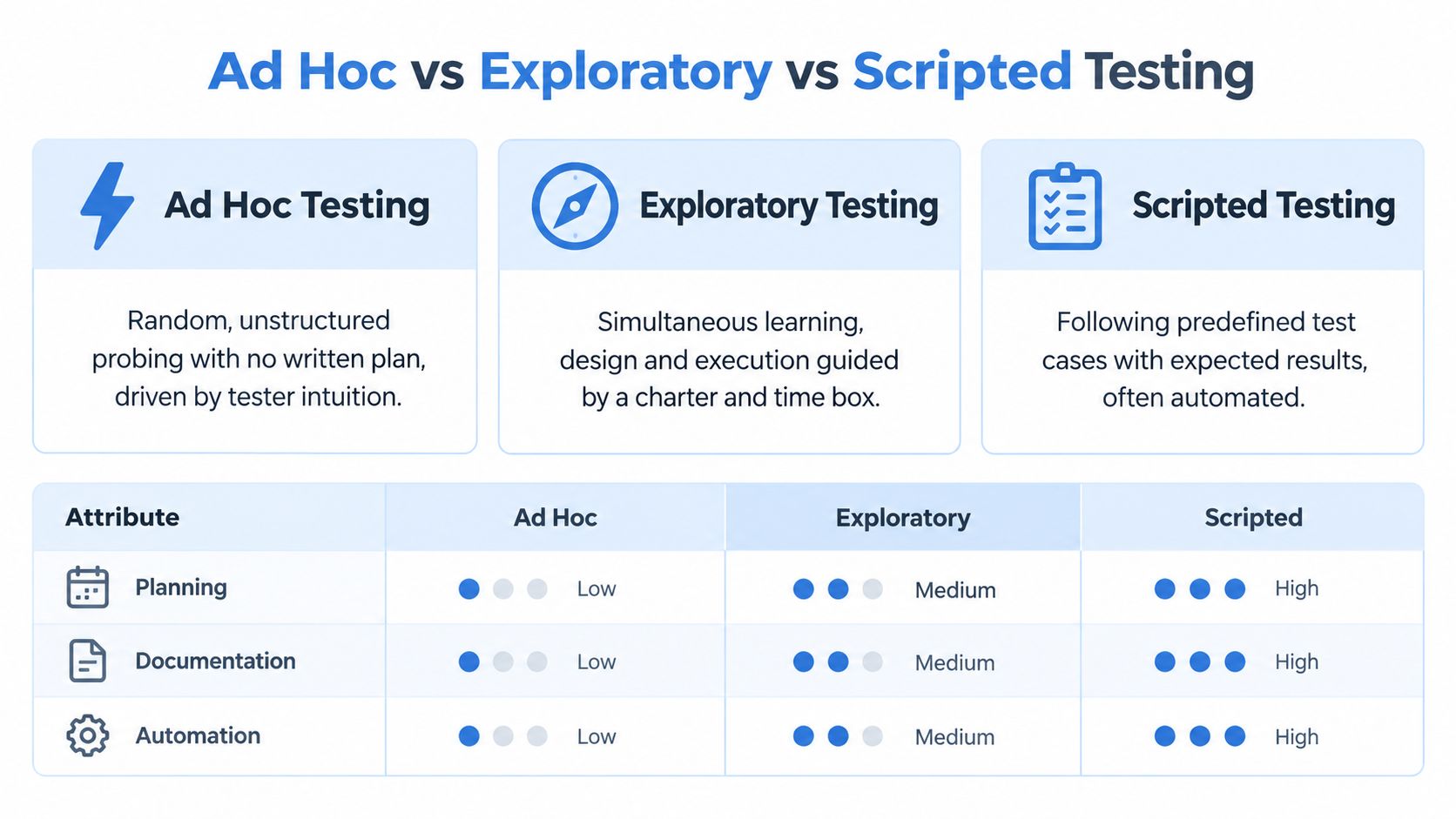
These approaches can all involve manual work outside an automated pipeline, but they answer different questions. Scripted testing asks whether a known scenario still produces its expected result. Exploratory testing combines learning, test design, and execution in a more organized session. Ad hoc testing uses fast, intuitive probing to challenge assumptions and expose surprises.
| Approach | Primary intent | Repeatability | Documentation | Best fit |
|---|---|---|---|---|
| Ad hoc | Find unexpected defects through spontaneous probing | Low, usually one-off | Minimal or post-session | Rapid checks, edge cases, unexplained behavior |
| Exploratory | Learn the product while designing and executing tests | Medium to high | Lightweight notes during the session | Feature investigation and risk-based discovery |
| Scripted | Verify predefined behavior against expected results | High | Detailed test cases and results | Regression, release gates, and auditability |
Choosing the right method
Reach for scripted testing when the behavior is stable, important, and likely to regress. A payment authorization check, permission rule, or API contract benefits from a repeatable test because another engineer must be able to run it later and trust the result. Automation is especially useful when the same verification belongs in continuous integration.
Exploratory testing is a better choice when the team needs to understand a feature, identify risks, and preserve enough context for others to continue the investigation. A lightweight charter might define the area to examine and the risks to challenge, while leaving the specific test design to the tester.
Ad hoc testing earns its place when speed and surprise matter more than formal coverage. A developer has changed session handling, a production error has no obvious reproduction path, or a tester suspects that two valid actions interact badly. The session can begin immediately, but the output should still be actionable.
Ad hoc testing is disposable as a test activity, not disposable as a source of engineering knowledge.
A useful workflow combines the three rather than ranking them. Use ad hoc probing to expose an unfamiliar failure, exploratory testing to investigate and understand it, then scripted testing to protect the fix from regression. That progression preserves speed without allowing important discoveries to disappear.
Practical Ad Hoc Testing Techniques
Unscripted testing becomes productive when the tester carries a mental model of common failure points. Two techniques are particularly useful: error guessing, which applies experience to predict likely failures, and boundary value analysis, which challenges the edges of accepted input.
Error guessing
Error guessing starts with a question: “Where would a hurried, confused, malicious, or unusual user push this workflow?” For a quantity field, try a negative value, an empty value, a decimal, a very large value, pasted whitespace, and rapid repeated submissions. For authentication, test expired sessions, special characters, back-button navigation, and actions performed in multiple tabs.
The technique also applies to APIs and state transitions. A tester can probe behavior after a partial failure rather than only during a clean request sequence:
await addItem(productId);
await page.reload();
await submitOrder();
The important observation isn’t whether this exact sequence is valid for every application. It’s that the tester deliberately interrupts the expected flow and checks whether the application recovers safely. Try the same idea around retries, redirects, uploads, permissions, and network interruptions.
Boundary value analysis
Boundary testing targets the edges of an input contract. If a field accepts a range, test just below the lower boundary, at the lower boundary, a normal value, at the upper boundary, and just above the upper boundary. If the requirements are unclear, that uncertainty itself is a useful finding.
For a password field with an allowed length range, the probe might look like this:
const values = [
  "",
  "a",
  "valid-password",
  "a".repeat(MAX_LENGTH),
  "a".repeat(MAX_LENGTH + 1)
];

for (const password of values) {
  await enterPassword(password);
  await submitForm();
  await recordVisibleResult();
}
The code isn’t a substitute for judgment. It helps make the probe deliberate, while the tester checks validation messages, server responses, layout behavior, logging, and data persistence.

A practical mental checklist includes state changes, retries, empty and malformed input, permission changes, time-dependent behavior, rapid repetition, and interrupted workflows. Don’t probe everything indiscriminately. Start with the changed feature and the paths where a failure would affect users or corrupt data.
Integrating GoReplay for Realistic Scenarios
A local test session can be technically careful and still miss the conditions that matter in production. Real users arrive with different headers, session histories, request order, payload shapes, and timing. A captured traffic pattern gives the tester a more credible starting point than manually reconstructing a simplified journey.
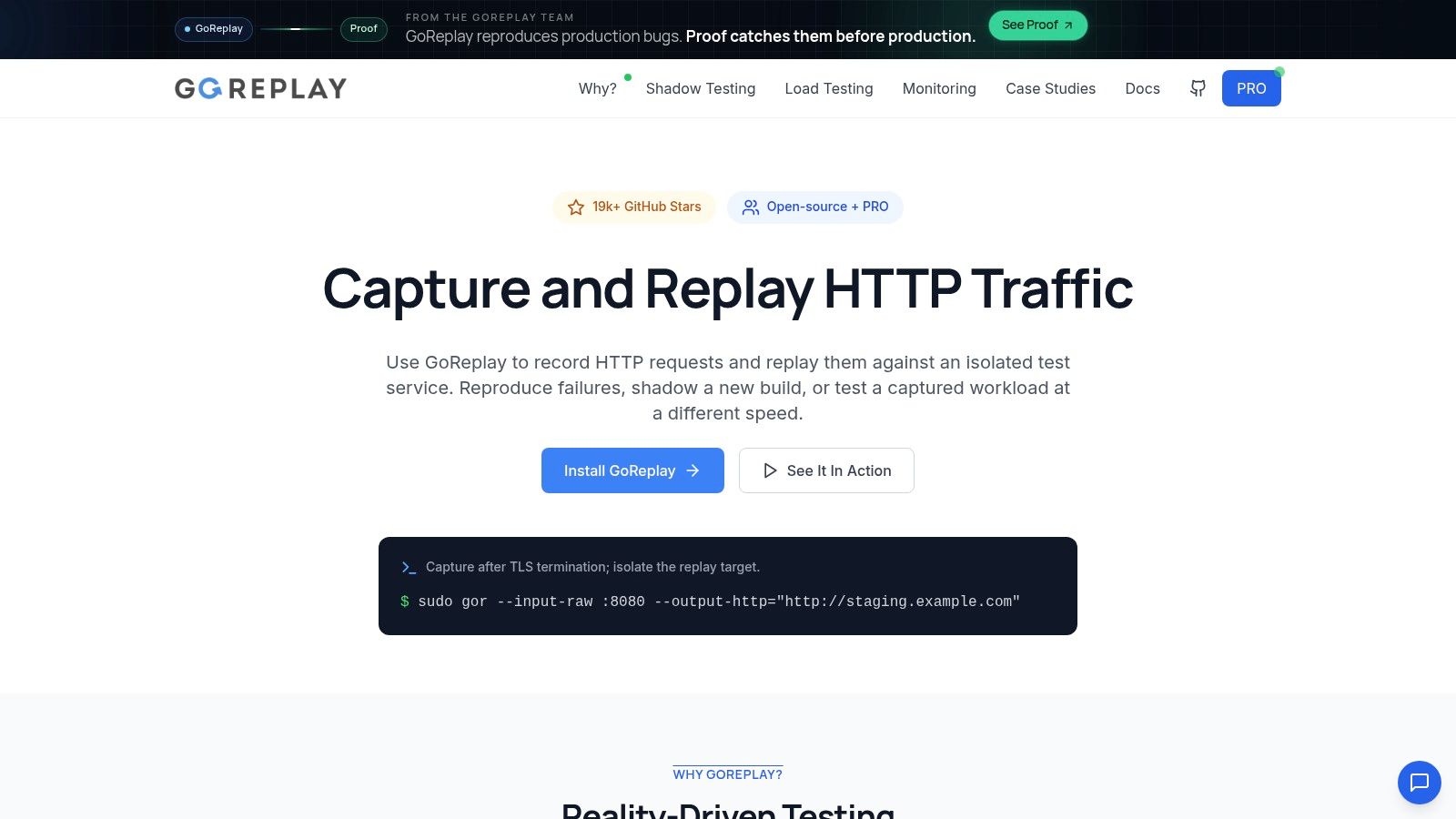
GoReplay can capture live HTTP traffic and replay it into an isolated testing environment. That supports ad hoc analysis of real request sequences while keeping the target build separate from production. Before replaying anything, remove sensitive data, define the target service clearly, and confirm that the environment can safely accept the requests.
A safe capture and replay workflow
Start by capturing traffic at an approved point in the request path, then store the capture where the QA team can inspect and sanitize it. The replay target should be a staging or isolated service, never an environment that can send real emails, charge real payment methods, mutate production records, or call external systems without controls.
A representative command-line pattern is:
sudo gor --input-raw :8080 --output-file=requests.gor
gor --input-file=requests.gor --output-http="https://staging.example.test"
The first command records HTTP traffic from the listening interface into a capture file. The second reads that file and sends requests to the test target. Adapt the listening point, target URL, filtering, and data-handling controls to your deployment rather than copying the example unchanged. The GoReplay setup guidance for testing environments provides the product-specific configuration context.
After replay begins, ad hoc testing still requires human investigation. Watch for state mismatches, rejected requests, unexpected authorization results, duplicate writes, and failures that appear only when requests arrive in a realistic order. A replay can reveal that the new build handles individual requests correctly but fails when a user’s earlier actions establish a particular session state.
Realistic traffic doesn’t replace tester judgment. It gives that judgment better evidence.
Use replay selectively. A captured request may contain credentials, personal information, tokens, or identifiers, so sanitize or mask sensitive values before sharing or storing it. Also check whether replayed requests are safe to repeat. Read operations are easier to isolate than writes, and destructive endpoints need explicit safeguards.
For teams that need more than a single replay, traffic can be filtered, redirected, or exercised at controlled speeds against a test service. The point is not to turn every ad hoc session into a load test. It’s to give a tester realistic inputs and sequences, then let experience guide the unusual probes that follow.
Documentation and Metrics for Ad Hoc
Documentation doesn’t have to precede the session. It does need to follow the discovery. The fastest useful record is often a short trail of what changed, what the tester expected, what happened, and what evidence another person needs to reproduce it.
A lightweight note might contain:
- Context: Build, feature area, environment, and relevant recent change.
- Probe: Input, sequence, interruption, or traffic pattern that was tried.
- Result: Observable behavior, error message, response, or data change.
- Evidence: Screenshot, request identifier, sanitized payload, log reference, or recording.
- Next action: Bug report, exploratory follow-up, or new regression test.
This record protects the team from the most expensive ad hoc failure, a valid defect that nobody can reproduce. It also gives developers a starting point for diagnosis instead of forcing them to interpret “it broke after I clicked around.”
Measuring useful outcomes
Traditional coverage is hard to calculate for an unstructured session because the tester hasn’t defined a complete set of cases in advance. That doesn’t make the work unmeasurable. Track the defects found, the severity and risk of the affected area, the time from the start of the session to detection, and whether each important finding becomes a repeatable test.
Avoid turning one metric into a target that encourages shallow behavior. A tester who reports many trivial UI inconsistencies may appear productive while missing a single data-loss defect. Review the quality of findings, the clarity of reproduction steps, and the areas that remain weak after the session.
The GoReplay guidance on reporting and metrics is relevant when captured traffic becomes part of a broader testing and observability workflow. Keep the measurement close to a decision: should the team fix the issue, add a regression check, improve monitoring, or revisit the risk assessment?
Conclusion and the Balanced Testing Strategy
Ad hoc testing belongs in a mature QA strategy because software fails in combinations that no team can fully script in advance. Its strength is rapid, experience-driven investigation. Its weakness is limited repeatability, uncertain coverage, and the risk that a useful discovery remains trapped in the tester’s memory.
Scripted testing should protect known behavior and release-critical regression paths. Exploratory testing should give testers enough structure to learn a feature, record observations, and revisit important questions. Ad hoc testing should challenge assumptions quickly, especially around recent changes, defect-prone workflows, unusual inputs, and strange state transitions.
The strongest teams let findings move between these modes. An ad hoc probe reveals a failure, an exploratory session isolates the conditions, and a scripted test preserves the fix. Realistic HTTP traffic can make the first stage more representative, while lightweight notes make the result useful to the rest of the team.
The balanced approach: Keep the test activity flexible, but make the knowledge reusable.
Don’t schedule ad hoc testing as a substitute for CI checks or a thorough regression suite. Give it a clear purpose and a safe environment, then let skilled testers follow evidence instead of forcing every investigation into a predefined path. When a defect matters, capture it, report it, and convert it into protection the team can run again.
GoReplay captures HTTP traffic and replays it into an isolated testing environment, giving your ad hoc sessions realistic request sequences to investigate safely. Visit GoReplay to explore a practical way to bring production-shaped behavior into staging and strengthen the gap between scripted checks and real-world failures.