
What Is Test Plan in Testing? Key Guide Explained

A test plan acts as your project’s blueprint, laying out strategy, objectives, schedule, team responsibilities, and final deliverables. It guides every step of quality assurance, so nobody’s left guessing. Picture it as the architectural drawing that defines a building’s shape—and your software’s reliability.
Your Blueprint for Software Quality

Imagine starting a skyscraper project without those precise blueprints. Chaos, cost overruns, missed deadlines—you name it. A test plan does the same for software development. It turns testing from a haphazard check-the-box task into a deliberate, well-choreographed exercise.
More than just a list, this document brings everyone under the same roof—developers, testers, product managers, and stakeholders. It’s the one source of truth that answers the project’s essential questions:
- What will we test? (Scope)
- How will we perform those tests? (Approach)
- When do we run each phase? (Schedule)
- Who owns every deliverable? (Resources)
Time and again, research shows that projects with well-documented test plans cut risk and boost coverage—crucial when release windows are tight. You can explore more on the benefits of detailed test planning at BugBug.io.
By flagging risks early, setting clear success criteria, and mapping out resource needs, a test plan lays the groundwork for a product that not only meets user expectations but also aligns with business goals. In fact, it’s non-negotiable on any software project aiming for success.
Anatomy of a Modern Test Plan
A great test plan is way more than just a checklist. Think of it as the strategic blueprint for your entire quality assurance effort—a living document that gives everyone involved absolute clarity on what’s happening, why it’s happening, and how it’s all going to get done.
These components aren’t just isolated sections; they work together like the different systems in a body. Each has its own job, but they all need to be in sync for the whole operation to succeed. Let’s break down the essential parts.
Core Strategic Components
First things first, every solid test plan needs a strategic foundation. This isn’t about listing a bunch of tasks. It’s about defining the purpose and drawing the lines around the entire testing effort.
- Test Objectives: This is your “why.” It’s where you state exactly what you’re trying to achieve. Are you validating new features? Aiming for a specific level of code coverage? Maybe you need to prove the application can handle 10,000 concurrent users. Whatever the goal, it goes here.
- Scope Definition: This part is critical. You clearly define what will be tested and—just as important—what will not be tested. A well-defined scope is your best defense against “scope creep,” that sneaky villain that tries to derail your team by adding unplanned work mid-sprint.
- Resource Planning: This section lays out the “who” and “what” of your testing team. It details everyone’s roles and responsibilities and lists all the hardware, software, and tools needed to get the job done.
This diagram really drives home how these foundational pieces—objectives, scope, and risk—build on each other to create a stable plan.
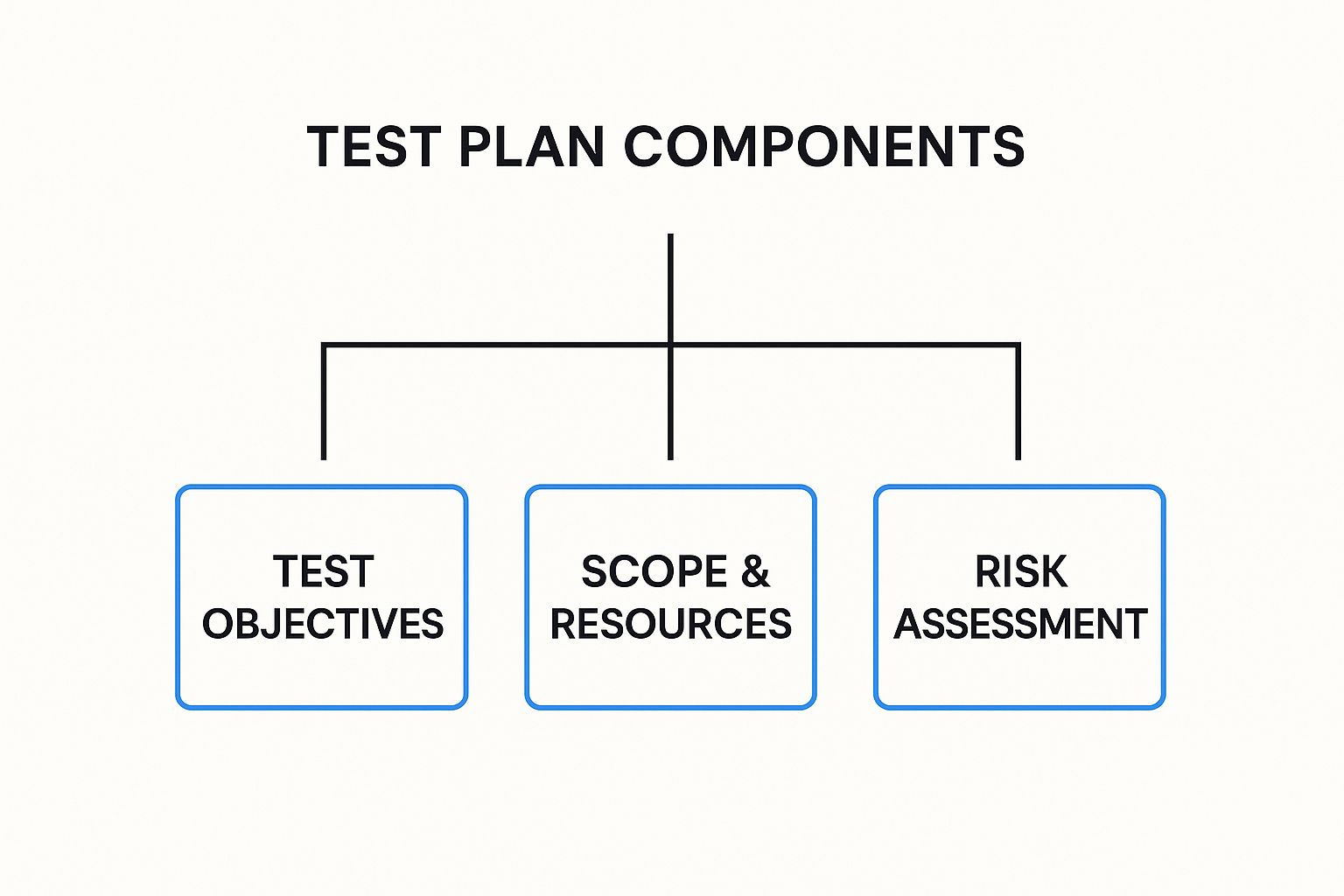
As you can see, clear objectives directly shape the scope, which in turn informs how you’ll assess and manage risk. It all flows together.
Execution and Logistics
Once the strategy is locked in, the plan shifts to the nitty-gritty of execution. These are the components that make your plan something you can actually do.
A great plan is useless if it can’t be executed. This is where you map out the environment, schedule, potential roadblocks, and the final proof of your work.
A few key logistical elements you can’t skip:
- Environment Requirements: Be specific here. List the exact hardware, software, and network configurations required to build a stable and accurate testing environment. No ambiguity.
- Risk Assessment: What could go wrong? This is where you identify potential showstoppers, like ridiculously tight deadlines or tricky technical dependencies, and map out a mitigation plan for each one.
- Schedules and Milestones: Put it on a calendar. This provides a clear timeline for all testing activities, with hard deadlines for things like test case design, execution sprints, and reporting.
- Test Deliverables: What will you have to show for all this work? This section lists all the documents and artifacts you’ll produce, like test cases, bug reports, and a final summary report for stakeholders.
To tie it all together, this table breaks down the key components you’ll find in a truly comprehensive test plan and the critical questions each part should answer.
Key Components of a Comprehensive Test Plan
| Component | Purpose and Key Questions Answered |
|---|---|
| Test Objectives | Why are we testing? Defines clear, measurable goals for the testing cycle. (e.g., Are we validating a new feature or confirming performance under load?) |
| Scope Definition | What are we testing (and what are we not)? Sets firm boundaries to prevent scope creep. (e.g., Which modules are in-scope for this release?) |
| Resource Planning | Who and what do we need? Outlines team roles, responsibilities, and necessary tools. (e.g., Do we have the right people and hardware?) |
| Environment Requirements | Where will we test? Specifies the exact setup needed for reliable results. (e.g., What OS, browser versions, and network config are required?) |
| Risk Assessment | What could go wrong? Identifies potential blockers and outlines mitigation plans. (e.g., What’s our backup plan if the test server fails?) |
| Schedules & Milestones | When will it be done? Provides a clear timeline for all testing activities. (e.g., What are the deadlines for test execution and final reporting?) |
| Test Deliverables | What will we produce? Lists the artifacts that prove the work was done. (e.g., What reports do stakeholders need to see?) |
Having these sections clearly defined turns a simple document into a powerful tool that aligns your team, manages expectations, and ultimately guides your project to a successful launch.
Test Plan vs. Test Strategy: What’s the Real Difference?

It’s one of the most common mix-ups in quality assurance. People often use the terms “test plan” and “test strategy” as if they’re the same thing. But they’re not—not even close. Getting this right is crucial because they represent two completely different levels of planning.
Think of it like a game of chess. The test strategy is your overall game plan. It’s the high-level approach you’ll use to win, defining your guiding principles, your preferred openings, and your long-term goals for controlling the board. It’s a fairly static document that outlines how your organization thinks about and approaches quality.
If you’re looking to build a rock-solid foundation for quality, check out our ultimate guide to creating a test strategy.
The Plan: Your Project-Level Blueprint
The test plan, on the other hand, is the specific set of moves for a single game. It’s the battle plan for one project or one release. This is a living, breathing document that puts your high-level strategy into action. It answers the nitty-gritty questions.
The test strategy sets the why and what for the whole organization. The test plan answers the how, when, and who for a specific project.
This is a critical distinction. It’s what separates broad principles from what you’re actually doing on Tuesday morning. Your test plan is where you’ll find the concrete details: schedules, which features are in scope, who is assigned to what, and the exact testing environment for this release.
Understanding this hierarchy is everything. A strong test strategy gives all your test plans a consistent direction, ensuring quality doesn’t drift from one project to the next. In turn, each test plan provides the actionable, on-the-ground roadmap your team needs to get a specific product out the door successfully.
Why Your Project Needs a Test Plan
Trying to skip a formal test plan might seem like a quick way to get moving, but it’s a high-stakes gamble that almost always ends in chaos. It’s a shortcut that isn’t short.
Without this crucial guide, teams end up working in silos. This inevitably leads to duplicated efforts, missed requirements, and critical bugs slipping straight into production. A proper test plan turns testing from a reactive, messy scramble into a proactive, strategic process.
It acts as the central source of truth for developers, testers, and product managers. Suddenly, everyone has a clear, shared picture of the testing scope, what success looks like, and how you’ll get there. This alignment is what keeps expectations grounded in reality and helps everyone make smart decisions about when a product is truly ready to ship.
Aligning Teams and Managing Risks
Think of a test plan as your best defense against project risk. By spotting potential roadblocks early on—things like overly complex features, tight deadlines, or not enough resources—you can build contingency plans before they turn into full-blown emergencies. This foresight means you can allocate resources intelligently, ensuring the right people and tools are ready right when you need them.
A test plan isn’t just about finding bugs; it’s about building confidence. It provides a structured argument to stakeholders that the product has been thoroughly vetted and is ready for release.
This structured approach pays off in real, measurable ways. Projects with well-documented test plans consistently see major improvements in both quality and efficiency. In fact, comprehensive analysis shows they can experience up to 40% fewer delays and a whopping 35% fewer post-deployment defects compared to projects that just wing it. You can explore more of the benefits of test planning on TatvaSoft.com.
At the end of the day, investing a little time upfront in a solid test plan saves you from costly rework down the line. It protects your budget, helps you deliver a high-quality product that actually meets customer expectations, and ultimately, solidifies your brand’s reputation.
Creating a Test Plan That Actually Gets Used

Knowing the theory behind a test plan is one thing. Crafting one that your team actually opens and references is another challenge entirely. A plan that just gathers dust is worse than no plan at all—it gives you a false sense of security.
The first step to making it useful? Don’t write it in a silo. Get developers, business analysts, and product owners in a room from day one. This simple move creates a sense of shared ownership and ensures the plan reflects reality, not just the QA team’s perspective. When everyone has a hand in it, they’re invested.
Make It a Living Document
In modern development, especially with Agile, a static test plan is already obsolete the moment you write it. Think of it as a “living document” that evolves right alongside the project. Requirements will change, priorities will shift, and new risks will pop up. Your test plan has to keep up.
A great test plan isn’t a stone tablet; it’s a dynamic map. It should be updated continuously to reflect the current state of the project, ensuring it remains relevant and valuable from the first sprint to the final release.
This iterative approach is what keeps the plan from becoming a forgotten relic of the project’s kickoff phase.
Define Clear Boundaries and Use Templates
Clarity is your best friend. A plan that’s vague or way too complex is guaranteed to be ignored. To sidestep that fate, stick to a few key practices:
- Keep it Concise: Ditch the jargon and long paragraphs. Use bullet points, tables, and clear headings to make information easy to find and digest.
- Define Entry and Exit Criteria: Be brutally clear about what must be true before testing can begin (entry criteria) and what “done” looks like (exit criteria). For example, an exit criterion might be that “95% of critical test cases must pass.”
- Use Templates: Don’t reinvent the wheel for every project. Create a standardized template for your organization. This builds consistency and makes it dead simple for anyone to find the information they need quickly.
Following these practices turns your test plan from a bureaucratic checkbox into a practical, day-to-day tool. For more hands-on guidance, you can learn how to create a test case that slots perfectly into your new, actionable test plan.
Got Questions About Test Plans? We’ve Got Answers.
Even when you’ve got the basics down, a few practical questions always pop up. Let’s tackle some of the most common ones that teams run into when they start putting test plans into action.
Getting these details right helps clarify roles, adapt to different development styles, and really drives home why a structured approach to quality is so important.
Who’s Actually in Charge of Writing the Test Plan?
On paper, the Test Lead or Test Manager usually owns the test plan. They’re the ones steering the ship, drafting the document, and making sure it stays up to date.
But here’s the thing: it’s never a solo mission. A great test plan is a group effort. The Test Lead is more of a facilitator, pulling in crucial insights from everyone involved to make sure the plan is realistic and lines up with the project’s bigger picture. That means they’re constantly talking with:
- Project Managers to get timelines and resources locked down.
- Developers to understand the tech and pinpoint potential weak spots.
- Business Analysts to ensure the testing goals actually match what the business needs.
- Product Owners to double-check that the scope and priorities are on point.
In smaller shops or agile teams, you might see a senior QA engineer or even the whole QA team sharing the responsibility. It becomes a living document they all contribute to.
How Do Test Plans Work in an Agile World?
Forget the old-school, massive, write-it-once-and-never-touch-it-again test plan. In an agile setup, that just doesn’t fly. The plan has to be as fast and flexible as the development process itself.
Instead of one giant document, you’ll typically have a high-level master test plan that sketches out the overall strategy. Then, for each sprint, a much leaner, sprint-specific test plan comes into play. These are hyper-focused on the user stories for that particular sprint and are updated on the fly. The whole game shifts from exhaustive upfront planning to smart, just-in-time preparation.
So, What Happens if We Just… Don’t Have One?
Skipping the test plan is like setting sail in a storm without a map or a compass. You might stay afloat for a little while, but you’re setting yourself up for some very predictable—and avoidable—problems.
Without a test plan, testing isn’t a planned, proactive process. It’s just chaotic, reactive firefighting. The lack of a clear direction leads to wasted time, missed bugs, and blown deadlines.
Here are the issues that almost always crop up:
- Scope Creep (and Gaps): With no clear boundaries, teams either over-test unimportant features or, worse, completely miss critical parts of the application.
- Wasted Resources: Testers spin their wheels trying to find the right tools, data, or environments, which leads to huge delays and a lot of frustration.
- Communication Breakdown: Nobody outside the QA team knows what’s going on. Stakeholders are in the dark about progress, risks, and timelines, and that’s a recipe for mismatched expectations.
- Sky-High Risk: Without a plan to identify risks early, critical bugs inevitably slip into production. And fixing a bug in production is easily 10x more expensive than catching it in development.
Ready to supercharge your testing with real user traffic? GoReplay allows you to capture and replay production traffic in your test environments, ensuring your application is ready for any real-world scenario. Discover how to build more resilient systems by visiting https://goreplay.org.