
What Is Reverse Proxy: Architecture and Use Cases

Your application is healthy in staging, but production traffic reaches it through a single public endpoint, and suddenly a backend starts timing out. Clients connect directly to the service, every instance exposes its own network boundary, and a deployment mistake can turn one unhealthy process into a wider incident. The immediate question is usually simple: what is reverse proxy architecture doing for you?
A reverse proxy creates a controlled edge between clients and origin services. It accepts public requests, applies traffic and security policy, selects an appropriate backend, and returns the response without requiring clients to know which server handled the work. That boundary supports routing, TLS management, caching, observability, and failure isolation, but it also creates architectural choices that are often blurred with load balancers and API gateways.
Why Reverse Proxies Matter in Production Traffic
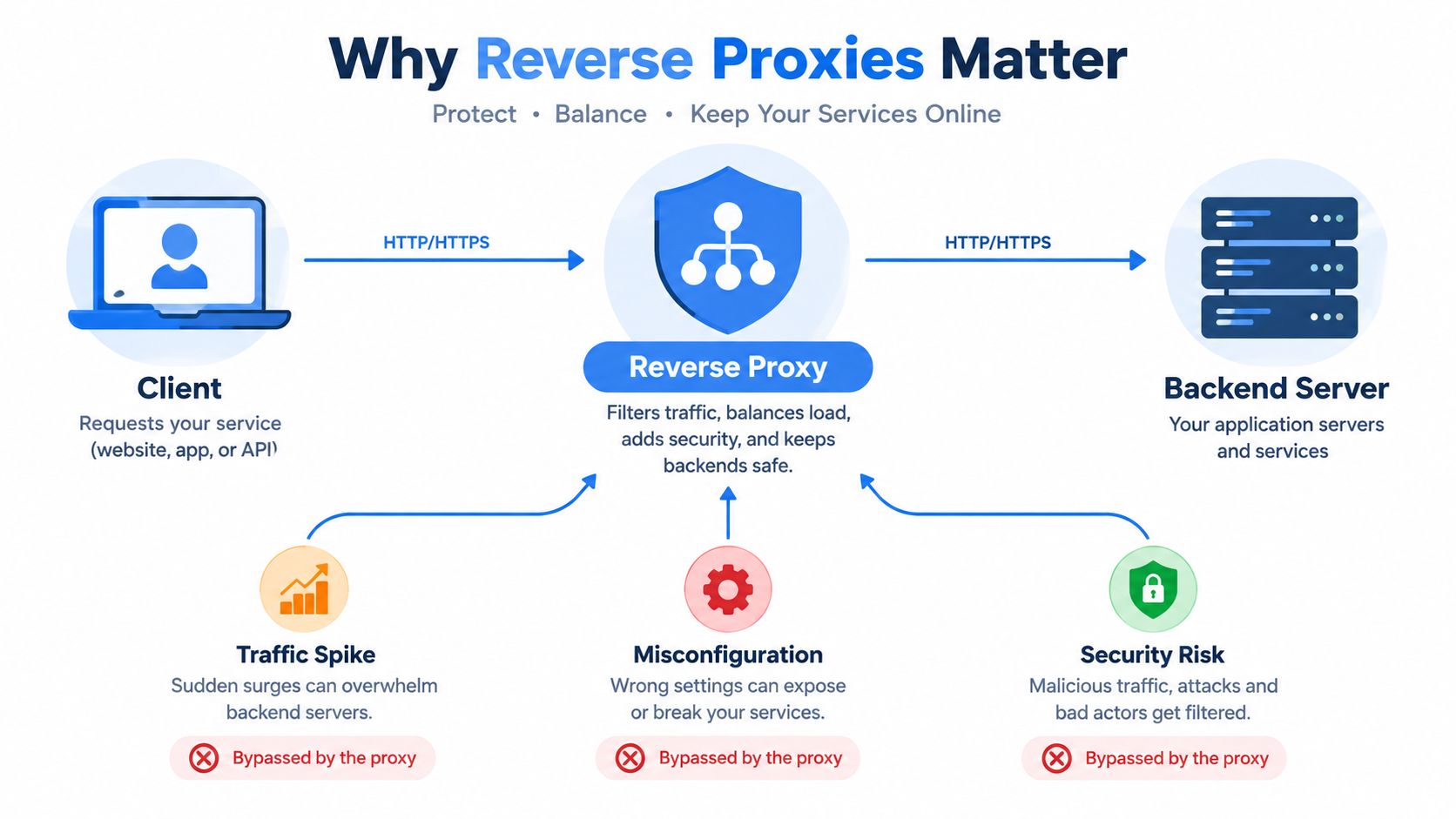
A production incident often begins with an ordinary request. A release leaves one backend misconfigured, a traffic surge exhausts its connection pool, or a compromised service starts receiving requests it should never have seen. If clients communicate directly with origin servers, every client-facing dependency becomes part of the failure surface. There’s no consistent place to reject bad traffic, redirect requests, remove an unhealthy instance, or hide internal topology.
A reverse proxy changes that shape. It sits in front of one or more origin servers, accepts the client connection, forwards the request to the selected backend, and sends the backend response back to the client. Wikipedia’s overview of reverse proxies describes the pattern as a public-facing intermediary that can make multiple backend systems appear to be one service.
The proxy as a failure boundary
Suppose an application has separate services for web pages, media, and an internal API. Clients still use one public hostname. The reverse proxy can route each path to the right service, stop requests to a failing upstream, and preserve a stable external interface while teams repair or replace the backend.
That doesn’t make the proxy a magic shield. A badly configured proxy can become a single point of failure, amplify retries, or conceal useful errors. The design works when engineers treat it as production infrastructure, with health checks, capacity planning, configuration validation, and logs that connect the client request to the upstream attempt.
Practical rule: Put policy at the edge, but keep application ownership in the service. The proxy should control admission and delivery, not become an untestable collection of business rules.
The security benefit is equally direct. A reverse proxy can hide origin servers from direct Internet exposure and filter traffic before it reaches them, a role described in Fortinet’s explanation of reverse proxy security. Clients see the proxy’s public boundary, while the origin network can restrict access to approved proxy paths.
That separation improves observability too. Operators get one place to inspect request rates, status codes, latency, rejected methods, and upstream failures. More critically, teams can introduce the boundary without rewriting every application, provided the services correctly handle forwarded host, protocol, and client identity headers.
How a Reverse Proxy Handles Requests and Responses
The cleanest way to understand a reverse proxy is to follow one request. A browser asks for /account, but it doesn’t know whether the account service runs on a virtual machine, a container, or a cluster member. It knows only the public endpoint.
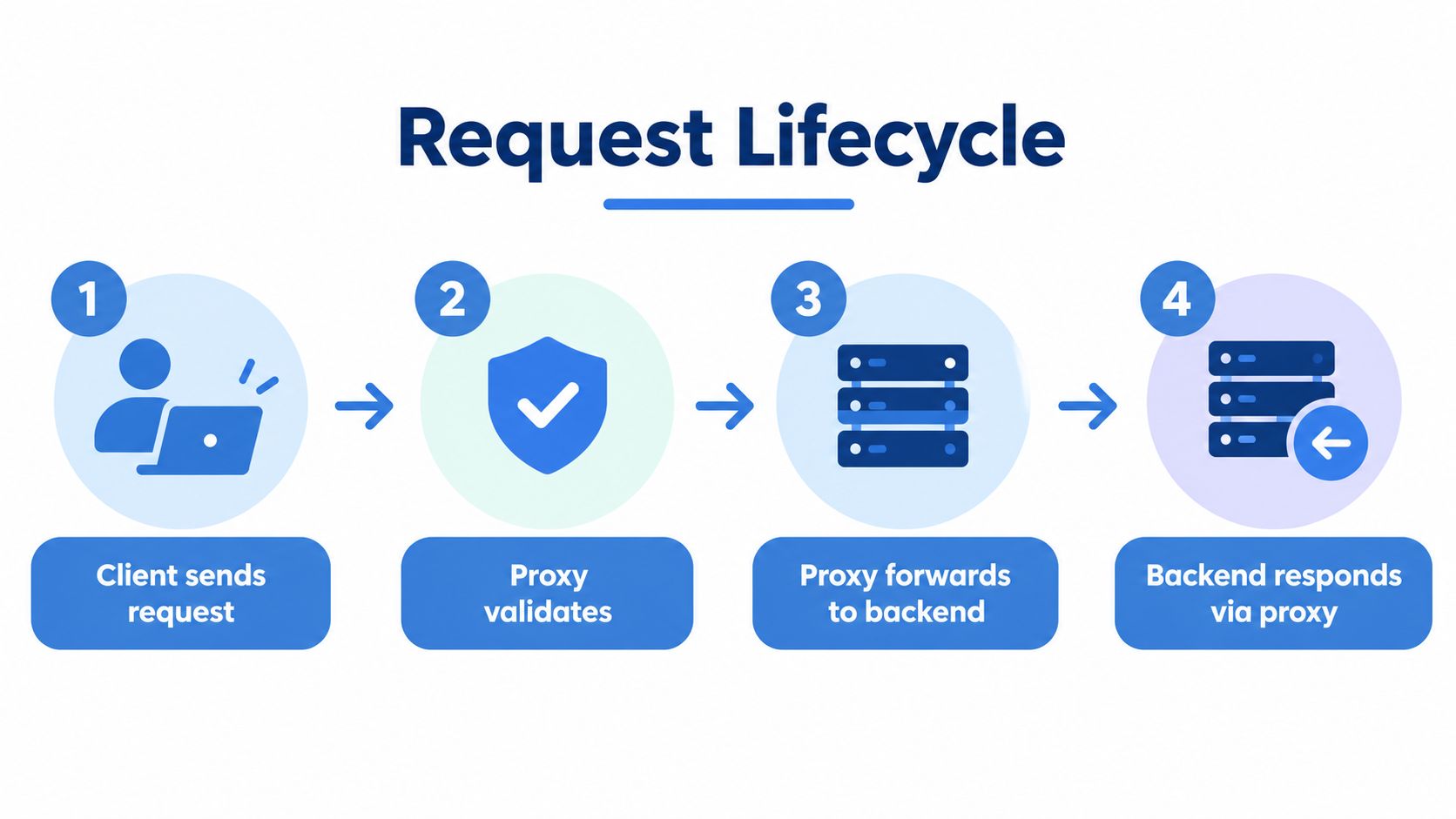
Four hops through the edge
-
The client opens a connection. The browser connects to the proxy’s public listener. If HTTPS is used, the proxy handles the client-side TLS negotiation and establishes the security context for that session.
-
The proxy validates and interprets the request. It can check the method, host, path, headers, body limits, and access policy. After TLS termination, it can inspect HTTP semantics such as paths and headers rather than treating the request as opaque encrypted bytes. Teleport’s reverse proxy guide explains why this visibility enables routing, authorization, rewriting, logging, and caching decisions.
-
The proxy selects an upstream. A routing rule may send
/accountto the account service, while/assetsgoes to a static-content backend. The proxy then opens or reuses a separate connection to the selected origin. -
The backend responds through the proxy. The proxy receives the status code, headers, and response body. It can alter headers, apply caching rules, record timing data, and return the final response to the browser.
The important detail is session separation. The client-to-proxy connection and proxy-to-origin connection are distinct. That lets the edge apply controls and collect diagnostics without forcing each application server to implement the same connection handling.
Debugging the two legs
When a request fails, ask which leg failed. A client-side TLS error points toward certificate binding, protocol support, or edge policy. A successful edge connection followed by a gateway error points toward upstream reachability, health checks, application timeouts, or response handling.
The same distinction helps with latency. Measure time to accept the client connection, time spent in proxy processing, time waiting for the upstream, and time spent transmitting the response. Without those separate measurements, teams often blame the application for delay caused by connection queues or edge buffering.
The request path is also why a proxy can centralize certificate operations. Akamai’s TLS and mutual TLS documentation describes an architecture where the edge terminates the client TLS session and can establish a separate protected session upstream when needed.
Core Responsibilities That Define a Reverse Proxy
Forwarding traffic is the basic operation, not the reason production teams keep a reverse proxy. The value comes from placing several decisions at one controlled edge.
Routing and traffic control
A proxy can route by hostname, path, method, header, or other request properties. That supports patterns such as sending /api to application services, /static to an asset origin, and selected test headers to a candidate release. It can also rewrite paths when the public URL and internal service contract differ.
The trade-off is configuration complexity. Every routing rule becomes part of the application delivery path. Teams need ownership, review, automated validation, and a rollback process, otherwise a harmless-looking path change can send traffic to the wrong service.
TLS termination
TLS termination at the proxy centralizes certificates instead of distributing certificate material across every application server. It also moves handshake processing away from the backend, while the proxy can establish a new TLS connection upstream when encryption between edge and origin is required. Akamai’s documentation outlines this split-session model.
That convenience introduces a trust decision. If the internal network is sensitive, plain HTTP between proxy and origin may be inappropriate. Encrypting the upstream leg protects traffic in transit, but it adds certificate validation and operational work. The right choice depends on the network boundary, compliance requirements, and the sensitivity of the data.
Caching and response handling
A reverse proxy can cache responses that are safe to reuse, reducing repeated work at the origin. It can also compress content, buffer upstream responses, modify response headers, and return controlled errors when an upstream is unavailable.
Caching fails when teams ignore invalidation. Private responses, authorization-dependent content, and mutation endpoints require careful cache rules. A stale response can be more damaging than a slow response, so cache keys, freshness rules, bypass conditions, and purge behavior should be explicit.
Policy and visibility
After TLS termination, the proxy can inspect methods, headers, paths, and request bodies where configured. That enables request-size limits, authorization checks, rate controls, path normalization, security filtering, and structured access logs. It becomes a policy enforcement point rather than a passive network hop.
A proxy can also normalize telemetry. If every service emits different access logs, incident analysis becomes slower. Central edge logs won’t replace application logs, but they provide a consistent record of what the client requested, what the proxy selected, and how the upstream responded.
Nginx, HAProxy, and Envoy in Real Deployments
There isn’t a universal winner among Nginx, HAProxy, and Envoy. The useful question is which operational problem dominates your architecture.
| Tool | Strong fit | Main trade-off |
|---|---|---|
| Nginx | General-purpose HTTP proxying, static content, and a mature configuration ecosystem | Advanced dynamic behavior can require additional components or careful configuration management |
| HAProxy | Connection handling, layer-four forwarding, health checks, and detailed load-balancing control | Its strengths can mean more deliberate integration work for application-level features |
| Envoy | Service-to-service traffic, dynamic configuration, advanced routing, and observability integrations | Its flexibility brings a larger operational surface and more concepts to manage |
Nginx for conventional edge delivery
Nginx is a practical default when the architecture needs a familiar HTTP edge, static-content delivery, TLS termination, and straightforward upstream routing. It fits teams that prefer explicit configuration and a broad ecosystem of established deployment patterns.
It becomes less comfortable when routing state changes constantly and operators need every proxy instance to receive coordinated dynamic updates. That doesn’t make Nginx unsuitable, but the surrounding control plane matters as much as the proxy binary.
HAProxy for precise connection behavior
HAProxy is often a strong choice when engineers care about connection reuse, health-check behavior, layer-four traffic, and predictable load-balancing decisions. It can sit in front of databases or other TCP services where HTTP-aware features aren’t the primary requirement.
The compromise is that application-specific API policy may belong elsewhere. If the proxy starts accumulating identity, transformation, and developer-facing controls, a separate API layer may produce a cleaner boundary.
Envoy for distributed systems
Envoy fits environments where services change frequently and teams need dynamic discovery, rich routing, and standardized telemetry. It commonly appears in service-mesh designs, where sidecars or gateways apply consistent traffic behavior across many services.
That power isn’t free. Operators must understand configuration propagation, resource consumption, failure behavior, and the interaction between mesh policy and application policy. For a small deployment, Envoy can add machinery without solving a real problem the team has.
For a concrete Apache-based configuration perspective, see this GoReplay guide to Apache reverse proxy setups. The broader lesson is to select the smallest proxy capability that matches the boundary you need, then add complexity only when operational requirements justify it.
Using Reverse Proxies with Traffic Replay Tools
A reverse proxy gives you a controlled place to observe and direct requests. A traffic replay tool lets you use those requests to test a different backend without sending real users there. Combined carefully, they support shadow testing, migration checks, load experiments, and regression detection.
GoReplay captures live HTTP traffic and replays it into a testing environment. The proxy can sit at the interception boundary, while the replay path points at an isolated target. Production users continue receiving responses from the origin, and engineers inspect how the candidate system behaves under request patterns drawn from actual usage.

What makes replay representative
A request copy isn’t automatically a realistic test. Engineers need to account for:
- Session relationships: Requests that depend on cookies, tokens, or ordering should retain the relationships required by the application.
- Sensitive data: Production payloads may contain credentials or personal information. Mask or transform data before it reaches a test environment.
- TLS boundaries: Decide whether capture occurs before or after edge termination, and make sure the replay target expects the same protocol behavior.
- Connection patterns: Reuse, concurrency, buffering, and upstream timeouts can materially change how a candidate service behaves.
- Side effects: A replay against a write endpoint can create duplicate orders, messages, or state changes unless the target is isolated or mutation handling is controlled.
The reverse proxy should not become an uncontrolled bridge from production into testing. Route replay to a dedicated environment, restrict its network permissions, and label replay traffic so application logs and metrics distinguish it from real users.
A sound workflow begins with capture and data handling, continues with replay against a controlled target, and ends with comparison. Compare status codes, latency distributions, error categories, response sizes, and downstream effects. GoReplay’s guide to traffic replay and load-testing accuracy covers the practical value of using real request patterns rather than relying only on synthetic examples.
The reverse proxy contributes the boundary and routing control. GoReplay contributes the capture and replay mechanism. Neither removes the need to define safe test data, realistic session behavior, and clear success criteria.
Reverse Proxy vs Load Balancer vs API Gateway
These terms overlap because modern products combine features. They aren’t interchangeable architectural ideas.
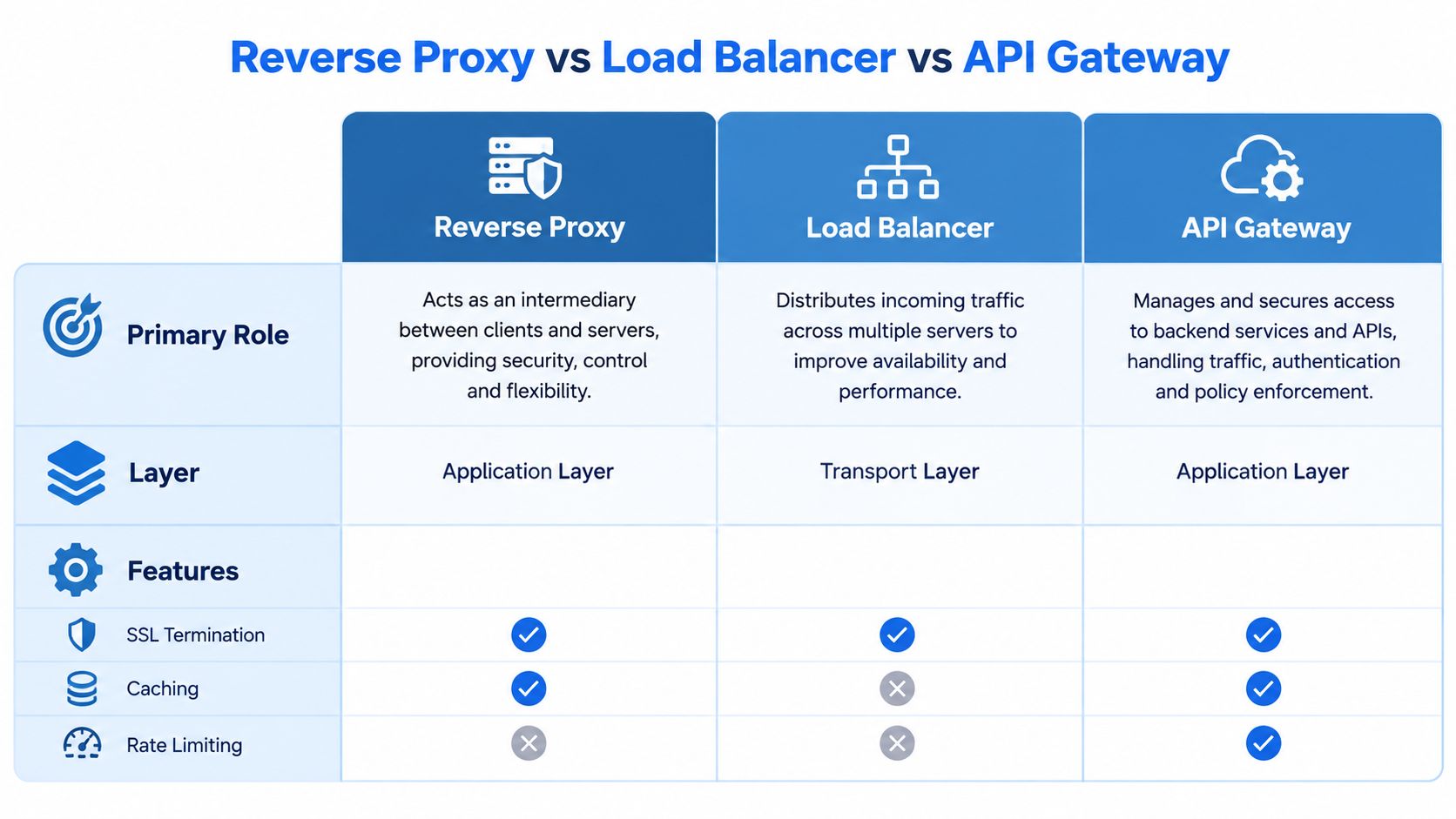
A reverse proxy is the broadest foundation. It provides a public-facing entry point, forwards requests to origins, and can apply TLS, routing, caching, logging, and policy controls.
A load balancer emphasizes distribution. Its central job is to spread connections or requests across healthy backends and remove instances that fail health checks. It may operate at the transport layer, where it doesn’t need to understand HTTP paths or API semantics.
An API gateway is designed around API consumers and service contracts. It commonly handles client authentication, per-client rate controls, request and response transformation, versioning, quotas, and developer-facing access management.
Choose by the problem, not the label
Use a reverse proxy when you need a stable edge boundary between clients and one or more internal services. Use a load balancer when distribution, health-based failover, and connection behavior are the dominant concerns. Use an API gateway when external API products need identity, quotas, transformations, and lifecycle controls.
In practice, one component can serve multiple roles. Nginx can reverse proxy and load balance. Envoy can provide gateway behavior. A managed cloud load balancer may terminate TLS and route HTTP requests. The name on the box matters less than the policies it owns and the failure modes operators must support.
The architectural boundary is intent. A load balancer answers, “Which healthy server should receive this connection?” An API gateway answers, “Is this API client allowed to make this request, and how should the contract be enforced?” A reverse proxy answers, “How should external traffic enter and reach internal services?”
Avoid buying an API gateway merely because it includes proxying, or deploying a large service mesh when a simple edge proxy solves the problem. Count the required controls, the team’s operational capacity, and the cost of another configuration plane.
Configuration Patterns and Common Failure Modes
Most reverse proxy incidents aren’t caused by obscure networking theory. They come from a mismatch between what the proxy assumes and what the backend actually supports.
Start with the upstream definition. Confirm the backend protocol, connection behavior, health endpoint, timeout expectations, and name resolution. A proxy that speaks HTTPS to an HTTP-only origin, or validates a certificate against the wrong identity, will fail before the application can help.
The settings that deserve review
- Upstream health checks: Test an endpoint that proves the service can handle useful work, not merely that its process is alive.
- Routing rules: Check path precedence, trailing-slash behavior, host matching, and rewrite effects.
- Forwarded headers: Preserve the original host, scheme, and client context according to an agreed trust model. Applications should not blindly trust headers from arbitrary clients.
- TLS bindings: Verify certificate selection, supported protocols, upstream encryption, and renewal behavior before an expiry becomes an outage.
- Timeouts and pooling: Align connect, read, write, idle, and queue limits with application behavior. Reusing connections can reduce overhead, but stale or incompatible connections create confusing failures.
- Buffering and caching: Tune them for response size and workload, then test invalidation and bypass rules with authenticated and mutable content.
Logging is not optional. Capture a request identifier that travels from the edge to the backend, then record the selected upstream, status, timing, and failure reason. Without that chain, a client sees an error while the proxy and application teams each claim the other side failed.
A disciplined troubleshooting path
Check the path in order. First verify that the client reaches the intended proxy listener. Next inspect proxy logs for routing and policy decisions. Then test backend reachability from the proxy’s network context, not from an engineer’s workstation. Finally compare proxy timing with application timing and inspect whether retries or buffering changed the observed behavior.
Misconfigured retries deserve special suspicion. Retrying a safe read may improve resilience, but retrying a mutation can duplicate work. Likewise, a cache can reduce origin load while serving stale or unauthorized content if its key and bypass rules are incomplete.
When a Reverse Proxy Is the Right Choice
A reverse proxy is the right choice when you need a stable public boundary, protected origins, centralized TLS handling, consistent traffic policy, and visibility across several backend services. It can simplify migrations and testing because clients keep using the same endpoint while operators change the upstream behind it.
It isn’t automatically necessary for every service. A small internal application with one trusted caller and minimal operational requirements may be better served by direct private connectivity. A managed platform may already provide the edge, certificate, routing, and protection features your team would otherwise configure.
The key is to identify the boundary you need. If clients must not know backend topology, if several services share an external interface, or if security and routing decisions need one controlled point, a reverse proxy remains a strong architectural fit. Its age isn’t a weakness. The pattern persists because it solves the practical problem of separating public traffic from private service operation.
GoReplay captures and replays live HTTP traffic into controlled testing environments, making it useful alongside a reverse proxy for migration validation, shadow testing, and regression checks. Visit GoReplay to evaluate a workflow that turns representative traffic into a safer way to test backend changes.