
What Is Chaos Testing for Resilient Systems

Chaos testing is the art of deliberately injecting controlled failures into a system. Why? To build unshakable confidence that it can handle the turbulent, unpredictable conditions of the real world. Think of it as a proactive way to hunt down hidden weaknesses before they turn into catastrophic outages.
Why Your Perfect System Is Built to Fail

Imagine your complex software as a high-performance race car—meticulously engineered, perfectly tuned, and incredibly fast. On a pristine, controlled track, it’s flawless.
But production environments aren’t clean racetracks. They’re chaotic, unpredictable public roads, littered with potholes, sudden traffic, and unexpected detours.
In today’s world of distributed systems, a single component failure can set off a devastating chain reaction. A sudden network delay, a server crash, or a botched dependency configuration can cascade through your architecture, bringing everything down. This fragility is often completely invisible during standard quality assurance.
The Limits of Traditional Testing
Traditional testing is essential, but it only verifies known conditions. It confirms your code works as expected on that perfect, clean track. It answers questions like, “Does this feature work?” or “Does the API return the correct data?”
But it’s fundamentally unprepared for the messy reality of live environments. It never asks the critical questions:
- What happens if a key database replica suddenly drops offline?
- How does the system react when network latency spikes by 300%?
- Can our application gracefully degrade when a third-party service stops responding?
These are the “unknown unknowns”—the exact scenarios where perfectly designed systems shatter. Traditional QA verifies the car runs; it doesn’t prepare it for the bumps and sharp turns of a real race.
Embracing Proactive Failure
This is where chaos testing flips the script. Instead of just hoping things don’t break, you take a disciplined approach to deliberately stress-testing your system’s resilience. It’s about introducing controlled turbulence to expose those hidden weaknesses before your customers do.
Chaos testing enables us to find shortcomings before our customers find them and therefore, provides us with the opportunity to create a better customer experience. It does not introduce chaos into your systems; it reveals the chaos that already exists.
By proactively injecting faults, you turn unpredictable future outages into controlled, observable experiments today. This is the cornerstone of building genuinely resilient systems that can weather any storm. If you want to dive deeper into this philosophy, check out our guide on designing resilient systems.
The goal isn’t destruction. It’s about building unbreakable confidence in your application’s ability to survive in the wild.
Understanding the Principles of Chaos Testing
The name “chaos testing” can be a little misleading. It conjures up images of randomly pulling plugs and watching things break. The reality is the complete opposite.
Real chaos testing is a disciplined, scientific method for building confidence in your system’s ability to handle turbulence. Think of it less like a wrecking ball and more like a controlled fire drill for your software. The whole practice is built on a foundation of structured, methodical experimentation.
At its heart, chaos testing is about systematically asking “what if?” and then actually creating that exact scenario in a safe, observable way. It’s how you move from hoping your system is resilient to proving it.
The process is pretty straightforward, moving from establishing a baseline to controlled failure injection and, finally, analysis.
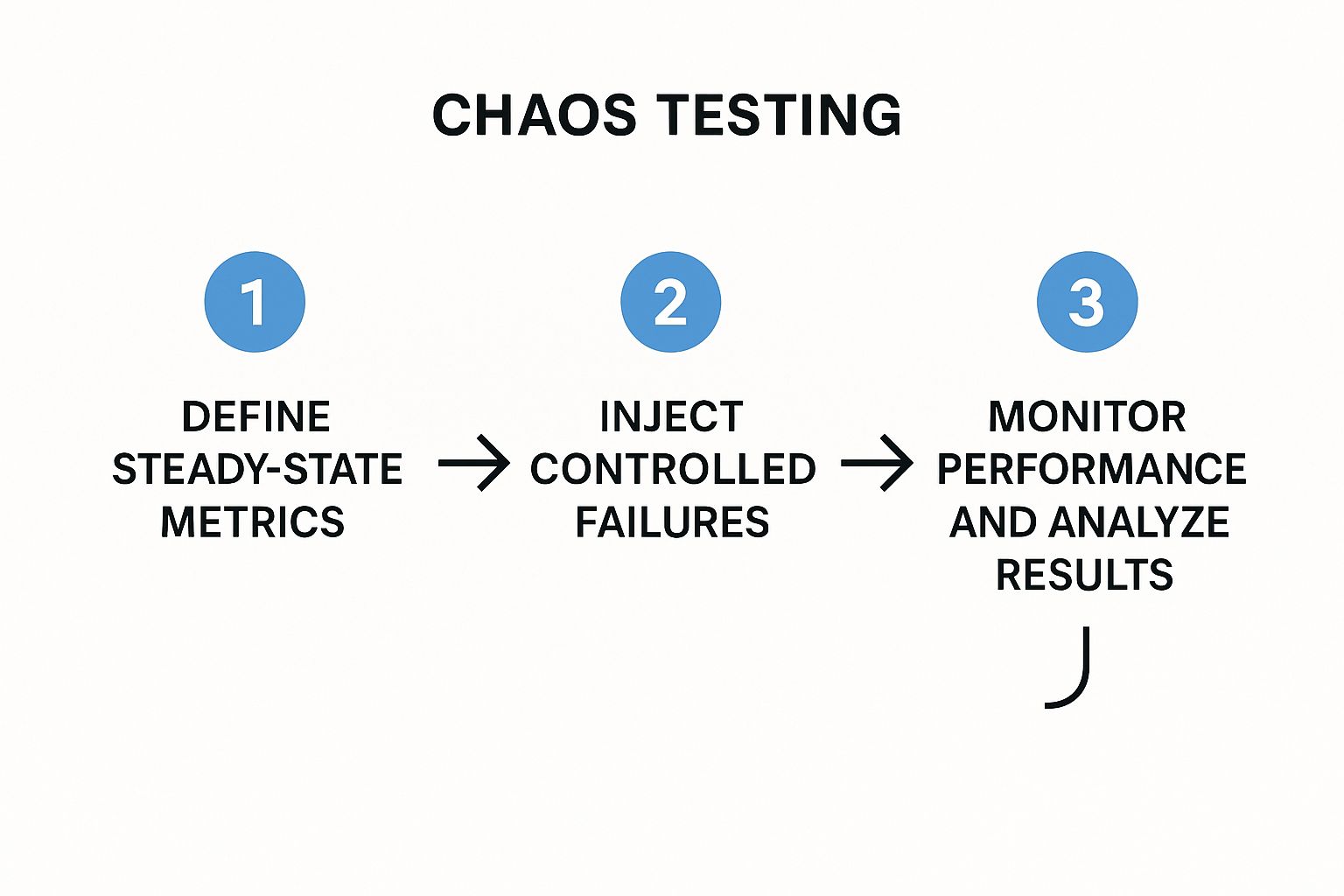
This flow highlights the methodical nature of the practice—it isn’t about causing mayhem. It’s about systematic discovery and improvement.
Defining Your System’s Steady State
Before you can break anything, you have to know what “normal” looks like. This baseline is your steady state—a measurable, data-driven snapshot of your application’s health during a typical operational period.
Defining this isn’t about gut feelings; it’s about hard numbers. Key metrics usually include:
- System Throughput: How many requests or transactions are you processing per second?
- Error Rates: What percentage of requests are failing versus succeeding?
- Latency Percentiles: What are the response times for your 95th or 99th percentile of users? This tells you how the slowest users are experiencing your app.
- Resource Utilization: What are the normal CPU, memory, and disk usage levels across your infrastructure?
This steady state becomes your control group. It’s the benchmark you’ll measure against to see what impact your experiment actually had. Without a clear definition of health, you have no way of knowing if anything you did mattered.
Forming a Testable Hypothesis
Once you know what “normal” is, it’s time to form a hypothesis. This is where you make an educated guess about how your system will handle a specific failure. A good hypothesis has to be specific, measurable, and provable—or disprovable.
A weak hypothesis sounds something like: “The system should survive a database failure.” That’s too vague.
A strong, testable hypothesis is much more precise: “If the primary database replica in the us-east-1 region goes offline, user-facing error rates will not increase by more than 1%, and 99th percentile login latency will stay under 800ms. This is because the system will automatically fail over to the secondary replica within 30 seconds.”
See the difference? This version gives your experiment a clear pass/fail outcome. You’ve turned a vague hope into a scientific question that can be answered with data.
Chaos testing, also known as chaos engineering, is a strategic approach to improving system resilience by intentionally injecting controlled failures into software environments to evaluate fault tolerance and recovery mechanisms. Its methodology involves a hypothesis-driven process where testers define specific failure scenarios—such as network latency, resource exhaustion, or dependency failures—then observe the system’s behavior and gather metrics like response times, error rates, and resource usage. You can discover more insights about this strategic methodology from the experts at Qentelli.
Injecting Real-World Failures
This is the part everyone thinks of—where you actually start breaking things. The goal here is to simulate realistic problems that can and do happen in complex production systems. You don’t just simulate them; you make them happen inside a controlled “experimental group” of your infrastructure.
Common types of fault injections include:
- Server Shutdowns: Terminating virtual machines or containers to check if your auto-scaling and self-healing mechanisms actually kick in.
- Network Latency: Artificially adding delays to network traffic to see how your application behaves when a dependency gets slow.
- Resource Exhaustion: Intentionally maxing out CPU or memory to verify that your resource limits and safety guards work as designed.
- Dependency Failure: Blocking access to a critical service (like a payment gateway or an API) to ensure the system degrades gracefully instead of crashing.
Crucially, these experiments need a limited “blast radius,” meaning their potential impact is contained. This is why teams almost always start in staging environments before carefully moving to production with very small, controlled tests.
Verifying and Learning from the Results
The final step is to verify your hypothesis. Compare the metrics from your experimental group to your steady-state control group. Did things happen the way you predicted?
If your hypothesis was right—for example, the database failover worked flawlessly without users noticing—you’ve just validated a key piece of your system’s resilience. That builds enormous confidence.
But the real gold often comes when your hypothesis is wrong. If the failover was slow, caused a spike in errors, or didn’t happen at all, you’ve just found a critical weakness in a controlled environment. That’s a huge win. You can now fix that vulnerability before it causes a real, customer-facing outage. You’ve turned an unknown threat into a known, solvable problem.
This iterative loop—hypothesize, experiment, learn, and improve—is what makes chaos testing such a powerful engine for building truly robust software.
Where Traditional Testing Falls Short

Standard QA practices like unit, integration, and end-to-end tests are the bedrock of software development. They’re a crucial safety net, making sure individual features and components behave exactly as expected.
These tests are fantastic at answering one very specific question: “Does this code do what I designed it to do under ideal conditions?”
They validate the clean, predictable paths. An integration test, for example, confirms that clicking “Add to Cart” triggers the right communication between the shopping cart and inventory services. It’s all about verifying the happy path.
But that’s precisely where their usefulness hits a wall. Traditional testing lives in a sanitized lab where networks are flawless, services respond instantly, and every dependency is online. It proves your application works in a perfect world—not in the messy, unpredictable reality of production.
The Blind Spots of Predictable Tests
The single biggest weakness of traditional testing is its complete inability to prepare you for the “unknown unknowns.” We’re talking about the bizarre, cascading failure modes that are all too common in modern distributed systems.
In a microservices architecture, you might have hundreds of services all talking to each other. It’s an intricate web.
Many of these dependencies aren’t even obvious. A single, slow service three or four hops away can create a domino effect, grinding your entire application to a halt. That’s a scenario most test suites would never even see, let alone anticipate.
Your tests can tell you if the code has bugs. They can’t tell you if the system is resilient. They check for correctness, not robustness.
Why Complex Systems Fail in Unexpected Ways
The move to distributed architectures brought a whole new class of failures that were almost non-existent in old-school monolithic apps. A small problem rarely stays small anymore; it ripples out with consequences you’d never expect. This is the exact problem chaos testing was born to solve.
The need for this became painfully obvious from real-world outages. A landmark incident in 2015 showed just how fragile things could be when an Amazon DynamoDB issue in one region caused cascading failures across over 20 different AWS products. That one event demonstrated how tightly intertwined our systems are, impacting countless users and businesses. You can read more about how events like these shaped the industry on Splunk’s blog.
Chaos testing directly confronts the reality that modern systems break in complex, systemic ways that have nothing to do with simple code bugs. It’s the missing layer in a mature reliability strategy because it actively hunts for these hidden weaknesses.
It forces your team to answer the uncomfortable questions that traditional QA ignores:
- What happens if a third-party API suddenly gets 10x slower?
- How does the user experience degrade when a message queue starts backing up?
- Can a single misconfigured server bring down an entire cluster?
Without deliberately creating these conditions, you’re just crossing your fingers and hoping for the best. And hope is not a strategy.
The table below breaks down the fundamental differences between the two testing mindsets.
Chaos Testing vs Traditional QA Methods
This comparison highlights how chaos testing isn’t a replacement for traditional QA, but a necessary complement that addresses the unique challenges of modern, distributed systems.
| Attribute | Traditional Testing (Unit, Integration) | Chaos Testing |
|---|---|---|
| Primary Goal | To verify that code works as intended under known conditions. | To discover systemic weaknesses and unknown failure modes under turbulent conditions. |
| Scope | Focuses on individual components or specific user flows in isolation. | Focuses on the behavior of the entire system and its interdependencies. |
| Environment | Primarily runs in development or isolated test environments. | Aims to run in production-like environments, and eventually, carefully in production. |
| Question Answered | ”Did we build the thing right?" | "Did we build the right, resilient thing?” |
Ultimately, traditional tests make sure your application works perfectly on a good day. Chaos testing makes sure it doesn’t fall apart on a bad one. It fills a critical gap that conventional methods simply can’t address.
Alright, let’s get our hands dirty. It’s time to move from theory to practice and see what chaos testing is really about. This is where you stop just talking about resilience and start actively building it.
Running your first chaos experiment can feel a little daunting, but if you treat it like a proper scientific process, you can demystify the whole thing and get some incredibly valuable insights—safely.
The key is to start small. Your first experiment should be dead simple, well-understood, and have a tiny scope. Think of it like learning to swim in the shallow end of the pool. You want to build confidence and skill before venturing out into the deep.
Step 1: Formulate a Clear Hypothesis
Every good experiment starts with a question. For chaos testing, that question becomes a clear, testable hypothesis. This isn’t some vague statement like, “The app should stay up.” It’s a specific prediction about how your system will behave under a precise failure condition.
A strong hypothesis is measurable. It has clear definitions for success and failure.
- Weak Hypothesis: “If a web server goes down, the load balancer should handle it.”
- Strong Hypothesis: “If one of our five web server instances is terminated, user-facing error rates will not increase by more than 2%, and the load balancer will redirect traffic to the remaining healthy instances within 15 seconds.”
See the difference? That level of detail turns your experiment from a random act into a scientific inquiry. You know exactly what to look for.
Step 2: Define and Limit the Blast Radius
The blast radius is the potential scope of impact your experiment could have. Managing this is probably the single most critical part of running chaos experiments safely. For your first test, you want that blast radius to be as small as humanly possible.
This means you absolutely start in a non-production environment, like staging or a dedicated testing cluster. Chaos testing is all about injecting faults and watching what happens, and you need to be able to do that without scaring anyone.
Here are a few ways to keep the blast radius tiny:
- Target a Single Host: Run the experiment on just one server or container instance, not the whole fleet.
- Focus on a Non-Critical Service: Pick a service whose temporary failure won’t break core user journeys.
- Limit User Impact: When you eventually test in production, you can target only internal users or a tiny fraction of live traffic.
And always, always have a “stop button”—a clear, immediate way to halt the experiment and roll back any changes if things go sideways.
Step 3: Establish a Performance Baseline
Before you break anything, you need to know what “normal” looks like. This is your system’s steady state.
Pull up your monitoring and observability tools and gather key performance indicators (KPIs) for a period before the experiment. Pay close attention to metrics like CPU usage, memory, latency, and error rates for the specific components you’re targeting. Having solid observability best practices isn’t just nice to have here; it’s a prerequisite.
This baseline data is your control group. Without it, you have no way to accurately measure the impact of the failure you’re about to introduce.
Step 4: Choose Your Tools and Inject the Fault
With your hypothesis, blast radius, and baseline ready, it’s showtime. You’ll need a tool to perform the fault injection—the action that actually introduces the failure you want to test.
The tooling landscape is pretty broad, from simple scripts to full-blown platforms:
- Open-Source Tools: Solutions like Chaos Monkey (for terminating instances) or
tc(a Linux utility for messing with network traffic) are great starting points. - Cloud-Native Services: Platforms like AWS Fault Injection Simulator (FIS) offer managed services for running controlled experiments.
- Commercial Platforms: Companies like Gremlin provide sophisticated features and a wide array of pre-built failure modes.
For our example hypothesis, you might use an AWS FIS experiment to terminate a single EC2 instance in your target group.
Step 5: Observe and Analyze the Results
During and after the experiment, your team’s eyes should be glued to your dashboards. Watch those KPIs you identified earlier.
The real learning in chaos testing doesn’t come from breaking things; it comes from observing the system’s response. The goal isn’t failure—it’s discovery.
Did the system behave as you predicted? Did the load balancer reroute traffic in under 15 seconds? Did error rates stay below that 2% threshold?
If your hypothesis was correct, awesome! You’ve just validated a key part of your system’s resilience. Document it and celebrate the win.
But if it was incorrect—maybe the failover took 90 seconds or errors spiked to 10%—that’s an even bigger victory. You’ve just uncovered a hidden weakness in a controlled, safe environment. Now you can dig into the root cause, create a ticket to fix it, and make your system stronger before a real-world outage does the damage for you.
The Business Case for Breaking Things on Purpose
Chaos testing sounds like something that lives purely in the engineering department, a sandbox for devs to play in. But its real value shows up on the balance sheet. Think of it as a strategic investment in business continuity—one that directly protects your revenue, customer trust, and operational sanity.
Every minute your service is down, it costs you. For a big e-commerce site, an outage can vaporize millions in sales. But beyond the immediate cash burn, there’s the long-term, hard-to-measure damage to your brand’s reputation. Chaos testing is simply the best way to get ahead of those costly failures before they happen.
By intentionally finding—and fixing—weaknesses in a controlled way, you’re systematically making your platform tougher. This isn’t just about preventing outages. It’s about building a reputation for being rock-solid, which is a massive competitive advantage.
Driving Down the Cost of Failure
The main business win is simple: preventing expensive downtime. A good chaos program takes the unpredictable, high-stakes drama of a real incident and turns it into a planned, low-stakes chance to learn.
Let’s be real about what an unexpected outage actually costs:
- Lost Revenue: The second your service is down, the cash register stops ringing. For a large company, that can be hundreds of thousands of dollars per hour.
- Customer Churn: Unreliable services send frustrated customers straight to your competitors. And we all know it costs way more to win a new customer than to keep an existing one.
- Engineering Toil: Instead of building cool new features that make you money, your best engineers are stuck fighting fires. Their time is spent on damage control, not creating value.
Chaos testing hits these problems head-on by finding the ticking time bombs in your system before a customer ever does.
Building Smarter Teams and Stronger Systems
The payoffs go way beyond just keeping the lights on. The very act of running chaos experiments creates powerful ripple effects that improve both your tech and your team.
Engineers who regularly break things on purpose develop a much deeper, almost intuitive feel for how their systems work. They discover hidden dependencies and weird failure modes you’d never find on a diagram. That knowledge feeds back into building smarter, more resilient architecture from the start.
Chaos Engineering enables us to find shortcomings before our customers find them and therefore, provides us with the opportunity to create a better customer experience. Chaos Engineering does not introduce chaos into your systems; it reveals the chaos that already exists.
On top of that, these experiments are the best fire drills your on-call team could ever ask for. When a real incident eventually hits, your engineers have already seen something like it before. They’ve built the muscle memory to diagnose problems faster, communicate clearly, and get things back online with less panic. This slashes your Mean Time to Resolution (MTTR) and shrinks the blast radius of any issue that slips through.
Ultimately, embracing chaos is how you build a culture of resilience—and that’s something that pays dividends across the entire company.
Best Practices for a Successful Chaos Program

Moving from a few one-off experiments to a real chaos program takes discipline. Just injecting random failures without a clear strategy is a recipe for confusion, not resilience. A truly successful program is built on a foundation of safety, clear goals, and continuous learning.
Following a structured approach is what separates effective chaos testing from just breaking things for the sake of it. It’s about building a systematic process to harden your systems.
Start Small and Start Safe
The golden rule of chaos testing is to minimize the blast radius—especially when you’re just getting started. This means kicking things off in a pre-production environment like staging or development. These environments are a safe sandbox to learn the tools and processes without putting customers at risk.
Never, ever run your first experiments in production. You need to build confidence and operational muscle memory in a controlled setting first. Once you’ve proven you can contain experiments and measure their outcomes, then you can think about moving to production with an extremely limited scope.
Chaos Engineering doesn’t introduce chaos into your systems; it reveals the chaos that’s already there. The whole point is to surface these hidden issues in a controlled way, making your system stronger over time.
And before you inject a single fault, make sure your monitoring and alerting are rock-solid. You can’t measure what you can’t see. Solid observability isn’t just a nice-to-have; it’s a non-negotiable prerequisite.
Common Mistakes to Avoid
Even with the best intentions, it’s easy to make mistakes that completely undermine the value of your chaos program. Knowing these common pitfalls can save you a world of hurt.
- Testing Without a Hypothesis: An experiment without a clear, measurable prediction is just noise. You won’t know if the outcome was good or bad because you never defined what success looked like in the first place.
- Failing to Communicate: Surprise! Your chaos experiment just lit up the production alerts, and the on-call team is scrambling. Always let stakeholders know about planned experiments to avoid unnecessary panic and wasted time.
- Treating It as a One-Off Project: Chaos testing isn’t a task you just check off a list. Real resilience comes from making it a continuous practice—something baked right into your development lifecycle.
A great way to make this a habit is to automate experiments in your CI/CD pipeline. This gives you continuous validation that new code changes haven’t introduced fresh systemic weaknesses. Stick to these guidelines, and you’ll be on your way to building a high-impact program that genuinely improves reliability.
Common Questions About Chaos Testing
Even after getting the hang of the theory, jumping into chaos testing for the first time brings up some real-world questions. Here are a few common ones I hear from engineering teams just starting their journey.
Is It Really Safe to Run Chaos Testing in Production?
Eventually, yes. But you don’t start there. The whole point is to test in production because it’s the only place you’ll find the messy, unpredictable reality of user traffic and complex system interactions.
That said, everyone—and I mean everyone—should start in dev or staging. Get your feet wet there. Once you’ve run a few experiments, dialed in your monitoring, and proven you can control the “blast radius,” then you can start inching into production. Start small. This part is non-negotiable.
How Is This Different from Performance Testing?
It’s a great question, and the two are often confused, but they solve completely different problems. Performance testing is about measuring how your system handles a predictable load. Think of it as answering, “How many users can we handle before things slow down?” It’s all about capacity and speed.
Chaos testing, on the other hand, is about what happens when things break unexpectedly. It’s not about load; it’s about resilience. One tests for a traffic jam, the other tests for a bridge suddenly collapsing. You absolutely need both.
A lot of people think chaos testing is just about breaking things for fun. The real goal is discovery. You aren’t introducing chaos; you’re just methodically finding the chaos that’s already hiding in your system, waiting to bite you.
What Are Some Simple Chaos Experiments to Start With?
The key is to start simple to build confidence and get some early wins. Testing for resource exhaustion is a perfect place to begin.
- CPU Exhaustion: Grab a tool and deliberately max out the CPU on one container. Does your auto-scaling group actually notice and spin up a new instance? Does the load balancer correctly stop sending traffic to the overloaded one?
- Dependency Failure: Find a non-critical internal service—like a recommendation engine—and block network access to it for a few minutes. Does your app handle it gracefully by just hiding that feature, or does the whole thing crash?
- Kill an Instance: This one’s a classic. Just terminate a single server in a replicated service. You’re just trying to verify that your failover works seamlessly without anyone on the front-end noticing.
These small, controlled experiments deliver huge insights with very little risk, making them the perfect way to get started with chaos engineering.
Ready to validate your system’s resilience with real production traffic? GoReplay lets you capture and replay live HTTP traffic in your test environments, giving your chaos experiments the dose of reality they need. Test with confidence at https://goreplay.org.