
What Is a Testing Plan? Key Steps for Software Success

Think of a testing plan as the architectural blueprint for your software. You wouldn’t build a skyscraper without a detailed plan, right? The result would be chaos—expensive, unstable, and dangerous. The same exact logic applies to building quality software.
A testing plan isn’t just a to-do list; it’s the single source of truth that guides your entire quality assurance process. It’s what gets everyone, from developers to product managers, on the same page about what quality actually means for this project.

Without a plan, testing devolves into a messy, reactive scramble. Teams end up wasting cycles on low-priority features while critical bugs sneak past into production. A solid plan stops this from happening by setting clear objectives and creating a structured path to follow.
Your Blueprint for Building Quality Software
As applications become more complex, a testing plan isn’t just good practice—it’s a strategic necessity. It’s the document that outlines how you’ll prove your software works as intended and meets every requirement.
This isn’t a niche concern. Over 82% of enterprises worldwide now invest heavily in quality assurance because they know how critical software reliability is. A single defect can lead to costly outages, a trashed reputation, and even major security breaches. You can dig into more of this data by checking out the global software testing market reports.
To make it even clearer, here’s a quick breakdown of what a testing plan really does for your team.
Core Functions of a Testing Plan
This table summarizes the essential roles a testing plan fulfills in any successful software project.
| Function | Why It Matters |
|---|---|
| Defines Scope | Draws a clear line around what will and won’t be tested, preventing scope creep and focusing effort where it counts. |
| Aligns Teams | Gets developers, testers, and project managers on the same page about quality goals and the process to achieve them. |
| Manages Risk | Identifies potential problems early, allowing the team to build mitigation strategies before they turn into full-blown crises. |
Essentially, the plan is your central playbook for finding and fixing problems before your users do.
The Core Components of an Effective Testing Plan
Think of a powerful testing plan like a recipe—each component is critical, and leaving one out can ruin the whole dish. It’s what turns a vague idea about “making sure things work” into a structured, actionable strategy that actually ensures quality.
First up, you need a clearly defined Test Scope. This is where you draw a firm line in the sand. It details exactly which features, functions, and user stories are on the table for testing. Just as important, it clarifies what’s out of scope, which stops your team from chasing tangents and keeps everyone’s expectations aligned right from the start.
Defining Your Goals and Resources
With those boundaries set, you can nail down your Test Objectives. These aren’t fuzzy goals like “test the checkout.” A real objective is specific and measurable: “Verify that all supported payment gateways can process transactions successfully under a peak load of 500 concurrent users.” These sharp, clear targets are what you’ll use to build out individual test cases.
For a deeper dive into that process, check out our guide on how to create a test case.
Next comes Resource Planning. Who’s doing the work (QA engineers, developers)? What do they need to get it done (hardware, software, specific tools)? This part of the plan answers those questions and lays out a solid schedule with clear timelines and milestones, keeping the testing effort locked in with the overall development cycle.
A well-structured plan also includes a clear Defect Management process. This outlines how bugs are reported, tracked, prioritized, and resolved, ensuring a smooth workflow for fixing issues discovered during testing.
Integrating Testing into Modern Workflows
In today’s agile and DevOps worlds, testing isn’t an afterthought—it’s woven directly into the development lifecycle. That means your plan needs to support this continuous flow.
Of course, it’s not always easy. The high cost of advanced tools and a shortage of skilled testers are real-world hurdles. But even with these challenges, a solid testing plan remains the essential framework guiding everything from test execution schedules to the final sign-off.
Unpacking the Benefits of a Solid Testing Plan
So, why sink time into writing a detailed testing plan when you could just jump straight into testing? The honest answer is that you get a massive return on that initial time investment. Think of a solid plan as a powerful risk mitigation tool—it helps you see problems coming long before they have a chance to blow up your project.
Skipping this step doesn’t actually save you time. It’s an open invitation to chaos and ballooning costs. Without a roadmap, teams end up working in silos, stakeholders are totally in the dark, and quality becomes a guessing game instead of something you build intentionally. This structured approach is what turns testing from a reactive bug hunt into a proactive quality assurance process.

Driving Alignment and Quality
A well-documented testing plan gets everyone reading from the same playbook. It pulls developers, testers, and business analysts together around a shared definition of what “done” and “successful” actually mean. That clarity is gold for managing expectations and giving stakeholders a clear view of progress.
The real-world benefits go way beyond just squashing bugs. They lead directly to:
- Higher Software Quality by making sure your test coverage is both comprehensive and laser-focused.
- Increased Customer Satisfaction because you’re shipping a more reliable and polished final product.
- Predictable Development Cycles by nailing down clear schedules and resource needs right from the start.
- Reduced Costs by catching defects early in the cycle, which is when they are exponentially cheaper to fix.
By making a strong case for quality from the very beginning, the purpose of a testing plan becomes crystal clear: it’s your project’s insurance policy against unexpected delays, budget overruns, and critical production failures. It’s the framework that supports a smooth, efficient, and successful release.
Testing Plan vs. Test Strategy: What’s the Difference?
In the world of quality assurance, you’ll often hear “test plan” and “test strategy” thrown around, sometimes even interchangeably. But make no mistake, they serve entirely different purposes. Mixing them up can lead to fuzzy goals, misaligned teams, and testing efforts that miss the mark.
Think of it like planning a big trip.
A test strategy is your high-level vision. It’s deciding you want to “backpack through Southeast Asia on a budget.” This sets the general direction—the principles, the overall goals, and the approach you’ll take. It’s a broad, guiding document that’s usually pretty static and can apply to many projects within your organization.
The testing plan, on the other hand, is the detailed, day-by-day itinerary. It’s the nitty-gritty of booking a specific flight to Bangkok, reserving a hostel for the first week, and mapping out exactly what you’ll do each day. It’s a dynamic, project-specific document that answers the who, what, when, and how of testing for a particular release.
A Strategy Guides, a Plan Executes
At the end of the day, a test strategy provides the guiding philosophy. The testing plan is where the rubber meets the road, turning those broad quality goals into a tactical roadmap your team can actually follow. Getting this distinction right is absolutely critical for effective software validation.
A solid testing plan is the backbone of improving software quality. In fact, in over 80% of organizations, functional test automation falls squarely on the shoulders of testers and QA pros, which just goes to show how vital a structured plan is for these specialized roles. You can discover more insights about the global software testing market and how modern teams are set up.
To make this even clearer, let’s break down the core differences in a simple table.
Testing Plan vs. Test Strategy: Key Differences
| Characteristic | Test Strategy | Testing Plan |
|---|---|---|
| Purpose | A high-level document outlining the general approach to testing. It’s the “why.” | A detailed document that describes the scope, approach, and resources for a specific project. It’s the “how, what, when, and who.” |
| Scope | Broad and organizational. It can apply to multiple projects or the entire company. | Narrow and project-specific. It’s tied to a single software release or feature. |
| Longevity | Generally static. It’s a long-term document that rarely changes. | Dynamic and temporary. It’s created for a project and becomes obsolete once the project is complete. |
| Core Questions | ”What are our guiding principles for quality?” “What kind of testing will we do in general?" | "What features will we test?” “Who will do the testing?” “When is the deadline?” “What are the pass/fail criteria?” |
| Analogy | The decision to “backpack through Southeast Asia.” | The detailed itinerary for the first week in Thailand. |
This table highlights that while both are essential, they operate at completely different altitudes. The strategy sets the vision, and the plan provides the concrete steps to make that vision a reality for a specific project.
This infographic breaks down two common testing approaches you’d typically detail within a plan—manual and automated—showing the trade-offs in execution time, accuracy, and resources.
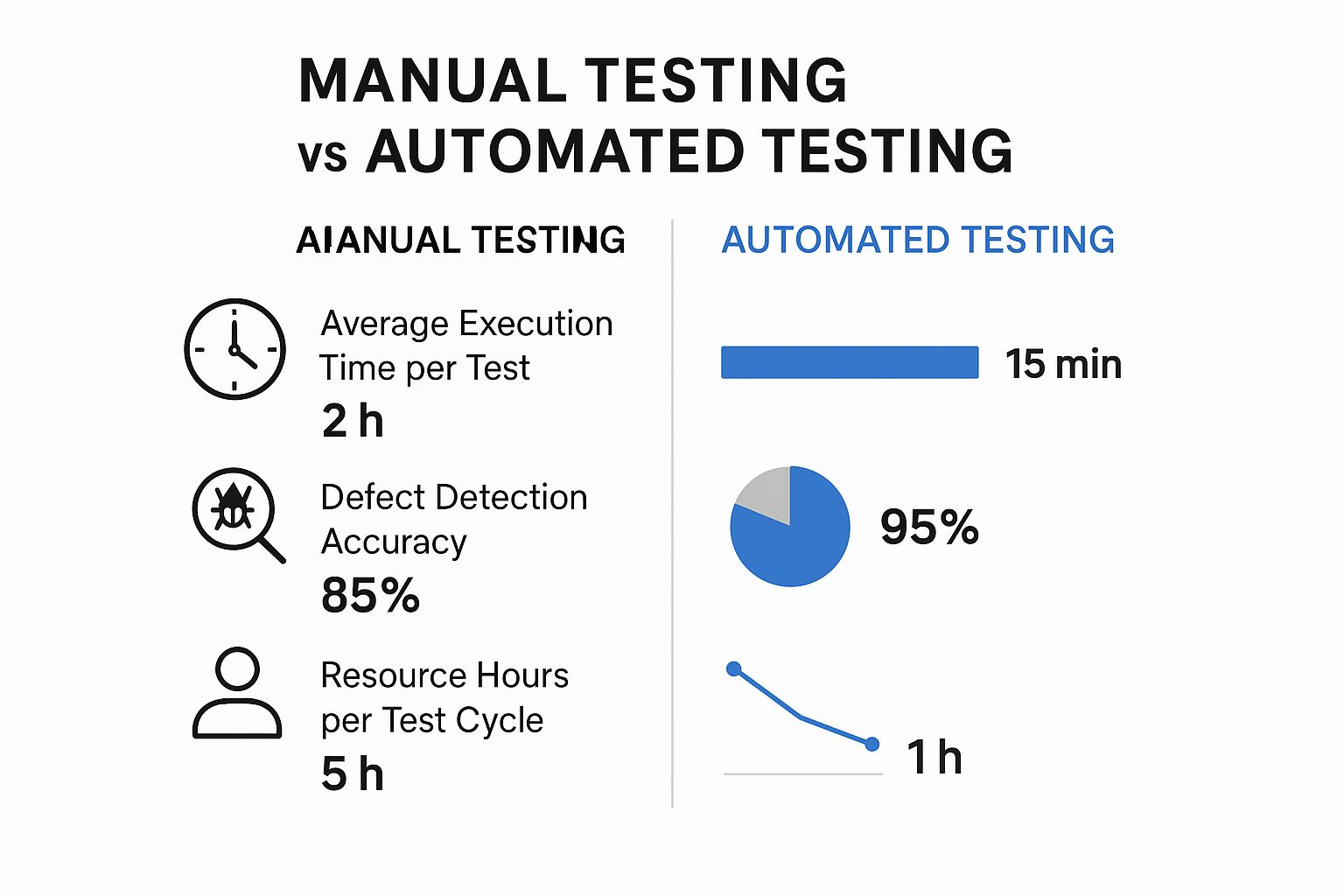
As you can see, the data clearly shows why automated testing is such a huge part of modern test strategies, offering massive gains in both speed and accuracy. It’s a perfect example of a strategic choice that gets implemented through a detailed plan.
Enhancing Your Testing Plan with Real Traffic
Let’s be honest, traditional testing plans have a built-in blind spot. They lean heavily on staging environments—those nice, clean, predictable sandboxes where everything is supposed to work perfectly. And while that’s useful, it’s not reality. Staging can’t possibly mimic the beautiful chaos of real-world user behavior.
This is exactly where a modern testing plan gets its edge. The secret is to stop guessing what users might do and start testing with what they actually do.
The core idea is simple but powerful: use your live production traffic as the ultimate test data. This technique, known as traffic shadowing or replay testing, captures user requests as they happen and replays them in a safe, isolated test environment. You get to see exactly how your new code holds up against real-world scenarios before a single user is affected.
Closing the Gap Between Staging and Production
Think about it—scripted tests only check for the problems you already know to look for. But real traffic? It surfaces the “unknown unknowns.” We’re talking about those subtle bugs, weird performance bottlenecks, and bizarre edge cases that only pop up when a user does something you never thought to test for. A truly comprehensive plan has to account for this randomness.
By simulating production conditions with 100% accuracy, you can validate functionality, performance, and stability under a completely realistic load. This is how you proactively catch the issues that standard QA cycles almost always miss, slashing the risk of a production failure.
This is precisely what tools like GoReplay were built for. It acts as a listener on your production server, silently capturing HTTP traffic without getting in the way, and then replays that traffic against your staging or development environment.
Here’s a quick look at the GoReplay homepage, which perfectly illustrates its main job: capturing and replaying real user traffic for rock-solid testing.

As you can see, it sits in the middle, safely duplicating and forwarding traffic so your team can test with the real deal. When you integrate a tool like this, your testing plan transforms from a good-faith estimate into a powerful and realistic blueprint for quality.
If you want to dig into the nuts and bolts, you can learn more about how to replay production traffic for realistic load testing. This approach gives your team a much higher degree of confidence to ship new features without holding their breath.
The Foundation of Quality Software
When all is said and done, a testing plan is much more than a stuffy procedural document—it’s the strategic bedrock of quality software. It brings the clarity, alignment, and foresight you need to cut through the complexities of development.
By defining scope, heading off risks, and setting clear goals for quality, a well-built plan elevates testing from a reactive bug hunt into a proactive quality assurance process.
A robust testing plan is a direct investment in your product’s reliability, your brand’s reputation, and your overall business success. It’s the essential commitment you make to delivering excellence.
In a world where user expectations for performance and reliability are always climbing, this kind of structured approach is no longer just a nice-to-have. It’s the essential promise a team makes to ship a stable, high-performing product.
So, what is a testing plan? It’s simple: it’s your promise of quality to your users, written down and made real.
Frequently Asked Questions
Even with a solid grasp of testing plans, some questions always pop up. Here are quick answers to the most common ones to help you put these ideas into action.
Who Is Responsible for Creating a Testing Plan?
Technically, a Test Lead or QA Manager usually owns the document. But a good testing plan is never a solo effort. It’s a collaborative guide that needs real input from project managers, developers, and business analysts to make sure it lines up with both the project’s goals and its technical reality.
Can a Testing Plan Change During a Project?
Absolutely. In fact, it should. Think of a testing plan as a living document, not a contract set in stone. This is especially true in Agile environments where requirements evolve, priorities get reshuffled, and new risks emerge. Regular reviews are what keep the plan useful from start to finish.
A great testing plan adapts to the project’s reality. Sticking to an outdated plan is often worse than having no plan at all—it can mislead your team and create a false sense of security.
How Detailed Does a Testing Plan Need to Be?
The right level of detail really depends on your project’s complexity, your team’s size, and any regulatory rules you have to follow (like in finance or healthcare). The golden rule is this: it must be detailed enough to leave no room for guesswork about the scope, resources, schedule, and what “done” actually looks like.
What Happens if You Do Not Have a Testing Plan?
Wingin’ it rarely ends well. Working without a testing plan almost always leads to chaos—missed deadlines, blown budgets, and buggy software. It creates confusion, makes it nearly impossible to track progress, and dramatically increases the chances that critical bugs will slip into production.
Ready to supercharge your testing plan with real user traffic? See how GoReplay helps you capture and replay production traffic to find critical issues before they ever affect your users. Learn more at https://goreplay.org.