
What is a Test Plan: Your Blueprint for Software Quality

Think of a test plan as the master blueprint for your entire quality assurance effort. It’s the document that lays out the strategy, goals, scope, and resources for every testing activity on a project. It’s what gets everyone on the same page, answering the who, what, when, and how of your QA process.
Your Blueprint for Software Quality
Trying to build a skyscraper without a blueprint would be pure chaos. You’d waste time, burn through money, and end up with something dangerously unstable. A software project without a test plan is headed for the same disaster. This document is the strategic guide that directs and aligns your entire QA effort.
At its core, a test plan is about bringing order to the testing process. It formalizes your approach to quality, making sure every feature is properly checked against its requirements. This kind of structured process is designed to find bugs as early as possible—when they’re still cheap and easy to fix.
The idea of a formal software test plan isn’t new; it grew in importance as software projects got more complex back in the 1980s, when systematic QA really started to take shape. You can find more on the history of test plans on Larion.
To give you a clearer picture of what a test plan really does, let’s break down its key functions.
Core Functions of a Test Plan at a Glance
This table offers a quick summary of a test plan’s primary roles and what each one brings to the table.
| Function | What It Achieves |
|---|---|
| Defines Scope and Objectives | Clearly outlines what will be tested and the specific quality goals to meet. |
| Guides Execution | Provides a step-by-step roadmap for the testing team to follow. |
| Manages Resources | Allocates people, tools, and environments needed for successful testing. |
| Aligns Stakeholders | Creates a single source of truth for developers, managers, and clients. |
| Mitigates Risks | Identifies potential problems early and establishes contingency plans. |
| Measures Success | Sets clear criteria for when testing is considered complete and successful. |
Ultimately, a good test plan is what elevates testing from a reactive, chaotic activity into a proactive, organized, and measurable discipline. It’s the strategic foundation that helps you deliver a stable and reliable product to your users.
Deconstructing an Effective Test Plan
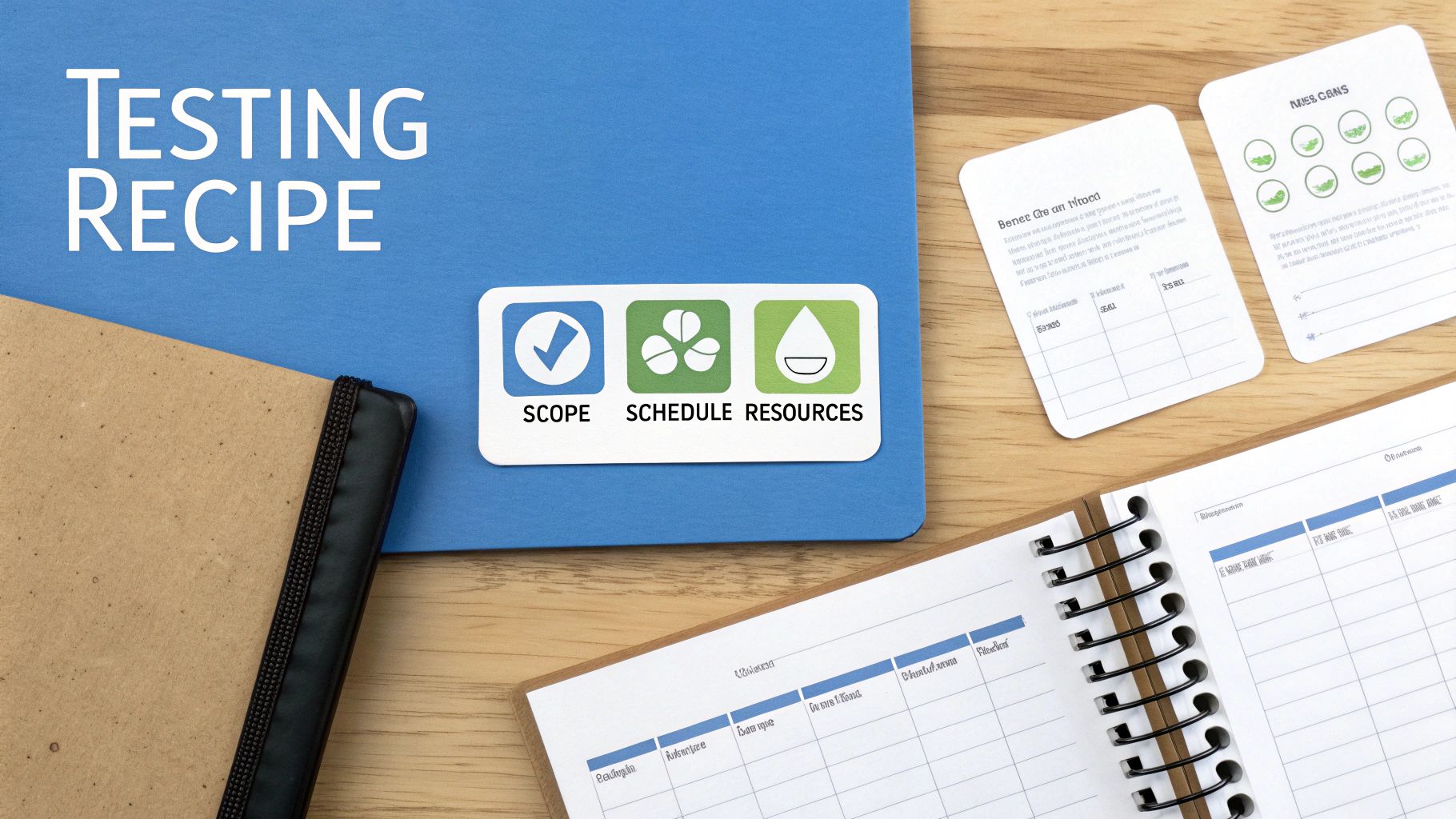
So, what really makes a test plan click? Think of it like a master recipe for a complicated dish. Every single ingredient and instruction is critical. Leave one thing out, and you could end up with a total disaster. The same goes for software testing—each section of the plan has a vital role to play.
A truly effective test plan is much more than a simple to-do list. It’s a carefully structured document where all the key components fit together, forming a complete strategy. Each piece is designed to answer a fundamental question about the testing process, leaving no room for guesswork.
Foundational Components
First up are the components that establish the “what” and “why” of your testing efforts. These create the high-level vision and set the boundaries for the entire project.
- Scope: This defines your testing battlefield. It clearly spells out which features, modules, and functions will be tested and—just as important—which will not. For instance, the scope might include the new user registration flow but specifically exclude legacy admin reporting features. No ambiguity.
- Objectives: These are your specific, measurable goals for quality. An objective isn’t a vague “find bugs.” It’s something concrete, like “achieve a 95% pass rate for all critical path test cases” or “ensure application response time stays under two seconds on average.”
Execution and Logistics
Once that foundation is solid, the next parts detail the “how,” “who,” and “when.” This is where the plan transforms from a document into an actionable guide for your team.
- Schedules & Resources: This section maps out the timeline for all testing activities and assigns clear ownership. It specifies who is responsible for writing test cases, who will execute them, and what tools or hardware they’ll need. For example, it might allocate two QA engineers for a three-week testing cycle.
- Test Environment: Here, you lay out the exact technical setup needed for testing. This covers hardware specs, software versions, network configurations, and where your test data will come from. A well-defined environment is key to getting consistent, reliable results.
- Deliverables: This is a simple list of all the documents and reports your testing team will create. Common deliverables include the test plan itself, the test case suites, daily status reports, and a final summary report that wraps everything up for stakeholders.
Key Takeaway: A test plan’s real strength is its completeness. Every component, from defining the scope to listing deliverables, works together to create a single source of truth. This prevents confusion and gets the entire team aligned on a shared quality goal.
Test Plans vs. Test Strategies: What’s the Difference?
Let’s clear up a common point of confusion. Teams often toss around the terms ‘test plan’ and ‘test strategy’ as if they’re the same thing. They’re not. Understanding the difference is the first step toward a truly organized and effective testing process.
Think of it like this: a test strategy is your high-level military doctrine. It’s the big-picture philosophy that guides every single operation, answering questions like, “What are our rules of engagement?” or “How do we define success?” This document is foundational, rarely changes, and applies to the entire organization.
A test plan, on the other hand, is the detailed mission briefing for a specific operation. It takes that high-level doctrine and applies it to a real-world goal. It spells out the objectives, resources, timelines, and tactics needed to capture one particular target. It’s tactical, project-specific, and has a clear start and end.
The Philosophy vs. The Blueprint
Your test strategy sets the long-term vision for quality. It’s where you decide on your core principles, like what tools you’ll standardize on or what your company’s universal standards are for performance testing. Getting this right is critical. For a deeper dive, check out our guide on creating a powerful performance testing strategy.
The test plan is where the rubber meets the road. It’s the practical, hands-on document that translates your strategy into action for a single project or release. It answers the nitty-gritty questions: what are we testing, how will we test it, when will it happen, and who is responsible for each piece?
The Key Distinction: A test strategy is the static, guiding philosophy for how your organization approaches quality. A test plan is the dynamic, project-level blueprint that outlines the specific testing activities for a particular release.
To really drive the point home, let’s look at a side-by-side comparison.
Test Plan vs Test Strategy Key Differences
This table breaks down the core differences, showing how the high-level philosophy of a strategy translates into the tactical execution of a plan.
| Attribute | Test Strategy (The Philosophy) | Test Plan (The Blueprint) |
|---|---|---|
| Scope | Organizational or product-line level | Specific to a single project or release |
| Lifespan | Long-term and relatively static | Short-term, tied to a project’s lifecycle |
| Detail Level | High-level, outlines general principles | Highly detailed, includes schedules and tasks |
| Purpose | To define testing standards and approach | To guide the execution of a specific test |
Ultimately, you need both. A great strategy without a solid plan is just a wish list. And a detailed plan without a guiding strategy leads to inconsistent, chaotic testing efforts. They work together to ensure you’re not just testing hard, but testing smart.
Here’s the rewritten section, designed to match the specified human-written style and tone.
The True Business Value of Test Planning
Think of a test plan as more than just a QA document or a box-ticking exercise. It’s a powerful business tool, and when done right, its impact shows up directly on your project’s bottom line. It’s the difference between chaos and control, transforming testing from a necessary evil into a core driver of efficiency and quality.
The most obvious win? Serious cost control. A solid plan forces you to find defects early in the development cycle. This is a huge deal. A bug that slips into production can cost up to 100 times more to fix than one caught during the initial design phase. Your test plan is your early warning system, stopping those expensive problems before they ever see the light of day.
From Confusion to Clarity
Without a central guide, it’s easy for teams to drift into their own silos. Developers are hammering away on one feature while QA is prepping for something else entirely. The result is friction, rework, and a lot of wasted time. A test plan cuts through the noise and creates a single source of truth, getting everyone aligned on objectives, timelines, and who owns what.
This alignment brings something every project needs: predictability. Stakeholders aren’t left guessing about progress or whether you’ll hit that release date. The plan gives them clear metrics and milestones, so they can manage expectations and make smart business decisions with real confidence.
The Bottom Line: Disciplined test planning leads directly to a higher-quality product. That means lower long-term maintenance costs, happier customers, and a stronger brand. It’s an investment in stability, plain and simple.
Quantifying the Impact
The financial upside isn’t just a nice theory. The numbers back it up. A detailed test plan can slash up to one-third of your total testing costs, mainly by optimizing how you use infrastructure and manage the testing process. You can dig into more insights on cost-efficiency in test planning over on BrowserStack.
Ultimately, a test plan’s real value is its ability to turn testing from a wild, unpredictable expense into a strategic activity that protects revenue and builds the kind of customer trust that lasts.
How to Create Your First Test Plan
So, you’re ready to build your first test plan? Good. Forget the idea of writing a massive, intimidating novel—a great test plan is a clear, actionable guide your team will actually use. When you break it down into a few manageable steps, the whole process becomes much simpler.
First things first, you have to get to know the product inside and out. That means digging into its features, mapping out user flows, and sniffing out potential risk areas. This initial analysis is what keeps you from testing in the dark, making sure your effort goes where it counts. From there, you can draw a clear line in the sand by defining the scope—what’s in, and just as importantly, what’s out. This saves you from the dreaded scope creep down the line.
Once the scope is locked in, it’s time to set measurable objectives. A vague goal like “test the login page” doesn’t help anyone. Instead, aim for something concrete, like “achieve a 95% pass rate on all login authentication test cases.” This simple shift turns testing from a guessing game into a data-driven process with crystal-clear criteria for success.
This whole process is what makes a test plan so valuable. It’s not just about paperwork; it’s about catching issues early, getting the whole team on the same page, and shipping a much higher-quality product.
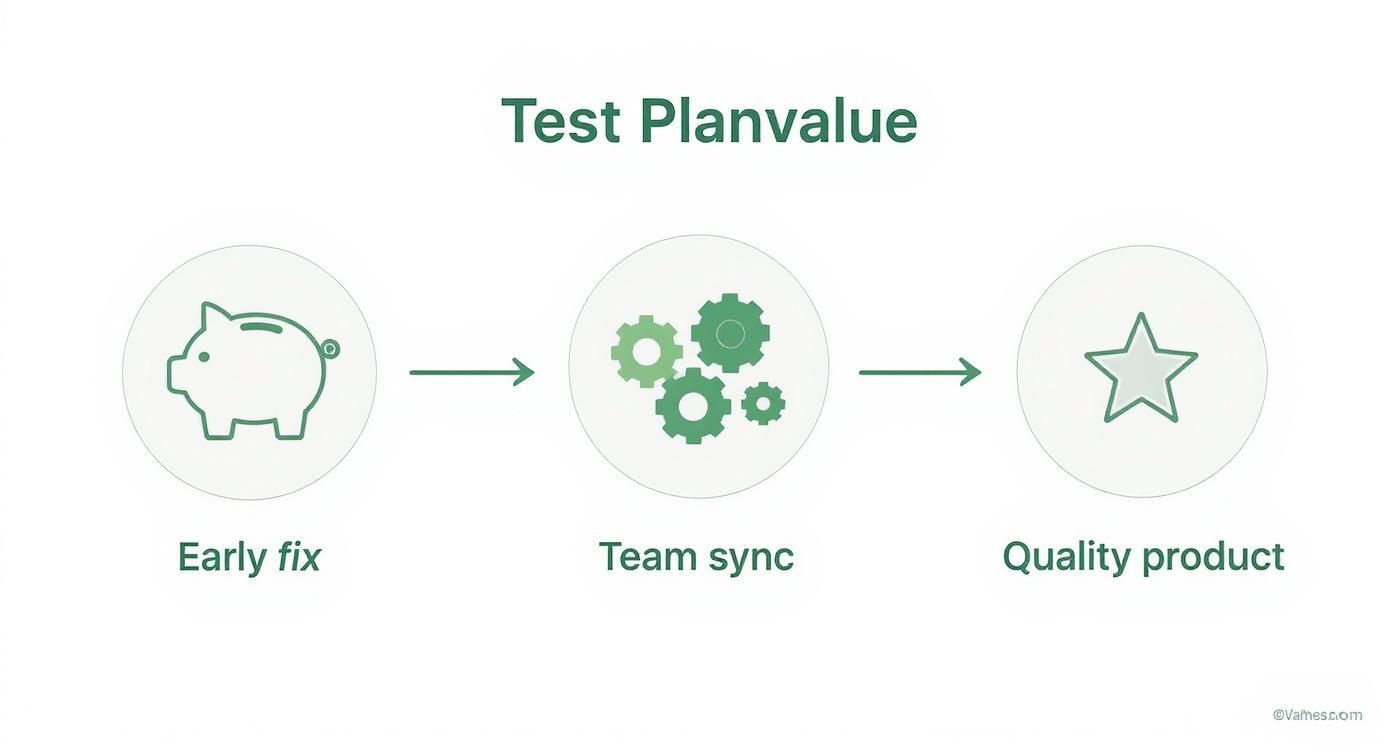
As you can see, a structured plan isn’t just theory. It translates directly into real project benefits and a more reliable product for your users.
Structuring Your Plan for Success
With your objectives nailed down, you can start building the core of your document. This is where you’ll map out a practical test strategy and define the specific test cases you’ll need. If you want to dive deeper into this critical part of the process, our guide on how to create a test case is a great next step.
Next up: define your entry and exit criteria. Think of these as the official rules of the game. They tell you exactly when testing can start and when it’s considered done. For instance, an entry criterion might be “the development build is deployed to the staging environment.” An exit criterion could be “no critical bugs remain open.” Simple, but powerful.
Finally, it’s time to sort out the logistics to actually make it all happen.
- Plan Resources and Roles: Figure out who does what. Assign specific QA engineers to different tasks and make sure they have the tools they need to succeed.
- Schedule Realistic Timelines: Don’t just pick dates out of thin air. Set key milestones and deadlines that actually make sense within the larger project schedule.
- Identify Potential Risks: What could go wrong? A delayed build? An unstable test environment? Write it down, and then create a backup plan for when things inevitably go sideways.
Got questions? You’re not alone. Even after you get the hang of what a test plan is, a few practical questions always pop up. Let’s dig into the common ones so you can handle these situations like a pro.
How Often Should I Update My Test Plan?
A test plan isn’t a “set it and forget it” document. If it’s gathering dust, you’re doing it wrong. Think of it as a living, breathing guide for your project.
You absolutely need to update it whenever something significant changes—scope, requirements, timelines, you name it. A good rule of thumb is to formally review and tweak the plan before each major development phase or sprint. This keeps it from becoming a relic of outdated assumptions and ensures it actually reflects what’s happening now.
Can Small Projects Really Skip Having a Test Plan?
Look, I get it. A tiny, fast-moving project probably doesn’t need a 50-page formal document. But skipping the planning part entirely? That’s a huge mistake. The risk of a critical bug slipping through the cracks is just too high, no matter how small the project is.
Even a simple, one-page plan that outlines the scope, goals, and resources is a game-changer. This lightweight approach keeps your testing intentional and organized without bogging you down.
Key Insight: The point isn’t to create paperwork. It’s to create clarity. A brief plan gives everyone on the team a shared understanding of what quality means for this project and how you’ll get there.
Who’s Actually Responsible for Writing the Test Plan?
Officially, this usually falls to the Test Lead or QA Manager. They own the document and are responsible for keeping it current.
But writing it should never be a solo mission. It’s a deeply collaborative process. The best test plans are built with input from project managers, developers, and business analysts. This teamwork ensures the plan is realistic, thorough, and actually supports what the project is trying to achieve.
Ready to supercharge your testing with real-world traffic? With GoReplay, you can capture and replay live user sessions in your test environment, ensuring your application is ready for anything. Discover a smarter way to test at https://goreplay.org.