
What is a Test Plan in Software Testing? Essential Guide
Think about trying to build a new skyscraper. Would you start pouring concrete and welding steel beams without a blueprint?Of course not. That would be a recipe for chaos, leading to a risky, expensive, and ultimately doomed project. A test plan is that exact blueprint for your software. It’s the foundational document that guides every single decision your team makes during the testing process.
Your Blueprint for Building Quality Software

This plan is so much more than a box-ticking exercise or bureaucratic paperwork. It’s a vital communication tool that gets everyone on the same page. Developers, testers, product managers, and even business stakeholders rely on it to create a shared understanding of what “quality” actually means for the project.
A well-crafted test plan transforms testing from a reactive, chaotic scramble into a proactive, organized, and strategic process. It ensures every testing activity is deliberate, repeatable, and directly tied to what the business actually needs.
Why a Formal Plan Matters So Much
Let’s be honest: without a clear plan, testing efforts often fall apart. Teams grapple with shifting scope, blown deadlines, and—worst of all—critical bugs that sneak into production. A formal test plan is your defense against this nightmare scenario. It forces you to define your strategy, scope, resources, schedule, and the specific activities needed to test your software right.
The difference this makes is staggering. Organizations that commit to formal test planning don’t just feel more organized; they see real results. They can improve defect detection and slash post-release bugs by up to 40% compared to teams that just wing it. You can dig into the numbers yourself by exploring insights on the global software testing market.
To give you a clearer picture, a test plan is the tool that helps you see the whole board. It’s a quick-reference guide that provides clarity on the most critical parts of your quality assurance efforts.
What a Test Plan Delivers at a Glance
| Function | Why It Matters for Your Project |
|---|---|
| Clear Scope Definition | Everyone knows exactly which features are in-scope for testing and, just as importantly, which are not. No more ambiguity. |
| Risk Management | You identify potential roadblocks and nasty surprises before they happen, with contingency plans ready to go. |
| Team Alignment | All stakeholders—from engineers to execs—share a common vision for what a high-quality, successful release looks like. |
| Resource Allocation | You know who is doing what, when, and with what tools. This prevents bottlenecks and ensures the team is set up for success. |
A solid test plan is your single source of truth. It’s what stands between a smooth, predictable release and a last-minute fire drill. It’s the foundation for preventing chaos and building excellence into every piece of software you ship.
Deconstructing an Effective Test Plan
So, what exactly is a test plan? Let’s pop the hood and see what makes a good one work. Forget the rigid, formal standards like IEEE 829 for a moment. A truly great test plan is a practical, living document that spells out the “what, how, and why” of your testing. Think of it as the strategic blueprint for your entire quality assurance effort.
The whole thing is built on a few core pillars—Objectives, Scope, and Approach—which form the foundation for everything else.
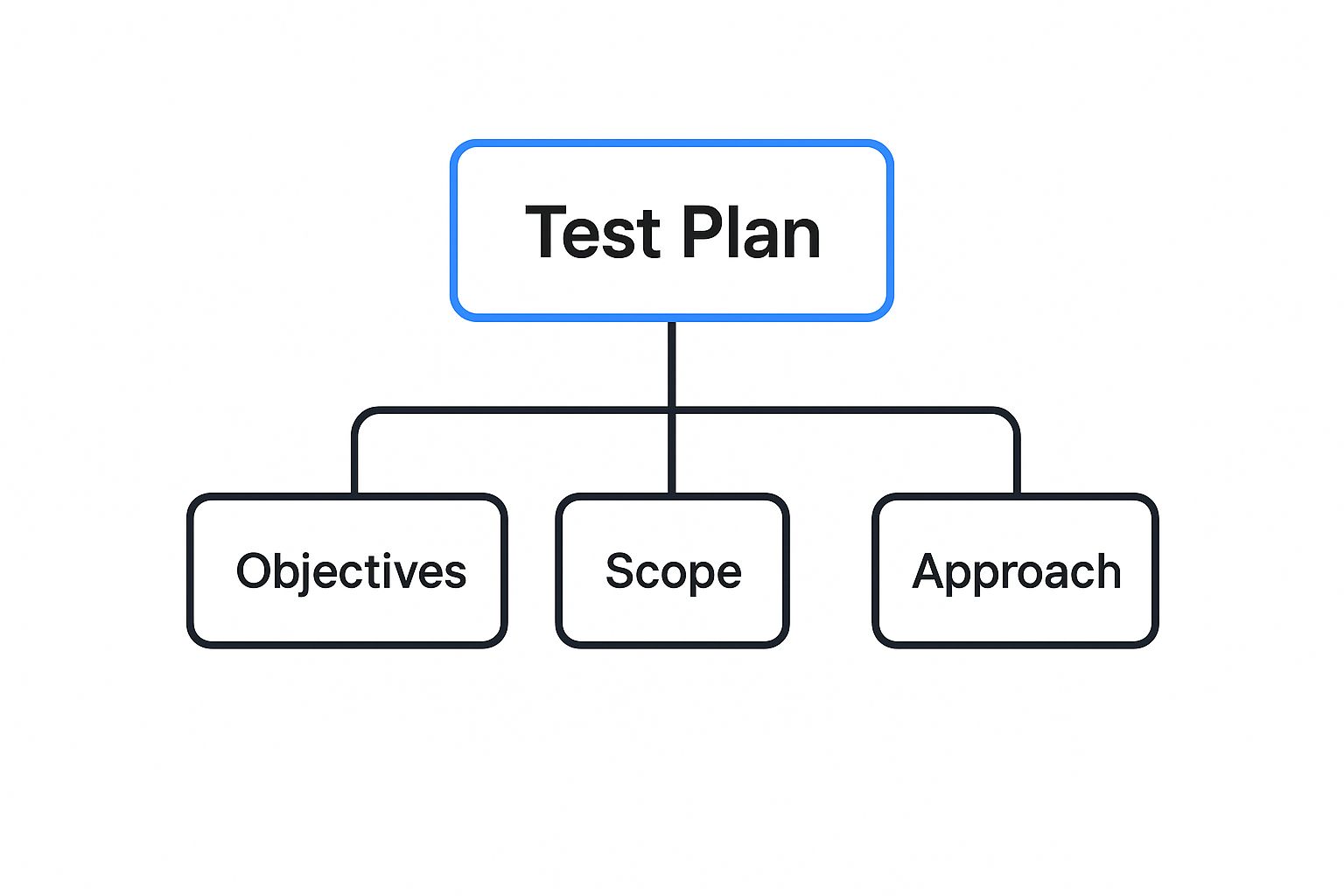
This shows that a test plan isn’t some random checklist. It’s a structured strategy. Once you nail these three, all the other details like schedules, resources, and specific tasks just naturally fall into place.
Core Components of a Robust Test Plan
A solid test plan breaks the project down into bite-sized, understandable pieces. Each section has a clear job, making sure nothing critical gets missed and the entire team is on the same page.
Here are the essentials you’ll almost always find:
- Scope Definition: This is where you draw a clear line in the sand. It spells out which features get tested and—just as critically—which features will not be tested. This single step is your best defense against scope creep and helps manage everyone’s expectations from day one.
- Test Objectives: What are you actually trying to accomplish here? This section lays out the specific goals, whether that’s verifying brand-new functionality, hammering the application to ensure it’s stable, or validating its performance under heavy traffic.
- Test Approach: This is the “how.” It details the specific types of testing you’ll be running, like manual, automated, or security testing. For instance, you might decide to automate your entire regression suite while using manual, exploratory testing for a new UI.
- Environmental Needs: You wouldn’t start cooking without setting up your kitchen first, right? This section defines all the hardware, software, and network configurations you need to run tests properly and get reliable results.
Planning for Success and Setbacks
A great test plan does more than just outline the happy path. It’s also a powerful risk management tool. It forces you to think about what could go wrong and prepares the team to handle those curveballs, keeping the project on track.
A test plan shouldn’t just outline the sunny-day scenario. It must also be a pragmatic guide for what to do when it rains, providing clear next steps for risks and failures.
This means defining clear pass/fail criteria—the non-negotiable rules that tell you if a test worked or not. It also involves identifying potential risks and contingencies. This is your Plan B for everything from a key feature being delayed to the test server going down.
Finally, the plan specifies the testing deliverables, like test summary reports and bug logs. For some projects, this could also include specialized reports from different types of testing. For instance, if you’re running performance tests, you’ll want to check out our detailed guide on what is load testing software to see what specific deliverables are involved.
How Test Plans Adapt to Modern Development

If you picture a test plan as a massive, static document that gets signed off months before a launch, you’re thinking of a relic. That old-school approach just doesn’t work in today’s world of fast-paced development. Test plans haven’t disappeared; they’ve just evolved.
In modern Agile and DevOps, the test plan is no longer a rigid contract. It’s a lightweight, living guide that adapts to constant change.
Instead of being a one-and-done activity, planning is now iterative. That giant document has been replaced by a more dynamic approach. The high-level strategy gets set early on, but the nitty-gritty details are fleshed out sprint-by-sprint. This nimbleness allows teams to respond to new information and shifting priorities without being chained to outdated docs.
This evolution is directly tied to the rise of continuous integration and continuous delivery (CI/CD). It’s no surprise that the global automation testing market was valued at $17.71 billion in 2024 and is expected to climb to $20.60 billion by 2025. This isn’t just a trend; it’s a fundamental shift in how quality software is built. You can explore the full research on automation testing market growth to dig deeper into the numbers.
From Static Documents to Living Artifacts
So, when we ask what is a test plan in software testing today, the answer looks very different. It’s less about a single, physical document and more about a collection of connected, always-current resources.
The modern test plan is a living system. It prioritizes clear communication and rapid feedback over exhaustive, formal documentation, ensuring quality remains central even at high speed.
This “living plan” might not live in one place. In fact, it’s often spread across several platforms that the team already uses every day.
- Wiki Pages: A central spot like a Confluence or Notion page is perfect for the high-level test strategy, scope, and risk assessment.
- Project Management Tools: Tools like Jira or Asana are where the sprint-level execution plans live, with test cases linked directly to user stories.
- CI/CD Pipelines: The plan integrates directly with automation servers, where automated test suites run continuously and provide instant feedback on every code change.
This agile approach keeps the test plan relevant and, most importantly, useful. It transforms from a historical record that gathers dust into a real-time guide that helps teams build quality in from the start, delivering better products faster.
Bringing Test Plans To Life With Real Examples

Theory can only get you so far. The real “aha!” moment comes when you see a test plan in action. So, let’s break down the concept with a practical, simplified example for a feature we’ve all used: a user login page.
Imagine you’re handed the task of testing a new login feature. Instead of writing a massive, intimidating document, you’d create a focused, agile plan. The scope, for instance, would clearly state you’re testing valid credentials and password reset links, but that the new user “Sign Up” page is out of bounds for this round.
Your approach would likely blend both manual and automated checks. You might use manual testing to get a feel for the user experience, while automated scripts hammer away at the login logic, verifying thousands of username and password combinations to ensure the system is rock-solid. This dual approach covers both usability and security.
A Mini Test Plan Snippet
To make this even clearer, here’s a snapshot of what those key sections might look like for our login feature. Notice how each part answers a specific question, which is exactly what a good plan should do—eliminate ambiguity.
| Test Plan Section | Example Scenario Content |
|---|---|
| Scope (In-Scope) | Valid user login, invalid user login, “Forgot Password” link functionality, “Remember Me” checkbox. |
| Scope (Out-of-Scope) | New user registration flow, account creation emails. |
| Approach | Manual: Exploratory testing on different browsers. Automated: Regression tests for login logic. |
| Pass/Fail Criteria | Pass: User is redirected to the dashboard on successful login. Fail: User sees an incorrect error message. |
This table shows just how concise and direct a test plan can be. It’s not about writing a novel; it’s about creating a clear blueprint for your team.
Contrasting With Performance Testing
Now, let’s switch gears and imagine a test plan for mobile app performance. The focus here shifts dramatically. The scope isn’t about whether individual features work, but about the app’s stability when it’s under serious stress.
A performance test plan prioritizes system behavior over user actions. It’s less about if a button works and more about what happens to the entire system when 10,000 users press it simultaneously.
The environmental needs would be totally different. You’d need to specify various mobile devices (different iOS and Android versions) and network conditions, like a spotty 3G connection versus fast Wi-Fi. The testing approach would lean entirely on performance testing tools to simulate that massive user load and measure every millisecond of server response time.
These hands-on scenarios reveal the true nature of a test plan: it’s not a rigid, one-size-fits-all document. It’s a flexible blueprint you adapt to fit the unique quality goals of any project, making the entire testing process feel manageable and clear from the start.
Best Practices for a Test Plan That Gets Used
Let's be honest. A test plan gathering digital dust in a shared drive is completely worthless. The real value isn't in just writing the document; it's in making something your team actually uses. To pull that off, you need to think of it as a communication tool, not just another procedural box to tick.The best plans are almost always born from collaboration. Don’t write it in a silo. Instead, bring your developers, product owners, and business analysts into the conversation early on. This creates a sense of shared ownership and ensures the plan reflects the messy reality of the project, not just a theoretical QA perspective. When everyone helps define the scope, they’re far more likely to stick to it later.
And please, keep it simple. Ditch the corporate jargon and dense paragraphs. Use visuals, bullet points, and tables to make the information easy to scan and digest. A plan that’s easy to read is a plan that gets read.
Make Your Test Plan a Living Document
The single biggest mistake you can make is treating a test plan like a static artifact, set in stone the moment it’s “finished.” In modern software development, requirements and priorities are constantly shifting. Your test plan has to evolve right alongside the project, or it will quickly become irrelevant.
A test plan is not a stone tablet; it’s a living map. It should be updated after every sprint retrospective or whenever a significant change in scope or risk occurs, guiding the team through the project’s real terrain.
This means you need to build a habit of reviewing and adjusting it based on new information. For example, if a critical bug pops up unexpectedly, the plan should be updated immediately to shift testing focus to that area. To learn more about building this kind of adaptive quality process, check out our complete guide to software testing best practices.
- Prioritize Based on Risk: Focus your testing efforts on what actually matters most to the business and the user, not just on what seems technically complicated.
- Define Clear Exit Criteria: Everyone on the team needs to agree on what “done” truly means. For instance, you might specify that a feature isn’t considered complete until zero critical bugs remain open.
By following these practices, you can create a dynamic guide that keeps the entire team aligned and helps you tackle problems before they spiral out of control.
Alright, let’s tackle some of the most common questions that pop up when teams start getting serious about test planning. Even with a solid template, the real world always throws a few curveballs.
Think of this as your practical FAQ for putting test plans into action.
What Is the Difference Between a Test Plan and a Test Strategy?
This is, without a doubt, the most frequent point of confusion. The easiest way to remember the difference is to think about scope and longevity.
A test strategy is your organization’s high-level, long-term philosophy on quality. A test plan is the specific, project-level game plan that executes that philosophy for a single release or feature.
Imagine a football team. Their overarching strategy might be built on a fast-paced offense. That philosophy stays consistent all season. But for each game, they create a specific game plan (the test plan) that details the exact plays they’ll run to exploit that particular opponent’s weaknesses.
You’ll likely have one test strategy for your entire product, but you could have dozens of test plans—one for every new feature or sprint.
How Detailed Should a Test Plan Be for an Agile Project?
In the Agile world, we’ve moved far away from the days of writing 100-page test manifestos that are outdated before they’re even approved. The modern mantra is “just enough” documentation to provide clarity without creating drag.
For an Agile team, a test plan is often a lean, living document focused squarely on the current sprint or release. It favors collaboration and flexibility over exhaustive, upfront detail. It might not even be a single document but a collection of resources, like a high-level approach on a Confluence page with sprint-specific tests tracked in a tool like Jira.
- Focus on the immediate: The plan covers what needs testing right now, not six months down the road.
- Spark conversation, don’t replace it: The plan is a starting point for discussions between QAs, developers, and product owners, not a rigid contract.
- Embrace change: It’s built to be updated. As the team learns more during a sprint, the plan adapts.
The goal here is to give the team clear direction, not to weigh them down with bureaucracy that kills momentum.
Who Is Responsible for Writing the Test Plan?
While a Test Lead or QA Manager almost always owns the document and drives its creation, a truly effective test plan is a team sport. It should never be written in a silo.
Think of the QA Lead as the architect drawing up the blueprints. They absolutely need input from the rest of the crew to make sure the design is sound and practical.
- Developers can point out which areas of the code are most complex, fragile, or carry the most risk.
- Product Owners are there to clarify business priorities and what users actually care about.
- Business Analysts help ensure that the tests map directly back to the documented requirements.
This collaborative approach is non-negotiable. It’s the only way to guarantee the plan is accurate, realistic, and has buy-in from everyone responsible for shipping a great product.
Creating and maintaining a robust testing process is crucial for delivering reliable software. GoReplay empowers your team by allowing you to capture and replay real production traffic in your test environments. This means you can validate updates against actual user behavior, identify performance bottlenecks, and ship with confidence. Stop guessing and start testing with data that matters. Discover how you can strengthen your QA process at https://goreplay.org.