
What Is a Benchmark Test Simplified
So, what exactly is a benchmark test?
Think of it as a standardized, repeatable experiment designed to measure the performance of a system, an application, or even a single component. It’s all about getting objective, quantifiable data by comparing results against a set standard, a previous version, or even a competitor’s product. It’s the only way to know for sure how well something really works.
Understanding the Foundations of a Benchmark Test

Let’s use an analogy. Imagine you’re a professional runner shopping for new shoes. You wouldn’t just try them on for comfort; you’d take them to a familiar track, run your usual laps, and time yourself under the same conditions. That process lets you objectively see how they stack up against your old pair.
A benchmark test applies that exact same logic to technology.
It’s a controlled, systematic process for measuring and comparing performance. Instead of relying on gut feelings or vague assumptions (“it feels faster”), a benchmark test gives you cold, hard data. This is how you uncover strengths, weaknesses, and opportunities for improvement that would otherwise stay hidden.
What Makes a Test a Benchmark
The whole idea is to create a reliable yardstick for measurement. This means a true benchmark test isn’t just a quick performance check; it’s built on a few core principles:
- Repeatability: The test has to give you consistent results when you run it multiple times under the same conditions.
- Relevance: It needs to measure metrics that actually matter for real-world performance and user experience.
- Objectivity: The results must be based on measurable data, not personal bias or opinions.
This structured approach is what turns a simple measurement into a powerful strategic tool. It’s the difference between guessing your app is faster and knowing it’s 25% faster than the last release. By setting a clear performance baseline, you gain the insights you need to guide future development. You can learn more about why this is so critical in our guide to performance baseline testing.
To get a clearer picture, let’s break down the key parts of any benchmark test.
Core Components of a Benchmark Test
This table breaks down the fundamental components of a benchmark test, giving you a quick reference for its purpose, common metrics, and applications.
| Component | Description |
|---|---|
| Workload | A set of tasks or operations that the system must perform. This is meant to simulate a specific, realistic usage pattern. |
| Metrics | The specific, quantifiable measurements used to evaluate performance. Think response time, throughput (requests per second), or CPU usage. |
| Standard | The reference point for comparison. This could be a previous version of the software, a competitor’s product, or an industry standard. |
| Environment | The hardware, software, and network configuration where the test is run. This must be controlled and consistent for results to be valid. |
| Methodology | The step-by-step procedure for conducting the test. This ensures the test is repeatable and objective. |
Having these components clearly defined is what makes a benchmark test trustworthy and its results actionable.
Its Technical Focus
When we talk about benchmark testing in software and systems, we’re zeroing in on a specialized type of performance evaluation. The goal is to measure things like speed, scalability, and resource usage against those predefined standards we just talked about.
This is very different from broader business benchmarking, which might look at things like organizational efficiency. In our world, we’re measuring concrete metrics like CPU clock speed, memory bandwidth, or application response times through rigorous, repeatable tests.
By removing ambiguity and replacing it with data, benchmark tests empower teams to make strategic decisions backed by evidence, not intuition. It’s the foundation for optimizing performance and gaining a competitive edge.
Why Benchmarking Is Your Secret Weapon for Growth
Knowing what a benchmark test is is one thing, but the real magic happens when you start using it as a strategic tool for growth. This isn’t just about collecting a bunch of numbers. It’s about turning that raw data into smarter, faster, and more profitable business decisions.
Without benchmarking, you’re flying blind.
Imagine a SaaS company rolling out a new feature. They feel like their app is faster than their main competitor’s, but “feeling” doesn’t win over new customers. By running a few targeted benchmark tests, they can get concrete proof.
That data instantly becomes a killer marketing asset. Instead of a vague claim like “our app is fast,” they can hit the market with, “Our app is 50% faster than the leading competitor.” That’s a statement that grabs attention, builds trust, and directly drives sales.
From Data Points to Strategic Advantage
This idea applies to way more than just software. Think about a logistics firm getting squeezed by rising fuel costs. By benchmarking its delivery routes against older performance data or even alternative paths, the company can suddenly see inefficiencies that were completely invisible before.
The result isn’t a boring spreadsheet of times and distances. It’s a real-world outcome: slashed fuel costs, quicker deliveries, and a healthier bottom line. Every single benchmark test offers a clear, actionable insight that pushes the business forward.
A well-executed benchmark test transforms abstract data into a genuine competitive edge. It gives you the hard evidence you need to back up your decisions, justify new investments, and prove your value to customers.
Ultimately, it builds a culture of continuous improvement. You stop guessing and start knowing.
The Tangible Business Outcomes
When you consistently apply benchmark tests, you start seeing measurable improvements all over the organization. It creates a direct line from a technical measurement to real business success, touching everything from user happiness to financial performance.
The benefits are impossible to ignore.
- Informed Decision-Making: Ditch the guesswork. Use hard data to guide your product roadmap, figure out where to put your resources, and make smarter strategic plans.
- Competitive Edge: Get objective proof of where your product shines. Arm your sales and marketing teams with undeniable facts that close deals.
- Resource Optimization: Find the exact bottlenecks slowing down your systems or processes. This lets you put your resources where they’ll make the biggest impact and cut down on waste.
- Enhanced Customer Satisfaction: By catching and squashing performance issues early, you deliver a faster, more reliable experience that keeps users coming back.
- Risk Mitigation: Catch performance regressions early in the development cycle—long before they have a chance to affect your users and tarnish your reputation.
By baking benchmarking right into your workflow, you create a powerful feedback loop that fuels growth. It ensures every single change, update, or new feature is measured against a clear standard, constantly pushing your business to be better. This is the proactive approach that separates the leaders from everyone else.
Choosing the Right Benchmarking Approach
Picking the right benchmarking strategy is a bit like choosing the right tool for a job—you wouldn’t use a hammer to turn a screw. There’s no single “best” approach. It all comes down to what you’re trying to achieve and what questions you need answers to.
The first thing to ask is, are you trying to improve your own systems over time, or do you need to see how you measure up against the competition? Your answer will immediately point you in the right direction. Let’s walk through the three main ways you can tackle this.
Internal Benchmarking
This is all about looking in the mirror. With internal benchmarking, you’re measuring your performance against your own historical data to see how things are changing. It’s the perfect way to figure out if that recent software update or new workflow actually made a difference.
Think about a retail company tracking its checkout page load times. They set a baseline, and after every website update, they run the test again. If the load time jumps from 1.2 seconds to 1.8 seconds, they have a clear signal that the latest change introduced a performance bottleneck that needs fixing, fast.
Competitive Benchmarking
This is where you look over the fence at your direct rivals. Competitive benchmarking is about measuring your performance directly against theirs to understand where you stand in the market. It gives you the kind of context that looking only at your own data just can’t provide.
That same retail company, for instance, might compare its shipping costs and delivery times directly against a giant like Amazon. This kind of head-to-head comparison shows them exactly where their logistics are lagging and gives them a clear target to aim for if they want to stay in the game.
By focusing on the right approach, you turn benchmarking from a simple measurement exercise into a targeted strategy. Whether you’re refining internal processes or sizing up the competition, the goal is to gather specific, actionable insights that drive meaningful improvement.
Functional Benchmarking
Sometimes, the best ideas aren’t found in your own backyard—or even in your own industry. Functional benchmarking is the art of looking at best-in-class examples from totally different fields to improve a specific function, whether it’s customer service, logistics, or billing.
Imagine a hospital wanting to streamline its patient check-in process. Instead of just looking at other hospitals, they might study the hyper-efficient check-in systems used by airlines. This kind of cross-industry thinking can spark innovative solutions you’d never have thought of otherwise. This practice of systematically comparing processes really took off in the 1980s, and you can explore the history of benchmarking to see just how far it’s come.
Running Your First Benchmark Test with GoReplay
Alright, theory is one thing, but the real learning happens when you get your hands dirty. Let’s walk through how to actually run your first benchmark test using GoReplay, a fantastic open-source tool built for exactly this kind of work. We’ll turn those abstract concepts we’ve been talking about into concrete, actionable steps.
The secret sauce of GoReplay is its ability to capture real user traffic straight from your production environment and then replay it somewhere safe, like a staging server. This isn’t a simulation. It’s the real deal. Using actual traffic gives you a level of accuracy that synthetic, script-based tests just can’t touch, showing you precisely how your system holds up under a normal day’s pressure.
This simple graphic breaks down the basic flow of setting up and running a benchmark test.
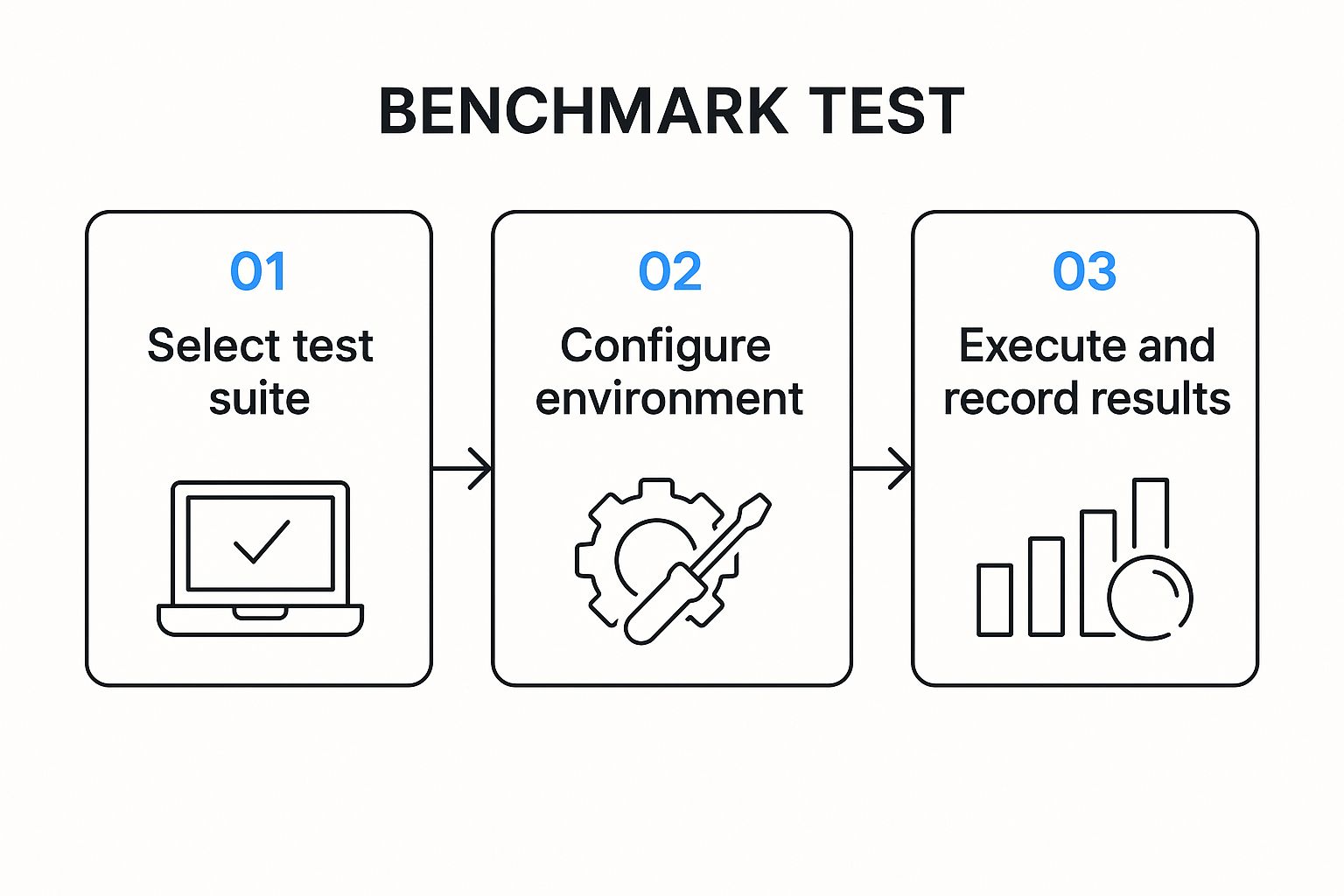
As you can see, it’s a logical process: pick your tools, set up the environment, run the test, and then dig into the data.
Setting Up Your Environment and Installing GoReplay
First things first, you need to get GoReplay installed on the server where you plan to listen for traffic, which is almost always your production server. Don’t worry, the process is quick and well-documented for pretty much any OS you’re running.
For most Linux systems, it’s as simple as downloading the latest binary and making it executable. The whole setup is lightweight by design, meant to get you up and running without wrestling with complex dependencies.
Capturing Real User Traffic
With GoReplay installed, it’s time for the fun part: capturing live traffic. This is where the magic happens. A simple command tells GoReplay to start listening on a specific network port (like port 80 for HTTP traffic) and save every request it sees into a file.
This file is now your testing ammunition. It’s a perfect recording of your production workload, containing a complete history of the requests your application handled. For a deeper look at this, check out our guide on how traffic replay improves load testing accuracy.
When you capture real interactions, you’re no longer guessing what your users are doing. Your benchmark test is built on a direct recording of their behavior, which gives you a much higher degree of confidence in your results.
Replaying Traffic and Analyzing Results
Now that you’ve got your captured traffic file, you can replay it against a test environment. This could be a staging server, your local machine, or a dedicated, production-like environment you’ve spun up just for benchmarking.
You’ll run another simple command, pointing GoReplay at your traffic file and telling it where to send the requests. As the test runs, you’ll want to keep an eye on your monitoring tools, watching for key performance metrics:
- Response Time: How fast is the system responding to requests?
- Throughput: How many requests per second is it handling?
- CPU and Memory Usage: Is the server getting overwhelmed?
- Error Rate: Are requests failing or throwing server errors?
By comparing these numbers against a baseline—say, from an older version of your app—you can definitively measure the impact of your changes. This is the whole point of a benchmark test: getting cold, hard data to help you make smarter decisions.
Avoiding Common Mistakes in Benchmark Testing
Running a benchmark test seems simple on the surface, but getting results you can actually trust takes more than just hitting “start.” A few common oversights can completely derail your efforts, leading you to make critical decisions based on bad data. The whole point is to create a reliable yardstick for performance, and that means sidestepping the pitfalls that can throw your numbers off.
One of the biggest blunders is jumping in without establishing a clear and stable performance baseline. It’s like trying to figure out if you’ve lost weight without ever stepping on the scale to see where you started. Without that “before” snapshot, you have no real way to measure the impact of your changes.
Another classic mistake? Testing in a messy, uncontrolled environment. If you run a benchmark on your local machine while a dozen other apps are hogging CPU and memory, your results will be all over the place. Your test environment has to be clean and consistent so the only thing you’re actually measuring is your system’s performance.
Ensuring Your Tests Are Valid and Accurate
To get data you can truly hang your hat on, you need to focus on two things: realism and repetition. Using synthetic tests that don’t actually mirror how real people use your application is a recipe for disaster. A test is only as valuable as the real-world scenario it mimics.
This is exactly why tools that can replay actual production traffic, like GoReplay, are so powerful—they pit your system against reality, not a simulation.
The goal of a benchmark isn’t just to get a number; it’s to get a number that tells you the truth. Small mistakes in how you test can lead to huge errors in your conclusions, turning a valuable insight into a costly misstep.
Finally, you should never, ever trust the results of a single test run. Performance can swing wildly due to all sorts of temporary factors, from a random network hiccup to a background process that decides to kick in.
To get the real story, you need to:
- Run tests multiple times: Don’t just run it once. Do it several times to spot the outliers and find a stable average.
- Use realistic traffic: Your test should reflect how your application is actually used in the wild, warts and all.
- Isolate the test environment: Keep external “noise” out. Eliminate anything that could interfere with your measurements.
By dodging these common mistakes, you can be confident that your benchmark tests are giving you the solid, actionable insights you need to make real improvements.
Your Questions About Benchmark Tests Answered

Even after you get the hang of what benchmark tests are all about, a few practical questions almost always pop up. Let’s tackle some of the most common ones to clear up any lingering confusion about how these tests work in the real world.
What Is the Difference Between a Benchmark Test and a Performance Test?
It’s easy to get these two mixed up. Think of it this way: a performance test is any test that measures how your system behaves under a certain workload—you’re looking at things like speed, stability, and responsiveness.
A benchmark test is just a specific type of performance test. The key difference is that a benchmark compares your results against a known standard. That standard could be an industry-wide metric, a previous version of your own software, or a direct competitor.
So, while every benchmark test is a performance test, not every performance test is a benchmark.
How Often Should I Run Benchmark Tests?
The honest answer? It depends entirely on what you’re trying to achieve.
If you’re in the middle of a development cycle, it’s a great idea to run them constantly with every new build. This approach, often called Continuous Benchmarking, helps you catch performance regressions the moment they happen, not weeks later.
But if you’re looking at the bigger picture—like how you stack up against the competition or industry standards—you might only need to run them quarterly or even annually.
Can I Trust Benchmark Results Published by Vendors?
Take them with a grain of salt. Vendor-published benchmarks can be a decent starting point, but they’re almost always run under perfect, lab-like conditions designed to make their product shine.
The only way to get a truly accurate picture of how a tool will perform for you is to run your own benchmark tests. Use workloads that mirror your actual use case. It’s the only way to know for sure.
Ready to run benchmark tests with real traffic, not simulations? With GoReplay, you can capture and replay your actual production traffic to get the most accurate performance insights possible. See how it works at https://goreplay.org.