
What Are Test Plans A Blueprint for Software Success

A test plan is the strategic document that details the scope, objective, approach, and resources for a software testing effort. Think of it as the blueprint for your entire quality assurance process, defining the who, what, where, when, and how of testing. This isn’t just tedious paperwork—it’s your project’s primary tool for taming risk and ensuring a successful launch.
Your Blueprint for Predicting Software Success

Could you imagine trying to build a skyscraper without a blueprint? The result would be chaos. Wasted resources. And, ultimately, a structure doomed to fail. A test plan serves this exact purpose for software, providing much-needed direction and clarity for everyone involved. It’s what transforms the fuzzy goal of “quality” into an actionable, measurable strategy.
A solid plan gets your entire team—developers, QA engineers, and project managers—aligned on a single vision of success. It cuts through ambiguity by outlining specific goals and the exact steps needed to get there. The focus on software quality isn’t just talk; the global software testing market is valued at over $45 billion and continues to grow.
By defining all the key components upfront, a test plan helps you manage expectations and—more importantly—resources. A well-crafted plan is the single best predictor of a successful software release that lands on-time and on-budget.
A great test plan acts as a project’s early warning system. It helps teams identify and neutralize risks before they escalate into costly problems, saving both time and money.
At its core, a test plan creates a baseline for quality, which is crucial for tracking progress with clear, undeniable metrics. It ensures every feature is tested thoroughly, preventing those critical bugs from ever reaching your end-users. For a deeper dive, check out our guide on the essential metrics for software testing.
Test Plan at a Glance
To put it simply, a test plan breaks down the abstract idea of “testing” into concrete, manageable functions. Here’s a quick look at what it really does for your team.
| Function | Description |
|---|---|
| Strategy | Defines the overall approach, methods, and tools for testing. |
| Scope Definition | Clearly outlines what will and will not be tested. |
| Resource Planning | Allocates the necessary people, tools, and environments. |
| Risk Management | Identifies potential risks and outlines a plan to mitigate them. |
| Scheduling | Sets timelines and key milestones for all testing activities. |
| Success Criteria | Establishes the specific conditions that define a successful release. |
Ultimately, this document serves as the single source of truth for your entire QA effort, ensuring everyone is on the same page from start to finish.
Anatomy of a Powerful Test Plan
So, what exactly is a test plan? Think of it less like a single document and more like a detailed blueprint for a construction project. A good plan isn’t just one big, monolithic file; it’s a collection of interconnected parts that, together, create a complete strategy for ensuring quality. Each piece serves a specific purpose, guiding the entire testing effort from start to finish.
This infographic breaks down how these core elements fit together.
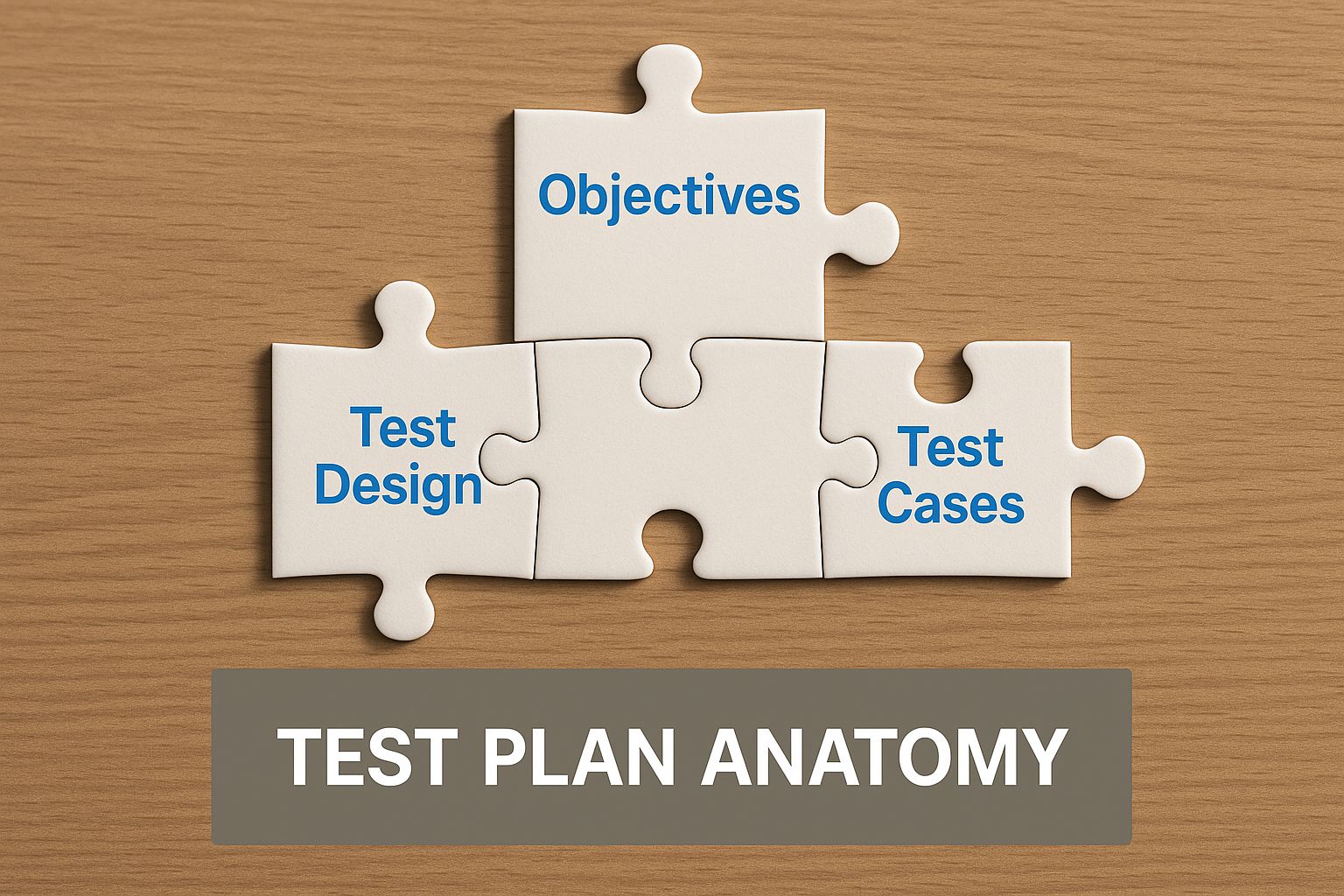
As you can see, each component builds on the last, creating a clear and comprehensive picture. Let’s dig into the essential elements you’ll find in almost every effective test plan.
Defining Scope and Objectives
First things first: you have to define the test scope. This is where you draw a clear line in the sand, spelling out exactly what will be tested (in-scope features) and, just as importantly, what won’t be (out-of-scope items). For example, a new checkout flow might be in scope, but the user registration page is out of scope for this particular release.
Next up are the test objectives. These are the specific, measurable goals for the testing cycle. An objective isn’t a vague wish like “test the app.” It’s a concrete target, like “achieve a 95% pass rate on all critical path test cases” or “confirm the application can handle 500 concurrent users without performance degradation.”
A well-defined scope is your best defense against “scope creep”—that dreaded moment when unplanned features get shoved into the testing cycle, draining resources and blowing up timelines.
Planning Resources and Deliverables
Once you know the what and the why, it’s time to figure out the how and the who. This is the logistical heart of the plan.
- Resources and Responsibilities: This section lists everyone involved, from the QA engineers executing tests to the developers on standby to fix bugs. It makes it crystal clear who is responsible for writing test cases, running them, and ultimately signing off on the release. No more confusion.
- Scheduling and Milestones: Here’s your timeline. This part breaks down the entire process into distinct phases—like test case design, execution, bug verification, and final reporting—and assigns start and end dates to each one.
- Test Deliverables: These are the tangible things you’ll actually produce. Common deliverables include the test plan document itself, the library of test cases, detailed defect reports for every bug found, and a final test summary report for stakeholders to review.
By laying all this out, the purpose of a test plan becomes obvious. It’s a comprehensive roadmap that leaves nothing to chance.
The True Cost of Skipping Your Test Plan
Thinking of a test plan as an optional step is one of the most expensive mistakes you can make on a project. Without that blueprint, teams drift into a chaotic cycle of reactive testing. It’s a place where critical issues only pop up way too late in the game, leading directly to delayed launches, frustrated developers, and spiraling costs.
Imagine developers pushing code while testers just scramble to validate it without any real strategy. They might miss crucial edge cases or burn precious time on low-priority features. This kind of disorganized approach just lets bugs slip through the cracks, only to be found by angry customers after the release. And we all know the cost to fix a bug post-release is exponentially higher than catching it early.
A test plan isn’t a cost—it’s an insurance policy against the financial and reputational damage of shipping a flawed product. It forces teams to think critically about risks before they become emergencies.
This is where a test plan really shines: proactive risk management. It acts as an early warning system, helping your team spot and neutralize threats before they escalate into project-derailing crises.
The Financial Impact of Poor Planning
The fallout from skipping a test plan isn’t just theoretical; it hits the bottom line, hard. When priorities are misaligned, you waste hours testing the wrong things. When unexpected defects crop up, you’re stuck paying for expensive emergency patches and developer overtime. It’s a reactive cycle that eats away at both your budget and your team’s morale.
Smart organizations get this. In fact, 40% of large enterprises now dedicate over a quarter of their total budget to testing, and nearly 10% invest more than half their budget in quality assurance. This isn’t just throwing money at a problem; it’s a clear signal that the industry recognizes a solid plan is essential for reliable software. You can discover more software testing statistics to see just how critical this has become.
Failing to plan properly creates a nasty domino effect:
- Budget Overruns: Unplanned bug fixes and endless re-testing cycles burn through resources meant for new features.
- Missed Deadlines: Finding major flaws late in the cycle forces you to push back release dates, shaking stakeholder confidence.
- Reputational Damage: A buggy release can destroy customer trust in an instant, leading to a flood of negative reviews and users leaving for good.
At the end of the day, a test plan provides the structure you need to stop these problems before they start. It makes sure every hour spent on testing is effective, protecting your timeline, your budget, and your brand.
Putting a Test Plan to Work on a Real-World App

Theory is one thing, but let’s see how this all clicks into place with a practical example. Imagine your team is gearing up to launch a brand-new e-commerce mobile app called “ShopSphere.” This is where a test plan stops being a document and becomes the strategic guide that separates a risky gamble from a calculated success.
This story will show you exactly how the concepts we’ve discussed translate directly into action. First up: defining what we’re actually going to test.
Defining Scope and Objectives
The very first step is drawing some clear lines in the sand. For ShopSphere’s initial launch, the core user journey is everything. Our plan needs to be crystal clear about what’s a must-have for launch and what can wait for a later update.
- In Scope: User login, product search, adding items to the cart, and the entire checkout process. If these don’t work flawlessly, we don’t have a product.
- Out of Scope: Fancy extras like user reviews, gift card support, and the loyalty program. These are important, but they can be tested and rolled out once the core app is stable.
With our scope locked in, we can move on to setting goals that actually mean something. A vague objective like “test the app” is useless. We need specifics.
Test Objective Example: Achieve a 99.5% transaction success rate for the checkout flow across all supported payment methods during performance testing.
Now that’s a target. It gives the team a precise finish line and sets a high standard for what “good enough” really means.
Identifying Risks and Next Steps
No project is ever smooth sailing, and a smart test plan calls out the potential icebergs ahead of time. For ShopSphere, a huge risk is the third-party payment gateway. What happens if it goes down during a flash sale?
The plan must tackle this head-on. We’d outline a mitigation strategy, like specifically testing how the app behaves when that gateway is totally unresponsive.
This entire process brings clarity to the testing effort. Once you have your scope and objectives nailed down, you can start writing the detailed instructions for each test. For a deep dive into that next step, check out our guide on how to create a test case. Building out these key sections shows how all the pieces of a great test plan work together to protect your launch.
Of course! Here is the rewritten section, crafted to sound human-written with an expert tone, following all your requirements.
Where Test Plans Go Wrong (and How to Keep Yours on Track)
Knowing what a test plan should have is one thing. Actually writing one that guides your team to a win is a whole different ballgame. I’ve seen even seasoned teams fall into common traps that turn a powerful document into something that just gathers dust on a server. If you want your test plan to actually improve your project, you have to know what those pitfalls are.
The most common mistake? Creating the plan in a silo. When it’s just the QA team in a room, the final document almost always misses key business goals or technical dependencies. The best test plans I’ve ever worked with were born from collaboration. They pull in feedback from developers, project managers, and business analysts to make sure everyone is actually on the same page.
Another huge problem is treating the plan like a static, rigid contract. Let’s be real—projects change. Priorities shift, and unexpected problems always pop up. Your test plan needs to be a living, breathing document that can adapt along with the project.
Think of your test plan as a map for a road trip, not a legal contract. It’s there to guide you, but you have to be ready to take a detour when you hit a roadblock or find a better route.
Don’t Get Tripped Up by Vague Details or Hidden Risks
Being too vague is a classic rookie move. A goal like “test the new feature” is useless because it gives no real direction. You need to get specific. Define clear entry and exit criteria for every single phase of testing. For example, a solid exit criterion would be: “95% of all critical test cases must pass before we even think about moving to user acceptance testing.”
Just as dangerous is being overly optimistic about your timelines or completely ignoring potential risks. A good plan doesn’t just hope for the best; it actively prepares for the worst.
Here are a few common tripwires I see all the time:
- Forgetting About Test Data: Not figuring out early how you’ll get realistic test data is a surefire way to cause massive delays down the road.
- Ignoring the Test Environment: Failing to define—and prepare—the specific hardware, software, and network configurations you’ll need is a recipe for disaster.
- Skipping the Risk Analysis: You have to identify what could go wrong (like a third-party API going down) and have a backup plan ready to go.
The testing world is also changing fast. A recent study shows that about 42% of enterprise-scale companies are now using AI in their operations, and that absolutely includes testing. A modern test plan has to be flexible enough to bring in these new methods and the metrics that show they’re actually working. You can get a deeper look into how AI is influencing software testing metrics on accelq.com.
Test Plan Do’s and Don’ts
To keep things simple, I’ve put together a quick cheat sheet. Think of it as a gut check to run through before you finalize your plan. Following these simple rules can make the difference between a plan that works and one that gets ignored.
| Do | Don’t |
|---|---|
| Collaborate with developers, PMs, and business analysts. | Write it in a silo. This guarantees missed requirements. |
| Be specific with entry/exit criteria and scope. | Be vague. Ambiguity leads to confusion and rework. |
| Keep it flexible and update it as the project evolves. | Treat it as a static document. Projects always change. |
| Perform a risk analysis and create contingency plans. | Ignore potential risks. Hope is not a strategy. |
| Plan for test data and environment setup early on. | Assume data and environments will just be ready. |
Sticking to the “Do” column will help you create a test plan that isn’t just a document, but a genuine tool that steers your project toward a successful launch.
Clearing Up Common Questions About Test Plans
As you start to work with test plans more, a few questions always seem to surface. These are the practical, real-world questions that bridge the gap between theory and what actually happens in a fast-paced development cycle. Let’s tackle some of the most common ones.
Test Plan vs. Test Strategy—What’s the Difference?
It’s incredibly common to hear “test plan” and “test strategy” used as if they’re the same thing, but they play very different roles.
Think of a test strategy as your organization’s constitution for quality. It’s a high-level, guiding document that lays out the core principles and general approach to testing across the entire company or a major product line. It’s built to last and rarely changes.
A test plan, on the other hand, is the battle plan for a specific project. It’s a tactical, hands-on document that gets into the nitty-gritty: the what, when, who, and how for a single feature or release. The strategy sets the direction, but the plan maps out the actual journey.
How Detailed Should a Test Plan Be?
Finding the right level of detail is always a balancing act. There’s no single right answer—it really depends on the complexity of your project, how your team works (like Agile vs. Waterfall), and whether you’re bound by any industry regulations.
A great rule of thumb is to make it just detailed enough for a new team member to read it and grasp the testing scope, key objectives, and timeline without needing a two-hour briefing. At the same time, it shouldn’t be a rigid, 100-page novel that shatters the moment a project requirement changes (and they always do).
Who Is Responsible for Writing the Test Plan?
On paper, a QA Lead, Test Manager, or a senior QA engineer usually takes the lead. They are the ones who will own the document, steer its creation, and make sure it stays current.
But the very best test plans are born from collaboration. Getting input from developers, project managers, and business analysts isn’t just nice to have—it’s essential. This teamwork ensures the plan is grounded in reality, comprehensive, and perfectly synced with what the project needs to achieve.
When you skip that collaboration, you risk creating a plan in a silo, completely disconnected from the project’s actual state. And a disconnected plan is just a document, not a guide.
Ready to stop guessing and start knowing? With GoReplay, you can capture and replay real user traffic to validate your application’s performance and stability under real-world conditions. Find and fix issues before they impact your customers. Explore how to build a more resilient testing process at https://goreplay.org.