
8 Essential Testing Types QA Professionals Must Know (2025)

In the competitive software development landscape, quality assurance is more than a final checkbox; it’s an integrated discipline that protects user experience, secures data, and drives business objectives. Merely asking “Does it work?” is no longer sufficient. To build robust, scalable, and secure applications, teams must deploy a sophisticated mix of testing strategies tailored to specific goals. Understanding the different testing types QA professionals use is the first step toward creating a truly effective quality engineering culture.
This guide moves beyond surface-level definitions to provide a comprehensive roundup of essential testing methodologies. We will dissect eight critical approaches, from foundational Waterfall and Agile methodologies to more specialized strategies like Behavior-Driven Development (BDD) and Risk-Based Testing (RBT). Each section offers a clear breakdown, including practical use cases, distinct advantages and disadvantages, and actionable implementation advice.
Our goal is to equip developers, QA engineers, and DevOps teams with the knowledge to select and combine these testing types for maximum impact. Furthermore, we will explore how modern tools like GoReplay can amplify each method. By using real user traffic to create more realistic testing scenarios, teams can significantly enhance the accuracy and efficiency of their QA efforts, ensuring their applications are not just functional, but truly production-ready. This article provides a clear roadmap for building a multifaceted testing strategy that delivers tangible results.
1. Waterfall Testing Methodology
The Waterfall methodology is a traditional, linear approach to software development and testing. It operates as a sequential process where progress flows steadily downwards, like a waterfall, through distinct phases: Requirements, Design, Implementation (Coding), Testing, Deployment, and Maintenance. In this model, each phase must be fully completed and signed off before the next one can begin, making it a rigid and highly structured framework.

Testing in a Waterfall model is a distinct, separate phase that occurs only after the development phase is entirely finished. The primary goal of this testing phase is to validate the full application against the requirements that were defined and frozen at the very beginning of the project. This makes it one of the most straightforward testing types in QA to plan and manage, as the scope is fixed from the outset.
When to Use the Waterfall Approach
This methodology is best suited for projects where requirements are well-understood, comprehensively documented, and unlikely to change. Its predictability and emphasis on documentation make it a strong choice for specific scenarios:
- Critical Systems: Projects like NASA’s space shuttle software or medical device firmware, where every requirement must be met without deviation and extensive documentation is non-negotiable.
- Regulatory Compliance: Industries such as banking and defense often require meticulous record-keeping and a traceable, step-by-step process to meet strict regulatory standards.
- Fixed-Scope Projects: Construction or manufacturing software where the project’s goals and features are known upfront and are not expected to evolve.
Actionable Tips for Implementation
To succeed with the Waterfall model, discipline and upfront planning are paramount.
- Invest Heavily in Requirements: Dedicate significant time to the initial requirements gathering and analysis phase. All stakeholders must review and approve this documentation before any design or coding begins.
- Create Detailed Test Plans Early: During the design phase, the QA team should develop a comprehensive test plan, test cases, and test scripts based on the requirements documents.
- Maintain Rigorous Documentation: Every phase should produce thorough documentation. This creates a clear audit trail and serves as the definitive reference for the testing team.
- Enforce Strict Change Control: Because changes are costly and difficult to implement in Waterfall, establish a formal and stringent process for managing any change requests.
2. Agile Testing Methodology
The Agile methodology represents a fundamental shift from traditional, sequential models. It is an iterative and collaborative approach where software development and testing are performed concurrently in short, incremental cycles known as “sprints.” Unlike Waterfall, testing is not a distinct final phase; instead, it is an integral activity woven throughout the entire development lifecycle, promoting continuous feedback and rapid adaptation to change.

In an Agile environment, testers are active members of the cross-functional development team, working alongside developers, product owners, and business analysts from day one. The primary goal is to deliver small, functional pieces of the software frequently, ensuring quality is built in at every step. This continuous validation makes Agile one of the most responsive and efficient testing types in QA for dynamic projects.
When to Use the Agile Approach
Agile is the preferred methodology for projects where requirements are expected to evolve and rapid delivery is a competitive advantage. Its flexibility and focus on customer collaboration make it ideal for modern software development.
- Dynamic and Evolving Projects: Startups and product development teams creating innovative applications where requirements are not fully known upfront and are likely to change based on user feedback.
- Customer-Centric Products: Projects like e-commerce platforms or mobile apps where continuous user feedback is crucial for shaping the product’s direction and feature set.
- Fast-Paced Markets: Industries like SaaS, where the ability to quickly release new features and respond to market demands, such as at companies like Spotify and Salesforce, provides a significant edge.
Actionable Tips for Implementation
Successfully adopting Agile testing requires a cultural shift towards collaboration and automation.
- Integrate Testers into the Team: Ensure QA professionals participate in all sprint planning meetings, daily stand-ups, and retrospectives to provide early feedback and understand requirements thoroughly.
- Invest in Test Automation: Automate repetitive tests, especially regression tests, from the very beginning. This frees up QA to focus on more complex exploratory testing and edge cases.
- Maintain a Prioritized Backlog: Work with the product owner to ensure user stories in the backlog have clear, testable acceptance criteria before a sprint begins.
- Practice Continuous Integration (CI): Implement a CI/CD pipeline where code changes are automatically built and tested, allowing teams to identify and fix integration issues quickly.
3. Test-Driven Development (TDD)
Test-Driven Development (TDD) is a software development process that inverts the traditional code-then-test sequence. Instead of writing code first, developers start by writing an automated test case that defines a desired improvement or new function. This initial test will inevitably fail because the feature has not yet been implemented. The developer then writes the minimum amount of code required to make the test pass, after which they can refactor the new code to meet acceptable standards.
This short, repetitive cycle of “Red-Green-Refactor” (Red: write a failing test, Green: write code to pass, Refactor: clean up the code) is the core of TDD. It fundamentally shifts the role of testing from a verification activity to a design driver. By writing tests first, developers are forced to consider the requirements and design from the perspective of a user or consumer of the code. This makes TDD a powerful methodology among the different testing types in QA for building robust, maintainable, and well-documented systems.
When to Use the TDD Approach
TDD excels in environments that require high code quality, long-term maintainability, and a clear understanding of requirements at a granular level. It is particularly effective for:
- Complex Logic: Developing algorithms, business rules, or intricate systems where each component’s behavior must be precisely defined and verified.
- Long-Term Projects: Building applications that will evolve over many years, as the comprehensive test suite acts as living documentation and a safety net against regressions.
- API and Library Development: When creating reusable components, TDD ensures the API is well-designed, easy to use, and reliable from the start. Both IBM and Microsoft have reported significant reductions in post-release defects after adopting TDD practices.
Actionable Tips for Implementation
Successfully adopting TDD requires a disciplined mindset and a commitment to its core cycle.
- Start with the Simplest Failing Test: Begin by writing the most basic test case you can think of that will fail. This forces you to focus on one small piece of functionality at a time.
- Write Just Enough Code: Your goal in the “Green” phase is to pass the test, not to write perfect code. Write the simplest possible implementation that satisfies the test.
- Never Skip the Refactor Step: Refactoring is crucial. Once the test is passing, clean up your code, remove duplication, and improve its design, all while ensuring the tests continue to pass.
- Keep Tests Fast: TDD relies on a rapid feedback loop. Unit tests should be independent and run in milliseconds. Use mock objects and stubs to isolate dependencies and maintain speed.
4. Behavior-Driven Development (BDD)
Behavior-Driven Development (BDD) is a collaborative approach to software development that extends Test-Driven Development (TDD) by focusing on the application’s behavior from the user’s perspective. It uses natural, human-readable language to define acceptance criteria, bridging the communication gap between technical teams and non-technical business stakeholders. This ensures everyone shares a common understanding of what the system should do.
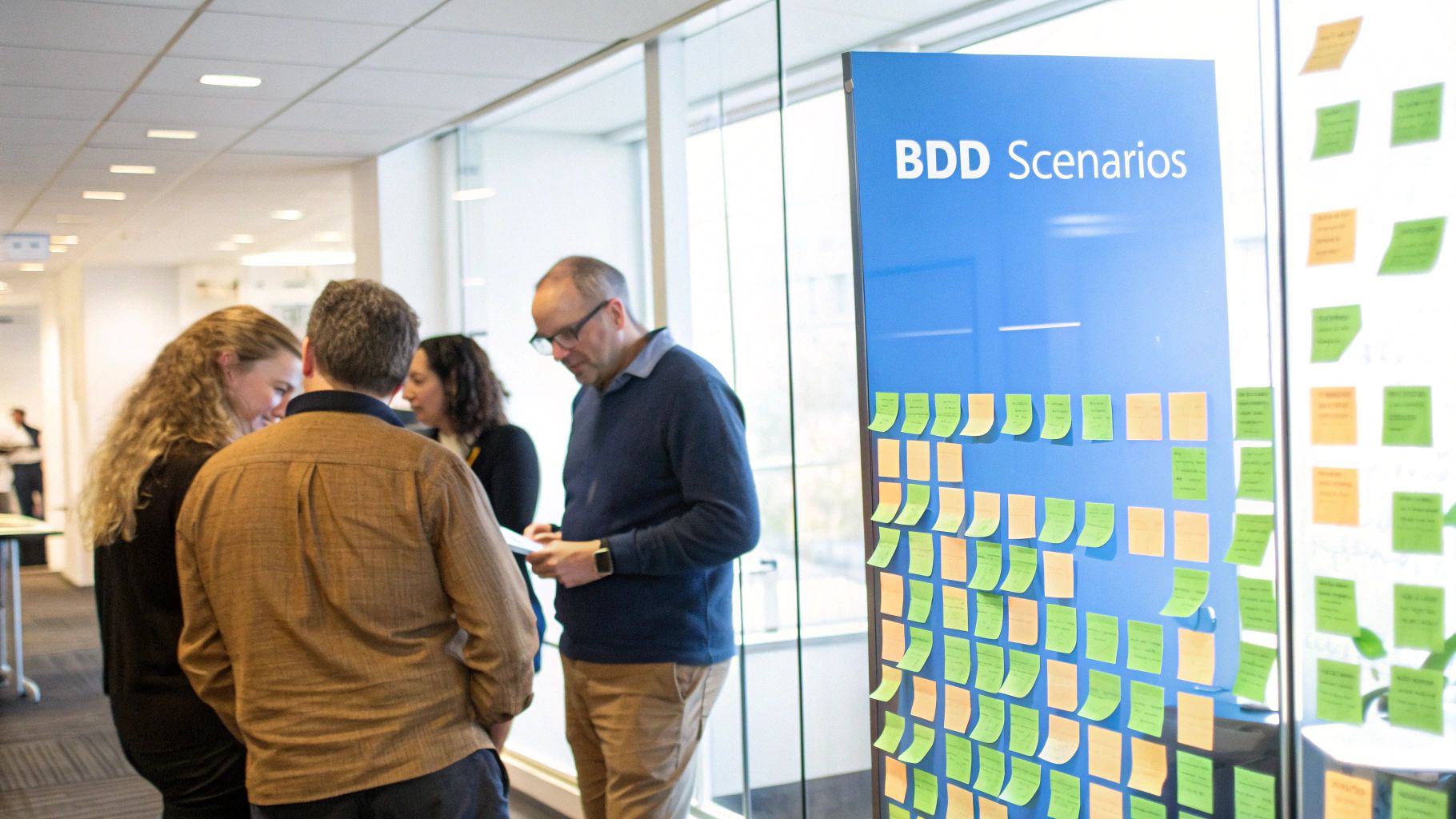
In BDD, requirements are framed as “scenarios” written in a structured format called Gherkin, using a Given-When-Then syntax. This format describes a feature’s behavior by outlining a precondition (Given), an action (When), and an expected outcome (Then). These scenarios serve as living documentation, automated tests, and acceptance criteria all in one, making it one of the most transparent testing types in QA for aligning development with business goals.
When to Use the BDD Approach
BDD is most effective in collaborative, agile environments where clear communication and a shared understanding of user needs are critical for success. Its structure provides clarity and reduces ambiguity, making it ideal for certain contexts:
- Complex Business Logic: Applications in finance or e-commerce, where business rules are intricate and must be precisely implemented. Vanguard, for instance, used BDD to ensure its financial systems behaved exactly as specified.
- Cross-Functional Teams: Projects involving developers, QA engineers, product managers, and business analysts who need a common language to discuss requirements. The BBC uses BDD to coordinate development across its vast digital platforms.
- User-Facing Features: When building features with a strong focus on user experience, BDD ensures the final product aligns with user expectations and solves their problems effectively.
Actionable Tips for Implementation
Successfully adopting BDD requires a cultural shift towards collaboration and a disciplined approach to defining behavior.
- Start with ‘Three Amigos’ Meetings: Before development, bring together a developer, a tester, and a business analyst to discuss and agree upon the behavior of a feature.
- Write Scenarios from the User’s Perspective: Focus on what the user wants to achieve, not how the system will implement it. Use concrete examples to make scenarios clear and unambiguous.
- Utilize BDD Frameworks: Leverage tools like Cucumber, SpecFlow, or Behave to translate Gherkin scenarios into automated tests that can be executed against your application code.
- Establish a Ubiquitous Language: Work with business stakeholders to create a common vocabulary that is used consistently in conversations, requirements, and code.
5. Exploratory Testing Methodology
Exploratory Testing is a dynamic, hands-on approach where test design and test execution occur simultaneously. Unlike scripted testing, it relies on the tester’s freedom, creativity, and domain knowledge to discover defects by actively exploring the application. Testers continuously learn about the software and adjust their testing strategy based on their findings, making it an intellectually engaging and highly effective method for unearthing unexpected issues.
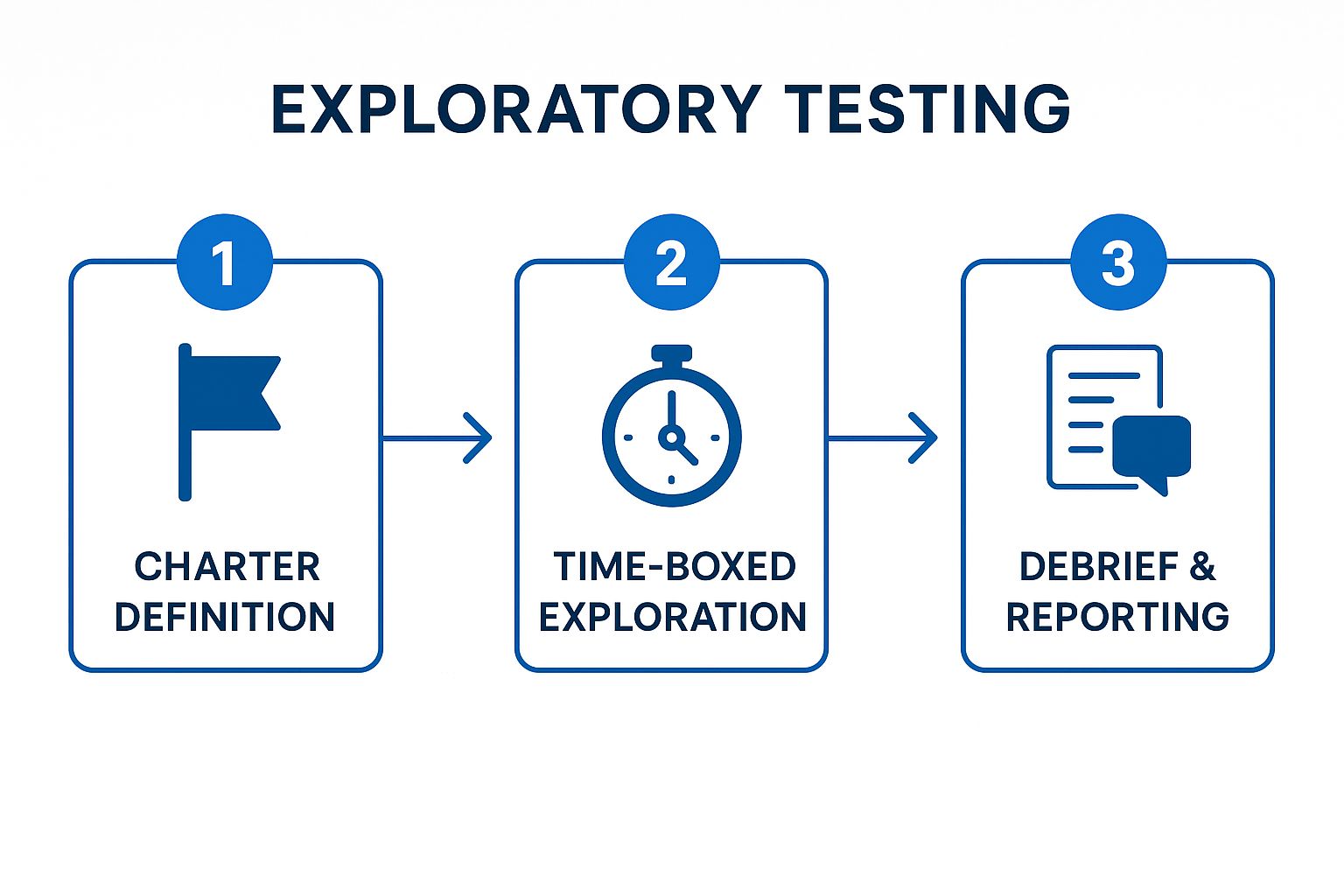
Pioneered by QA leaders like James Bach and Cem Kaner, this methodology formalizes the process of unscripted testing to ensure it remains focused and productive. The typical flow involves defining a clear mission, executing a time-limited session, and then reporting on the discoveries. This structured freedom is one of the most powerful testing types in QA for complementing automated and scripted checks.
When to Use the Exploratory Approach
This methodology excels in complex, rapidly changing environments where exhaustive test scripting is impractical. Its adaptability makes it ideal for several scenarios:
- Agile and DevOps Environments: When new features are delivered frequently, exploratory testing allows QA to provide rapid feedback without waiting for comprehensive test case documentation.
- Complex Applications: For systems with intricate workflows or a high degree of user interaction, testers can discover usability issues and edge-case bugs that scripts often miss.
- Legacy Systems: When documentation is poor or outdated, testers can use exploration to reverse-engineer and understand system behavior while simultaneously searching for defects.
- User Experience (UX) Validation: Companies like Amazon apply this approach to ensure the user journey feels intuitive and seamless, going beyond simple functional checks.
Actionable Tips for Implementation
To maximize the value of exploratory testing, structure and discipline are key.
- Use Time-Boxed Sessions: Conduct tests in focused, uninterrupted sessions, typically lasting 60 to 90 minutes, to maintain high engagement and prevent burnout.
- Create Testing Charters: Before each session, define a clear charter that outlines the mission, scope, and goals. This provides direction without overly restricting the tester’s creativity.
- Apply Heuristics and Mnemonics: Use established testing heuristics like “SFDPOT” (San Francisco Depot) to guide your exploration and ensure you cover various quality characteristics.
- Take Detailed Notes: Document your process, observations, questions, and potential bugs as you go. Mind maps and session-based test management tools are excellent for this. Explore more details by reading about QA testing best practices.
6. Risk-Based Testing (RBT)
Risk-Based Testing (RBT) is a strategic methodology that prioritizes testing activities based on the probability of failure and its potential business impact. Instead of attempting to test everything with equal intensity, RBT focuses resources on the features and functions where a defect would cause the most significant harm. This approach involves a systematic process of identifying, analyzing, and mitigating risks throughout the software development lifecycle.
Testing in an RBT model is driven by a prioritized risk register. The primary goal is to minimize the overall level of residual risk in the product before release, ensuring that the most critical components have undergone the most rigorous scrutiny. This makes it one of the most efficient testing types in QA for projects with tight deadlines or limited resources, as it maximizes the value derived from every testing hour.
When to Use the Risk-Based Approach
This methodology is ideal for complex, large-scale projects where exhaustive testing is impractical or impossible. Its focus on impact makes it a cornerstone of quality assurance in high-stakes environments.
- Critical Systems: Banking institutions use RBT to rigorously test payment processing systems, and healthcare software companies prioritize features related to patient data privacy and safety.
- Safety-Critical Applications: The aviation industry applies RBT to flight control software, and the automotive sector uses it for safety systems like airbags and anti-lock brakes, where failure is not an option.
- Resource-Constrained Projects: E-commerce platforms with frequent updates use RBT to focus testing on the checkout and payment flows, ensuring core revenue-generating functions are stable, even with limited time.
Actionable Tips for Implementation
Successful RBT requires a collaborative and analytical mindset, moving beyond simple test case execution to strategic risk management.
- Host Collaborative Risk Workshops: Involve stakeholders from business, development, and product teams early on to identify and assess risks. A diverse perspective is crucial for identifying both technical and business-impact risks.
- Use a Risk Matrix: Create a visual risk matrix that plots the likelihood of a failure against its potential impact. This helps prioritize which risks to address first and justifies the allocation of testing resources.
- Document and Revisit Assumptions: Clearly document the assumptions made during risk assessment. As the project evolves, regularly review and update the risk register to ensure it remains relevant.
- Leverage Historical Data: Analyze defect data from past projects or previous versions of the application. This historical information can provide valuable insights into which modules are historically prone to failure.
7. Continuous Testing in DevOps
Continuous Testing is a core component of the DevOps methodology where automated tests are executed as part of the software delivery pipeline. Unlike traditional models where testing is a separate phase, this approach integrates testing into every stage, from code commit through to production deployment. The goal is to obtain immediate feedback on business risks associated with a software release candidate, ensuring the code is always in a releasable state.
This model fundamentally shifts quality assurance “left” (earlier in the development cycle) and “right” (into production monitoring). By doing so, it makes testing a continuous, integrated activity rather than a bottleneck. As one of the most modern testing types in QA, it enables the rapid, high-quality, and reliable releases demanded by today’s fast-paced market.
When to Use the Continuous Testing Approach
Continuous Testing is essential for organizations aiming to achieve high-velocity software delivery without compromising on quality. It is the standard for modern, agile teams.
- DevOps and Agile Environments: Teams practicing DevOps, Continuous Integration (CI), and Continuous Delivery (CD) rely on this approach to automate their delivery pipelines and enable frequent, low-risk deployments.
- Rapid-Release Products: Companies like Netflix, Amazon, and Etsy, which deploy code thousands of times per day, use Continuous Testing to validate every change automatically.
- Microservices Architectures: In complex systems with numerous independent services, Continuous Testing is critical for validating integrations and ensuring that a change in one service doesn’t break another.
Actionable Tips for Implementation
Successfully adopting Continuous Testing requires a strategic and tool-supported approach.
- Establish a Solid CI/CD Pipeline: Before implementing full Continuous Testing, ensure you have a mature Continuous Integration and Continuous Delivery pipeline using tools like Jenkins, GitLab CI, or CircleCI.
- Adopt the Test Pyramid: Build a healthy test suite with a large base of fast unit tests, fewer integration tests, and a minimal number of slow end-to-end UI tests.
- Use Containerization: Leverage tools like Docker to create consistent, ephemeral environments for testing, which eliminates the “it works on my machine” problem.
- Implement Test Result Analytics: Monitor test execution times, identify flaky tests, and analyze failure patterns to continuously improve the efficiency and reliability of your test suite. To dive deeper into implementation, you can explore some continuous testing best practices.
8. Acceptance Test-Driven Development (ATDD)
Acceptance Test-Driven Development (ATDD) is a collaborative practice that aligns business stakeholders, developers, and testers around a shared understanding of user requirements. In ATDD, the team jointly defines acceptance criteria in the form of concrete, executable tests before development begins. These acceptance tests effectively become the definition of “done” for a feature, guiding development to ensure the final product meets customer expectations.
Unlike unit tests that focus on code components, ATDD operates at the feature level, describing user behavior and system outcomes from an external perspective. This collaborative approach minimizes ambiguity and rework by ensuring everyone agrees on what needs to be built. It is a powerful communication tool that makes business requirements one of the most transparent testing types in QA. The cycle is simple: write a failing acceptance test, write the code to make it pass, and then refactor.
When to Use the ATDD Approach
ATDD is ideal for Agile environments where collaboration and rapid feedback are crucial. Its focus on shared understanding makes it invaluable for projects with complex business logic or those requiring tight alignment between technical teams and business stakeholders.
- Complex Business Domains: In industries like finance or e-commerce, where rules are intricate, ATDD helps clarify requirements. For instance, Refinitiv uses it to ensure its financial data platforms meet precise specifications.
- Customer-Facing Applications: SaaS companies and government digital services leverage ATDD to guarantee that new features directly address documented user needs and behaviors.
- Agile and Scrum Teams: Teams practicing Agile, like those at Spotify, use ATDD to facilitate conversation and ensure each user story has clear, testable acceptance criteria before it enters a sprint.
Actionable Tips for Implementation
Successfully adopting ATDD requires a shift towards collaborative requirement definition and a commitment to communication.
- Hold ‘Three Amigos’ Sessions: Before sprint planning, bring together a developer, a tester, and a business analyst (the “three amigos”) to collaboratively write acceptance criteria for upcoming user stories.
- Write Tests in Business Language: Use tools like Cucumber or FitNesse to write tests in a human-readable format (e.g., Gherkin’s Given-When-Then). This ensures non-technical stakeholders can easily read, understand, and validate the tests.
- Focus on ‘What,’ Not ‘How’: Acceptance tests should describe the desired outcome and system behavior from a user’s perspective, not the technical implementation details.
- Automate Everything: The acceptance tests created during requirements definition should be automated. This creates a living documentation of the system that continuously verifies its functionality.
Testing Methodologies Comparison Matrix
| Methodology | Implementation Complexity 🔄 | Resource Requirements ⚡ | Expected Outcomes 📊 | Ideal Use Cases 💡 | Key Advantages ⭐ |
|---|---|---|---|---|---|
| Waterfall Testing Methodology | Moderate to high; linear phases with strict order | Moderate; extensive documentation and planning | Predictable milestones; late defect detection | Projects with fixed requirements, regulated industries | Clear process, easy management, stable requirements |
| Agile Testing Methodology | High; requires iterative cycles and collaboration | High; skilled teams, automation tools | Early defect detection; frequent releases | Dynamic projects, startups, projects needing flexibility | Continuous feedback, flexibility, fast delivery |
| Test-Driven Development (TDD) | High; requires test-first coding discipline | Moderate to high; developer skills, testing frameworks | High code quality and coverage | New projects, teams focused on quality and reliability | Modular code, early defect detection, living docs |
| Behavior-Driven Development (BDD) | Moderate to high; involves collaboration and natural language tests | Moderate; cross-team involvement, tooling | Improved communication; aligned requirements | Projects needing clear business-developer collaboration | Shared understanding, reduced ambiguity, executable specs |
| Exploratory Testing Methodology | Low to moderate; minimal upfront planning | Low to moderate; skilled testers required | Finds unexpected defects; rapid feedback | Usability testing, supplementing automation, new features | Flexibility, tester creativity, quick issue discovery |
| Risk-Based Testing (RBT) | Moderate; requires upfront risk analysis | Moderate; stakeholder involvement | Focused testing on critical risks | Projects with limited resources, safety-critical applications | Optimized resource use, critical coverage, stakeholder alignment |
| Continuous Testing in DevOps | High; integrates automation in CI/CD pipelines | High; automation tools, skilled engineers | Rapid release cycles; constant feedback | Organizations needing speed, cloud-native apps, competitive markets | Fast feedback, frequent deployments, reduced risks |
| Acceptance Test-Driven Development (ATDD) | Moderate; needs collaboration and acceptance criteria definition | Moderate; business and tech team involvement | Clear requirements alignment; reduced rework | Agile teams with business involvement, complex domains | Better communication, clear acceptance criteria, living docs |
Building a Holistic QA Strategy for the Future
Navigating the complex world of software development requires more than just a cursory checklist of quality checks. As we’ve explored, the landscape of testing types QA professionals utilize is a rich and diverse ecosystem, not a monolithic process. From the foundational logic verified by functional and unit tests to the user-centric insights gained from usability and acceptance testing, each type serves a distinct and vital purpose. The true power of a modern QA strategy lies not in choosing one “best” method, but in thoughtfully composing a symphony of them.
The journey from a simple bug hunt to a proactive quality engineering mindset is a significant one. It involves shifting from a reactive stance, where testing is a final gate before release, to an integrated approach where quality is woven into every sprint, commit, and deployment. This is the core principle behind the methodologies we discussed, from the collaborative nature of Behavior-Driven Development (BDD) to the continuous feedback loops of a DevOps testing culture. A robust strategy acknowledges that performance, security, and compatibility are not afterthoughts but essential architectural pillars that must be tested early and often.
From Silos to Synergy: Weaving Your Testing Mosaic
The most common pitfall for growing teams is treating these testing types QA practices as isolated, sequential phases. A developer runs unit tests, a QA engineer performs manual regression, and a performance specialist runs load tests just before launch. This siloed approach is inefficient, slow, and often leads to critical issues being discovered too late in the cycle, when they are most expensive and difficult to fix.
A holistic strategy breaks down these walls. It’s about creating a unified pipeline where different testing types build upon each other.
- Foundation of Functionality: Start with a strong base of unit and integration tests to ensure the core components work as expected. This provides a safety net for developers and accelerates the feedback loop.
- User-Centric Validation: Layer on acceptance and usability testing to ensure the software not only works technically but also solves the right problems for the end-user in an intuitive way.
- Non-Functional Resilience: Simultaneously, integrate performance, security, and compatibility testing into your CI/CD pipeline. Don’t wait until the end; test these critical aspects on every significant change to prevent technical debt and unforeseen bottlenecks.
- Real-World Simulation: Finally, elevate your entire strategy by moving beyond synthetic, predictable test data. The ultimate validation comes from understanding how your system behaves under the chaotic, unpredictable conditions of real user traffic.
The GoReplay Advantage: Injecting Reality into Your Process
This is where the paradigm of traffic shadowing and replay testing becomes a game-changer. Tools like GoReplay bridge the gap between your controlled test environments and the unpredictable reality of production. By capturing and replaying real user traffic, you can supercharge nearly every testing type we’ve discussed. Imagine running a performance test with an exact replica of your peak traffic spike or validating a security patch against actual user request patterns. This approach transforms your QA from a theoretical exercise into a realistic dress rehearsal for production.
Mastering the diverse array of testing types QA offers is no longer optional; it’s a critical differentiator in a competitive market. It is the key to delivering software that is not just functional but also reliable, secure, performant, and delightful to use. By embracing a blended, continuous, and reality-based testing strategy, you transform your quality assurance process from a cost center into a powerful engine for innovation, customer satisfaction, and sustainable business growth. The future of quality isn’t about finding more bugs; it’s about building better, more resilient software from the very beginning.
Ready to elevate your QA strategy from theory to reality? See how GoReplay can help you leverage real user traffic to validate performance, find elusive bugs, and confidently deploy changes across all the essential testing types QA teams rely on. Visit GoReplay to discover how traffic replay can transform your development lifecycle.