
Understanding Test Environment Management Beyond The Basics
Think of test environment management like conducting an orchestra. Each instrument (service) must be perfectly tuned, play its part at the right moment, and blend harmoniously with the others to create a beautiful symphony (your application). This becomes significantly more intricate when you add microservices, containers, and continuous deployment. Your once small string quartet transforms into a full orchestra, each section with its unique needs and dependencies.
This demands a shift away from the old “set it and forget it” method. You can’t simply tune the instruments once and expect perfect harmony throughout the performance. Environment drift—the gradual deviation of a test environment from its intended configuration—becomes a real issue. Imagine a percussionist subtly altering their tempo, disrupting the entire rhythm section. Likewise, minor configuration changes in one microservice can cascade through your system, causing unforeseen issues elsewhere in your application.
Traditional testing environments often struggle with the sheer number of interconnected services. Managing dependencies, data requirements, and configuration peculiarities for numerous individual services quickly becomes overwhelming. Tools like GoReplay can help simplify this complexity, particularly when setting up testing environments. This increasing complexity has also led to the growth of specialized testing teams. In fact, the field of test environment management (TEM) has seen a substantial rise in large testing teams—growing from 17% two years ago to 30% recently, reflecting the increasing intricacy of software projects. Discover more insights on TEM growth
The Challenges of Complex Test Environments
The image below visually represents the different levels of software testing:
As the image illustrates, software testing involves multiple layers, from unit testing individual components to system testing the entire integrated application. This layered approach underscores the need for diverse test environments suited to each testing phase. Without proper test environment management, maintaining consistency and reliability across these layers becomes a major obstacle.
This means effective test environment management isn’t simply about providing hardware and software. It’s about orchestrating a complex system of interconnected parts. It’s about ensuring consistency, managing dependencies, and equipping your testing team with the right tools and resources. It’s about creating an environment where your “orchestra” can perform in perfect harmony, allowing you to identify problems early and deliver high-quality software.
Why Traditional Testing Environments Keep Failing You
Imagine building a house. You wouldn’t start with the walls before the foundation, would you? A test environment is the foundation of software testing. Unfortunately, traditional approaches to managing these environments are often shaky and unreliable, leading to frustrating problems. Let’s explore why those familiar testing headaches – the mysteriously broken staging server, the missing test data, the cascading failures – aren’t random events, but symptoms of deeper issues.
The Bottleneck of Shared Resources
A common problem is the “too many cooks” scenario. Multiple teams vying for limited testing infrastructure inevitably leads to resource conflicts. Think of several construction crews trying to work on the same foundation at once – delays and structural compromises are bound to happen. These resource bottlenecks ripple through the development process, slowing down testing and pushing back release dates.
The Perils of Environment Drift
Another major culprit is environment drift. This occurs when the test environment’s configuration slowly deviates from the intended setup. Manual changes, undocumented updates, or inconsistent configurations are often to blame. It’s like building a house where the measurements subtly change throughout the process. You’ll end up with misaligned walls and ill-fitting doors. Environment drift makes test results unreliable, obscuring real bugs and increasing the risk of deploying flawed code.
Coordination Nightmares and Quick Fixes That Backfire
Managing test environments often involves complex coordination between different teams, tools, and processes. When this coordination breaks down, it creates testing nightmares. Environments are constantly changing, data is unreliable, and test results are inconsistent. Teams often resort to “quick fixes” – temporary band-aids that create bigger problems down the line. It’s like patching a crack in the foundation with duct tape – a temporary fix, not a solution.

The screenshot above shows a Jira dashboard, a common tool in software development. Jira dashboards help visualize project progress but can also reveal bottlenecks caused by poor test environment management. If tasks related to setting up or troubleshooting test environments consistently cause delays, it’s a clear sign that your current approach isn’t working. Ignoring these warning signs can lead to serious problems and compromise the quality of your software. Understanding the root causes of these challenges and implementing effective test environment management strategies is crucial for building a solid foundation for successful software development.
Building Your Test Environment Strategy That Actually Works
Think of building a robust test environment strategy like designing a city’s infrastructure. You need to consider current needs while anticipating future growth. A well-defined strategy helps balance those immediate needs with the ability to scale later, ensuring your testing remains efficient and effective as your software evolves. This involves carefully examining your current situation, identifying pain points, understanding their root causes, and focusing on improvements that deliver real results.
Assessing Your Current State and Prioritizing Improvements
Start by taking an honest look at your current test environment management process. Where are the biggest slowdowns? Are teams constantly competing for resources? Does environment drift (where the test environment differs from production) keep popping up? Don’t just address the surface-level issues; investigate the underlying causes.
For example, slow tests might not be caused by inefficient test scripts. They could be a symptom of limited resources within the test environment itself. Focus on improvements that have the biggest impact on how quickly your development team can deliver working software. Automating repetitive tasks, like setting up environments, frees up testers to focus on more important work.
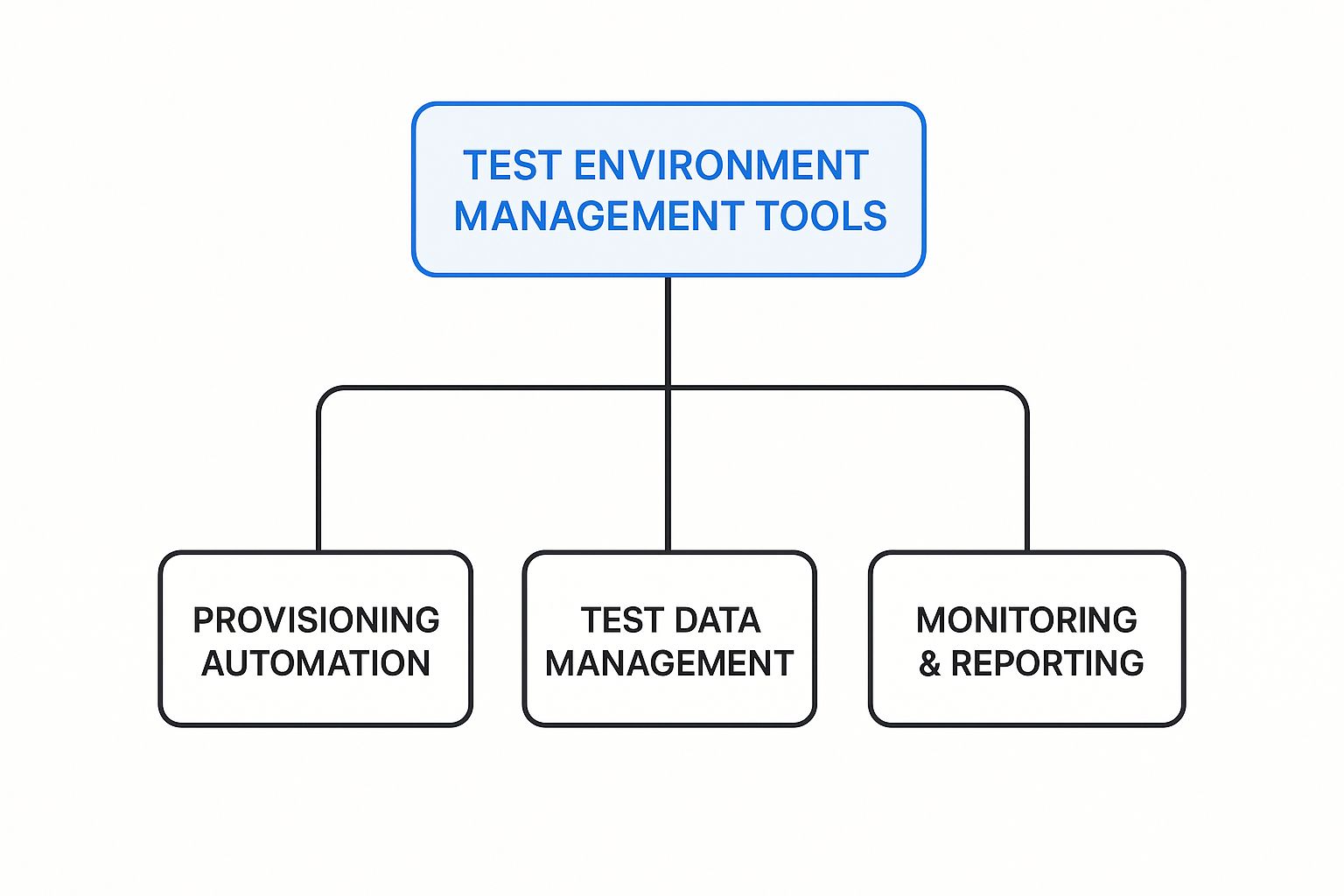
This infographic highlights the three core categories of test environment management tools. Notice how effective test environment management hinges on a combination of provisioning automation, test data management, and tools for monitoring and reporting. These three areas work together to streamline the entire process, from setting up the environment to analyzing results and identifying areas for improvement.
To help you understand the different types of test environments and their uses, let’s look at a comparison table:
Test Environment Types and Use Cases Comparison A comprehensive comparison of different test environment types, their optimal use cases, resource requirements, and management complexity
| Environment Type | Primary Use Case | Resource Requirements | Management Complexity | Typical Lifespan |
|---|---|---|---|---|
| Development | Unit testing, component testing | Low | Low | Short |
| Integration | Integration testing, system testing | Medium | Medium | Medium |
| Staging | User acceptance testing, performance testing | High | High | Long |
| Production | Monitoring, real-user testing | Very High | Very High | Permanent |
This table summarizes the key differences between environment types, allowing teams to choose the right environment based on their specific testing needs. Notice the increasing resource requirements and complexity as you move closer to production.
Balancing Automation and Human Oversight
While automation is key for efficiency, human oversight is still crucial. Think of a self-driving car. It handles many driving tasks automatically, but a human driver is still needed in tricky situations. Apply the same principle to test environment management. Automate repetitive tasks, but keep human oversight for strategic decisions and troubleshooting complex issues. This balance ensures efficient use of resources while maintaining the flexibility to handle unexpected situations.
This screenshot shows the Kubernetes website, a platform for managing containerized applications. Kubernetes can play a vital role in test environment management by automating the deployment, scaling, and management of these applications. This helps create consistent and reproducible test environments, reducing the risk of environment drift and leading to more reliable test results.
Aligning With Development Workflows and Business Constraints
Your test environment strategy needs to align with how your development teams work and your business constraints. Just like a city’s infrastructure must accommodate different modes of transportation and budget limitations, your test environment management must support various development methodologies (like Agile or Waterfall) and stay within budget. This requires careful planning and prioritization, making smart choices that optimize resource allocation while meeting business goals. Effective test environment management is a key factor in how quickly your team can develop and release high-quality software. By building a solid strategy, you can transform your testing process from a source of frustration into a strategic advantage.
The Test Environment As A Service Revolution

This screenshot of AWS Device Farm shows a perfect example of Test Environment as a Service (TEaaS). See how it lets you test on a huge range of real devices? That’s a core benefit of TEaaS. It helps developers find device-specific bugs early, so users have a smooth experience on any platform.
This move towards service-based testing is changing how companies manage their test environments. Instead of struggling with in-house infrastructure, they’re choosing the flexibility and affordability of TEaaS.
Think of it like the shift to cloud computing. Businesses used to run their own servers. Now, they rely on cloud providers. TEaaS does the same for testing: it gives everyone access to advanced testing, not just big companies with huge budgets. Even startups can now run high-end performance tests without buying expensive hardware. This levels the playing field, giving smaller teams the same testing power as the big players.
Key Drivers of TEaaS Adoption
So, what’s pushing this change? Several things. Modern software is getting more complex. Think microservices, containers, and cloud-native apps. These need dynamic, scalable test environments. TEaaS providers are experts at managing this complexity, so internal teams can focus on building and testing software.
The cost savings are also a big draw. Switching from big upfront investments to a pay-as-you-go model lets companies lower initial costs and scale testing as needed. This is huge in today’s fast-paced development world, where speed is everything.
This rapid growth is clear in the market. TEaaS has quickly become a multi-billion-dollar industry. By 2024, it was worth USD 15.2 billion and is predicted to hit USD 62 billion by 2033. Discover more insights on TEaaS market growth. This explosion shows how important TEaaS is becoming for modern software development.
Evaluating TEaaS Providers
Picking the right TEaaS provider is crucial for success. Good teams consider several factors:
- Range of services offered
- Security certifications
- Service level agreements
- Integration with current tools and workflows
Moving from your own infrastructure to a service takes careful planning. Teams must assess their testing needs, find potential compatibility problems, and create a smooth migration strategy. It’s also vital to measure TEaaS’s impact on development speed and operating costs. Tracking things like test execution time, environment setup time, and infrastructure costs shows the value of TEaaS and justifies the investment.
Tools And Technologies That Deliver Real Value
Choosing the right tools for test environment management can feel like navigating a dense jungle. Vendors promise the moon, but separating reality from marketing hype can be tough. Let’s explore some tools that genuinely deliver, based on real-world feedback, and discuss why some fall short.
Containerization and Orchestration: A Powerful Partnership
Imagine building with LEGOs. Each brick is a self-contained unit, and you can combine them to create complex structures. Containerization platforms like Docker work similarly. They package applications and their dependencies into isolated containers, guaranteeing consistency across different environments. This eliminates the dreaded “it works on my machine” scenario.
This screenshot from Docker’s website highlights how easy it is to build, share, and run containerized applications. Docker’s simplicity and portability make it a favorite for building reliable test environments. Because your development, testing, and production environments are consistent, your test results are more dependable.
Orchestration tools like Kubernetes take containerization to the next level. They automate the deployment, scaling, and management of containerized applications. Think of Kubernetes as the conductor of an orchestra, making sure each instrument (container) plays its part harmoniously. This is especially crucial for complex microservice architectures, where managing multiple interconnected services can be a real headache.
Choosing the Right Tools: More Than Just a Checklist
Effective teams go beyond simply checking off features on a vendor’s list. They consider practical factors like:
-
Learning Curve: How quickly can your team get up to speed with the tool? A steep learning curve can hinder adoption and lead to frustration.
-
Maintenance Overhead: How much effort is required to keep the tool running smoothly? High-maintenance tools can drain resources and distract from other important tasks.
-
Integration Complexity: Does the tool play well with your existing systems and workflows? Seamless integration is key for efficiency and minimizing disruption.
Building a Sustainable Tool Stack: Smart Growth
Creating a sustainable tool stack is like building a house. You need a solid foundation and the flexibility to expand later. Start with essential tools that solve your most pressing problems, such as automating environment provisioning or managing test data.
Then, gradually add tools that enhance specific areas of your testing, like performance or security testing. Our ultimate guide to load testing APIs provides further insights into this process.
Don’t fall into the trap of chasing every shiny new tool. Focus on building a cohesive workflow where tools work together seamlessly, rather than a jumbled mess of disconnected solutions. This allows your tool stack to grow with your needs without becoming a maintenance nightmare.
To help you make informed decisions, let’s look at a comparison of some popular test environment management tools:
Popular Test Environment Management Tools Comparison A detailed comparison of leading test environment management tools, their key features, pricing models, and best-fit scenarios
| Tool Name | Key Strengths | Best Use Case | Pricing Model | Learning Curve |
|---|---|---|---|---|
| Docker | Containerization, portability, ease of use | Building and deploying consistent environments | Open source (Community Edition), Subscription (Business) | Relatively easy |
| Kubernetes | Orchestration, automation, scalability | Managing complex containerized applications | Open source | Moderate to steep |
| Azure DevOps | Comprehensive CI/CD platform, integration with Azure services | Teams heavily invested in the Microsoft ecosystem | Subscription-based | Moderate |
| AWS CodePipeline | Comprehensive CI/CD platform, integration with AWS services | Teams using AWS infrastructure | Pay-as-you-go | Moderate |
This table highlights the key differences between several popular tools, helping you consider which might best fit your specific needs. Each tool offers unique strengths and is better suited for certain use cases. Remember to consider factors like existing infrastructure, team expertise, and budget when making your decision.
By focusing on practical needs and building gradually, you can create a test environment management tool stack that delivers real value and empowers your team to build high-quality software.
Operational Practices That Transform Testing Operations
This section dives into the practices that help testing operations evolve from reactive problem-solving to proactive, predictable processes. Think of these practices as the secret sauce used by high-performing teams to achieve smooth and efficient testing. They establish control without stifling innovation, allowing teams to adapt and scale while keeping everything reliable.
Governance That Fosters Innovation
Effective test environment management requires a delicate balance. It’s like running a city: you need rules and regulations (governance), but you also want to encourage creativity and growth (innovation). Top-performing teams establish clear guidelines: who can access and change environments, what changes need approval, and how resources are allocated. This prevents chaos and ensures consistency, but doesn’t squash the experimentation essential for rapid development.
Monitoring and Alerting: Early Warning Systems
Think of a smoke detector: it warns you of a problem before it becomes a raging fire. Similarly, robust monitoring and alerting for your test environments can catch issues early. These systems track key metrics like resource usage, application performance, and error rates. When something goes off-kilter, alerts are triggered, giving teams time to react and prevent small glitches from escalating into major outages.

This screenshot shows the Jenkins website, a popular open-source automation server frequently used in CI/CD pipelines. Jenkins can automate many parts of test environment management, from provisioning and setup to deployment and testing. This helps maintain consistency across different environments, reducing manual work and errors.
Documentation That Empowers, Not Confuses
Good documentation is like a well-organized toolbox: you can quickly find the right tool for the job. Clear, concise, and up-to-date documentation is crucial for efficient troubleshooting in test environment management. This includes details on environment configurations, dependencies, known issues, and troubleshooting steps. It empowers teams to solve problems quickly, instead of creating more confusion.
Environment Lifecycle Management: From Cradle to Grave
Just as products have lifecycles, so do test environments. Environment lifecycle management encompasses the entire process, from creation and setup to decommissioning and retirement. This ensures resources are used efficiently and environments are consistently configured. Defined processes for requesting, setting up, using, and shutting down test environments prevent conflicts and minimize waste.
Balancing Standardization and Flexibility
Standardization brings consistency and reduces complexity. But too much can stifle innovation. The best teams find the sweet spot. They standardize core elements, like operating systems and base configurations, but allow for flexibility where needed for different projects. This keeps environments manageable while still meeting diverse testing requirements.
Building Scalable and Adaptable Processes
As your organization evolves, so must your test environment management processes. Build processes that can scale with demand and accommodate new technologies and testing needs. Automate wherever possible, use tools that enable self-service provisioning, and design environments that can easily scale up or down. This creates a resilient and adaptable test infrastructure ready for future growth.
Incident Response, Change Management, and Continuous Improvement
Effective incident response is like a well-rehearsed fire drill: it helps you react quickly and efficiently in emergencies. Established procedures for environment-related incidents minimize disruption and speed up recovery. Combine this with solid change management, ensuring all changes are documented, reviewed, and approved beforehand, reducing the risk of unintended problems. Finally, commit to continuous improvement. Regularly evaluate your test environment management practices, find areas to improve, and make changes to boost efficiency and effectiveness. This creates a culture of learning and optimization.
Measuring Success and Driving Continuous Improvement
Imagine steering a ship. You wouldn’t rely solely on a map, right? You’d also need instruments like a compass and speedometer to track your progress and ensure you’re on course. Test environment management is similar. Just checking if your environments are “up” isn’t enough. You need to measure how well they’re truly serving your team and your goals.
Establishing Meaningful Baselines
Before you can improve anything, you need a starting point. Think of it like setting your ship’s log at the beginning of a voyage. This is where baselines come in. By collecting data on key performance indicators (KPIs), you create a snapshot of your current test environment effectiveness. These KPIs might include things like how long it takes to set up a new environment, how often environment-related problems occur, or even how happy developers are with the tools they’re using.
This baseline becomes your reference point. It lets you track progress over time and demonstrate the value of your test environment management efforts. For instance, if it takes a week to set up a new environment, that’s a clear sign of a bottleneck. With data in hand, you can make informed decisions and focus on improvements that matter most.
Tools like Grafana provide dashboards for visualizing these key metrics. The screenshot above shows an example. Being able to see trends in environment uptime, resource usage, and error rates empowers teams to quickly spot and address problems that impact testing.
Identifying KPIs That Matter
Just like a ship’s captain needs the right instruments, you need to choose the right KPIs for your test environment. These will vary depending on your specific goals. Some common ones to consider include:
- Environment Uptime: This measures how often your test environments are available.
- Environment Provisioning Time: How long does it take to spin up a new environment?
- Test Execution Time: How quickly can your tests run within the environment?
- Defect Escape Rate: How many bugs slip through testing and make it into production?
- Developer Satisfaction: How satisfied are your developers with the testing environment?
These metrics provide valuable insights into your test environment’s effectiveness, helping you pinpoint bottlenecks and areas for improvement. Focusing on the right KPIs ensures your efforts deliver maximum impact. For instance, if your test execution time is slow, perhaps you need better hardware or optimized test scripts.
Gathering Actionable Feedback and Demonstrating Value
Regularly checking in with your development team is essential. This isn’t just about sending out satisfaction surveys. You need to dig deeper. How much time are developers wasting wrestling with environment issues? What frustrates them most about the current tools or processes? This feedback helps identify bottlenecks that directly affect how quickly you can deliver software.
The value of dedicated test environment management and specialized tools is increasingly recognized. More organizations are investing in this area because they understand how crucial effective testing is for software quality and project timelines. The market for test environment management is expected to grow steadily through 2031, with continuous advancements in cloud-based solutions, automation, and integration with CI/CD pipelines. Discover more insights on the TEM market
This information is powerful ammunition when requesting budget or advocating for improvements. Demonstrating how better test environment management reduces production issues, accelerates releases, and boosts team productivity resonates with decision-makers. Data-backed arguments always carry more weight than anecdotes.
Building a Culture of Continuous Improvement
The ultimate goal isn’t just about tracking numbers; it’s about fostering a culture of continuous improvement. High-performing teams regularly review their test environment management practices. They look for ways to optimize and refine their approach based on data, not guesswork. This involves evaluating new tools, experimenting with different processes, and consistently gathering feedback. This iterative approach ensures that the test environment remains a strategic asset, not a bottleneck, for quality software development.
Ready to take your testing to the next level? Explore how GoReplay can help you capture and replay live HTTP traffic, creating realistic test environments that accurately reflect real-world user behavior.