
Test and QA: How Testing and Quality Assurance Differ
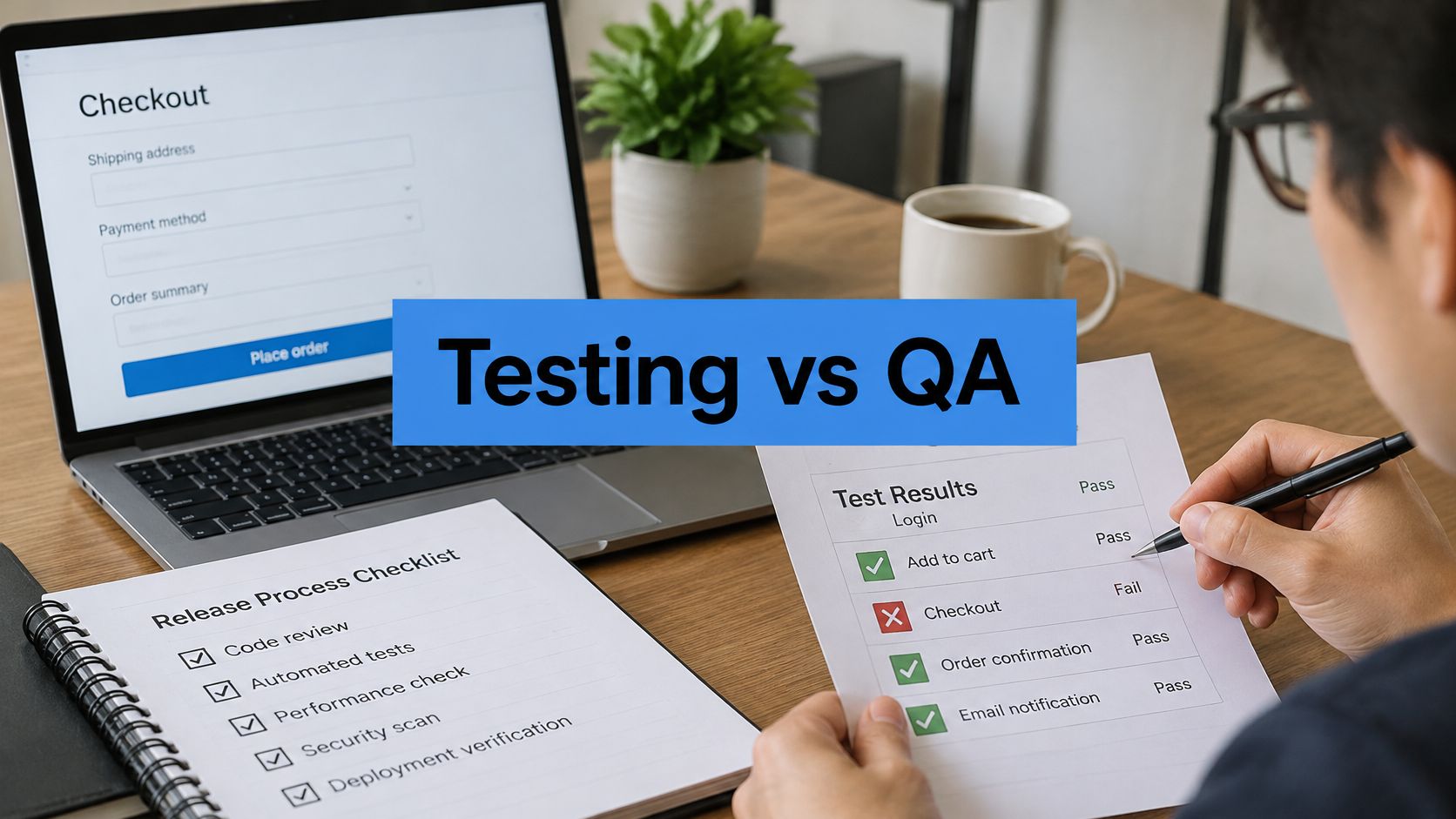
If every test passes, why can customers still end up with software that doesn’t meet their needs? Because checking a product and creating the conditions for building a good product are different jobs.
Teams often use testing and quality assurance, or QA, interchangeably. That confusion makes prevention easy to undervalue: a tester can show a broken checkout, but a careful requirements review may leave nothing dramatic to show because the defect never gets built.
How They Differ and Relate
Testing checks whether a built product behaves as specified, while also exploring risks and unexpected behavior. Quality assurance designs and governs the process that makes quality likely, from requirements through production feedback.
The distinction is about the question you’re answering, not the title on your badge. A QA engineer can spend the morning testing a feature and the afternoon improving how the team reviews requirements.
Testing versus quality assurance on the same criteria
| Aspect | Software testing | Quality assurance |
|---|---|---|
| Question answered | Does the built software behave as specified? | Does our process reliably produce quality software? |
| Focus | Defects in a specific build or feature | Process, standards, prevention and improvement |
| Timing | Mainly during build, integration and before release | Across the whole lifecycle, from requirements onward |
| Typical activities | Writing and running test cases, logging defects, regression checks | Defining standards, reviewing requirements, auditing process, measuring trends |
| Typical output | Test results and defect reports | Quality plan, entry and exit criteria, process changes |
| Typical owner | Testers and QA engineers | QA lead with the whole team |
The question row separates product evidence from process confidence. Testing asks what happened when someone exercised the software; QA asks whether the team’s way of working reliably addresses quality risks.
The focus row explains why finding a broken checkout button is testing, while noticing that checkout defects repeatedly escape because acceptance criteria are vague is QA. Fixing the button addresses that defect; changing the requirements review addresses a recurring cause.
Timing isn’t a strict boundary. Testers can examine prototypes and requirements early, and QA work continues after release through incident reviews and process improvement.
The activities and outputs also differ. A defect report describes an observed problem, while a quality plan defines responsibilities, standards, and the evidence needed before work moves forward.
Finally, ownership means accountability, not exclusive permission. Developers, product managers, operations engineers, and testers all contribute, even when a QA lead coordinates the process.
Think of a building inspection
Before people occupy a building, someone checks whether doors open, alarms work, and installed systems behave correctly. That final walkthrough resembles testing.
The broader quality system includes blueprint reviews, material inspections, safety rules, contractor training, and checks during construction. QA resembles that whole arrangement, with testing providing evidence inside it.
Practical rule: Detection finds a problem that exists. Prevention changes the conditions that would allow a problem to enter the product.
Neither job is more important by definition. A carefully documented construction process won’t reveal whether someone installed a faulty alarm unless someone checks it.
Follow a login feature
Before development, QA work might uncover ambiguity in a requirement such as allowing users to recover access securely. The team must decide what happens when a recovery link expires, an account is locked, or someone requests another link.
During implementation, developers follow a password-handling standard and review security-sensitive changes. Testers then exercise valid logins, invalid credentials, recovery flows, and unexpected sequences to discover what slipped through.
Testing without QA can leave the team rediscovering the same categories of defects. QA without testing leaves the team with confidence in its procedures but little evidence about the actual software.
This is why prevention needs visible artifacts: clarified acceptance criteria, recorded design decisions, and process changes tied to recurring failures. Otherwise, people may mistake the absence of incidents for the absence of useful work.
Testing finds problems in what was built; QA shapes how it gets built and whether the team learns from those findings. In your current workflow, which activities prevent problems, and which only detect them?
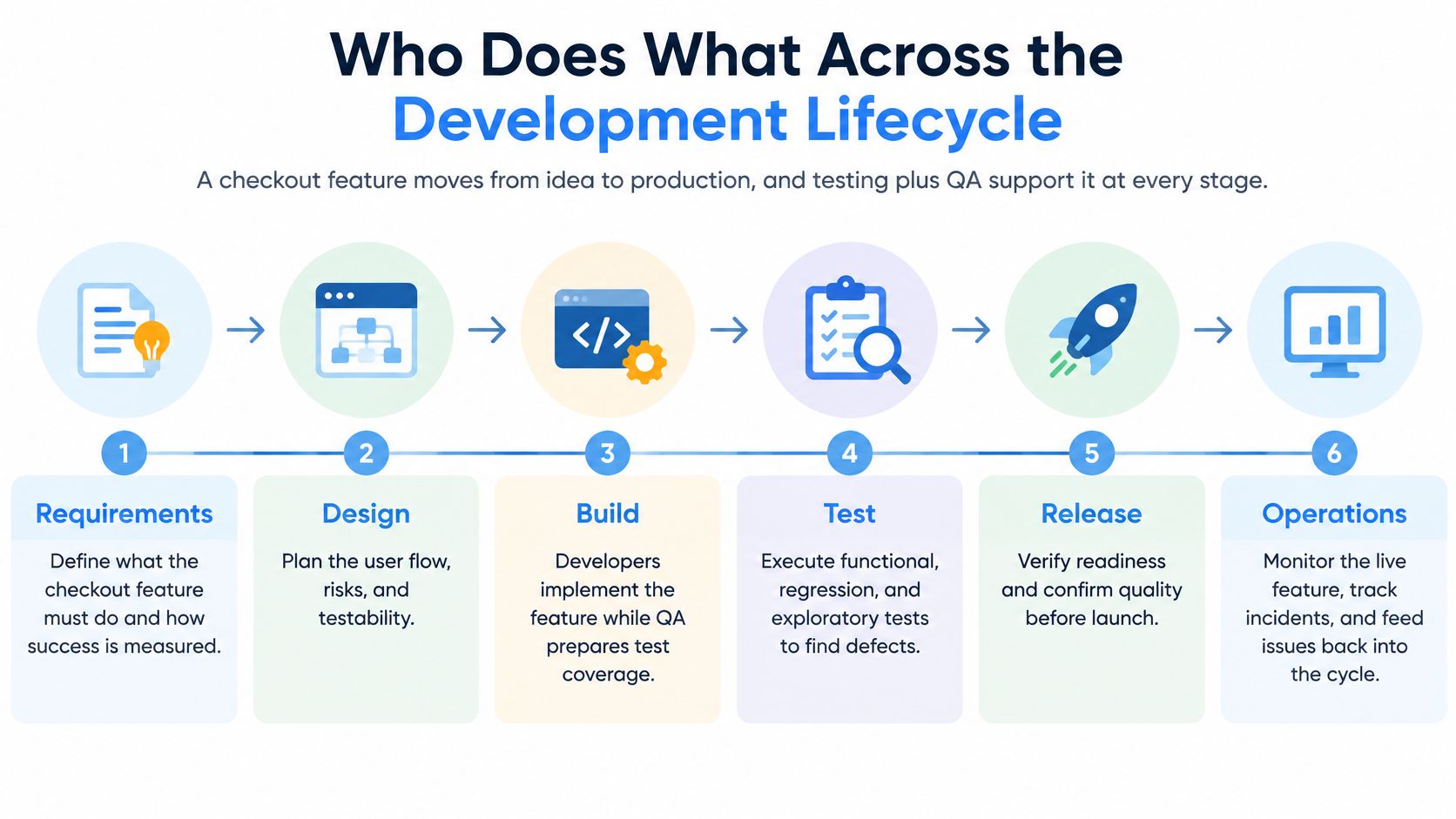
Who Does What Across the Development Lifecycle
A checkout feature moves from idea to production, and testing plus QA support it at every stage.
The handoffs matter as much as the individual tasks. If nobody owns the transition from an approved design to a testable implementation, developers and testers can make different assumptions about the same checkout behavior.
Use the lifecycle as a shared ownership map.
Testing and QA activities by lifecycle phase
| Phase | Testing activity | QA activity |
|---|---|---|
| Requirements | Draft test scenarios from acceptance criteria | Review criteria for clarity and testability |
| Design | Identify risky flows and data needs | Check design against quality standards and risk |
| Development | Developers write unit and integration tests | Enforce coding standards and run pair reviews |
| Build and integration | Run automated regression and API tests | Track flake rate, coverage gaps and test health |
| Release | Run smoke and performance checks | Apply go or no-go criteria and sign-off rules |
| Operations | Analyze incidents and replay production traffic | Lead root-cause reviews and feed lessons back |
Make each handoff explicit
At requirements, the product manager explains what a successful purchase means. Testers draft scenarios such as a declined payment followed by a retry, while the QA owner checks whether the expected outcome is unambiguous.
At design, engineers decide how payment, inventory, and order creation interact. Testers identify risky interruptions; QA checks whether the design provides ways to observe failures and recover safely.
During development, developers test calculations and service interactions. Coding standards and pair reviews help the team examine concerns such as duplicate submissions before those concerns become release surprises.
The software testing life cycle provides a complementary view of how testing work is planned, prepared, executed, and completed. It shouldn’t become a separate queue that starts only after developers declare their work finished.
Don’t let responsibility disappear between teams
During build and integration, an automated checkout failure needs an investigator, not just a red pipeline indicator. The QA owner should also identify missing coverage, unhealthy tests, and environment problems that make those results difficult to interpret.
At release, smoke checks establish whether essential paths work in the release environment. The release decision-maker applies agreed criteria and records any accepted risks, rather than asking a tester for an undefined assurance that everything is fine.
In operations, engineers investigate payment failures and unexpected order states. QA work turns those findings into changes to requirements, design checks, or release controls.
A small team doesn’t need a separate person for every responsibility. It does need named owners, especially where one person assumes another has checked something.
Common Misconceptions About Testing and QA
The easiest way to confuse testing and QA is to describe both as making sure everything works. That phrase hides the work, the evidence, and the limits of what anyone can reasonably promise.
These misconceptions lead to concrete management mistakes:
- QA is just testing at the end. QA includes upstream standards and reviews, so treating it as a final inspection leaves preventable misunderstandings untouched until implementation is complete.
- Testing at the end guarantees quality. Late checks can reveal problems but can’t retroactively clarify requirements without rework, so a release deadline becomes a negotiation over unfinished decisions.
- QA means hiring more testers. More testers add investigation and detection capacity, but recurring process failures continue unless someone changes how the team works.
- Automation replaces QA judgment. Automated checks execute the scenarios people encode, so an overlooked risk remains overlooked even when the suite runs frequently.
- A passing suite proves the software is correct. Passing establishes that checked conditions held in that execution, so treating it as universal proof creates unjustified confidence about untested behavior.
A passing test is evidence about the cases tested, not a verdict on the product.
Listen to the questions people ask
A meeting dominated by test counts and completion percentages can miss the customer’s actual problem. Ask what the checks establish, which important behaviors remain uncertain, and who is accepting that uncertainty.
For example, a checkout suite might validate successful card payments without exploring what happens when the payment succeeds but the confirmation request times out. Adding more successful-payment cases won’t answer that question.
You can spot the underlying misconception when someone says QA will handle it after development, or asks whether everything has been tested. Replace those statements with specific questions about risk, evidence, and ownership.
Why Defects Cost More the Later They Are Found
A 2002 NIST-commissioned study estimated that software defects cost the U.S. economy approximately $59.5 billion annually, about 0.6% of GDP at the time, with more than half of the costs attributed to defects discovered downstream, according to the NIST report on inadequate software testing infrastructure. This was a historical economic estimate, not a current forecast or a budget formula for an individual team.
A useful bug report connects an observed failure to the release decision.

The fix isn’t the whole cost
A flaw spotted on a building sketch might require an eraser and a revised drawing. Find that flaw after construction, and someone must remove finished work, coordinate repairs, and check whatever the repair disturbed.
Software has a similar pattern, although not every defect becomes more expensive with time. Correcting a misunderstood checkout rule before implementation is different from repairing affected orders, reconciling payments, and helping customers after release.
The distinction matters because engineering effort is only part of the consequence. Support staff, operations teams, and customers may all need to spend time recovering from the failure.
Economic lens: Evaluate a defect by the work and disruption it creates, not just the time needed to edit the code.
Specific feedback also reduces avoidable investigation. For interface issues, teams can use PinDrop to pin client comments on live websites, then turn that contextual feedback into reproducible reports with expected behavior, browser details, and impact.
Use the video as a prompt for discussing where your team discovers problems.
The practical response isn’t to move every check earlier regardless of usefulness. Review decisions while they’re still easy to change, then verify the integrated product under realistic conditions.
Testing and QA are economic controls, not administrative ceremonies. They help teams avoid rework and customer-facing failures while preserving evidence for release decisions.
Keeping Test Results Trustworthy
A suite that fails randomly trains people to ignore failures. Eventually, someone reruns a build until it turns green without understanding what changed.
In Google’s continuous-integration environment, nearly 16% of its 4.2 million tests exhibited some flakiness, and 84% of pass-to-fail transitions were associated with flaky tests rather than deterministic code changes, according to Google’s study of flaky tests. Those findings describe Google’s environment, but the operational question applies broadly: can your team trust a failure enough to investigate it?
Establish a repeatable evidence chain
- Capture a baseline with context. Preserve the relevant traffic slice, timestamps, session boundaries, dependency behavior, and build identity so investigators can reconstruct the conditions.
- Control the replay environment. Isolate test data, control clocks where practical, stabilize dependency responses, and repeat the capture against the current build; record concurrency and request ordering rather than assuming they’re equivalent.
- Measure performance and compare outcomes. Compare response codes, latency distributions including p95 and p99, and application state against explicit expectations, because a successful replay alone does not establish correctness.
- Classify failures before trusting them. Reproduce a failure under the same traffic slice and environment before treating it as a confirmed regression; quarantine an unreliable check while retaining telemetry and an investigation owner.
An intermittent failure still deserves attention. Correlation with a particular session or timing window may indicate a race condition, not merely a defective test harness.
Track flake rate separately from defect yield. Otherwise, repeated retries can make the pipeline appear healthy while obscuring how often checks produce misleading results.
Protect the capture without breaking the scenario
Before replay, mask identifiers, tokens, and payment data, and remove requests that could trigger uncontrolled external effects. Preserve session relationships through consistent substitutions, so a login request and its later checkout still belong to the same simulated user.
Verify that transformed payloads retain the structures and edge cases you intend to test. A privacy-safe sample that removes every difficult interaction won’t answer the original testing question.
The discipline needed to control software quality includes defining what counts as acceptable evidence. A reliable result identifies the build, inputs, environment, expected outcome, observed outcome, and any remaining uncertainty.
Setting Up Testing and QA Roles in Your Team
You don’t need to reorganize the department to separate these responsibilities. Start with a release your team already understands, and make its decisions and handoffs explicit.
The useful deliverable is a working agreement, not a new collection of job titles. Developers should know which evidence they must produce, testers should know what they’re investigating, and release owners should know which risks require a decision.
Turn responsibilities into operating rules
-
Assign named owners across the lifecycle. Map each phase to someone accountable for testing evidence and someone accountable for the QA process, even when the same person holds both responsibilities. For checkout, explicitly assign ownership of payment-provider assumptions, test-data preparation, and release-risk acceptance so none of those tasks falls between teams.
-
Write usable entry and exit criteria. Require reviewed acceptance criteria before development begins, and define the defect, performance, and test-health conditions needed before release. Set a flake-rate threshold appropriate to your pipeline and identify who can approve an exception, with the reason and follow-up recorded.
-
Make the flaky-test policy operational. Give the team a documented path for reproducing failures, quarantining unreliable checks with telemetry intact, and tracking flakiness separately from confirmed defects. Assign someone to review quarantined tests so quarantine doesn’t become permanent storage for unanswered questions.
-
Add production-like verification for risky changes. For a hypothetical API infrastructure migration, select a representative capture window, then use a tool such as GoReplay, which captures HTTP traffic and replays it into an isolated test environment, to compare behavior before cutover. ResDiary used GoReplay to validate infrastructure requirements for its RackSpace-to-Azure migration and successfully migrated its UK and Australia regions.
Make prevention visible without inventing savings
Record important changes that happen before implementation: an ambiguous retry rule clarified, a missing rollback requirement added, or an unsafe dependency assumption challenged. Don’t claim those actions prevented a precise number of bugs; explain the risk addressed and the decision changed.
Review those records alongside escaped defects and release exceptions. That gives prevention work a place in engineering discussions without turning QA into a contest over document counts.
Which phase currently has no QA owner? Name it, assign an accountable person this week, and agree on the evidence they’ll bring to the next release review.
GoReplay offers HTTP traffic capture and replay so your team can test changes against production-derived behavior in an isolated environment. Visit GoReplay to explore the workflow, then choose a risky API or infrastructure change and define the response, performance, and application-state evidence you’ll require before release.