
Technical Recruiting Agency Guide for IT

The popular advice is to choose a technical recruiting agency that can send the most résumés, move fastest, or claim the largest talent network. That advice solves the wrong problem. Engineering leaders don’t need more keyword matches. They need evidence that a candidate can debug a failing service, reason about production risk, protect sensitive data, and make sound trade-offs when the system behaves differently from the diagram.
A recruiting partner earns its fee only when it improves that signal without slowing the team down. The right agency acts as an extension of engineering, not as a forwarding address for LinkedIn profiles. It understands the role, tests the relevant skills, documents its reasoning, and keeps candidates engaged while your interview loop does its work.
Table of Contents
- The Reality of Technical Recruiting Agencies
- Market Scale and the Demand for Engineering Talent
- Comparing Technical Engagement Models and Pricing
- How TekRecruiter Can Help
- Validating Real Engineering Ability Over Keywords
- Managing Recruiter Capacity and Hiring Velocity
- Building Sustainable Technical Talent Pipelines
- The Engineering Leader RFP and KPI Checklist
The Reality of Technical Recruiting Agencies
Many staffing firms can identify people who have worked with Python, Kubernetes, AWS, or React. Far fewer can determine whether someone understands the operational consequences of using those tools. A résumé may show experience with distributed systems, but it won’t tell you how the engineer approaches a partial outage, a noisy alert, an unsafe migration, or a regression hidden behind an apparently healthy dashboard.
That distinction matters because generalist recruiting rewards surface similarity. A recruiter compares the job description with a profile, asks how many years the candidate has used a technology, and forwards the match. A technical recruiting agency should do something more demanding. It should clarify what the engineer will own, identify the failure modes that matter, and test for the habits that keep production systems reliable.

What technical specialization should mean
Specialization isn’t demonstrated by putting “technology” in an agency’s name. It appears in the questions a recruiter asks before sourcing begins.
For an SRE search, the recruiter should understand on-call ownership, observability, incident response, capacity planning, and deployment controls. For QA automation, the conversation should include test isolation, flaky-test diagnosis, environment management, and release confidence. For backend engineering, the agency should distinguish API design from production operation, and implementation speed from safe change management.
The recruiter doesn’t need to replace the hiring manager. The recruiter does need enough fluency to separate meaningful evidence from polished vocabulary.
Practical rule: Ask an agency to explain what evidence would make it reject a candidate who matches every required keyword.
A credible answer includes observable behaviors. The candidate might need to explain a difficult incident, review a small code change, interpret latency data, or design a test around realistic traffic. “The résumé looks strong” isn’t a screening method.
The hidden cost of weak validation
Low-signal submissions consume more than interview time. Engineers stop trusting the agency, hiring managers spend meetings correcting basic misunderstandings, and qualified candidates wait while the team works through unsuitable profiles. The agency may appear productive because it sends volume, while the client absorbs the cost of evaluation.
The strongest partnerships begin with a calibrated intake. Define the system boundary, the first problems the hire will face, the technologies that are absolutely essential, and the risks the person must manage without constant supervision. Then require the agency to return evidence against those criteria, not a generic candidate summary.
A useful partner can tell you why a candidate is suitable, where the evidence is incomplete, and what your team still needs to test. That honesty is more valuable than confident language, because production-readiness can’t be inferred from titles alone.
Market Scale and the Demand for Engineering Talent
Technical recruiting agencies sit inside a large labor-market intermediary, not a narrow niche serving occasional software searches. The global IT staffing market was estimated at approximately $123.3 billion in 2025, with projected growth to $152.47 billion by 2031, a compound annual growth rate of 3.61%, according to Mordor Intelligence’s IT staffing market analysis. North America represented 44.05% of global revenue in 2025, while Asia-Pacific was forecast to expand at 8.15% annually through 2031, based on the same source.
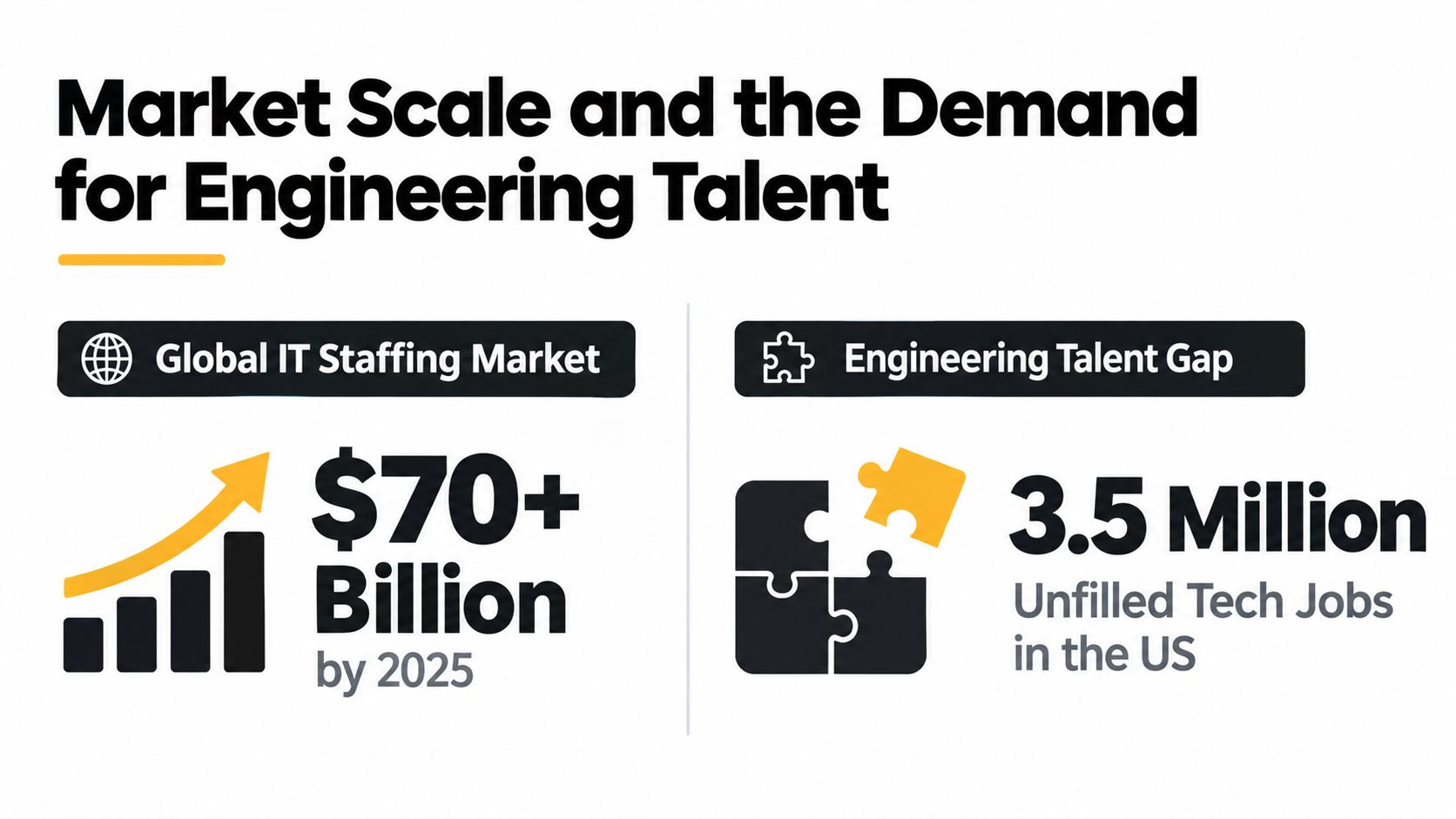
Software developers accounted for 37.05% of IT staffing demand in 2025. That share explains why agencies have become operationally important to companies modernizing cloud platforms, shipping software, improving cybersecurity, and building data products. Internal recruiting teams may understand the business well, but they can’t always maintain specialist sourcing coverage while engineering leaders are also trying to deliver roadmaps.
Why scale changes the buyer’s position
The U.S. market shows how established this intermediary has become. In 2023, the U.S. IT staffing market was estimated at more than $41.5 billion, and the country had nearly 26,000 staffing and recruiting agencies overall. Approximately 57% operated in temporary and contract staffing, according to AltLINE’s overview of IT staffing industry trends.
The broader U.S. staffing industry generated roughly $186 billion in sales in 2023 and supported approximately 12.7 million temporary and contract workers during that year. Technology demand accelerated earlier in the decade, with U.S. IT staffing revenue increasing 17% in 2021 and another 16% in 2022, as cloud services, remote work, software delivery, and digital infrastructure expanded.
The market is both broad and concentrated. In 2021, 71 U.S.-based IT staffing firms reported more than $100 million in revenue, and those firms generated $36.4 billion together. Thousands of agencies can compete for business, while large providers retain considerable enterprise reach.
What this means for engineering leaders
Scale gives an agency access to candidate networks, recruiters, contract administration, and geographic coverage. It doesn’t automatically give the agency technical judgment. A large database can find more people who mention Go or Terraform. It can’t, by itself, determine whether those people design safe rollbacks or understand the consequences of replaying sensitive traffic in a test environment.
That distinction should shape procurement. Buy reach when the role is geographically broad, urgent, or contract-heavy. Buy specialization when the position involves a difficult technical domain or a high cost of failure. For either purchase, require proof that the people working on your search understand the role well enough to protect engineering time.
The agency’s size also affects negotiating advantage. Enterprise providers may offer useful infrastructure but assign a search to a generalist team. A boutique may provide deeper calibration but lack capacity for a large hiring program. The correct choice isn’t the biggest logo. It’s the provider whose operating model matches your technical risk, hiring volume, and need for hands-on validation.
Comparing Technical Engagement Models and Pricing
The engagement model determines where the agency carries risk, how much attention the search receives, and what behavior the fee structure encourages. Don’t select a model because it sounds standard. Select it based on role scarcity, confidentiality, urgency, and your team’s ability to evaluate candidates.
| Model | Best use case | Pricing structure | Risk profile |
|---|---|---|---|
| Retained search | Confidential executive, principal, or unusually specialized searches | Agreed fee paid in stages, usually with an upfront commitment | Lower candidate-competition risk, higher commitment if the search changes |
| Contingent recruitment | Clearly defined individual-contributor roles where several agencies or internal channels can source candidates | Fee due when a hire starts | Lower upfront financial exposure, but incentives can favor speed and submission volume |
| Contract-to-hire | Uncertain headcount, urgent delivery needs, or a role that benefits from observing performance before conversion | Hourly or periodic contractor cost, with conversion terms agreed in advance | More flexibility, but higher coordination and onboarding demands |
Retained search
Retained search is appropriate when discretion and judgment matter more than a fast stream of profiles. A principal infrastructure architect, security leader, or senior engineering executive may require market mapping, passive-candidate outreach, reference work, and a carefully managed candidate experience. Paying for dedicated attention can prevent a critical search from being treated as one requisition among many.
The trade-off is commitment. If the role changes halfway through the process, you may have already paid for work that can’t be recovered. Define the research deliverables, communication cadence, replacement terms, and conditions for pausing the search before signing.
Contingent recruitment
Contingency works best when the job specification is stable and the agency can access candidates your team isn’t reaching. It preserves cash until a hire is made, but the agency may be competing against other suppliers. That can produce useful urgency, or it can produce duplicate outreach and shallow screening.
Limit the number of agencies working on one role. Give each partner a clear candidate-ownership policy, require written evidence for submissions, and make the interview feedback loop fast enough that the agency can recalibrate. A contingent agreement should also state whether the replacement guarantee is a refund, a replacement search, or a credit, and what happens if the candidate leaves voluntarily.
Contract-to-hire
Contract-to-hire is useful when delivery pressure is immediate or when the team wants to observe collaboration, code quality, and operational discipline before making a permanent decision. It can expose fit issues that interviews miss, especially for roles involving on-call work, release coordination, or cross-team debugging.
The cost isn’t only the rate. Plan for access controls, onboarding, mentoring, documentation, and the manager’s time. The agreement should cover conversion restrictions, intellectual property, confidentiality, termination notice, and what happens to work in progress. “No conversion restrictions” sounds attractive, but the actual contract language controls the outcome.
A low upfront fee doesn’t make a search inexpensive. Count interview time, coordination, replacement risk, and the cost of a bad technical hire before comparing proposals.
Ask each agency to price the work transparently. You need to know what the fee covers, who performs the technical screen, what evidence you receive, and how the agency remains accountable after placement. The best commercial model is the one that aligns payment with the quality and level of service your role requires.
How TekRecruiter Can Help
TekRecruiter is a staffing and recruiting agency focused on technology, engineering, product, go-to-market, and leadership roles. Its stated specialization includes software engineering, AI engineering, DevOps, SRE and cloud infrastructure, data, SDET and test automation, cybersecurity, product, technical account roles, and technology leadership.
The useful question isn’t whether an agency lists your stack. It’s whether its process produces evidence your hiring team can evaluate. TekRecruiter describes an approach built around deep candidate conversations, asking people to explain how their work was built, why decisions were made, and what the work did for the business. It also describes an internal screening framework based on high agency, execution, accountability, resourcefulness, and transparency.

When the model fits
TekRecruiter may be a useful option for companies that need direct hires, contract-to-hire support, staff augmentation, nearshore engineering, executive search, or supplier discovery. Its described coverage spans startups through enterprises and includes multiple offices and a nearshore network.
The agency also states that its AI-native operating system supports sourcing, pipeline management, screening, and matching, while recruiters make the judgment calls. That division is worth testing in an evaluation call. Ask which tasks the system automates, which decisions remain human, and what candidate evidence reaches the hiring manager.
For a more detailed view of its capabilities and role coverage, review TekRecruiter’s technical recruiting agency services. Then ask for a sample evidence packet, a role-specific scorecard, and a clear explanation of who will conduct the technical conversation. The right choice depends on whether those materials meet your standards, not on the marketing description alone.
Validating Real Engineering Ability Over Keywords
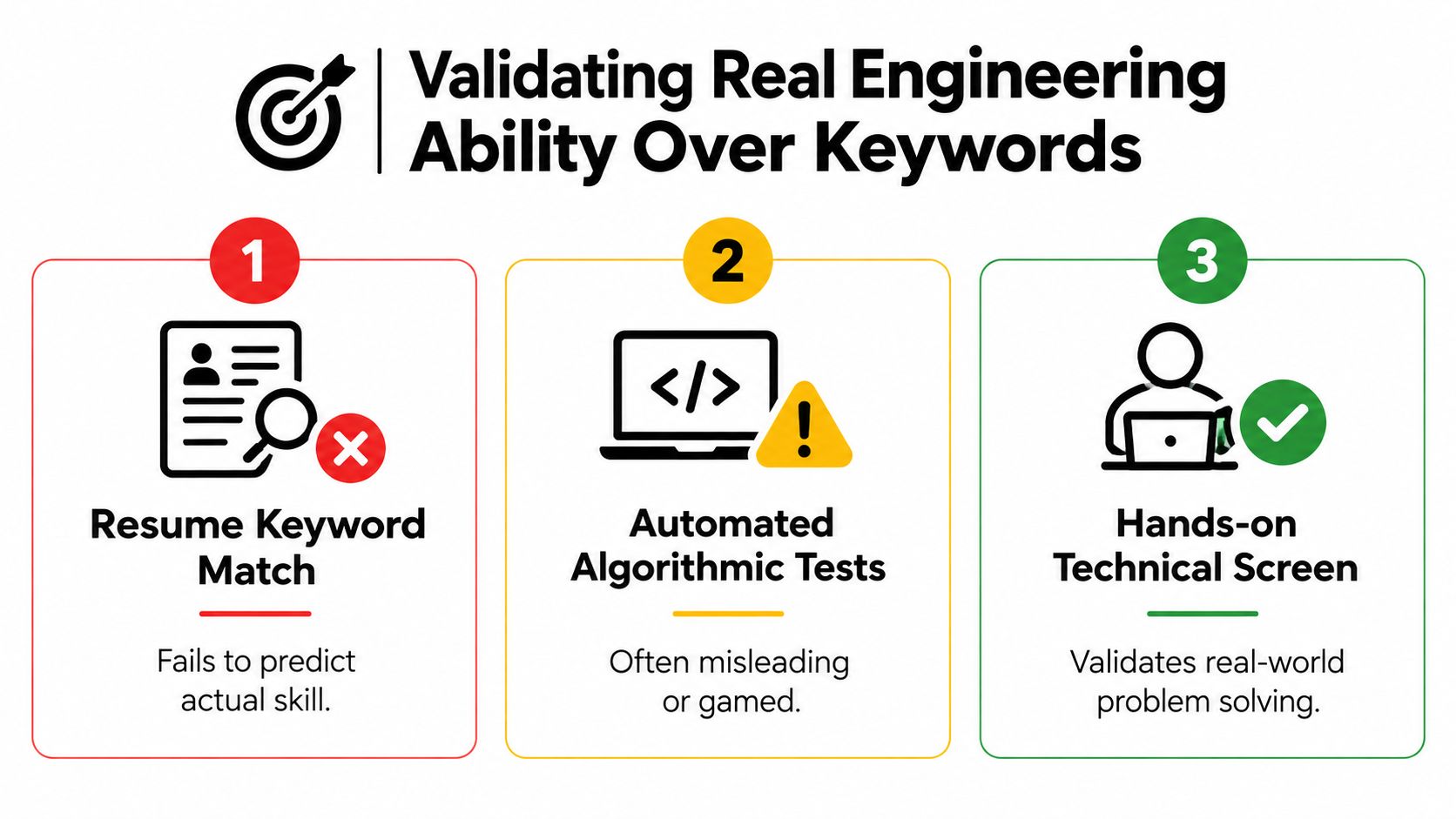
A résumé is a sourcing document, not a technical verdict. It can identify relevant environments, but it can’t show how a person behaves when a deployment increases latency, a test suite becomes unreliable, or a production payload contains data that must not leave a controlled boundary.
The agency’s technical screen should resemble the work. That doesn’t mean forcing candidates through an abstract puzzle unrelated to the role. A developer-skills benchmark reports that 66% of developers prefer practical challenges resembling day-to-day work over abstract coding problems, and that the average technical interview score required to receive an offer increased by 12% year over year, according to the developer hiring statistics benchmark.
Build the screen around production decisions
For a backend engineer, provide a small HTTP service with a defect and ask the candidate to diagnose it. For a QA engineer, ask for a test strategy that addresses data isolation, flaky dependencies, and meaningful failure reporting. For an SRE, provide latency or error-rate observations and ask how they would narrow the fault domain before changing the system.
A strong exercise has a bounded environment and observable scoring. Assess:
- Correctness: Does the proposed fix address the actual behavior rather than the visible symptom?
- Test coverage: Does the candidate add tests that protect the change and expose likely regressions?
- Rollback safety: Can the change be deployed, limited, and reversed without creating a larger incident?
- Performance reasoning: Does the candidate explain resource use, bottlenecks, and trade-offs?
- Communication: Can the candidate describe uncertainty, assumptions, and next steps clearly?
Sensitive traffic requires an extra layer of discipline. A candidate working on traffic replay or production-like testing should understand masking rules, session boundaries, authentication handling, and the difference between realistic test data and uncontrolled data exposure. You aren’t testing whether the person memorizes a tool. You’re testing whether they can create useful evidence without introducing another risk.
Demand an evidence packet
Never accept “strong candidate” as the complete recommendation. Require the agency to provide the exercise prompt, the candidate’s output, the scoring rubric, interviewer notes, and unresolved concerns. The hiring team should be able to distinguish a technically correct solution from a lucky answer or a polished explanation.
Calibration matters too. Have the agency review an example of a strong, borderline, and unsuitable response. If it can’t explain why the examples differ, its screening process probably isn’t mature enough for a high-risk engineering search.
The agency should also disclose where its screen stops. A recruiter can test baseline reasoning, but the hiring team still needs to evaluate architecture judgment, collaboration, domain context, and the candidate’s ability to operate within your constraints. Outsourcing the first filter doesn’t mean outsourcing engineering accountability.
This video can help teams think about the difference between surface-level assessment and evidence of practical ability:
A useful agency protects your interview loop from low-signal work. It doesn’t promise certainty. It creates a better starting point, makes uncertainty visible, and gives engineers enough information to spend their time on the questions only they can answer.
Managing Recruiter Capacity and Hiring Velocity
An agency can’t provide specialist attention if one recruiter is carrying too many searches. Benchmark data found that recruiters managing 20 or more concurrent requisitions averaged 45 days to hire, compared with 29 days for recruiters managing 1 to 4 requisitions, a 16-day difference, according to the HackerRank Tech Recruiting Benchmark Report.
That gap is operational, not theoretical. Overloaded recruiters have less time for intake calibration, candidate conversations, technical follow-up, interview scheduling, and offer management. A specialized candidate may accept another role while the agency is still waiting for feedback on the previous submission.
Put capacity into the contract
Ask who owns the search, how many active requisitions that person manages, and who covers the work during absence. Require a weekly funnel report that separates application review, recruiter screen, technical screen, hiring-manager interview, and offer stages. A single “candidates in progress” number hides aging and bottlenecks.
Use escalation rules rather than vague promises. If a candidate sits without feedback beyond the agreed window, the agency should flag the issue. If the role produces many profiles but few technical screens, the team should revisit the sourcing criteria or the assessment. If candidates repeatedly withdraw after interviews, investigate communication, compensation alignment, and process length.
A practical service-level design includes:
- Ownership: One named recruiter and one accountable agency lead.
- Funnel aging: Dates for every stage, not only the submission date.
- Interview windows: Pre-agreed blocks that reduce scheduling drift.
- Feedback discipline: A defined response expectation after each interview.
- Candidate communication: Clear updates, rejection handling, and offer follow-up.
- Escalation: A route for stalled candidates and unresolved calibration issues.
Don’t build the pipeline around seniority alone
Speed also depends on the size of the available market. If every search demands a fully formed senior engineer, your agency and internal team will compete for the same narrow group repeatedly. A more durable plan combines immediate specialist hiring with a pipeline that develops capable early-career engineers.
That means defining what the team can teach. An agency can source candidates who show disciplined debugging, thoughtful testing, clear communication, and a willingness to learn, even when they haven’t held every target title. The internal team then provides structured onboarding and bounded ownership rather than expecting a new hire to arrive fully configured.
Teams planning this balance can use capacity planning strategies for engineering organizations to connect hiring demand with delivery constraints. Recruiter capacity and engineering capacity should be managed together. Otherwise, a fast shortlist moves the bottleneck into interviews, onboarding, or production support.
Building Sustainable Technical Talent Pipelines
Hiring only senior engineers feels safe because the team gets immediate experience. It also creates a bidding contest and leaves the organization dependent on a narrow supply of people who already have the exact background. A sustainable technical recruiting agency should help you identify candidates who can become effective contributors, not only candidates who have already performed the job elsewhere.
Recent data shows that 71% of growth in software-development postings from May 2025 to May 2026 came from senior roles, while senior positions represented 69.3% of software-development postings in the first quarter of 2026, according to Second Talent’s technology job market analysis. The same source reports that new-graduate hiring at large technology companies remained approximately 65% below 2019 levels.
Those conditions make early-career development a strategic choice, not a charitable add-on. An agency can help evaluate learning velocity, debugging discipline, test design, communication, and production-safety habits. Years of experience remain relevant, but they shouldn’t be the only proxy for competence.

Design a staged path to independence
Start with a realistic but sanitized exercise. A junior candidate might investigate a failing HTTP request, write a regression test, or analyze a controlled traffic sample. The assessment should reveal how the person forms hypotheses, checks assumptions, and responds when the first fix doesn’t work.
A paid trial project can then test collaboration without pretending that a short exercise predicts every aspect of employment. Give the candidate a bounded problem, clear acceptance criteria, and access only to safe environments. Evaluate the quality of questions, the handling of incomplete information, and the ability to explain trade-offs.
For an apprenticeship or junior pipeline, define progression before recruiting begins:
- Foundational contribution: The engineer can make small changes with review and add useful tests.
- Reliable ownership: The engineer can diagnose bounded issues, communicate status, and complete work with normal guidance.
- Independent delivery: The engineer can plan and ship changes, respond to failures, and protect operational safety.
- Broader contribution: The engineer improves tooling, documentation, test strategy, or team practices.
The exact timeline will vary by role and environment. Measure the transition from one stage to the next rather than promising an arbitrary promotion date.
Put pipeline outcomes in the agency brief
Your RFP should ask the agency to present separate approaches for immediate senior hiring and early-career development. Require sample exercises, evaluator training, candidate support, and a plan for reaching people who may be overlooked by title-based searches. Ask how the agency will prevent a “junior” label from becoming an excuse for weak standards.
Useful pipeline measures include technical-screen completion, exercise quality, interview progression, offer acceptance, onboarding completion, time to independent contribution, manager confidence, and retention. These measures should be reviewed by cohort and role, with qualitative notes explaining why candidates progressed or dropped out.
A strong pipeline doesn’t lower the bar. It makes the bar observable and gives more candidates a fair way to demonstrate that they can reach it.
The Engineering Leader RFP and KPI Checklist
A recruiting agency RFP should read more like an engineering service specification than a request for résumés. It should describe the work, the risks, the evidence required, and the operating behavior expected from the supplier.
Questions to include in the RFP
Ask each agency to answer in writing:
- Role calibration: Who conducts intake, and how will the agency translate system responsibilities into screening criteria?
- Technical validation: Which practical exercises, technical conversations, or work samples will candidates complete?
- Scoring evidence: Will the client receive outputs, rubric scores, interviewer notes, and unresolved risks?
- Specialist ownership: What experience does the assigned recruiter have with the target domain?
- Capacity: How many active requisitions does the assigned recruiter manage?
- Market mapping: How will the agency identify passive candidates and explain the reachable talent pool?
- Candidate experience: How are interview expectations, feedback, rejection, and offer conversations handled?
- Commercial terms: What are the fee, payment trigger, replacement terms, contract conversion rules, and termination conditions?
- Data handling: How will candidate information and technical exercise data be protected?
- Inclusion: Which sourcing channels and review practices reduce unnecessary dependence on pedigree or keyword matching?
Require a sample candidate packet before awarding the work. The sample should make it easy for an engineering manager to see what the agency knows, what it tested, and what remains uncertain.
Track quality, not activity
Time-to-fill matters, but it becomes misleading when an agency fills a role with a poor fit or sends large numbers of unsuitable profiles. Build a dashboard around the full funnel:
- Qualified submission rate: How many submitted candidates meet the agreed technical and behavioral criteria?
- Technical-screen pass rate: How often does the agency’s screen produce a candidate worth deeper engineering evaluation?
- Interview conversion: How many submissions reach the hiring-manager stage?
- Offer acceptance: Which issues cause candidates to decline?
- Stage aging: Where do candidates wait, and who owns the delay?
- Early performance: Does the placement meet the role’s expectations after onboarding?
- Retention: Do agency-placed engineers remain and contribute over the period that matters to your organization?
- Calibration changes: How quickly does the agency improve after rejection feedback?
For a broader measurement framework, use key performance indicators for software development and adapt the principles to recruiting operations. The point isn’t to create a larger spreadsheet. It’s to connect agency activity with engineering outcomes.
The best agency review asks one uncomfortable question: Did the supplier help us make a better technical decision, or did it merely help us make a faster one?
Review the partnership at regular intervals. Drop requirements that don’t predict success, strengthen exercises that reveal production judgment, and change the engagement model when the search’s risk profile changes. A technical recruiting agency should welcome that calibration because its value depends on improving signal over time.
The final decision is straightforward. Hire an agency for access and capacity, but keep technical standards in your hands. Demand practical validation, transparent evidence, visible recruiter ownership, and a pipeline that develops more than the small group of engineers already carrying the most market demand.
If your team is hiring developers, QA engineers, DevOps professionals, or SREs, start by auditing your current agency process against the checklist above. Then test every shortlisted partner with one role-specific work sample, one capacity review, and one evidence packet request. Before any candidate reaches your production systems, use GoReplay to capture and replay sanitized HTTP traffic in a controlled testing environment, so your hiring process and your engineering process both reward the same standard, safe, observable, production-ready work.