
7 Essential Capacity Planning Strategies for 2025

In a world where downtime equals lost revenue and a tarnished reputation, getting capacity right is non-negotiable. Simply adding more servers or staff is a reactive, expensive game of catch-up that leaves businesses vulnerable. True resilience and efficiency come from a deliberate, forward-looking approach. The right capacity planning strategies enable you to anticipate future needs, optimize resource spending, and deliver a consistently excellent user experience, even as demand skyrockets or fluctuates unexpectedly.
This guide moves beyond guesswork and provides a framework to build a scalable, reliable, and cost-effective system. We will explore seven distinct, field-tested strategies that tech leaders use to align their infrastructure with business goals.
You will learn the specific implementation details, pros, cons, and ideal use cases for the following approaches:
- Lead Strategy: Proactively adding capacity ahead of demand.
- Lag Strategy: Reactively adding capacity after demand materializes.
- Match Strategy: Incrementally adding capacity in response to real-time trends.
- Adjustment Strategy: Dynamically managing capacity for short-term changes.
- Service Level-Based Strategy: Aligning capacity with performance and availability targets.
- Constraint-Based Strategy: Focusing resources on system bottlenecks.
- Demand Management Strategy: Actively shaping user demand to match existing capacity.
By understanding these powerful capacity planning strategies, you can select the perfect approach to support your organization’s unique growth trajectory and ensure performance never becomes a barrier to success.
1. Lead Strategy (Capacity Leads Demand)
The Lead Strategy is one of the most proactive capacity planning strategies, where an organization deliberately adds capacity in anticipation of future demand. Instead of reacting to market needs as they arise, this approach involves making significant investments in infrastructure, technology, and personnel before a surge in demand materializes. This forward-thinking method ensures resources are readily available, positioning the company to capture market share and meet customer expectations without delay.

This strategy is particularly effective in high-growth industries where being the first to meet demand provides a significant competitive advantage. It minimizes the risk of stockouts, service degradation, or long wait times, which can lead to customer churn and reputational damage. By staying ahead of the curve, organizations can absorb sudden demand spikes seamlessly.
How It Works in Practice
A prime example is Amazon’s expansion of its fulfillment center network. The company consistently builds massive warehouses in strategic locations years ahead of projected e-commerce growth, ensuring it can handle peak shopping seasons like Prime Day and Black Friday without system failures. Similarly, Tesla’s construction of Gigafactories is a classic lead strategy, building massive production capacity based on long-term forecasts for electric vehicle adoption rather than current sales figures.
Actionable Tips for Implementation
To successfully implement a lead strategy, consider the following tactics:
- Invest in Forecasting: Your success hinges on accurate demand prediction. Utilize advanced analytics, market research, and predictive modeling to gain a clear view of future trends.
- Embrace Modularity: Instead of building a monolithic system, add capacity in modular, scalable increments. This allows you to scale up more efficiently as demand gradually meets your built-out capacity.
- Monitor Leading Indicators: Keep a close watch on market signals, competitor movements, and macroeconomic trends that could influence future demand.
- Build Financial Reserves: This strategy requires significant upfront capital. Ensure you have the financial runway to sustain operations during the initial period of underutilization before demand catches up.
The lead strategy is best suited for organizations with strong financial backing, high confidence in their market forecasts, and a strategic goal of market leadership. While it involves the risk of overprovisioning, the reward is unparalleled service reliability and the ability to outmaneuver competitors.
2. Lag Strategy (Capacity Follows Demand)
The Lag Strategy is one of the more conservative capacity planning strategies, where an organization adds capacity only after demand has demonstrably increased. This reactive approach prioritizes financial prudence and high resource utilization, ensuring that significant capital expenditures are made only when a clear, sustained need exists. Instead of anticipating future growth, a company waits until its current resources are stretched to their limits before expanding.
This method is highly effective for businesses operating in stable or slow-growth markets, or for those with limited capital. It minimizes the financial risk associated with overprovisioning and unused assets. However, this cost efficiency comes at the risk of temporarily losing potential customers to competitors or experiencing service degradation during the period between demand-spike and capacity-addition.
How It Works in Practice
A classic example is a budget airline that only adds a new flight route after the existing ones are consistently overbooked. Similarly, a local restaurant might only expand its seating area after experiencing long wait times and turning away customers for several months. In the tech world, a SaaS company might use a lag strategy by only upgrading its server infrastructure after performance monitoring tools show sustained high CPU and memory usage that begins to impact user experience.
Actionable Tips for Implementation
To successfully implement a lag strategy, consider the following tactics:
- Monitor Utilization Metrics: Continuously track key performance indicators (KPIs) like server load, transaction times, or order backlogs. Set clear thresholds that trigger the capacity expansion process.
- Develop Quick-Response Processes: Since you are reacting to demand, your ability to add capacity quickly is critical. Standardize and streamline procurement, hiring, and deployment processes to minimize lead times.
- Utilize Temporary Capacity: Bridge short-term gaps with flexible solutions. This could involve hiring temporary staff, leasing equipment, or leveraging cloud bursting to handle unexpected peaks without a permanent investment.
- Manage Customer Expectations: Be transparent with customers about potential delays or stockouts. Strong customer relationships and loyalty programs can help retain business while you scale up to meet their needs.
The lag strategy is best suited for organizations that prioritize capital efficiency and operate in predictable markets. While it carries the risk of short-term service limitations, its conservative nature protects the business from costly miscalculations in demand forecasting.
3. Match Strategy (Capacity Tracks Demand)
The Match Strategy is a balanced and responsive approach among capacity planning strategies, where an organization adds capacity in small, frequent increments to closely align with real-time demand. Rather than making large speculative investments or waiting for service degradation, this method seeks a middle ground. It minimizes the risks of both overprovisioning (wasted resources) and underprovisioning (lost revenue and customer dissatisfaction) by maintaining a near-perfect equilibrium.

This strategy is highly effective in markets with fluctuating or unpredictable demand, as it provides the agility to scale resources up or down as needed. The core principle is continuous adjustment, ensuring that supply never strays too far from demand. This dynamic approach prevents capital from being tied up in idle assets while still being prepared for gradual growth.
How It Works in Practice
Cloud computing is the quintessential example of the match strategy. Services like AWS Auto Scaling or Azure Virtual Machine Scale Sets automatically add or remove server instances based on real-time traffic metrics, perfectly matching computational capacity to current user load. Similarly, ride-sharing services like Uber and Lyft use dynamic pricing and driver incentives to continuously adjust the number of available drivers to match rider demand in specific areas. In retail, this strategy is seen when staffing levels are adjusted seasonally, weekly, and even hourly to handle customer traffic.
Actionable Tips for Implementation
To effectively implement a match strategy, focus on agility and data:
- Implement Real-Time Monitoring: Deploy robust monitoring and analytics tools to get an instant, accurate picture of your system’s performance and current demand levels.
- Choose Modular Infrastructure: Opt for technologies and infrastructure that can be scaled incrementally. Cloud-native architectures, microservices, and containerization are ideal for this approach.
- Define Clear Scaling Triggers: Establish specific, automated thresholds for capacity adjustments. For example, scale up when CPU utilization exceeds 75% for five consecutive minutes.
- Build Strong Vendor Relationships: Ensure you have agreements with vendors or suppliers that allow for the quick procurement of additional resources, whether it’s hardware, software licenses, or cloud services.
The match strategy is best for organizations that require flexibility and cost-efficiency. While it demands sophisticated monitoring and automation, the reward is a highly optimized system that operates leanly without compromising its ability to meet customer needs.
4. Adjustment Strategy (Dynamic Capacity Management)
The Adjustment Strategy is a highly flexible approach to capacity planning, focused on rapidly increasing or decreasing resources in direct response to real-time demand fluctuations. Instead of making long-term commitments to permanent capacity, organizations use temporary resources like variable workforce arrangements, outsourcing, and on-demand services to align their operational capabilities with immediate needs. This dynamic method allows businesses to scale efficiently without the financial burden of maintaining idle resources during periods of low demand.

This strategy is ideal for industries with significant seasonality or unpredictable demand spikes, such as retail, manufacturing, and IT services. By maintaining a lean core capacity for baseline demand and leveraging external resources for peaks, companies can optimize costs, improve agility, and respond to market opportunities with speed. It’s a core tenet of modern, agile operations and is central to effective application capacity planning.
How It Works in Practice
A classic example is a retailer hiring seasonal workers to manage the holiday shopping rush. Similarly, manufacturers often use contract manufacturing partners to handle overflow production when a new product launch exceeds initial forecasts. In the tech world, IT departments rely heavily on cloud services like AWS or Azure, scaling server capacity up or down to handle variable application workloads without purchasing physical hardware. Gig economy platforms like Uber and TaskRabbit are built entirely on this model, adjusting their active workforce based on user demand.
Actionable Tips for Implementation
To effectively implement an adjustment strategy, focus on these key tactics:
- Build a Partner Network: Cultivate strong relationships with reliable temporary staffing agencies, contractors, and outsourcing partners you can call upon quickly.
- Standardize Onboarding: Develop streamlined and efficient training and onboarding processes to integrate temporary resources into your workflows with minimal disruption.
- Maintain a Stable Core: Keep a permanent, skilled workforce and infrastructure to handle your baseline, predictable demand, ensuring operational stability.
- Negotiate Flexible Contracts: Create framework agreements with suppliers and partners that include flexible volume terms, allowing you to scale usage up or down without penalty.
The adjustment strategy is best suited for businesses that need to remain agile and cost-effective in volatile markets. While it requires strong partner management and operational coordination, the payoff is a highly responsive and resilient organization that can adapt to change instantly.
5. Service Level-Based Strategy
The Service Level-Based Strategy flips the script on traditional capacity planning by tying resource allocation directly to customer experience goals. Instead of forecasting demand in isolation, this approach defines specific service level targets, such as acceptable wait times or system availability, and then engineers the capacity required to consistently meet those objectives. This customer-centric method ensures that capacity decisions are driven by strategic service commitments rather than just raw volume projections.
This strategy is foundational in industries where performance and reliability are key competitive differentiators. By setting clear benchmarks like “99.99% uptime” or “80% of calls answered in 20 seconds,” organizations can align their infrastructure investments with tangible business outcomes. It shifts the focus from simply having enough resources to having the right amount of resources to deliver a promised level of service.
How It Works in Practice
A classic example is a call center that uses Erlang C formulas, a model from queuing theory, to determine the exact number of agents needed to meet its goal of answering a specific percentage of calls within a set time frame. Similarly, e-commerce giants guarantee two-day shipping by building out a logistics network with precisely enough capacity to meet that delivery promise for a target percentage of orders. In the digital realm, cloud service providers use this strategy to guarantee Service Level Agreements (SLAs) for uptime and latency, sizing their data centers accordingly.
Actionable Tips for Implementation
To effectively implement service level-based capacity planning strategies, consider these tactics:
- Use Queuing Theory: Employ mathematical models like queuing theory to accurately calculate the capacity required to hit specific performance targets under variable loads.
- Define Realistic Service Levels: Set achievable targets based on thorough competitive analysis, customer expectations, and financial constraints. An overly ambitious goal can lead to excessive costs.
- Monitor Performance Continuously: Implement real-time dashboards to track service level achievement. This allows for immediate adjustments and proactive management before a breach occurs.
- Build in Buffer Capacity: Account for unexpected demand spikes and system variability by incorporating a buffer. This safety margin helps ensure service levels are maintained even during unforeseen events.
- Segment Your Service Levels: Consider offering different service tiers for different customer segments. A premium customer might have a guaranteed 99.999% uptime, while a standard user gets 99.9%.
This strategy is ideal for organizations where customer satisfaction and reliability are paramount. While it requires sophisticated monitoring and modeling, it directly links infrastructure costs to business value and competitive positioning.
6. Constraint-Based Strategy (Theory of Constraints)
The Constraint-Based Strategy, rooted in the Theory of Constraints (TOC) developed by Dr. Eliyahu Goldratt, shifts the focus of capacity planning from a broad, system-wide approach to a highly targeted one. Instead of adding capacity uniformly, this strategy identifies the single most significant bottleneck or “constraint” that limits the entire system’s throughput. By concentrating investment and improvement efforts on this specific point, organizations can achieve maximum impact with minimal resources.
This approach is powerful because it acknowledges that the output of any system is determined by its weakest link. Strengthening non-constraint components yields little to no overall performance improvement. By addressing the primary bottleneck, this capacity planning strategy ensures that every dollar spent on expansion directly translates into increased total system capacity, making it one of the most efficient methods for scalable growth.
How It Works in Practice
The classic example comes from manufacturing, as detailed in the book The Goal, where a plant identifies a single machine that dictates the entire factory’s production rate. All improvement efforts, from scheduling to maintenance and staffing, are focused on maximizing that machine’s uptime and efficiency. In software development, a testing or QA phase that cannot keep up with development becomes the constraint; capacity is added by hiring more QA engineers or investing in test automation rather than hiring more developers. Similarly, a logistics company might find its warehouse processing speed is the bottleneck, prompting investment in warehouse automation instead of buying more delivery trucks.
Actionable Tips for Implementation
To successfully apply a constraint-based strategy, follow the Five Focusing Steps of TOC:
- Identify the Constraint: Use data analysis and process mapping to pinpoint the part of your system that limits overall throughput.
- Exploit the Constraint: Get the absolute most out of the constrained resource without major investment. Optimize its schedule, reduce its downtime, and ensure it only works on high-priority tasks.
- Subordinate Everything Else: Align all other processes and resources to support the needs of the constraint. Non-constraints should operate at a pace that prevents the bottleneck from being starved of work or overwhelmed.
- Elevate the Constraint: If the previous steps are insufficient, now is the time to invest in additional capacity for the constraint, such as buying a new machine, hiring more specialized staff, or upgrading technology.
- Repeat the Process: Once a constraint is elevated, a new bottleneck will emerge elsewhere in the system. The process is a continuous cycle of identification and improvement.
The following infographic illustrates the core workflow of implementing this strategy.
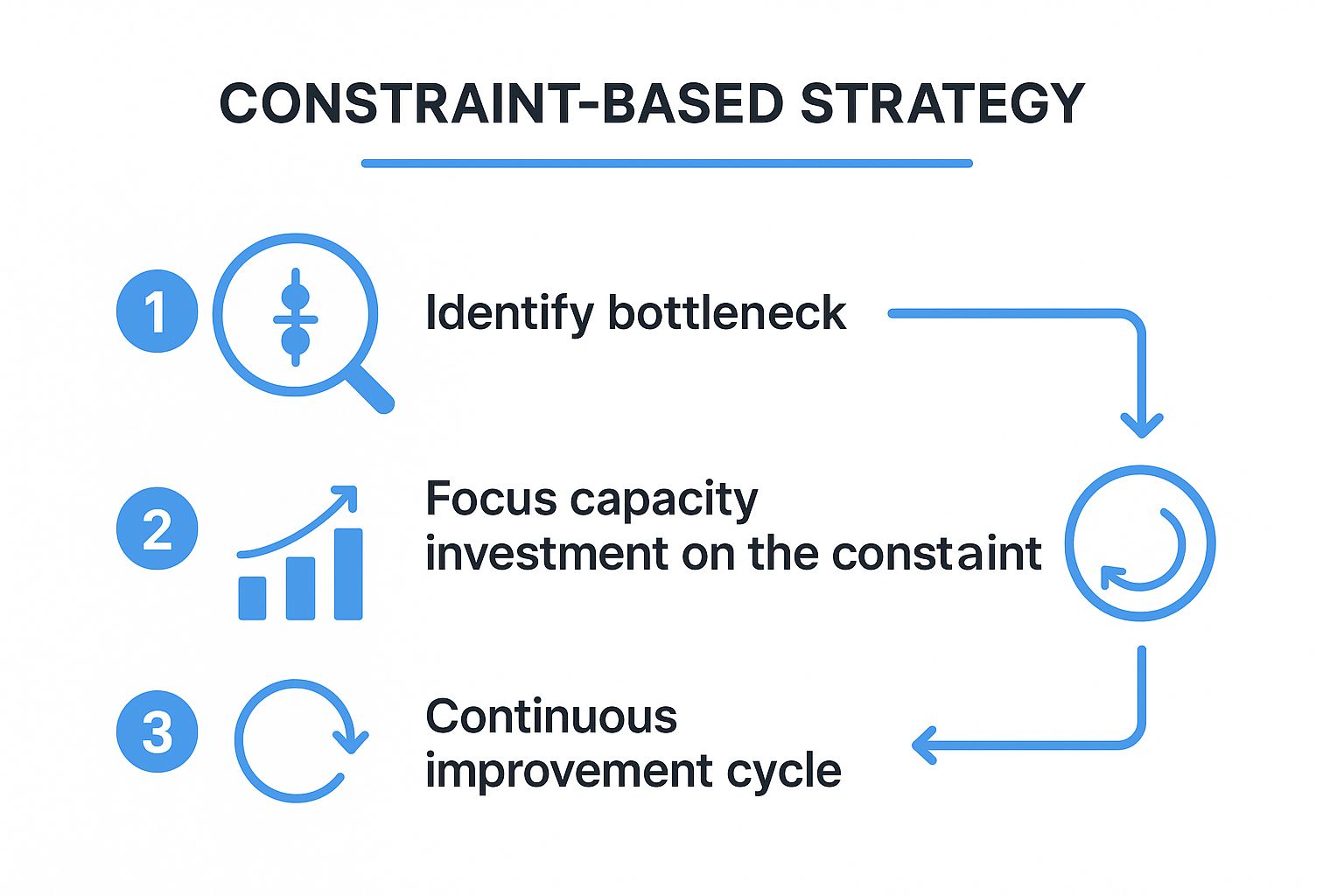
This visual reinforces that the strategy is a continuous loop, ensuring that capacity investments are always directed at the most critical point for system-wide improvement.
This strategy is ideal for complex systems where resources are limited and leaders need to make high-impact decisions. It forces a data-driven focus on what truly matters, preventing wasted investment and delivering measurable gains in overall throughput and efficiency.
7. Demand Management Strategy
The Demand Management Strategy flips the traditional capacity planning model on its head. Instead of adjusting supply (capacity) to meet fluctuating demand, this approach focuses on influencing demand itself to better align with existing capacity. By using techniques like dynamic pricing, promotions, and scheduling, organizations can smooth out demand peaks and fill in troughs, optimizing resource utilization without costly infrastructure changes.
This strategy is a powerful tool for businesses with high fixed costs and perishable inventory, such as airline seats or hotel rooms. Rather than letting valuable capacity go unused during slow periods or being overwhelmed during peaks, companies proactively shape customer behavior. This allows for more predictable operations, stable performance, and maximized revenue from the assets already in place.
How It Works in Practice
The airline industry is the quintessential example, pioneering revenue management systems that adjust ticket prices based on demand, booking time, and seat availability. Ride-sharing services like Uber and Lyft use “surge pricing” to the same effect, increasing fares during high-demand periods to encourage more drivers to come online and balance the supply-demand equation. Similarly, electric utilities offer time-of-use pricing, incentivizing customers with lower rates to run appliances during off-peak hours, thereby reducing strain on the power grid.
Actionable Tips for Implementation
To effectively implement one of the most proactive capacity planning strategies, consider the following tactics:
- Implement Revenue Management Systems: Use sophisticated software that combines historical data with real-time market signals and demand forecasting to automate pricing adjustments.
- Segment Your Customers: Analyze your customer base to identify different segments based on their price sensitivity and flexibility. Tailor offers and pricing to each group to maximize uptake.
- Offer Genuine Off-Peak Value: Instead of just offering discounts, provide added value to encourage off-peak consumption. This could include bundled services, premium features, or exclusive access. For a deeper look at aligning service levels with user demand, explore our guide on capacity planning for web applications.
- Communicate Transparently: Be clear with customers about why prices fluctuate. Transparency, especially when tied to availability or service levels, can help manage expectations and reduce negative sentiment.
The demand management strategy is ideal for service-based industries where capacity is fixed and perishable. While it requires sophisticated data analysis and a deep understanding of customer behavior, the reward is a highly efficient, profitable operation that makes the most of its existing resources.
Capacity Planning Strategies Comparison
| Strategy | Implementation Complexity 🔄 | Resource Requirements ⚡ | Expected Outcomes 📊 | Ideal Use Cases 💡 | Key Advantages ⭐ |
|---|---|---|---|---|---|
| Lead Strategy (Capacity Leads Demand) | High – requires accurate forecasting and long-term planning | High – upfront capital investment, infrastructure | High service levels, buffer capacity, market readiness | Industries with predictable growth, high stockout costs, long lead times | Eliminates stockouts; competitive advantage; smooth ramp-up |
| Lag Strategy (Capacity Follows Demand) | Low to Moderate – reactive, simpler planning cycles | Low – capital investment after proven demand | Cost efficiency, higher utilization, but risk of lost sales | Cash-constrained, uncertain markets, cost-focused organizations | Minimizes overcapacity risk; better cash flow; flexible |
| Match Strategy (Capacity Tracks Demand) | Moderate to High – continuous planning, frequent adjustments | Moderate – scalable/modular capacity required | Balanced risk of stockouts and overcapacity | Moderate demand variability; access to scalable/flexible capacity | Balanced investment timing; reduces excess and shortages |
| Adjustment Strategy (Dynamic Capacity Management) | Moderate to High – coordination of flexible/temporary resources | Variable – relies on contingent workforce, outsourcing | High flexibility, minimal long-term commitment | High demand variability; seasonal businesses; flexibility prioritized | Maximum flexibility; converts fixed to variable cost |
| Service Level-Based Strategy | High – requires complex modeling and ongoing monitoring | Moderate to High – capacity sized to meet targets | Customer-centric service levels, measurable targets | Service industries, contact centers, healthcare, organizations competing on service quality | Aligns capacity with customer expectations; accountability |
| Constraint-Based Strategy (Theory of Constraints) | Moderate to High – bottleneck identification and systemic focus | Focused – investment on constraints only | Maximized throughput; focused and efficient investments | Manufacturing, complex processes, throughput improvement focus | Maximizes return on capacity; continuous improvement |
| Demand Management Strategy | High – needs sophisticated analytics & pricing/promotions system | Moderate – relies on demand-shaping tools | Smoothed demand, reduced capacity strain | Service industries with perishable capacity and demand variability | Delays capacity investments; increases revenue; demand smoothing |
Choosing and Implementing Your Optimal Strategy
Navigating the landscape of capacity planning strategies reveals a powerful truth: there is no single “best” approach. The optimal solution is not a static choice but a dynamic, hybrid model tailored to your organization’s unique operational realities, risk tolerance, and strategic objectives. We’ve explored a spectrum of methodologies, from the proactive foresight of the Lead Strategy to the reactive precision of the Lag Strategy, and the dynamic agility of the Adjustment Strategy.
Each framework offers a distinct lens through which to view your resource management. The Match Strategy provides a balanced, incremental path, while a Service Level-Based approach anchors decisions in customer experience. For complex systems, the Constraint-Based Strategy offers a focused methodology for unlocking systemic potential, and Demand Management provides the tools to actively shape your operational load rather than just react to it. The key takeaway is that these are not mutually exclusive options; they are components in a sophisticated toolkit.
From Theory to Action: Your Next Steps
Transitioning from understanding these concepts to implementing them requires a structured, data-driven plan. Your immediate goal should be to build a clear, evidence-based picture of your current state and future needs.
Here are actionable steps to get started:
- Audit Your Current Demand: Begin by meticulously analyzing historical data. Identify seasonal trends, peak usage hours, and the demand drivers for your key services. This baseline is the foundation for any successful capacity planning strategy.
- Identify Your Core Constraints: Apply the principles of the Constraint-Based Strategy to pinpoint your system’s primary bottlenecks. Is it database throughput, network I/O, or application server CPU? Knowing your weakest link is critical for effective resource allocation.
- Model and Validate Scenarios: Don’t just forecast; validate. Use the strategies discussed as models for different future scenarios. For instance, how would a Lag Strategy handle an unexpected 30% surge in traffic? How much buffer would a Lead Strategy require to maintain performance during a major marketing launch?
The True Value of Proactive Capacity Management
Mastering these capacity planning strategies moves your organization from a reactive, firefighting posture to a proactive, strategic one. Effective capacity management is more than just preventing outages; it is a direct enabler of business growth. It ensures you can confidently launch new features, enter new markets, and handle viral traffic spikes without compromising performance or user trust.
This proactive stance transforms your infrastructure from a potential liability into a competitive advantage. By aligning your resource allocation with business goals, you ensure that your systems are always ready to support the next big opportunity. This foresight builds resilience, protects revenue, and fosters a culture of reliability and engineering excellence. Ultimately, a well-executed capacity plan is the bedrock upon which scalable, dependable, and successful digital products are built.
Ready to move from guesswork to certainty in your capacity planning? Validate your strategies against real-world conditions with GoReplay. By capturing and replaying your actual production traffic, GoReplay provides the data-driven proof you need to choose and implement the right capacity planning strategies with confidence.