
SMS Verification Service: Architecture and Testing
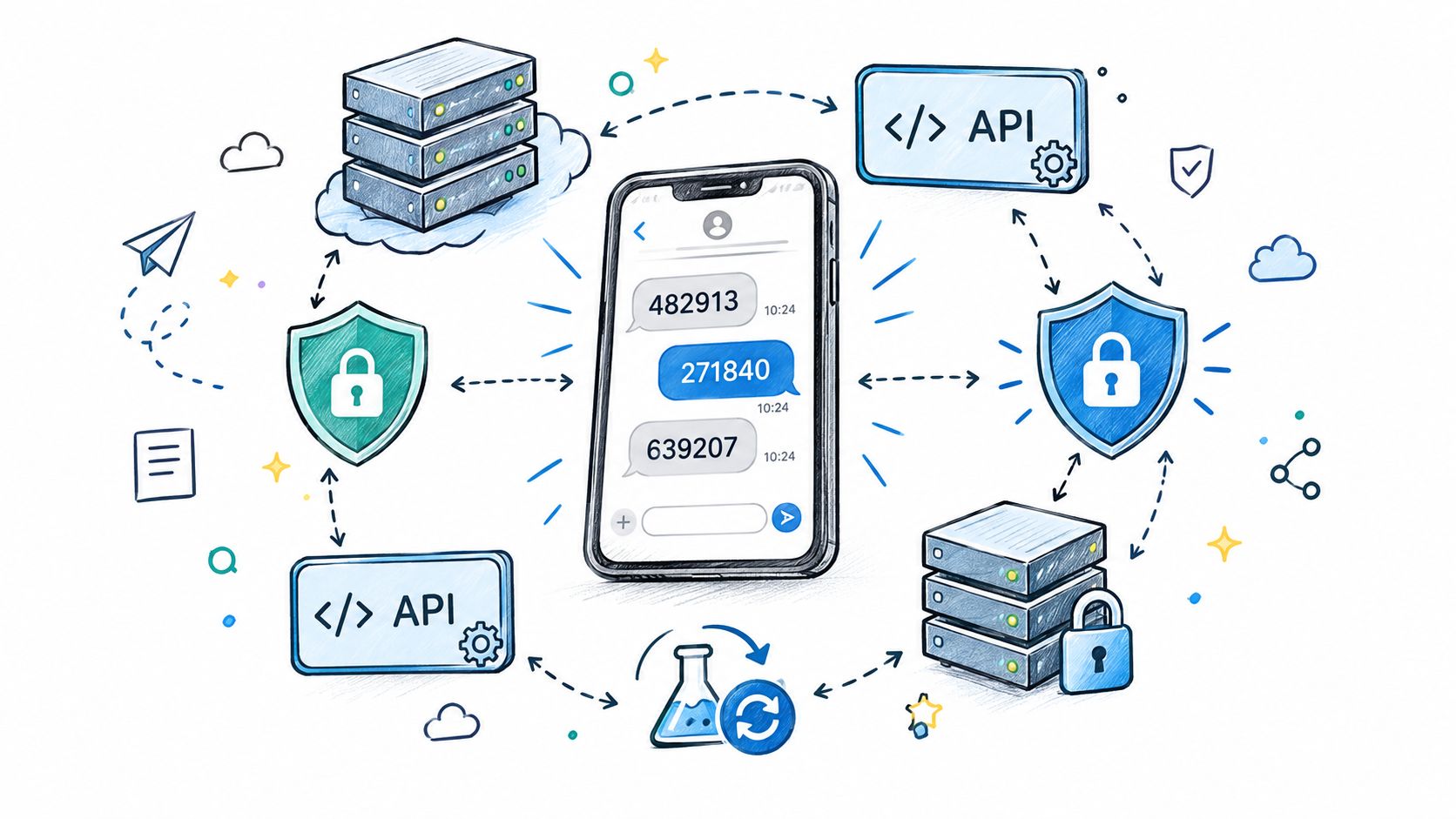
“Use SMS because it’s easy” is incomplete advice. An SMS verification service is easy to call, but the surrounding system carries telecom, security, cost, privacy, and recovery risks that a successful API response won’t reveal. A message can arrive promptly while automated requests gradually inflate carrier charges, or while a phone number remains vulnerable to SIM swaps and reassignment.
The practical approach is to treat SMS as a delivery component and a risk boundary, not as authentication strategy by itself. Build an API that isolates your application from gateway behavior, enforce strict OTP lifecycle rules, measure completed verification rather than messages sent, and test failure paths with realistic traffic. SMS still offers valuable reach, but it should coexist with stronger factors and carefully designed recovery journeys.
Table of Contents
- The Hidden Costs of SMS Verification
- Telecom Foundations and API Architecture
- Designing Resilient OTP Generation and Validation
- How SMS Activate Can Help
- Detecting and Mitigating SMS Pumping Fraud
- Navigating Security Standards and Fallback Paths
- Testing Verification Flows with Traffic Replay
- Evaluating Alternatives and Future-Proofing Authentication
The Hidden Costs of SMS Verification
Many teams optimize the wrong dashboard. They watch delivery status, carrier response, and message latency, then conclude that verification is healthy when those values look acceptable. A delivered code only proves that a message entered a telecom route. It doesn’t prove that a legitimate user requested it, that the account was protected, or that the message volume is financially sustainable.
SMS pumping is the clearest example. Attackers automate verification requests for numbers or destinations that generate carrier charges, often without any intention of completing registration. The service remains available, delivery may remain high, and the telecom bill still grows because the system counts outbound messages as success.
A 2025 analysis of more than 205 million authentication requests across over 200 destination countries classified 11.83% as fraudulent, with 24.3 million blocked requests and an estimated $3.26 million in avoided SMS costs. Those figures come from Prelude’s 2025 SMS fraud analysis, and they illustrate why message delivery and business success must be separated.
Measure conversion, not just delivery
A useful verification dashboard has at least two distinct views:
- User outcome: Track requested, delivered, code submitted, code accepted, registration completed, and recovery completed as separate events.
- Financial exposure: Monitor message volume, destination, carrier response, route, and estimated spend without treating the phone number itself as a log identifier.
- Abuse signals: Compare request velocity, account velocity, device or network reputation, destination prefix, and resend behavior.
- Legitimate access: Watch completion by geography and client version so a new control does not inadvertently exclude valid users.
Generic rate limiting is necessary, but it isn’t enough. A limit keyed only to an IP address misses distributed automation. A limit keyed only to a phone number can punish shared devices, recycled numbers, or legitimate households. A country block may reduce exposure while excluding users who have no alternative channel.
Practical rule: A verification request should earn permission to send a message. It shouldn’t receive that permission merely because the phone number is syntactically valid.
Build a privacy-preserving control loop
Keep raw OTP values out of analytics and avoid making phone numbers the permanent identity of your abuse system. Store a normalized, access-controlled representation for correlation, then retain only the minimum data needed for investigation and billing reconciliation. Separate security telemetry from product analytics so teams can analyze conversion without exposing authentication secrets.
The control loop should be testable:
- Observe request and completion events.
- Score destination, account, network, device, and velocity risk.
- Apply a graduated action, such as allow, challenge, delay, review, or deny.
- Compare legitimate completion against message volume and cost.
- Replay representative abuse and recovery scenarios before changing production rules.
This reframes SMS verification as a financial and security control. High availability matters, but it’s only one dimension of a trustworthy service.
Telecom Foundations and API Architecture
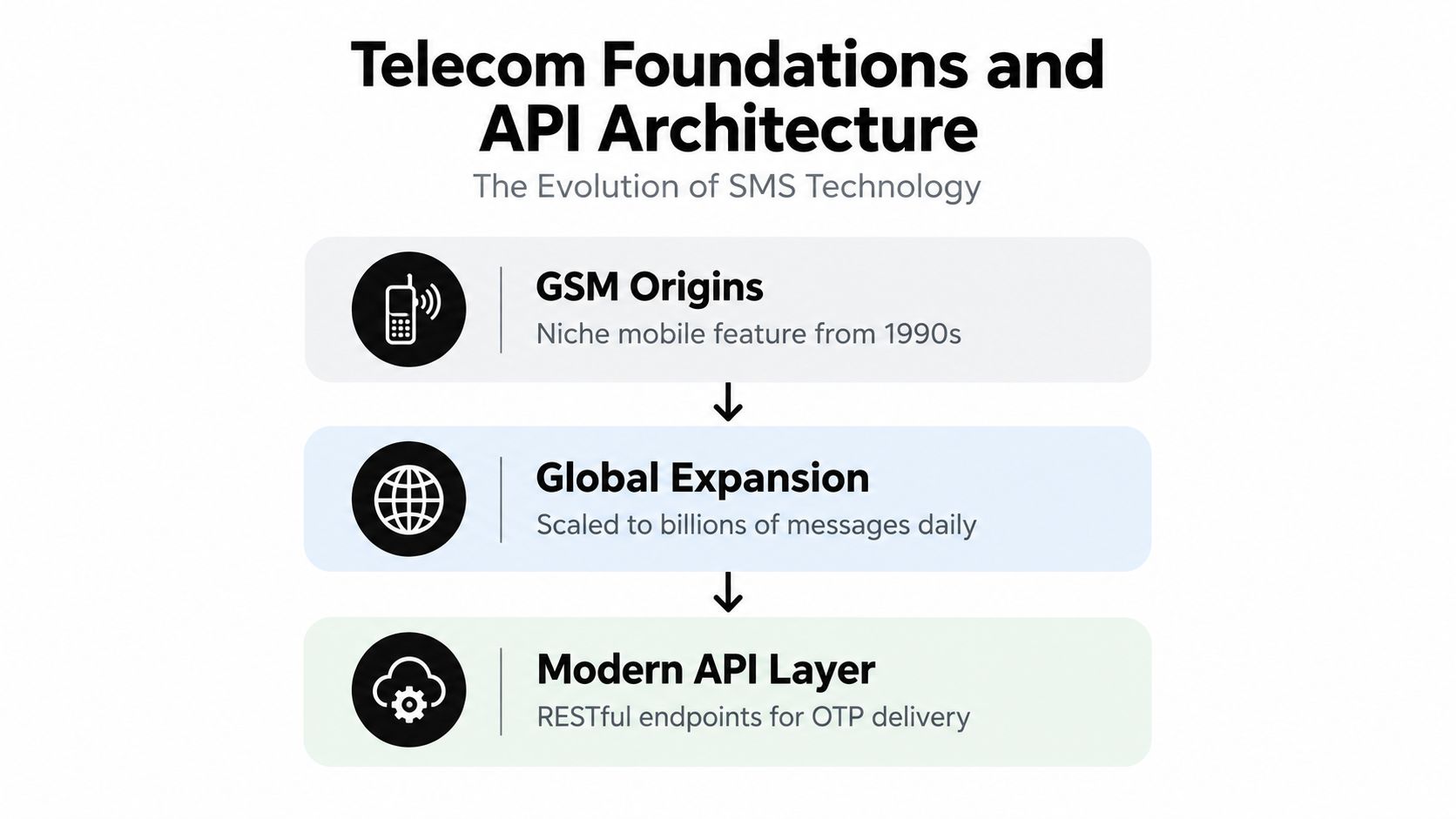
SMS works as a verification channel because it sits on infrastructure that predates modern mobile applications. GSM standards incorporated SMS specifications in 1986, and engineer Neil Papworth sent the first SMS on 3 December 1992 over Vodafone’s UK network, as documented in the history of SMS. Commercial infrastructure followed in 1993, when Sweden deployed the first commercial short-message service center, and Nokia later brought SMS-capable handsets to ordinary users.
Adoption expanded from operator systems into a global consumer channel. The world sent approximately 366 billion SMS messages in 2002, compared with about 6.1 trillion in 2010, roughly a 17-fold increase over eight years, according to the same SMS history reference. That scale explains SMS’s reach across device types, operating systems, and countries. It also explains its limitations, because verification inherits the behavior of carrier routing, number assignment, and legacy signaling systems.
Put an abstraction layer around the gateway
Your application shouldn’t know whether a provider uses a short code, long code, sender ID, regional route, or fallback carrier. It should call an internal verification interface with stable semantics.
A practical contract might expose:
POST /verifications, accepting a user or session reference, normalized phone number, purpose, and risk context.POST /verifications/{id}/check, accepting the submitted code and an authenticated session reference.POST /verifications/{id}/resend, enforcing resend policy independently from the original request.GET /verifications/{id}, returning a safe state such as pending, approved, expired, blocked, or delivery_unknown.
Use E.164 normalization before persistence and provider calls. Return ordinary HTTP status codes consistently, then include a machine-readable application error such as verification_expired, attempt_limit_reached, or destination_not_allowed. Clients can handle 400, 401, 403, 404, 409, and 429 predictably instead of parsing provider-specific strings.
Keep the provider adapter behind your own boundary. The adapter translates provider callbacks and error codes into internal states, while the rest of your product remains insulated from a vendor migration.
Model state instead of storing a loose token
A verification record should include a random internal identifier, purpose, user or session binding, normalized destination reference, creation time, expiry time, attempt counters, resend counters, provider request identifier, risk decision, and terminal state. Store a verifier derived from the OTP rather than the plaintext code, and encrypt sensitive operational fields where access is justified.
Use explicit transitions:
createdtosentonly after the provider accepts the request.senttoapprovedafter a valid check.senttoexpiredafter the validity window closes.- Any active state to
blockedafter risk or attempt policy triggers.
Make approval idempotent. A user can submit the same code twice because a browser retries, a mobile client resubmits after a timeout, or two application servers process the same request. The first valid transition should win, and later requests should receive the already-resolved state without repeating the protected action.
Designing Resilient OTP Generation and Validation
Generating an OTP is simple. Protecting its lifecycle requires more discipline than the code that creates it. Use a cryptographically secure random generator, define the code space deliberately, and never use predictable arithmetic or pseudo-random helpers intended for simulations.
The service should generate, hash, persist, and send in a carefully ordered transaction. If you persist a token before the provider accepts the message, a failed send can leave a valid-looking challenge. If you send before persistence, a fast user can submit a code before the database has a record. A pending record with a provider request identifier, an atomic state transition, and a recovery job for uncertain outcomes handles both cases more safely.
Enforce a strict lifecycle
Keep only one active challenge per user, purpose, and destination unless the product has a clear reason to allow parallel flows. A resend should either invalidate the previous challenge or explicitly preserve it under a bounded policy. Multiple valid codes create confusing support cases and widen the attack surface.
The validation endpoint should perform these checks in order:
- Authenticate the application session or signed verification context.
- Load the pending record by an internal identifier.
- Confirm the purpose and user binding.
- Reject terminal, expired, or blocked records.
- Check the attempt budget.
- Compare the submitted code with the stored verifier using a constant-time comparison.
- Atomically mark the record approved.
- Issue the next session or authorization result only once.
Don’t return different messages for “wrong code” and “code doesn’t exist” if an attacker can use that distinction to enumerate state. Keep user-facing errors understandable, but make invalid, expired, and unknown challenges look similar where practical.
Security boundary: The OTP proves possession of a delivery channel for a short period. It doesn’t prove that the person controlling the channel is the original account owner.
Handle concurrency and abuse at the same layer
Use a database uniqueness rule or distributed lock to prevent two concurrent checks from approving the same challenge twice. Increment attempts atomically. A process-local counter fails as soon as requests reach different application instances.
Apply controls at several levels:
- Challenge level: Limit failed checks and invalidate after terminal failure.
- Account level: Slow repeated requests across destinations and sessions.
- Destination level: Limit sends and checks for a normalized number representation.
- Network and device level: Detect bursts, distributed retries, and suspicious client reuse.
- Action level: Require stronger proof before high-impact operations even after SMS approval.
Exponential backoff helps absorb repeated retries, but don’t make legitimate users wait indefinitely after a carrier delay. A resend policy should distinguish a delayed message from repeated automated requests, and support staff should be able to inspect a redacted event trail without seeing the OTP.
Log event type, internal challenge ID, provider result, risk decision, latency category, and terminal outcome. Never log the plaintext code, full authorization headers, or unmasked request bodies. Retain enough context to reconstruct why a request was accepted or rejected, then delete or aggregate it according to your security and privacy requirements.
How SMS Activate Can Help
SMS Activate is a virtual phone number service for receiving SMS verification codes online. It can provide temporary numbers for one-time use, longer rentals for services that may request another verification later, and access to numbers from 190+ countries, according to the product description supplied for this article.
That makes it useful for a narrow set of legitimate scenarios. QA teams may need a disposable destination for testing a registration journey. Privacy-conscious users may not want to expose a personal number to a low-trust service. Distributed teams may need a number in a country where they don’t maintain a local SIM, while marketers or operators may need to verify separate business accounts under the platform’s rules.
The service offers pay-per-use access, real-time code display in its dashboard, long-term rentals, and support for many online platforms. Those features solve a practical test and privacy problem, but they don’t remove the security responsibility from the application receiving the request.
For developers, the important distinction is ownership and authorization. A virtual number can help test whether a flow handles delivery, expiration, retries, and number changes. It shouldn’t be used to evade a platform’s account policy, defeat identity checks, or create deceptive accounts. Before choosing a SMS verification service, confirm that the intended use complies with the target platform’s terms and that the number remains available when recovery may be needed.
SMS Activate is the right choice when you need controlled access to a receiving number for an authorized test, privacy-preserving signup, or temporary workflow. It isn’t a substitute for anti-abuse controls, user identity assurance, or a durable account-recovery design.
Detecting and Mitigating SMS Pumping Fraud
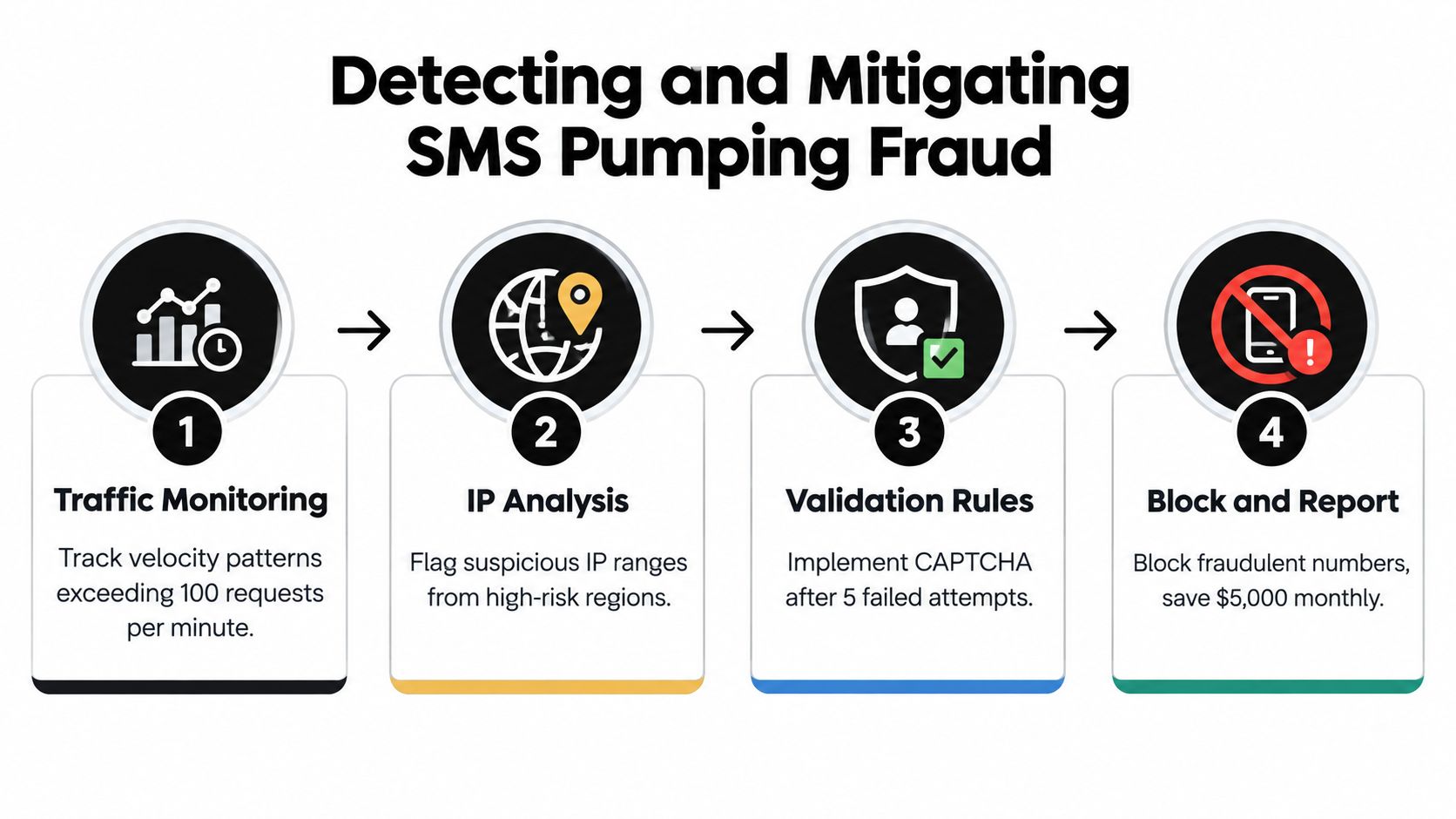
SMS pumping leaves patterns, but no single signal is reliable enough on its own. A burst of requests from one network is suspicious, yet legitimate mobile networks can aggregate many users behind shared addresses. A high-risk destination may deserve review, but geography alone is a poor reason to deny access. Effective controls combine signals and respond proportionally.
Start with a feature set that doesn’t require reading message content:
- Velocity: Requests per session, account, destination, device, network, and destination prefix.
- Sequence: Repeated sends without code submission, rapid resends, and many failed checks.
- Concentration: Sudden activity in a country, prefix, carrier, or route that differs from normal demand.
- Network reputation: Hosting, proxy, compromised-device, and previously abusive network indicators.
- Economic risk: Estimated message cost, route cost changes, and spend against a configured budget.
- Outcome quality: Completed verifications compared with requested and delivered messages.
Use a destination-risk score as a decision input, not an automatic verdict. A low-risk established session might proceed normally. A new session with unusual velocity might receive a proof-of-work challenge, a delayed send, or an alternate channel. Deny only when multiple indicators agree or when the expected cost exceeds a defined risk threshold.
Make controls financially observable
Set spend alerts before a carrier invoice arrives. Alert on unusual message volume, destination mix, prefix concentration, route changes, and a widening gap between codes sent and successful verifications. Keep product conversion dashboards separate from fraud dashboards. A campaign can have strong signup conversion and still contain a costly automated segment.
CAPTCHA can help, but it shouldn’t be the entire design. Attackers can outsource challenges, and CAPTCHA introduces accessibility friction. Combine it with per-purpose limits, authenticated sessions, destination scoring, device signals, and a clear recovery path for users who fail a challenge.
NIST treats SMS and other PSTN-based out-of-band methods as exposed to SIM swaps, number reassignment, SS7 interception, and forwarding. Its Digital Identity Guidelines therefore support treating SMS as a restricted mechanism, with additional validation and stronger alternatives for sensitive operations.
Test the fraud policy before deployment. Generate synthetic requests with masked destinations and controlled risk labels, then replay:
- Distributed requests with low per-IP velocity but high destination concentration.
- Resends that never produce a code check.
- Legitimate bursts from shared networks.
- Delayed carrier responses and provider timeouts.
- High-risk destinations with genuine successful users.
- Duplicate submissions after a valid approval.
Measure both prevented spend and legitimate completion. A control that blocks abuse but also blocks an important user population isn’t finished. The test passes only when the team can explain why each action occurred and recover a valid user without weakening the policy globally.
Navigating Security Standards and Fallback Paths
SMS should rarely be the strongest factor for a valuable account. The channel can be redirected through a SIM swap, exposed through signaling weaknesses, delivered to a reassigned number, or forwarded by a carrier or device feature. NIST’s guidance on PSTN-based out-of-band authentication is the right engineering baseline, because it treats those failure modes as properties of the channel rather than exceptional bugs.
A verification service should validate that a destination is associated with a physical device where possible, reject or risk-score VoIP and recently ported numbers where the available data supports that decision, and collect the OTP only through an authenticated, encrypted application channel. These checks address different risks. A compromised carrier account can redirect future messages, SS7 weaknesses can expose messages in transit, and number recycling can send a code to a new subscriber.
Choose the factor by operation
Use a decision matrix rather than a universal rule:
| Workflow | SMS role | Stronger default |
|---|---|---|
| Low-risk signup or contact confirmation | Primary convenience channel with abuse controls | SMS plus session and risk checks |
| Routine sign-in to a low-impact account | Fallback when stronger enrollment is unavailable | Passkey, WebAuthn, or TOTP |
| Password reset | Recovery path with additional account signals | Passkey recovery, trusted device, or support review |
| Financial or sensitive-data action | Avoid SMS as the sole proof | Phishing-resistant factor and transaction controls |
| Lost-device recovery | Carefully constrained fallback | Recovery code, verified device, or manual review |
This choice also has an access dimension. Users may have older devices, limited mobile plans, or unreliable coverage. Replacing SMS without testing the replacement can lock out precisely the people the original flow served. The migration must preserve a usable recovery path while reducing SMS exposure for higher-risk operations.
Test recovery as a hostile journey
Capture the state transitions, not live secrets. Mask OTP fields, phone numbers, cookies, authorization headers, and personal data before storing or replaying traffic. The GoReplay guidance on sensitive data protection is relevant to teams building this pipeline, because realistic traffic is useful only if the test environment cannot turn it into a credential store.
Replay cases where a passkey fails, a device disappears, a number changes, a SIM swap is suspected, or a code expires during a carrier delay. Verify that the service doesn’t downgrade a high-risk action to SMS after a failed passkey attempt without explicit notice. Every fallback should carry its own risk decision, rate limits, audit event, and support procedure.
A phased migration works better than a forced switch. Offer passkey or WebAuthn enrollment after a successful authenticated session, retain SMS for constrained recovery, require stronger proof for sensitive changes, and monitor which users still depend on SMS. Remove SMS from a workflow only after its replacement and recovery path have survived realistic failure testing.
Testing Verification Flows with Traffic Replay
Scripted tests cover intended behavior. Production traffic adds duplicate taps, browser retries, stale mobile clients, delayed provider callbacks, incomplete registrations, and users requesting a second code while the first is still crossing a carrier route. Those sequences expose ordering and state bugs that clean test scripts rarely create.
Traffic replay exercises an authentication service with the shape of real requests while sending them to an isolated candidate environment. The method is useful only when the capture pipeline removes secrets before storage and before transmission to the test system. The GoReplay approach to replaying production traffic for realistic load testing offers a practical model for this validation.
Capture behavior, not credentials
At the edge, define masking rules for OTP fields, phone numbers, cookies, authorization headers, session identifiers, and personal data. Use deterministic test tokens when correlation matters, or generated values when each request needs unique data. Preserve the method, path, routing headers, response timing categories, request order, and relevant application states.
Never replay a captured production OTP through a real provider. Send requests to a fake gateway or provider sandbox with deterministic outcomes. Include accepted, delayed, rejected, rate-limited, and unknown delivery results so the service must handle each branch.
A replay run should answer specific questions:
- Does resending invalidate the expected challenge?
- Does a duplicate check return one stable result?
- Does a provider timeout leave the record recoverable?
- Does a carrier outage trigger an approved fallback?
- Does a fraud rule throttle only the suspicious segment?
- Does a passkey failure retain the correct risk level?
- Does changing a number require the expected reauthentication?
Compare approaches objectively
Unit tests are fast and precise for token generation, expiry, constant-time comparison, and state transitions. Integration tests check provider adapters and callback handling. Replay tests interactions and sequencing under traffic patterns the team did not write by hand. Each approach catches a different class of failure, so replacing one with another leaves blind spots.
Use sampling and redaction for routine regression runs, then build targeted replay suites for fraud, fallback, and migration scenarios. The same captures can reveal whether SMS pumping controls, provider failures, and alternative authentication paths behave consistently under realistic ordering.
Replay must also test controlled load without turning an authentication endpoint into an uncontrolled stress target. Bound concurrency, isolate the provider mock, and monitor database locks, queue depth, rate-limit state, and downstream session issuance. A service that accepts volume but serializes every approval on one database row still has a resilience defect.
The final artifact should record the redacted request sequence, policy decision, expected outcome, actual outcome, and state-transition trace. QA can reproduce a telecom edge case, DevOps can validate a rollout, and security can assess whether a new control changed access unexpectedly.
Evaluating Alternatives and Future-Proofing Authentication
SMS remains useful because it reaches people who may not have a password manager, passkey-capable device, stable app installation, or reliable data connection. It also remains weak against channel takeover and phishing. The right architecture doesn’t pretend one method fits every user or operation.
Recent institutional changes make migration planning more urgent. The U.S. Patent and Trademark Office ended SMS and voice authentication in 2025, and European Commission services phased out SMS OTP for users during 2025, as reported in Security Boulevard’s overview of the move beyond SMS OTP. Those changes don’t mean every product should remove SMS immediately. They do mean authentication teams should know which flows still depend on it and what replaces them.
| Method | Phishing Resistance | User Friction | Accessibility |
|---|---|---|---|
| SMS OTP | Low | Familiar, but delivery can be delayed | Broad reach where cellular service exists |
| TOTP | Better than SMS, but codes can be phished | Requires setup and an authenticator | Works offline on supported devices |
| Push authentication | Depends on approval design and device security | Convenient after enrollment | Requires a functioning app and notifications |
| Passkeys | Strong, phishing-resistant design | Low after enrollment, unfamiliar during migration | Depends on device, platform, and recovery support |
| WebAuthn security keys | Strong, phishing-resistant design | Requires an additional credential | Can be difficult for users without a key |
| Email recovery | Vulnerable if email is compromised | Familiar and widely available | Broad, but dependent on email access |
Roll out in risk tiers
Start by inventorying every SMS use, including signup, login, password reset, number change, payment confirmation, and support recovery. Classify each by account value, data sensitivity, fraud impact, and user consequences. Don’t let a single global setting decide all of them.
Enroll stronger factors during successful sessions. Offer passkeys as the preferred option, keep TOTP or push where they fit the product, and preserve SMS only where its accessibility benefit outweighs its risk. For high-value actions, require a phishing-resistant factor or a separately reviewed recovery path.
Test the migration with cohorts and explicit exit criteria. Monitor enrollment, fallback use, failed recovery, support contacts, and suspicious downgrade attempts. Users with older devices or limited mobile access need a documented alternative, not an assumption that they will upgrade.
A durable authentication system treats SMS as one replaceable adapter in a broader identity architecture. Keep the verification API provider-neutral, store state transitions cleanly, mask replay data, and make every fallback observable. Then you can reduce SMS exposure without turning security improvement into an availability failure.
If your team is building or migrating an SMS verification service, start with a redacted traffic capture, a provider mock, and a state-transition test suite. Use GoReplay to replay realistic authentication journeys into a safe environment, validate pumping controls and fallback behavior, and document which workflows can move to passkeys or WebAuthn. Explore the testing capabilities at GoReplay and turn verification reliability into something you can measure before the next production deployment.