
Sensitive Data Protection When Replaying Production Traffic

You’ve captured a useful slice of production traffic, replayed it against staging, and found a problem that synthetic tests never exposed. Then someone asks where the capture file went. It’s in object storage, a developer’s laptop, the CI workspace, an observability index, and perhaps a vendor-managed replay service. The traffic still behaves like production, but the data now lives in places that don’t have production’s controls.
That’s the engineering tension behind sensitive data protection when replaying production traffic. Strong redaction protects people and the business, but it can destroy the session state, validation paths, and request relationships that make replay valuable. Weak redaction preserves fidelity while expanding the blast radius. The practical answer is to classify data before capture, transform it before persistence, isolate every output, and continuously test that the protection still works.
Why Replaying Production Traffic Creates a Sensitive Data Problem
Traffic replay doesn’t merely observe production. It copies requests and responses into environments that usually have broader access and weaker controls, such as staging, shared development clusters, CI runners, or external SaaS platforms. A request may contain an authorization header, session cookie, customer address, payment information, or confidential business payload. Once the replay pipeline duplicates it, every destination becomes part of the data-protection boundary.
This differs from ordinary PII handling because the capture process creates operational copies at speed. A packet capture, replay dump, sidecar proxy, middleware process, output plugin, and log shipper can each retain some version of the same exchange. If a tokenized card number or JWT reaches disk before transformation, removing it later means finding every replica, cache, backup, index, and local copy. Capture-time decisions are therefore more important than cleanup scripts.
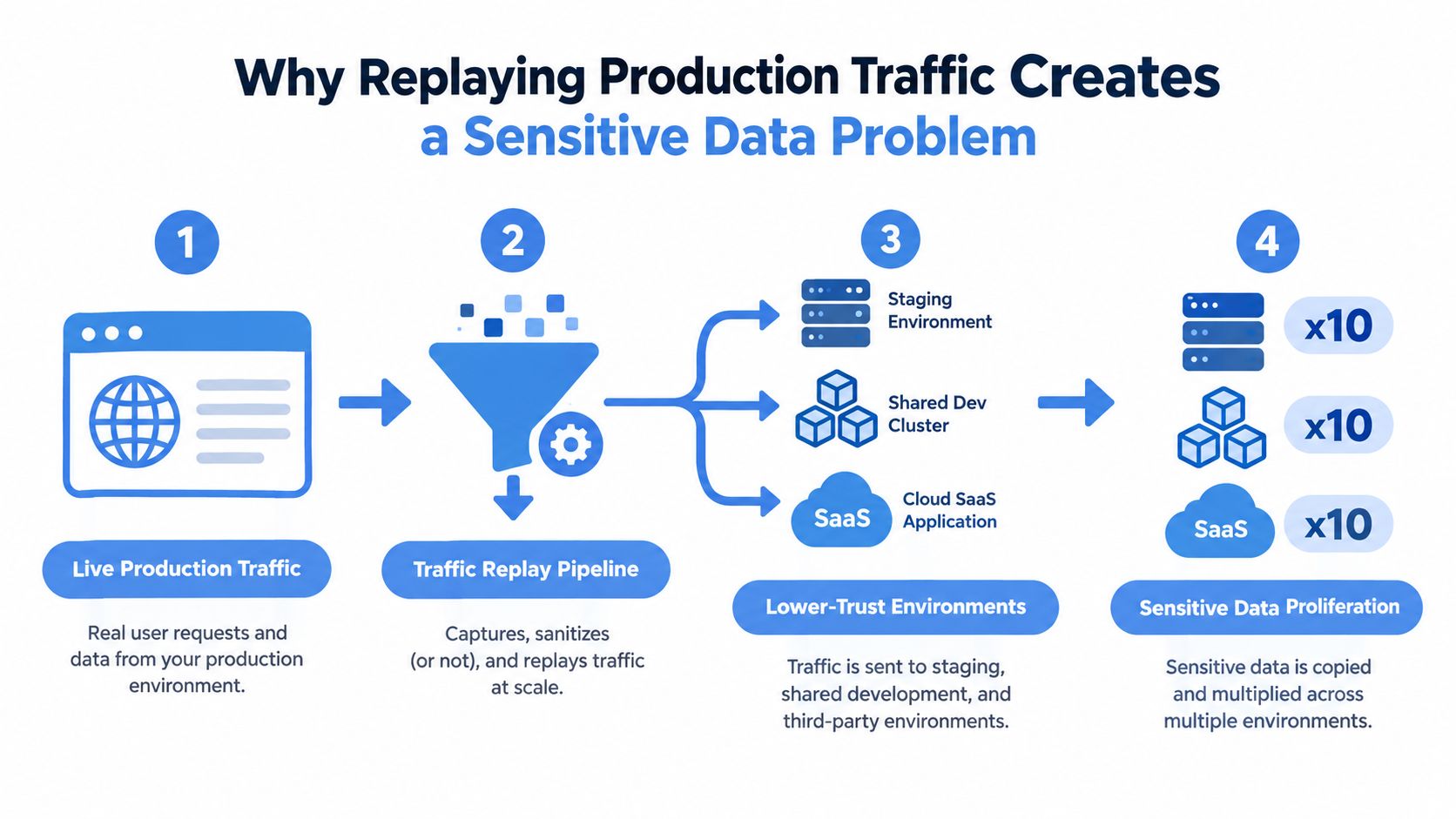
Where exposure happens
A useful review traces the data path rather than focusing only on the replay command:
- Capture files: Raw request and response bodies can remain on the host that records traffic.
- Log shipping: Debug output or middleware errors may send headers and payload fragments to ELK.
- Object storage: A replay archive may inherit permissive bucket policies or broad developer access.
- CI runners: Jobs can copy captures into temporary workspaces, artifacts, or cache directories.
- Developer machines: A locally run GoReplay process can leave readable dumps behind.
- Downstream services: Sidecars, analytics pipelines, and vendor tools may create additional copies.
Fidelity creates the conflict. Keeping headers, cookies, and bodies intact preserves authentication and stateful behavior, but those same fields often contain the most dangerous material. Removing every sensitive field makes the capture safer, yet it can turn a realistic workflow into a collection of requests that no longer exercises authorization, validation, or correlation.
Practical rule: Treat every output target as a new sensitive-data boundary. A single misconfigured destination can move regulated information outside its approved environment in one step.
The European Union’s GDPR became a major milestone in formalizing these responsibilities. The regulation was adopted in 2016 and became fully enforceable on 25 May 2018, after a two-year transition period, as documented by the European Data Protection Supervisor’s GDPR history. Its influence extends beyond Europe because organizations now have to define rights, obligations, retention, breach response, and governance practices with much greater precision.
Classifying and Mapping Sensitive Data in Captured Traffic
Don’t start by writing masking rules. Start by finding out what the traffic contains.
Take a representative production sample during a controlled window, store it in a restricted analysis location, and scan it offline before deciding what to retain. Combine regex detectors for email addresses, payment card patterns, API keys, and tokens with schema-aware rules for JSON paths such as user.email and payment.card. Regex alone misses structured secrets and can also overmatch harmless strings. Schema rules alone miss unexpected fields and malformed payloads.
Build a sensitivity map
Organize findings into operational categories, then record where each value appears. The location matters because a URL query parameter needs a different control from a nested JSON field or a binary upload.
| Sensitivity Tier | Examples | Typical Location | Detection Signal |
|---|---|---|---|
| Regulated identifiers | Government identifiers, payment card numbers | JSON body, form data, query string | Pattern match, checksum, schema path |
| Authentication material | Session cookies, JWTs, API keys, OAuth tokens | Headers, cookies, request body | Header allowlist, token shape, secret scanner |
| Personal data | Names, addresses, phone numbers, email addresses, IP addresses | JSON fields, headers, URL parameters | Field names, regex, data classification |
| Business-confidential payloads | Pricing, internal IDs, contractual terms | JSON body, documents, response body | Endpoint schema, dictionary, ownership review |
For each endpoint, record the method, path, query parameters, headers, body fields, response fields, and whether the value must remain correlated across requests. That produces a per-endpoint sensitivity map instead of one global rule that treats every payload the same way.
A payment endpoint might require exclusion, while a profile endpoint may support deterministic replacement. An authentication endpoint may need its authorization header removed but its user identifier preserved in a synthetic form. This classification should happen before capture-at-rest decisions, because an unknown field is effectively an unredacted field.
The legal and operational context also matters. Teams handling donations, financial records, or other personal information can use resources such as CEFCore’s data handling guidance for church extension funds to inform ownership, retention, and access discussions. The link doesn’t replace a technical inventory, but it helps clarify why data stewardship continues after an application sends the request.
Assign an owner to every rule
A platform team can maintain the scanner, but service owners should confirm field meaning. Ask three questions for each sensitive value:
- Does replay need the original value?
- Must the replacement remain stable across requests?
- Can the endpoint be excluded and tested with synthetic traffic instead?
Those answers determine whether you’ll mask, tokenize, redact, or refuse capture. They also give auditors a defensible explanation for why each field is handled differently.
Masking, Redaction, and Tokenization for Replay Workflows
The right transformation depends on what the target system needs to exercise.
Masking replaces a real value with a structurally valid substitute. A fake phone number can preserve formatting, while a deterministic replacement for a payment-like field can keep schema validation and downstream parsing active. Masking works well for load tests and analytics where the system needs realistic shapes but not original identities.
Redaction removes the value or replaces it with an empty value. It provides the strongest reduction in exposure, but it can break workflows that depend on the field. Removing an authorization header may prevent the request from reaching the intended application path. Blank a required customer identifier and the target may return a validation error before the code under test runs.
Tokenization replaces the original with an opaque reference. A token service can return the same synthetic value whenever the replay pipeline encounters the same source value, preserving relationships across requests. That’s useful for session-aware flows, account lookups, and sequences where correlation matters. It also introduces a network dependency, a vault, access policies, failure modes, and another secret-management problem.
Choose for behavior, not appearance
A masked body can preserve most application behavior when the target only checks structure and format. Redacted credentials can eliminate an entire login flow. Tokenization may preserve state but makes replay dependent on the availability and correctness of the token service.
The often-requested 90 to 95 percent fidelity figure shouldn’t be treated as a universal guarantee. Fidelity depends on the endpoint, the application’s validation rules, the fields you transform, and whether the replacement remains correlated. Measure behavior against your own replay corpus instead of promising a fixed percentage.
| Technique | Fidelity Impact | Reversibility | Replay Suitability |
|---|---|---|---|
| Masking | Preserves shape and often preserves validation paths | Usually one-way | Analytics, load tests, schema-driven workflows |
| Redaction | Can bypass or break dependent application logic | Not reversible | Fields with no replay value, high-risk payloads |
| Tokenization | Preserves correlation when tokens remain stable | Reversible only through a protected vault | Stateful flows and cross-request relationships |
A good rule is to mask values that the application needs to parse, redact values that add no test value, and tokenize values that must correlate. Don’t use reversible tokenization casually. If the vault contains the original data and has broad access, you’ve recreated the original sensitivity problem in a different system.
For implementation details on transforming captured requests, see GoReplay’s production data masking guidance for testing. The important design decision comes first: define the behavior your test must preserve, then select the least sensitive representation that can support it.
Configuring GoReplay for Sensitive Data Protection
GoReplay can sit inside a protection pipeline that transforms traffic before it reaches a replay target or durable output. The exact placement matters. If raw traffic is written to a capture file before middleware runs, the middleware can protect replay input without protecting the stored artifact. For high-risk fields, transformation needs to happen before persistence.
A representative command might look like this:
gor --input-file capture.log --middleware 'scripts/redact.py' --output-http target.example
The middleware can remove authorization headers, replace cookies with deterministic values, and transform selected JSON fields. A custom modifier should work from explicit header-name allowlists and schema paths rather than broad substitutions. For example, strip Authorization, replace session cookies with a stable synthetic cookie, and preserve harmless headers required for routing. Hashing a cookie can preserve correlation, but the hash must not become an accepted credential.
Selective capture beats universal capture
Use request and response body recording only where the test needs it. If a response body contributes nothing to the scenario, don’t record it. If an endpoint contains payment data or unstructured documents that your sanitizer can’t inspect reliably, exclude that path and generate synthetic coverage separately.
| Flag / Hook | Purpose | Sensitive Data Use Case |
|---|---|---|
| Request and response modifiers | Transform parsed traffic fields | Remove headers and replace known body fields |
--middleware | Send traffic through external processing | Apply schema-aware redaction or tokenization |
| Output plugins | Deliver transformed traffic to another destination | Keep protected data out of downstream systems |
--output-http-filter | Restrict which traffic reaches an HTTP output | Exclude payment or high-risk routes |
--record-request-body | Record request bodies when needed | Enable only for endpoints with tested sanitization |
--record-response-body | Record response bodies when needed | Avoid unnecessary copies of personal or confidential data |
GoReplay’s request rewriting documentation is useful when deciding whether a rule should operate on headers, URLs, or payload content. Headers are already structured, so a denylist or allowlist is safer than text replacement. Raw body bytes require format-aware processing, especially for compressed, multipart, or binary content.
After configuring the pipeline, inspect actual artifacts, not just middleware output. Verify that authorization headers are absent, cookies are transformed, JSON fields contain synthetic values, and capture files contain no plaintext personal data. Search logs from the middleware and output stages too. A sanitizer that protects the replay stream but logs the original payload during an exception has failed operationally.
Verification standard: A replay configuration isn’t complete until the capture file, middleware logs, output artifacts, CI workspace, and observability indexes all pass the same sensitive-data scan.
Mapping Compliance Requirements to Replay Controls
Compliance frameworks become practical when translated into pipeline behavior. The question isn’t only whether a policy mentions minimization or encryption. The question is what the capture process does when it encounters a sensitive field.
For GDPR, minimize the data collected for testing, establish an appropriate basis for processing, limit access, and define retention. If a replay store leaks, the organization needs an incident process that treats the store as a location where personal data was processed. The GDPR’s broad influence is one reason replay teams should document purpose, ownership, deletion, and access rather than treating captures as disposable engineering files.
HIPAA requires a different operational discussion when replay traffic contains electronic protected health information. The lower-trust environment effectively becomes part of the environment handling ePHI, which affects administrative, physical, and technical safeguards. Teams also need to decide whether vendors, replay platforms, or storage providers fall within Business Associate Agreement scope.
PCI DSS Requirement 3 is usually the strongest reason to avoid capturing payment paths altogether. If the test doesn’t need real cardholder data, route those requests to a sink, drop them at capture, or replace them with synthetic payment traffic before storage. Masking can preserve a format, but it doesn’t automatically make a real card number acceptable for retention.
| Regulation / Clause | Replay Pipeline Control | Verification |
|---|---|---|
| GDPR data minimization and protection | Filter unnecessary fields, define purpose, restrict retention | Data inventory, deletion evidence, access review |
| HIPAA Security Rule safeguards | Isolate ePHI-capable environments and assess vendor scope | Environment controls, access logs, contractual review |
| PCI DSS Requirement 3 | Exclude payment paths or use synthetic traffic | Capture scans, route filters, artifact inspection |
| Cross-cutting security obligations | Encrypt files, restrict IAM, log privileged access | Key policy review, audit events, recovery tests |
Use a simple decision tree. If the field has no replay value, exclude or redact it. If the application needs its shape but not its identity, mask it. If multiple requests must refer to the same synthetic entity, tokenize or deterministically transform it. If the value remains regulated even after transformation, don’t assume the transformation is enough. Confirm the result with your compliance owner.
For teams translating privacy obligations into software governance, operator licence software data protection information can provide useful legal context. It should complement, not replace, a control map tied directly to capture, storage, replay, and deletion.
Secure Storage, Transport, Access, and Audit
Masking reduces exposure, but it doesn’t secure the pipeline by itself. The capture host, transport path, storage system, keys, identities, and audit trail still need deliberate controls.
Protect traffic in transit with TLS between the GoReplay listener, middleware, output target, and storage service. Encrypt capture files at rest with envelope encryption and keys managed through a KMS. Keep environment storage separate, with IAM policies that prevent a development role from reading production captures or a vendor integration from browsing unrelated replay archives.
Make access narrow and observable
Most engineers need protected replay data, not raw capture data. A security or privacy team may need controlled raw access for investigation, but that access should require a deliberate break-glass path and create an audit event.
- Replay access: Let engineers run approved captures without granting them decryption rights to raw artifacts.
- Raw access: Restrict decryption and export to a small, accountable group.
- Environment separation: Use separate buckets or volumes and deny cross-environment reads by policy.
- Retention enforcement: Apply automatic purge and verify that replicas, caches, and CI artifacts follow the same schedule.
- Audit collection: Record who requested a capture, which rules ran, who decrypted an artifact, and when deletion completed.
Key management needs an operational plan too. Rotate keys according to organizational policy, revoke compromised keys promptly, and decide whether historical replays must be re-encrypted, retired, or deleted when a key changes. A key rotation event shouldn’t leave old files in an undefined state.
Teams handling health information can also review practical data security measures for weight loss telehealth when comparing encryption, access control, and privacy practices across sensitive operational systems. The same principle applies to replay: protect the data throughout its lifecycle, not only while it sits in the primary archive.
The common failure is treating capture storage like ordinary application logs. A world-readable object-store location, inherited developer policy, or unencrypted temporary volume can undo careful masking. Scan storage continuously, inspect effective permissions, and test deletion instead of assuming the lifecycle policy worked.
Integrating Protection into CI/CD and Verifying It Works
Sensitive-data controls belong in automated gates, not in a checklist someone remembers after a load test. The first gate should run before a capture becomes an artifact. Feed request and response samples through the same classifier used for production analysis, then fail the job if it finds unmasked personal data, credentials, or secrets.
The second gate should validate behavior after replay. Compare synthetic response fields with expected schemas and verify that tokenization hasn’t broken contracts between services. A protected replay can still be useless if the replacement values violate application constraints or if a stateful flow no longer correlates.
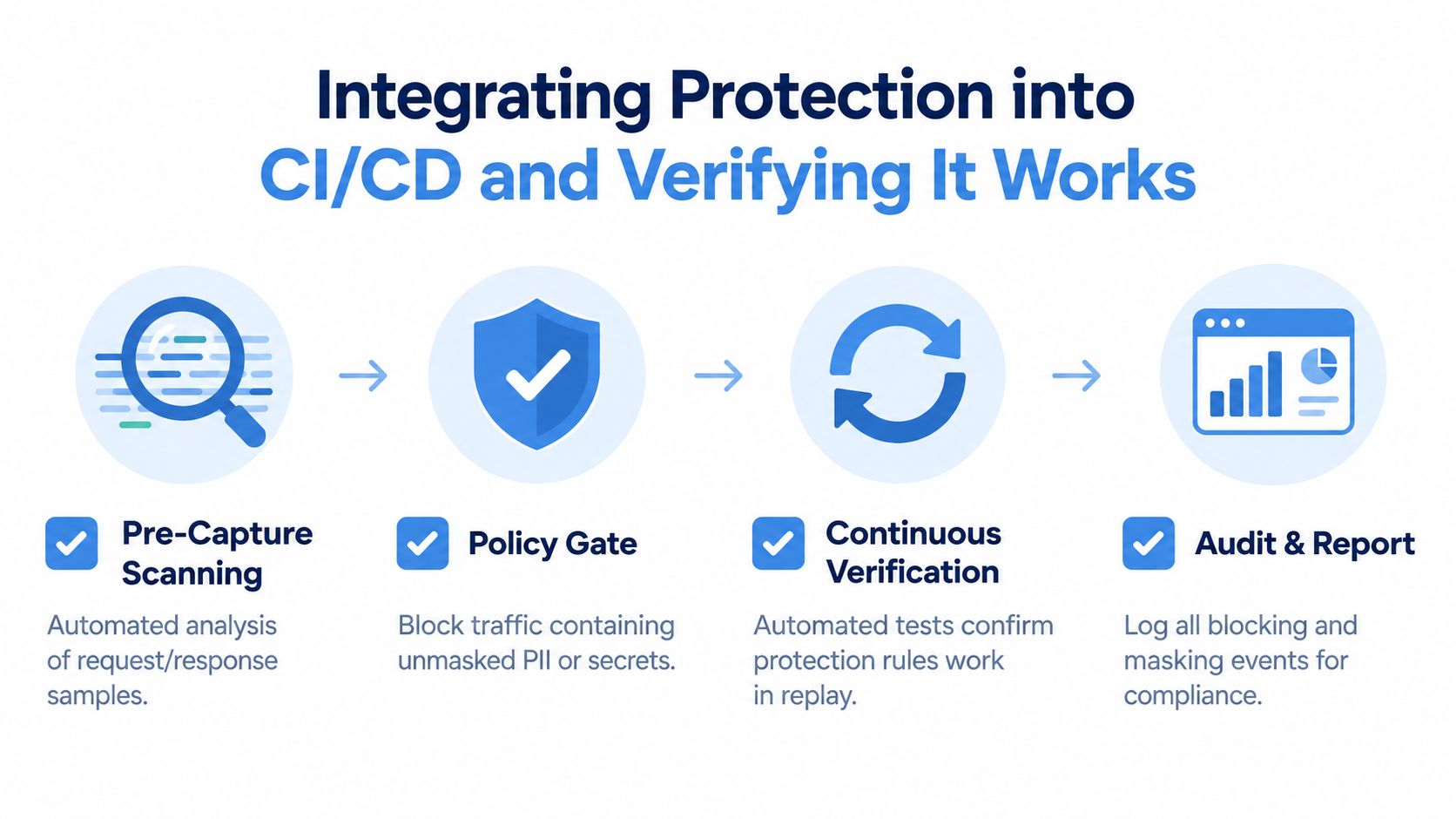
Turn protection into a tested artifact
Version middleware, modifiers, dictionaries, and GoReplay configuration with the application code they protect. Unit tests should include representative JSON, headers, query strings, compressed content, malformed payloads, and fields added by newer service versions.
A practical CI sequence looks like this:
- Pre-capture scan: Inspect samples and reject unknown sensitive fields.
- Transformation test: Assert that each rule removes, masks, or tokenizes the intended value.
- Artifact scan: Search the resulting capture, logs, and build workspace for plaintext secrets and personal data.
- Replay contract test: Confirm schemas, status behavior, session correlation, and expected synthetic values.
- Performance gate: Measure added latency, dropped requests, and memory overhead from regex and dictionary lookups.
- Access test: Confirm that unauthorized identities can’t read or decrypt the capture.
- Deletion test: Verify that retention automation removes the artifact and its known replicas.
The performance budget should be measured rather than guessed. A complex regex can consume excessive CPU, while dictionary lookups and tokenization calls can add latency or create backpressure. If protection causes dropped requests, teams may disable it under delivery pressure. That’s why the pipeline should fail when transformation overhead exceeds an agreed budget, while still refusing to permit raw sensitive data through.
Place a scheduled verification job behind the normal build process. Replay a known protected corpus against staging, scan every generated artifact, inspect access logs, and confirm encryption and deletion after infrastructure changes. Drift is normal. A rule that worked before a storage migration or middleware upgrade needs evidence again.
The global direction makes this discipline harder to postpone. By 2025, 172 countries had enacted data protection or privacy legislation, representing 79% of UN member states, and GDPR enforcement had generated more than €7.1 billion in fines since May 2018, according to global data privacy statistics from StationX. The same source reports regulators were receiving more than 400 breach notifications per day, at a pace 22% higher year over year. Those figures don’t prescribe a replay design, but they show why an overlooked capture file can become a compliance event rather than a minor testing mistake.
Protect replay fidelity deliberately. Don’t preserve a real secret just because the test happens to depend on its shape.
GoReplay can capture and replay live HTTP traffic while supporting middleware, filtering, rewriting, and data-masking workflows that fit into a controlled test pipeline. Review your current capture path this week, add an artifact scan before persistence, and visit GoReplay to evaluate how it can support safer production-traffic replay.