
Security Vulnerability Testing Guide for 2026
Vulnerability exploitation accounted for 20% of initial access actions in breaches, a 34% increase from the previous report, according to Verizon’s 2025 Data Breach Investigations Report. That makes security vulnerability testing a release decision, not just a scanning task. Finding more weaknesses matters only if your team can establish which ones attackers could reach, what they could do, and which fixes must ship.
What Security Vulnerability Testing Is For
Say your team patches an internet-facing customer portal. The dependency scanner stops reporting the vulnerable package, the build passes, and someone closes the ticket. But the deployed service still routes a legacy endpoint to an unpatched instance.
The package check was useful. It didn’t establish that the exposed system was fixed.
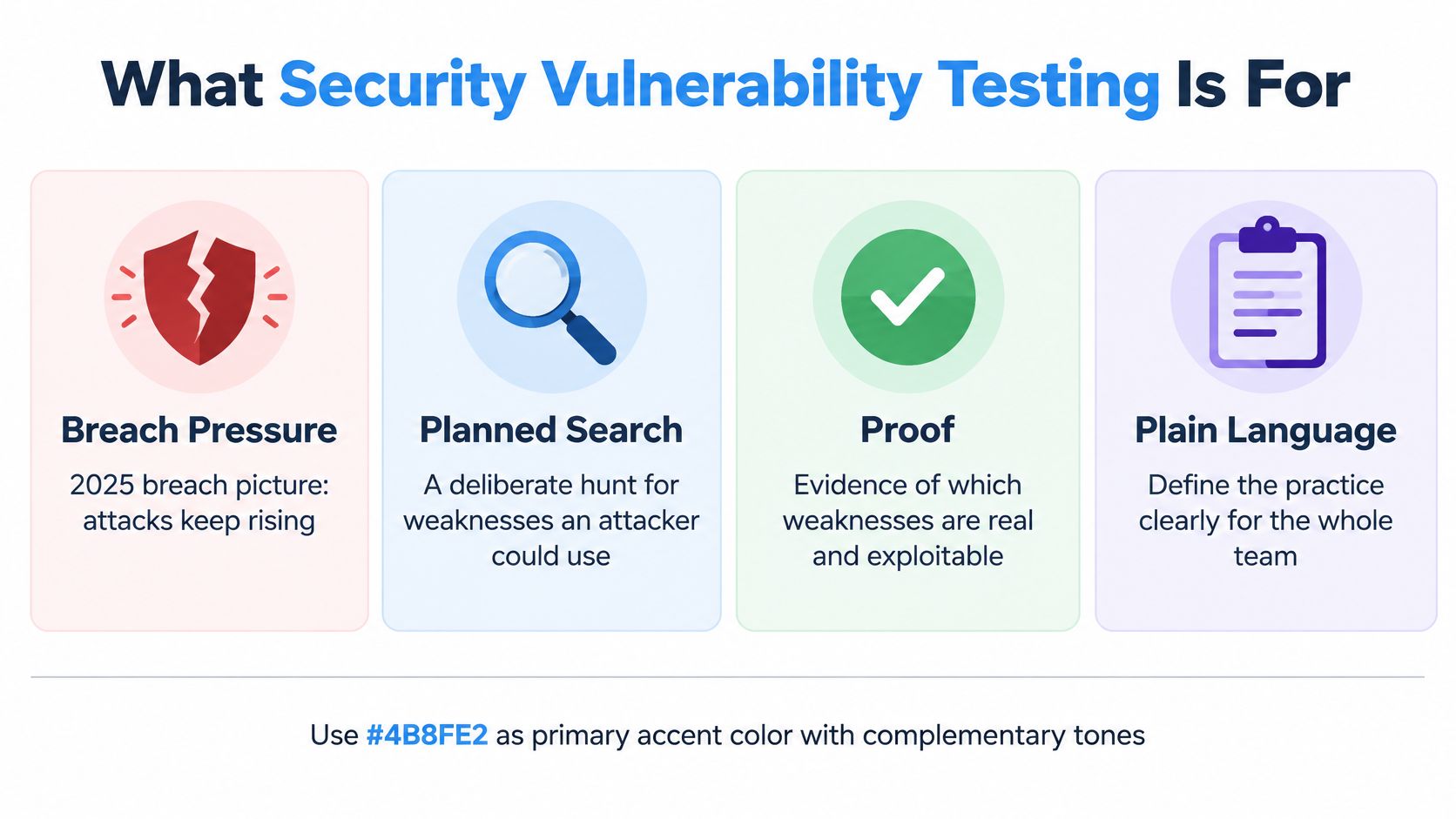
Security vulnerability testing is a planned search for weaknesses an attacker could use, plus evidence of which weaknesses are reachable in the systems you actually run.
Think of a scanner as a smoke alarm. It signals something that needs investigation. A useful security test is closer to a fire drill: it checks whether the escape route works under the conditions people will encounter, rather than merely confirming that an alarm exists.
For the customer portal, that means exercising the affected route through the deployed gateway, with the relevant account role and session state. The test must distinguish a patched response from a request that never reached the vulnerable component.
The distinction between discovery and proof is central to the testing program.
Test the system users actually reach
An application isn’t just its source code. Its exposure includes authentication gateways, routing rules, session stores, deployment configuration, and the behavior of dependencies when something fails.
A production-like test should answer concrete questions:
- Authentication: Does the deployed route enforce the intended identity and role checks?
- Routing: Can an alternate path bypass the component that applies a security control?
- Session handling: Does a revoked or expired session lose access throughout the workflow?
- Patch behavior: Is the corrected component serving the requests that previously reached the weakness?
- Failure modes: Does a timeout, unavailable identity service, or malformed request cause the application to reject access safely?
These checks belong before deployment and after deployment. Staging can establish expected behavior, while a narrowly scoped post-deployment check confirms that routing and configuration haven’t invalidated the result.
The deliverable shouldn’t be a raw alert dump. It should be a short, defensible remediation queue, with reproduction evidence, affected assets, business impact, a named owner, and a retest date.
A passing test has a boundary. It establishes what happened on the tested build, path, role, and environment. It doesn’t establish that every endpoint or attack sequence is safe.
Major Testing Types and When Each Fits
| Type | Examines | Strength | Limit | Best moment |
|---|---|---|---|---|
| SAST | Source and build artifacts | Finds insecure patterns before runtime | Misses deployed configuration, authentication flows, and reachability | Every pull request |
| DAST | Running application over HTTP | Exercises deployed behavior, headers, and errors | False positives and weak business-logic coverage | Staging before release |
| IAST | Instrumented runtime | Ties a finding to the code path that ran | Needs instrumentation and traffic that executes the path | QA with realistic sessions |
| SCA | Dependencies and images | Flags known vulnerable library versions | A version match isn’t proof of exploitability | Build pipeline |
| Network and configuration scan | Hosts, ports, patches, TLS, and edge devices | Discovers exposure and missing patches | Scanner severity isn’t business impact | Scheduled and after infrastructure changes |
| Penetration test | Chained attack paths | Demonstrates damage an attacker can complete | Requires skilled time and remains point-in-time | Major releases and periodic assurance |
Security vulnerability testing types compared: choose each method for the question it can answer, not for the size of its report.
SAST and software composition analysis belong close to the change. Developers can resolve an unsafe data flow or dependency update while the relevant code is still in context. Neither should become a blanket excuse to postpone deployment whenever a tool reports a version match without a usable attack path.
Dynamic testing needs a deployed application. IAST adds runtime context, but instrumentation doesn’t create coverage by itself. If the test traffic never exercises an administrative export or recovery flow, the runtime tool can’t establish how that path behaves.
Choose coverage by change and exposure
For a source or library change, start with the pull-request checks. For a gateway, authentication, or session change, require testing against the deployed build. For a host image or ingress change, include network and configuration checks rather than assuming application tests cover the infrastructure.
Keep penetration testing for questions that require judgment: Can a low-privilege account reach an administrative function? Can individually modest findings be chained into access to sensitive data? Does the application permit an operation that violates its business rules even though each request is syntactically valid?
Automated assistance can broaden that work, but the same evidence requirements apply to AI penetration testing: authorized scope, reproducible findings, and a clear explanation of impact.
Authenticated dynamic testing has an operational cost. You need controlled accounts, representative roles, reliable sign-in, and a way to detect when the scanner has fallen back to anonymous requests. A completed scan with an expired session can look thorough while missing the protected application.
Use approved windows, conservative request rates, and safe checks for shared environments. The more state a test can change, the more carefully you need to constrain its accounts and destinations.
Selection rule: Use automation to discover candidates. Use contextual validation to establish whether those candidates justify a remediation or release decision.
Buying another testing type won’t compensate for missing ownership. Keep a method because it answers a distinct question, and remove duplicate tickets before they reach developers.
How to Run the Testing Lifecycle
NIST’s technical guide to information security testing and assessment distinguishes discovery and vulnerability scanning from penetration testing: scanners identify hosts, services, missing patches, and potentially vulnerable versions, while controlled exploitation helps establish exposure and potential damage. Treat those as complementary activities, not interchangeable labels.
A repeatable pass from authorization to regression
-
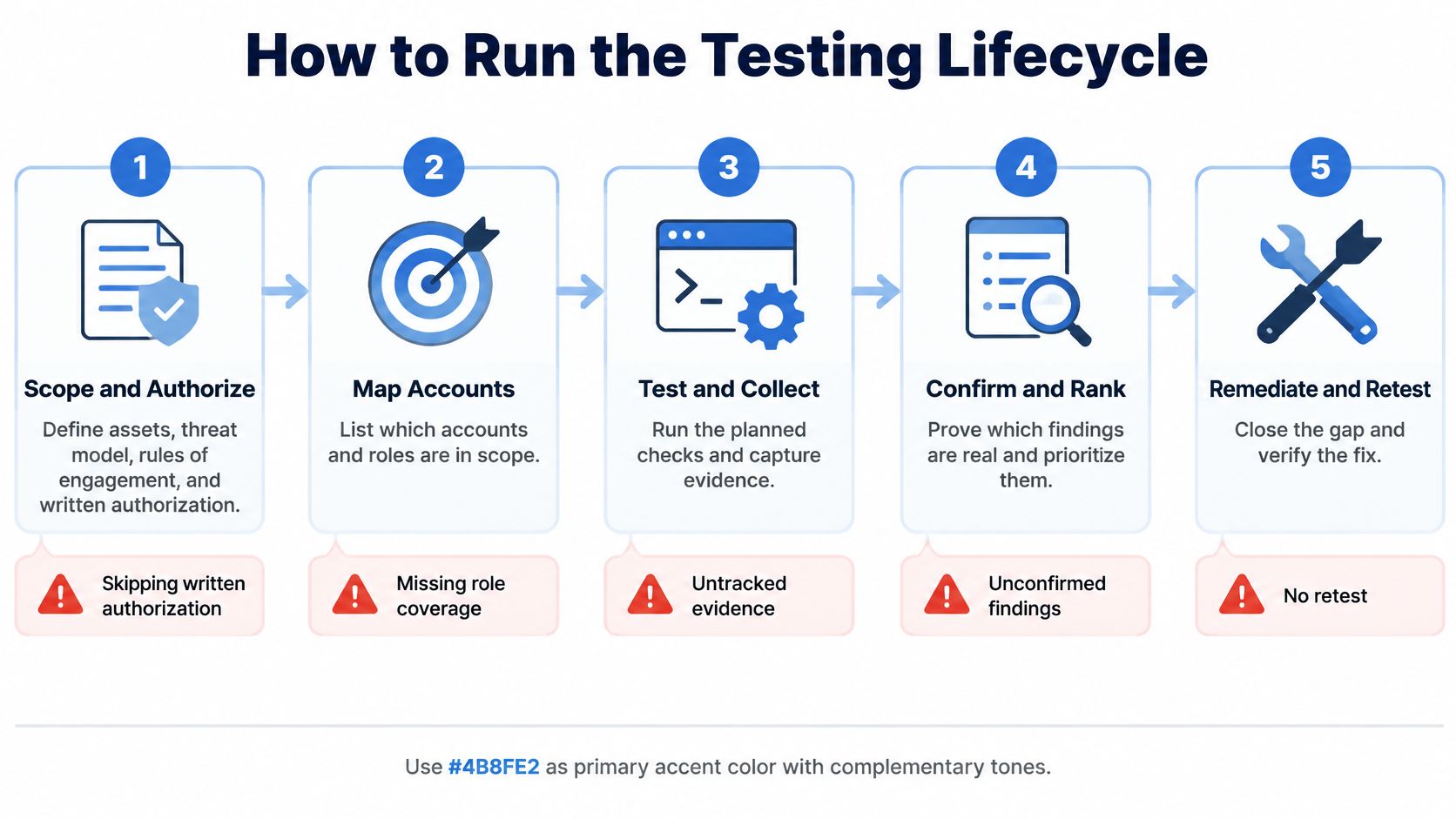
Plan the scope and obtain written authorization. Identify assets, environments, account roles, threat scenarios, and rules of engagement. Specify prohibited actions, stop conditions, and who can halt the test. The usual slip is treating permission to assess an application as permission to test every connected service.
-
Prepare an isolated, representative target. Match the security-relevant configuration, seed masked test data, and replace external integrations with controlled destinations. Disable customer email, real payments, and production queue publishing. The common mistake is isolating the application server while leaving its downstream credentials or callbacks connected to live systems.
-
Run discovery and scanning within operational limits. Test both signed-in and anonymous access, apply rate limits and safe checks, and record the scanner version, rules, build, and routes exercised. Watch bandwidth and response times so testing doesn’t become an availability incident. A frequent slip is recording that authentication succeeded at the start without checking whether it remained valid.
-
Validate high-risk candidates by hand. Reproduce the issue with the least disruptive method that establishes reachability and impact. Merge duplicate findings that share a root cause, and preserve sanitized requests, responses, and relevant application state. Don’t mistake a scanner’s severity label for proof that the application permits the claimed outcome.
-
Assign remediation and a decision date. Give each confirmed issue an owner, a proposed fix or compensating control, and a deadline based on exposure and consequence. Document any temporary restriction and how you’ll verify it. The usual failure is accepting a workaround without identifying who will remove it or finish the underlying repair.
-
Retest the affected path and retain a regression check. Run the original reproducer against the corrected build, then confirm the legitimate operation still works. Keep a suitable automated assertion so subsequent changes can’t restore the weakness. Closing the ticket because a patch merged skips the evidence that matters.
The lifecycle requires both execution and interpretation.
Make the release decision explicit
Human review prevents false positives, duplicate tickets, and missed business-logic implications from becoming a misleading backlog. It should also distinguish not exploitable under tested conditions from not investigated.
A remediation ticket needs enough evidence for another engineer to reproduce the result without a meeting. Include prerequisites, affected role, request sequence, observed consequence, and the expected secure behavior.
Ship based on verified exploitability and impact, with explicit handling of unresolved risk. A clean-looking scanner score isn’t a substitute for that decision.
Replay Production Traffic Without Production Risk
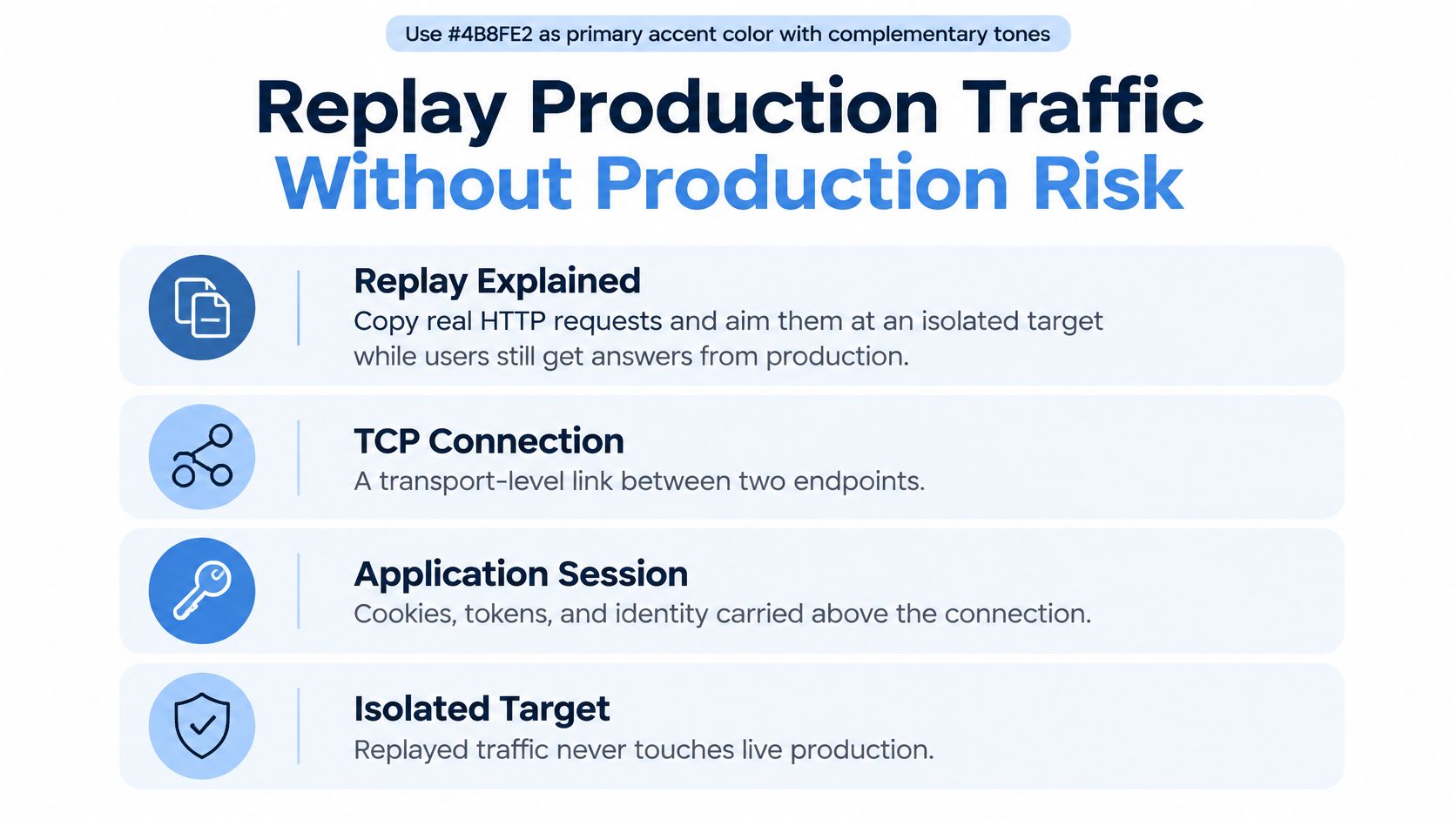
In a shadow test, users continue receiving responses from production while copies of selected HTTP requests go to an isolated candidate build. The candidate can fail without becoming the service that answers customers.
That makes replay useful for security-related regression testing, but realistic requests don’t automatically produce realistic sessions. A TCP connection is a transport link. An application session carries identity and workflow state through cookies, tokens, and object identifiers, potentially across many connections.
The separation between live service and replay target must remain deliberate.
Prepare the sample before running it
- Choose the capture point. Capture the required HTTP requests at a suitable plaintext point after TLS termination. Measure capture overhead, restrict access to captured material, and avoid collecting bodies or headers that the test doesn’t need.
- Transform the workload. Remove unsuitable requests and rewrite destinations for the isolated target. Apply deterministic masking so related identifiers remain consistent without retaining personal data. Use an explicit sensitive-data protection workflow rather than assuming that deleting an authorization header makes the sample safe.
- Compare outcomes. Examine status codes, meaningful payload fields, latency, and application state. Normalize expected differences such as generated identifiers, but don’t normalize away authorization failures or missing writes.
Grouping sockets won’t refresh an expired token, create a missing cart, or translate a production object identifier into a seeded test object. Use middleware or test setup to reconstruct those prerequisites.
Never send candidate responses back to users, and never replay destructive actions against live systems.
Use replay for questions it can answer
Shadow a candidate build to check whether a patch or configuration change still supports existing journeys. Save an approved workload and replay it later at a chosen speed for a soak test. For debugging, filter a captured sample down to the request sequence that reproduces the suspected fault.
ResDiary used GoReplay to validate infrastructure requirements during its migration from RackSpace to Azure and successfully migrated its UK and Australia regions. The move involved different load balancers, databases, and caches, with custom middleware mapping ASPX session cookies. Once external side effects were controlled, unattended multi-day testing helped the team assess its prospective setup.
The operational controls matter as much as the traffic source. Replay against an incorrectly prepared environment can produce convincing-looking failures that are merely missing state, or apparent successes that never exercised the intended operation.
The video demonstrates the traffic-replay approach in practice.
Keep scripted tests for new behavior that has no production traffic yet. Replay supplies observed journeys, not a complete specification of what the application must permit or reject.
API and Session Paths Scanners Skip
In OpenText’s application-security report, API security became a C-level priority at 46% of companies in 2025, yet only about 7.5% had mature API testing and modeling programs. The practical gap isn’t a shortage of scanners. Teams need a reliable way to reach stateful workflows and test their security rules.
Testing a checkout page is like testing a shop’s front door. It doesn’t establish that the stockroom stays locked after a customer creates a cart, initiates payment, and triggers a fulfillment webhook.
Follow a valid session before breaking its rules
A conventional crawl can miss undocumented routes, event-driven service calls, and mobile backend operations. Even a known endpoint may be usable only with the correct token, tenant context, headers, and preceding actions.
Start with a valid checkout journey in the isolated environment. Discover its routes from approved traffic, mask related data consistently, and reproduce the sequence with test credentials. Confirm that it reaches the intended application state before introducing negative cases.
Then alter an otherwise valid request:
- Swap the tenant identifier. Keep the user’s identity unchanged and request an object assigned to another test tenant.
- Expire the token. Resume the workflow after the credential should no longer authorize access.
- Skip a prerequisite. Attempt fulfillment without the required payment state.
- Repeat a callback. Submit the same test webhook again and inspect the resulting transaction state.
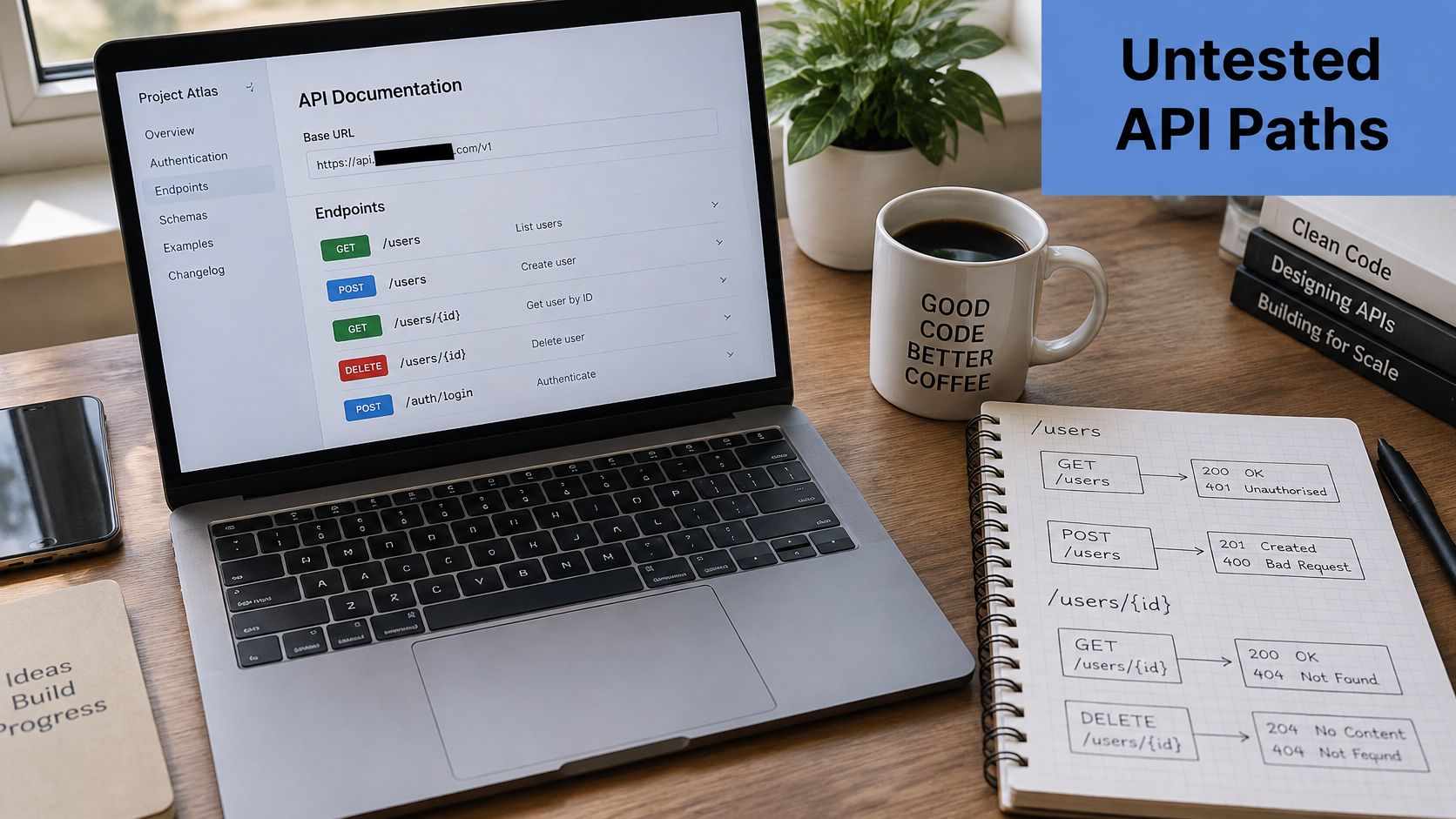
Documentation helps identify intended routes, but session evidence shows how those routes connect.
Assert invariants rather than isolated responses
Write assertions around security invariants, rules that must remain true across the whole journey. A user mustn’t read another tenant’s object. A repeated webhook mustn’t create another charge. A failed authentication step mustn’t leave the remaining chain authorized.
A rejected response alone may be insufficient evidence. Inspect whether the backend still queued fulfillment, changed ownership, or wrote a transaction before returning the error.
Keep destructive mutations on the isolated target, including requests that appear harmless but trigger asynchronous work. Give application developers ownership of the workflow assertions so security testing isn’t detached from the people who understand the state transitions.
Realistic multi-request testing doesn’t require exposing personal data. It requires capture restrictions, consistent masking, reconstructed session state, and controlled side effects before mutation begins.
Metrics and Pitfalls That Distort Risk
Checkmarx’s 2025 CISO guide reports that one-third of organizations could identify and remediate most or all vulnerabilities, while two-thirds could not consistently remediate critical issues. More alerts will not solve a program that cannot turn confirmed exposure into completed repairs. The useful measure is whether a finding is reachable on a production-like journey and tied to a remediation decision.
Use a remediation scorecard
| Metric | What to count | Useful signal |
|---|---|---|
| Exploitable criticals open | Confirmed reachable critical findings, not raw alerts | Backlog of demonstrated risk |
| Median time to remediate | Days from confirmed finding to deployed fix | Whether repair time is improving |
| Findings ever resolved | Share of confirmed findings closed | Whether issues reach completion |
| Retest pass rate | Fixes that hold on the original path, including after deployment | Whether closure is supported by evidence |
| False-positive rate | Alerts rejected after human validation | Analyst effort spent sorting noise |
| Authenticated coverage | Internet-facing assets and relevant roles tested while signed in | Exposure hidden by anonymous-only checks |
Set denominators before comparing results. A remediation rate can look better if difficult tickets are excluded. Authenticated coverage can also be overstated when a successful login is counted without confirming that protected routes were exercised.
Use the OWASP Benchmark to measure detection against deliberately embedded vulnerability cases with known ground truth. Record true positives, false positives, and missed cases against the same corpus when comparing tools or configurations. Production replay tests observed behavior; a benchmark tests whether tooling detects specified weaknesses. Neither replaces the other.
Correct the metric when the test misleads
- Scanner severity treated as impact: Require evidence of the affected asset, reachable path, privileges, and consequence before prioritizing the ticket.
- Anonymous happy paths counted as coverage: Record the roles and protected operations exercised.
- Live side effects ignored: Verify downstream isolation before counting a run as safely completed.
- Session state omitted: Confirm the intended workflow reached its prerequisites rather than measuring repeated login failures.
- Replay completion counted as correctness: Compare responses and application state, not just requests sent.
A successful replay alone doesn’t establish correctness. Requests can complete and response times can look acceptable while authorization is broken or the backend writes incorrect state. Retest the affected journey and check the relevant state before treating a fix as closed.
Set a release gate that defines required coverage of critical cases, how confirmed exploitable findings must be resolved or dispositioned, and a false-positive rate the team can handle. Agree on thresholds with engineering and risk owners, then keep the evidence behind each release decision. The goal is fewer unresolved, reachable weaknesses, not a larger scan.
Decide the Next Test Before You Ship
Choose the next test from the change in front of you. A source or library change starts with pull-request checks. A configuration, authentication, or patch change on an existing journey calls for sanitized replay and authenticated dynamic testing against an isolated build.
A new API without captured sessions needs scripted positive and negative cases. A major release also deserves a focused penetration test of its highest-impact attack path, with broader scope where the threat model requires it.
Make the final pass small enough to finish
Select an internet-facing service and compare the current and candidate builds using a modest-speed workload. Inspect latency, errors, and application state, and preserve the request sequence needed to reproduce any discrepancy.
GoReplay’s Open Source edition provides HTTP capture and replay, request filtering, rewriting, middleware, a command-line interface, and community support. Use middleware when the test session needs explicit cookie mapping rather than assuming connection reuse preserves application identity.
Don’t ship a demonstrated critical exposure merely because it has an owner and due date. Require remediation or an explicitly approved risk disposition, a successful retest of the affected path, and evidence that the legitimate session still completes.
GoReplay lets you bring captured HTTP journeys into isolated testing so patch and configuration checks exercise requests your users make. Visit GoReplay to build a filtered, sanitized replay workflow for your next candidate release, then judge the result by verified behavior and remediation evidence.