
Understanding Regression Testing In Agile Development

Traditional software development often leaves testing until the very end. Agile development, however, requires a different strategy. Agile focuses on continuous validation, incorporating testing throughout the development sprints. This means rethinking regression testing.
Instead of long testing phases, agile teams use rapid feedback loops to speed up development. This helps identify and fix problems quickly, preventing small issues from becoming major headaches later on. This proactive approach is essential for maintaining the velocity of agile development.
Regression testing in agile isn’t just about finding and fixing bugs. It also helps developers confidently make code changes. This fearless coding is central to agile’s iterative nature. A solid regression testing process allows for experimentation and improvement without breaking what already works.
For example, when adding a new feature, regression testing makes sure this addition doesn’t disrupt existing functionality. This safety net allows for continuous improvement and innovation. It also promotes a culture of quality throughout development.
Regression testing has evolved alongside agile methodologies. Agile has shifted back towards its core principles of simplicity and customer value. Regression testing strategies need to adapt to this focus on efficiency and user-centric development. Explore this topic further
The Mindset Shift For Successful Agile Regression Testing
The difference between teams who struggle with testing and those who use it to their advantage is often a mindset shift. Successfully integrating regression testing in agile requires seeing testing not as a separate phase, but as an integral part of development. This means testing isn’t just for the QA team; it’s a shared responsibility.
This collaborative approach improves communication and understanding of how the application works, leading to more effective testing. It also creates a culture of quality ownership, ensuring everyone is invested in delivering a top-notch product. This mindset shift transforms regression testing from a potential roadblock into a powerful tool for faster development and achieving business goals.
Building Regression Test Strategies That Actually Work
Stop wasting time on ineffective regression tests. High-performing agile teams know exactly which tests to run, when to run them, and how those tests contribute to business goals. This starts with understanding your application’s critical paths and user journeys: the interactions that directly impact your bottom line. Building a strong regression test suite begins with knowing what truly matters to your users and your business.
Prioritizing Tests Based on Business Impact
A proven method for building a robust regression testing strategy is categorizing tests based on their potential business impact and how often they need to be run. This risk-based approach ensures the most critical tests are executed more frequently.
-
High-Impact, High-Frequency: These tests cover core functions essential for day-to-day operations and run with every code change. For an e-commerce platform, this might include checkout flows, user logins, and product searches.
-
High-Impact, Low-Frequency: This category includes tests for less frequently used, but still essential, features. Think complex financial reporting or annual system updates.
-
Low-Impact, High-Frequency: These tests might cover cosmetic UI changes or small feature updates. Though important, they can often be automated and run less frequently than high-impact tests.
-
Low-Impact, Low-Frequency: This category encompasses tests for edge cases or rarely used features. These are important for overall coverage but run less often due to their lower potential impact.
This framework ensures efficient resource use by focusing testing efforts where they have the most business value. Prioritizing tests helps teams prevent problems that could directly affect users or revenue.
To further illustrate this approach, let’s look at a practical example:
The following table provides a comparison of different test prioritization approaches, highlighting how risk level, execution frequency, and business impact intertwine to determine automation priority.
Regression Test Prioritization Matrix
| Test Category | Risk Level | Execution Frequency | Business Impact | Automation Priority |
|---|---|---|---|---|
| User Login | High | High | Critical | High |
| Product Search | High | High | High | High |
| Checkout Process | High | High | Critical | High |
| Financial Reporting | High | Low | High | Medium |
| UI Updates (minor) | Low | High | Low | High |
| Edge Case Scenarios | Low | Low | Low | Low |
This matrix clearly demonstrates how tests are prioritized based on their potential impact. High-risk, high-impact areas like user login and checkout receive high automation priority, while low-risk areas like edge cases are given lower priority.
Keeping Your Test Suite Lean and Effective
Your regression test suite will inevitably grow alongside your application. A large test suite, however, can become difficult and time-consuming to maintain. This is where test automation becomes essential for agile teams. Automating repetitive tests frees up testers to focus on exploratory testing and more complex scenarios.
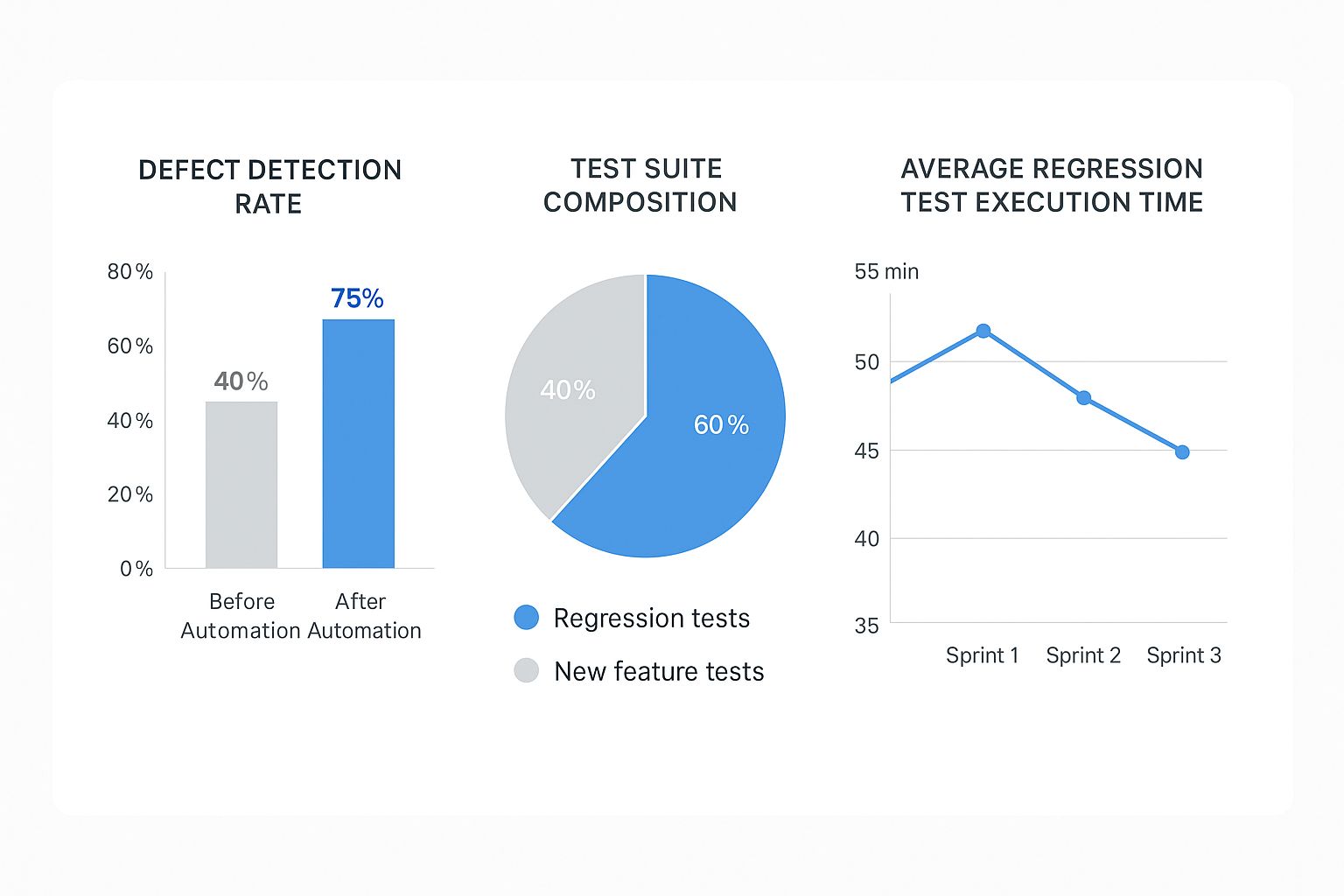
The infographic above visualizes data on test automation and suite composition. It compares defect detection rates before and after automation, shows the proportion of regression tests versus new feature tests, and tracks average execution time across sprints.
The data shows a substantial increase in defect detection after implementing automation, rising from 40% to 75%. While regression tests make up 60% of the test suite, optimizing execution time—evident in the reduced time for Sprint 3—remains key for continuous improvement. This highlights the power of automation in finding defects and the importance of ongoing optimization in managing regression test execution time. By strategically automating and focusing on optimization, agile teams can build an efficient and sustainable regression testing process.
Integrating Regression Testing With CI/CD Pipelines

The true strength of regression testing in agile shines through when it’s integrated with your Continuous Integration/Continuous Delivery (CI/CD) pipeline. Instead of slowing things down, it becomes a powerful accelerator. Catching bugs early in development prevents expensive fixes later on, allowing teams to deliver high-quality software quickly. This integration helps ensure your application remains stable and functional throughout the agile development lifecycle. Learn more about regression testing in agile environments.
Structuring Automated Workflows for Maximum Efficiency
Effective automated workflows are crucial for top-notch efficiency. Here are some key considerations:
-
Trigger Points: Decide when automated regression tests should run. Common triggers include new code commits, merges to the main branch, or after successful builds.
-
Test Suite Selection: Use a tiered approach. Run quick smoke tests with every commit, and more extensive regression suites during nightly builds or before release.
-
Parallel Execution: Running tests at the same time drastically cuts down feedback time, which is especially important for large test suites. Tools like GoReplay can simulate real user traffic and stress-test your application, highlighting performance bottlenecks. This helps identify critical issues before they affect users.
-
Test Environment Management: Use clean, consistent test environments for reliable results. This often involves containerization technologies or dedicated testing servers.
Handling Test Failures Without Blocking Deployments
A failed test demands attention, but it shouldn’t always stop your entire deployment.
-
Quarantine Failing Tests: Set up a system to automatically isolate flaky or consistently failing tests without halting the pipeline.
-
Notifications and Alerts: Set up alerts to notify the right team members about failed tests.
-
Analysis and Debugging: Integrate debugging tools and logging into your CI/CD process for quick root cause analysis.
Achieving Balance Between Speed and Coverage
Balancing test speed and test coverage is a continuous process.
-
Risk-Based Testing: Prioritize testing the parts of your application that are most crucial to your business goals.
-
Test Prioritization: Regularly review your test suite. Ensure high-priority tests always run, while less critical tests might run less often.
-
Performance Optimization: Analyze your test execution time regularly to find ways to make it faster.
By implementing these best practices, you can successfully integrate regression testing into your CI/CD pipeline. This results in faster feedback, quicker development, and better software quality.
Smart Automation Strategies For Agile Teams
A robust regression testing strategy is the foundation. Smart automation is the next level for agile teams. This doesn’t mean automating every test. Instead, it’s about strategically automating the right tests. High-performing teams know that not everything needs automation. What is automated must be robust and resilient to change. This means creating test suites that adapt to application updates, utilize realistic data, and reduce, not increase, maintenance efforts.
Building Resilient Test Suites
Imagine your automated tests as small robots, each designed for a specific task. When the application changes, these robots need to adapt. This is where resilient test design becomes critical. Focus on the underlying functionality, not specific UI elements that are subject to change. For example, instead of checking for a button with a specific ID, verify the action triggered by the button. This approach minimizes maintenance when the UI updates, making your tests less fragile and more adaptable. You might find this helpful: How to master API test automation for increased success.
The Value of Manual Testing
Automation is key for regression testing in agile development. However, manual testing still plays a crucial role. Automated tests excel at checking known scenarios. Manual testing is better at uncovering the unexpected. Exploratory testing, where testers actively search for vulnerabilities, is a prime example of manual testing’s strength. This type of testing is invaluable for evaluating the user experience and identifying edge cases automated tests might miss.
Choosing the Right Automation Frameworks
Selecting an automation framework is a crucial decision. Think of it like choosing the right tool for a specific job. Consider your team’s skills and the project’s requirements. Popular options include Selenium, Cypress, and Playwright. Each has advantages and disadvantages. Selenium, for example, is widely used and supports multiple languages, but can be slower than Cypress or Playwright. The right choice empowers your team to build and maintain effective automated tests.
Practical Guidance for Managing Automation
Even with the best framework, automated tests can become a challenge. Flaky tests—those that inconsistently pass or fail without code changes—are a frequent source of frustration. Effective debugging and test management are essential. Regularly review your test suite. Address flaky tests quickly. Continuously improve your automation strategy to prevent your tests from becoming a burden. This includes building testing expertise within your team through focused training and knowledge sharing.
Managing Test Data And Environments Like A Pro
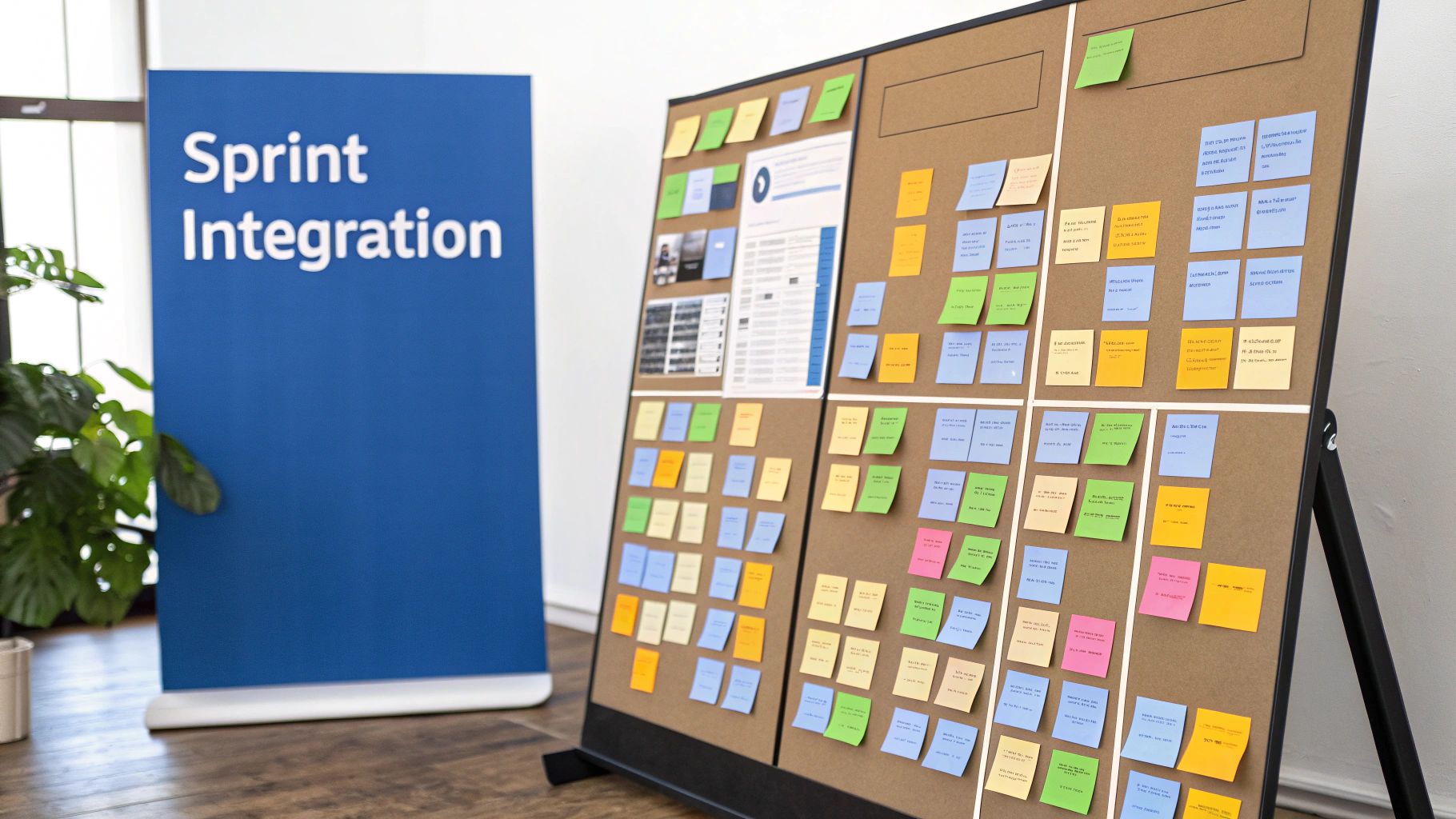
Effective regression testing in agile development relies heavily on well-managed test data and stable environments. Inconsistent data or unstable environments often lead to inaccurate test results. This section explores practical solutions for maintaining clean, reliable test data and managing those complex application dependencies.
Maintaining Pristine Test Data
Accurate test data is the foundation of reliable test results. Think of it like baking a cake: if your ingredients are bad, the cake won’t be good. Database seeding, the process of populating a database with initial data, is paramount.
Here are a few proven strategies:
- Automated Scripts: Develop scripts to efficiently populate your database with precise data tailored for each test case.
- Data Generation Tools: These tools are invaluable, especially for large datasets, creating realistic and varied data for testing.
- Data Masking: Protect sensitive information by masking real production data before using it in your test environment.
Keeping your test data fresh is also critical. Data can quickly become outdated, so regular refreshes are essential. This might involve using production backups (with appropriate masking) or data generation tools to create updated datasets reflecting real-world scenarios.
Taming Complex Application Dependencies
Many applications interact with external services or databases. These dependencies can make testing complicated. Containerization offers a robust solution by isolating your application and its dependencies.
Docker is a popular tool allowing you to package your application and its dependencies into a container. This container can be easily deployed and replicated across various environments. This isolation prevents cascading failures, where one failing test impacts other unrelated tests, a common pain point in agile.
Strategies For Cost-Effective Testing Infrastructure
A cost-effective testing infrastructure that scales with your project is essential. This might involve leveraging cloud-based testing environments, virtual machines, or a combination of on-premise and cloud resources. Choosing the right strategy depends on your specific needs and budget.
To help you evaluate different approaches, let’s look at a comparison table:
Test Environment Management Approaches
| Approach | Setup Time | Maintenance Effort | Cost | Scalability | Isolation Level |
|---|---|---|---|---|---|
| Dedicated Servers | High | High | High | Low | High |
| Virtual Machines | Medium | Medium | Medium | Medium | Medium |
| Containerization (Docker) | Low | Low | Low | High | High |
| Cloud-Based Environments | Low | Low | Variable | High | Medium |
As the table illustrates, containerization offers a compelling balance of low setup time and maintenance costs, combined with high scalability and a strong isolation level.
Addressing Data Privacy
In today’s world, data privacy is paramount, especially when dealing with sensitive data in test environments. Adhering to data privacy regulations is not just good practice, it’s essential.
Strategies like data masking, anonymization, and using synthetic data can protect sensitive information while ensuring your tests use realistic data. Prioritizing data privacy builds trust with your users and promotes ethical testing practices. These considerations are crucial for a responsible and robust regression testing process within your agile workflow.
Measuring Success and Driving Continuous Improvement
How do you know if your regression testing in agile is truly effective? It’s about more than just superficial metrics. We need to dive into the Key Performance Indicators (KPIs) that truly matter for agile teams focused on tangible business outcomes. This means understanding which metrics actually reflect real-world success, from relevant test coverage to defect detection rates that accurately predict customer satisfaction.
Identifying Key Performance Indicators (KPIs)
Building a strong measurement system starts with identifying the right KPIs. These will differ depending on your specific business goals. However, some common examples include:
-
Test Coverage: While 100% code coverage is often unrealistic, focusing on covering critical user paths and high-risk areas is essential. This targeted approach maximizes impact without wasting resources on less important areas.
-
Defect Detection Rate: This metric shows how effectively your regression tests are finding bugs before they impact your users. A rising detection rate suggests your testing is improving. Conversely, a declining rate requires further investigation.
-
Test Execution Time: Speed matters in agile. Tracking execution time helps identify bottlenecks and optimize your testing process for faster feedback. Tools like GoReplay can help simulate real user traffic for stress-testing.
-
Mean Time to Resolution (MTTR): How quickly can your team resolve identified bugs? A low MTTR indicates an efficient debugging process, minimizing the impact of defects.
Establishing Baselines and Tracking Progress
After choosing your KPIs, establish baseline measurements to understand your current performance. This provides a benchmark for measuring future progress. For more information, check out this article: Essential Metrics for Software Testing. Tracking these metrics over time reveals trends and highlights the effectiveness of your testing. Ongoing monitoring helps pinpoint areas for improvement and measure the impact of any changes you make.
Balancing Multiple Metrics and Gathering Feedback
While tracking several KPIs offers a comprehensive view, avoid measurement overload. Focus on the metrics directly aligned with your business goals. Gathering stakeholder feedback is also essential. Regular communication with developers, product owners, and customers ensures your strategy stays relevant and valuable. This collaborative approach maximizes your impact by aligning testing with overall business priorities.
Continuous Improvement Through Retrospectives
Testing retrospectives, similar to sprint retrospectives, dedicate time for teams to analyze past testing efforts. These meetings concentrate on what worked, what could be better, and specific actions for the next sprint. Retrospectives promote continuous improvement and learning, ensuring regression testing in agile stays effective and adapts to changing needs. By combining data analysis with stakeholder feedback, your team can target improvements that deliver real results, sprint after sprint.
Common Challenges And Battle-Tested Solutions
Regression testing in agile development is essential but often presents recurring challenges. Luckily, solutions to these roadblocks are often more straightforward than you might expect. Let’s explore some common hurdles, from managing growing test suites to tackling legacy code.
Overcoming Test Maintenance Overhead
As your applications expand, so do the corresponding test suites. Maintaining these large collections of tests can become a significant burden, consuming time and resources. One effective solution is adopting a modular approach to test design. This involves building reusable test components, easily updated and adapted as the application changes. For example, imagine reusing a login component across multiple tests, simplifying updates when the login process is modified.
Choosing the right automation framework is also vital. Frameworks that emphasize resilient test design, focusing on core functionality rather than superficial UI elements, minimize the impact of application updates on your tests.
Taming Legacy Code
Legacy code can be a real headache. Often lacking documentation and tightly coupled, these systems are notoriously difficult to test. A practical strategy is starting with risk-based testing. By focusing on the most critical features, you gain valuable knowledge and gradually build confidence.
Techniques like service virtualization can isolate the parts of the legacy system you’re testing. This helps manage dependencies and control the test environment, preventing unforeseen issues from disrupting tests and ensuring more reliable results.
Managing Test Execution Time
Long test runs can slow down agile development. Parallel test execution offers a significant improvement, drastically reducing feedback time. This involves running multiple tests concurrently across different environments or machines. Tools like GoReplay can significantly improve this process by effectively simulating real traffic and load testing your application as part of your CI/CD pipeline, allowing for quicker identification of performance bottlenecks.
Adapting To Constant Change
Agile thrives on rapid iterations and frequent updates, requiring a testing strategy that can adapt quickly. A robust solution is integrating continuous testing within your CI/CD pipeline. By including automated regression tests in your pipeline, you receive immediate feedback on every code change. This early detection of issues prevents problems from escalating and keeps your development speed high.
Building Testing Expertise Within Resource Constraints
Agile teams often face resource limitations, especially regarding specialized testing expertise. One effective approach is fostering a culture of shared testing responsibility. Empowering developers to take part in testing, not just writing unit tests, leverages existing skills and distributes the testing workload more effectively. This collaboration enhances product quality and streamlines the testing process.
Setting Realistic Expectations
It’s crucial to set attainable goals for regression testing. Perfect test coverage is often impractical, especially in complex applications. Concentrate on risk-based testing, prioritizing essential functions to direct testing efforts where they have the most impact. Using tools like GoReplay can help simulate real traffic and prioritize important performance tests, which aids in establishing realistic expectations. This sensible approach ensures your team delivers high-quality software while recognizing that testing every edge case isn’t always feasible.
Ready to improve your agile regression testing? GoReplay helps you identify issues early with real-world traffic replay and load testing. Visit GoReplay to learn more and get started.