
Performance Test Strategy Document Template for 2026

You’ve got a release date, a staging environment, and a request to prove the application can handle peak traffic. Someone has already suggested a load-testing tool. Nobody has agreed on what passing means, whether staging represents production, or whether the captured requests are safe to replay.
A useful performance test strategy document template settles those questions before execution. It connects business risk to measurable limits, requires evidence that the workload represents real users, and puts production-derived data under control before anyone starts a capture.
The Template Fields Every Strategy Needs
Fix the pass/fail rules before anyone sees a graph. Otherwise, a team can reinterpret disappointing results until they look compatible with the release date.
Copy this template into your working document. The checkout entries are illustrative planning choices, not recommended universal thresholds.
| Template section | What to record | Example entry |
|---|---|---|
| Objectives and risks | Business goal and what a failure costs | Checkout must stay usable throughout the planned sale; failed payments block launch |
| System scope | Services, endpoints, dependencies, exclusions | Checkout API, payment gateway stub, inventory service; live payment processing excluded |
| Workload model | Users, transaction mix, arrival rate, think time | Captured sale profile; preserve journey mix and arrival timing; concurrency checked against production observations |
| Test data and environment | Data source, masking rules, environment differences | Masked order history; staging has fewer application nodes than production |
| Scenarios and ramp plan | Scenario types, ramp steps, run length | Normal, peak, burst, failure recovery, soak; fixed load increments after stabilization |
| Metrics and thresholds | Percentiles, error rate, throughput, resource limits | Checkout p95 and p99 below approved SLOs; completed orders meet demand; errors stay within budget |
| Execution schedule | Dates, owners, environment booking | Before sale readiness review; QA lead owns runs; staging reserved through retesting |
| Defect triage | Severity rules and retest path | Release-blocking defects require a fix and retest against the unchanged profile |
| Release decision | Pass/fail rule and sign-off | All mandatory thresholds pass across valid repeat runs; product and engineering approve residual risk |
Write decisions before procedures
The order follows the measurement logic in NIST’s measurement guidance: identify fitness-for-purpose measures, define acceptable limits, and assess test data and simulations before production testing. Collection methods need to be planned before execution, not reconstructed afterward from whatever dashboards happen to contain.
Keep the strategy short enough to review in a meeting. Put scripts, environment manifests, raw results, and detailed runbooks in linked artifacts rather than turning the strategy into a binder.
For projects requiring formal traceability, devPulse’s test strategy templates for regulated projects provide useful context for documenting approvals and responsibilities. Keep those governance requirements connected to actual release decisions rather than adding signatures nobody understands.
Start by filling in objectives and thresholds, then complete the supporting fields. Choose the tool after you know what evidence it must produce.
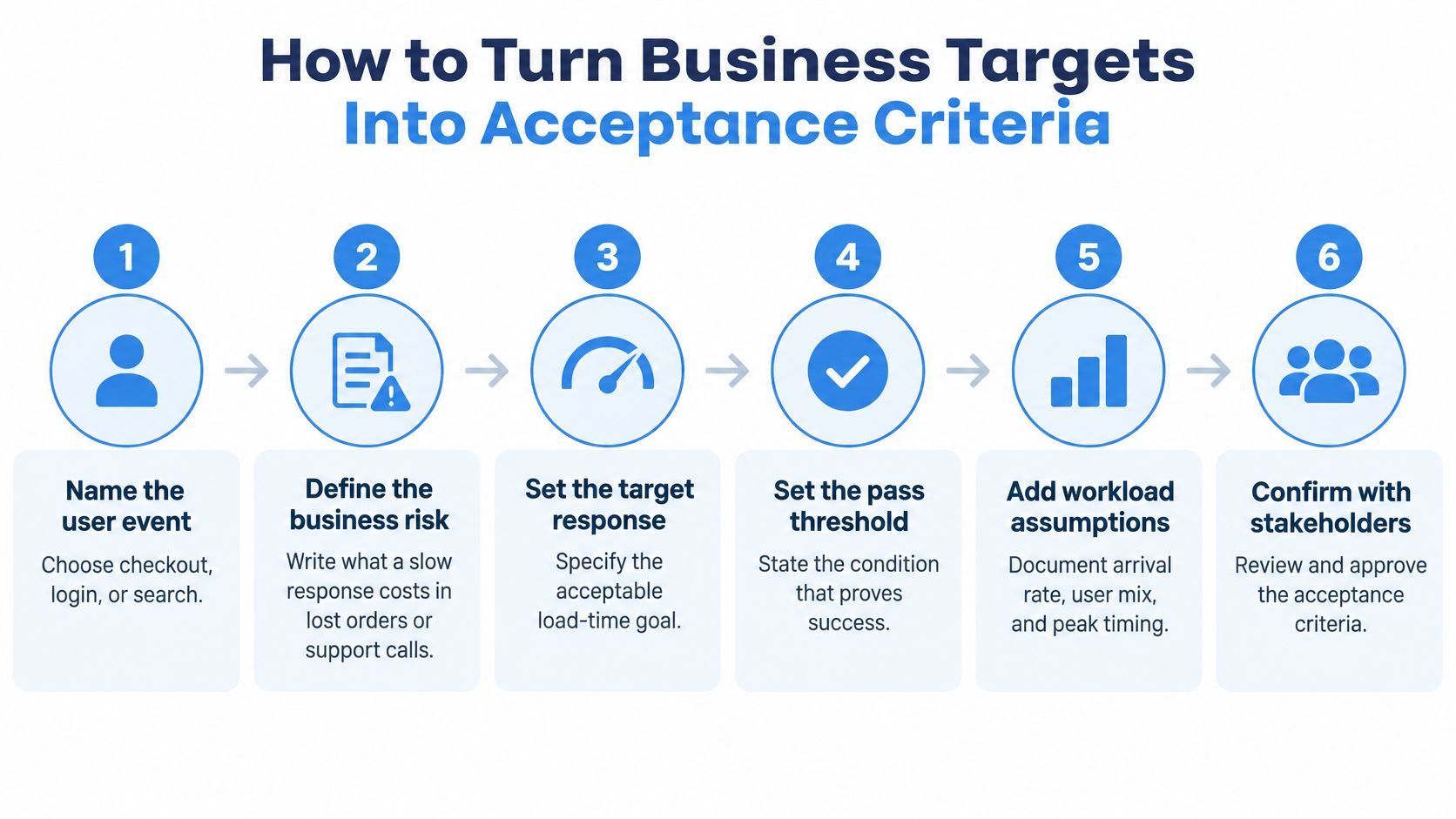
How to Turn Business Targets Into Acceptance Criteria
Start with the user event worth protecting. For checkout, a slow order confirmation can leave buyers unsure whether they paid, while retries can create additional work for payment and support teams.
The ISTQB performance-testing syllabus distinguishes user, business, and technical perspectives and notes that users may abandon a website when response time exceeds 10 seconds. That’s a warning about user experience, not a sensible checkout target.
Translate the user event into a measurable contract
-
Name the transaction and its owner. Define where checkout starts and ends, including what counts as a completed order. Assign a product owner to the business outcome and an engineering owner to the measurement.
-
Set a perceived response-time ceiling. Measure the interval the user experiences, not just the application handler. Include gateway, network, dependency, and rendering time where they belong, and specify the geography and client conditions under which the ceiling applies.
-
Use percentile targets rather than an average alone. Define p95 and p99 limits for each important transaction, with the measurement window and treatment of failed requests. Otherwise, teams can calculate different answers from the same run by excluding timeouts or combining unrelated endpoints.
-
Allocate the response budget across layers. Give the gateway, service, database, and external dependencies explicit budgets within the end-to-end target. Don’t add independent component percentiles and call the result an end-to-end percentile; use distributed traces to check which work is sequential and which overlaps.
-
Choose a business-readable throughput unit. Completed checkout transactions per minute means something different from HTTP requests per second. Record both when useful, but make the release criterion about successful business work rather than traffic sent.
-
Write the pass/fail rule and repeat policy. Specify which violations block release, who investigates them, and what makes a run invalid. A repeat should follow an identified setup problem or a documented fix, not a search for a more favorable result.
Use the approval conversation to connect each technical limit to a user outcome.
Check that the contract is observable
Microsoft’s performance-testing guidance recommends measurable objectives and allocating performance or error budgets across workload layers. Apply that discipline to monitoring ownership: someone must know where each acceptance measure comes from and how it’s calculated.
Practical rule: If the team can’t identify the query, histogram, trace, or transaction counter that measures a threshold, it isn’t ready to approve that threshold.
Distinguish representative traffic from deliberately artificial stress traffic in the acceptance record. A realistic sale profile tests readiness for expected demand; an aggressive stress profile investigates capacity boundaries. They shouldn’t inherit identical release rules without a business reason.
Workload Scenarios and Ramp Rules to Document
Use separate scenarios because everyday load, sudden arrivals, infrastructure loss, and sustained operation ask different questions. The table below is an illustrative execution plan, with scenario-specific durations and recovery targets that require approval for your service.
| Scenario | Question it answers | Load shape | Minimum duration | Pass rule |
|---|---|---|---|---|
| Normal | Does everyday traffic meet targets? | Recorded daily profile at 1x | 30 minutes | p95 and error rate within thresholds |
| Peak | Can the busiest hour be served? | Recorded busiest hour replayed at 1x | Complete busiest-hour capture | p95 under target with no sustained queue growth |
| Burst | How fast does the system recover from a spike? | Step from 1x to 3x within one minute | 15 minutes | Baseline latency restored within 5 minutes |
| Failure recovery | Does the system recover after losing a node? | Peak load with one node removed | Through failure and stable recovery | p95 restored within 10 minutes of node loss |
| Soak | Do memory, connections, or disk drift over time? | 80% of peak load | 8 hours | No unexplained sustained resource growth |
Oracle’s capacity-planning guidance recommends gradually increasing load until throughput stops increasing or an SLA or resource target is reached, with benchmark runs of at least 30 minutes, preferably longer. The shorter burst example above is a targeted recovery experiment, not a substitute for that benchmark.
Define the controls beside the scenario
Record the increment, stabilization condition, warm-up exclusion, stopping rule, and recovery observation period. Stabilization should mean something observable, such as settled instance counts and queues, rather than merely waiting for a timer.
Repeat scenarios against the same reset dataset and synchronize clocks across generators, application hosts, and monitoring systems. Predeclare the repeat count, then investigate variation instead of selecting the best-looking run.
Our load-testing feature replays a captured HTTP workload at a chosen speed against a test environment, then measures latency, errors, and resource limits. The strategy must define those speeds and explain whether amplification preserves the behavior the scenario is meant to test.
For platform-specific planning, Kogifi’s SharePoint Online performance testing resource is relevant when defining the boundary between the application and a managed collaboration platform. A platform’s dependencies and operating constraints belong in the scenario, not in a footnote after execution.
A valid stop condition protects the environment and preserves an interpretable result. It isn’t a failed attempt to reach an arbitrary user count.
Soak runs deserve their own booking. Short tests can miss slow memory growth, connection accumulation, and disk expansion, although an extended run alone doesn’t guarantee those defects will appear.
Proving the Workload Matches Real Traffic
More virtual users doesn’t automatically mean a more realistic test. A convincing latency chart can describe the wrong arrival pattern, the wrong customers, or a workload dominated by inexpensive endpoints.
The GDS performance-testing guidance recommends complete user journeys, arrival-rate modeling, identification of affected downstream services, and recording the load and failure mode at the breaking point. Those requirements call for workload evidence, not just a concurrency field.
A workload review should compare observed production behavior with what the generator sends.

Establish capture provenance
Our workflow starts by choosing a suitable plaintext capture point, recording the requests needed, and measuring capture overhead. Choose a location after authorized TLS termination rather than assuming encrypted packets contain usable request content.
Check host CPU, memory, network behavior, and request handling with capture enabled. If capture changes the source system’s behavior, investigate that effect before treating the sample as representative.
Require an evidence record for every scenario:
- Traffic source: Capture artifact, approved capture window, collection point, and excluded traffic.
- Endpoint or journey share: Relative representation of checkout, search, sign-in, and background activity.
- Arrival-rate distribution: Timing variation, quiet periods, and clustered arrivals.
- Peak-to-average ratio: The observation window and calculation used to identify peaks.
- Dependency mix: Which journeys invoke payment, inventory, email, or other services.
- Session behavior: Correlation, authentication refresh, ordering, and think time.
- Expected growth: The business assumption used to change demand beyond the observed profile.
Compare what arrived, not just what was configured
Set tolerances before replay and compare distributions at the target. In a hypothetical review, the team might require endpoint shares to remain within five percentage points of production; that’s a chosen tolerance, not an industry standard.
Keep related user journeys together. Sign-in, search, add to cart, and payment depend on state, so replaying those endpoints independently may create failures unrelated to capacity. The explanation of how traffic replay improves load-testing accuracy helps frame this distinction, but the scenario still needs its own evidence.
Name downstream services and agree on rate limits before ramping. Payment and email integrations can become overloaded while the application’s own resource graphs look healthy.
An illustrative evidence entry could read: artifact sale-checkout-capture; capture date recorded in the approved manifest; checkout share 31%; peak-to-average ratio 3.2; session validation passed. Those figures describe a hypothetical sample, not a production benchmark. Record mismatches with an owner and a disposition before approving the scenario.
Governing Test Data From Production Captures
| Data type | Use when | Privacy exposure | Performance fidelity | Required control |
|---|---|---|---|---|
| Synthetic | Default for new features and shared environments | Low if generated without sensitive inputs | Can miss real cardinality and skew | Documented generation rules and seed |
| Masked production | Database size or relationships drive results | Treat as sensitive until validated | Preserves shape when transformations retain relevant properties | Irreversible masking and re-identification check |
| Sampled production | Real records are needed for the traffic mix | High without filtering | High only if the sample is representative | Approval, access audit, automatic expiry |
| Captured HTTP replay | Real request sequences drive the load | Identifiers and credentials may remain | Strong traffic-shape fidelity; state still needs validation | Field redaction and removal of destructive requests |
Production-derived data can provide realistic inputs and create avoidable privacy exposure at the same time. Default to synthetic data, then document the performance question that requires something closer to production.
Tesbo’s privacy-in-test-data guidance recommends source-side masking, irreversible transformations, re-identification checks, access auditing, and automatic expiration. Don’t treat a renamed customer field as proof that a dataset is safe.
Record lifecycle controls
- Sensitivity inventory: Classify headers, cookies, query parameters, bodies, and response fields, including credentials and customer identifiers.
- Masking validation: Verify removal of sensitive values and preservation of referential integrity, field formats, and performance-relevant distributions.
- Access and encryption: Name authorized users, audit access, and protect captures during storage and transfer.
- Retention and deletion: Record expiry, deletion responsibility, and treatment of copied artifacts and backups.
- Artifact redaction: Apply a policy to logs, dashboards, replay files, and exported failure samples, not only the primary dataset.
Bridge Global’s guidance on building a test data management strategy is useful when assigning lifecycle ownership across QA, security, and platform teams. Traffic-specific controls also need attention, including the practices described in our sensitive-data protection guidance.
Set the safe replay boundary
Our next workflow step removes unsuitable requests and rewrites the sample for an isolated target with controlled external side effects. Remove writes to shared records, replace live destinations, and disable real payments, customer emails, and other unintended actions.
Keep state-changing test flows only where they operate on isolated, resettable records. Require explicit approval before using captures containing customer records, authentication material, or fields whose sensitivity hasn’t been resolved.
The trade-off is fidelity versus exposure. Approve the smallest dataset that answers the performance question, not the broadest capture that happens to be available.
Mistakes That Make a Strategy Fail and How to Fix Them
Every performance test passed, but the release still broke. That can happen when the team measures transport success while missing incorrect business behavior or invalid test conditions.
| Symptom | Likely cause | Fix |
|---|---|---|
| Averages look fine but users complain | Averages hide slow-tail behavior | Set p95 and p99 thresholds and preserve raw samples |
| Latency rises only above a certain load | Generator may have reached its own CPU limit | Check generator telemetry; distribute generation; discard saturated-generator runs |
| Replay passes but bugs reach production | Responses and state weren’t compared | Add status, payload, and state checks as acceptance criteria |
| Shared records change during testing | Destructive or stateful requests weren’t excluded | Remove shared-record writes and use an isolated target |
| Results differ between runs | Warm-up, data, or configuration changed | Exclude warm-up, reset data, and repeat the approved profile |
Treat these as diagnostic hypotheses. Rising latency doesn’t prove the generator is saturated; application contention, dependency delays, and queueing also require investigation.
Keep the evidence interpretable:
- Change log: Record every configuration change made during the test window, including emergency adjustments.
- Raw samples: Retain enough detail to recalculate percentiles and inspect failed transactions.
- Run identity: Label results with application build, environment configuration, workload artifact, and data version.
A completed replay isn’t a correctness check
Our measurement step compares performance, responses, and application state. Successful replay alone establishes neither correct pricing nor successful order creation.
Write checks for expected status codes, key payload fields, and final application state into the strategy. For checkout, that means validating the amount and currency, checking the order identifier, and confirming that the resulting order exists in the expected state.
A fast response containing the wrong order total is a failed checkout, not a performance success.
Assign an owner to each comparison and define allowable differences, such as generated identifiers or timestamps. Otherwise, teams either ignore noisy comparisons or mistake legitimate variation for defects. Route a failed business-state check through defect triage just as deliberately as a failed latency threshold.
Sign Off the Strategy Before Your First Run
Sign-off is a review of whether the proposed test can support a release decision. It isn’t permission to start generating traffic and decide later what the results mean.
The QA lead should coordinate approval, but business, engineering, platform, and data owners need to accept the decisions within their remit. Record exclusions and residual risks explicitly, especially where staging differs from production or a dependency is replaced by a stub.
Approval test: One named owner should be able to explain each threshold, its business purpose, and its measurement without reading the template aloud.
Pre-run approval checklist
-
Every threshold has a measure, owner, and target source. Identify the SLA, SLO, capacity forecast, or business requirement it protects. Resolve conflicts between business expectations and technical budgets before execution.
-
Every scenario has complete evidence. Confirm the source artifact, capture date, endpoint or journey share, peak-to-average ratio, and approved deviations. An unsupported assumption needs a decision, not an empty cell.
-
The data decision is approved. Verify the selected data type, masking validation, authorized access, and expiry date. Approval must cover derived logs and replay artifacts as well as the capture itself.
-
Execution controls are scheduled. Reserve the environment for ramping, stabilization, full runs, resets, repeats, and defect retests. Identify who can stop the test and who handles dependency incidents.
-
The smallest dry run passes. Verify capture, replay, metrics, response comparisons, and application-state checks together. Include a deliberate safe failure so the team knows that detection and triage work.
I would run that smallest scenario with GoReplay before booking the full capacity exercise. Inspect whether the arriving requests match the approved workload model, then confirm that monitoring and correctness checks can support a decision.
Keep the signed performance test strategy document in version control with its workload manifest and approval record. The next release should start from an explicit, reviewable decision history rather than someone’s memory of the last successful run.
GoReplay’s Open Source edition provides HTTP traffic capture and replay, request filtering, rewriting, middleware, and a command-line interface. Visit GoReplay to put this strategy into practice with an isolated dry run, then validate the workload and response checks before scaling up.