
Mvn Clean Install Skip Test Guide, Flags, and CI Tips
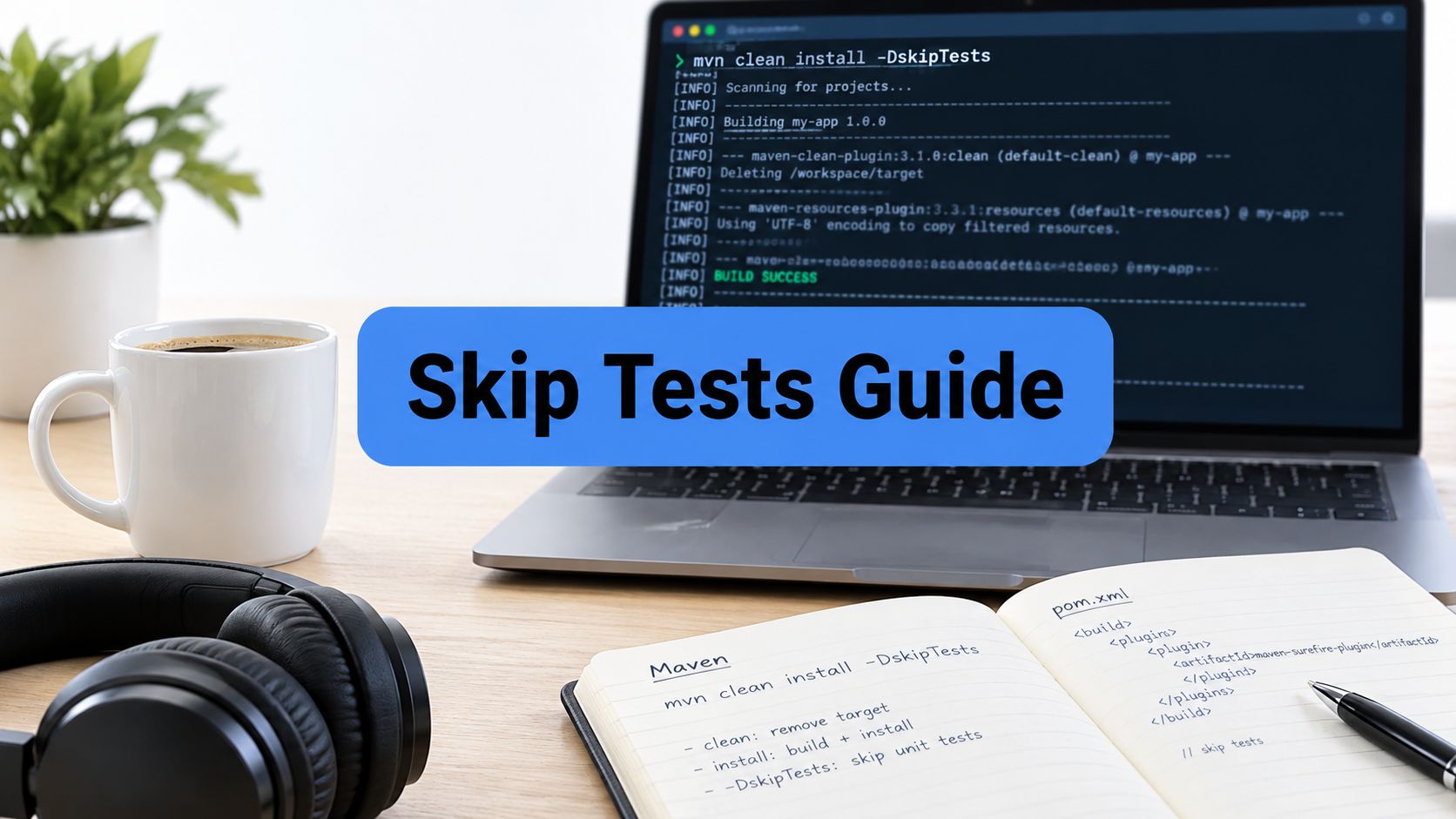
A CI build is crawling, a flaky integration test is blocking a hotfix, and someone suggests running mvn clean install skip test. The command you usually want is mvn clean install -DskipTests, but that hyphenated property matters. It doesn’t mean “ignore everything related to tests,” and it isn’t interchangeable with -Dmaven.test.skip=true.
The difference affects compilation, test-JAR production, multi-module reactor builds, Docker layers, and the point at which your pipeline can still catch a defect. Use the flag that matches the build objective, then place the missing verification in a deliberate location rather than removing it without a clear reason.
What mvn clean install -DskipTests Actually Does
The command combines Maven’s separate clean and default lifecycles. Maven documents three built-in lifecycles, clean, default, and site, while the default lifecycle includes phases such as validate, compile, test, package, verify, install, and deploy in sequence. The Maven lifecycle documentation describes how this command first removes generated output, then reconstructs and installs the project.
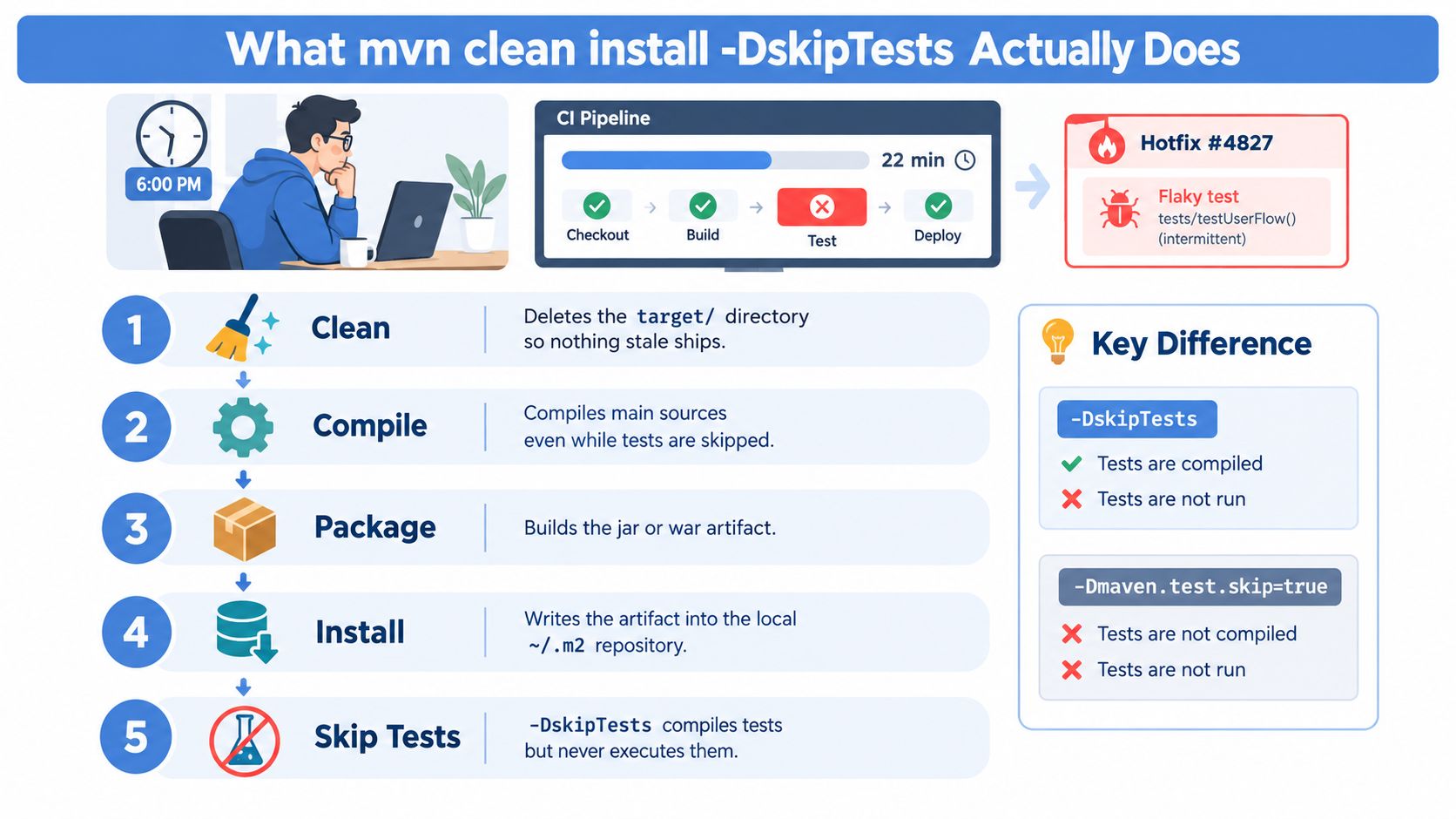
Under the hood, the build proceeds roughly like this:
-
Clean removes generated output. Maven’s
cleanphase deletes files produced by an earlier build, including the usualtarget/contents. That gives compilation and packaging a fresh directory rather than allowing stale classes or artifacts to influence the result. -
Validate checks the project model. Maven reads the POM hierarchy, resolves the reactor structure, and validates the project configuration before compiling application code.
-
Compile builds main sources. Production Java sources still compile. A skipped test run doesn’t turn
installinto a source-only operation. -
Test compilation still happens. This is the detail many short tutorials omit. With
-DskipTests, Maven skips test execution while allowing test sources to compile. The Surefire documentation on skipping tests distinguishes this behavior from the strongermaven.test.skipproperty. -
Package creates the artifact. Maven builds the configured JAR, WAR, or other package output.
-
Verify runs its bound checks. Plugins attached to
verifycan still run unless their own configuration or skip property disables them. The command doesn’t remove the phase from the lifecycle. -
Install writes to the local repository. The resulting artifact and its metadata go into the developer’s local Maven repository, where other local projects can resolve them as dependencies.
Practical rule:
-DskipTestssuppresses test execution. It doesn’t suppress the surrounding lifecycle, main compilation, test compilation, packaging, verification, or local installation.
That makes mvn clean install -DskipTests useful for producing a clean local artifact when test execution is temporarily too slow or unstable. It still catches many test-source and API incompatibilities during compilation, which is a useful contract to preserve.
By contrast, mvn clean install without the property allows the configured test execution to run. A failing test can prevent the build from reaching a successful install, depending on the plugin configuration and lifecycle result. Skipping tests therefore changes the build’s evidence, not just its duration. You get an installed artifact, but you haven’t demonstrated that the test methods pass.
-DskipTests vs -Dmaven.test.skip and the Test-JAR Trap
These properties answer different questions. -DskipTests asks Maven to compile test sources but not execute the tests. -Dmaven.test.skip=true asks Maven to skip test compilation as well as execution, and Maven’s Surefire, Failsafe, and Compiler Plugin honor that stronger property according to the documented behavior.
| Behavior | -DskipTests | -Dmaven.test.skip=true |
|---|---|---|
| Compile production sources | Yes | Yes |
| Compile test sources | Yes | No |
| Execute configured tests | No | No |
| Build an attached test-JAR when configured | Generally yes, because test classes are compiled | No, because test classes aren’t compiled |
Make -Dtest exclusions useful | No tests execute, so the selection has no practical effect | No tests compile or execute |
The last two rows deserve careful handling. A test-JAR is only produced when the project has the appropriate plugin configuration, but a module that attaches one needs compiled test classes available. With -DskipTests, those classes remain available. With -Dmaven.test.skip=true, they don’t.
That creates a classic reactor failure. A parent build installs an upstream module, and a downstream module depends on the upstream module’s test-JAR for shared fixtures or test utilities. The stronger skip property prevents the upstream test classes and test-JAR from being produced. The downstream module then fails with missing symbols, often at a location that makes the original cause hard to spot.
| Build objective | Recommended choice |
|---|---|
| Create a local artifact while retaining test-source and test-fixture compilation | mvn clean install -DskipTests |
| Run a compile-only pass where test compilation and test-JAR reuse are irrelevant | mvn clean install -Dmaven.test.skip=true |
| Validate behavior before release | mvn clean verify or mvn clean install without a skip property |
| Separate integration testing from packaging | Configure a dedicated Failsafe stage, following the Maven Failsafe plugin guidance |
Use -DskipTests for a smoke install when downstream modules may consume test fixtures. Reserve -Dmaven.test.skip=true for a deliberately narrower build, such as an emergency compile-only pass where test sources are known to be irrelevant or are causing an independent compilation problem. It can make the reactor appear healthy while removing a contract that another module expects.
-Dtest also deserves a precise interpretation. It can select or exclude tests for a runner that actually executes them, but it doesn’t override either skip property. A test selection parameter cannot make skipped test execution happen.
Running the Command in Local Shells, CI, and Docker
The command stays conceptually the same across environments, but each environment needs a different level of control. On a developer laptop, the direct form is usually enough: mvn clean install -DskipTests. It removes stale output, compiles the project and its test sources, packages the artifact, and places it in the local repository without executing the tests.
For repeated local iterations, mvn -DskipTests=true clean install makes the property value explicit. Maven accepts the property in either position because it is a command-line system property, but keeping a consistent form in team documentation avoids needless variation. Add -q only when the normal log volume is obstructing the useful result. Quiet output can hide the detail needed to diagnose a failed plugin, so it isn’t a substitute for inspecting the build result.
CI needs an explicit policy rather than a developer’s temporary shortcut. In GitHub Actions, pass the property in the Maven command, such as mvn -B -ntp clean install -DskipTests, and keep the later verification job separate. GitLab CI can place the same command in the job’s script list. A Jenkinsfile can pass it through the Maven invocation or an argument list used by the pipeline step. The implementation differs, but the important point is that the job name and logs should make the skipped execution visible.
A profile can make the choice more deliberate. For example, a team might define a ci-skip-tests profile in settings.xml that sets the appropriate property, then activate that profile only for a job whose purpose is artifact assembly. That is safer than allowing several unrelated scripts to grow slightly different command-line flags.
The continuous integration testing guidance is relevant here because a packaging job and a test job don’t have to be the same job. A fast artifact stage can produce an installable output, while a later stage exercises that output under the required test conditions.
Docker adds another layer. A multi-stage Dockerfile can use a build stage with mvn -B -ntp clean install -DskipTests, then copy only target/*.jar into a smaller runtime stage. That keeps Maven, source files, and the local repository out of the final image. A BuildKit cache mount for ~/.m2 can preserve downloaded dependencies between builds, provided the runner supports cache mounts and the cache policy fits the project.
The caveat is operational, not syntactic. A CI job that ships a release artifact shouldn’t normally skip all behavioral tests just because the Docker build is faster. If the image is only an intermediate developer image, the trade-off can be reasonable. If it can reach a deployment stage, attach a real verification job before promotion.
Pitfalls When Skipping Tests in Multi-Module Projects
A single-module command often looks safe until the Maven reactor introduces shared fixtures, child plugin configuration, and multiple test phases. The failures below are the ones I check first when a skip-enabled build behaves differently from a normal build.
| Pitfall | Symptom | Root cause | One-line fix |
|---|---|---|---|
| Upstream test-JAR is missing | A downstream module reports missing test utility classes | -Dmaven.test.skip=true prevented test compilation and test-JAR creation | Use -DskipTests when downstream modules consume the upstream test-JAR |
| Surefire runs despite the skip | Unit tests execute in one child module | The child POM uses a separate execution or redefines the skip configuration | Run mvn help:effective-pom and align the child plugin configuration with the command-line property |
| Failsafe coverage is absent | Integration tests don’t run, but packaging succeeds | The pipeline treats install success as verification or skips the verify stage | Add a dedicated verify job with Failsafe configured and its skip property checked |
| Skip behavior changes by job | One profile runs tests while another silently suppresses them | A profile or system property shadows or resets skipTests | Print the effective properties and make one wrapper or profile the source of truth |
The test-JAR trap is the most expensive because the downstream error is often indirect. The consumer may fail during compilation with an unresolved class, or a later test setup may fail because its fixture dependency never arrived. The fix isn’t to add random dependencies to the child. First inspect whether the upstream module is meant to attach a test-JAR, then use the less aggressive -DskipTests path for that reactor build.
Surefire overrides require a different diagnosis. A parent POM may define a normal skip property, while a child adds another execution with its own configuration. The command line remains visible in the job log, but the child plugin can still behave differently if it uses a custom property or execution setup. Inspecting the effective POM is faster than guessing at command ordering.
Failsafe causes a separate category of false confidence. Integration tests commonly belong later in the lifecycle than unit tests, so a successful install doesn’t prove that those checks ran. A pipeline that needs integration evidence should call the phase that owns those checks and should verify the plugin’s skip settings independently.
Property shadowing is usually a configuration hygiene problem. Profiles, parent properties, environment-derived Maven options, and wrapper scripts can all alter the final value. Keep the decision in one place, log the effective choice, and give the job a name that says whether it assembles an artifact or verifies behavior.
Why Skipping Tests Is Not a Quality Gate
An installed artifact is not the same thing as a validated artifact. mvn clean install -DskipTests proves that Maven could clean the output, compile production code, compile test sources, package the project, complete the configured lifecycle checks, and install the result locally. It doesn’t prove that test methods pass, that integration tests work against their dependencies, or that the application behaves correctly under representative traffic.
The distinction is useful because not every build has the same purpose. A developer may need a local dependency while iterating on an unrelated module. An ephemeral CI job may need to assemble an artifact for a later stage. A release pipeline needs stronger evidence before it promotes an image or package.
Skipping tests is acceptable only when the pipeline can name the gate that replaces them.
The two skip properties also leave different blind spots. -DskipTests retains test-source compilation, so changes that break test APIs, imports, or syntax can still stop the build. -Dmaven.test.skip=true removes that check too. The stronger option can be appropriate for a narrowly controlled compile-only task, but it creates a larger gap between “the build completed” and “the change is safe.”
A replay-driven workflow closes that gap without forcing every developer iteration to run the full suite in the same command. One stage can create and install the artifact with skipped test execution. A later stage can run verify or a configured Failsafe suite against that artifact, then use representative HTTP traffic in an isolated environment. The result is not a claim that packaging itself tested behavior. It is a separate, visible gate that exercises the output before promotion.
That separation also improves diagnosis. If compilation fails, the assembly stage owns the failure. If an integration check fails, the verification stage owns it. If replay exposes a compatibility or performance defect, the team has evidence from an environment closer to the actual request patterns rather than a green packaging log.
The right question isn’t “Can we skip tests?” Maven clearly allows that. Ask instead, “Which job runs the tests, and does it run before this artifact can be deployed?” If the answer is nowhere, the build has traded feedback for speed without managing the resulting deployment risk.
Decision Checklist and Best Practices for Skipping Safely
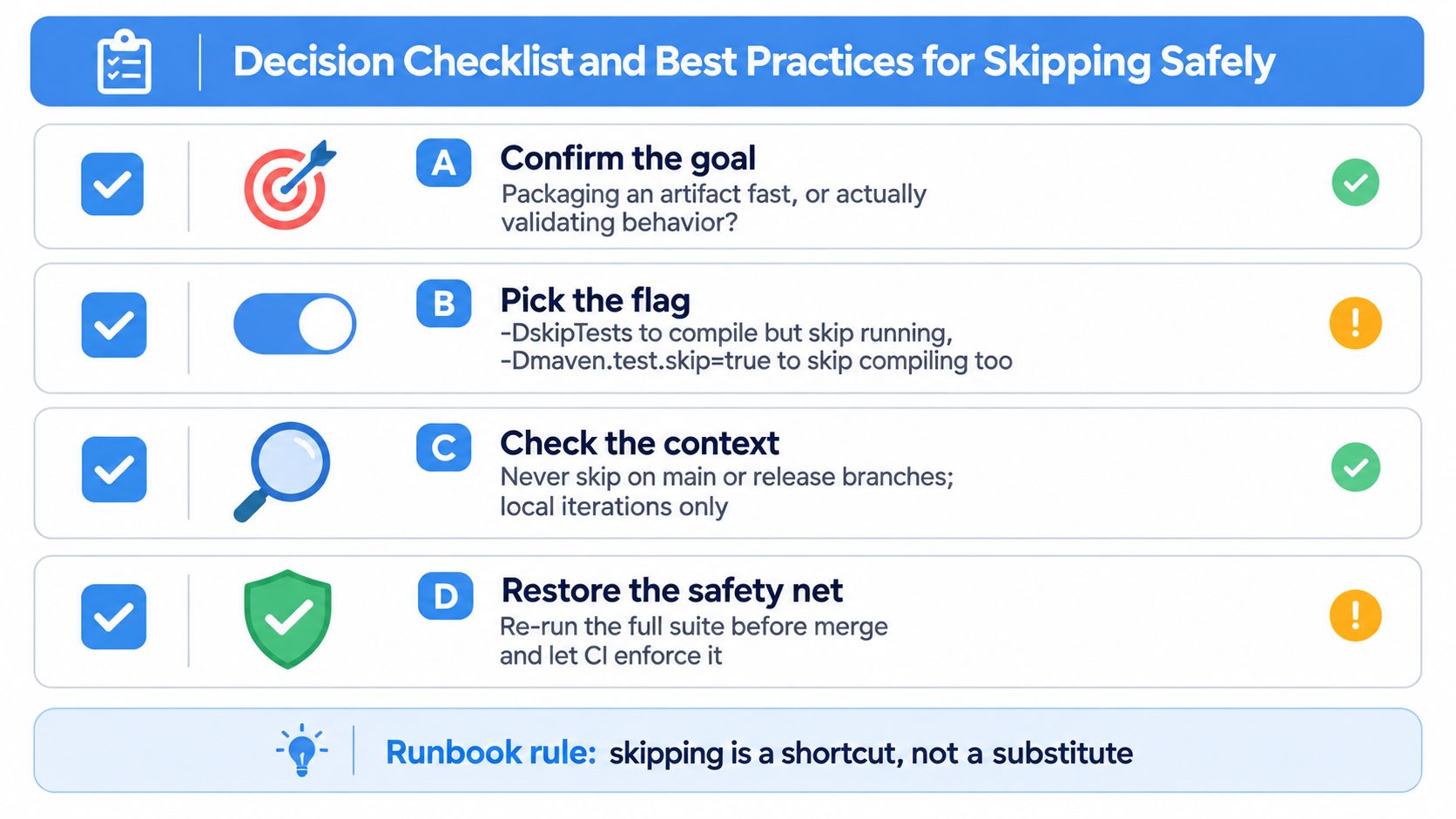
A skip flag should be a documented build decision, not a piece of command-line folklore. Put the following checklist in the project runbook and make the job behavior match it.
Confirm the objective
Decide whether the command is producing an artifact or validating application behavior. If the immediate need is a clean local dependency, mvn clean install -DskipTests may fit. If the need is release evidence, use a full verification path instead.
Match the property to the objective
Choose -DskipTests when test sources must still compile or when a configured test-JAR may be consumed by another module. Choose -Dmaven.test.skip=true only when skipping test compilation is intentional and no downstream build contract depends on those classes.
Check the execution context
Local iteration, a temporary troubleshooting job, and a release pipeline don’t carry the same risk. Make the context visible through the wrapper script, profile, or job name. Don’t hide a skip in a shared command that developers and release jobs invoke identically.
Restore the safety net
Keep a real verify or full install stage elsewhere in the workflow. Run Failsafe checks in a dedicated stage when integration tests are separated from unit tests, and add a smoke test against the installed artifact before deployment. If downstream modules require a test-JAR, verify that the artifact exists before starting consumers.
A few implementation habits keep the choice consistent:
- Pin the policy at the wrapper level: Use a Maven wrapper or one CI script so jobs don’t drift between
-DskipTestsand-Dmaven.test.skip=true. - Record the reason: Put the reason in the job name, build annotation, or commit context. “Artifact assembly, tests run in verification” is more useful than “Maven build.”
- Inspect the effective configuration: Check the effective POM and relevant properties when a child module behaves differently from the parent.
- Keep integration checks separate: A later Failsafe or replay stage should consume the artifact produced by the earlier stage.
- Protect release branches: Require the full suite and artifact smoke test before merge or promotion, even if local developers use a skip during iteration.
The runbook rule is simple: -DskipTests means compile and package without executing tests, while -Dmaven.test.skip=true means skip test compilation too. Choose by intent, then preserve verification somewhere that can block release.
GoReplay captures and replays live HTTP traffic into a testing environment, giving teams a way to exercise the artifact after a fast Maven install instead of treating skipped tests as final evidence. Visit GoReplay to evaluate a replay stage that fits alongside your Maven verification workflow.