
Jax Ws Web Services
REST dominates new projects, but JAX-WS remains foundational for stable legacy SOAP integration, especially where WSDL contracts and enterprise clients already govern production behavior. Successful maintenance requires disciplined annotations and contract management alongside traffic replay, not unit tests alone.
A common incident starts with a harmless-looking Java upgrade. The service still compiles, the endpoint deploys, and the unit suite passes. Then a partner sends a request containing an attachment, a SOAP header, or an older namespace, and production returns a fault that nobody reproduced locally. The failure isn’t usually the business method. It’s the contract, handler chain, provider, connection state, or generated artifact around it.
That’s why JAX-WS web services deserve a production-minded treatment. The framework is more than annotated Java classes exposed over HTTP. It is a coordinated system of SOAP messages, WSDL and XSD artifacts, JAXB bindings, runtime providers, handlers, security configuration, and client behavior. Each layer can change independently, and each can invalidate an apparently successful migration.
The Foundations of JAX-WS Web Services
An enterprise team inheriting a SOAP service rarely receives a clean Java project with an obvious entry point. More often, it receives a WSDL in a document repository, generated sources in a build directory, a server-specific deployment descriptor, and a partner who treats every element name as permanent. The endpoint may look old, but it can still sit on a critical integration path.
SOAP and WSDL emerged in the late 1990s to standardize machine-to-machine communication through structured XML messages and formal service descriptions. REST later became the dominant style for many general-purpose web APIs. A 2006 AWS discussion reported that REST represented approximately 85% of that organization’s web-service usage at the time, an early signal of the shift away from SOAP for many new services (historical comparison of SOAP and REST).
JAX-WS persists because enterprise integration values explicit contracts, generated clients, formal faults, and established security extensions. Replacing those capabilities with a newer protocol can be sensible for a new boundary, but it isn’t automatically sensible for a mature partner ecosystem. The cost of change includes client regeneration, certification, message compatibility, operational rollout, and recovery when one consumer implements the contract differently from the others.
The practical foundation has three parts:
- SOAP defines the message envelope, headers, body, and faults.
- WSDL defines operations, messages, bindings, and endpoint expectations.
- JAXB maps XML Schema structures to Java types and maps Java values back to XML.
The important insight is that these are not isolated features. A Java field can influence generated XML, the WSDL can influence generated client classes, and a handler can alter the message before the business method receives it. Treating JAX-WS as “just an HTTP endpoint” hides the dependencies that break during maintenance.
How SOAP WSDL and JAXB Work Together
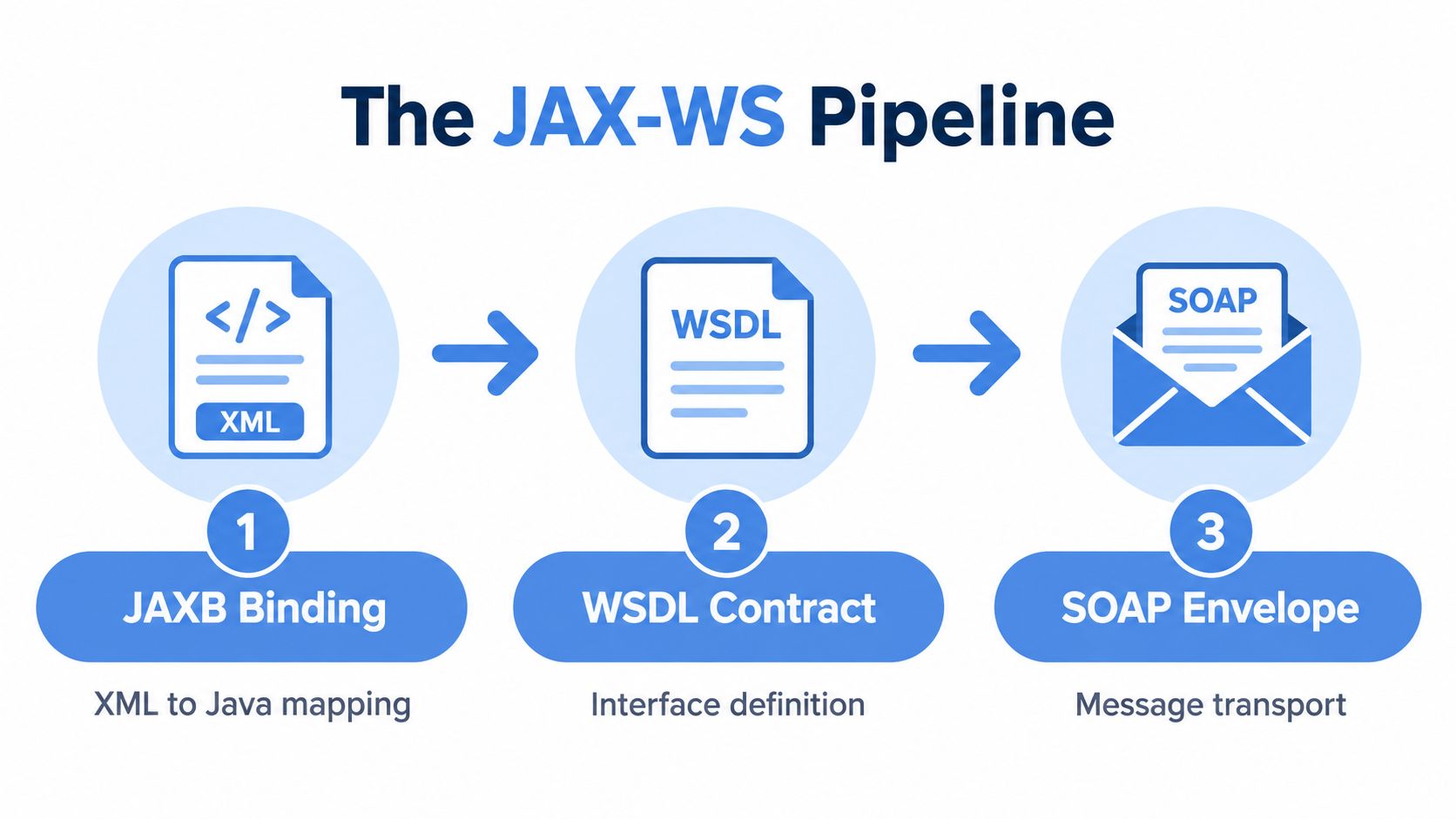
JAX-WS works as a pipeline rather than a single abstraction. The service contract describes the wire shape, JAXB supplies data binding, and SOAP carries the resulting message. The official specification identifies standardized WSDL-to-Java mapping as the central interoperability mechanism, while JAXB performs XML Schema-to-Java and Java-to-XML binding (Jakarta XML Web Services specification).
Start with the data model
JAXB annotations describe how Java types map to XML. A class may become a complex type, a field may become an element, and annotations can control names, namespaces, ordering, optionality, and nillability. Those details aren’t cosmetic. A partner can reject a message because an element appears in an unexpected namespace or because a missing value is represented differently from an explicitly nil value.
The binding layer also determines how generated clients interpret responses. If an XSD changes from an optional element to a required element, or if a Java type changes in a bottom-up project, the generated artifacts may change even when the endpoint URL stays the same.
Treat WSDL and XSD as release artifacts
JAX-WS supports contract-first development from WSDL and bottom-up development from annotated Java classes. In both cases, the WSDL and imported schemas should be checked into version control, reviewed, published, and versioned with the service. Runtime-generated metadata is convenient during development, but it creates an operational trap when the contract changes unexpectedly after a deployment.
A reliable build keeps track of:
- The exact WSDL and every imported XSD.
- Generated client and server sources.
- Namespace and binding customizations.
- SOAP version and endpoint binding.
- Compatibility tests for representative partner messages.
Practical rule: If a client needs a WSDL to generate or validate code, that WSDL belongs in the dependency graph, not in a temporary server directory.
Follow the message through the runtime
A client creates a Java request object. JAXB marshals it into XML. JAX-WS places the XML inside a SOAP envelope, applies headers and handlers, and sends the message through the configured transport. The server reverses the process, then unmarshals the response or fault into Java objects.
That separation gives teams useful control, but it also multiplies failure points. A valid Java object doesn’t prove that the wire message matches the partner contract. Contract tests should inspect serialized messages, namespaces, ordering, headers, faults, and attachments, not only Java return values.
Essential Annotations and Service Lifecycle
Annotations provide the metadata that turns Java types into a service contract. They also establish assumptions that remain active after deployment, so annotation changes deserve the same review discipline as public method changes.
A typical service begins with @WebService, which identifies the service endpoint interface or implementation. @WebMethod controls exposed operations, while @WebParam and @WebResult make parameter and return-value names explicit. Explicit names are safer than relying on defaults because compiler changes, refactoring, or generated wrapper behavior can alter the wire contract unexpectedly.
@SOAPBinding controls important binding choices, including document versus RPC style and wrapped versus bare parameter handling. Most enterprise services use document-oriented contracts, but the correct choice is the one already required by consuming clients. Changing it for aesthetic reasons can invalidate generated proxies.

The request lifecycle has more than a business method
At runtime, the server resolves the endpoint, creates or obtains the provider, receives the HTTP request, parses the SOAP envelope, executes inbound handlers, unmarshals the body, and invokes the operation. Outbound handlers then process the response before the transport sends it back.
Handlers often contain executable business policy, not mere logging. They can validate correlation identifiers, add authentication headers, enforce message signatures, apply tenant rules, or reject requests based on metadata. A handler that changes order or is disabled after a migration can produce behavior that unit tests never see.
The Jakarta XML Web Services documentation describes handler and attachment extension points as part of the framework’s SOAP-specific behavior (JAX-WS API overview). Test handler chains as deployed configuration. Verify whether they run inbound, outbound, or both, and record the headers they add or consume.
Resource and runtime decisions matter
Don’t instantiate a new client proxy for every call without understanding the runtime’s connection and resource behavior. Reuse must be balanced against stale connections, thread safety, credentials, and endpoint failover. Configure timeouts explicitly, close resources where the implementation requires it, and monitor connection reuse rather than assuming the transport behaves efficiently.
Keep handler state isolated unless shared state is deliberate. A handler that stores a correlation value in an instance field can leak data between concurrent requests if the runtime reuses the handler. Use request-scoped context or message properties for per-call data, and include concurrency tests in deployment validation.
Choosing Between Contract-First and Bottom-Up Approaches
Contract-first is the safer default when multiple organizations, vendors, or platforms consume the service. The team starts with WSDL and XSD, agrees on namespaces and message shapes, then generates Java artifacts with tools such as wsimport. Java implementation details remain subordinate to the published contract.
This approach costs more discipline early. Developers must understand schema design, versioning, imports, bindings, and compatibility rules before writing the implementation. The payoff is that the wire format remains intentional, and a Java refactor doesn’t automatically redefine the interface.
Bottom-up starts with annotated Java classes and uses wsgen or the runtime to produce WSDL and schema artifacts. It is productive for an internal prototype or a service controlled by one team. Developers can model domain types directly and expose operations quickly.
The weakness appears when Java evolution becomes contract evolution by accident. Renaming a field, changing a type, moving a package, or adjusting annotations can alter generated XML. A client may continue compiling against an older WSDL while the server publishes a subtly different contract, creating failures that only appear during integration.
| Decision factor | Contract-first | Bottom-up |
|---|---|---|
| External partner integration | Strong fit, because the wire contract leads | Riskier, because Java changes can affect XML |
| Rapid internal prototyping | Slower at the start | Efficient for early experiments |
| Long-term schema governance | Clear ownership and review | Requires strict artifact publication |
| Java refactoring | Usually insulated from the contract | Can change the contract unexpectedly |
| Migration testing | WSDL and XSD provide stable fixtures | Generated output must be diffed carefully |
Use bottom-up when speed and local control matter more than cross-team contract governance. Use contract-first when compatibility is a product requirement. In either model, publish the resulting WSDL and schemas as versioned dependencies, then test generated clients against the exact artifacts used in deployment.
Creating and Consuming Services with Traffic Capture
A minimal service can start with an annotated endpoint interface, an implementation class, JAXB request and response types, and a server configuration that publishes the endpoint. The client can then generate a proxy from the WSDL, configure the endpoint address, set credentials and timeouts, and invoke the operation through the typed interface.
That workflow proves basic interoperability, but it doesn’t prove production compatibility. Real SOAP traffic includes retries, delayed responses, duplicate requests, session identifiers, changing headers, malformed fields, partner-specific namespaces, and attachments. A useful regression corpus must preserve those interaction patterns while masking sensitive values.
Build the client around the contract
Generate client artifacts from a pinned WSDL and imported schemas. Keep those generated files reproducible, and make the build fail if the source contract changes without an explicit review. Configure the client’s SOAP version, endpoint address, authentication, TLS behavior, and timeout policy outside business logic so test environments can substitute them safely.
Capture the full HTTP exchange where possible, including:
- SOAP headers and correlation identifiers.
- The complete envelope, not only the body.
- Content type and MIME boundaries.
- Attachment content identifiers and metadata.
- Cookies or session markers used by the application.
- Response faults, status codes, and timing order.
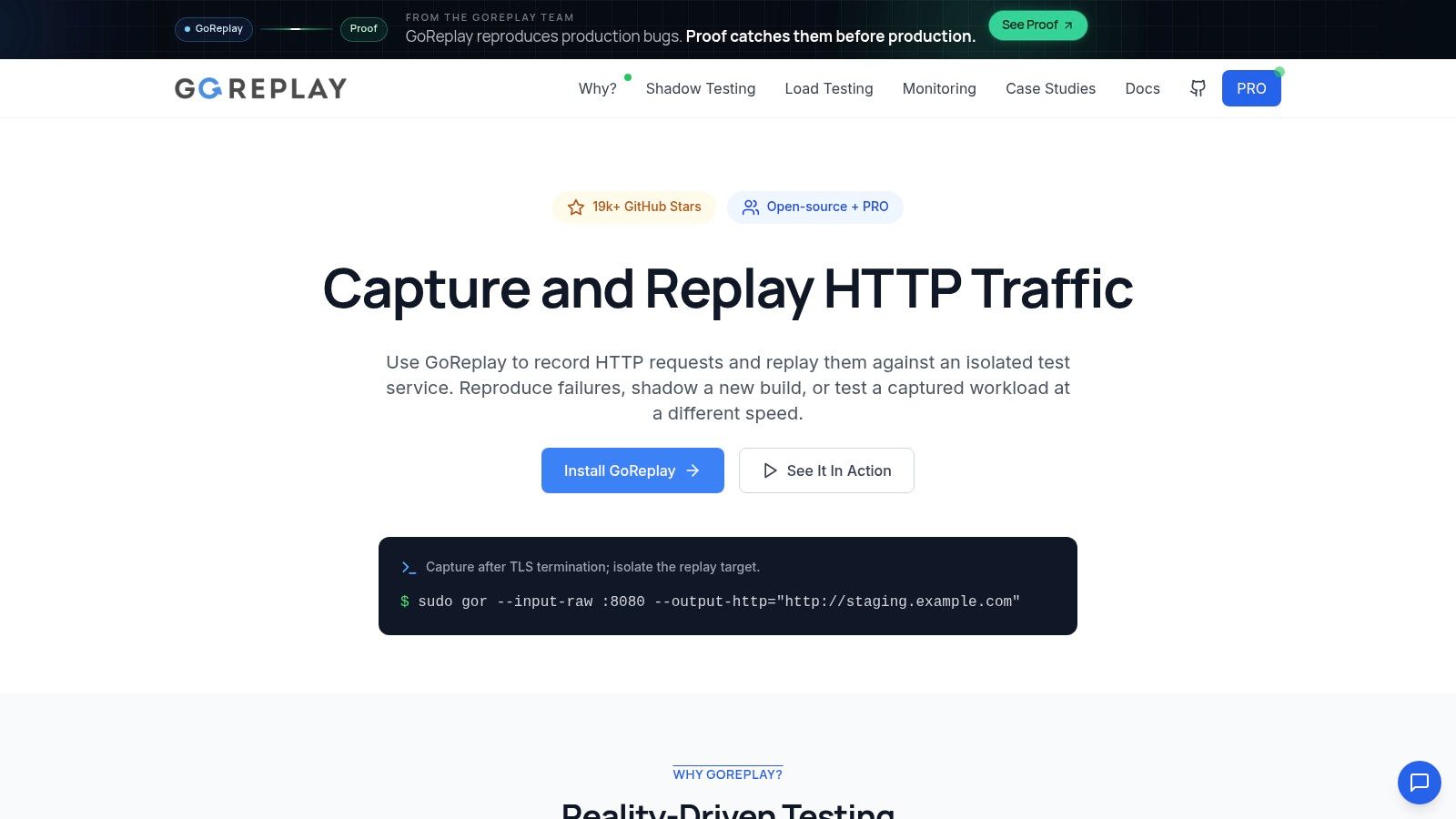
A traffic tool can replay HTTP requests, but the test harness must understand the application’s semantics. Replace production endpoint addresses, credentials, tokens, and personal data. Preserve relationships between identifiers when the service uses them to correlate calls. This is one of the practical foundations of how to avoid brittle integrations, because tests remain tied to observed behavior rather than to an idealized example.
Use replay to find state drift
Stateful SOAP services often fail only when requests arrive in sequence. A login or session-establishing call may set a cookie, a later operation may require a correlation header, and a retry may be valid only after a specific fault. Replay those flows in order and compare both the response body and the resulting state.
Learn how SOAP testing tools differ when choosing a workflow for contract inspection, exploratory requests, and traffic replay.
The following video provides additional context for inspecting and replaying HTTP traffic:
A migration test should deliberately include attachment requests, repeated calls, expired sessions, reordered calls, and SOAP faults. Compare whether the migrated service preserves session continuity, handler-generated headers, attachment extraction, idempotency, and failure recovery. A service that passes a valid request test can still fail every one of these production conditions.
Optimizing Performance and Securing Endpoints
XML processing remains a real production cost, and adding threads does not remove it. A SOAP request can spend substantial time in XML parsing, JAXB marshalling and unmarshalling, schema validation, and handler execution before network transfer is complete. Measure each stage separately when diagnosing latency, CPU use, or allocation pressure.
Large binary values need a separate design decision. Base64 encoding enlarges the XML payload and makes the parser and binding layer process data that is not naturally XML. SOAP attachments keep binary content outside the envelope, but both sides still require compatible MIME boundaries, content identifiers, and binding configuration. Migration tests should include attachment extraction, not only ordinary request and response bodies.
Tune the message path
Start with representative traffic rather than synthetic requests with small payloads. Track endpoint latency, CPU, allocation behavior, payload size, schema-validation time, handler time, and connection reuse. Change one setting at a time so its effect remains visible.
Useful controls include:
- Schema validation: Keep it where contract enforcement requires it, then measure the cost and remove redundant validation across layers.
- Object allocation: Reuse safe client infrastructure and avoid unnecessary conversions between domain objects and JAXB models.
- Attachments: Use them for large binary content when partner compatibility supports the required MIME and binding behavior.
- Connection behavior: Verify keep-alive and pooling under the deployed runtime, proxy, and load-balancer configuration.
- Logging: Never log complete sensitive envelopes by default. Record correlation data and selected structural fields instead.
Secure the endpoint as a message processor
Transport encryption protects the network channel. SOAP headers and message-level security add processing steps and configuration dependencies. Validate signatures, timestamps, credentials, and replay protections against the deployed policy. Harden XML parsers against external entity processing and resource-exhaustion attacks, and enforce sensible message-size and nesting limits.
Handlers execute inside the message path, so they can change security outcomes and business behavior. A handler that trusts an unsigned identity header, accepts unexpected serialized data, or logs secrets can compromise the endpoint. Review handler code, provider configuration, certificate stores, and deployment descriptors together. Teams reviewing secure development fundamentals can consult this guide to write secure code for interviews, then apply those practices to production code rather than interview exercises.
A migration should also test stateful behavior under captured traffic. Replayed calls can expose session drift, handler-generated header differences, attachment failures, and retry behavior that isolated endpoint tests miss. Compare the resulting state as well as the response body.
For embedded server deployments, establish the runtime and dependency boundary before changing transport settings. This guide to tomcat-embed-core provides context for the surrounding Tomcat component, while endpoint security still depends on the complete JAX-WS provider and application-server configuration.
Migrating from JAX-WS to Jakarta and Modern Alternatives
The most dangerous migration assumption is that replacing javax.xml.ws with jakarta.xml.ws completes the work. It may complete compilation, but runtime compatibility is a separate problem. Generated client classes, deployment descriptors, handler providers, service discovery, WSDL packaging, and application-server support can all remain tied to the old environment.
Jakarta XML Web Services 4.0 requires Java SE 11 or later, removes the fallback to a default implementation, and drops jaxws.properties-based implementation lookup (Jakarta XML Web Services 4.0 specification). Those changes make clean-environment startup especially important. A developer machine with an old provider on the classpath can hide a deployment failure that appears in a container or application server.
Validate the runtime, not just the source
Build a migration matrix around the Java versions and runtimes your organization supports. Include the selected provider, application-server version, generated artifacts, handler configuration, deployment descriptors, and rollback path. Regenerate clients from the approved WSDL and XSD files, then compare the resulting XML contract with the previous release.
Run tests in an empty, production-like environment. Verify provider discovery, endpoint activation, handler initialization, TLS negotiation, authentication, SOAP faults, and attachment processing. Then replay sanitized interaction flows that include session establishment, retries, delayed responses, malformed requests, and partial authentication. Unit tests can confirm method behavior, but only deployed integration tests can reveal missing providers or changed handler chains.
Decide whether SOAP still fits
JAX-RS is often a better choice for a new HTTP API with lightweight resource representations and broad client accessibility. gRPC can fit internal service-to-service communication where generated contracts, efficient binary messages, and controlled client ecosystems matter. Neither option automatically replaces a mature SOAP boundary with formal partner agreements, WS-* dependencies, or long-lived generated clients.
Keep JAX-WS when the contract is stable, consumers depend on SOAP behavior, and migration risk exceeds the value of replacement. Modernize the surrounding delivery process, version WSDL and XSD artifacts, isolate handlers, upgrade the runtime deliberately, and replay real interaction flows after every significant change. Move to another protocol when you control the consumers and can fund compatibility, security, observability, and operational migration as a single program.
GoReplay captures and replays live HTTP traffic so teams can test migrated JAX-WS endpoints with realistic sequences, headers, sessions, faults, and attachment behavior instead of relying only on unit fixtures. Visit GoReplay to see how it can turn sanitized production interactions into repeatable regression and load tests.