
HTTP Testing Golang: Master Advanced API Testing
Let’s be honest—we’ve all been burned by flaky tests. You push a change, the CI pipeline glows red, and it’s because some external service timed out, not because your code is actually broken. It’s a massive drain on time and confidence.
This is where mastering HTTP testing in Golang becomes a true game-changer. It’s not just about finding bugs; it’s about building genuine resilience into your services. Go’s slick concurrency model and powerful standard library are practically built for creating fast, reliable, and totally isolated API tests.
Why Effective Go HTTP Testing Is a Game Changer
Go isn’t just another language for building APIs; for many teams, it’s the language. Its raw performance and straightforward approach make it a go-to for scalable backend services and microservices that live and breathe HTTP. With so much of the modern software stack built on Go, solid testing isn’t just a nice-to-have—it’s absolutely essential for keeping the lights on.
Good Go HTTP testing practices cut right to the heart of common development headaches. Instead of leaning on slow, brittle end-to-end tests that need a universe of external services to be perfectly aligned, Go lets you write lightning-fast unit and integration tests in complete isolation.
The payoff is huge:
- Blazing Speed: Your tests finish in milliseconds, not minutes. That means instant feedback.
- Rock-Solid Reliability: By mocking dependencies, you kill the flakiness that comes from network hiccups or a third-party API having a bad day.
- Real Confidence: Shipping new features or refactoring a tricky piece of code stops being a stressful event when you’ve got a comprehensive test suite watching your back.
The Rise of Go in API Development
The language’s explosive growth in the enterprise world really drives this point home. The 2023 H2 Go Developer Survey found that a staggering 74% of Go developers use the language to build API/RPC services. Simplicity and performance are the big draws, especially in B2B worlds where API uptime is non-negotiable.
This chart from the survey paints a crystal-clear picture—API development isn’t just a use case for Go, it’s the dominant one.
This data confirms what many of us already know from experience: the vast majority of Go developers are living in the world of web services. That makes getting good at http testing golang a fundamental, must-have skill.
To help you get started, here’s a quick look at the core tools you’ll be working with.
Core Golang HTTP Testing Tools at a Glance
This table breaks down the main packages in Go’s standard library for HTTP testing, giving you a quick reference for what to use and when.
| Tool/Package | Primary Use Case | Key Benefit |
|---|---|---|
net/http/httptest | Creating mock HTTP servers and clients for tests. | Full control over server responses without real network calls. |
net/http | The foundational package for all HTTP work. | Provides the core Request and ResponseWriter types. |
io and ioutil | Reading and writing request/response bodies. | Essential for asserting payloads and preparing test data. |
testing | The standard Go testing framework. | The backbone for running tests, sub-tests, and benchmarks. |
These packages are the building blocks for almost any HTTP testing scenario you’ll encounter in Go.
For any team building microservices in Go, mastering the
httptestpackage is non-negotiable. It’s the foundation for creating a test suite that is both fast and incredibly thorough, catching bugs long before they ever see a production environment.
This guide will give you the roadmap to do just that. We’ll start with the fundamentals of the standard library and work our way up to more advanced patterns. We’ll cover everything from basic handler tests to sophisticated strategies like replaying real production traffic, giving you the practical skills you need to ship code with total confidence.
Crafting Your First Tests With The httptest Package

Alright, enough theory. Let’s get our hands dirty. The workhorse for isolated http testing in golang is the built-in httptest package. It’s a fantastic tool because it lets you test your HTTP handlers directly without firing up a real server or making actual network calls. The result? Blazing-fast and totally reliable tests.
We’ll start with something simple: a basic HTTP handler. Its only job is to take a GET request and respond with a JSON object containing a greeting. This is a bread-and-butter pattern you’ll see in just about any API you build or work with.
Here’s our GreeterHandler:
package main
import ( “encoding/json” “net/http” )
type Greeting struct {
Message string json:"message"
}
func GreeterHandler(w http.ResponseWriter, r *http.Request) { w.Header().Set(“Content-Type”, “application/json”) w.WriteHeader(http.StatusOK) json.NewEncoder(w).Encode(Greeting{Message: “Hello, Tester!”}) }
Now that we have a handler, we can write a unit test to make sure it does what we expect. This is exactly where httptest comes into play.
Simulating Requests and Capturing Responses
To test our handler in isolation, we need two key pieces from the httptest package:
httptest.NewRequest(): This function lets us create a mock*http.Requestto feed into our handler. We can control everything—the HTTP method, URL, and even the request body or headers.httptest.NewRecorder(): This gives us a special kind ofhttp.ResponseWriterthat acts like a black box, recording everything our handler tries to send back. It captures the status code, headers, and the full response body so we can inspect it later.
Let’s see them in action. We’ll create a new test file, main_test.go:
package main
import ( “net/http” “net/http/httptest” “testing” )
func TestGreeterHandler(t *testing.T) { // First, create a mock request to pass to our handler. req := httptest.NewRequest(http.MethodGet, “/greet”, nil)
// Next, we create a ResponseRecorder to capture the response.
rr := httptest.NewRecorder()
handler := http.HandlerFunc(GreeterHandler)

// Finally, we serve the request to our handler, which writes to the ResponseRecorder.
handler.ServeHTTP(rr, req)
}
So far, we’ve successfully called the handler. But we haven’t actually checked if it did the right thing. That’s the next step: the assertion phase.
The core idea behind
httptestis simple but incredibly effective. It builds the “scaffolding” around your handler.NewRequestpretends to be the user sending a request, andNewRecorderpretends to be the browser receiving the response—all without ever touching the network.
Asserting the Outcome
Let’s finish our test by adding the assertions. We need to confirm two things: that the status code is 200 OK and that the response body contains the JSON message we expect.
// Inside TestGreeterHandler, after handler.ServeHTTP(rr, req)
// Check if the status code is what we expect. if status := rr.Code; status != http.StatusOK { t.Errorf(“handler returned wrong status code: got %v want %v”, status, http.StatusOK) }
// Check if the response body is what we expect.
expected := {"message":"Hello, Tester!"} + “\n”
if rr.Body.String() != expected {
t.Errorf(“handler returned unexpected body: got %v want %v”,
rr.Body.String(), expected)
}
And there you have it. You’ve just created a complete, isolated, and fast unit test for an HTTP handler. This is a fundamental skill, and once you master it, you open the door to testing much more complex scenarios.
As you look to scale these efforts, you might want to explore our guide on automating API tests and related strategies for success to see how these fundamentals fit into a larger testing picture.
Testing Full Servers and Client Logic

While testing individual handlers is a fantastic start, modern applications are much more than a collection of disconnected functions. You have routers, middleware for logging and authentication, and complex request lifecycles. How do you test that everything works together? This is where httptest.NewServer really shines.
Unlike httptest.NewRecorder, which just captures a handler’s output, httptest.NewServer spins up a genuine, in-memory HTTP server running your code. This server listens on a local port, letting you use a standard http.Client to make real requests to it. It’s a huge step up in confidence because you’re testing the entire request chain from end to end.
Integration Testing with an In-Memory Server
Let’s imagine you have an application using a router like chi and some simple logging middleware. You need to be sure that a request to /api/user/123 correctly passes through the logger, gets routed to the right handler, and returns the expected result.
Setting up a test for that entire flow is surprisingly straightforward:
- Build Your Router: In your test function, you’ll create an instance of your router and register all your handlers and middleware, just as you would in your
main.gofile. - Start the Test Server: Pass this fully-configured router to
httptest.NewServer. It will return a server instance, which is what you’ll use to get the server’s URL. - Make Real Requests: Now you can use
http.Getor a completehttp.Clientto fire a request at the server’s URL.
A key tip I’ve learned is to always use
defer server.Close()immediately after creating the server. This guarantees the server is torn down and its resources are released after the test completes, preventing annoying resource leaks.
This method is perfect for verifying that your routing rules are correct, your middleware chain is executing in the right order, and that context values are being passed down as you expect.
Flipping the Script to Test Your HTTP Client
The other side of the coin is testing code that makes HTTP requests. What if your application depends on a third-party API? You definitely don’t want your tests to fail just because an external service is down, slow, or flaky.
The solution is to mock that external API, and httptest.NewServer is the perfect tool for the job. You can create a mock server that returns predictable, controlled responses, giving you total command over the testing environment.
Imagine your code needs to fetch user data from some external service. You can now easily test its behavior under different conditions:
- Success Case: The mock server returns a 200 OK with valid JSON.
- Not Found: It returns a 404 Not Found error.
- Server Error: It returns a 500 Internal Server Error to check your retry logic.
- Timeout: You can even make the mock server delay its response to test your client’s timeout handling.
This approach completely isolates your client logic. You can confidently test your data parsing, error handling, and retry mechanisms without ever making a real network call to an unpredictable external system. This makes your client tests fast, deterministic, and incredibly robust.
Applying Advanced Patterns for Scalable Tests
As your Go application and its test suite grow, you’ll quickly find that simple handler tests just don’t cut it anymore. What starts as a clean set of tests can easily become a tangled, unreadable mess. To avoid that fate, you need to adopt patterns that keep your tests clean, scalable, and genuinely useful.
The first big step is creating test helpers. These are small, focused functions that handle all the repetitive setup work, like crafting an authenticated request or parsing a JSON response. By tucking that boilerplate away, your actual test functions can focus purely on the specific behavior you’re trying to verify. This single change makes your tests dramatically easier to read and maintain.
Embracing Table-Driven Tests
If you want to write idiomatic Go tests, you have to embrace the table-driven test. This pattern is a perfect match for HTTP testing. The idea is simple: you define a slice of test cases, where each case has its own set of inputs and expected outputs. Then, you just loop over the slice and run a dedicated sub-test for each one.
This approach is incredibly efficient for covering all your bases for a single endpoint:
- Valid Inputs: Testing the “happy path” to make sure everything works as expected.
- Malformed Payloads: What happens when you send bad JSON? Your handler should fail gracefully.
- Edge Cases: Checking behavior with empty strings, zero values, or other weird data.
- Permission Errors: Simulating requests from users who shouldn’t have access.
A table-driven structure keeps your test code incredibly compact. Even better, adding new scenarios is trivial—no more copy-pasting huge blocks of code. It’s a fantastic way to get high test coverage without writing a mountain of code.
Managing Complex Scenarios
Of course, real-world applications are a lot more than just simple GET requests. Sooner or later, you’ll need to test file uploads, streaming responses, or handlers locked down by authentication middleware.
This is where dedicated helpers truly shine. For instance, you could write a helper that attaches a valid JWT to a request header. Suddenly, the messy details of token generation are completely abstracted away from your test logic.
Another pro tip is to make friends with t.Cleanup. This nifty function schedules an action to run after your test (or sub-test) finishes. It’s perfect for things like closing a database connection, deleting a temporary file, or shutting down a test server. It’s the key to making sure your tests are stateless and don’t trip over each other.
As you build out these more sophisticated tests, it’s worth noting that the tooling ecosystem is evolving right alongside them. The market for AI-enabled and cloud-based software testing is projected to hit nearly USD 3.82 billion by 2032, a clear sign that the industry is hungry for more efficient and powerful testing solutions. New tools are constantly popping up to simplify complex validation and anomaly detection in HTTP services. You can get a deeper look at this trend in a detailed industry report.
The growth in this market is pretty telling, as you can see below.
This surge in investment highlights just how critical scalable testing has become. By combining Go’s powerful standard library with smart patterns like these, you can build a test suite that’s not just robust, but a genuine pleasure to work with.
Validating with Real Traffic Using GoReplay
Unit and integration tests are fundamental, but they have a blind spot: they only test for scenarios you can think of. What about the chaotic, unpredictable behavior of real users in the wild? This is where http testing in Golang gets really interesting, especially with tools like GoReplay.
Instead of just faking requests, you can capture actual production traffic and replay it against a staging or local environment. This technique, often called shadow testing, is the ultimate confidence boost before a big deployment. You move beyond sterile, hypothetical test cases and start battle-hardening your application against the weird edge cases, malformed requests, and quirky user behaviors that only ever show up in production.
Capturing and Replaying Traffic
The core idea behind GoReplay is brilliantly simple yet incredibly powerful. It all boils down to two main phases: capturing and replaying.
- Capturing Traffic: First, you run GoReplay on your production server in listening mode. It quietly inspects network traffic on a given port and writes the HTTP requests it sees to a file. The best part? It does this without slowing down or affecting your live application.
- Replaying Traffic: Next, you take that file of recorded requests and use GoReplay to fire them at your test instance. The requests are replayed with the exact same timing and concurrency as they originally occurred, creating a load test that’s as real as it gets.
The real magic here is uncovering the “unknown unknowns.” I once worked on an API that kept failing because of a specific, non-standard header sent by an old mobile client. None of our handcrafted tests could have ever caught that. Replaying production traffic flushed it out in minutes.
Filtering and Safety Considerations
Of course, replaying raw production traffic immediately brings up security and privacy concerns. You should never replay requests containing sensitive user data like passwords, API keys, or personal information into a non-production environment.
Thankfully, GoReplay gives you robust tools to handle this:
- Header Filtering: Configure it to ignore or hash specific HTTP headers.
- URL Path Rewriting: Modify request paths to scrub user-specific identifiers.
- Body Modification: Use custom middleware to remove sensitive fields from JSON payloads before they’re ever saved.
By putting these safeguards in place, you get all the benefits of realistic traffic patterns without compromising user data. You can find some excellent strategies for this in our guide on how to replay production traffic for realistic load testing.
The infographic below offers a great comparison, contrasting Go’s built-in testing tools with third-party assertion libraries. It really highlights the trade-offs in verbosity, error clarity, and how steep the learning curve is for each.
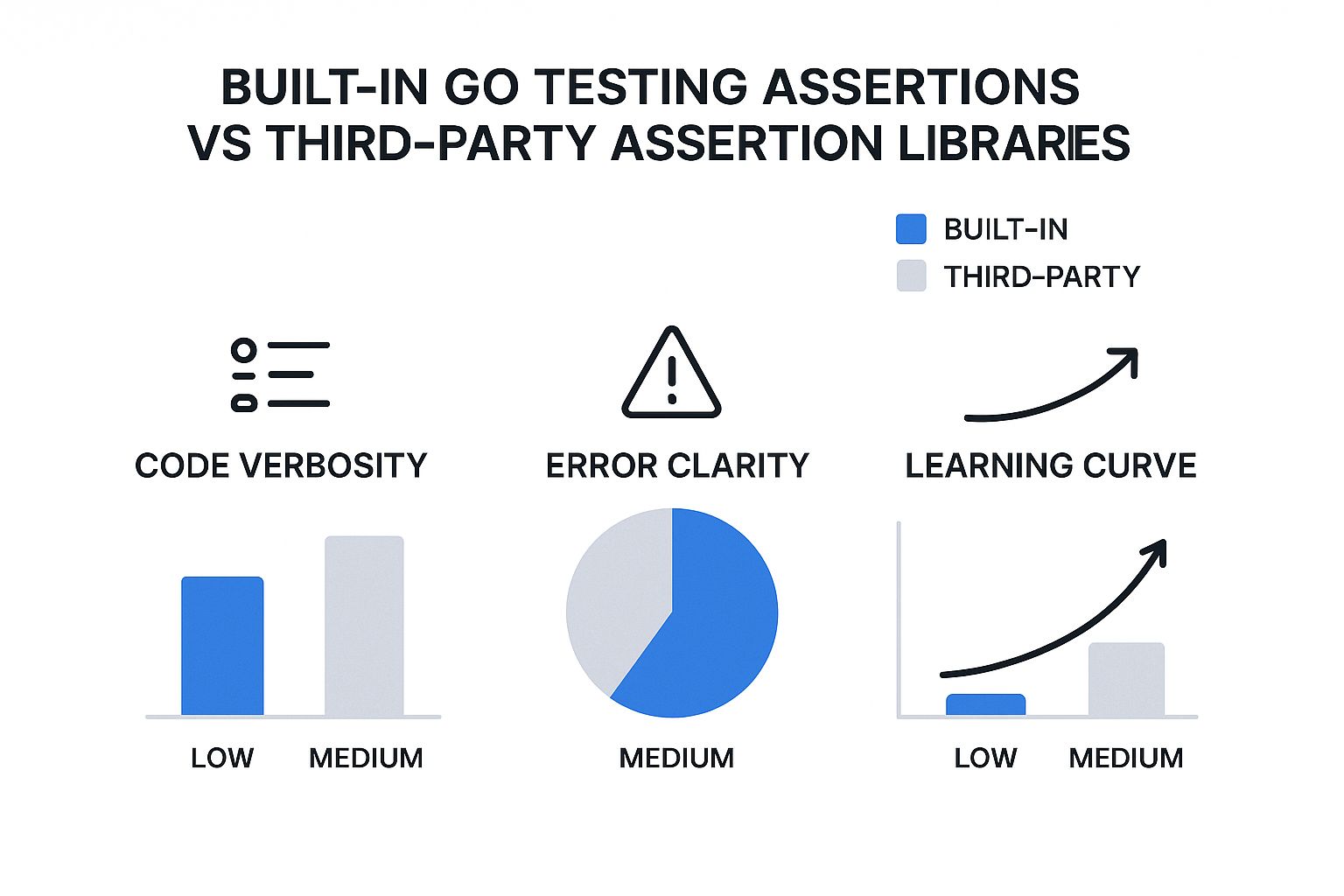
As the visual shows, while the built-in tools get you started quickly, third-party libraries often give you much clearer error messages, which can be a lifesaver in complex tests.
This push for better, more realistic testing is part of a much larger trend. Testing as a Service (TaaS)—an outsourced model for software quality assurance—is becoming a huge focus. The market is projected to swell to around USD 19.15 billion by 2034. North America is leading the charge, currently holding a 39.2% market share. This growth is fueled by the demand for advanced HTTP testing solutions that help teams ship high-quality, reliable software. You can dive deeper into the TaaS market on Precedence Research.
To help you decide which approach is right for you, here’s a quick breakdown of the different methodologies we’ve discussed.
Testing Approach Comparison
| Testing Method | Best For | Key Advantage | Limitation |
|---|---|---|---|
Go net/http/httptest | Unit testing individual HTTP handlers. | Simple, fast, and part of the standard library. | Doesn’t test the full network stack; isolates components. |
| Third-Party Libraries | Integration and end-to-end tests. | Rich assertions and clearer failure messages. | Adds external dependencies and a learning curve. |
| GoReplay (Shadow Testing) | Pre-deployment validation and performance testing. | Tests with 100% realistic user traffic. | Requires careful handling of sensitive data. |
Ultimately, the best strategy often involves a mix of these methods. You can use httptest for quick feedback on individual functions, assertion libraries for robust integration checks, and GoReplay for final, real-world validation before you ship.
Common Questions About Go HTTP Testing
As you move past the “hello world” of http testing golang, you’ll quickly run into real-world roadblocks. The path from a few basic tests to a truly robust suite is paved with small, specific challenges that boilerplate tutorials just don’t cover. Let’s tackle some of the most common hurdles I see developers face.
One of the first big ones is dealing with anything outside your application—especially databases. How do you test a handler that needs to query a database without spinning up a full-blown PostgreSQL instance every time you run go test? The answer isn’t to connect to a real database, but to use abstraction and mocking.
How Should I Handle Database Dependencies
The best approach is to design your handlers to depend on interfaces, not concrete database types. Instead of your handler knowing about a *sql.DB connection, it should accept an interface, maybe something like a UserStore.
In your main application, you’ll pass in a real database implementation that satisfies this interface. But in your tests, you create a simple mock struct that also satisfies the UserStore interface but just returns hardcoded data. It’s a game-changer.
This simple shift gives you several massive wins:
- Total Isolation: Your test is completely self-contained. It no longer needs a real database to run, making it independent of any external services.
- Blazing Speed: The test executes in milliseconds. There’s no network lag or slow disk I/O to wait for.
- Predictable Behavior: You’re in complete control. You can easily simulate any scenario, like a “user not found” error, just by changing what your mock returns.
This dependency injection pattern is really a cornerstone of writing clean, testable Go. It makes your http testing golang efforts far more reliable and a lot less brittle.
By defining clear boundaries with interfaces, you’re not just making your code easier to test; you’re making it more modular and maintainable in the long run. The testability is almost a happy side effect of good software design.
Should I Use Third-Party Assertion Libraries
While Go’s built-in testing package is perfectly capable, its assertion style can feel a bit clunky and verbose. It’s why many developers reach for third-party libraries like testify/assert or gomega to get a more fluent and expressive testing experience.
So, should you use one? It’s a classic trade-off.
- The upside: They offer much cleaner, more readable assertions.
assert.Equal(t, expected, actual)is just tidier than a multi-lineifblock. Plus, they provide incredibly detailed failure messages that pinpoint the exact difference between what you expected and what you got. - The downside: They add an external dependency to your project. For teams strictly committed to the standard library, this can be a deal-breaker.
From my experience, the improved readability and developer experience from a library like testify are almost always worth the minor dependency. The time you save debugging a single failed test often pays for itself many times over. Ultimately, though, it comes down to your team’s preference and project standards.
Ready to validate your application with real-world chaos? GoReplay captures and replays your live traffic, letting you test your changes against actual user behavior before they ever hit production. Ensure your next deployment is your most stable one yet by visiting https://goreplay.org to get started for free.