
Distributed Systems Testing Guide for Reliable Services
Your CI passed. Staging looked calm. Then production got weird.
An order was accepted, inventory was reserved, the payment service retried after a timeout, and the shipping service saw two events that looked close enough to the same request to do the wrong thing. Each service behaved “correctly” in isolation. The system as a whole still failed.
That’s the moment many teams realize they aren’t really testing a distributed system. They’re testing a collection of components and hoping the interactions stay polite under stress.
Single-process software usually breaks in ways you can step through. Distributed software breaks when clocks drift, packets arrive late, a replica sees stale state, or one service commits while another is still waiting. The ugly part is that these bugs often don’t show up in a clean, deterministic test run. They appear when real traffic, retries, queues, caches, and partial failures all meet.
Introduction Why Distributed Systems Fail Differently
A familiar incident looks like this. You deploy a small change to a service that writes to a primary store and publishes an event for downstream consumers. Unit tests pass. Contract tests pass. Even the end-to-end suite passes because it assumes a neat request order and immediate propagation.
Production doesn’t.

A consumer reads from a replica before replication catches up. Another service retries because it got a slow response, not a hard failure. Cleanup jobs race with delayed messages. Suddenly you have duplicate side effects, stale reads, or a workflow stuck halfway between “accepted” and “compensated.”
Why green tests still miss distributed failures
The core difference is simple. In a single-node app, most failures are local. In a distributed system, many failures are interaction failures. The bug isn’t inside service A or service B alone. It lives in timing, ordering, retries, partitions, and shared state spread across boundaries.
That’s why classic distributed systems work changed the way engineers think about testing. The CAP theorem was introduced by Eric Brewer in 2000 and formally proved by Gilbert and Lynch in 2002. It says a shared-data distributed system can guarantee at most two of three properties at the same time: consistency, availability, and partition tolerance. That turned network partitions from an edge case into a central testing concern, not a footnote in architecture diagrams (Brewer CAP overview).
Distributed systems testing starts getting useful when you stop asking, “Does the feature work?” and start asking, “What does the system do when part of reality goes missing?”
What good testing actually validates
For distributed systems, the target isn’t broad coverage for its own sake. It’s observable failure behavior.
You want to know things like:
- When a dependency is slow: Does the caller retry safely, or create duplicates?
- When replicas diverge briefly: Which reads are allowed to be stale, and which aren’t?
- When events arrive out of order: Can consumers recover without corrupting state?
- When cleanup runs early: Do parallel tests contaminate each other across services?
That shift matters because distributed systems exhibit non-linear, stochastic, and dynamic behavior, which makes them harder to test than single-node software. Research on distributed system testing notes that effective testing often needs emulation-based or cluster-based harnesses, not only analytical models or ad hoc production tests (distributed testing framework paper).
If you’re used to measuring test quality by the number of end-to-end flows, that can feel backward. But in practice, more full-stack coverage doesn’t automatically mean better defect discovery. In distributed systems, realism, observability, and adaptive exploration usually matter more.
What Makes Distributed Systems Testing So Hard
Testing a distributed system is like judging a relay race where the runners can’t always hear the starter, some batons arrive late, and two lanes occasionally disagree about who crossed the line first. The problem isn’t just code correctness. It’s coordination under uncertainty.
Partitions change the rules
A lot of confusion starts here. Developers hear “network partition” and think “rare outage.” In distributed systems, a partition is any condition where nodes can’t reliably exchange the information they need. That can look like packet loss, extreme latency, one-sided connectivity, or a service that times out often enough to be effectively absent.
Once you accept that, CAP stops sounding theoretical and starts shaping test design. If your system chooses availability during a partition, some readers may see stale data. If it chooses consistency, some requests may fail fast or block. Neither choice is “wrong.” But each choice creates different test cases.
Timing isn’t a detail
A common testing mistake is to treat timing as noise around the logic. In distributed systems, timing often is the logic.
Consider a checkout service that writes an order, emits an event, and expects an inventory service to reserve stock. Your test might assert that after a request completes, inventory eventually reflects the reservation. But what if:
- the event broker delays delivery,
- the inventory service processes an older event first,
- a retry sends the same reservation again,
- a read model updates between those steps?
Now you don’t just need to test whether the reservation happened. You need to test whether the system handles duplicates, reordering, and delayed convergence in a way you can observe and verify.
Practical rule: If correctness depends on “eventually,” your test needs an oracle that can distinguish acceptable delay from silent corruption.
Static scripts don’t search enough of the system
Distributed behavior isn’t just complicated. It’s state-space complicated. Small changes in arrival order, concurrency, or node health can produce very different outcomes.
Empirical failure studies of open-source distributed systems found that testing should prioritize failure-triggering inputs and strong oracles, because inducing a fault isn’t enough if you can’t reliably detect that it caused a failure. The same study also concluded there was no general-purpose, disciplined testing method that solved distributed-system failures across systems (empirical failure study).
That’s why mature teams move beyond one static scenario.
What distributed tests need instead
A more useful harness usually does some combination of the following:
- Varies timing deliberately: Add delay, jitter, retries, and cancellation at controlled points.
- Exercises concurrency: Send overlapping requests that contend on shared entities or workflows.
- Runs with realistic topology: Use multi-node or emulated environments, not only in-memory mocks.
- Checks invariants, not only responses: Validate that state converges, side effects aren’t duplicated, and forbidden states never appear.
| Concern | Single-node assumption | Distributed reality |
|---|---|---|
| Request order | Usually stable enough | Often interleaved or reordered |
| Failure type | Exception or crash | Timeout, partition, partial success |
| Assertions | Immediate output | Eventual state and cross-service invariants |
| Test harness | Process-local | Cluster or emulation-based |
The hard part isn’t writing more tests. It’s writing tests that explore enough of the uncertainty to tell you how the system behaves when reality stops being tidy.
Essential Test Strategies for Distributed Systems
The names of the test layers are already well known. The useful question is narrower: what does each layer prove, and what does it miss?
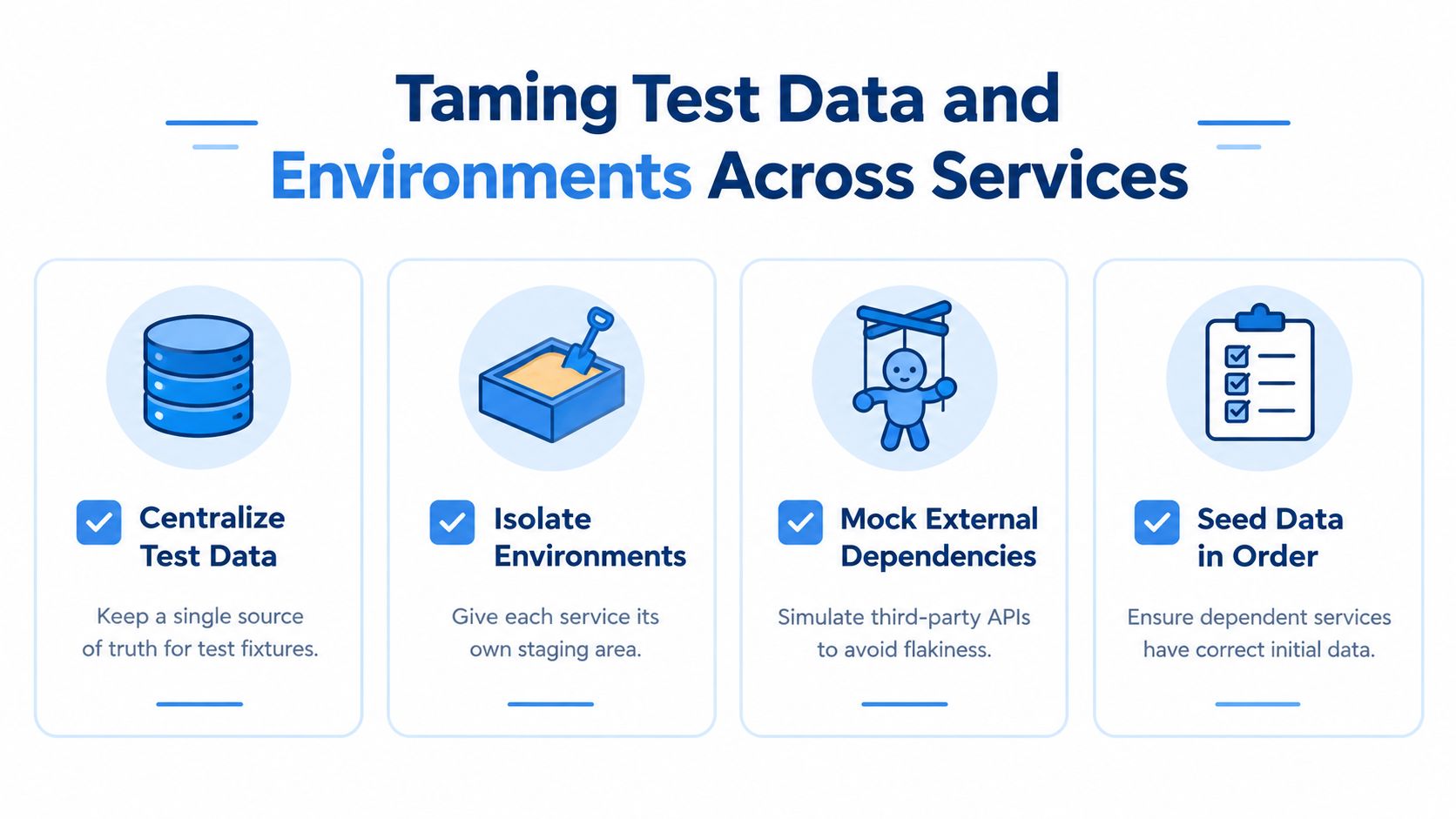
Unit tests still matter because they pin down local logic. Serialization rules, idempotency key handling, retry backoff calculations, and event validation all belong there. But unit tests can’t tell you whether two services interpret the same event sequence consistently.
Integration tests step up one level. They validate interactions between a small set of real components, such as an API service plus a database, or a producer plus a queue plus a consumer. They’re where you catch transaction boundaries, schema mismatches, and side effects that mocks politely hide.
Where contract, load, and canary tests fit
Contract tests answer a very specific question. Do both sides agree on request and response shape, or on event format and semantics? They’re excellent for preventing accidental breakage between independently deployed services.
Load tests reveal a different class of issues. They show what happens under pressure. In distributed systems, pressure often changes behavior rather than just increasing latency. Queues grow, retries pile up, timeouts become more common, and eventually consistent paths stretch long enough to break assumptions.
A canary test is less about correctness in the abstract and more about safe exposure. It lets you watch a small blast radius before broad rollout, which is useful when behavior depends on real traffic patterns that synthetic test data won’t mimic.
Here’s a quick visual reference before we compare the harder strategies in more detail:
Chaos and replay test what broad end-to-end suites often miss
Chaos testing exists because distributed failures are probabilistic. Netflix popularized chaos engineering in 2011 and open-sourced Chaos Monkey in 2012. The point was to deliberately inject failures into production-like environments to verify that systems tolerate the failures they’re expected to withstand. That shift turned fault injection from an ad hoc tactic into a structured discipline for resilience testing (chaos engineering history).
Replay testing answers a different weakness. Synthetic end-to-end tests usually guess at user behavior. Traffic replay uses real request patterns, real sequencing, and realistic payload diversity. That makes it far better at surfacing race conditions, unexpected payload combinations, and integration paths nobody remembered to script.
Broader end-to-end coverage can still miss subtle bugs if the traffic shape, timing, and data relationships aren’t realistic.
Choosing the mix instead of defaulting to more end-to-end tests
A practical test portfolio tends to look like layered evidence, not one giant suite.
| Strategy | What It Validates | Best For |
|---|---|---|
| Unit tests | Local business rules and pure logic | Fast feedback on service internals |
| Integration tests | Real behavior across a few components | Databases, queues, side effects |
| Contract tests | Interface compatibility between services | Independent deployment safety |
| Load tests | Behavior under stress and queueing | Capacity and timeout behavior |
| Canary tests | Change safety under real production exposure | Gradual release decisions |
| Chaos tests | Resilience under injected failure | Failover, retries, dependency loss |
| Replay tests | Behavior under realistic request patterns | Hidden interactions and timing bugs |
If you’re deciding where to invest next, use this rule of thumb:
- Use unit tests to lock down local correctness.
- Use integration and contract tests to catch interface and persistence mistakes.
- Use chaos tests to learn how failures propagate.
- Use replay tests when synthetic traffic keeps giving you false confidence.
The best distributed systems testing strategy isn’t “add more end-to-end tests.” It’s combining test types so each one covers a failure class the others naturally miss.
Taming Test Data and Environments Across Services
The hardest part of distributed systems testing often isn’t failure injection. It’s state management.
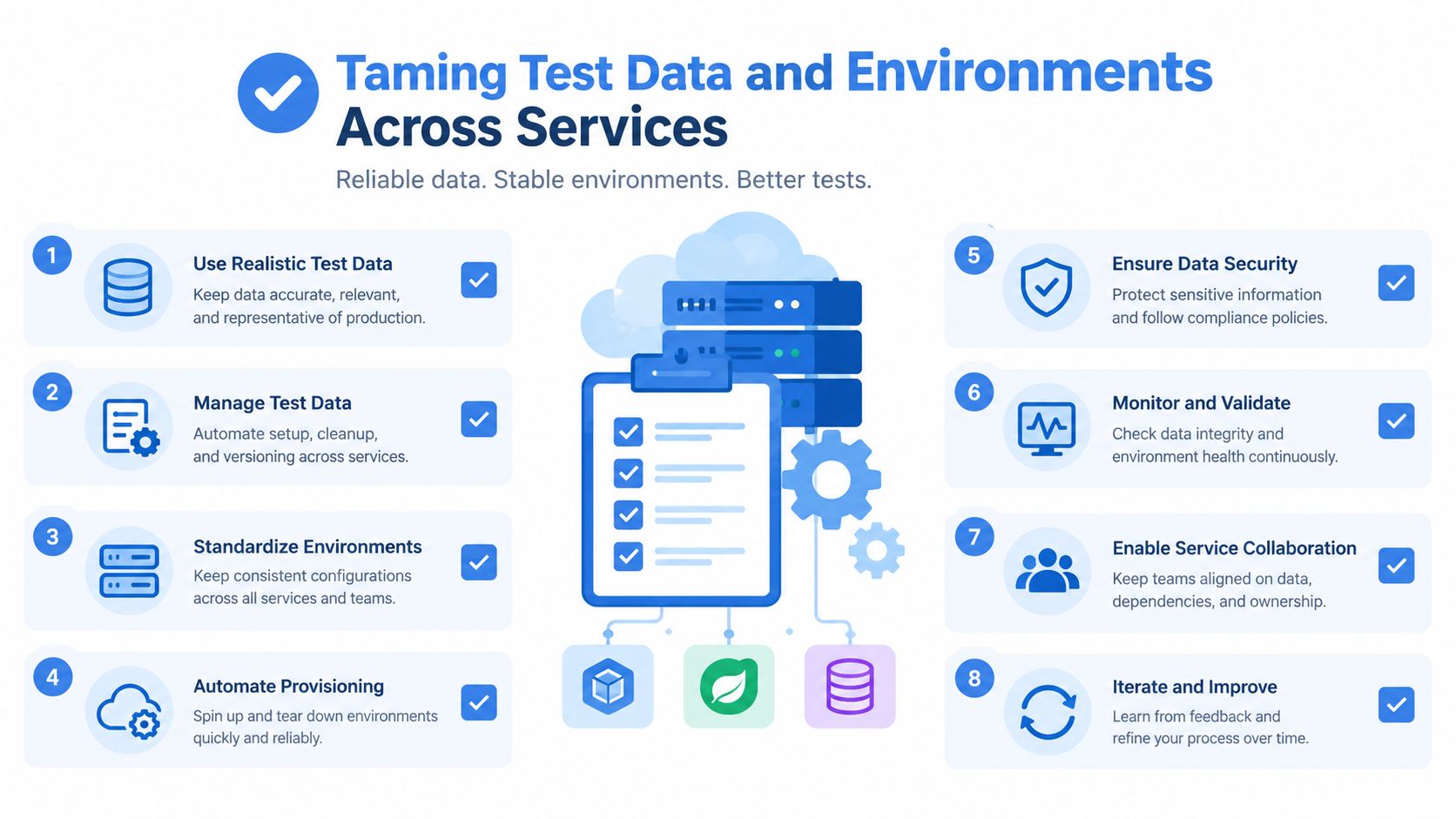
A single-service test can usually set up a few rows, run a request, and clean up. A multi-service workflow is different. One service stores canonical records, another keeps a denormalized view, a third emits asynchronous events, and a fourth caches state that won’t disappear just because your test ended. Now parallel execution becomes dangerous.
Independent material on test data challenges in distributed systems highlights five recurring pain points: data consistency across services, eventual consistency verification, cross-service data isolation, stateful test-data orchestration, and coordinated cleanup across distributed stores (test data challenges in distributed systems). That’s exactly why so many suites become flaky as soon as teams scale them beyond a few happy-path flows.
Why parallelization breaks first
Suppose test A creates a user, a payment profile, and a shipping preference. Test B does the same with overlapping identifiers or shared downstream fixtures. If one service cleans up eagerly while another still has pending events, you get failures that look random but aren’t. They’re just hidden coupling.
The tempting answer is to add more environment isolation. Sometimes that helps. Sometimes it just hides the fact that your tests don’t model eventual consistency clearly enough.
Patterns that work better than blind expansion
Instead of treating every full workflow as one giant test, break it into state-aware stages:
- Create fixtures with lineage: Track which service owns the source of truth for each entity.
- Assert propagation explicitly: Don’t only check the final UI or API response. Check that downstream state changed in the expected way and within the expected conditions.
- Isolate by namespace or tenant: Give each test run its own identifiers and storage boundaries when possible.
- Clean up in dependency order: Delete or expire data based on how services reference one another, not just where the test started.
A useful mindset is to treat test data as a distributed workflow of its own. If production needs orchestration, testing does too.
Watch for this smell: if your only cleanup strategy is “reset the environment nightly,” your test suite is probably hiding state coupling it can’t control.
Why adaptive testing matters here
Recent survey material points to a tooling gap around the state-space explosion created by microservice interdependencies without losing detection fidelity, as noted in the same discussion of current challenges above. That insight matters because random or unguided testing doesn’t scale well when many services, stores, and async paths can interact.
So the contrarian move is often the right one. Don’t respond to complexity by only making the suite broader. Make it more behavior-guided. Pick scenarios based on risky state transitions, delayed propagation, duplicate delivery, and cleanup races. Those are usually the edges where distributed systems tell you the truth.
Realistic Testing With Production Traffic Replay
If synthetic scripts keep missing production bugs, it usually isn’t because your engineers are lazy. It’s because your scripts are guessing. Real users don’t hit your system in neat sequences, with evenly distributed payloads and perfect think times.
Traffic replay changes the input, which changes the value of the test.
What replay gives you that handmade tests don’t
When you capture real HTTP traffic after TLS termination and replay it into an isolated environment, you preserve patterns that are hard to invent on purpose:
- odd request ordering,
- bursts against a single account or tenant,
- payload combinations from older clients,
- retries triggered by upstream behavior,
- naturally skewed traffic across endpoints.
That’s where replay shines. It doesn’t replace targeted tests. It complements them by putting the system under a workload shaped by reality rather than by your assumptions.
One practical reference for this approach is production traffic replay for realistic load testing, which walks through replay-based validation in test environments.
A safe replay workflow
A sensible replay setup usually follows this pattern:
- Capture traffic at a stable boundary. Teams do this after TLS termination so requests are already visible in plaintext within trusted infrastructure.
- Store the capture for controlled use. File-based recording lets you replay the same sequence repeatedly during debugging or before a release.
- Replay into an isolated target. Never point replay traffic at systems that can cause real customer side effects unless the system is explicitly built for shadow handling.
- Disable dangerous actions. Email sends, payment execution, third-party callbacks, and destructive webhooks should be stubbed, masked, or rerouted.
- Compare outcomes. Look at status codes, payload differences, latency drift, and side effects across downstream services.
Where GoReplay fits
For HTTP services, GoReplay is one option teams use to capture live traffic and replay it into test environments. That’s useful when you want a release candidate, a rewritten service, or a new dependency path to see realistic request streams without serving real users from the candidate environment.
The value isn’t “more traffic.” It’s better shaped traffic.
Session awareness and side effects are where people trip
Readers often get stuck on one concern here: “If I replay traffic, won’t I just create garbage data everywhere?” You will, unless you isolate aggressively.
A few practical safeguards matter:
- Mask sensitive fields before storing or replaying captures.
- Use replay-only tenants or namespaces so you can identify and delete derived state.
- Stub outbound integrations that would contact external systems.
- Handle session and auth assumptions carefully. Some requests depend on earlier requests, cookies, or token state.
- Keep replay targets production-like enough that concurrency, caching, and queue behavior still resemble reality.
A migration is a good example. Say you’re moving an API endpoint to a new service. Synthetic tests may prove that known contract cases still pass. Replay can show whether the new path behaves differently under old mobile client payloads, bursty retries, or skewed traffic distributions. That’s often where bugs are.
Observability Metrics and CI/CD Integration That Actually Catch Failures
Logs and traces help you investigate a failure after it happens. They don’t automatically make a weak test meaningful.
That distinction matters more in distributed systems because many failures cross node boundaries, involve time-dependent events, and only become obvious when several components disagree about the same request. Practitioner research has highlighted common pain points around collecting container metrics and logs, distributed tracing, and manual or integration test creation, while newer systems work argues that random state-space sampling misses subtle bugs and that emerging architectures create fresh observability challenges (observability and adaptive testing research).
Make failure modes observable by design
A good distributed test doesn’t stop at “request failed.” It gives you enough signals to explain why.
That usually means instrumenting around these checks:
- Status comparison: Did the candidate return a different class of response than the baseline?
- Payload comparison: Did both paths succeed but produce materially different data?
- Latency comparison: Did one path cross timeouts or tail-latency thresholds that trigger retries?
- Side-effect checks: Did downstream writes, events, or cache invalidations differ?
If you’re looking for implementation guidance, observability best practices for testing and operations is a useful reference point for tying visibility back to system behavior.
Turn observability into a CI gate
Teams often underuse their pipelines. CI should do more than confirm that unit and integration tests are green. It should reject builds when replay or environment tests produce suspicious diffs.
A practical gate might fail a candidate when:
| Signal | Why it matters |
|---|---|
| Response status differs from baseline | Indicates direct behavior change |
| Response body differs unexpectedly | Catches semantic regressions |
| Latency shifts enough to trigger retries | Exposes distributed knock-on effects |
| Downstream events or writes diverge | Reveals hidden side-effect regressions |
That turns observability into test evidence, not just a dashboard.
Systems become easier to debug when tests are built to expose disagreement, not just success.
Feedback-guided testing beats static scripts
One of the more useful recent shifts is toward feedback-guided or adaptive testing. Instead of running the same fixed script forever, the test process uses observed behavior to decide what to explore next.
In practical terms, that can mean generating more cases around requests that caused unusual latency, replaying traffic slices that produced divergent payloads, or stressing the services involved in traces with the highest failure concentration. The idea is simple. Let the system tell you where it is fragile, then test those edges harder.
That’s a better fit for distributed systems than pretending one static suite can anticipate every meaningful interaction.
Common Pitfalls and Your Next Steps to Reliable Releases
The most expensive mistake in distributed systems testing is chasing coverage volume instead of failure clarity. Teams add more end-to-end tests, wait longer for CI, and still miss the bug that only appears when retries, stale state, and cross-service cleanup collide.
A few pitfalls show up again and again:
- Over-relying on broad end-to-end suites: They feel complete but often hide weak oracles.
- Ignoring oracle design: If you can’t tell whether the system converged correctly, fault injection won’t help much.
- Replaying traffic without isolation: Realistic inputs are valuable, but only if side effects are controlled.
- Treating observability as a rescue plan: Logs won’t save a test that never checked the right failure behavior.
- Flattening all risk into one environment: Different failure classes need different harnesses.
The stronger approach is narrower and more disciplined. Test the behaviors that matter under failure. Use contracts and integration tests for local interaction safety. Use chaos to pressure resilience assumptions. Use traffic replay to surface request patterns and timing issues synthetic scripts miss. Then wire observability into the pipeline so regressions fail before release, not after a war room starts.
If you’re improving an existing setup, start small:
- pick one risky workflow with async propagation,
- define the invariants you can observe,
- isolate test data per run,
- replay realistic traffic into a safe environment,
- add CI gates on response and side-effect diffs.
That sequence usually teaches you more than another batch of generic end-to-end scenarios.
GoReplay gives teams a concrete way to bring realistic HTTP traffic into distributed systems testing without serving that traffic from production candidates. If you want to validate behavior under real request patterns, compare candidate responses, or add traffic-driven checks to your release process, visit GoReplay.