
Data Masking vs Encryption: Which One Do You Need?
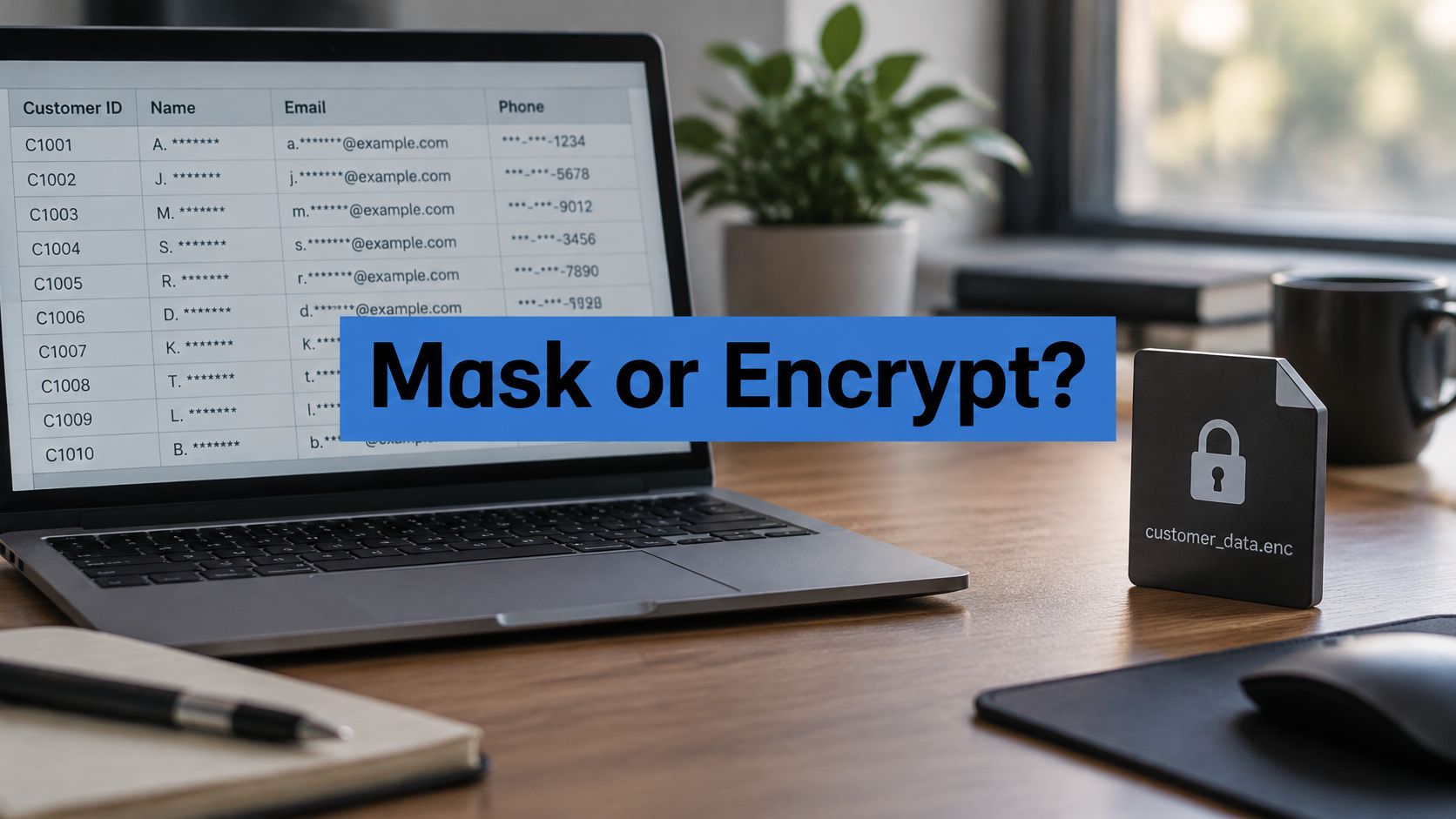
The usual advice draws a clean line. Encrypt production. Mask whatever you copy into test. Treat data masking vs encryption as a contest, pick a winner, and move on.
I would throw out that split. Each control covers a different moment of exposure, and neither one makes a capture safe by itself. An encrypted file is still readable to anyone who holds the key. A masked capture can still be linked across requests when the stand-in values stay consistent enough for the app to behave. For traffic replay, the useful target is the least realism that still reproduces the failure, not the most production-like payload you can store.
Data Masking vs Encryption at a Glance
Neither control makes data safe on its own, because each one guards a different exposure point. Encryption keeps stored or transmitted data unreadable without the key. Masking replaces or obscures values so people and test systems can work with realistic data without seeing the originals.
That split is a cost problem, not a vocabulary problem. IBM’s 2024 Cost of a Data Breach report analysed real-world breaches at 604 organisations between March 2023 and February 2024 and reported a global average breach cost of approximately $4.88 million, 10% higher than the previous year and the highest total in that report’s series. Encryption can reduce the usefulness of stolen files when attackers lack the keys. It does not stop authorised users, applications, logs, or test systems from exposing readable personal data during normal processing. Masking limits what developers, QA engineers, analysts, and replay environments see in the first place, which matters when production traffic is copied into lower environments that often have broader access and looser operational controls.
Eight dimensions, one table
| Dimension | Data masking | Encryption |
|---|---|---|
| Primary purpose | Hide or replace sensitive values while keeping the data usable | Keep stored or transmitted data unreadable without the key |
| Reversibility | Often irreversible; deterministic variants stay linkable | Reversible with the correct key |
| Protects data | In use: dev, QA, analytics, support views | At rest and in transit: disks, backups, databases, network |
| Key or secret | No key for irreversible masking; token vault for deterministic tokens | Requires managed cryptographic keys |
| Output | Realistic fake values, e.g. aliases or last 4 card digits | Ciphertext unrelated to the original values |
| Typical overhead | Low query-layer cost for basic dynamic masking | Longer processing, extra storage, slower queries |
| Compliance status | Pseudonymised data is still personal data under GDPR guidance | Encrypted data you can decrypt is still personal data |
| Main failure mode | Re-identification by joining quasi-identifiers | Key compromise or plaintext exposure during processing |
A sensible layout is layered, not either-or. Encrypt recordings and databases. Mask or pseudonymise names, emails, tokens, and account numbers before replay. Isolate any re-linking information and keys with separate access controls. The breach figure is not a score for masking. It is the reason both controls belong in the same design.
Three questions sort every later choice. Must the original values be recoverable? Must the data look realistic? Is the data at rest, in transit, or in use?
How Data Masking Works
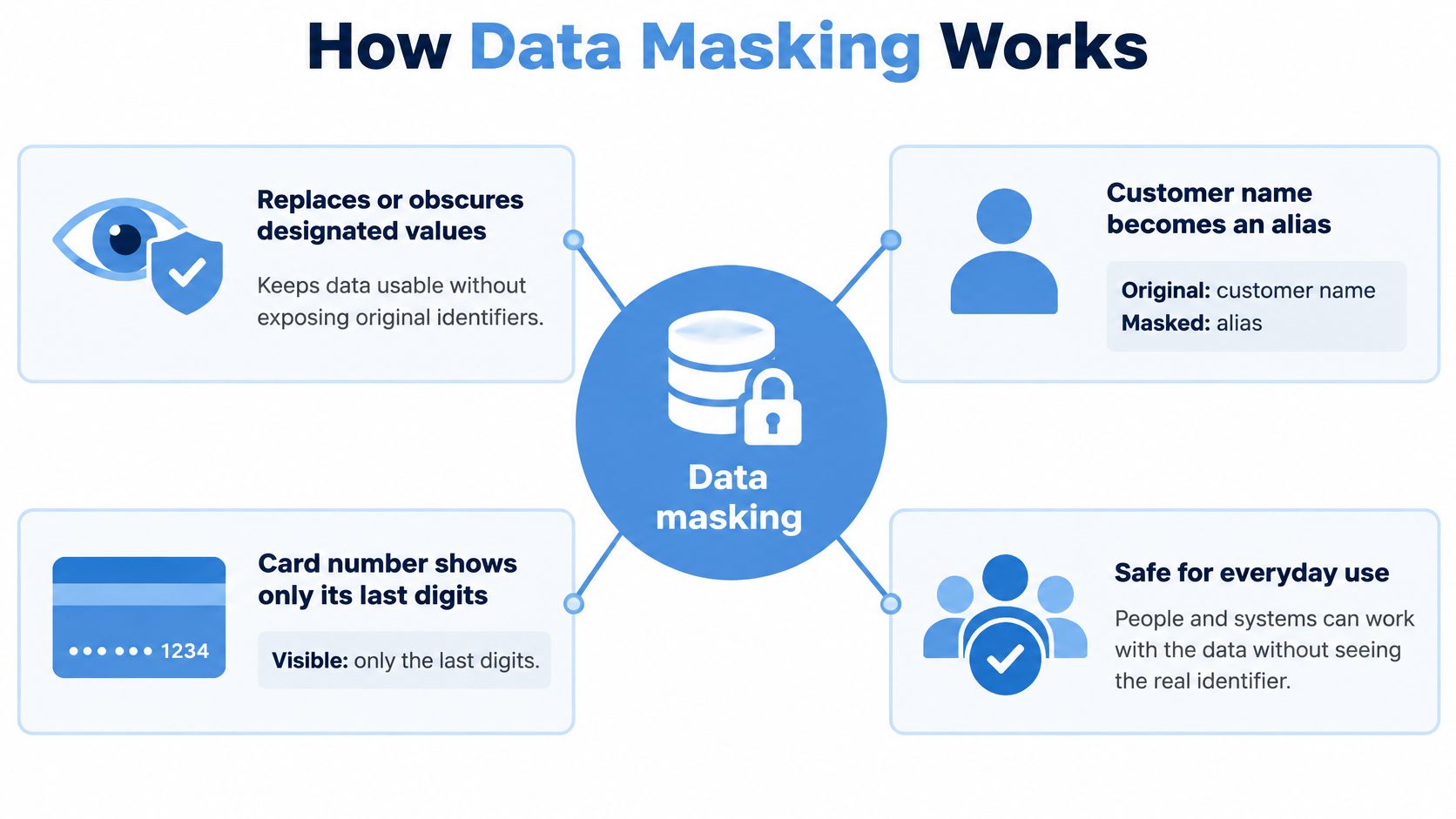
Masking replaces or obscures designated values so the record stays usable without exposing the original identifier. A customer name becomes an alias. A card number shows only its last four digits. An email becomes a token that looks like an email. The consumer of the data never needs the original string.
Techniques, from blunt to precise
Static masking rewrites a copied dataset before anyone else receives it. You transform the extract once, then hand the copy to QA or analytics. There is no live lookup back to production.
Dynamic masking rewrites values at query time, usually by role. A support agent might see the last four digits of a card while a fraud analyst sees more. The stored row can stay intact. The view does not.
Deterministic masking always turns the same input into the same token. Joins survive. A session id in request one still matches request two, which is what replay needs for continuity.
Format-preserving masking keeps the shape that validators expect. A 16-digit card stays 16 digits and can still pass a Luhn check if you design the substitute that way. The app does not reject the payload for looking wrong.
Vaulted tokenization stores the mapping so a tightly controlled process can look the original up later. That is no longer “set and forget.” The vault is a secret, and anyone who can read it can undo the mask for those fields.
Still personal data
Under the European Data Protection Board guidelines on pseudonymisation, pseudonymisation produces two components: a transformed dataset and separately held additional information that can reconnect it to the individual. Because that extra information exists, pseudonymised data remains personal data and is not the same as anonymisation. Encryption does not clear the obligation either. Encrypted information remains personal data when the organisation can still restore it.
For replay testing the practical difference is sharp. Masking can permanently or consistently transform production identifiers before traffic enters a test environment. Encryption preserves recoverability but demands controlled key management. A masked test payload cuts exposure during debugging. An encrypted payload helps when an authorised team must later recover the original values. Strong designs do both: mask sensitive fields for testing, then encrypt the recordings.
Selection rule: Use irreversible masking when nobody needs to connect the stand-in back to the person. Use deterministic tokens only when cross-request correlation has to work, and accept the linkability that comes with them.
How Encryption Works
Encryption is a deliberate, reversible transform. Plaintext becomes ciphertext, and only holders of the correct key can read it back. That is why it is a confidentiality control for data at rest and in transit, not a way to hand realistic records to a tester.
A published database study drawing on NIST’s distinction separates the two controls by objective and reversibility. Encryption protects data through a cryptographic transformation that can be reversed with the appropriate key. Masking tools replace or remove designated fields while preserving useful relationships between tables. The same discussion cautions that masking tools were designed to give developers and testers realistic data with minimal privacy protection. Without extra controls, masking should not be treated as enough confidentiality protection, and it should not be used alone for a public data release.
Two families, one operational bill
Symmetric encryption uses one shared key to encrypt and decrypt. It is the practical choice for bulk data: full-disk volumes, database files, and field-level encryption of a column you still need to query after decrypt. The key is the whole control. Lose it and you lose the data. Leak it and the ciphertext is plaintext with extra steps.
Asymmetric encryption uses a key pair. You encrypt or verify with one half and decrypt or sign with the other. It is too slow for bulk payloads, so production systems use it to exchange a symmetric key and to sign, which is the pattern under TLS. Generating and protecting that pair is ordinary key hygiene. If you are standing up file encryption for capture archives, start with a documented key rather than an ad hoc passphrase, and our walkthrough of creating a GPG key shows the generation steps without mixing them into the replay path.
The cost most comparisons skip is not the algorithm. It is key generation, storage, rotation, access control, and audit. That usually means a key management service or a hardware security module, plus a written recovery procedure. Anyone who can decrypt can undo the protection. For messages that leave the app entirely, SendX on email encryption is a useful companion: mailbox contents need their own confidentiality control, because disk encryption does not follow a message into someone else’s inbox.
What the CPU actually pays
In that same database experiment, encrypted inserts achieved 6,938 transactions per second versus 8,111 for plaintext, an approximately 14.46% throughput reduction. Precise-query overhead was 1.35%, while fuzzy-query overhead was 5.83%. Point lookups stay close to plaintext. Broader scans and every insert feel the cipher.
For capture and replay, mask or irreversibly transform direct identifiers before storage when replay needs no recovery. Use authenticated encryption, or format-preserving encryption, when values must stay recoverable or must keep a strict format. Benchmark the full capture-to-replay path, because query cost and transform cost do not move together.
Encryption stops at the boundary of authorised use. It protects stored and moving data. It does not constrain what an authorised application, log pipeline, or tester does with plaintext in memory.
Security Tradeoffs and Residual Risks
Popular explainers call masking “safe for testing” and encryption “reversible,” then stop. That pairing hides the failure you ship.
Where encryption stops protecting you
Encryption protects data at rest or in transit and stays reversible for anyone with the key. Protection ends wherever plaintext or keys appear. Authorised users, applications, logs, dashboards, and test systems still see readable data during normal work. An encrypted capture that your organisation can decrypt is still personal data. Handing the key to a replay worker, or logging the decrypted body “just for this bug,” puts the original identifiers back in a place with weaker controls than production.
Where masking keeps too much structure
Masking can be irreversible, and that is its strength. It is also where replay breaks. Replacing each value independently can smash referential integrity, authentication flows, and the edge cases you were trying to reproduce. A session token that no longer matches its cookie, or a foreign key that no longer matches its parent row, produces a new bug instead of the production one.
Deterministic masking keeps replay behaviour intact because the same input always yields the same token. It also keeps requests linkable across the capture. Stripe’s comparison of data masking and encryption puts the missed question plainly: masking a production traffic capture does not automatically make it safe for replay. It can merely make fields look different. Residual patterns still permit re-identification when fields are combined with auxiliary data.
Quasi-identifiers that look harmless
Location, gender, and birth date look safe one column at a time. Together they act as quasi-identifiers. Join them to an external dataset that sits in the same replay environment, a CRM extract, a support export, a public records file, and a “masked” capture can still name people. Our notes on data masking and anonymization cover how to scrub captured HTTP fields before they reach that environment. Scrubbing the obvious identifiers is not the same as breaking every join path.
Replay datasets often need session continuity, realistic field relationships, and valid identifiers. That need is exactly what makes the most useful masked replay data the most linkable.
Maximum realism is not maximum safety. Target the minimum realism that reproduces the failure or workload.
A residual-risk check per field
Before a capture is cleared for replay, score each field, not the file:
- Re-identification risk: Could this value, alone or with two neighbours, pick out a person?
- Joinability: Does the token stay stable across requests, tables, or days?
- Uniqueness: Is the value rare enough that a substitute still points at one customer?
- Temporal consistency: Do timestamps, sequences, and session order still line up after the rewrite?
- Key exposure: Who can decrypt, and does that person also run the test?
- Recovery need: Does anyone have to restore this field, or is recoverability just habit?
- External joins: Does the replay environment hold another dataset that could be matched to this capture?
Classify by purpose. Irreversible masking or synthetic substitutes for direct identifiers. Deterministic tokens only where cross-request correlation is required. Encryption only where a tightly controlled operator needs recovery.
Which Scenarios Call for Which Control
| Scenario | Better fit | Why |
|---|---|---|
| Database and file backups | Encryption | Restoration requires the original values |
| Stolen laptop or lost media | Encryption | Ciphertext is useless without the key |
| QA and staging environments | Masking | Testers need realistic data, never real customers |
| Debugging a failing request | Deterministic masking | Tokens keep the request chain correlated |
| Analytics on behavior | Masking or synthetic data | Patterns matter more than identities |
| Payment card numbers | Format-preserving masking plus encryption | Values stay valid while stored data stays unreadable |
| Third-party data sharing | Pseudonymisation or masking | Reduces exposure while keeping analytical value |
| Long-term archives | Encryption | Recovery stays possible under tight key control |
Backups and archives exist so someone can restore the original bytes later. Ciphertext with a managed key is the right tool. A masked backup cannot be restored to production, so it fails the job even if it looks tidy.
A stolen laptop is the same logic under worse conditions. If the disk and the capture files are encrypted, and the key is not sitting in the same bag, the media is noise. Masking does nothing for the unmasked files that were never rewritten.
QA and staging are the opposite problem. Testers need shapes, distributions, and unhappy paths. They do not need real customers. Irreversible masking, or a synthetic stand-in where production shape is unnecessary, belongs here.
Debugging one failing request is pickier. You need the chain: the auth header, the session, the follow-up call. Deterministic tokens keep that chain correlated without putting the live credential in the ticket. Drop the request if it cannot be rewritten safely. Do not “just this once” paste the original body into chat.
Behaviour analytics cares about funnels and frequencies. Identities are a liability. Mask direct identifiers, or switch to synthetic data when you are not trying to reproduce one user’s exact path.
Payment card fields fail closed if the format breaks. Keep a format-preserving substitute so validation still passes, and encrypt whatever you store so the substitute is not the only control on disk.
Third-party sharing should leave with less than you hold. Pseudonymisation or masking cuts exposure while the recipient can still compute. Do not ship a key “so they can decrypt if needed.”
Long-term archives invert the test-data rule. You may need the original years later, under a key that almost nobody can use day to day. Encryption, with rotation and a documented recovery path, fits. Masking would destroy the archive’s purpose.
The pattern is short. Encryption dominates wherever recovery and storage matter. Masking dominates wherever people or machines process live-looking data. Most real environments need both, including smaller teams with fewer people watching access, which is why preventing data breaches at small businesses is worth reading next to the control choice. The next section turns that pair into a capture-and-replay pipeline.
Building a Pipeline That Uses Both
Replay is where the two controls meet. You want production-shaped HTTP traffic, and you do not want production identifiers sitting in a test cluster.
The sequence I would run
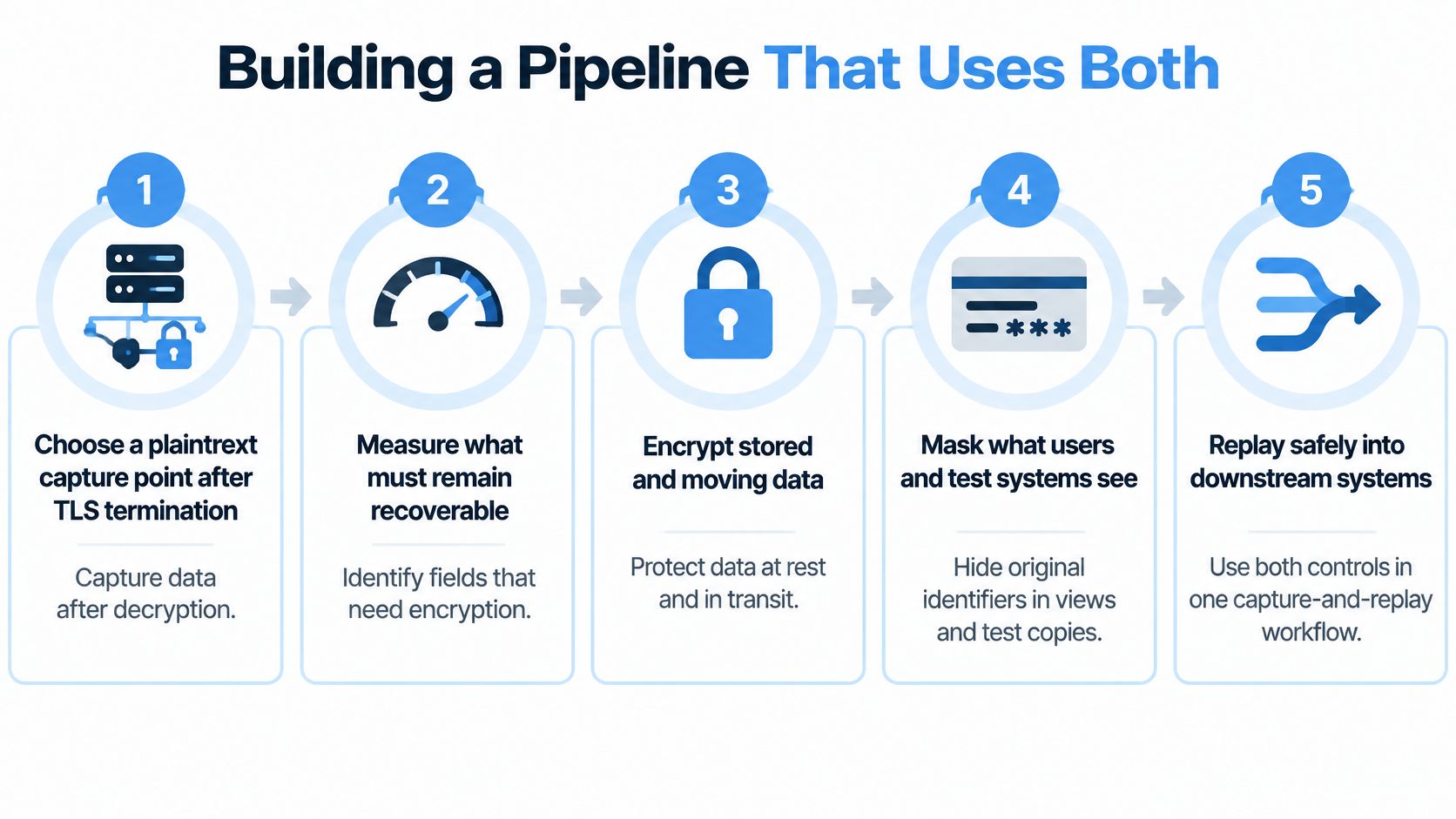
- Choose a plaintext capture point after TLS termination. Record only the requests you need, and measure capture overhead before you tune anything else. GoReplay captures traffic after TLS termination and isolates the replay target, so the capture point is a design choice, not an accident of the load balancer.
- Classify fields. Split them into direct identifiers, quasi-identifiers, credentials, and session tokens. A name is not a session id. Do not give them the same rewrite rule.
- Drop or rewrite unsuitable requests, then mask direct identifiers irreversibly before storage. Keep deterministic tokens only where cross-request correlation is required. Remove anything you cannot safely replay, and rewrite the sample for an isolated target with controlled external side effects. No live payment calls, no real email sends, no production webhooks.
- Encrypt the stored capture and its transport with authenticated encryption. Masking does not replace this. The file still moves and still sits on disk.
- Hold keys and any re-linking vault under separate access from the people who run tests. A tester who can both replay and decrypt has the original data.
- Replay into an isolated target with external side effects disabled. Compare what the target did with what you expected, on a filtered sample, not on the whole firehose.
- Verify fidelity and benchmark both ways. Compare status codes, payloads, and latency. Run the workload with masking on and with masking off. Record p50, p95, and p99 latency, throughput, and error rates. Functional “it returned 200” is not a performance result.
A concrete overhead check belongs in that last step. In a peer-reviewed Oracle 19c evaluation using the TPC-H benchmark at 1 GB and 10 GB database sizes, basic dynamic data masking increased the median SQL query duration by approximately 11%. The study called the impact weak for query completion under a 1,200-second limit. It is still operationally relevant: masking can keep realistic values and relationships while adding query-layer overhead. The same study reports that encryption generally introduces longer processing time, increased storage requirements, and slower query response, while secure-hardware processing can beat baseline cryptography at extra infrastructure cost. Measure your pipeline. Do not borrow someone else’s percentage as your budget.
The field split falls out of those measurements. Use irreversible masking for fields that only need statistical realism. Reserve encryption, or reversible format-preserving protection, for fields that must be restored or correlated across requests.
The workflow above is the shape of capture, filter, rewrite, and replay against an isolated target. If you want a short look at traffic capture in motion before you wire the controls, this walkthrough is a reasonable starting point.
Choosing Your Approach
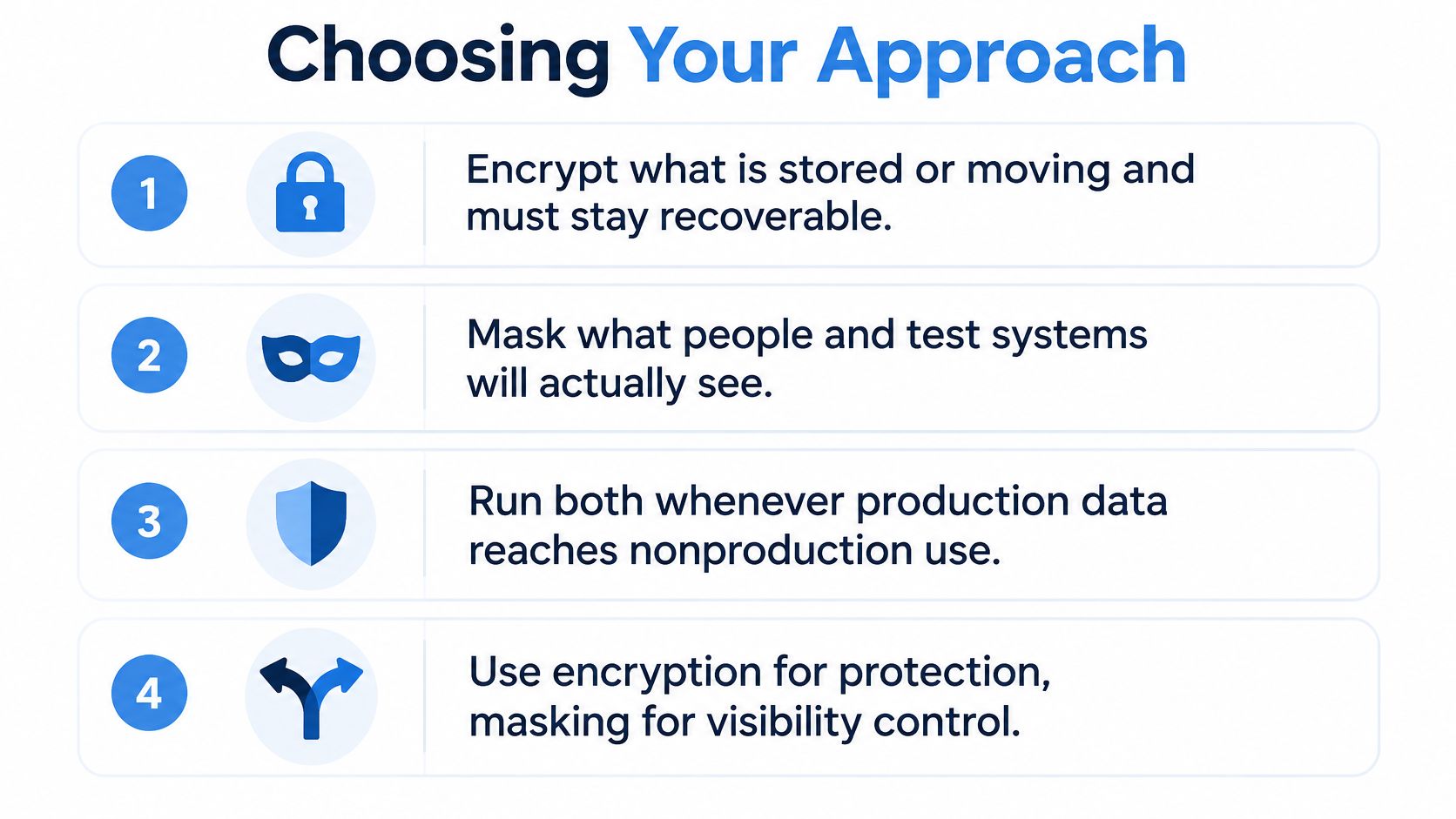
Encrypt what is stored or moving and must stay recoverable. Mask what people and test systems will see. Run both whenever production data reaches a non-production environment. I would not ship a design that picks only one.
Three checks sit outside the scenario table. Plan key management before the first encrypted store, including who can decrypt and how you rotate. Benchmark masked workloads on the full pipeline, not on a single query. Re-test re-identification risk after every schema or pipeline change, because a new log field can reopen a join you already closed.
This week, capture one real request, mask its identifiers, replay it against an isolated target, and compare the response with the behaviour you expected. Leave credentials and production request data out of any inquiry you send while you are setting that up.
The Open Source edition of GoReplay is free and includes HTTP traffic capture and replay, request filtering, rewriting and middleware, a command-line interface, and community support. The PRO edition adds S3 capture storage and replay, keep-alive TCP session recognition, dedicated support, and a commercial license on top of that. Use the free path until storage and long-lived sessions are the constraint.
The safest test data is the least data that still reproduces the failure.
GoReplay captures live HTTP traffic and replays it into an isolated test target, with filtering and rewriting so you can mask identifiers before storage and encrypt the capture around that. If you are deciding where masking stops and encryption starts on real requests, start with one captured call and see the difference on your own app. Visit GoReplay to pick the edition that matches the pipeline you are building.