
8 Key Benefits of Automation Testing in 2025
In modern software development, the pressure to deliver high-quality applications faster than ever is immense. Manual testing, while essential for certain exploratory tasks, can no longer keep pace with the demands of agile and DevOps workflows. It introduces bottlenecks, increases the risk of human error, and struggles to scale with complex applications. This is where a strategic shift to automated testing becomes not just an advantage, but a necessity for competitive survival and product excellence. For development and QA teams, understanding the core benefits of automation testing is the first step toward transforming your delivery pipeline.
This article moves beyond the surface-level discussion and provides a detailed breakdown of the tangible advantages that a well-implemented automation strategy delivers. We will explore eight critical benefits, offering practical insights and actionable examples for each one. You will learn how automation directly translates to enhanced speed, greater test coverage, and significant long-term cost savings. We will also cover its crucial role in supporting continuous integration, improving regression testing, and freeing up your skilled engineers to focus on higher-value, strategic work. By the end, you’ll have a clear roadmap for justifying and implementing automation to build better software, faster.
1. Enhanced Speed and Efficiency: Accelerate Your Release Cycles
One of the most immediate and impactful benefits of automation testing is the dramatic boost in speed. Manual testing, while essential for certain scenarios, is inherently slow and resource-intensive. Automated tests, by contrast, can execute complex test suites around the clock without human intervention, completing in minutes what would take a manual QA team hours or even days to accomplish.
This acceleration directly impacts your entire software development lifecycle (SDLC). In a Continuous Integration/Continuous Deployment (CI/CD) pipeline, automated tests are a critical gatekeeper. They can be triggered automatically with every code commit, providing developers with near-instantaneous feedback. This rapid validation allows teams to identify and fix bugs earlier in the process, preventing them from escalating into more complex and costly problems later on.
Practical Implementation and Impact
To realize these gains, integrate your test automation framework directly into your build server (e.g., Jenkins, GitLab CI, or GitHub Actions). Configure your pipeline so that every time a developer pushes new code, a suite of regression tests is automatically run.
- Scenario: A development team is working on a large e-commerce platform. A manual regression test of the entire checkout process takes a QA engineer eight hours to complete.
- Automation Solution: By automating this regression suite using a tool like Selenium or Cypress, the entire test run is reduced to just 15 minutes.
- Result: The team can now run the full regression suite multiple times per day instead of once per week. This allows them to release new features and bug fixes faster and with greater confidence, significantly shortening their release cycles from monthly to weekly or even daily.
Key Insight: The goal isn’t just to run tests faster; it’s to create a tight feedback loop that empowers developers to merge code with confidence, thereby accelerating the entire delivery pipeline. The speed gained from automation directly translates to a faster time-to-market and a more agile development process.
2. Improved Test Coverage and Accuracy: Eliminate Gaps and Human Error
Another crucial benefit of automation testing lies in its ability to vastly improve both the breadth and depth of your test coverage. Manual testing is constrained by time and human capacity, often forcing teams to test only the most critical paths. Automation shatters these limitations, enabling the execution of thousands of complex test cases across a wide array of configurations, something that would be logistically impossible to achieve manually.
Furthermore, automated tests eliminate the risk of human error. Manual testers, no matter how skilled, can make mistakes, forget steps, or become fatigued during repetitive tasks. An automated script, however, performs the exact same steps with perfect precision every single time it runs. This consistency ensures that if a bug is introduced, it will be caught reliably, leading to higher-quality software and more trustworthy test results.
Practical Implementation and Impact
To maximize coverage, use automation to tackle highly repetitive, data-driven, and complex scenarios that are prone to human error. This includes cross-browser testing, API validation, and performance checks under various load conditions. By leveraging the right test automation tools for your team, you can build a comprehensive safety net.
- Scenario: An international fintech application needs to test its payment processing logic across dozens of currencies, multiple payment gateways, and various user account types.
- Automation Solution: A data-driven automation framework is created. It reads test data from a spreadsheet or database, allowing it to systematically run hundreds of test combinations, validating each transaction for accuracy.
- Result: The team achieves near 100% coverage of all payment scenarios, a feat impractical for manual testers. They uncover subtle bugs in currency conversion and gateway integrations that would have been missed, preventing significant financial and reputational damage.
Key Insight: The true value of improved coverage isn’t just about running more tests; it’s about systematically eliminating blind spots. Automation provides a meticulous and unforgiving eye that ensures even the most obscure edge cases are validated, building deep confidence in the application’s stability and correctness.
3. Significant Long-term Cost Reduction: Maximizing Your ROI
While automation testing requires an initial investment in tools, infrastructure, and skilled personnel, it delivers substantial long-term cost savings. Manual testing is a recurring operational expense that scales linearly with application complexity and feature growth. Automation transforms this recurring cost into a one-time capital investment that yields compounding returns by dramatically reducing the hours required for repetitive test execution.
This strategic shift frees up valuable human resources from mundane, time-consuming regression checks, allowing them to focus on higher-value activities like exploratory testing, usability analysis, and complex test case design. Furthermore, by catching bugs earlier in the development cycle, automation prevents costly production failures, which can damage brand reputation and incur significant emergency-fix expenses. This proactive quality assurance is a core driver of the financial benefits of automation testing.
Practical Implementation and Impact
To maximize cost savings, begin by identifying the most frequently executed and business-critical test suites, such as regression tests for core functionalities. Calculating the potential Return on Investment (ROI) before starting helps secure stakeholder buy-in and sets clear financial goals for your automation initiative.
- Scenario: A financial services company performs a manual regression suite on its mobile banking app before every bi-weekly release. This process requires three full-time QA engineers for two days, incurring significant recurring salary costs.
- Automation Solution: The company invests in building a reusable automation framework with an open-source tool like Appium. The initial setup takes one month, but the automated suite now runs in just 30 minutes.
- Result: The company significantly reduces its manual testing overhead, reallocating those QA resources to new feature testing. Industry examples reinforce this potential; firms like HP have reported saving millions annually, while Dell reduced testing costs by 75% through similar automation strategies.
The following chart illustrates the typical financial outcomes of a well-executed test automation strategy, showing a strong ROI and significant cost reduction in repetitive testing.
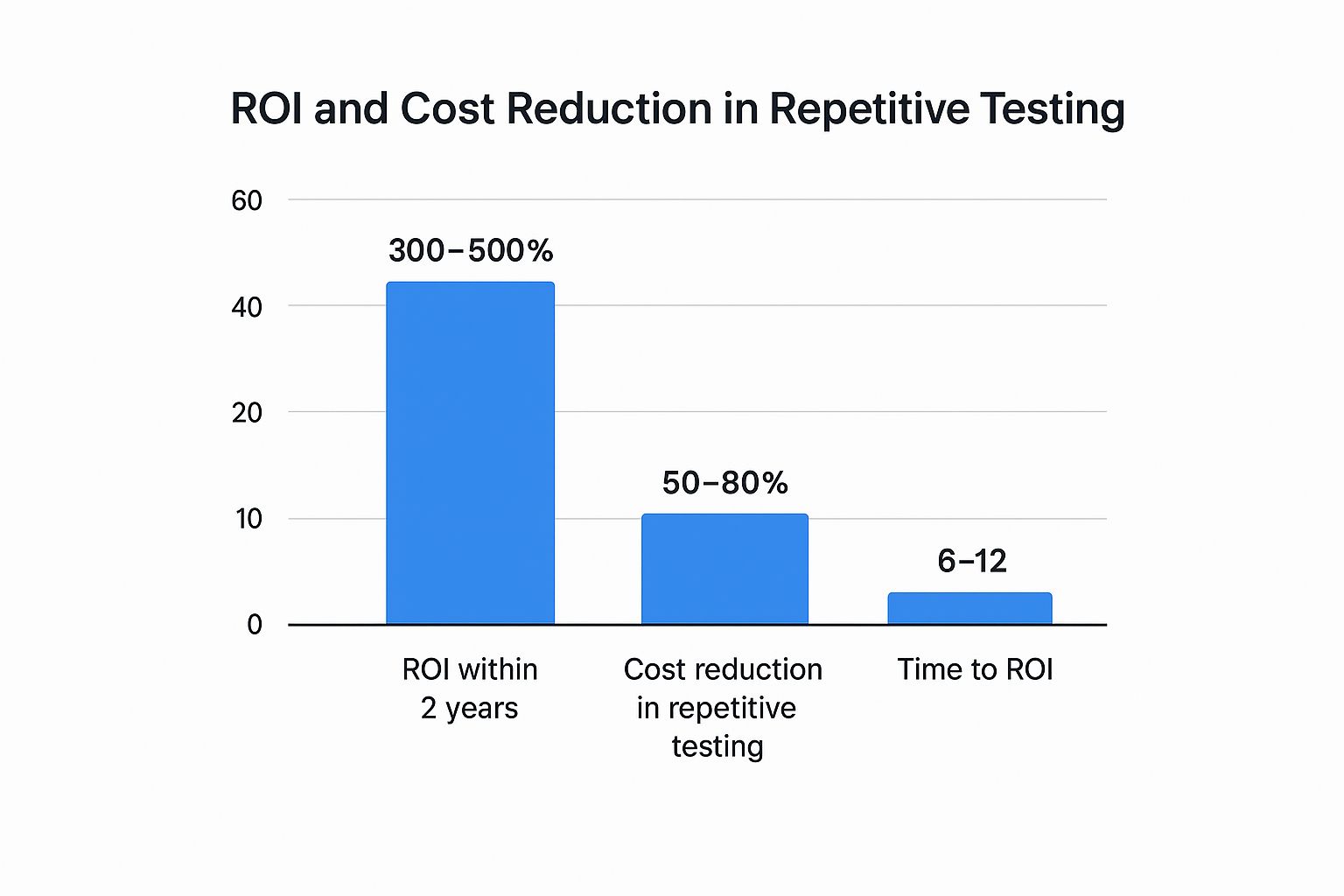
As the data shows, organizations can expect to see a return on their investment within 6-12 months, with the potential for massive cost reductions in ongoing testing efforts.
Key Insight: The primary financial benefit of automation testing isn’t just about reducing QA headcount; it’s about optimizing resource allocation. By automating the repetitive, low-value tasks, you unlock your team’s potential to prevent defects rather than just find them, leading to a higher quality product and a healthier bottom line.
4. Continuous Integration and DevOps Support
Automation testing is the linchpin of modern DevOps and a foundational element of any successful Continuous Integration and Continuous Delivery (CI/CD) pipeline. In these fast-paced environments, the goal is to integrate, test, and deploy code changes rapidly and reliably. Manual testing simply cannot keep up with this velocity, creating a bottleneck that undermines the entire DevOps philosophy. Automated tests provide the critical, high-speed feedback loop necessary to maintain development momentum while ensuring quality is built into every stage of the lifecycle.

By embedding automated tests directly into the CI/CD pipeline, every code commit can trigger a validation process, from unit and integration tests to crucial API checks. This immediate verification enables development teams to catch regressions and integration issues instantly, long before they reach production. Companies like Netflix and Facebook leverage this capability to deploy changes multiple times a day, using comprehensive automated test suites to validate each microservice and feature update with confidence.
Practical Implementation and Impact
To effectively support DevOps, your automation strategy must be tightly woven into your build and deployment tools. This involves creating different test suites that run at specific stages of the pipeline, providing progressively deeper levels of validation as code moves closer to production.
- Scenario: A company is transitioning to a microservices architecture and wants to adopt a CI/CD culture to accelerate feature delivery. Manually testing the interactions between services after each small update is proving impossible.
- Automation Solution: The team implements automated API tests that run every time a developer submits a pull request for a microservice. A broader suite of end-to-end tests is then triggered automatically in a staging environment after the code is merged.
- Result: Developers receive feedback on their changes in minutes, not days. This rapid validation ensures that new code doesn’t break existing functionality, allowing the team to deploy services independently and frequently. This approach drastically reduces integration risks and empowers a true continuous delivery workflow. For a deeper look into this area, you can learn more about automating API tests for CI/CD pipelines.
Key Insight: Automation testing is not just a QA activity; it’s a core DevOps practice. It transforms testing from a final, pre-release gate into an ongoing, integrated process that provides the safety net needed for high-velocity development and deployment.
5. Enhanced Regression Testing Capabilities: Safeguard Application Stability
One of the most critical benefits of automation testing is its ability to supercharge regression testing. As an application evolves, every new feature, bug fix, or dependency update carries the risk of inadvertently breaking existing, stable functionality. Manual regression testing is often prohibitively slow and incomplete, but automated tests provide a reliable safety net, ensuring new code changes don’t introduce regressions.
Automated regression suites can validate the entire application’s core functionality after every single change. This comprehensive, repeatable validation is essential for maintaining system stability and user trust. By automating this process, teams can confidently add new features or refactor code, knowing that a robust suite of tests is constantly verifying that the foundational parts of the application remain intact.
Practical Implementation and Impact
To implement effective automated regression testing, start by identifying and automating test cases for high-risk, high-value areas of your application. Use impact analysis to determine which tests are most relevant to run for a given code change, optimizing your CI/CD pipeline for both speed and coverage. This focused approach ensures maximum value from your testing efforts.
- Scenario: A large B2B SaaS company releases updates every two weeks. Manually testing all core features for regressions takes the QA team three full days, creating a significant bottleneck.
- Automation Solution: The team identifies the top 50 critical user workflows and automates them using a framework like Playwright. These tests are integrated into their CI pipeline and run automatically with every pull request.
- Result: The regression testing time is reduced from three days to 30 minutes. Developers get immediate feedback on whether their changes have broken critical functionality, preventing regressions from ever reaching the main branch. This allows the team to ship updates with higher confidence and without sacrificing release velocity.
Key Insight: Automated regression testing transforms your test suite into living documentation that actively protects your application’s integrity. It’s not just about re-running old tests; it’s about building a resilient system that can evolve safely and predictably over time, which is a cornerstone of agile development and a key benefit of automation testing.
6. Improved Test Repeatability and Consistency
Human testers, no matter how skilled, introduce variability. Factors like fatigue, distraction, or differing interpretations of test steps can lead to inconsistent execution. One of the core benefits of automation testing is the elimination of this human element, ensuring that every test is performed in exactly the same way, every single time. This perfect repeatability is crucial for building trust in your test results.
This consistency allows teams to reliably reproduce defects, which is often a major challenge in manual testing. When an automated test fails, you know the exact steps, data, and conditions that caused the issue, making it significantly easier for developers to diagnose and fix the root cause. This precision removes ambiguity and stops the “it works on my machine” debate, fostering a more efficient and collaborative debugging process.
Practical Implementation and Impact
To achieve this level of consistency, your automation strategy must focus on standardizing both the tests and the environments they run in. Use containerization or virtualization tools like Docker or Vagrant to create pristine, identical test environments for every run. This prevents “environment drift,” where subtle configuration changes can cause tests to fail for reasons unrelated to the code.
- Scenario: A financial services company needs to validate its loan application portal’s security protocols. Manual testing leads to occasional missed steps and inconsistent results, creating a potential compliance risk.
- Automation Solution: The security test suite is automated using a framework that meticulously follows each step, from inputting specific data patterns to verifying encryption standards. Test data is managed centrally and reset before each run.
- Result: The company now has a verifiable, auditable record that security checks are performed identically on every build. This not only improves product quality but also provides concrete evidence for regulatory compliance audits, ensuring consistent security posture and reducing risk.
Key Insight: Test repeatability isn’t just about running the same script; it’s about creating an identical execution context every time. By controlling the application state, data, and environment, automation provides a stable baseline for measuring quality, making any deviation a clear signal of a genuine regression.
7. 24/7 Testing and Multi-Environment Validation: Ensuring Global Consistency
A significant benefit of automation testing is its ability to run unattended, enabling round-the-clock test execution. This continuous capability is crucial for global applications that must function flawlessly across countless environments, browsers, and devices. Automated tests can be scheduled to run overnight or during off-peak hours, maximizing resource usage and ensuring constant quality monitoring without requiring a team to be physically present.
This capability goes beyond just 24/7 execution; it unlocks parallel testing across a vast matrix of configurations. Manually verifying an application on multiple operating systems, browser versions, and screen resolutions is impractical and prohibitively expensive. Automation makes it possible to validate functionality simultaneously across this entire spectrum, ensuring a consistent user experience for everyone, everywhere. This comprehensive coverage is essential for building robust, world-class software.
Practical Implementation and Impact
To achieve this, leverage cloud-based testing grids and containerization technologies. Platforms like BrowserStack or Sauce Labs provide instant access to thousands of real device and browser combinations, while Docker can be used to create consistent, isolated test environments. Integrating these tools into your CI/CD pipeline allows for automated, parallel execution across your target configurations with every build.
- Scenario: A company like Adobe needs to ensure its Creative Suite applications work perfectly on both the latest and older versions of Windows and macOS, as well as on various hardware specifications.
- Automation Solution: The team creates automated test suites that are executed in parallel on a cloud grid. Every night, these tests validate critical workflows like file rendering and tool functionality across dozens of specified OS and hardware profiles.
- Result: The team can confidently release updates, knowing they have validated performance and compatibility across their diverse user base. This prevents brand-damaging bugs, such as a new feature working on macOS but crashing on a specific version of Windows, from ever reaching the customer.
Key Insight: The value here is not just running tests continuously, but validating application behavior in the wild, fragmented world of user devices. This approach shifts testing from a limited, in-house activity to a comprehensive, global quality assurance strategy that reflects real-world usage.
8. Better Resource Utilization and Team Productivity: Elevate Your QA Team’s Impact
One of the most profound organizational benefits of automation testing is its ability to optimize your most valuable asset: your people. By automating mundane, repetitive, and time-consuming test cases, you liberate your skilled QA professionals. They are no longer bogged down by tedious regression checks and can redirect their expertise toward high-value activities that require human intellect, intuition, and creativity.
This strategic reallocation of resources transforms the role of a QA engineer from a simple bug-finder into a true quality advocate. Freed from monotonous tasks, they can focus on complex exploratory testing, usability assessments, developing comprehensive test strategies, and collaborating more closely with developers. This shift not only enhances product quality but also boosts team morale and professional growth, making the QA role more engaging and strategic.
Practical Implementation and Impact
To achieve this, clearly define which test types are best suited for automation (e.g., regression, performance, data validation) and which require manual oversight (e.g., exploratory, usability, ad-hoc testing). Invest in training your team to build and maintain the automation framework, empowering them to own the quality process.
- Scenario: A company’s QA team spends 70% of its time manually running regression tests for each bi-weekly sprint, leaving little time for anything else. Team morale is low due to the repetitive nature of the work.
- Automation Solution: The company invests in training and tools to automate its core regression suite. This transition gradually shifts the team’s workload, following a model similar to Atlassian, which reduced its manual testing effort significantly.
- Result: The team’s time allocation is inverted. They now spend the majority of their time on high-impact exploratory testing to uncover complex user-facing issues, improving test strategies, and collaborating with developers on quality initiatives early in the cycle. This leads to higher job satisfaction and more meaningful contributions to the product.
Key Insight: Automation doesn’t replace QA professionals; it elevates them. The true power of this benefit is in transforming your QA team from a safety net into a strategic partner that proactively drives product quality and innovation.
Automation Testing Benefits Comparison Matrix
| Aspect | Enhanced Speed and Efficiency | Improved Test Coverage and Accuracy | Long-term Cost Reduction | Continuous Integration and DevOps Support | Enhanced Regression Testing Capabilities | Improved Test Repeatability and Consistency |
|---|---|---|---|---|---|---|
| Implementation Complexity 🔄 | Moderate setup; requires maintenance | Moderate; needs well-defined scenarios | High upfront tools and training costs | High; requires robust infrastructure | Moderate; needs upkeep as app evolves | Moderate; careful test design needed |
| Resource Requirements ⚡ | Requires automation tools and parallel execution | Requires test data management and cross-platform tools | Skilled automation engineers and tool investment | Robust test environment and CI/CD pipeline tools | Automation scripts, integration with version control | Standardized environments and logging tools |
| Expected Outcomes 📊 | 60-90% reduction in test time; faster releases | Consistent, precise test execution; detects complex bugs | 50-80% cost reduction over time; ROI in 6-12 months | Enables continuous delivery; reduces integration errors | Immediate regression bug detection; 80-95% manual effort reduction | Reliable, reproducible results; <5% test variance |
| Ideal Use Cases 💡 | Rapid regression and frequent test execution | Complex workflows, edge cases, multi-browser testing | Projects with long-term testing and maintenance costs | Agile teams practicing CI/CD | Frequent code changes needing validation | Teams requiring consistent, bias-free testing |
| Key Advantages ⭐ | 24/7 execution, instant feedback, parallel testing | Eliminates human error; tests complex scenarios | Substantial long-term savings; faster product releases | Seamless CI/CD integration; fast feedback | Confidence in code stability; reduced manual regression | Consistent defect reproduction; quality standards across teams |
| Aspect | 24/7 Testing and Multi-Environment Validation | Better Resource Utilization and Team Productivity |
|---|---|---|
| Implementation Complexity 🔄 | High complexity managing multiple environments | Moderate; requires training and role definition |
| Resource Requirements ⚡ | Robust infrastructure; cloud platforms and virtual environments | Investment in team training and automation skills |
| Expected Outcomes 📊 | Continuous, global validation across devices and platforms | 40-60% productivity increase; 50-80% less manual work |
| Ideal Use Cases 💡 | Global apps needing multi-browser/device coverage | QA teams wanting to shift focus to exploratory and strategic testing |
| Key Advantages ⭐ | Maximizes infrastructure use; supports global testing | Frees QA from repetitive tasks; boosts team morale |
Harnessing the Full Potential of Automation Testing
The journey from manual to automated testing represents a fundamental paradigm shift in software development, not merely a change in tooling. As we’ve explored, the benefits of automation testing extend far beyond simple efficiency gains. They form a strategic foundation for building higher quality, more reliable, and more ambitious software products. By embracing automation, teams unlock a virtuous cycle where speed, accuracy, and confidence fuel innovation rather than being constrained by the fear of regressions.
Recapping the core advantages reveals a deeply interconnected ecosystem of improvements. The initial boost in speed and efficiency directly enables 24/7 testing cycles and robust support for Continuous Integration and DevOps pipelines. This, in turn, facilitates vastly improved test coverage and accuracy, catching bugs that manual processes would inevitably miss. The ability to execute tests with perfect repeatability and consistency strengthens the entire regression testing strategy, ensuring that new features don’t inadvertently break existing functionality. While there is an upfront investment, the long-term cost reduction becomes undeniable as you eliminate redundant manual effort and accelerate release cycles. Ultimately, this frees up your most valuable assets, your people, leading to better resource utilization as QA engineers transition from repetitive task execution to high-value strategic quality assurance.
From Theory to Practice: Your Next Steps
Understanding these benefits is the first step; implementing them is where the true transformation happens. The path forward involves a strategic, phased approach rather than a sudden, all-encompassing switch.
- Identify High-Impact Candidates: Begin by auditing your current testing processes. Prioritize automating tests that are repetitive, critical for business continuity, and prone to human error. Your regression suite is often the perfect starting point.
- Select the Right Tools: The toolset you choose must align with your technology stack, team skill set, and long-term goals. Consider frameworks that support your programming languages and platforms that simplify test creation and maintenance.
- Foster a Culture of Quality: Automation is not just a QA responsibility. Encourage developers to write testable code and contribute to the automation suite. This collaborative approach, a cornerstone of DevOps, ensures that quality is built into the product from the very beginning, not just inspected at the end.
The cumulative effect of these actions is profound. Mastering automation testing isn’t just about finding bugs faster; it’s about creating a development environment where teams can build, innovate, and deploy with confidence. It transforms quality assurance from a final gatekeeper into an integrated, continuous process that empowers the entire organization. The real power of automation lies in its ability to give you the confidence to move faster, the data to make smarter decisions, and the freedom to focus on what truly matters: delivering exceptional value to your users.
Ready to experience one of the most powerful benefits of automation testing firsthand? Explore how GoReplay can capture and replay real user traffic to validate your application’s stability and performance, providing unparalleled regression testing capabilities without writing a single script. See the future of automated testing in action at GoReplay.