
7 Key Automated Testing Benefits to Know in 2025

In a competitive software market, speed and reliability are non-negotiable. Manual testing, while valuable, often becomes a bottleneck, slowing down release cycles and struggling to match the complexity of modern applications. This is where automation becomes a strategic imperative, not just a technical upgrade. The primary automated testing benefits extend far beyond simply running tests faster; they fundamentally reshape how teams approach quality assurance and product delivery.
This article provides a detailed breakdown of the most impactful advantages of test automation. We will explore how it accelerates feedback loops, enhances test coverage, and significantly improves accuracy. You’ll gain practical insights into how these benefits translate into tangible ROI, bolster DevOps pipelines, and lead to more consistent, reliable results. We’ll also examine how specific tools, such as GoReplay, use innovative techniques like traffic shadowing to amplify these advantages.
By the end of this guide, you will understand how to leverage automation to not only catch bugs earlier but also to optimize resources and scale your testing efforts effectively. Let’s dive into the seven core benefits that can transform your software development lifecycle.
1. Faster Execution and Time Savings
One of the most significant automated testing benefits is the dramatic reduction in the time required to validate software functionality. Manual testing is inherently slow, often taking days or even weeks for a comprehensive regression suite. Automated tests, by contrast, can execute thousands of test cases in just minutes or hours, running concurrently across multiple environments without needing human intervention. This acceleration enables rapid feedback loops, a cornerstone of modern CI/CD pipelines.
This speed isn’t just about convenience; it fundamentally changes the development lifecycle. Teams can get immediate feedback on code changes, identify bugs earlier, and iterate faster. By removing the bottleneck of slow, manual verification, development velocity increases, allowing for more frequent and confident deployments.

Real-World Impact on Release Cycles
The impact of this velocity is evident in how top tech companies operate.
- Netflix runs thousands of automated tests continuously, which has been pivotal in shrinking its release cycle from weeks to mere days.
- Amazon practices continuous deployment, pushing code to production multiple times a day, a feat only possible through extensive and rapid automated testing.
- Spotify executes its automated test suites across more than 15 platforms simultaneously, ensuring a consistent user experience on every device without slowing down development.
Key Insight: The primary goal of faster test execution isn’t just to save time; it’s to create a high-velocity feedback loop that empowers developers to build, test, and deploy with confidence and speed.
How to Implement for Maximum Time Savings
To achieve these time savings, a strategic approach is crucial.
- Prioritize Critical Paths: Start by automating tests for your application’s most critical user journeys and high-risk functionalities. These are areas where bugs have the most significant impact.
- Use Data-Driven Testing: Instead of writing separate tests for different data inputs, create a single test script that can read data from an external source (like a CSV file). This maximizes test coverage without duplicating code.
- Leverage Parallel Execution: Utilize cloud-based testing platforms to run tests in parallel across various browsers, devices, and operating systems. This is one of the most effective ways to slash execution time.
2. Improved Test Coverage and Accuracy
Another of the core automated testing benefits is the ability to achieve far greater test coverage and precision than is possible with manual methods. Manual testing is limited by human capacity, making it impractical to test every user path, data combination, or edge case. Automated tests can tirelessly execute thousands of complex scenarios, ensuring that even the most obscure corners of an application are validated consistently. This eliminates the risk of human error, such as missed steps or incorrect assessments, leading to more reliable and accurate results.
This comprehensive approach ensures that new features do not inadvertently break existing ones and that the application behaves as expected under a wide variety of conditions. By systematically covering more ground, teams can identify defects that manual testing might miss, ultimately leading to higher-quality software and a more stable user experience.

Real-World Impact on Software Quality
Leading technology companies rely on extensive automation to maintain their quality standards at scale.
- Google Chrome employs a massive automated testing framework to verify functionality and compatibility across more than a thousand different device configurations and operating systems before each release.
- PayPal runs extensive automated security tests that cover millions of potential transaction scenarios, safeguarding its platform against vulnerabilities that would be impossible to simulate manually.
- Microsoft Office 365 integrates automated accessibility testing into its CI/CD pipeline, ensuring all features comply with global standards and are usable by everyone.
Key Insight: Improved test coverage isn’t about running more tests for the sake of it; it’s about systematically eliminating blind spots and ensuring every part of the application is verifiably stable, secure, and reliable.
How to Implement for Maximum Coverage and Accuracy
Achieving comprehensive coverage requires a methodical and strategic approach to test design.
- Combine Test Design Techniques: Use techniques like boundary value analysis and equivalence partitioning to test edge cases and common user inputs efficiently without creating redundant tests.
- Implement Code Coverage Tools: Integrate tools like JaCoCo or Istanbul into your pipeline. These tools analyze which lines of your code are executed during tests, visually highlighting untested areas.
- Create Comprehensive Test Data Sets: Develop a diverse range of test data that reflects real-world user inputs, including valid, invalid, and edge-case scenarios, to ensure your application handles all possibilities gracefully.
3. Cost Reduction and ROI
While automated testing requires an upfront investment, one of its most compelling long-term automated testing benefits is a significant reduction in operational costs. Manual testing is labor-intensive and expensive, consuming countless hours that could be better spent on strategic tasks. By automating repetitive and high-volume tests, organizations free up valuable engineering resources, directly translating to lower testing-related expenses over time.
This cost-saving effect compounds because automation finds defects earlier in the development cycle. Bugs caught in the early stages are exponentially cheaper to fix than those discovered in production, which can cause costly downtime, customer support overloads, and damage to brand reputation. Automation transforms testing from a cost center into a powerful tool for financial efficiency and risk mitigation.
The bar chart below visualizes the substantial financial impact that a well-implemented automation strategy can have across key business metrics.
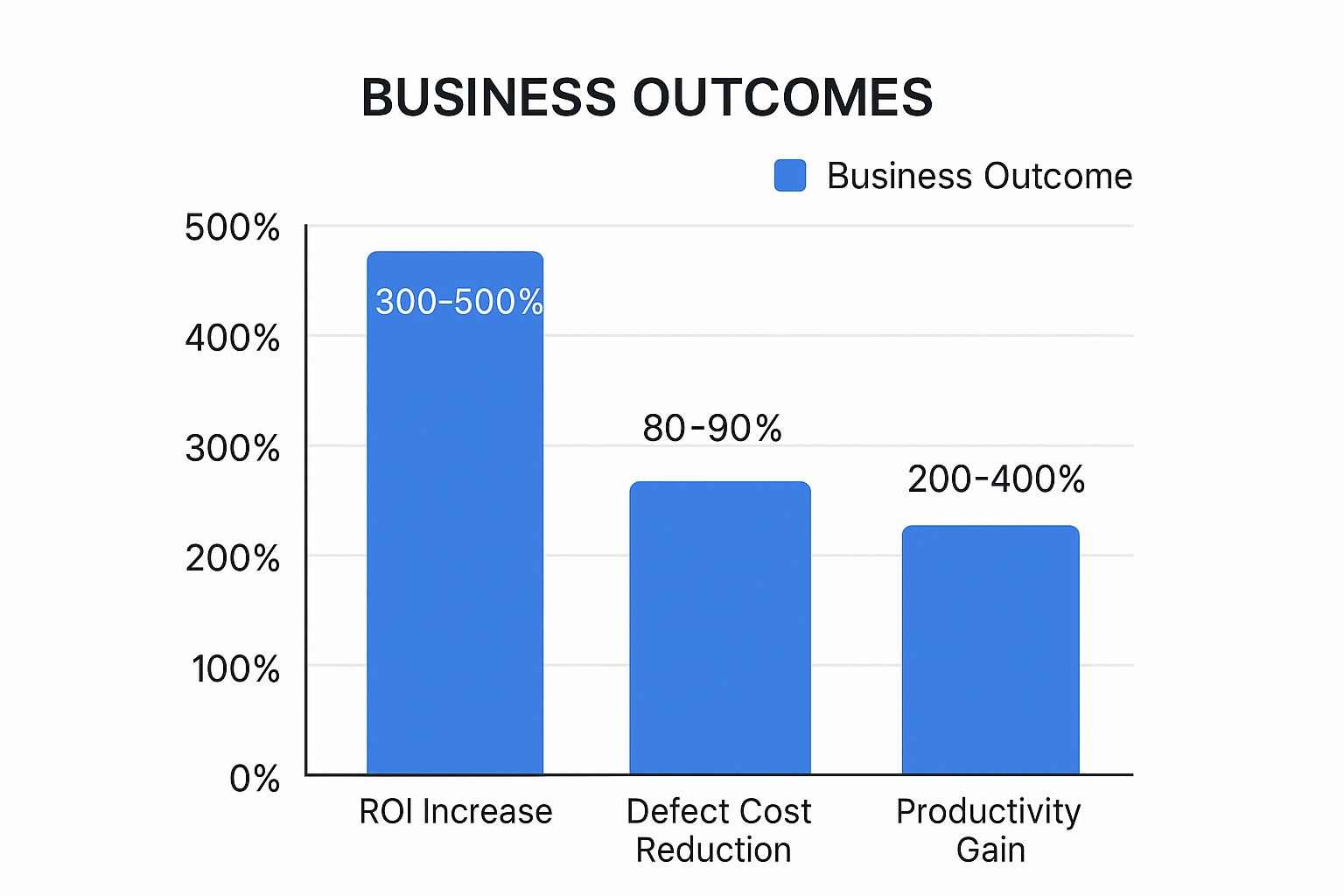
As the data shows, the gains are not marginal; organizations can see a massive return on investment, dramatic reductions in defect-related costs, and substantial productivity improvements.
Real-World Impact on Business Finances
Leading companies provide clear evidence of automation’s financial advantages.
- IBM reported a staggering 90% cost reduction in regression testing efforts after successfully implementing a comprehensive automation framework.
- Salesforce calculated annual savings of $2.3 million by automating key testing processes, freeing up their quality assurance teams to focus on more complex, exploratory testing.
- Adobe leveraged automation to cut its overall testing costs by 70%, all while simultaneously improving crucial software quality metrics and delivering a better product.
Key Insight: The ROI of automated testing isn’t just about saving on manual testing hours. It’s about preventing the high cost of production failures, accelerating time-to-market, and reallocating human capital to innovation.
How to Implement for Maximum ROI
To achieve a strong return on investment, a deliberate approach is essential.
- Calculate ROI Systematically: Begin by tracking the hours spent on manual testing. Compare this against the initial investment in automation tools and setup time to clearly demonstrate the savings achieved.
- Start with High-Impact Cases: Prioritize automating tests that are stable, run frequently (like regression suites), and cover critical business workflows. These provide the quickest and most significant ROI.
- Utilize Open-Source Tools: To minimize initial capital expenditure, consider starting with powerful open-source tools. This lowers the barrier to entry and allows you to prove value before investing in commercial licenses.
4. Enhanced Continuous Integration and DevOps
Automated testing is the engine of modern DevOps, acting as the critical quality gatekeeper within Continuous Integration and Continuous Deployment (CI/CD) pipelines. Without it, the “continuous” aspect of DevOps would be impossible. By automating the validation process, teams can integrate new code into a shared repository multiple times a day, confident that each change is automatically verified against a comprehensive test suite. This provides the rapid, reliable feedback necessary to maintain development velocity and software quality simultaneously.
This synergy allows development teams to push smaller, incremental changes frequently, rather than bundling them into large, risky releases. Automated tests run with every commit, immediately flagging regressions or new defects. This tightens the feedback loop, empowering developers to fix issues while the context is still fresh and supporting the agile goal of faster, more predictable delivery cycles. This is a foundational element of the automated testing benefits that high-performing teams leverage.

Real-World Impact on Release Cycles
The adoption of automated testing in CI/CD pipelines has revolutionized how elite software companies deliver products.
- Facebook famously deploys code to its massive user base twice a day, a cadence made safe and achievable only through rigorous, automated testing at every stage.
- Etsy executes over 50 deployments per day, using a sophisticated CI/CD pipeline where comprehensive automated test coverage ensures that each change is production-ready.
- Netflix’s engineering culture is built around continuous deployment, where automated testing enables a code commit to reach production in a matter of hours, not weeks.
Key Insight: In a DevOps context, automated testing transforms from a quality assurance activity into a core development enabler, making rapid, continuous, and safe deployments the standard.
How to Implement for Maximum DevOps Enhancement
Integrating automated testing effectively into your CI/CD pipeline requires a strategic framework.
- Establish Clear Quality Gates: Define strict pass/fail criteria within your pipeline. A build should automatically fail and alert the team if critical tests do not pass, preventing flawed code from moving forward.
- Implement the Test Pyramid: Structure your tests with a large base of fast unit tests, a smaller layer of integration tests, and a minimal number of end-to-end (E2E) tests. To learn more, explore these continuous integration best practices.
- Use Feature Flags: Decouple deployment from release by using feature flags. This allows you to deploy new code to production environments behind a flag, test it safely, and then enable it for users without a separate deployment.
5. Consistent and Reliable Results
One of the most critical automated testing benefits is the delivery of consistent and reliable outcomes. Unlike manual testing, which is susceptible to human error, fatigue, and individual variation, automated tests perform the exact same steps in the exact same sequence every single time they are run. This unwavering consistency eliminates variability and produces dependable, reproducible results.
This reliability is the foundation of trust in the QA process. When an automated test fails, teams know it’s due to a genuine code change or environmental issue, not a tester’s mistake. This precision allows for confident go/no-go decisions for deployments and provides detailed, unambiguous logs that are essential for rapid debugging and analysis.
Real-World Impact on High-Stakes Industries
In sectors where failure is not an option, this level of consistency is non-negotiable.
- NASA leverages extensive automated testing for its space mission software, where there is zero tolerance for error. Every calculation and command must be executed with perfect, repeatable precision.
- Banking Institutions rely on automated compliance testing to meet strict regulatory requirements. These tests must consistently verify that financial transactions and reporting adhere to legal standards without fail.
- Pharmaceutical Companies use automated validation for systems that must comply with FDA regulations. The reliability of these tests is crucial for ensuring product safety and data integrity.
Key Insight: Consistency in testing isn’t just about avoiding mistakes; it’s about building a trustworthy, data-driven foundation for quality that empowers teams to make critical decisions with confidence.
How to Implement for Maximum Reliability
To achieve truly reliable results, a meticulous approach is necessary.
- Use Assertions and Checkpoints: Implement comprehensive validation points within your scripts. Instead of just checking if a page loads, use assertions to verify specific text, element states, and API responses to ensure the application is behaving exactly as expected.
- Implement Proper Error Handling: Design tests to handle unexpected pop-ups, slow load times, or API failures gracefully. A resilient test suite can recover from minor issues and continue execution, preventing false negatives.
- Maintain Test Data Consistency: Ensure that the data used for testing is stable and consistent across all environments. Inconsistent data is a common source of flaky tests and unreliable results.
6. Early Bug Detection and Prevention
One of the most transformative automated testing benefits is its ability to facilitate a “shift-left” approach, catching defects early in the development lifecycle. Manual testing often identifies bugs late in the process, making them exponentially more complex and expensive to fix. By integrating automated tests into the CI/CD pipeline, teams can run validations immediately after every code commit, identifying issues before they become deeply embedded in the codebase.
This early detection prevents the ripple effect where a small, initial bug leads to multiple subsequent failures. Finding and fixing a defect at the unit or integration stage is significantly cheaper and faster than addressing it in a staging environment or, worse, after it has impacted users in production. This proactive strategy ensures a higher quality codebase from the very beginning.
Real-World Impact on Software Quality
The principle of early bug detection has a profound impact on product stability and organizational costs.
- Microsoft has reported a significant reduction in post-release defects, some estimates as high as 90%, by implementing robust, early-stage automated testing in their development cycles.
- Toyota uses extensive automated testing for its manufacturing software, where early bug detection is critical to preventing costly halts in its production lines.
- Airbnb’s continuous testing framework catches potential API integration issues moments after code is committed, preventing broken user experiences from ever reaching deployment candidates.
Key Insight: The true value of early bug detection lies in cost avoidance. It’s not just about finding bugs faster; it’s about finding them when they are cheapest and easiest to resolve, preserving developer time and protecting revenue.
How to Implement for Maximum Prevention
To effectively shift bug detection left, teams should adopt specific practices and tools.
- Implement Test-Driven Development (TDD): Popularized by Kent Beck, this practice involves writing an automated test before writing the production code to fulfill it. This ensures every piece of logic is testable and validated from its inception.
- Create Comprehensive Unit Tests: Focus on creating a strong foundation of unit tests that cover critical business logic. These tests are fast, isolated, and provide the quickest feedback on code correctness.
- Set Up Automated Smoke Tests: Configure your CI pipeline to run a quick suite of smoke tests on every build. This provides an immediate “health check” to confirm that the most critical functionalities are not broken before proceeding to more extensive testing.
7. Scalability and Resource Optimization
One of the most powerful automated testing benefits is the ability to scale testing efforts effortlessly as an application grows in complexity. As new features are added, platforms are supported, and user loads increase, manual testing quickly becomes a bottleneck, requiring a proportional increase in human resources. Automated testing, however, can handle this expansion efficiently, running tests across countless configurations and scenarios without needing more people.
This scalability directly translates to significant resource optimization. By offloading repetitive, high-volume regression tests to automated scripts, QA professionals are freed from mundane tasks. Their expertise can be redirected toward more strategic activities like exploratory testing, user experience validation, and complex test case design, which add far more value to the product.
Real-World Impact on Complex Systems
The impact of this scalability is most visible in companies managing enormous complexity and fragmentation.
- Uber uses automated testing to validate its app’s functionality across more than 600 distinct city-specific configurations, each with unique rules and pricing.
- WhatsApp must ensure flawless messaging performance across billions of device combinations, a scale that is impossible to cover manually.
- Samsung performs rigorous automated testing across thousands of its Android device variants to guarantee consistent software behavior on every model.
Key Insight: True scalability in testing isn’t just about running more tests; it’s about optimizing human capital by letting machines handle volume, allowing your team to focus on quality and innovation.
How to Implement for Maximum Scalability
Achieving effective scalability requires a thoughtful approach to test architecture.
- Use Containerization: Implement tools like Docker to create consistent, isolated test environments. This ensures that tests run reliably everywhere, from a developer’s local machine to the CI/CD pipeline.
- Leverage Cloud-Based Testing: Utilize cloud platforms for elastic scalability. These services allow you to spin up thousands of test environments on demand, run tests in parallel, and then shut them down, paying only for what you use. This is crucial for effective application capacity planning; you can learn more about managing application performance under load here.
- Design Modular Test Frameworks: Build your test suites with reusable and modular components. This approach makes it easier to maintain and extend your test coverage as the application evolves, preventing the framework itself from becoming a bottleneck.
Automated Testing Benefits Comparison
| Aspect | Faster Execution and Time Savings 🔄⚡📊💡 | Improved Test Coverage and Accuracy ⭐📊💡 | Cost Reduction and ROI 📊⭐💡 | Enhanced Continuous Integration and DevOps 🔄⚡💡 | Consistent and Reliable Results ⭐📊💡 | Early Bug Detection and Prevention ⭐📊💡 | Scalability and Resource Optimization ⚡🔄💡 |
|---|---|---|---|---|---|---|---|
| Implementation Complexity 🔄 | High initial setup and maintenance | Requires well-defined requirements and test scenarios | High upfront investment and ongoing maintenance | Complex pipeline setup and robust infrastructure needed | Moderate; designing reliable tests requires discipline | Needs disciplined development and comprehensive planning | Infrastructure investment and specialized skills required |
| Resource Requirements ⚡ | Requires automation tools and parallel execution setup | Needs data-driven frameworks and cross-platform tools | Tools, training, and skilled personnel | CI/CD tools and integration with version control systems | Standardized environments and logging tools | Integration with static analysis and unit test frameworks | Cloud infrastructure and containerization for scalability |
| Expected Outcomes 📊 | Dramatically reduced test execution time | Higher accuracy and coverage, fewer defects | Significant long-term cost savings and ROI | Fast feedback, reduced integration conflicts, frequent deploys | Reliable, consistent, reproducible test results | Early defect detection and reduced debugging time | Efficient resource use and handling of growing complexity |
| Ideal Use Cases 💡 | Rapid feedback loops, frequent releases | Complex scenarios, risk-averse environments | Organizations seeking cost efficiency and defect reduction | Agile/DevOps workflows with continuous integration | Compliance-driven projects and quality gate enforcement | Shift-left testing in development, TDD practices | Large-scale, multi-platform testing environments |
| Key Advantages ⭐🔄⚡📊💡 | Parallel tests, 24/7 execution, faster time-to-market | Eliminates human error, thorough regression testing | ROI in 6-12 months, defect cost reduction, productivity gain | Enables continuous deployment, immediate dev feedback | Eliminates human variability, detailed reports | Reduces defect fixing cost, improves software quality | Handles complexity without proportional resource growth |
Harnessing Automation for a Competitive Edge
The journey from manual, time-intensive testing to a streamlined, automated quality assurance process represents a fundamental shift in modern software development. As we’ve explored, the benefits of automated testing extend far beyond simply running scripts without human intervention. This evolution is about building a more resilient, efficient, and innovative engineering culture. By embracing automation, teams can break free from the constraints of repetitive manual checks and refocus their expertise on complex problem-solving and creative feature development.
The core advantages we’ve detailed form a powerful, interconnected ecosystem of value. Faster execution cycles directly fuel robust CI/CD pipelines, enabling the rapid, reliable delivery that modern markets demand. Improved test coverage and accuracy provide a critical safety net, allowing developers to innovate boldly with the confidence that regressions will be caught early. This proactive approach to quality not only reduces the direct costs associated with fixing bugs late in the development cycle but also protects brand reputation and enhances user satisfaction.
From Theory to Strategic Implementation
Understanding the “why” behind automation is the first step, but a successful transition hinges on the “how.” The most impactful automation strategies are those that are deeply integrated into the development lifecycle, not treated as an afterthought.
Here are the key takeaways to transform your testing approach:
- Integrate Early and Often: Shift quality assurance left. The earlier you introduce automated tests in the development process, the cheaper and easier it is to address issues. This is the cornerstone of effective DevOps and a primary driver of the automated testing benefits we’ve discussed.
- Prioritize for Impact: You don’t need to automate everything. Begin by targeting high-risk, business-critical functionalities and repetitive, time-consuming manual tests. This strategic prioritization ensures you achieve the highest return on investment quickly.
- Embrace Realistic Testing Scenarios: The ultimate goal is to validate how your application performs under real-world conditions. Synthetic test data and scripted scenarios have their place, but nothing provides more confidence than testing against actual user behavior.
Unlocking High-Fidelity Testing
This is where innovative tools like GoReplay change the game. Instead of simulating user traffic, GoReplay allows you to capture and replay real production traffic in your testing environments. This approach provides an unparalleled level of realism for load testing, regression analysis, and performance validation. By using a shadow of your production environment, you ensure that every deployment is stress-tested against the complex, unpredictable patterns of genuine user interactions.
Adopting automated testing is no longer a luxury; it is a strategic imperative. It’s the engine that powers continuous delivery, fortifies application quality, and ultimately provides a significant competitive edge. By building a robust automation framework, you are investing in a future of faster innovation, superior product quality, and greater business agility. The path forward is clear: automate thoughtfully, test realistically, and deploy confidently.
Ready to experience the most powerful automated testing benefits by validating your code against real production traffic? Discover how GoReplay can help you eliminate risks and deploy with absolute confidence. Visit GoReplay to learn more and start your free trial.