
Why Application Load Testing Is Your Digital Insurance Policy
Imagine this: your e-commerce site launches a much-anticipated flash sale. Traffic surges, orders pour in… and then, the site crashes. This nightmare scenario is a reality for many businesses that underestimate application load testing. This type of testing simulates real-world user traffic, identifying performance bottlenecks and ensuring your application can handle the load. Think of it as your digital insurance policy against expensive outages and damage to your reputation.
One key reason to prioritize load testing is the increasing complexity of modern applications. Microservice architectures, while offering flexibility and scalability, introduce multiple points of potential failure. Furthermore, today’s users expect smooth, fast experiences, and even small delays can cause frustration and abandonment. This means performance is a business imperative, not simply a desirable feature.
For example, picture a banking app freezing while a user tries to transfer funds. This not only frustrates the customer, but also damages trust in the bank’s reliability. Lost customers and a damaged brand reputation can quickly follow. Robust application load testing is essential for maintaining customer trust and loyalty.
The importance of application load testing is reflected in its growing market presence. As digital experiences become central to business strategy, application load testing has become a multi-billion-dollar industry. The global load testing tools market was estimated at $2.5 billion in 2025 and is projected to reach approximately $7.8 billion by 2033. This substantial growth is driven by the increasing demand for resilient digital infrastructure capable of handling growing traffic and the increasing complexity of modern applications. Learn more about load testing market trends here: Load Testing Tools Market Report
The Real Cost of Neglecting Load Testing
The consequences of overlooking application load testing can be severe, going far beyond temporary inconvenience. Downtime leads directly to lost revenue, especially for businesses reliant on online transactions. System failures also erode user trust and harm your brand’s reputation, impacting customer acquisition and retention. You might be interested in: What is load testing software?
Proactive Prevention: How Load Testing Safeguards Your Business
Application load testing allows you to proactively identify weaknesses in your system before they affect your users. By simulating realistic traffic scenarios, you can find bottlenecks, optimize resource allocation, and guarantee a smooth user experience, even during peak loads. This proactive strategy not only minimizes disruption, but also helps optimize your infrastructure for cost-effectiveness. Investing in load testing is investing in the long-term success and stability of your business.

Choosing the Right Load Testing Approach For Your Reality
Application load testing isn’t a one-size-fits-all solution. Different testing methods exist, each designed to uncover specific performance bottlenecks. Understanding these nuances helps you choose the right approach. This approach should align with your application’s unique characteristics and expected user behavior. It also means picking the right tools to gain the most effective insights.
Understanding the Core Load Testing Types
Several core load testing types give you different perspectives on how your application performs under pressure. Stress testing, for example, pushes your system to its limit. This reveals its maximum capacity and identifies potential points of failure, helping you understand application behavior under extreme conditions. Endurance testing, on the other hand, assesses performance over a long time. It uncovers hidden problems like memory leaks that might not appear in shorter tests. Spike testing simulates sudden traffic bursts, which is crucial for applications with seasonal demand changes or promotional campaigns.
Matching Testing Types to Your Needs
The best testing method depends on your goals. If you want to ensure your application stays stable during peak traffic, stress testing is key. If your application needs long-term stability and reliability, endurance testing is essential. If you expect sudden traffic increases, spike testing is critical. Many businesses use a combination of these methods.
Let’s look at how a comprehensive load testing strategy can benefit your application. The following infographic shows potential improvements: faster response times, greater maximum concurrent user capacity, and a lower error rate.
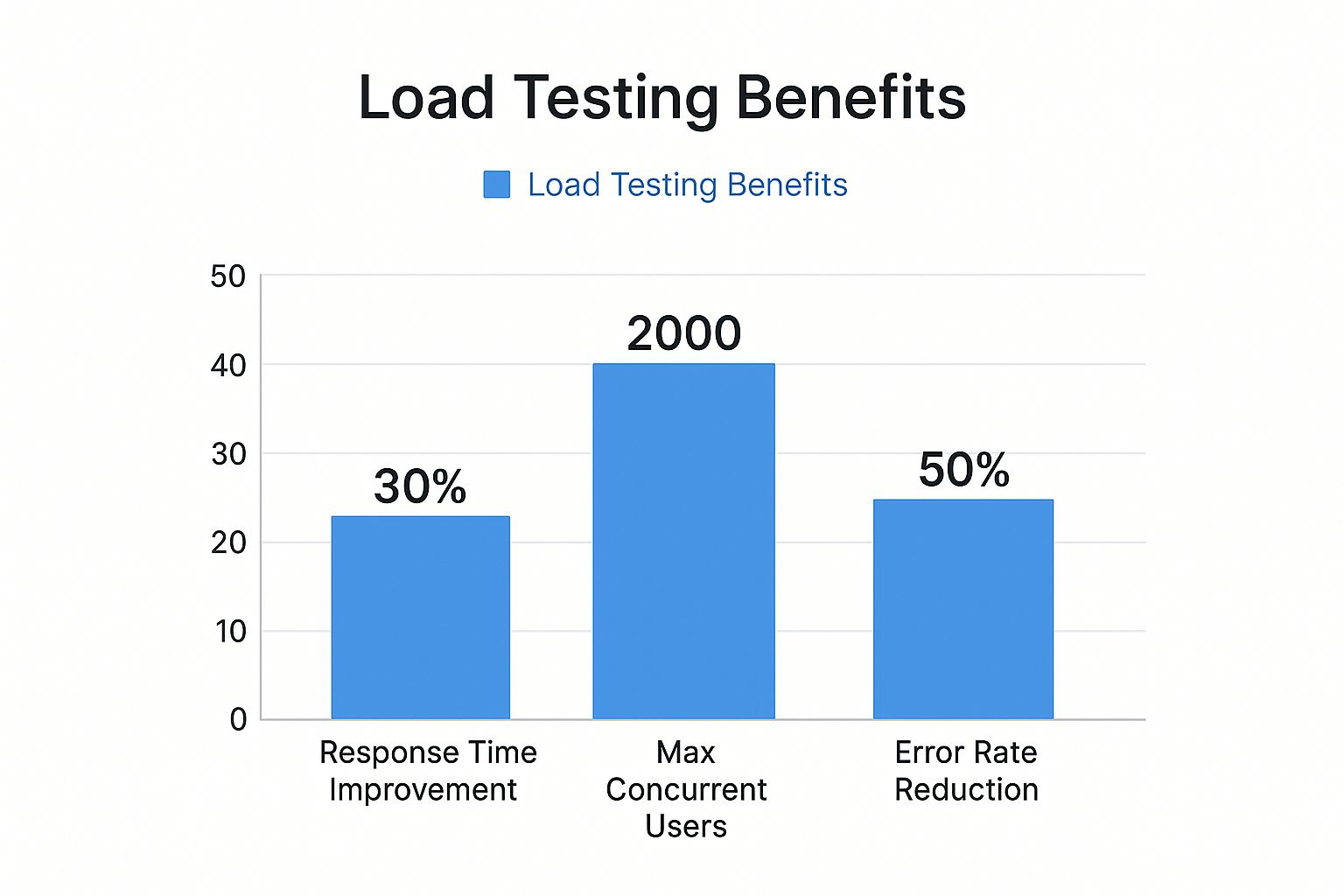
As the infographic illustrates, load testing can lead to a 30% faster response time, support up to 2000 concurrent users, and reduce the error rate by 50%. These improvements create a better user experience, increase potential revenue, and make your application stronger and more reliable.
Practical Examples of Load Testing in Action
Imagine an e-commerce platform preparing for a Black Friday sale. Spike testing would be essential to simulate the expected traffic surge and ensure the site can handle the load. Alternatively, a financial institution might prioritize endurance testing. This ensures their systems remain stable during extended trading hours. Using multiple testing methods provides the most thorough coverage.
To help illustrate the different approaches, the following table provides a comparison:
Comparison of Application Load Testing Types This table compares different load testing methodologies by their purpose, execution approach, and suitable use cases.
| Testing Type | Primary Purpose | Duration | Load Pattern | Key Metrics | Best Used For |
|---|---|---|---|---|---|
| Stress Testing | Identify system breaking point | Short, high-intensity | Gradually increasing load beyond expected limits | Peak load, breaking point, error rate under extreme load | Determining maximum capacity, identifying bottlenecks, and understanding failure modes. |
| Endurance Testing | Evaluate long-term stability | Long, sustained load | Constant load over extended periods | Response time stability, resource utilization trends, memory leaks | Ensuring application stability over time and identifying performance degradation. |
| Spike Testing | Simulate sudden traffic bursts | Short, varying intensity | Sudden, sharp increases and decreases in load | Response time under peak loads, recovery time, error rate during spikes | Evaluating application resilience to traffic fluctuations and unexpected demand. |
The table clearly shows how each type of load testing serves a distinct purpose. Understanding these differences is vital for choosing the right approach for your needs.
Combining Load Testing Approaches
A well-rounded load testing strategy often involves a mix of different test types. You might perform endurance tests to establish a baseline performance level. Then, you could run stress tests to find the application’s breaking point. This combined approach creates a more complete understanding of your application’s performance.
By understanding the different load testing methods and their strengths, you can create a testing strategy tailored to your application’s specific needs. This strategy will ensure optimal performance under any circumstance and helps you find and fix problems before they affect your users.
The Evolution of Load Testing Tools: What Actually Works Now
Application load testing has evolved significantly. Early methods often relied on cumbersome, custom-built scripts. These were difficult to maintain, scale, and often only understood by a few individuals, creating bottlenecks. This approach no longer meets the needs of today’s complex applications and high user expectations.
From On-Premise to Cloud: A Shift in Approach
Load testing tools have progressed from clunky on-premise solutions to cloud-based platforms. These platforms are generally more user-friendly and accessible to a broader range of team members, democratizing the load testing process and enabling more people to contribute to performance optimization.
Over 50% of companies in major markets now utilize cloud-based testing environments, simulating real-world traffic from various global locations. This aligns with the overall growth of the software testing market, projected to surpass $60 billion by 2025. Find more information here: Test Automation Statistics
Open-Source vs. Commercial: Finding the Right Balance
Today’s environment provides a variety of load testing tools. Many organizations effectively combine both open-source and commercial solutions. Open-source tools like GoReplay offer flexibility and cost-effectiveness for capturing and replaying live traffic, simplifying real-world simulations. Commercial platforms often provide advanced features, including AI-driven analysis and detailed reporting.
This combined approach allows teams to customize testing based on their specific needs and budget. Open-source tools offer customization and community support. Commercial platforms provide robust features, dedicated support, and the scalability needed for larger teams and complex applications.
The Rise of AI in Load Testing: Smarter Analysis
Integrating AI represents a major advancement in application load testing. AI-powered analysis is changing how teams interpret results. Machine learning algorithms can automatically identify performance anomalies that human analysts might miss. They can also predict potential bottlenecks before they impact users, enabling proactive optimization.
This means AI is a practical tool that helps teams identify performance problems faster and more accurately. By automating analysis and prediction, AI allows testers to concentrate on strategic planning and more complex problem-solving. This enhanced approach ensures high performance under pressure and allows us to anticipate and prevent future issues.

These advancements in load testing tools offer more efficient and effective methods for ensuring optimal application performance. The focus has shifted from merely identifying breaking points to proactively preventing them and ensuring a seamless user experience. By adopting these improvements, businesses can create resilient, high-performing applications that meet today’s demands.
Building a Load Testing Strategy That Actually Delivers
Application load testing involves more than simply choosing a tool and executing a test. It demands a well-defined strategy that aligns with both your business goals and the practical constraints of your technical infrastructure. A truly successful strategy doesn’t just go through the motions; it accurately predicts real-world performance.
Identifying Critical User Journeys
The first crucial step is identifying the most critical user journeys within your application. These are the core workflows that directly impact your business objectives and, importantly, user satisfaction.
For an e-commerce website, the checkout process is paramount. For a social media platform, it might be posting updates and viewing news feeds. Pinpointing these key journeys focuses your testing efforts where they truly matter.
Importantly, these critical journeys aren’t always the ones management thinks are most important. Data analysis and user feedback are essential for objective identification.
Establishing Meaningful Performance Baselines
Once you’ve identified your critical user journeys, you need to establish realistic performance baselines. These baselines should reflect actual user expectations and established industry best practices.
A two-second page load time might be acceptable for a blog, but it’s certainly not sufficient for a high-frequency trading platform. Researching and analyzing competitor performance helps you understand user expectations and set targets that are both achievable and ambitious. These baselines then provide the foundation for evaluating the effectiveness of your load testing.
Designing Realistic Test Scenarios
Effective application load testing demands realistic test scenarios that accurately mirror genuine traffic patterns. Tools like GoReplay allow you to capture and replay live traffic, providing a precise representation of user behavior.
This includes not just the number of users, but also their geographical distribution, the types of devices they use, and the specific actions they perform within your application. The more accurately your tests simulate real-world conditions, the more reliable your results. This, in turn, allows you to accurately predict how your application will perform under pressure.
Learning From Successes and Failures
Analyzing case studies of successful load testing strategies—and the mistakes that led to costly failures—offers invaluable insights. Learning from the experiences of others helps you avoid common pitfalls and adapt proven best practices to your specific context.
This includes understanding how different industries prioritize performance. Financial institutions, for example, prioritize transaction consistency, while e-commerce platforms focus on seasonal scalability. This means tailoring your approach is essential for success.
Determining Appropriate Test Coverage
The scope of your application load testing should be determined by your application’s business impact and overall risk profile. A mission-critical application requires significantly more extensive testing than a less critical internal tool.
This practical framework ensures your testing efforts are proportionate to the potential consequences of performance issues. Factors to consider include revenue impact, user base size, and any regulatory requirements.
Key Metrics to Track: What Matters Most
Focusing on the right metrics is fundamental to effective application load testing. These metrics provide the quantifiable data that reveals how your application performs under varying loads.
To understand this better, let’s look at the following table:
Application Load Testing Metrics That Matter This table outlines the essential metrics to track during load testing, what they measure, and why they’re important for application performance.
| Metric | What It Measures | Target Range | Impact on User Experience | How to Improve |
|---|---|---|---|---|
| Response Time | The time it takes for the application to respond to a request. | < 2 seconds (ideal) | Directly impacts user satisfaction. Slow response times lead to frustration and abandonment. | Optimize code, improve database performance, and scale infrastructure. |
| Error Rate | The percentage of requests that result in errors. | < 1% (ideal) | Errors disrupt user workflows and damage trust. | Implement robust error handling, thoroughly test code, and monitor application logs. |
| Throughput | The number of requests processed per unit of time. | Depends on application requirements. | Affects the application’s capacity to handle user load. | Optimize code, improve database performance, and scale infrastructure. |
| Concurrency | The number of users accessing the application simultaneously. | Depends on application requirements. | Determines how many users the application can support without performance degradation. | Optimize code, improve database performance, and scale infrastructure. |
By understanding these metrics and their respective impact, you can create a targeted load testing strategy that identifies and addresses performance bottlenecks, ensuring your application not only meets but exceeds user expectations.
Making Application Load Testing Thrive in DevOps Culture
Integrating application load testing into fast-paced DevOps environments presents unique challenges. Teams often struggle to balance thorough testing with rapid delivery cycles. This section explores practical solutions to common obstacles, from limited resources to CI/CD pipeline integration.
Overcoming Common DevOps Load Testing Hurdles
A frequent challenge is creating realistic test environments. Replicating production data and infrastructure for testing can be complex and expensive. Another hurdle is determining performance testing ownership. In a DevOps culture, performance responsibility should be shared, not siloed. This shared responsibility ensures everyone invests in delivering high-performing applications. Finally, automating load tests without impacting delivery speed requires careful planning and appropriate tools.
Automating Load Tests Within CI/CD Pipelines
Automating application load testing is crucial for DevOps. This automation evaluates performance with every code change, catching regressions early. However, simply adding load tests isn’t enough. Tests must be efficient and provide quick feedback. Tools like GoReplay can simplify creating realistic test scenarios by capturing and replaying live traffic within your CI/CD workflow. This streamlines the process, making real-world simulations readily available. Check out this guide on boosting application performance with load testing.
The increased integration of DevOps and Agile has accelerated automated load testing adoption, with over 70% of software teams in North America and Europe embedding these tests in their CI/CD pipelines. More detailed statistics can be found here: Load Testing Tools Market Report
Establishing Effective Performance Gates
Performance gates define acceptable performance thresholds within the CI/CD pipeline. If an application fails to meet these standards, the pipeline stops, preventing performance regressions in production. These gates must be carefully calibrated. Gates that are too strict create bottlenecks, while overly lenient gates miss critical performance issues.
For example, a performance gate might require average response times below 500 milliseconds for a key transaction under a specific load. If the response time exceeds this limit during a load test, the pipeline stops, alerting the team to investigate.
Building Realistic Test Data
Realistic test data is essential for accurate application load testing. Using production data, while ideal, often raises privacy concerns. Therefore, techniques like data masking and synthetic data generation are essential. These techniques ensure accurate tests reflecting real-world usage without compromising sensitive information. This builds confidence in predicting production performance. Also, consider using different data sets for different test types. Stress tests, for example, might use data pushing the application’s boundaries, revealing potential breaking points.
Fostering a Culture of Shared Performance Ownership
In DevOps, performance is everyone’s responsibility. Developers, testers, operations teams, and even business stakeholders should participate in defining and achieving performance goals. This shared ownership fosters accountability, leading to better-performing applications. Regular communication and collaboration are key.
Practical Tips for Success
Here are some practical tips for thriving with application load testing in DevOps:
- Start small and iterate: Don’t try to automate everything immediately. Begin with a few key tests and gradually expand coverage.
- Use the right tools: Select tools integrating well with your CI/CD pipeline and providing needed features. For more information, see Boosting application performance with load testing.
- Monitor and analyze results: Track key performance metrics over time and analyze trends to identify improvement areas.
- Communicate effectively: Keep all stakeholders informed about performance test results and identified issues.
By implementing these strategies and fostering shared responsibility, organizations can successfully integrate application load testing into their DevOps practices, ensuring high performance and a positive user experience.
How AI Is Transforming Application Load Testing Practices

Artificial intelligence (AI) is rapidly changing how we approach application load testing. Beyond the buzz, AI provides practical solutions to make performance testing more effective and accessible. This empowers teams of all sizes to achieve optimal performance under pressure.
Generating Realistic Test Scenarios
One of AI’s most significant contributions is its ability to generate realistic test scenarios. Traditional load testing often relies on simplified user simulations. These simulations may not accurately reflect real-world usage. AI-powered tools, however, can analyze actual user behavior data. This allows them to create dynamic and complex test scenarios.
For example, machine learning algorithms can identify common user journeys and predict traffic patterns. They can even simulate realistic user interactions. This allows for accurate simulations of peak loads, identifying potential bottlenecks before they impact users.
Automating Anomaly Detection
AI also excels at automating anomaly detection during load testing. In complex applications, subtle performance deviations can easily be missed by human analysts. AI algorithms, however, can be trained to identify these anomalies automatically.
This faster identification of performance issues reduces the risk of releasing software with hidden defects. AI can also provide root-cause analysis. This assists in quicker problem resolution, allowing teams to focus on fixing problems instead of searching for them.
In 2025, over 60% of enterprise test cases are predicted to be covered by AI-driven testing solutions. This shift not only reduces manual testing efforts but also improves testing accuracy and speed. Businesses that invest in automated performance testing can experience up to a 50% reduction in manual testing time. Learn more: Test Automation Statistics
Predictive Insights for Proactive Optimization
The most exciting potential of AI in application load testing is its capacity for predictive insights. By analyzing historical performance data and current trends, AI algorithms can predict potential bottlenecks before they occur.
This allows teams to proactively optimize their applications, preventing performance issues and ensuring a smooth user experience. It represents a shift from reactive problem-solving to proactive performance management. This foresight helps maintain optimal performance, even as applications evolve.
Evaluating AI Testing Tools and Team Skills
Choosing the right AI-powered load testing tool is critical. Consider factors like ease of integration with your current CI/CD pipeline, customizable dashboards, and the tool’s ability to handle your application architecture.
Furthermore, upskilling your team is essential. Understanding how to interpret AI-generated insights, refine test scenarios, and use AI-driven analysis will maximize the benefits of these technologies. While the adoption of AI in application load testing is still developing, the potential benefits are significant. By embracing these advancements, businesses can enhance their testing practices, optimize application performance, and deliver superior user experiences.
What Leading Companies Know About Application Load Testing
The difference between high-performing companies and those constantly dealing with issues often comes down to their approach to application load testing. Industry leaders understand that effective load testing isn’t just a routine task; it’s a crucial strategic advantage. They know that anticipating and addressing performance bottlenecks before they affect users is essential for staying competitive. This proactive strategy ensures a smooth user experience, protects brand reputation, and ultimately boosts revenue.
Sector-Specific Strategies: Tailoring Tests to Business Needs
Different industries prioritize performance testing based on their unique needs. For example, financial services companies, focused on transaction security and regulatory compliance, emphasize rigorous stress testing. This ensures their systems can handle extreme loads and maintain data integrity. E-commerce businesses, however, concentrate on spike testing to prepare for high-traffic periods like Black Friday or Cyber Monday. These targeted strategies reflect a clear understanding of their specific business contexts.
Leading organizations also recognize the importance of customizing load testing based on user expectations. A global gaming platform, for instance, must consider varying network conditions and device capabilities when designing its load tests. This helps deliver a consistent experience for users worldwide, no matter their location or device.
Furthermore, the application’s technical architecture significantly influences the load testing strategy. Companies with complex microservice architectures prioritize testing individual services and their interactions to pinpoint bottlenecks and ensure overall system resilience. This targeted approach addresses specific performance risks and provides detailed insight into how various system components contribute to overall performance. By 2025, over 5,492 companies globally are expected to use performance and load testing software, with 2,852 using multiple solutions. This demonstrates a growing awareness of the importance of thorough testing in today’s intricate digital environments. Find more information about performance testing software adoption here: Performance and Load Testing Software Adoption Statistics
Benchmarking and Continuous Improvement: The Path to Excellence
Top companies understand the importance of benchmarking their load testing practices against industry standards. This helps identify areas for improvement and ensures they’re always striving for peak performance. They monitor key performance indicators (KPIs) such as average response time, error rate, and throughput, using these metrics to objectively measure progress and identify optimization opportunities.
Simply measuring performance isn’t enough, though. Successful companies cultivate a culture of continuous improvement. They consistently analyze load test results, determine the root causes of performance bottlenecks, and implement solutions to enhance performance. This iterative process ensures they stay ahead of the curve and provide the best possible user experience. This dedication to improvement is what sets them apart.
By understanding how top-performing companies prioritize application load testing, businesses of any size can gain valuable insights. Implementing these practices and adopting a strategic approach to load testing will result in more robust applications, improved user experiences, and a stronger bottom line.
Ready to enhance your application performance? GoReplay offers powerful open-source and enterprise solutions for capturing and replaying live traffic, enabling you to create realistic load tests and identify bottlenecks before they impact your users. Learn more about GoReplay and start optimizing your application performance today!