
API Regression Testing: A Practical Guide for 2026
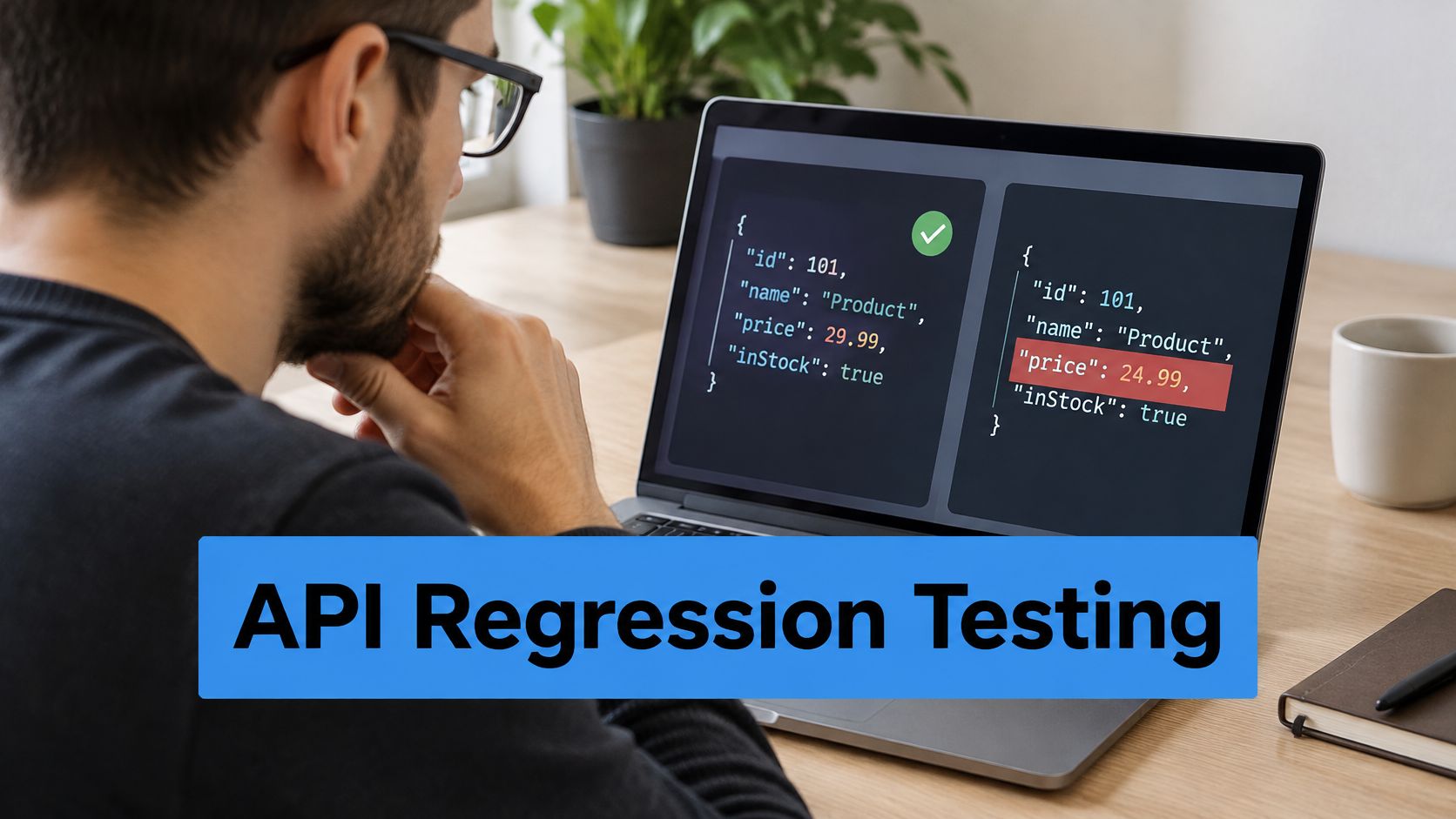
You pushed a small API cleanup yesterday afternoon. Every unit test passed, your Postman collection ran green, and the pull request sailed through code review in ten minutes. This morning, support tickets started rolling in from a partner integration that hasn’t changed its code in a year. Or maybe you’re living the mirror image of that problem: your CI pipeline just failed on an endpoint you didn’t touch, and three teammates told you to click “rerun” until it goes green.
Most engineering teams already automate parts of their verification. In 2025, 45% of 1,400 QA professionals in the Katalon test automation statistics survey reported automating regression testing, making it the most automated test type in the study. Yet gaps remain wide, with 12% of more than 800 software-testing respondents across Germany, Austria, and Switzerland telling the 2024 Richard Seidl software testing survey that they didn’t automate regression checks at all.
Even teams with big automated suites run into a quiet failure mode. Everyone talks about slow builds, yet slowness is rarely what kills a suite. API regression testing is really a trust system. Suites lose credibility when flaky failures waste developer afternoons, and when careless test inputs leak sensitive customer records or trigger unsafe side effects in staging.
What API Regression Testing Protects Against
Say a backend team ships a minor release that renames a JSON field from user_id to account_id to keep naming tidy across services. Every unit test passes because the test fixtures updated along with the handler, and the web frontend ships the new field name in the same deploy. Two days later, an older version of the mobile app starts crashing on the profile screen for every user who hasn’t updated from the app store.
That failure is a textbook regression. API regression testing means rerunning existing interface checks after any change to endpoints, schemas, authentication, or dependencies to confirm that behavior that worked yesterday still works today. Consider changing one lock in an apartment building: a small tweak to the cylinder can stop the master key from turning doors on another floor, so you test the other locks before handing out keys.
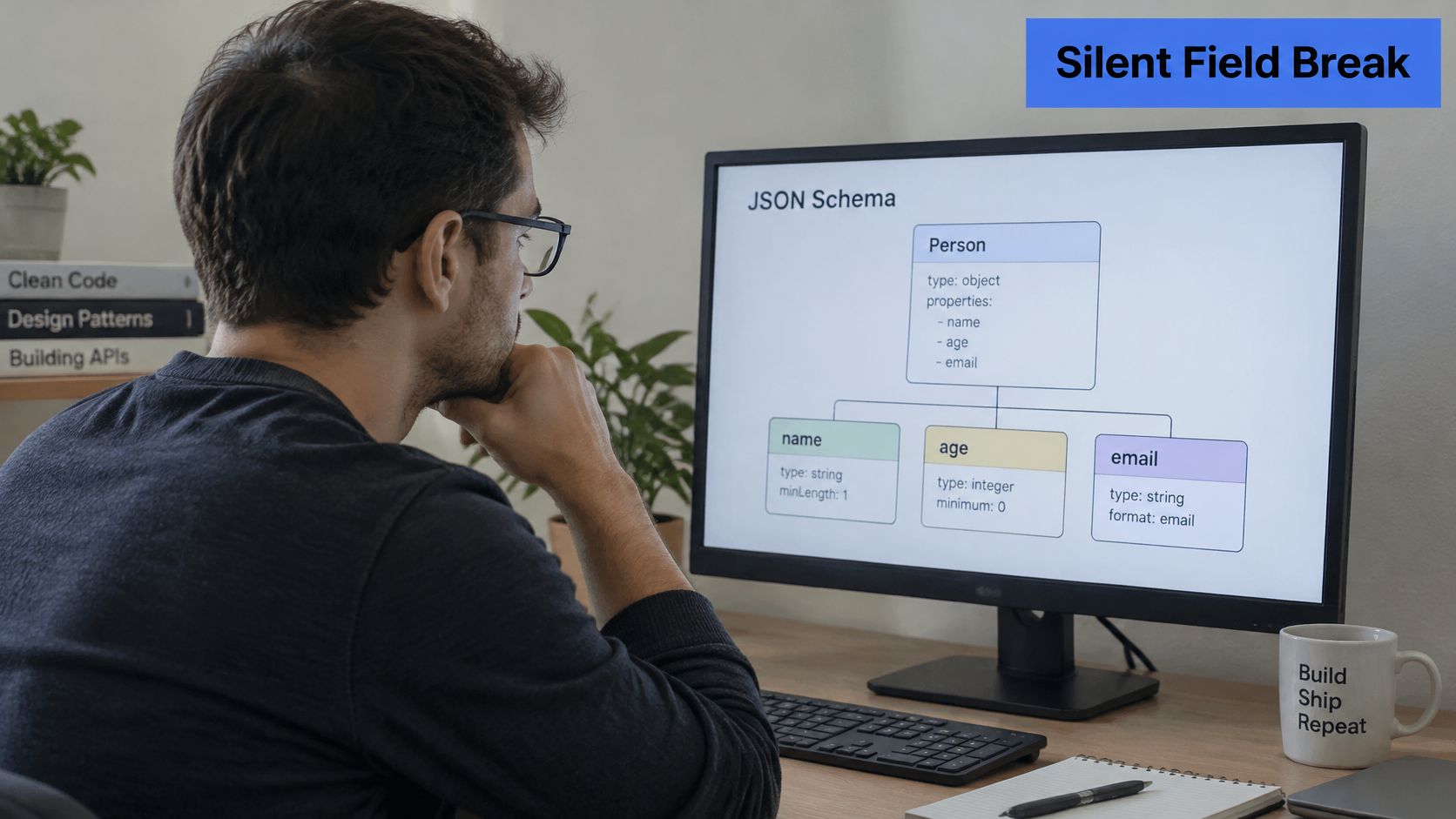
Changes That Quietly Break Working APIs
Regressions rarely come from reckless rewrites. They sneak in through routine maintenance that looks harmless in a pull request diff:
- Removed or renamed fields: Dropping a deprecated key or altering its casing breaks clients that deserialize responses strictly.
- Stricter input validation: Tightening a regex or rejecting trailing whitespace breaks legacy integrations that always sent slightly messy payloads.
- Altered HTTP status codes: Switching a missing-resource response from not-found to bad-request, or changing a standard success response to an empty-body status, trips client retry logic and error handlers.
- Token lifetime or scope shifts: Shortening JWT expiration or tightening role permissions locks out background workers that refresh tokens on an older schedule.
- Dependency upgrades: Bumping a serialization library or database driver can change null handling, decimal rounding, or date formatting without touching a line of your own business logic.
Catching these breaks at the interface layer is an economic defense, not just a quality habit. A landmark National Institute of Standards and Technology (NIST) economic impact study estimated that inadequate software-testing infrastructure cost the U.S. economy between $22.2 billion and $59.5 billion annually, with more than half of software bugs surfacing only in downstream stages where fixes cost the most. That same study found that identifying and fixing defects accounted for roughly 80% of software-development costs, compared with about 20% of labor costs for formal testing by independent groups.
Those NIST figures predate modern microservices and REST or GraphQL APIs, so the lesson isn’t the exact dollar total for your stack. The lesson is the cost curve: automated interface checks catch broken contracts in minutes before users ever see them, avoiding emergency hotfixes and manual data repairs. Because distributed architectures amplify the blast radius of a bad deploy, teams hiring for reliability often emphasize contract and regression skills across roles like quality assurance jobs on Blockchain Jobs.
Pull up the postmortem from your team’s last production outage. Did it stem from brand-new functionality failing for the first time, or from a routine change that broke an existing behavior everyone assumed was safe?
Regression Testing Approaches Compared
Pair fast schema validation on every commit with traffic replay before any major release. That default combination covers the widest surface area without grinding your pipeline to a halt.
Teams usually mix five distinct approaches across their pipelines: schema and contract validation, scripted regression suites, differential replay across versions, production-log replay, and end-to-end workflow tests. No single layer catches everything because each one inspects a different slice of system behavior.
| Approach | What It Catches | What It Misses | Best Fit |
|---|---|---|---|
| Schema and contract validation | Removed fields and type changes against the OpenAPI document | Behavior changes inside running code | Every commit as a fast gate |
| Scripted regression suite | Known business rules and expected status codes | Unusual inputs nobody scripted | Core workflows with stable expectations |
| Differential replay across versions | Changed status codes, payloads, headers and error handling between old and new builds | Behavior the baseline never exercised | Service upgrades, rewrites and migrations |
| Production-log replay | Real request mixes, unusual parameters and call sequences | Requests that never reached production | Pre-release checks before large changes |
| End-to-end workflow tests | Failures across a full journey such as checkout | Root cause detail; slow to run | A few critical journeys before release |
Why Layering Matters More Than Test Count
Schema validators run in seconds inside GitHub Actions or GitLab CI, which makes them ideal for pull request feedback. Their blind spot is simple: they only verify what your OpenAPI or Protobuf specification explicitly declares. If an endpoint still returns a valid JSON object while calculating sales tax wrong, a schema check smiles and passes.
Scripted suites built in tools like Jest, pytest, or RestAssured fill that gap by encoding explicit business rules. Still, scripted cases only cover the paths an engineer remembered to write down. They routinely miss weird header combinations, half-migrated legacy clients, and rare query filters.
Relying on a single layer leaves blind spots by design. Fast checks protect your commit loop, while replay protects your assumptions about how real clients behave.
Production-log replay closes that realism gap by turning observed operational requests into repeatable evidence. The 2013 NIST report on software-testing metrics and standards highlights production-log replay as a practical regression practice and notes that testing budgets can consume 50% to 80% of development budgets. NIST’s combinatorial-testing guidance in that body of work also reports that failures are frequently triggered by interactions among six or fewer variables, while basic pairwise testing can still miss 10% to 40% or more of system bugs in some contexts.
That interaction problem explains why replay should complement structured suites rather than replace them. Replayed logs expose real client quirks and multi-step sequences, while targeted combination and differential tests probe boundary conditions that haven’t shown up in live traffic yet. End-to-end tests sit at the top of the stack: keep them limited to a small handful of revenue-critical journeys, because they’re slow to execute and usually tell you that checkout failed rather than which service caused it.
Choosing Production Traffic Without Leaking Data
Production traffic exposes undocumented client habits, odd parameter mixes, and authorization edge cases that specification-based suites routinely overlook. At the same time, raw HTTP captures are packed with customer emails, bearer tokens, street addresses, and payment payloads. Replaying them carelessly turns your QA environment into a privacy incident waiting to happen.
Industry practice shows a wide gap between running API checks and governing contracts cleanly. The 2025 Postman State of the API report, which surveyed more than 5,700 global developers, architects, and executives, found that 81% reported running API tests while only 17% reported adopting contract testing. When teams lean heavily on broad functional checks without tight contracts, realistic request samples become even more valuable, and mishandling them becomes far riskier.
Synthetic test data isn’t automatically safer or more thorough. Hand-crafted fixtures often achieve high nominal endpoint coverage while testing only tidy happy paths that bear little resemblance to live traffic distributions. You need a repeatable policy that strips out risk before a single request hits disk.
A Risk-Based Policy for Selecting Replay Inputs
Treat traffic selection as a five-part filtering pipeline rather than an all-or-nothing dump:
- Classify endpoints by sensitivity and business impact: Group routes into tiers before capturing anything. Public catalog lookups belong in a low-sensitivity bucket, while identity, billing, and health records demand strict handling or exclusion.
- Mask or tokenize personal data before storage: Scrub email addresses, card numbers, phone numbers, and account IDs in transit, before the capture lands in a file or object store. Use deterministic tokenization when referential integrity matters across related requests.
- Swap tokens and isolate tenants: Strip production JWTs, API keys, and session cookies immediately, replacing them with credentials valid only in your test cluster. Keep tenant IDs strictly separated so replayed traffic from one customer account can never read or modify another tenant’s records.
- Preserve sequence only where state demands it: Stateless
GETrequests can run in any order. Stateful sequences, such as adding an item to a cart before submitting an order, need session grouping and relative ordering intact. - Redirect third-party calls to deterministic stubs: Never allow replayed traffic to reach external payment processors, email relays, or shipping APIs. Point those outbound URLs to local mocks or wire-level stubs.
For deeper patterns on redacting payloads and preventing accidental leaks during capture, review our sensitive data protection guide.
Walk through a checkout workflow to see how those rules work together. You retain authentic product catalog lookups and cart mutation calls because they carry messy real-world filter parameters and coupon combinations. You tokenize the customer ID, swap in a staging auth token, and replace the downstream payment gateway call with a stub that returns a fixed approved response. Finally, you write privacy-safe assertions that verify the HTTP status, order state transition, and JSON structure rather than comparing raw payment reference strings.
Decision rule for test inputs: Keep read-heavy requests and unusual parameter combinations, transform stateful write requests with masked data and stubs, and drop any endpoint you can’t make provably safe.
Build Your First Regression Gate Step by Step
Trying to cover two hundred endpoints on day one is the fastest way to stall out. Start small: pick the ten endpoints with the highest business risk, such as sign-in, checkout, payment capture, and order status. Wire automated schema and contract checks for those ten routes into every commit first so developers get fast feedback before you layer on traffic replay.
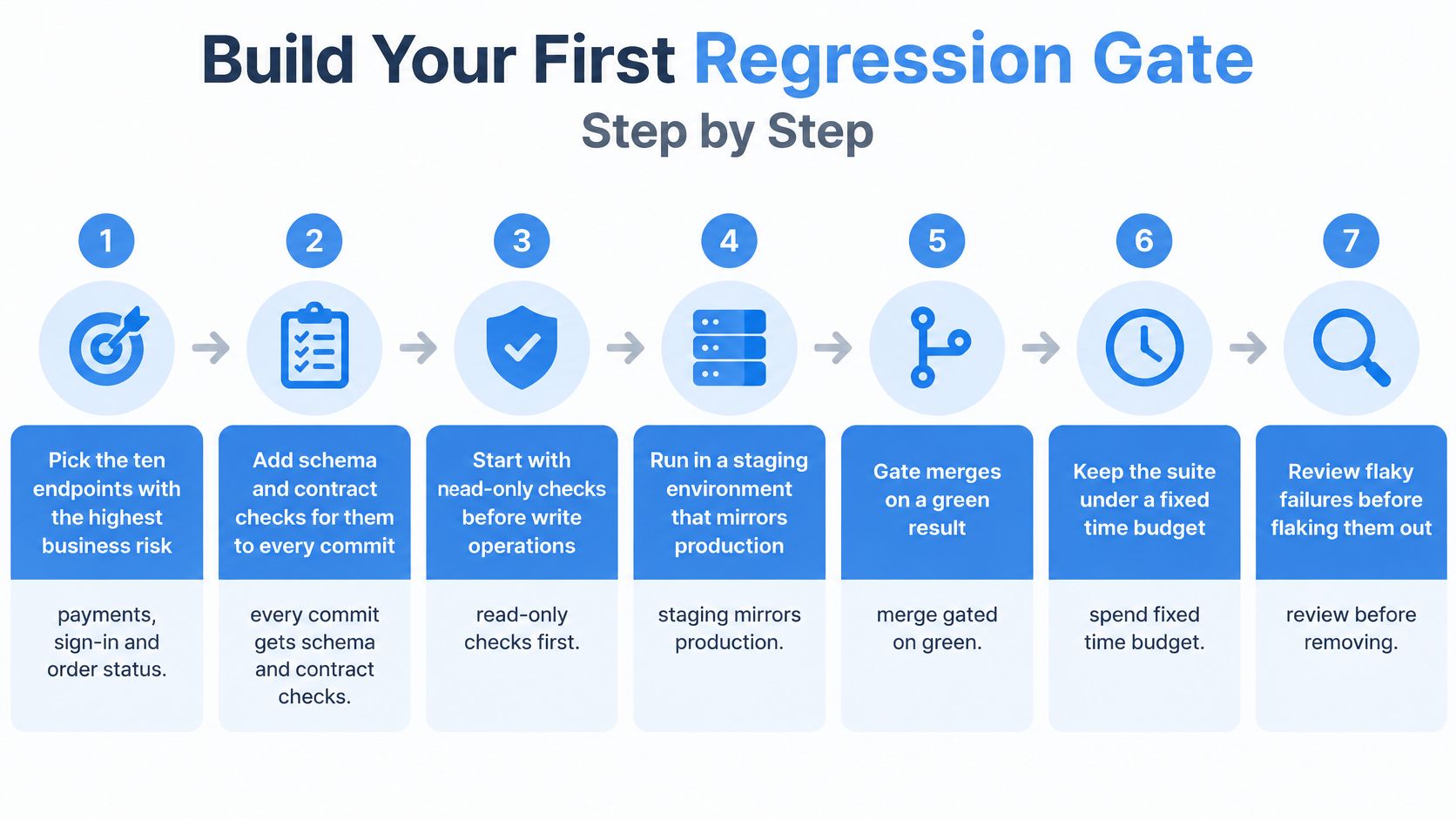
Once those commit-level checks run cleanly, build a pre-release traffic replay gate in seven concrete steps. Integrating this cleanly into your delivery workflow aligns closely with proven CI/CD pipeline testing practices.
- Choose a plaintext capture point and measure overhead. The first step of the workflow is to choose a suitable plaintext capture point, record the requests needed, and measure capture overhead before scaling up. Place the listener right after TLS termination, such as on the application host behind your load balancer or ingress controller, because capturing on an encrypted hop yields unreadable ciphertext. Common slip: turning on capture at full production volume during peak hours without measuring CPU and memory impact first.
- Record one full week of sanitized traffic. Capture representative requests for your ten high-risk endpoints over seven days, applying your masking and token-replacement rules before storing the file. A single afternoon misses Monday morning traffic bursts, weekly subscription renewals, and weekend mobile client versions. Common slip: saving raw captures to an S3 bucket with a plan to scrub them next sprint, which leaves live customer secrets sitting in test storage.
- Strip unsuitable requests and target an isolated environment. The second step is to remove unsuitable requests and rewrite the sample for an isolated target with controlled external side effects. Drop destructive admin endpoints or one-time webhook callbacks, and point the cleaned traffic at a staging cluster where payment gateways, outbound emails, and SMS relays are switched off. GoReplay can route captured HTTP traffic into an isolated test environment while rewriting headers and endpoints to keep side effects contained. Common slip: stubbing the payment provider but forgetting an asynchronous worker that still sends real order-confirmation emails to customers.
- Replay the sample against baseline and candidate builds at a fixed speed. Run the exact same sanitized request file against both the current production build (your baseline) and the release candidate, using GoReplay or your own replay runner at a controlled request rate. Keeping the replay pace steady isolates code regressions from noisy resource contention. Common slip: blasting requests at maximum concurrency into an undersized staging database and chasing phantom timeout regressions that only happened because the test box ran out of connections.
- Normalize dynamic fields before diffing responses. Strip or replace nondeterministic fields like server timestamps, generated UUIDs, request trace IDs, and fresh auth tokens before running comparisons. Without normalization, every single response looks like a failure and engineers stop reading the diff output. Common slip: ignoring an entire nested JSON object just to silence one timestamp field, which accidentally blinds your gate to missing fields right next to it.
- Compare responses, latency, and application state. The third step measures performance and compares responses and application state, and a successful replay alone doesn’t establish correctness. Check HTTP status codes, payload structures, headers, and tail latency, then query the staging database or cache to confirm writes landed accurately. An endpoint can return
200 OKquickly while dropping an optional column or failing to enqueue a fulfillment event. Common slip: asserting only on HTTP status codes and assuming a green replay means healthy persistence. - Gate merges on unexplained contract differences. Fail the release gate whenever an unexplained difference touches documented contract elements, and let intentional changes pass only after recording them in a versioned baseline that names who approved the change. Requiring an explicit baseline update turns silent drift into a deliberate review conversation. Common slip: allowing anyone to click “accept all diffs” in bulk without reviewing individual field changes.
Keeping the Gate Healthy After Launch
Building the gate is half the work; maintaining developer trust keeps it turned on. Review two operational numbers every week: flake rate (the share of gate failures that disappear without a code change) and time to first failure (how many minutes pass before the pipeline alerts an author to a real break).
Quarantine any check that passes only intermittently rather than leaving it to spam pull requests. You’ll know your regression gate has earned its place when it blocks a genuine breaking change before production at least once, and when every blocked build points to a clear, explainable cause instead of guesswork.
Spotting Behavior Changes Between Versions
Consider a backend refactor that changes a price_cents field from an integer to a quoted string. If your OpenAPI document uses a loose type definition or lags behind the codebase, static schema validation lets that build ship without a warning. Meanwhile, every typed Swift, Kotlin, or Java client that parses price_cents as an integer crashes the moment the response arrives.
Differential regression testing catches bugs like that by sending identical requests to both the old and new versions of a service and comparing their live responses side by side. Instead of trusting a manually maintained spec to describe every quirk of your API, you let the currently running production build act as the behavioral reference.
Real-world evidence shows how much slips past specification checks alone. In an empirical study of 17 production versions of Azure networking APIs released between 2016 and 2019, differential regression testing detected 14 regressions: 5 sat inside the official API specifications, while 9 occurred inside the running services themselves. Relying strictly on OpenAPI validation would have missed the majority of those live breaks.
Separating Breaking Changes From Harmless Noise
Running a diff against live responses produces a lot of output until you teach your pipeline which differences threaten clients and which ones are benign. Sort every detected mismatch into two explicit buckets:
- Breaking compatibility shifts: Removed response fields, altered data types (like number to string), stricter input validation that rejects previously accepted payloads, changed authentication or role checks, and materially different error semantics (such as changing error codes or status classes that clients branch on).
- Expected nondeterministic noise: Server-generated timestamps, random request IDs, distributed tracing headers, cache-hit metadata, and array ordering on endpoints that don’t guarantee sorted results.
Once your normalizer filters out the noise bucket, wire the breaking bucket straight into release governance. Any unexplained difference affecting a documented contract element fails the build automatically. When a team intends to change behavior, say migrating an error payload format in a planned version bump, they update a versioned baseline file in Git alongside the code change, recording who signed off and why. That audit trail stops accidental regressions while keeping deliberate API evolution fast.
Selecting Tests for Each Change
Running your entire regression suite on every pull request sounds thorough until build queues stretch past forty minutes and developers start stacking unreviewed commits to dodge the wait. Smart teams scope each run to what changed, saving broader runs for nightly schedules and release candidates.
Empirical data backs up the value of bounded test subsets. A large study of regression-test selection techniques found that selection algorithms materially affect cost-effectiveness; even simple random selection achieved a median effectiveness of 88% while running just 25% of the available tests, and related work reported median relative effectiveness above 90% when tests ran at short intervals.
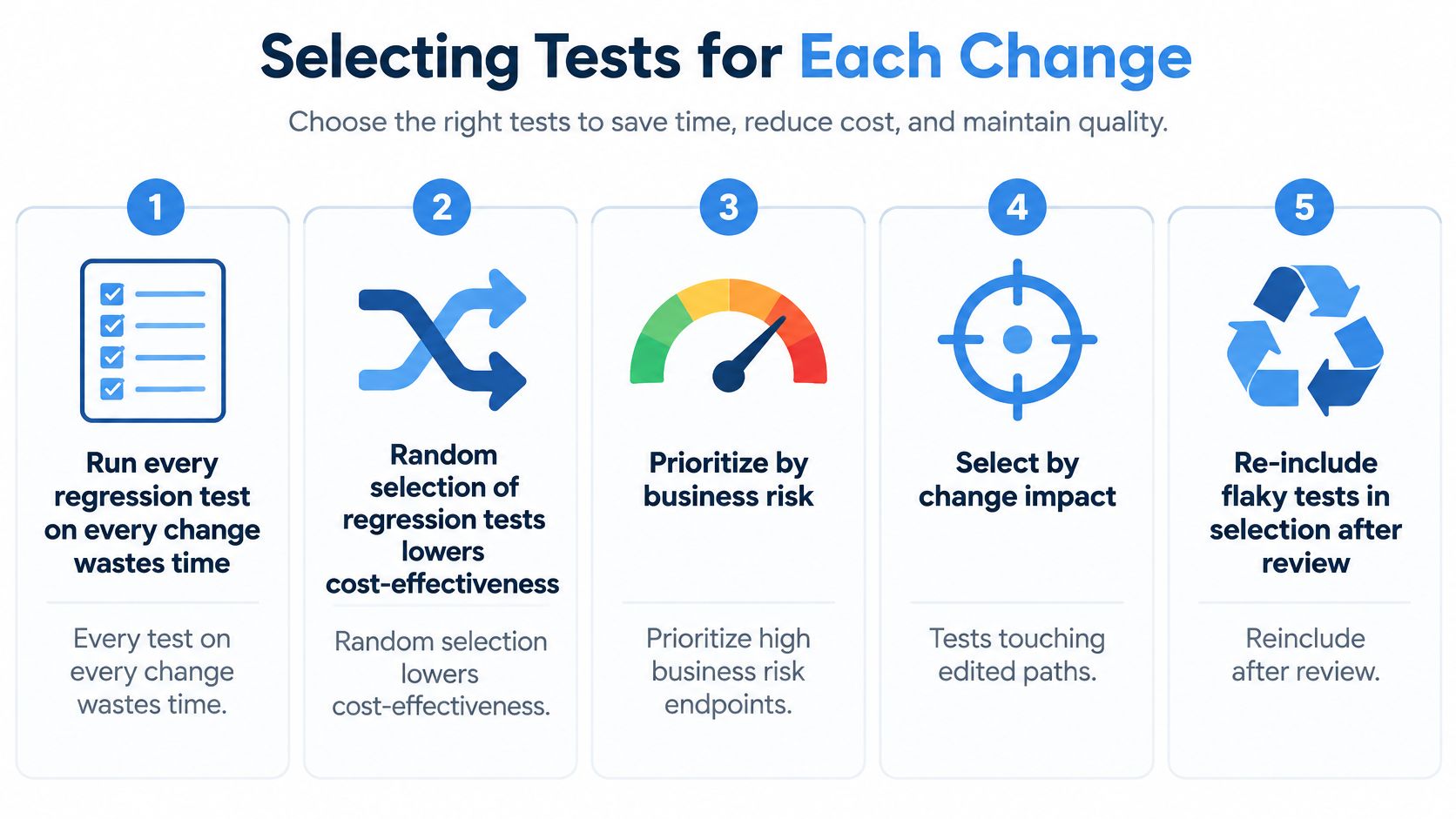
Random selection isn’t a replacement for coverage-based analysis. Leaving payment validation or access control to a coin flip invites avoidable outages. What the study proves is that you don’t need to run 100% of your tests on every commit to retain most of your defect-detection power under tight CI budgets.
Map your pull request diffs to the specific API checks most likely to surface regressions first:
| Change Type | Run First | Why |
|---|---|---|
| Endpoint handler code | Tests for that endpoint and its direct callers | Logic changes usually surface there first |
| Request or response schema | Contract checks and replay for every consumer | A single field change can break clients you do not own |
| Database migration | Flows that read or write the migrated tables | Data shape changes surface in stored-data paths |
| Authorization rule | Each permitted and denied role for affected endpoints | Access changes fail silently when only allowed paths are tested |
| Downstream integration | Tests against a stubbed dependency, plus one live-like run | Stubs catch logic faults; the live-like run catches contract drift |
Metrics That Prove Your Selection Works
A selection strategy only stays sharp if you measure whether it catches real bugs quickly. Track four numbers over time instead of obsessing over raw test count: time to first failure, unique defects found, endpoint coverage, and fault-detection effectiveness (such as mutation scores or the share of bugs caught before merge).
A smaller test run that fails in three minutes on real bugs earns far more developer respect than an exhaustive run nobody waits to finish.
Recalculate test priorities periodically from your execution history. Modules that churn every sprint, handle larger diffs, or have a history of subtle integration faults deserve a permanent spot in your fast pull-request tier, while untouched legacy endpoints can drop back to nightly or pre-release runs.
Flaky Failures and How to Tell Them Apart
A developer updates a single log statement, opens a pull request, and watches the checkout API regression test fail in CI. They spend ninety minutes stepping through order pricing code that didn’t change, find nothing wrong, and click rerun out of frustration. The job turns green, the code merges, and the underlying instability stays buried in the suite.

It’s common to assume that adding more regression tests automatically raises release confidence. In practice, growing test volume without measuring flake rate and failure reproducibility does the exact opposite. Once developers expect red builds to be false alarms, they stop investigating real regressions too.
Nondeterministic API failures almost always trace back to four culprits:
- Shared state across tests: One test mutates a shared staging user, inventory count, or Redis key that the next test expects to start clean.
- Unstable external dependencies: Calling a live sandbox payment gateway or third-party geocoder introduces random timeouts and rate limits that have nothing to do with your commit.
- Timing and race conditions: Asserting on an asynchronously updated read replica or background job before the worker finishes creates failures that vanish on slower or faster runners.
- Test-order coupling: A test passes only because an earlier test happened to seed an auth token or database row, then fails the moment CI shards tests across parallel workers.
Hitting rerun hides these faults instead of diagnosing them. Research on the ChaosAPI flaky-test detection approach highlighted how flaky failures mislead developers into chasing nonexistent bugs in recent commits while basic reruns often miss the underlying cause. In manual validation, ChaosAPI achieved 94.9% precision and surfaced additional flaky tests more effectively than rerunning suites alone.
A Practical Diagnostic Routine for Suspect Failures
When an API regression check fails without an obvious tie to the commit diff, resist the urge to rerun once and walk away. Replay the same representative request five times back to back to check raw repeatability. Next, shuffle the request ordering and increase concurrency on the same sample to flush out race conditions and order dependencies.
Isolate any external services behind local stubs during diagnosis so network jitter can’t disguise a code bug. Tag every reproduced or intermittent failure with four fields: determinism (consistent or intermittent), endpoint, dependency involved, and data state. Over a few weeks, those tags show you immediately whether one flaky staging service or one shared database table is poisoning half your builds.
For a closer look at how teams structure API regression workflows and spot unstable behavior before release, watch this walkthrough:
Adopt one strict team rule this week: any regression test that passes only some of the time leaves the blocking release gate immediately. Move it to a quarantine lane, label it with its suspected cause, and assign an owner to fix the nondeterminism before it earns its way back into CI. Protecting the credibility of a red build matters more than keeping a noisy test in the pipeline.
Building a trustworthy API regression gate starts with realistic traffic that doesn’t put production data or customer workflows at risk. GoReplay captures live HTTP requests and replays them safely against isolated test environments so you can compare old and new service versions, catch subtle behavioral shifts, and keep your release pipeline reliable. Explore the open-source tool and documentation at GoReplay to start testing your next release against real-world traffic.