
What Is Test Planning A Guide to Software Quality

Think of test planning as the architect’s blueprint for quality assurance. It’s the strategic process that transforms testing from a chaotic, reactive bug hunt into a predictable, goal-oriented plan for building great software.
Your Blueprint for Building Flawless Software

You wouldn’t build a skyscraper without a detailed architectural plan, right? The result would be a mess—dangerous, over budget, and almost certainly doomed to fail. Test planning serves the exact same purpose in the software world. It’s the foundational strategy that guides every testing effort, giving everyone clarity and a shared understanding of what success actually looks like.
Without a solid plan, testing teams are flying blind. They might waste time on low-priority features, completely miss critical user workflows, or run out of runway right before a major release. This kind of reactive approach is not only inefficient but incredibly risky, often leading to costly post-launch defects and a serious blow to user trust.
Aligning Teams and Defining Success
A good test plan gets everyone on the same page—developers, QA engineers, product managers, and business stakeholders. It forces the tough, critical conversations to happen early in the development lifecycle, answering the big questions before anyone writes a single line of test code.
This proactive discipline establishes clear guardrails for the entire process:
- Scope Definition: It spells out exactly what will be tested (in-scope) and, just as importantly, what won’t be (out-of-scope). No more assumptions.
- Objective Setting: It defines the specific goals. Are we validating new functionality, ensuring the system can handle a massive load, or triple-checking security protocols?
- Resource Allocation: It identifies who is doing what, which tools they’ll need, and the specific hardware and software requirements for the test environment.
- Risk Management: It shines a light on potential risks—like impossibly tight deadlines or tricky third-party integrations—and lays out a game plan to mitigate them.
Test planning isn’t just about creating a document that gathers dust. It’s about building a living strategy. It shifts the entire team’s focus from just finding bugs to systematically proving that the software actually delivers on its business promises.
The investment in this foundational step is huge, and the market reflects it. The global software testing market was valued at roughly USD 55.8 billion in 2024 and is expected to balloon to over USD 112.5 billion by 2034. This explosive growth shows a clear, industry-wide consensus: structured testing, guided by meticulous planning, is non-negotiable. You can dive deeper into these trends in this market analysis from Market Growth Reports.
Ultimately, this blueprint ensures every single testing activity is purposeful, efficient, and directly contributes to a high-quality product that users will love.
The Real Business Value of a Strong Test Plan
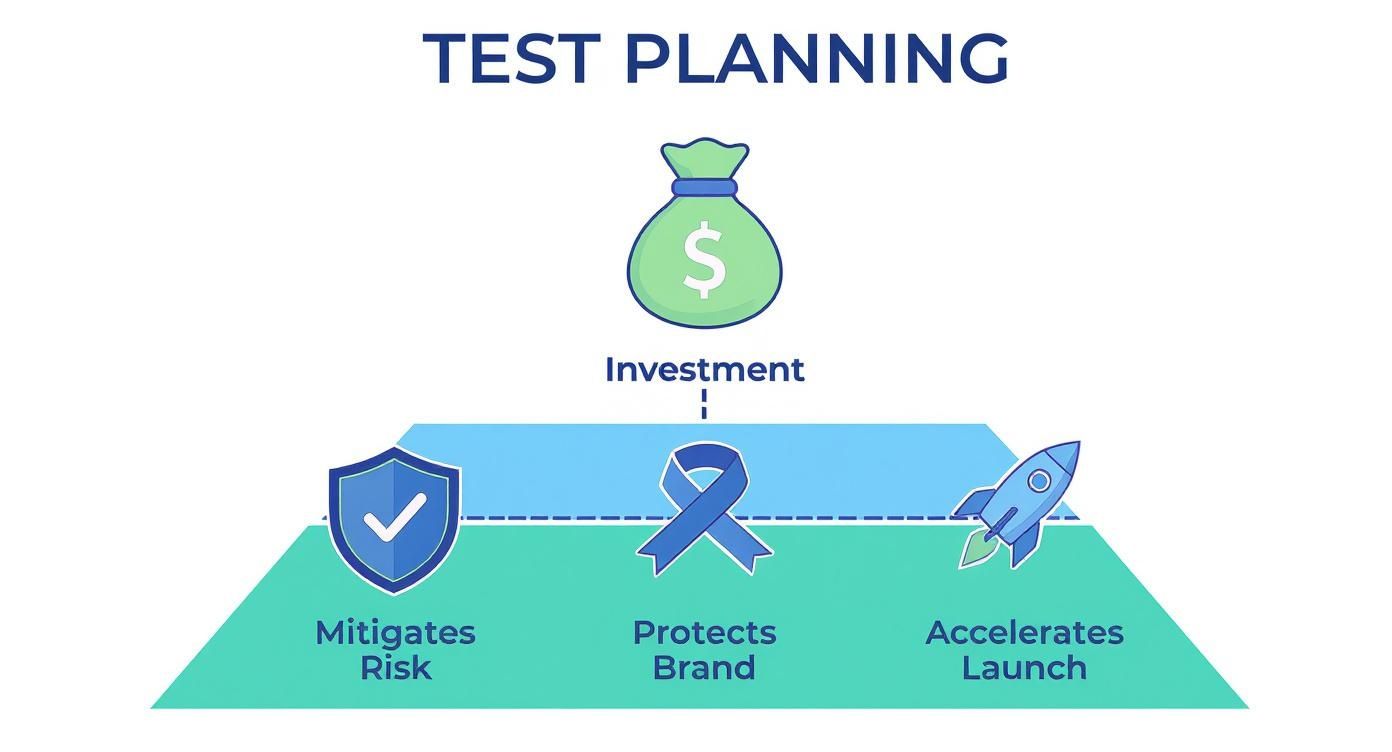
It’s easy to look at a test plan and see a checklist for squashing bugs. But that’s just scratching the surface. A truly solid test plan delivers tangible business outcomes that go way beyond the QA team. It’s a direct line of defense against financial risk, a protector of your brand, and, when done right, a secret weapon for getting to market faster.
This is where you connect the technical work to what actually matters to the business. Instead of just asking, “Does this button work?” a great plan forces you to ask, “Does this feature deliver the value our customers expect and our business depends on?” That small shift in thinking turns testing from a cost center into a strategic asset.
From Technical Task to Strategic Asset
Think of your test plan as a business playbook. It gives you a structured way to make sure your team’s most valuable resources—their time and talent—are aimed at the right targets. Without a plan, you risk developers burning hours on low-impact tests while your core, revenue-generating features are left vulnerable.
This strategic focus prevents that classic, nightmare scenario where development runs late, and testing gets squeezed into the last few hours before launch. By planning ahead, you make quality a part of the process from day one, not an afterthought.
A well-structured plan is built to hit key business goals:
- Financial Risk Mitigation: It forces you to prioritize testing on the features that make you money, like your payment gateway or subscription funnels, directly protecting your revenue.
- Brand Protection: By systematically catching deal-breaker bugs before they reach your users, it prevents the kind of public meltdown that kills customer trust.
- Resource Optimization: It ensures your testers are focused on the highest-priority tasks, so you’re not wasting money and effort on things that don’t matter.
A Real-World E-Commerce Launch Scenario
Let’s make this real. Imagine your company is launching a new e-commerce site just weeks before the holiday shopping rush. The pressure is on. A buggy launch could wipe out a huge chunk of your annual revenue. This is where your test plan becomes the most important tool you have.
A strong plan would map out every critical user path. It would demand ruthless testing of the entire checkout flow—adding to the cart, applying discount codes, processing different credit cards, and getting that order confirmation. It would also specify performance tests to prove the site won’t buckle under a sudden surge of 100,000 simultaneous users.
By focusing testing on these high-stakes areas, the test plan acts as an insurance policy. It’s the thing that guarantees on the biggest sales day of the year, your payment gateway won’t crash, customers won’t rage-quit with full carts, and your revenue will be safe.
Without that strategic blueprint, the team would be flying blind. They might spend days perfecting the look of a secondary page while a critical bug in the payment API slips right through. The result? A catastrophic launch day, a flood of angry customer emails, and a ton of lost sales.
Ultimately, a strong test plan provides the clarity and direction needed to navigate high-pressure projects. It turns testing from a chaotic scramble into a focused, strategic operation that directly protects your bottom line. It’s the difference between hoping for a successful launch and engineering one.
Anatomy of an Effective Test Plan Document
A test plan isn’t just a formality—it’s the command center for your entire quality assurance effort. Think of it as the detailed schematics that bring a high-level blueprint to life. While your test strategy points you in the right direction, the test plan provides the turn-by-turn navigation your team needs to get there without getting lost.
Breaking the plan down into its core components makes the whole process feel less intimidating. Each section serves a specific purpose, forcing you to answer critical questions before a single test is run. This structure turns ambiguity into a clear, actionable roadmap for everyone involved.
The takeaway here is simple: a good test plan isn’t overhead. It’s a direct investment in your product’s health and your team’s speed. Let’s pull apart the essential pieces.
A solid test plan document acts as a single source of truth for the entire team. Below is a breakdown of the standard components you’ll find in one.
Essential Components of a Test Plan Document
| Component | Purpose | Example Content |
|---|---|---|
| Test Scope | Defines the exact boundaries of the testing effort. | In-Scope: New user authentication module. Out-of-Scope: Legacy admin reporting features. |
| Test Objectives | States the high-level goals of the testing cycle. | Verify that the new API can handle 500 requests per second with latency under 200ms. |
| Test Strategy | Outlines the “how”—the types of testing and tools to be used. | Functional testing via automated scripts; performance testing using traffic replay; manual exploratory testing for usability. |
| Resources & Schedule | Assigns ownership and sets a timeline for key milestones. | QA Lead: Jane Doe. Test Environment Setup: By May 5. Execution Phase: May 10-20. |
| Entry Criteria | Lists the prerequisites that must be met before testing can begin. | All new code has been deployed to the staging environment; the build is stable. |
| Exit Criteria | Defines the conditions for successfully completing the testing phase. | 98% of test cases passed; 0 open critical bugs; product owner sign-off received. |
| Deliverables | Lists the documents and reports that will be produced. | Test Summary Report, Defect Log, Performance Benchmark Analysis. |
| Risks & Mitigation | Identifies potential problems and outlines a plan to address them. | Risk: Test environment instability. Mitigation: Daily health checks and a dedicated on-call engineer. |
Each part of this document works together to create a comprehensive guide that eliminates guesswork and aligns the entire team on the goals and processes.
Defining Scope and Objectives
The very first step is to draw a clear boundary. What, precisely, are we testing? The Test Scope section explicitly lists all features, user stories, and modules that are in-scope. Just as important, it calls out what is out-of-scope, which is key for preventing wasted effort and managing expectations.
For example, a new payment gateway integration is in-scope, but the third-party analytics dashboard it feeds data to is out-of-scope for this particular cycle.
Next, you need to define your Test Objectives. These are the clear, measurable goals that justify the entire testing effort.
- To validate that the new checkout flow processes transactions correctly for all major credit cards.
- To ensure the application can handle 1,000 concurrent users without performance dropping off a cliff.
- To verify that user input fields are hardened against common security vulnerabilities.
Outlining Strategy and Logistics
With the “what” and “why” sorted, the Test Strategy moves on to the “how.” This is your game plan. It outlines the types of testing you’ll perform (functional, performance, security), the tools you’ll use (GoReplay for traffic replay, Selenium for UI automation), and the overall approach. It might specify that all critical bugs found during regression testing must be fixed and verified within 24 hours.
Then comes the people and the calendar. Who is doing what? Who is writing the test cases, who is running them, and who is responsible for keeping the test environment from catching fire?
A test plan without clear ownership is just a wish list. Assigning specific roles ensures accountability and prevents crucial tasks from falling through the cracks when things get hectic.
The schedule provides a timeline with key milestones, not just a single drop-dead date. You’ll want dates for test case creation, environment setup, different phases of test execution, and bug-fixing windows. This keeps the project on the rails and gives everyone visibility into progress.
Setting the Rules of Engagement
Finally, every effective test plan needs clear rules for when to start and when you’re done. These are your Entry and Exit Criteria.
Entry Criteria are the non-negotiable prerequisites that must be met before the testing phase can even begin. For example:
- The code for all planned features is deployed to the staging environment.
- The test environment is stable and configured correctly.
- All critical test cases have been written and peer-reviewed.
On the other hand, Exit Criteria define what “done” looks like. These are the metrics that tell you the software is actually ready to ship.
- 95% of all test cases have been executed and passed.
- There are zero open critical or high-severity defects.
- All major functionality has been signed off by the product owner.
These criteria remove the guesswork from the release decision. Instead of going with a gut feeling, the team has a concrete, data-driven checklist to prove the product has met the quality bar.
Integrating Modern Tools and Automation
In today’s fast-paced development world, a static test plan that gathers dust on a shelf is a recipe for falling behind. A modern test plan isn’t just a document outlining manual steps; it’s a living strategy that weaves in the right tools and automation from day one. This approach turns testing from a slow, manual bottleneck into an engine that keeps up with rapid release cycles.
The whole idea is to embed your tooling strategy directly into the plan itself. You’re not just deciding what to test, but how you’ll test it efficiently and at scale. Think of it as the difference between planning to manually check a login form every day versus building an automated script that does it perfectly in seconds.
This move toward automation isn’t just a trend—it’s a massive industry shift. The global automation testing market was valued at USD 17.71 billion in 2024 and is expected to explode to USD 63.05 billion by 2032. That staggering growth shows just how critical automation has become for any organization serious about speed and quality. You can dive deeper into this expanding market on Fortune Business Insights.
Identifying Prime Candidates for Automation
Let’s be clear: not every test should be automated. A great test plan strategically pinpoints where automation will deliver the biggest bang for your buck. The goal is to offload the repetitive, mind-numbing tasks so your human testers can focus their brainpower on complex, exploratory work that machines can’t do.
Your plan should be explicit about which test suites are ripe for automation:
- Regression Tests: These are the low-hanging fruit and the most valuable candidates. Automating checks for existing features is the best way to prevent new code from breaking something that used to work perfectly.
- Data-Driven Tests: Any test that needs to run over and over with different data—like verifying user profiles with hundreds of different inputs—is a perfect job for automation.
- Performance and Load Tests: It’s physically impossible for humans to pretend to be thousands of concurrent users. Tools are absolutely essential to see how your system holds up under a heavy load.
- API Testing: Automating the checks on your application’s APIs ensures that the critical communication layer between your services stays stable and reliable.
By calling out these automation targets right in the plan, you create a clear roadmap for your engineering team and set the right expectations for the entire testing cycle. You can learn more by exploring our detailed guide on building a robust test automation strategy.
Planning for Realistic Test Environments
One of the biggest headaches in testing is creating an environment that actually mirrors the real world. Staging environments often fall short, using sanitized or synthetic data that completely misses the chaotic, unpredictable nature of live user traffic. This is a huge risk that your test plan must tackle head-on.
This is where modern tools offer a game-changing solution: traffic replay.
By capturing and replaying real production traffic, you can put your staging environment through the exact scenarios, data patterns, and load your application will face in the wild. This isn’t just testing; it’s a full dress rehearsal before opening night.
Tools like GoReplay were built for this exact purpose. When you plan to use a tool like this from the start, you can build a much more resilient testing process. Your test plan can specify the “what, where, and how” of traffic capture, guaranteeing your pre-production tests are as close to reality as you can get.
The GoReplay homepage shows how real traffic can be captured and put to work for testing.
This visual gets right to the point: turning live user interactions into a powerful asset that helps developers and QA teams ship with confidence.
Integrating Tools into Your CI/CD Pipeline
Finally, a modern test plan has to think about how testing plugs into the bigger DevOps picture—specifically, the Continuous Integration/Continuous Deployment (CI/CD) pipeline. The plan needs to spell out which automated tests will run automatically every single time a developer commits new code.
This integration gives you instant feedback, catching bugs just moments after they’re introduced instead of weeks later during a manual QA cycle. Your plan should define:
- Trigger Points: What actions (like a code merge) will kick off an automated test run?
- Test Suites: Which specific tests (like smoke tests or API tests) will run at each stage?
- Failure Protocols: What happens if a test fails? Does it block the deployment? Who gets an alert?
By detailing this integration, the test plan becomes a central blueprint that aligns development, QA, and operations. It ensures that automated testing isn’t just some side activity but a core part of your software delivery machine, helping you ship better software, faster.
Mastering Your Test Data Management Strategy

Even the most carefully designed test cases will fall flat without the right fuel—high-quality, relevant test data. This is where a solid Test Data Management (TDM) strategy becomes the bedrock of your entire test plan. TDM is the whole process of creating, managing, and delivering the data your tests need to be effective. It’s every bit as important as writing the tests themselves.
Trying to test without a data plan is like test-driving a race car on a quiet suburban street. Sure, you’ll confirm the engine starts, but you won’t learn a thing about its performance under pressure. A good data strategy ensures your tests mirror real-world chaos, helping you find those nasty bugs that pristine, simple data would never expose.
This isn’t just a niche concern anymore. The global test data management market hit USD 1.54 billion in 2024 and is expected to nearly double to USD 2.97 billion by 2032. The demand is real. You can see a full breakdown of the global TDM market from Verified Market Research to get a sense of the growth.
Choosing Your Data Source
A huge part of your TDM plan comes down to a simple question: what kind of data are you going to use? There’s no single right answer. Each type has its own trade-offs, and your choice will depend on your testing goals and, just as importantly, your compliance rules.
Your test plan needs to be crystal clear about which data sources you’ll tap into and why.
- Production Data: This is the real deal—a direct copy from your live environment. It offers unmatched realism, but using it is often a massive security and privacy minefield thanks to regulations like GDPR.
- Masked Data: Think of this as production data in disguise. You take real data and then scramble or anonymize the sensitive bits. It keeps the realistic structure while dialing down the privacy risks, making it a go-to choice for many teams.
- Synthetic Data: This is data you create from scratch to fit specific test conditions. It’s fantastic for corner-cases that might not even exist in your live data, and from a privacy perspective, it’s the safest bet you can make.
Formalizing TDM in Your Test Plan
For TDM to really work, it can’t be an afterthought. It needs to be a formal, documented part of your test plan. You’re essentially building a supply chain for your test data, and it needs a blueprint.
Your plan should spell out a few key areas to keep things consistent, secure, and predictable.
Test Data Management isn’t just about having data; it’s about having the right data, at the right time, without putting user privacy on the line. Building this into your plan stops last-minute panic and closes major security holes.
To make your strategy official, your test plan must nail down:
- Data Requirements: For each major feature, define exactly what you need. For example, testing a new user profile page might require 10,000 user records with a wide mix of complete and incomplete profiles.
- Provisioning Workflows: Map out the step-by-step process for getting data ready. Who generates it? Who masks it? What tools are they using? Leave no room for ambiguity.
- Security and Compliance: Get specific about how you’ll protect sensitive info and comply with rules like GDPR or HIPAA. This means defining who can access the data and what the masking rules are.
For instance, a team building a healthcare app has to use masked patient data. Their test plan would mandate that all personally identifiable information (PII)—names, social security numbers, you name it—is replaced with realistic but fake values before it ever touches the test environment. This keeps the tests accurate while upholding the non-negotiable requirement of patient privacy.
For more hands-on advice, check out our guide covering test data management best practices.
Making Test Plans Work in the Real World
A great test plan is a living document, not some static artifact carved in stone. In fast-moving projects, especially with agile teams, a plan that can’t adapt is a plan that’s destined to fail. You need practices that embrace change and get the whole team on board.
The goal here is to ditch the rigid, top-down document and create a flexible, team-owned guide instead. This way, as requirements shift and new information pops up, your testing strategy evolves right alongside the project. A plan that’s out of sync with development is honestly worse than having no plan at all.
Get Everyone to Own It from the Start
Quality isn’t just QA’s job—it’s a team sport. The most effective test plans are built with input from everyone: developers, business analysts, and product owners. When the whole team chips in, they build a shared vision of what “quality” means and take collective ownership of the outcome.
This collaborative approach brings potential risks and misunderstandings to the surface early on. A developer might point out a tricky technical dependency the QA team missed, or a product owner can clarify which feature actually delivers the most business value.
- How to do it: Just schedule a quick planning session. Get developers, BAs, and product owners in a room to review the testing scope and objectives together.
- Why it matters: This simple meeting kills the classic “us vs. them” mentality and makes sure the plan is grounded in both technical reality and business priorities.
An agile test plan isn’t a contract handed down from on high. It’s a group agreement that shows the team’s shared commitment to building something great. This turns test planning from a bureaucratic hurdle into something that actually brings the team together.
Prioritize Based on What Could Actually Break the Business
Let’s be real: not all bugs are created equal. A typo on a marketing page is a minor annoyance; a flaw in your payment processing flow is a complete catastrophe. Your test plan has to reflect this by prioritizing tests based on business risk, not just how complex or easy something is to test.
Focus your team’s limited time and energy on the areas that could cause the most damage if they go wrong. This means you need a deep understanding of which features are truly critical to your users and your bottom line.
Make Sure Everyone Knows What’s Going On
Even the best plan is useless if no one talks about progress or problems. Your test plan should spell out exactly how the team will report status, bugs, and blockers. Any gray area here just leads to confusion and delays.
Set up a clear rhythm for communication:
- Daily Stand-ups: A quick check-in to share testing progress and call out any immediate roadblocks.
- Bug Triage Meetings: A dedicated session to review, prioritize, and assign new defects.
- Summary Reports: A regular, concise update for stakeholders that highlights key stats like test pass rates and critical open bugs.
This structure keeps information flowing freely so that everyone, from engineers to executives, has a clear picture of the product’s quality. A solid communication strategy turns your test plan from a static document into a dynamic tool that helps you drive the project forward with confidence.
Frequently Asked Questions About Test Planning
Even with a solid grasp of test planning, a few common questions always pop up when teams start putting theory into practice. Let’s clear up some of the most frequent points of confusion so you can move forward with confidence.
What Is the Difference Between a Test Plan and a Test Strategy?
It’s easy to mix these up, but they operate on totally different levels. Think of your test strategy as the constitution for your quality efforts—it’s the high-level, guiding philosophy for QA across the whole company. It’s a fairly static document that answers the big “how” questions, like what your approach to automation is or which tools are standard.
A test plan, however, is tactical and project-specific. It’s the law written for a single legislative session. It takes the principles from your strategy and applies them to a specific feature or release, getting into the nitty-gritty of what, when, and who. It’s where you’ll find the scope, schedules, and specific exit criteria for that one project.
One guides the big picture; the other manages the immediate details.
What Is the Difference Between a Test Plan and a Test Case?
This one comes down to scale. A test plan is the master blueprint for the entire testing effort. It outlines the scope, objectives, and resources but stays out of the weeds of individual test actions. It’s the document that says, “We need to test the login functionality.”
A test case is where the rubber meets the road. It’s a granular, step-by-step script for verifying one tiny piece of functionality. For instance, a single test case for a login form would look something like this:
- Step 1: Navigate to the login page.
- Step 2: Enter a valid username.
- Step 3: Enter a valid password.
- Step 4: Click the “Login” button.
- Expected Result: The user is logged in and sees the dashboard.
The test plan provides the direction, while the dozens (or hundreds) of test cases are the individual instructions to get you there.
How Often Should We Update Our Test Plan?
A test plan should be a living document, not a “set it and forget it” artifact gathering digital dust. This is especially true in agile environments where change is constant.
You should revisit and update your plan whenever something significant happens. Good triggers for a review include:
- Scope changes: New features get added, or old ones get the axe.
- Timeline shifts: Development schedules get compressed or extended.
- New risks appear: A key developer leaves, or a critical dependency is delayed.
- During retrospectives: The team can reflect on what’s working and tweak the plan for the next sprint.
Keeping the plan current ensures it remains a useful guide instead of an outdated document nobody trusts.
Ready to eliminate the guesswork in your test environments? GoReplay helps you capture and replay real production traffic, ensuring your tests are as realistic as possible. See how it works and start shipping with confidence at https://goreplay.org.