
What is test plan: A Blueprint for Flawless Software

A test plan isn’t just some formal document you check off a list. It’s the strategic roadmap that guides your entire testing process, detailing the scope, approach, resources, and timeline for all testing activities. Simply put, it ensures everyone knows what’s being tested, why it’s being tested, and how it will be done before a single line of code is deployed.
Your Blueprint for Software Quality
Think of a test plan as the architectural blueprint for a skyscraper. You wouldn’t start pouring a foundation without a detailed plan guiding every single step of the construction. In the same way, you shouldn’t start writing test cases without a solid test plan to direct the entire quality assurance effort. This document becomes the single source of truth for the whole team.
A good test plan cuts through the noise and answers the critical questions that prevent a project from descending into chaos:
- What are we actually testing? (The Scope)
- Why are we testing this specific feature? (The Objectives)
- How are we going to test it? (The Approach & Strategy)
- When will we get this done? (The Schedule)
- Who is responsible for what? (The Resources & Roles)
This level of planning gets everyone—developers, QA engineers, product managers, and stakeholders—on the same page from day one. It transforms testing from a reactive, last-minute fire drill into a structured, predictable, and managed process. By defining what success looks like and spotting potential roadblocks early, a test plan helps you manage expectations and sidestep risks long before they become user-facing problems.
The Foundation of Quality Assurance
A test plan is more than just documentation; it’s a communication tool that creates accountability. It provides the framework needed to measure code quality effectively throughout the development lifecycle.
The image below gives you a sense of what a standard, industry-approved test plan looks like.

As you can see, it covers everything from test identifiers and feature lists to risk analysis and scheduling, giving you a complete picture of the testing effort.
To quickly summarize its function, here’s a look at the core role of a test plan.
Test Plan at a Glance
| Key Question It Answers | Its Role in the Project |
|---|---|
| What’s the game plan for quality? | Serves as the central, guiding document for all testing. |
| Are we all on the same page? | Aligns stakeholders, developers, and QA on goals and scope. |
| How do we know when we’re done? | Defines clear pass/fail criteria and the “definition of done.” |
| What could go wrong? | Identifies potential risks and outlines how to handle them. |
This blueprint is what sets the stage for a successful release.
A well-crafted test plan is the difference between hoping for quality and planning for it. It removes ambiguity and replaces guesswork with a clear, actionable strategy that guides the team toward a shared objective: delivering a flawless product.
Ultimately, a test plan ensures every testing activity is purposeful, efficient, and directly tied to what the business and its users actually need.
Deconstructing an Effective Test Plan
So, what really goes into a solid test plan? To get it, we need to pop the hood and look at the moving parts. A powerful test plan isn’t some bloated document nobody reads; it’s a collection of connected components, each designed to solve a specific problem before it can blow up your project.
Think of it like a car engine—every part has a job to do, and they all have to work together perfectly to get the car moving.

This kind of structured approach, often guided by standards like IEEE 829, is what turns a vague idea like “let’s test the app” into a clear, actionable strategy. Let’s break down the essential pieces that make a test plan tick.
Defining Your Test Scope
First up, and arguably the most important piece, is the Test Scope. This section is like putting up a fence around your project. It clearly marks what’s inside the testing boundaries and, just as importantly, what’s outside. This is your number one defense against the dreaded “scope creep,” where testing spirals out of control, burning through time and money.
Your scope needs to be crystal clear about:
- Features to be Tested: Which specific functionalities, modules, or user stories are we looking at? For example, “User authentication, product search, and the checkout process.”
- Features Not to be Tested: What are we intentionally leaving out? For instance, “Admin panel reporting features and third-party API integrations will not be tested in this cycle.”
Getting this right from the start aligns the whole team on priorities and manages everyone’s expectations. No surprises.
Establishing Clear Test Objectives
If the scope answers “what,” then the Test Objectives answer “why.” This component defines the actual goal of your testing. Are you on a bug hunt? Are you trying to verify that the system meets specific business needs? Or is the goal to confirm the app doesn’t fall over under heavy load?
Objectives need to be specific and measurable. For example:
- Objective 1: To verify that the new payment gateway integration processes transactions correctly for all major credit cards.
- Objective 2: To ensure the application’s response time stays under 2 seconds with 500 concurrent users.
- Objective 3: To confirm that the user registration flow is compliant with data privacy regulations.
These goals give you a clear definition of success and directly inform what kinds of test cases you’ll need to write.
Allocating Resources and Responsibilities
A plan is just a wish without the right people and tools. The Resource Planning section is the logistical backbone of your testing effort, outlining exactly who is doing what and what they’ll need to get it done.
This part typically covers:
- Team Roles: Assigning specific responsibilities (e.g., Test Lead, QA Engineer, Automation Specialist).
- Hardware & Software: Listing necessary devices, testing servers, and any automation tools.
- Environment Needs: Defining the specs for the test environment to make sure it mimics production as closely as possible.
Sorting this out early prevents bottlenecks and makes sure the team is set up for success right from day one.
Setting Pass and Fail Criteria
How do you know when you’re done? The Pass/Fail Criteria tell you. These are the objective, black-and-white rules that determine if a test case, a feature, or the entire application has hit the quality bar. They are the final gatekeepers standing between your code and a live release.
A test plan without clear pass/fail criteria is like a game without a scoreboard. You might be playing, but you have no idea if you’re winning. This section removes all ambiguity, making the decision to ship a data-driven one.
Examples might include:
- Pass Condition: 95% of all critical test cases must pass.
- Fail Condition: Any single “showstopper” bug (like a system crash or data loss) is found.
- Exit Criteria: No more than 5 medium-priority defects can remain open before deployment.
These rules ensure quality isn’t just a gut feeling—it’s a measurable result.
Analyzing and Mitigating Risks
Finally, a truly proactive test plan includes a Risk Analysis. This is where you put on your pessimist hat and ask, “What could go wrong?” This section identifies potential problems that could wreck your schedule or the product’s quality, then outlines a backup plan for each one.
Here are a few common risks and how to handle them:
| Potential Risk | Mitigation Strategy |
|---|---|
| Tight Deadlines | Prioritize testing based on the most critical business features. |
| Unstable Test Environment | Schedule dedicated time just for environment setup and validation. |
| Late Delivery of Code | Implement a clear and constant communication plan with the dev team. |
Having this kind of foresight is non-negotiable in today’s fast-moving development world. Companies are pouring money into quality assurance because they know it directly impacts their bottom line. The global software testing market is expected to jump from USD 54.68 billion in 2025 to over USD 99.79 billion by 2035—a huge sign that smart test planning is a core competitive advantage. You can explore more about the software testing market growth and see how the best in the business are staying ahead.
Defining Your Test Strategy and Scope
It’s easy to get tangled up in the details of a test plan—the ‘what’ and ‘how’—but without a solid test strategy, you’re just building a to-do list. The strategy is the ‘why.’ It’s your organization’s high-level philosophy on quality, and the test plan is the boots-on-the-ground document that brings that philosophy to life.
Think of it this way: without a strategy, your test plan has no direction. It’s just a series of disconnected tasks. A strong strategy, on the other hand, guides every decision you make, from resource allocation to deciding which bugs are acceptable risks at launch. It makes sure your testing is laser-focused on what actually matters to the business and your users.
Clarifying Your High-Level Approach
Before you can nail down the scope, you need to decide on your overarching approach. Are you going for exhaustive, cover-all-the-bases testing? Or are you pushing for speed-to-market and focusing only on the most critical user journeys? Your strategy sets these ground rules from the start.
Most teams lean on a few common approaches:
- Risk-Based Testing: This is all about smart prioritization. You focus your testing firepower on features with the highest probability of failure or those that would cause the most damage to the business if they broke.
- Requirements-Based Testing: With this method, every single test case is explicitly tied back to a specific business or user requirement. The goal is simple: prove the software does exactly what it’s supposed to do.
- Reactive Testing: You might know this as exploratory testing. It’s a less structured, more creative approach where testers actively hunt for defects that rigid, pre-scripted test cases would likely miss.
In the real world, it’s rarely just one or the other. Most projects use a hybrid model. For instance, you might use a risk-based strategy to pick your battles, then apply strict requirements-based testing to those high-priority items.
Drawing a Clear Line with Scope
Scope is your first and best defense against chaos. This is where you draw a hard line in the sand, stating exactly what will be tested and—just as importantly—what won’t. This single act is crucial for preventing “scope creep,” that all-too-common problem where new testing demands pop up mid-cycle, derailing your schedule and budget.
A well-defined scope leaves no room for ambiguity. It doesn’t just list features; it provides crucial context.
Example of an “In-Scope” Item:
- User Login and Authentication: We will test the entire login flow, including password reset and two-factor authentication via SMS, on the latest versions of Chrome, Firefox, and Safari.
Example of an “Out-of-Scope” Item:
- Third-Party Analytics Integration: We will not test the internal functionality of the analytics provider’s dashboard. Our testing is limited to verifying that our application sends the correct data points to their API.
This kind of clarity is a game-changer. It manages expectations across development, product, and business teams, ensuring everyone is on the same page from day one.
Prioritizing Features for Maximum Impact
Let’s be realistic: you can’t test everything with the same intensity. Prioritization isn’t just a good idea; it’s essential for delivering value efficiently. A smart test plan focuses the most effort where the risk is greatest.
To get this right, you need to evaluate features based on three core factors:
- Business Impact: How critical is this feature to making money or to core business operations? A broken “Add to Cart” button is a catastrophe; a typo on the “About Us” page is an annoyance.
- User Impact: How many people will this feature touch, and how badly will a bug disrupt their experience? A glitch in a popular search filter is far more urgent than an issue on an admin-only settings page.
- Technical Complexity: How gnarly is the code behind this feature? Brand new, intricate logic or integrations with creaky old legacy systems are breeding grounds for bugs and demand more rigorous testing.
By mapping your features against these criteria, you create a natural testing hierarchy. This ensures your team’s limited time is spent shoring up the parts of the application that matter most. If you want to dive deeper into building a robust testing framework, our guide on test strategy for performance testing offers some fantastic insights.
Validating Your Plan with Real User Traffic
A test plan, no matter how meticulously crafted, is still built on assumptions. You assume how users will behave, you anticipate certain system loads, and you prepare for the risks you can foresee. But what happens when your assumptions are just plain wrong? This is where traditional testing, which often leans on synthetic or manually created data, can leave you dangerously exposed.
Synthetic data is clean. It’s predictable. It follows the rules you give it. Real user traffic, on the other hand, is the complete opposite—it’s messy, chaotic, and wildly unpredictable. It’s full of bizarre edge cases, user journeys you’d never dream up, and sudden traffic spikes that come out of nowhere. That’s exactly why validating your plan against real-world conditions isn’t just a “nice-to-have” anymore; it’s a flat-out necessity for building resilient software.
The Limits of Synthetic Test Data
Relying only on manufactured test scenarios is a bit like training a boxer to fight exclusively against a stationary punching bag. Sure, it’s great for practicing form and basic punches, but it does absolutely nothing to prepare them for a real opponent who dodges, weaves, and throws punches from completely unexpected angles.
In the same way, synthetic tests almost always miss the subtle, elusive bugs that only crawl out of the woodwork under the strain of production-level chaos. These are the kinds of issues that grind performance to a halt, crash entire systems, and create a miserable user experience—all of which hit your bottom line, hard.
To truly battle-test your plan, you have to throw it into the ring with the same conditions it will face in the wild. This is where modern traffic-replay tools completely change the game.
Bridging the Gap with Traffic Replay
Tools like GoReplay give you a powerful way forward. They let you capture live user traffic straight from your production environment and then replay it in a safe, controlled staging environment. What you get is essentially a perfect clone of your production traffic, complete with all its quirks, complexities, and chaos.
By doing this, you can validate every single component of your test plan against the ultimate source of truth: your actual users.
A test plan validated with real traffic is no longer a document of theoretical assumptions; it becomes a proven, battle-hardened strategy. You move from guessing how your system will perform to knowing exactly how it holds up under real-world pressure.
This approach gives you a level of confidence that synthetic testing simply can’t touch. It’s also the key reason why enterprise adoption of record and replay testing tools is skyrocketing. In fact, projections show that over 70% of Fortune 500 companies will be using these tools for at least part of their software testing strategies by 2025. This trend points to a clear industry shift toward validating test plans with authentic, real-world user traffic.
Putting Your Plan to a Realistic Test
Using real traffic lets you verify the most critical parts of your test plan under conditions that are impossible to simulate by hand.
Here’s how you can put it into practice:
- Verify Pass/Fail Criteria Under Load: Your plan says the application’s response time must stay under 2 seconds. Instead of estimating, replay a peak traffic hour from production. You’ll get a definitive answer, not a guess.
- Confirm Environmental Needs: You’ve specified the hardware and software your test environment needs. By replaying production traffic, you can see if your staging environment can actually handle the load or if you need to scale up.
- Stress-Test Risk and Contingency Plans: What happens during a massive, unexpected traffic spike? Don’t just theorize about it. Capture a real spike and replay it at 2x or 5x speed to find your system’s true breaking points.
The process of creating a solid strategy always involves analyzing risks, defining the scope, and then building the plan itself.
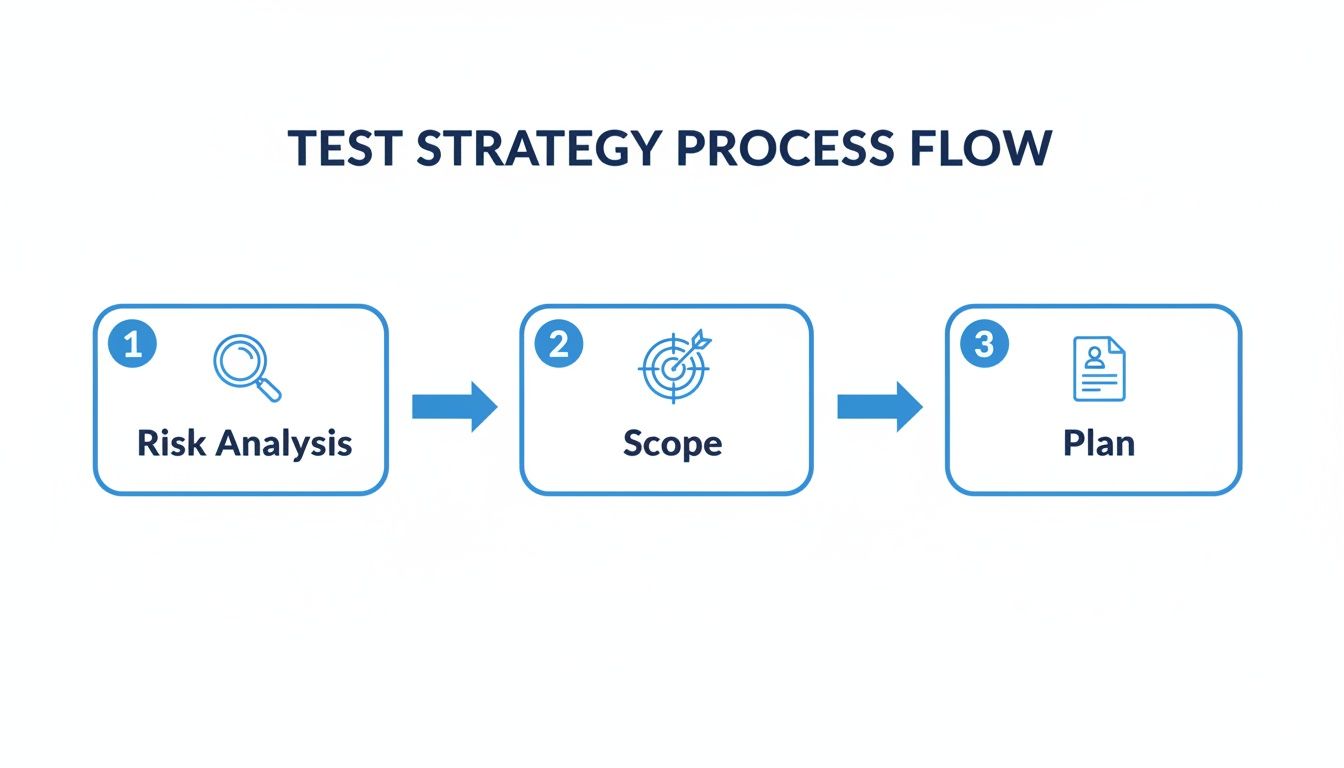
This visual underscores that a good plan is the final output of a strategic process, which makes validating it against real-world scenarios even more critical for success. To dig deeper into this approach, check out our guide on how to replay production traffic for realistic load testing.
By integrating real traffic into your validation process, you transform your test plan from a static document into a dynamic, reliable blueprint for shipping quality software.
Common Pitfalls and Best Practices
Creating a test plan is one thing. Creating one that actually prevents disasters and guides the team to a successful launch? That’s a whole different ball game. Too many teams fall into the same traps, turning a powerful strategic document into a bureaucratic chore that just gathers dust.
Let’s break down the common mistakes and, more importantly, the practices that separate a truly effective test plan from a forgotten file. The secret is to stop thinking of your plan as a static contract written in stone and start treating it like a dynamic playbook for game day. A coach adjusts the strategy based on what’s happening on the field, and a great test team does the same.
Embrace a Living Document Mindset
The single most common mistake is treating the test plan as a “one-and-done” task. The team spends weeks crafting the perfect document, gets all the signatures, and then promptly files it away, never to be seen again. This approach is completely broken. Projects are messy—requirements change, timelines slip, and unexpected problems always pop up.
A test plan that isn’t updated is a test plan that’s already obsolete. Its value lies not in its initial creation but in its continuous alignment with the project’s current state. It should be a compass, not an anchor.
The best practice is simple: treat your test plan as a living document. Schedule regular, quick check-ins to review and update it. Did a new feature just get added? Update the scope. Did the dev team uncover a nasty technical risk? Get it into the risk analysis and reshuffle your priorities. This is how the plan stays relevant and genuinely useful.
Tie Every Test to a Business Goal
Another classic pitfall is writing test objectives in a technical vacuum. A plan full of goals like “Test the login API endpoint” is okay, but it’s weak. It doesn’t tell anyone why it matters.
Contrast that with a business-focused objective: “Verify users can securely access their accounts to prevent data breaches and maintain customer trust.” See the difference? Now we’re talking about business impact.
The best practice here is to link every single testing objective directly to a business requirement. This small change in framing makes a huge difference:
- It clarifies priority: When you’re short on time, it’s immediately obvious which tests are non-negotiable because they protect core business functions.
- It improves communication: Stakeholders instantly get the value of your work because you’re speaking their language.
- It focuses the team: Testers aren’t just hunting for bugs; they’re actively validating the company’s goals.
This strategic mindset is a hallmark of mature QA organizations. It’s also a key reason the global Testing as a Service (TaaS) market, valued at USD 4,541.8 million in 2023, is projected to hit USD 11,376.8 million by 2030. Companies are increasingly seeking out experts who can build test strategies tied directly to business outcomes. You can explore more data on the TaaS market growth to see how this trend is shaping the industry.
Avoid Vague Scope and Unclear Boundaries
Perhaps the most destructive mistake of all is a poorly defined scope. When the lines between “in-scope” and “out-of-scope” are blurry, you’re just inviting scope creep. Before you know it, the QA team is being asked to test “just one more little thing,” schedules blow up, and the plan becomes a source of conflict instead of a source of clarity.
To prevent this chaos, your test plan must be unambiguously clear about its boundaries. Don’t just list what you will test; make a point to explicitly list what you will not test.
Test Plan Do’s and Don’ts
To make it even clearer, here’s a quick cheat sheet comparing effective strategies with the common mistakes that derail test plans.
| Effective Strategy (Do) | Common Mistake (Don’t) |
|---|---|
| Collaborate and Iterate | Treat the plan as a static, solo task. |
| Link to Business Value | Write technical, isolated objectives. |
| Define Strict Boundaries | Leave the scope open to interpretation. |
| Prioritize Based on Risk | Try to test everything equally. |
By building a collaborative, business-aligned, and clearly defined plan, you’re not just writing a document. You’re creating a powerful tool that guides your team to success instead of holding them back.
Got Questions About Test Planning?
Even with a solid grasp of the basics, a few practical questions always seem to pop up when you’re in the trenches creating and executing a test plan. Let’s tackle some of the most common ones to clear up any confusion and get you planning with confidence.
What’s the Difference Between a Test Plan and a Test Strategy?
This one trips up a lot of people. They’re often used interchangeably, but they operate at completely different levels. Think of it like a country’s foreign policy versus a specific diplomatic mission.
A test strategy is your high-level, guiding philosophy. It’s the big-picture document for your entire organization that defines the “why” behind your testing approach—your standards, principles, and overall commitment to quality.
A test plan, on the other hand, is the boots-on-the-ground action plan for a specific project. It takes the ideas from your strategy and makes them real, answering the practical questions: “How, what, and when are we going to test this feature or this release?”
In short, your test strategy is the long-term vision for quality across all projects. Your test plan is the detailed roadmap for making that vision a reality on a single project. One is the philosophy; the other is the execution.
Getting this distinction right is key. It helps you stay consistent across your organization while giving individual projects the flexibility they need.
How Detailed Should a Test Plan Be?
There’s no magic number here. The right level of detail depends entirely on your context. The goal is clarity, not a high word count. A plan just needs to be detailed enough to stamp out ambiguity and let anyone on the team understand what needs to be done.
Think about these two very different scenarios:
- A small, fast-moving Agile team: A lightweight plan is probably all you need. It could be a simple document focusing on the scope, key objectives, and risks for the next sprint. The whole point is to stay nimble.
- A project in a regulated industry like finance or healthcare: You’ll need a much more formal, exhaustive document to meet compliance standards. This plan would meticulously detail everything from specific test cases and environment configs to traceability matrices that tie every test back to a legal requirement.
Here’s the ultimate test: Can a new team member pick up this document and understand the entire testing process without needing their hand held? If the answer is yes, you’ve probably nailed it.
Who Is Responsible for Writing the Test Plan?
While one person usually holds the pen, creating a test plan should never be a solo effort. The best plans are born from collaboration, not created in a vacuum.
Typically, the Test Lead or QA Manager is the one who owns the document. They’re responsible for pulling it all together, gathering input, and keeping it current.
But they should be acting more like a facilitator than an author. A truly solid test plan pulls in expertise from all over:
- Developers can give you the ground truth on technical complexity, risky areas of the code, and potential integration headaches.
- Project Managers help make sure the plan lines up with the project’s timeline, budget, and available resources.
- Business Analysts are there to confirm that your testing objectives actually map back to what the business and the users really need.
When everyone chips in, you end up with a plan that’s comprehensive, realistic, and has buy-in from the whole team.
How Does a Test Plan Work in Agile Development?
The traditional, massive, upfront test plan just doesn’t fly in an Agile world. The focus shifts from exhaustive pre-planning to a more continuous, adaptive approach. An Agile test plan isn’t a static contract; it’s a living document that grows and changes right along with the project.
Agile teams often break it down into layers:
- Master Test Plan: This is the high-level guide. It outlines the overall test strategy, tools, and quality goals for the whole project. It rarely changes.
- Sprint-Specific Test Plans: These are lightweight, focused plans created for each sprint. They get into the nitty-gritty of which user stories are being tested, the scope for that cycle, and who’s doing what.
This approach gives you the strategic direction you need without killing the flexibility that makes Agile work. It’s all about planning just enough, just in time.
Ready to validate your test plan against real-world chaos? GoReplay helps you capture and replay live production traffic, ensuring your application is truly battle-tested before it reaches your users. Discover how to build more resilient software by visiting https://goreplay.org.