
What Is Compliance Testing for DevOps
Passing functional QA doesn’t mean your system is compliant. A test can confirm that a valid user can log in, a payment can complete, or an API can return the expected response while missing the control failure an auditor cares about. The question isn’t whether the feature works in a clean test case. It’s whether the security, privacy, and operational controls work correctly under representative conditions, and whether you can prove that they did.
So, what is compliance testing in a DevOps environment? It’s a structured process for evaluating whether systems, processes, and safeguards satisfy defined legal, regulatory, contractual, or internal requirements. The engineering challenge is turning those requirements into repeatable tests that produce trustworthy evidence, expose failed controls, and preserve a clear record from obligation to remediation.
Redefining Compliance Testing for Engineering Teams
A policy document can say that administrators must use strong authentication. A functional test can show that an administrator successfully signs in. Neither result proves that the deployed system blocks a weak authentication path, applies the rule to every privileged service, or records the event in an audit log.
That gap between declared control and observed behavior is where compliance testing earns its value. NIST’s control-assessment guidance separates the control itself from the assurance gained by assessing it. Its Special Publication 800-53 Revision 5 organizes security and privacy requirements into 20 control families, while its assessment approach asks whether controls are implemented correctly, operating as intended, and producing the required outcome.
A policy is not evidence of operation
In an audit, “we have a policy” answers a design question. It doesn’t answer an operating question.
For an authentication control, engineering evidence might include:
- Configuration state: The identity provider and application settings enforce the intended authentication policy.
- Execution records: Access logs show successful and rejected attempts, including privileged access.
- Negative-path results: A deliberately invalid or incomplete authentication attempt is rejected as expected.
- Change history: The team can connect the deployed configuration to an approved change and identify who reviewed it.
- Repeatable output: Another qualified person can reproduce the test and reach the same conclusion.
The same principle applies to encryption, authorization, change management, backup restoration, logging, and incident response. A system may contain the right code and still fail because a deployment variable disables it, a service uses a different path, or an exception was never removed.
Practical rule: Test the control where it actually runs, not where the architecture diagram says it should run.
Compliance becomes an engineering artifact
The useful unit of compliance isn’t a binder of screenshots. It’s a relationship between a requirement, a control objective, a test scenario, expected behavior, collected evidence, and a remediation record.
That relationship makes compliance testing repeatable. Teams can run the same check after an infrastructure change, compare results over time, investigate deviations, and show an auditor why a finding was opened or closed. It also makes ownership clearer. Developers own application behavior, platform engineers own deployment and access configuration, security teams define assurance needs, and control owners approve exceptions.
This doesn’t make external assessment unnecessary. Independent review can identify gaps in scope, challenge assumptions, and test whether the evidence is sufficient. But an external audit shouldn’t be the first time anyone discovers that a control only works in a diagram or in a developer’s laptop.
Navigating Regulatory Privacy and Security Frameworks
Compliance requirements depend on the data handled, services operated, contracts signed, and systems included in scope. A privacy assessment asks different questions from a payment-card assessment, even when both review access control, logging, and encryption. Treating every framework as one universal test suite creates noise and leaves gaps at the boundaries between systems.
Start with the obligation, not the testing tool. Identify the applicable framework or contract, map the assets and data flows in scope, then translate the wording into control objectives and observable system behavior. This prevents teams from testing every environment just because a framework exists somewhere in the organization.
Compare the purpose before choosing the test
| Framework | Primary Focus | Key Technical Evidence Required |
|---|---|---|
| HIPAA | Protection and handling of health information | Access records, authorization behavior, audit trails, risk responses, and evidence that safeguards operate in relevant workflows |
| GDPR | Privacy rights, lawful data handling, and protection of personal data | Data-flow records, access controls, retention behavior, masking or deletion results, and evidence that processing safeguards work as designed |
| SOC 2 | Trust-service controls across security and related operational practices | Control descriptions, configuration records, tickets, approvals, monitoring output, and repeatable operating evidence |
| PCI DSS | Protection of payment-card data and the cardholder data environment | Segmentation tests, access records, configuration evidence, vulnerability and security testing output, and remediation records |
| Internal policy | Organization-defined risk and operating requirements | Approved procedures, system settings, execution logs, exceptions, ownership records, and retest results |
The categories overlap, but their scope and evidence requirements differ. One access-control test may support several frameworks, while each framework can define different populations, systems, review duties, or retention rules. Reuse evidence only when it demonstrates the specific obligation. A screenshot of a setting rarely proves how the service behaves under real traffic.
Production-traffic replay makes that distinction visible. Replay sanitized requests through the same gateways, services, and authorization paths used in production, then compare expected and observed behavior. Masking must remove sensitive values while preserving the conditions that exercise the control. The resulting request, response, configuration, and log trail can show whether a safeguard operated across the workflow, rather than merely existed in a document. Store the evidence with restricted write access and integrity checks so later changes are detectable.
PCI DSS shows why precise requirements matter. Its testing expectations turn broad network-security language into a defined activity for service providers that rely on segmentation. The PCI DSS assessment history and testing requirements describe penetration testing of segmentation controls at least every six months and after changes to the segmentation method. A general application regression suite cannot satisfy that requirement because the test target is the boundary itself.
Build scope before test coverage
Scope decisions affect cost and assurance more than the choice of test framework. Include services that store, process, transmit, administer, or protect regulated data, plus deployment paths and third parties that can change those services. Record exclusions with a reason, owner, and risk decision. Leaving an asset off a spreadsheet does not remove its risk.
The output should be a framework-specific control matrix. Record the obligation, affected asset, control owner, test frequency, evidence location, and events that trigger reassessment. Developers then get a concrete release question: which behavior must this release prove?
The Three Pillars of Control Assessment
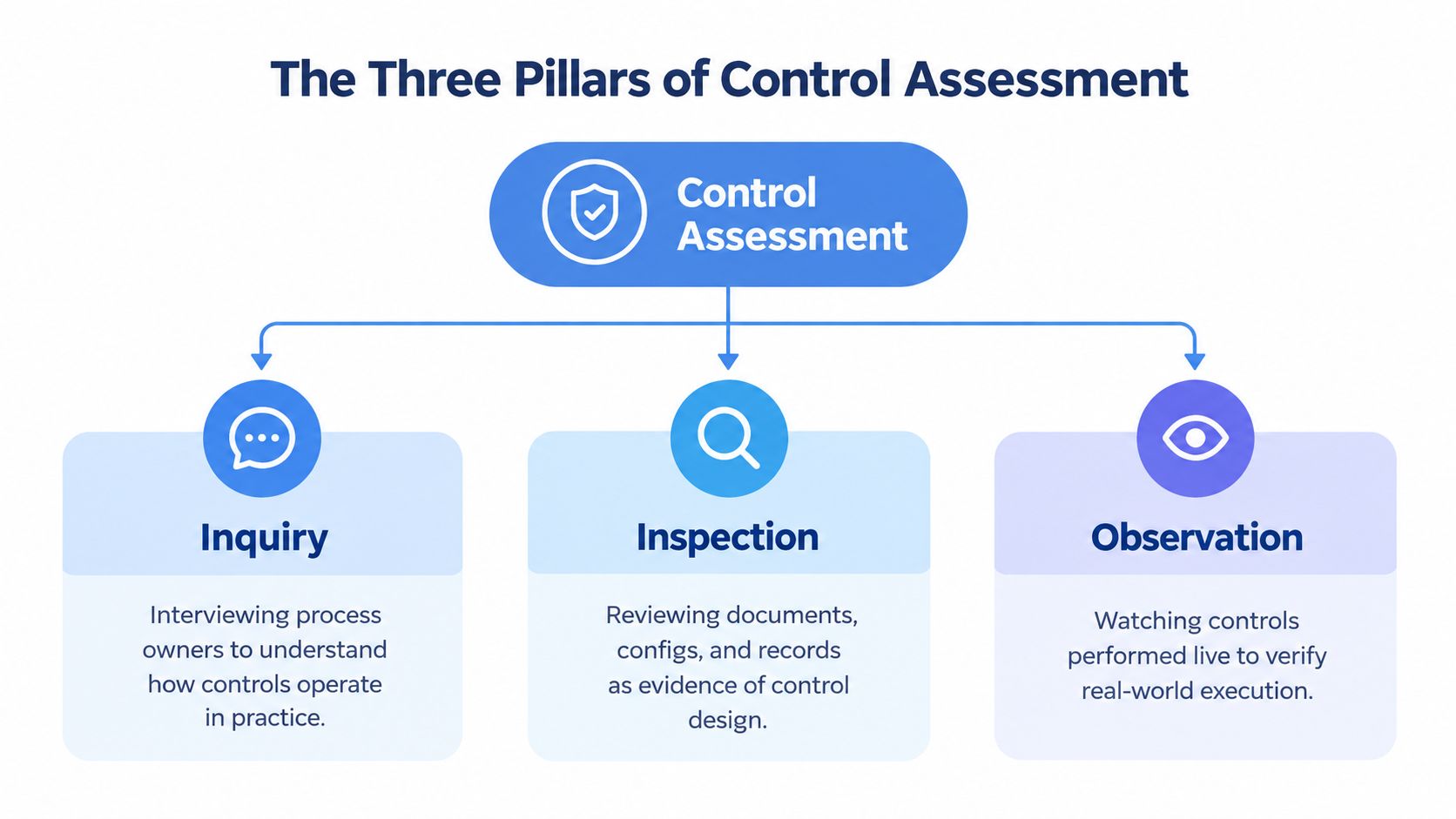
NIST describes three complementary assessment methods: examine, interview, and test. Each reveals a different part of the control. Documentation shows how the organization says a process should work. Interviews reveal how people understand and perform it. Technical testing shows what the mechanism does under specified conditions.
Examine the designed control
Examination covers specifications, architecture documents, policies, configurations, records, tickets, and other artifacts. It can answer whether a control has been defined, whether a service is supposed to emit audit logs, and whether a change received the required approval.
It can’t reliably prove that the system followed the design during execution. A configuration export may show that logging is enabled, but it won’t necessarily show that every relevant request generated an event, that events reached the retention system, or that an operator could not alter them without detection.
Interview the people who operate it
Interviews expose operational knowledge that documents often omit. Ask the service owner how access is granted, the on-call engineer what happens during an alert, and the release manager how emergency changes are reviewed. Their answers can reveal undocumented dependencies, manual workarounds, and controls that exist only because one experienced person remembers a procedure.
Interview evidence is valuable, but it’s vulnerable to misunderstanding and memory gaps. People describe intended practice, especially when the question sounds like an audit question. Their answers should shape test cases and identify evidence sources, not replace execution evidence.
Teams that are still defining boundaries can use a practical guide to scoping and controls for compliance risk before writing test cases. Clear scope gives interviews a useful target and keeps technical tests from drifting into unrelated assurance work.
Test the mechanism under realistic conditions
Technical testing compares observed behavior with expected behavior. It can evaluate whether a control exists, functions correctly, covers the necessary paths, and produces the intended result.
For an authorization control, don’t stop at a successful request from an approved user. Test an unauthorized role, an expired session, a direct object reference, a background worker, and a failure path that should still create an audit record. For backups, test restoration rather than merely checking that backup jobs report success. For change management, verify that a production-relevant configuration change creates the required approval and traceability.
NIST’s assessment method treats these approaches as complementary, but technical execution is the strongest defense against false assurance. A policy and an interview may establish intent. A controlled test establishes whether the deployed mechanism delivered.
Designing an Audit-Ready Testing Workflow
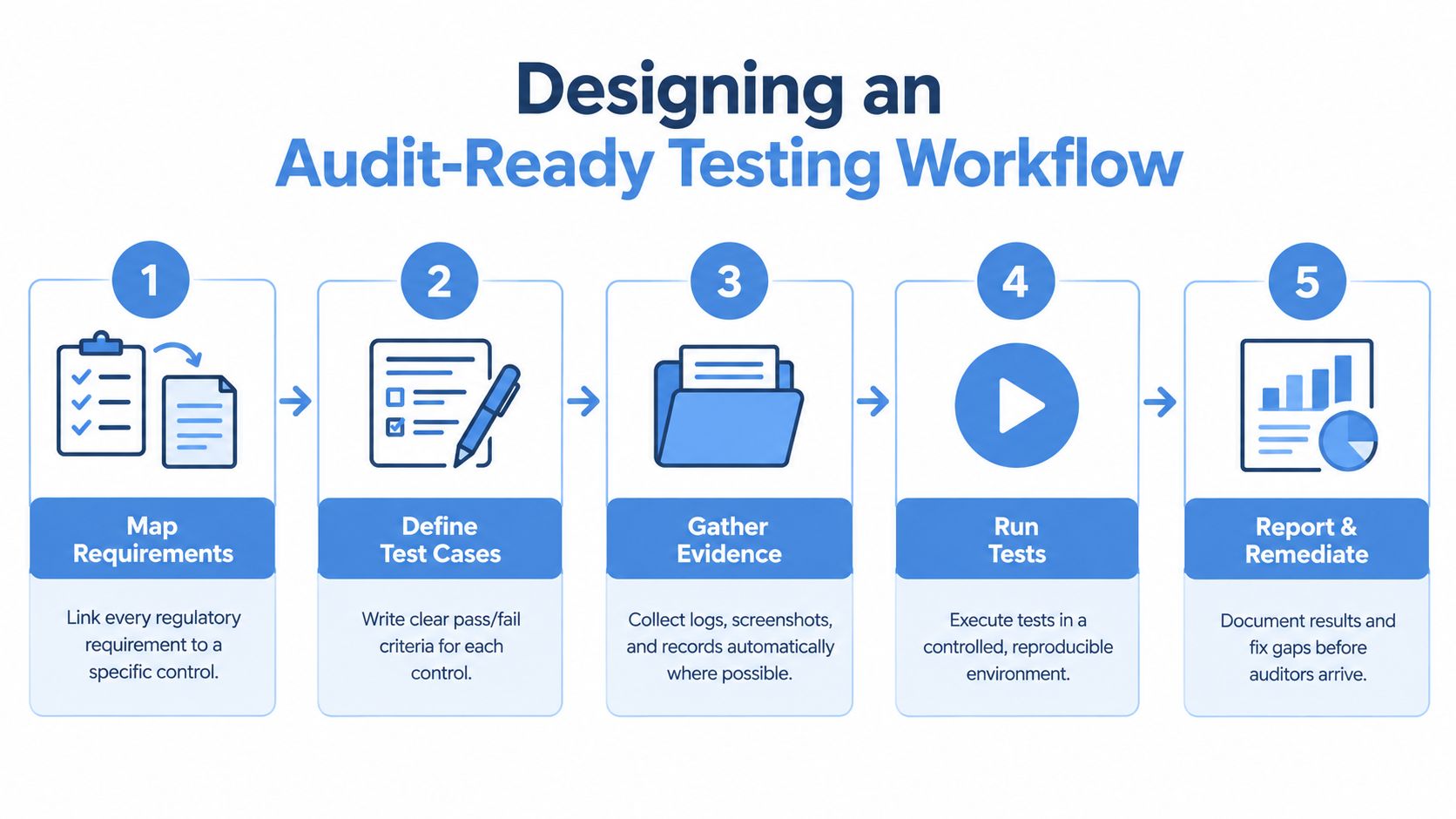
An audit-ready test starts with a requirement and ends with evidence that someone else can understand without a meeting. The workflow below is deliberately close to a software delivery workflow. Requirements become testable objectives, tests produce artifacts, failures become tracked work, and retests close the loop.
Start with a control contract
For each requirement, record five things:
- Control objective: State the protection or outcome in operational terms.
- Test scenario: Define the request, event, configuration, or process to execute.
- Expected result: Write objective pass and fail conditions.
- Evidence artifact: Identify the logs, records, outputs, approvals, or screenshots to retain.
- Ownership and remediation: Assign the control owner and the person responsible for resolving a failure.
NIST’s assessment procedures for Revision 5 support this model by emphasizing selected procedures, methods, objects, depth, and coverage that match the control and system environment. The point isn’t to maximize the number of tests. It’s to cover the failure paths that matter while removing duplicated effort.
A vague case such as “verify encryption” is not executable. A stronger case identifies the relevant data flow, checks the effective configuration, sends a representative transaction through the path, verifies the resulting behavior, and stores the output with a timestamp and environment identifier.
Capture evidence as the test runs
Evidence collection should be part of the test harness, not a manual task left for the end of the quarter. Store the test definition, input or fixture identifier, environment, commit or deployment reference, execution time, result, and relevant logs together. Where screenshots are needed, supplement them with machine-readable output because screenshots are difficult to search, compare, or validate.
A finding should state the failed condition, affected asset, severity, evidence reference, corrective action, owner, and retest result. Don’t write “authentication issue” when the actual failure is “the service accepted a session after the required expiration condition.” Specific language makes remediation possible.
Control the test environment
Risk-based testing doesn’t mean testing carelessly. Use an isolated or production-like environment with side effects disabled, sanitize sensitive inputs, and define who can approve and execute the run. If replayed requests can send email, create orders, charge accounts, or modify customer records, add explicit guards before execution.
For cryptographic controls, teams often need a separate evidence trail for key creation, approval, rotation, access, and retirement. A focused resource on how to build a crypto audit process can help connect those operational events to the broader control matrix.
Finally, preserve evidence against casual alteration. Restrict write access, retain hashes or equivalent integrity indicators where appropriate, and keep the relationship between the original result and any exported report. The auditor needs to see not only the conclusion, but also how the conclusion was produced.
Safely Replaying Production Traffic for Realistic Validation
Synthetic tests are clean by design. Production traffic isn’t. Real requests contain unusual sequences, optional fields, stale sessions, retries, malformed input, authorization differences, and state transitions that scripted happy paths rarely reproduce. Those behaviors often expose the difference between a control that works in theory and one that survives actual application use.

The obvious response, copying live traffic and data into staging, creates a different problem. PCI DSS 4.0 Requirement 6.5.4 prohibits using real production account data in test or development environments, so realistic validation must separate traffic realism from raw data. The data-masking guidance for production-like testing describes why masking, anonymization, or pseudonymization is needed before sensitive data enters a non-production environment.
Preserve behavior without preserving identity
A useful transformation retains the properties the test needs:
- Protocol structure: Methods, paths, headers, content types, and response relationships remain valid.
- State transitions: A login can precede a session request, and a session can precede an authorized action.
- Referential integrity: A masked customer identifier remains consistently linked across related requests.
- Edge-case patterns: Invalid values, retries, missing fields, and error paths remain available for testing.
- Privacy boundaries: Personal, payment, credential, and account data are tokenized, redacted, or replaced with controlled fixtures.
Masking isn’t automatically safe because a field was renamed or partially hidden. Teams should evaluate re-identification risk, access controls, retention, purpose limitation, and whether transformed values can be joined with another dataset. They should also verify that masking didn’t remove the relationship that makes the test meaningful.
A record-and-replay workflow can capture HTTP requests, apply filtering and transformation, and send the sanitized workload to an isolated service. The production-data masking workflow for testing is relevant when the objective is to preserve request behavior while removing sensitive values from the test corpus.
Make replay evidence reproducible
A replay becomes compliance evidence only when the team can explain what was captured, what was transformed, what was excluded, where it ran, and what result was expected. Record the masking rules, fixture version, test environment, deployment identifier, timestamps, response comparisons, and application-state checks. Keep the original sensitive capture out of the test system, and limit access to any controlled source material.
Replay also needs guardrails. Disable external side effects, isolate queues and databases, prevent outbound notifications, and use test credentials with narrowly defined permissions. A realistic request without realistic consequences is the right balance for most validation work.
The video below provides additional context for using traffic replay as part of controlled testing.
Executing a Shadow Test for Network Segmentation
A network-segmentation test passes only when it proves the boundary under realistic application traffic. Healthy responses are not enough. The evidence must show that an allowed path reaches the intended service while requests outside the permitted boundary cannot access the cardholder data environment.
Start by defining the boundary and exclusions. Identify the candidate service, protected service, permitted routes, denied routes, and production side effects that must never occur. Obtain authorization from system owners before capturing or replaying traffic. Sensitive fields must be sanitized before the workload leaves the controlled source environment.
Capture at the right observation point
If the application terminates TLS at a trusted internal boundary, the team can observe the plaintext HTTP request after termination, subject to authorization and data-protection controls. That request includes the method, path, headers, body structure, and session context received by the application. Capturing earlier may leave the payload encrypted. Capturing later may omit the network behavior required to validate segmentation.
Filter the workload to relevant routes, then transform regulated values while preserving the relationships that make the requests meaningful. Run the candidate service in an isolated environment with writes, notifications, payment actions, and external integrations disabled. Replay ordinary requests alongside sequences that exercise authorization, session handling, error behavior, and logging.
A shadow test sends captured traffic to a candidate service without replacing the live response path. The shadow testing documentation describes this pattern. The engineering and security teams still define the control objective, masking rules, isolation boundaries, and acceptance criteria.
Compare more than status codes
A successful status code does not demonstrate that segmentation worked. Compare response codes and bodies where safe, then inspect application state, audit events, downstream calls, and network telemetry. A denied request should remain denied, expose no protected content, and produce the expected security record.
Treat the evidence as an engineering artifact, not a screenshot collected for an auditor. Store the capture identifier, transformation rules, fixture version, deployment identifier, timestamps, response comparisons, and application-state checks in controlled, append-only records. Preserve access history and approvals so another engineer can reproduce the test and identify any alteration.
For each route, preserve:
- The intended boundary: Which source and destination relationship the test represents.
- The expected decision: Allow or deny, with the control objective stated plainly.
- Observed behavior: Response, logs, state changes, and relevant network evidence.
- Failure interpretation: Whether the issue is routing, authorization, service configuration, logging, or test setup.
- Remediation status: The change made, approval reference, and retest result.
Service providers using network segmentation must penetration-test those controls at least every six months and after changes to the segmentation method, as documented in the PCI DSS testing requirements. A shadow test can strengthen the evidence package by exercising realistic application paths, but it does not replace a required penetration test. Compliance testing, penetration testing, performance testing, resilience testing, and ordinary QA can support the same assurance effort while retaining different objectives and evidence.
Avoiding Common Pitfalls and Building Continuous Assurance
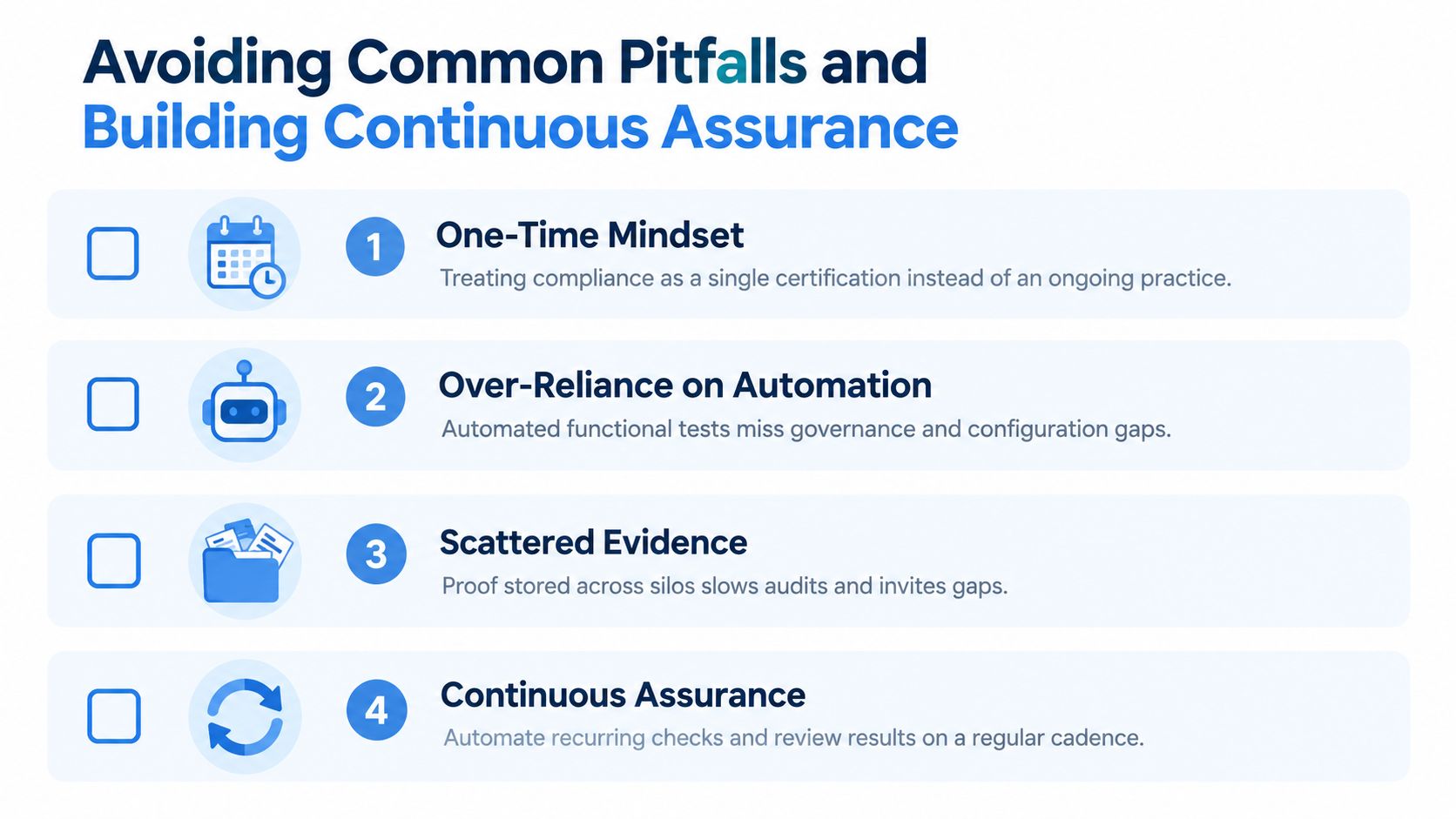
The most damaging compliance mistake is treating the audit date as the start of testing. By then, teams often discover that evidence is scattered, control owners have changed, test environments contain unsafe data, and a passing functional suite says nothing about the configuration that reached production.
Replace the common shortcuts
One-time certification mindset creates long gaps between assurance activities. A control can drift after an infrastructure change, identity-provider update, vendor integration, or emergency release. Put recurring checks on the same planning surface as deployment and operational work.
Automated functional QA alone misses governance, evidence, and configuration failures. A test may confirm that a user can complete a workflow while failing to verify whether the event was logged, whether a denied path stayed denied, or whether the approval record exists. Add control-specific assertions and retain their output.
Scattered evidence turns a straightforward audit request into an archaeology project. Store test definitions, results, approvals, logs, exceptions, and remediation records with stable identifiers. The evidence repository should tell a coherent story without requiring the original engineer to reconstruct it from memory.
Uncontrolled realism can expose production data or trigger real side effects. Mask inputs, isolate environments, restrict credentials, and verify that transformed traffic still represents the regulated workflow before relying on the result.
Put assurance into the delivery system
A practical pipeline doesn’t run every possible compliance test on every commit. It selects checks according to risk and change impact. A change to authorization code should trigger permission-path tests and audit-log assertions. A network change should trigger boundary validation. A logging configuration change should verify event generation, delivery, retention, and access restrictions.
Keep human review where judgment matters. Automated checks can compare responses, inspect configuration, and collect logs. They can’t decide whether a new data flow changes regulatory scope or whether an exception remains acceptable. Assign those decisions to named owners, record them, and make the approval part of the evidence.
DORA has moved resilience expectations toward ongoing assurance. The ISACA discussion of NIS2 and DORA requirements notes that financial entities must maintain operational-resilience testing and address vulnerabilities identified through testing. That direction favors teams that continuously connect requirements, realistic scenarios, evidence, and remediation instead of staging a last-minute compliance performance.
The senior-engineering view is simple: compliance belongs in the system’s feedback loops. Build the control matrix beside the service, run representative tests after meaningful changes, protect the test data, and make every failure actionable. When an auditor asks whether a safeguard works, your answer should be a reproducible result, not a promise that someone checked the policy.
GoReplay captures and replays live HTTP traffic into isolated test environments, giving engineering teams a practical way to validate real workflows, compare behavior, and support compliance evidence when paired with masking and a control matrix. Visit GoReplay to evaluate how traffic replay can fit into your audit-ready testing workflow.