
What Is Cassandra and How Does It Actually Work
You usually start asking about Cassandra when the current database has become the bottleneck you can’t ignore anymore. Writes keep climbing, downtime is no longer acceptable, and the next requirement is often geographic reach, not just more hardware in one room. At that point, the question isn’t whether Cassandra is “modern.” It’s whether your workload needs a distributed database that stays available when parts of the system fail, even if that means giving up some of the convenience you’re used to in SQL.
Why Teams Reach for a Distributed Database
A team reaches for Cassandra when the business asks for two things at once, more write capacity and less fragility. That combination shows up in event pipelines, user activity feeds, telemetry, session stores, and other systems where data arrives continuously and the service still has to answer quickly when a node, rack, or datacenter misbehaves. Cassandra’s appeal is not that it replaces relational databases everywhere. It’s that it’s built for a specific operational pressure.
The first decision is about tolerance, not syntax
If your team can afford to stop the world for maintenance or depend on one primary node to serialize writes, Cassandra is probably the wrong fit. If you need the system to keep taking writes while infrastructure changes underneath it, Cassandra starts to make sense. Its design trades relational joins and ad hoc querying for partition-oriented scalability and multi-master availability.
The mental model should be simple. You are not choosing a database because it has a wide-column label. You are choosing how your data will behave when the cluster is under stress, when requests arrive out of order, or when the network stops being perfectly polite.
Practical rule: If the most important question is “Can this keep serving traffic during failure?”, Cassandra belongs in the evaluation. If the most important question is “Can I ask arbitrary questions later?”, it probably doesn’t.
The rest of this guide is about the questions that matter in production, how data gets distributed, how reads stay available, and where the trade-offs show up once failure is part of the design instead of an edge case.
The Peer-to-Peer Architecture Behind Cassandra
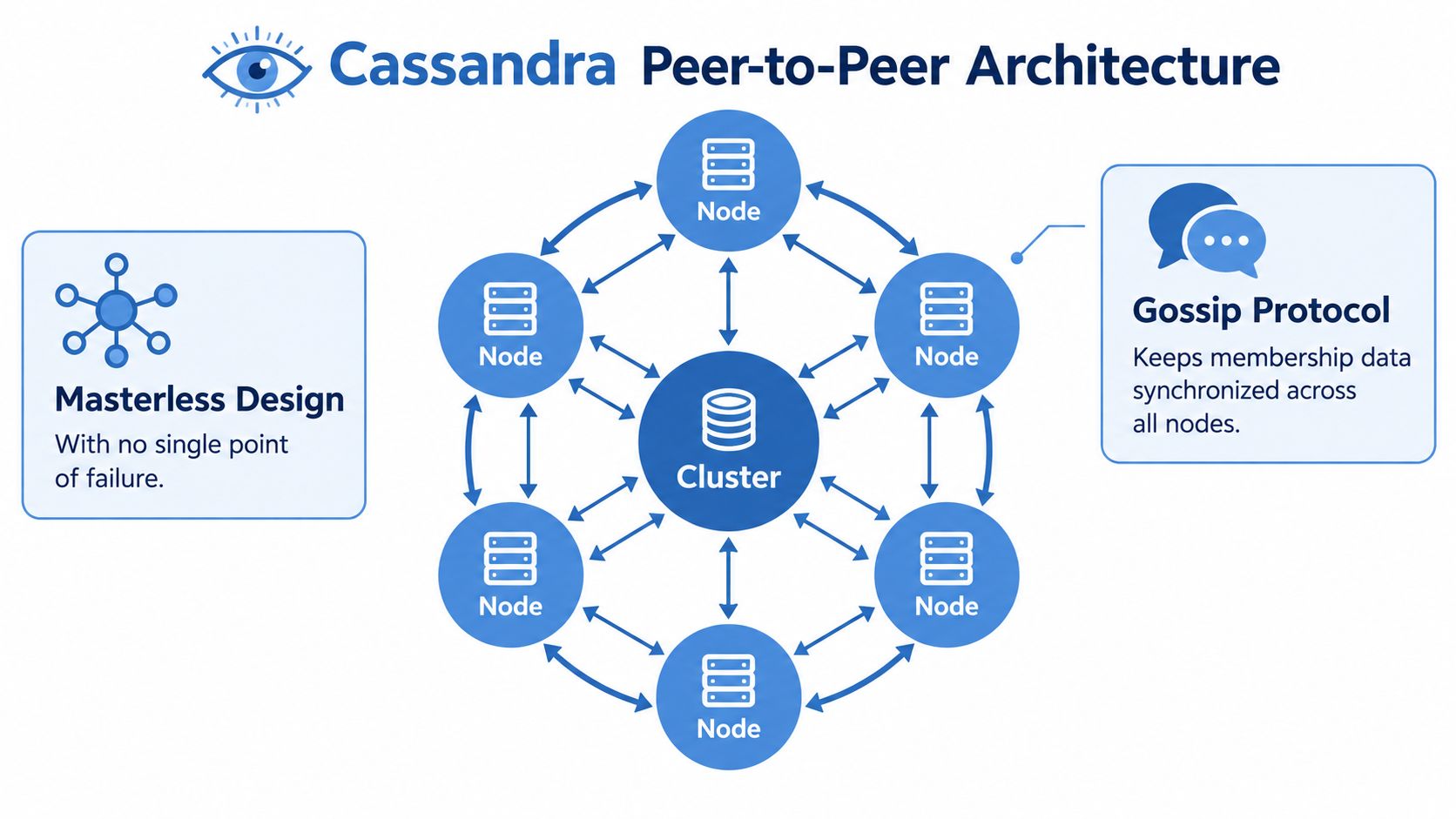
Cassandra is easiest to understand if you stop looking for a primary node. There isn’t one. Every node can accept a write, every node can answer a read, and the cluster behaves like a set of peers that share responsibility rather than a stack with a boss at the top. That is why teams use it for always-on systems, there’s no single node that must stay alive for the database to exist.
How the ring actually works
A partition key is hashed with a variant of consistent hashing to choose a token range, and that token range points to the nodes responsible for the data. In practice, that means Cassandra spreads partitions across the cluster by key, not by table in the relational sense. The same idea explains why a good partition key matters so much, the key is not just a lookup field, it is also the routing mechanism.
Gossip keeps the cluster’s membership and state moving between nodes. Each node shares what it knows with others, so the ring stays aware of who is alive, who is moving, and who needs work redistributed. Virtual nodes, or vnodes, help smooth rebalancing and recovery because data ownership is split into smaller chunks instead of one large range per node. When a node joins or leaves, Cassandra doesn’t require a manual reshuffle of the entire dataset.
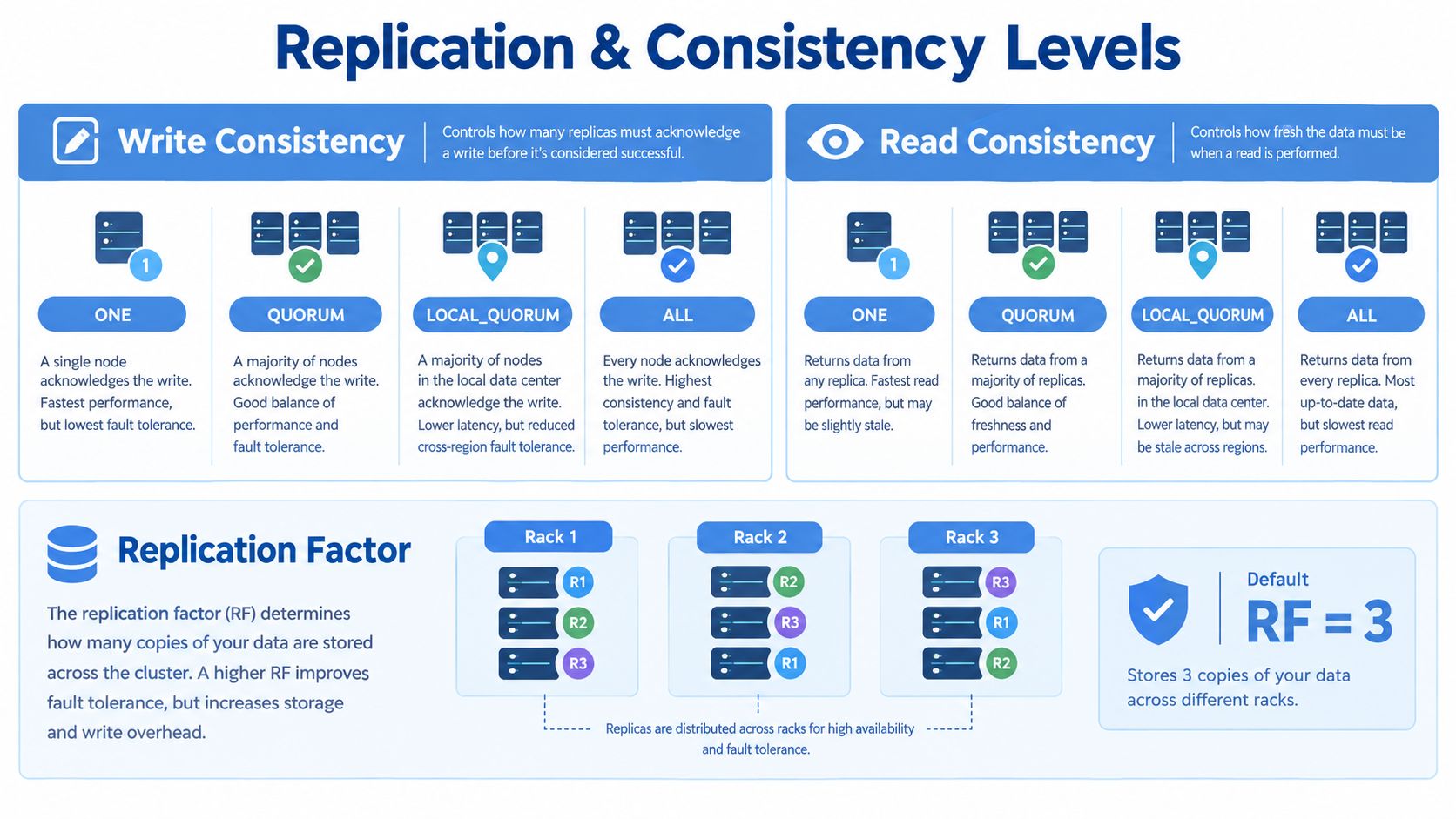
Think of writes like a coordinator handing a request to the replicas that own the key. Reads work the same way, except the coordinator gathers what it needs from the replicas and reconciles the result according to the chosen consistency level. The design is what lets Cassandra keep running when the cluster is uneven, but it also means you need to think about routing and replication before you think about query syntax.
Operational shortcut: In Cassandra, key choice is architecture. A bad key doesn’t just slow a query, it can create a hot node and distort the whole cluster.
Data Modeling with CQL and Partition Keys
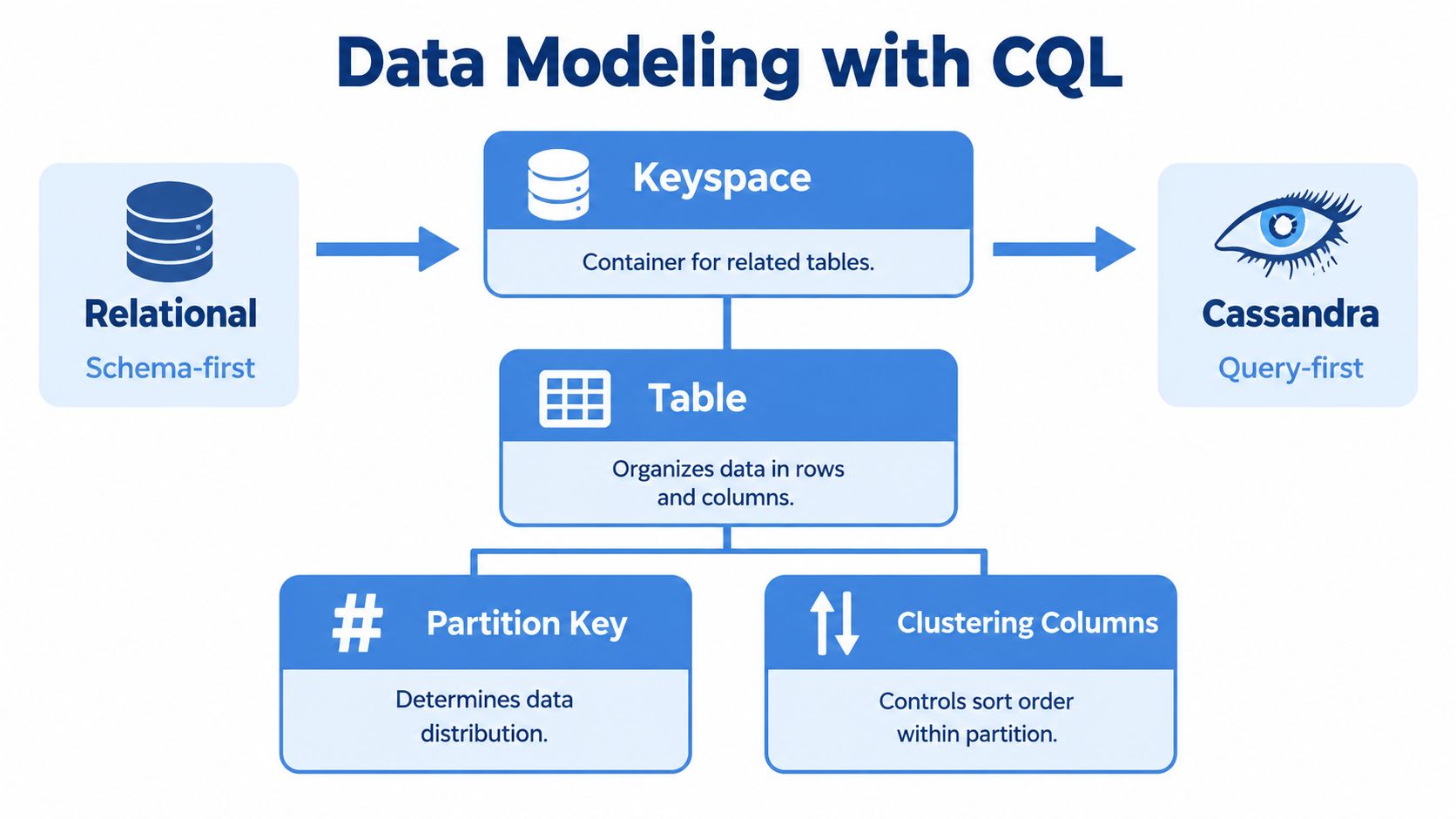
CQL looks familiar enough to lull SQL users into false confidence. It has keyspaces, tables, rows, and columns, but the design rules are different because Cassandra is built around queries that already matter, not a schema that can be mined later with joins. The table shape should come from the access path, then the primary key should make that path efficient.
Partition first, then everything else
A partition key decides where data lives and how requests are routed. A clustering column decides how rows are ordered within that partition. A simple partition key is a single field, while a compound partition key combines fields so the partition can be bounded and distributed more evenly.
SQL habits can mislead you here. In a relational system, you might normalize data and rely on joins later. In Cassandra, you often denormalize on purpose, because the table needs to answer one shape of request without cross-partition work. The verified data points out that schema should follow application query patterns, and that compound partition keys or bucketing are how you keep partitions from growing without bound.
Why oversized partitions hurt
Large partitions create read amplification, more compaction work, higher repair cost, and a bigger chance that one hot key limits throughput. They also make replay-window reads and parallel processing less predictable. For a traffic replay or load testing platform, that means the practical key usually includes a bounded combination such as tenant, endpoint or session bucket, and time window, not a low-cardinality field like HTTP method alone.
Rule of thumb: If a partition keeps growing forever, the table is working against you.
The useful test is simple. Ask which query needs the data, then ask whether the partition key keeps that query local and bounded. If the answer is no, the model needs to change before the cluster does.
Replication, Consistency and What Eventual Consistency Means in Practice
Cassandra’s replication model is where the trade-offs become visible. The phrase “eventually consistent” can sound abstract until you ask a practical question, such as, “How many replicas need to agree before I trust this write?”
Replication factor and acknowledgments
A replication factor sets how many physical copies of each partition exist, and those copies can span racks or datacenters. Writes are sent to the replicas, while the chosen consistency level decides how many acknowledgments the coordinator waits for. With RF=3, QUORUM means at least two replica responses, while ONE means only one. ONE gives lower latency and better availability, but it also weakens read-after-write guarantees.
Reads follow the same rule set. If a coordinator reads from fewer replicas, it can return older data while another replica still has a newer version or a pending reconciliation. Cassandra timestamps mutations, including deletes, and uses last-write-wins conflict resolution, so clock discipline and idempotent ingestion both matter. Tombstones, which represent deletes, live in that same distributed versioning system, so they need careful handling too.
What failure looks like in practice
A write can be acknowledged, then a later read can still return the older value if the replicas that answered the read have not converged yet. That is the contract you get when you choose lower coordination overhead instead of immediate global agreement. Hinted handoff, read repair, and repair jobs help replicas catch up, but they do not make every happy-path test tell the truth about failure.
That gap between “write succeeded” and “every later read sees it” is why QA and DevOps teams need workload-level validation, not just integration checks against an ideal cluster. Stale reads under failure resemble the isolation anomalies covered in our transaction isolation guide (https://goreplay.org/blog/transaction-isolation/).
Practical rule: Test the combination of RF, read and write consistency levels, retries, and repair, not each setting in isolation.
For many multi-datacenter workloads, LOCAL_QUORUM is a sensible compromise because it keeps most coordination local while still giving stronger guarantees than ONE. The right choice still depends on how much staleness your application can tolerate, and the only honest way to prove that is to break the happy path on purpose.
Writing and Querying Data with Simple CQL Examples

A compact example usually teaches Cassandra better than a long schema discussion. The key is to read the statement like an operator would, not just like a developer.
CREATE KEYSPACE traffic
WITH replication = {
  'class': 'NetworkTopologyStrategy',
  'dc1': 3
};

CREATE TABLE traffic.requests_by_tenant (
  tenant_id text,
  endpoint text,
  bucket text,
  request_ts timeuuid,
  status int,
  payload text,
  PRIMARY KEY ((tenant_id, endpoint, bucket), request_ts)
) WITH CLUSTERING ORDER BY (request_ts DESC);
NetworkTopologyStrategy fits multi-datacenter placement, while the compound partition key ((tenant_id, endpoint, bucket)) keeps each partition bounded and distributed by the workload’s natural slices. request_ts is a clustering column, so rows inside a partition are ordered and can be read in time order without scanning unrelated data.
INSERT INTO traffic.requests_by_tenant
(tenant_id, endpoint, bucket, request_ts, status, payload)
VALUES ('acme', '/checkout', '2026-01-08T10', now(), 200, 'ok');
That insert lands in one partition, not across a join graph. It’s fast because Cassandra knows exactly where the row belongs, and because the write path doesn’t need a primary node to serialize the operation.
SELECT tenant_id, endpoint, bucket, request_ts, status
FROM traffic.requests_by_tenant
WHERE tenant_id = 'acme'
  AND endpoint = '/checkout'
  AND bucket = '2026-01-08T10'
  AND request_ts >= minTimeuuid('2026-01-08 10:00:00')
  AND request_ts <  maxTimeuuid('2026-01-08 11:00:00');
This query stays inside one partition and uses a clustering-range filter, which is the shape Cassandra likes. Avoid ALLOW FILTERING unless you already know why the query can’t be rewritten, because it usually means the table wasn’t modeled for the request you’re making.
Prepared statements are still useful, and Cassandra’s IF syntax exists for conditional updates, but neither should be treated as a substitute for transactional design across multiple partitions. They’re tools for narrow coordination, not a general replacement for database transactions.
Comparing Cassandra to Relational and Other NoSQL Databases
Cassandra looks tempting to people comparing it to PostgreSQL, MySQL, MongoDB, or HBase, but the cleanest comparison is workload fit. Relational databases win when joins, constraints, and broad ad hoc querying matter more than horizontal write scale. MongoDB is often easier for document-shaped data. HBase fits some wide-column patterns well, especially in ecosystems built around Hadoop-style storage access.
Where Cassandra fits best
Cassandra shines when the application already knows the query shape, the write path has to stay available, and the cluster needs to keep serving under partial failure. It is a strong match for time-series workloads, event ingestion, and multi-datacenter active-active systems. The masterless design and tunable consistency are the reasons it behaves predictably when infrastructure gets messy.
That doesn’t mean it’s simple. You give up joins, flexible query exploration, and a lot of relational convenience. You also take on schema discipline, partition planning, and operational review of consistency settings. Those trade-offs are not side effects, they’re the core of the product.
New features don’t change the design contract
Cassandra 5.0 adds Storage-Attached Indexes, trie-based memtables and SSTables, vector data types and similarity functions, dynamic data masking, Unified Compaction Strategy, mathematical CQL functions, JDK 17 support, and tooling for identifying large partitions. Those are meaningful additions, especially for teams evaluating whether newer releases improve selectivity, masking, or compaction behavior. But feature availability is not the same as production suitability.
A vector function doesn’t turn Cassandra into a general-purpose relational engine. An index doesn’t remove the need to design around partition shape. The right question is whether the feature improves your real query path without creating more write amplification or tail-latency risk.
Comparison shortcut: Choose Cassandra for controlled access patterns and failure tolerance. Choose a relational database when the shape of the question changes more often than the shape of the data.
That distinction saves a lot of bad migrations. Cassandra can be the right system and still be the wrong mental model for the team using it.
Operating Cassandra in Production and Validating It with Real Traffic
Running Cassandra well starts after the cluster is already up. Capacity planning has to respect partition shape, not just total disk size. Token-aware drivers matter because they reduce unnecessary hops and keep traffic closer to the owning replicas. Compaction strategy also matters because it changes how the cluster behaves under sustained writes and reads.
What to watch every day
The main operational signals are straightforward: read and write latency, pending compactions, hinted handoff activity, repair progress, tombstone buildup, and large partitions. Those are the signs that the table design and the workload are either staying in balance or drifting apart. Backups are typically a mix of snapshots and incremental SSTable copies, and rolling upgrades need discipline because the cluster is made of peers that have to keep agreeing often enough to stay useful.
Different compaction strategies suit different shapes of data, and Cassandra’s own documentation makes that clear in its compaction guidance. If the workload is time-bound, the strategy choice should reflect that. If partitions are growing too large, fix the model before tuning the machine.
Why synthetic load isn’t enough
Synthetic tests are helpful for capacity checks, but they miss Cassandra-specific failure modes. A replay that never duplicates requests, never reorders them, and never loses a coordinator won’t expose stale reads, retry amplification, or compaction storms. That’s why production-traffic replay with sanitization is the more honest validation method. It lets you test the system with the request patterns your users generate, not a neat approximation.
If you need a practical reference for documenting these behaviors for the team, technical documentation software can help turn cluster rules, runbooks, and rollback steps into something operators will use. Pair that with replay-based validation and you catch the failures that are easy to miss in a lab.
For a deeper operational tuning mindset, the database performance tuning guide is a useful companion when you’re deciding how to observe the system under real traffic, not just in a benchmark window.
If you’re evaluating Cassandra, don’t stop at architecture diagrams. Use GoReplay to capture real request patterns, sanitize sensitive fields, and replay them against a Cassandra-backed environment before you cut over. That gives your team a realistic way to test partition design, consistency behavior, and failure handling with the traffic your users produce.