
Practical Guide: testing of microservices for Reliability


Testing microservices is a whole different ballgame compared to testing traditional software. The focus shifts completely—you’re no longer inspecting a single, unified codebase. Instead, you’re trying to guarantee that dozens, or even hundreds, of independent services can talk to each other reliably to create a smooth user experience. This distributed setup introduces a whole new class of challenges around integration, data consistency, and what happens when things inevitably break.
Why Testing Microservices Is Different
Think of a classic, monolithic application as a single, intricate clock. All the gears are tucked away inside one casing, working together. If you test one gear, you can pretty easily predict how it will affect the entire machine because it’s all one self-contained system.
Now, picture testing microservices. It’s less like inspecting a clock and more like conducting a symphony orchestra.
Each musician is a microservice—an expert on their own instrument. They can practice and perfect their part in isolation, which is fantastic for speed and efficiency. But the real show happens when they all play together. Timing, harmony, communication… that’s what makes or breaks the performance. If the violins are out of sync with the drums, the whole piece falls apart, even if every musician played their individual notes perfectly.
The Shift from Monolithic to Distributed Systems
That symphony analogy really gets to the heart of the matter. With microservice testing, you’re not just testing internal logic anymore; you’re testing the contracts and conversations between services. This brings in complexities that just don’t exist in a monolithic world.
And this isn’t a niche problem. A recent survey from Solo.io found that about 85% of modern enterprise companies are now running their complex applications on microservices. This massive shift away from old-school architectures has created a real need for new testing strategies built for this distributed reality, a trend you can read more about in this software testing trends report.
So, what are the core differences that force this new mindset?
- Constant Network Chatter: Services talk to each other over a network. That means you have to deal with latency, dropped connections, and general unpredictability right from the start. Your tests have to account for it.
- Independent Deployments: Any service can be deployed at any time. This is great for agility, but it means you constantly have to make sure a new version of one service doesn’t break another one that depends on it. Versioning becomes a huge deal.
- Decentralized Data: Each microservice usually manages its own data. This makes it a real headache to keep data consistent across services, especially when a single user action triggers updates in multiple databases.
The real goal of testing microservices isn’t just to prove each service works on its own. It’s to build confidence that the entire ecosystem of services will hang together as a resilient, cohesive system when it’s live in production.
Ultimately, the very independence that makes microservices so scalable and flexible is also what makes them so much harder to test. A specialized approach isn’t just a nice-to-have—it’s absolutely essential for building reliable, modern applications that can actually grow and adapt.
Deconstructing the Microservices Testing Pyramid
To build a testing strategy that won’t crumble under pressure, you need a solid blueprint. The classic testing pyramid isn’t a new concept, but it’s more critical than ever in the world of distributed systems—though it does need a few modern tweaks.
Think of it like building a real pyramid. You start with a massive, strong base made of countless well-fitted stones. This foundation has to be rock-solid to support everything above it. The peak is tiny in comparison, just a few capstones. If you tried to build it upside down, with a huge, heavy top and a tiny base, the whole thing would be unstable, expensive, and guaranteed to collapse.
This infographic shows how that testing focus shifts when you move from a single monolithic app to a network of microservices.
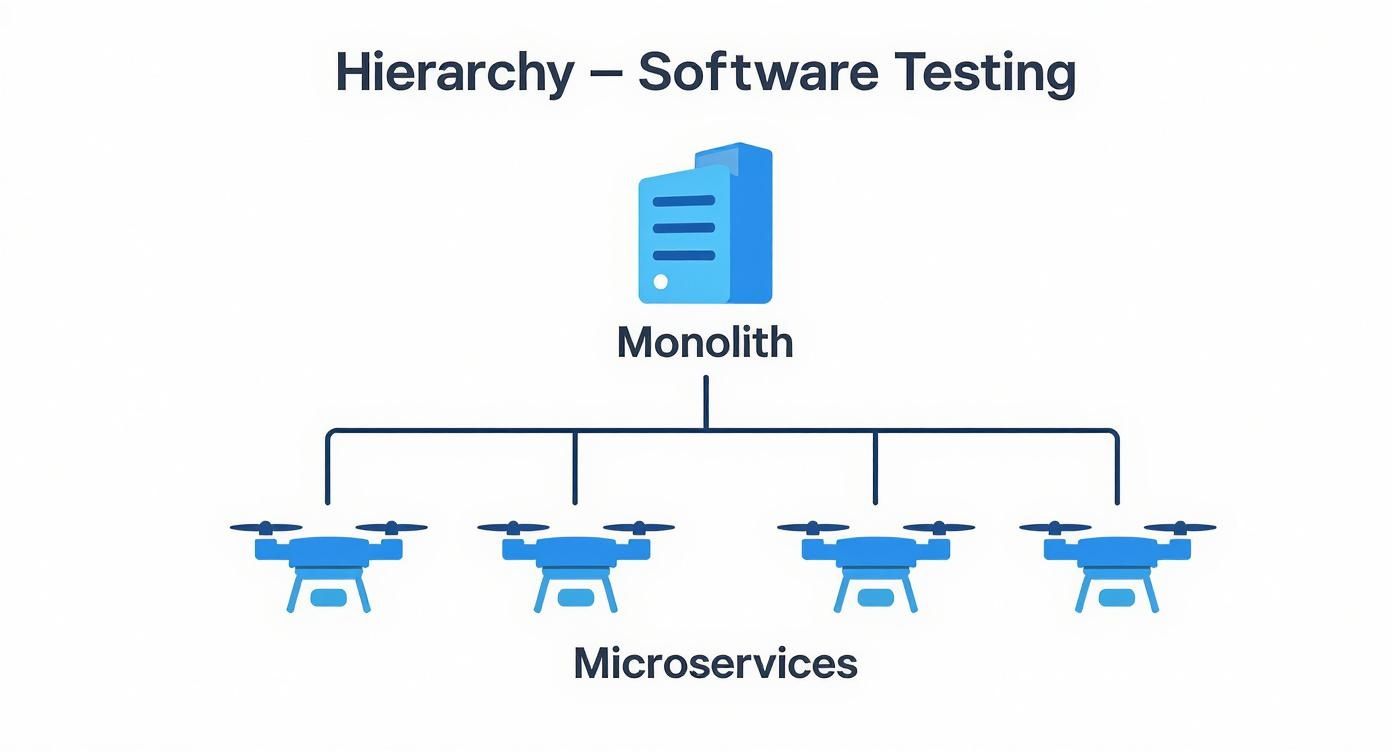
You can see the emphasis moves from testing one big system to validating a whole web of independent, collaborating services. Let’s break down what each layer of this new pyramid really means.
The Foundation: Unit Tests
Right at the bottom, forming that broad, stable base, are your Unit Tests. Their job is simple: verify one tiny, isolated piece of code inside a single microservice. Think of a single function or a method. They are blazingly fast, cheap to write, and give developers instant feedback.
For instance, a unit test for a UserService might just check if the isValidEmail() function correctly says true for “[email protected]” and false for “not-an-email”. These tests never touch a real database, a network, or another service. They use mocks or stubs to fake any external dependencies, focusing purely on whether the internal logic works as expected. The goal here is high code coverage.
The Middle Layers: Integration and Component Tests
Move up a level, and you’ll find Integration Tests. This is where you check how your service plays with its direct dependencies, like a real database, a message queue, or an external API it needs to call.
Unlike unit tests, integration tests ditch the mocks for the real thing. An integration test for an OrderService, for example, would confirm it can actually write a new order to the Orders database and then read it back successfully. They’re slower than unit tests, but they’re essential for catching problems with database connections, data formatting, or infrastructure misconfigurations.
Next up is a layer that’s especially critical for the testing of microservices: the Component Test. This test looks at an entire service as a complete, working unit but keeps it totally isolated from its peer services.
A component test treats a single microservice like a black box. You hit its API endpoints and check the responses, but any other microservices it would normally talk to are completely faked with mocks. This lets you confirm the service works as a whole, without the headache of spinning up a full multi-service environment.
You could, for example, test an InventoryService by sending it a request to check the stock for a product. A mock ProductService would feed it a fake product ID, and you’d just verify that the InventoryService returns the correct stock level from its own database. It’s a fantastic way to build confidence in one service before letting it interact with others.
The Peak: End-to-End Tests
At the very top of the pyramid, you have End-to-End (E2E) Tests. These are the heavy hitters—the most complex and expensive tests you’ll run. Their purpose is to validate a complete user journey that cuts across multiple services. An E2E test acts like a real user, clicking buttons in the UI and verifying the final outcome across the entire system.
A classic example is testing the full checkout flow on an e-commerce site. The test would simulate adding an item to the cart, entering payment details, and getting an order confirmation. Behind the scenes, this single action would involve the CartService, PaymentService, OrderService, and NotificationService all working in concert.
While these tests are amazing for proving the whole system hangs together, you have to use them sparingly. They are slow, notoriously fragile (a tiny change in one service can break the whole test), and a nightmare to debug when they fail. A healthy strategy relies on a small, carefully selected suite of E2E tests that cover only your most critical business flows.
Essential Testing Strategies for Modern Systems
Okay, so you’ve got your unit and component tests down. That’s a solid foundation. But to build a truly resilient microservice architecture, you need to go a step further. We’re talking about the strategies that validate your entire distributed system, not just the individual pieces.

These are the approaches that separate fragile, unpredictable applications from the ones you can trust in production. Let’s dive into three absolute game-changers that modern engineering teams are leaning on hard: Contract Testing, Chaos Testing, and the “Shift-Left” mindset.
Guaranteeing Communication with Contract Testing
Think of an API as a handshake deal between two services. The service providing the API (the provider) promises to deliver data in a specific shape. The service using it (the consumer) agrees to ask for that data in a very specific way. If either side changes their part of the deal, even slightly, the whole conversation falls apart.
This is the entire idea behind Contract Testing. It’s a method for making sure this agreement is always honored, but—and this is the key part—without having to spin up a full integration test environment.
Instead of firing up both services just to see if they can still talk to each other, contract tests check if each service individually sticks to a shared “contract.” This makes testing faster, more isolated, and way more reliable.
Here’s the typical flow:
- The Consumer Defines the Contract: The consumer service basically says, “Here’s the exact API endpoint I need, these are the fields I expect, and this is what the response should look like.” This document becomes the contract.
- The Provider Validates the Contract: The provider service then takes this contract and runs it as part of its own test suite. If a developer on the provider team makes a “harmless” change—like renaming a field the consumer relies on—the build fails immediately.
This simple process prevents that all-too-common headache where one team deploys a small update that unknowingly breaks another team’s service downstream. It’s a must-have strategy for keeping things stable when you have dozens of services being deployed independently.
Building Resilience Through Chaos Testing
What happens when a critical dependency suddenly vanishes? Or when the network between your services gets incredibly laggy? You can design for these scenarios, but you can’t be sure your system will behave as expected unless you actually test it.
That’s where Chaos Testing comes in. You don’t just hope for the best; you intentionally inject failures into a controlled environment to see what breaks. It’s like a fire drill for your application—you’re proactively finding the weak spots before a real emergency forces your hand.
Some classic chaos experiments include:
- Service Unavailability: Kill a non-critical service and watch to see if the fallbacks and circuit breakers kick in properly.
- Network Latency: Introduce artificial delays between services to see if your timeout and retry logic actually works.
- Resource Exhaustion: Deliberately spike the CPU or memory on a service to see how it degrades under pressure. You can get some great ideas on this from our guide to load testing microservices.
By running these controlled experiments, you uncover hidden dependencies, confirm your alerting is working, and build real confidence that your system can handle the messy reality of a production environment.
Adopting a Shift-Left Mindset
Finally, one of the most powerful strategies isn’t a type of test at all—it’s a cultural shift. The “Shift-Left” mindset is all about moving testing activities as early as possible in the development lifecycle. We’re talking about moving quality from the end of the process right to the very beginning.
This is more than just “finding bugs sooner.” It’s about building quality into the product from day one. Instead of waiting for a QA team to find problems in a staging environment weeks later, developers are empowered and expected to test their own code continuously, as they write it.
This cultural change looks like this in practice:
- Developers write unit and integration tests right alongside their feature code.
- Automated tests are triggered on every single commit, giving instant feedback.
- Quality becomes a shared responsibility for the entire team, not just a siloed department.
By shifting left, teams catch issues when they are exponentially cheaper and easier to fix. This prevents small mistakes from snowballing into major blockers that delay releases and ruin the user experience.
Navigating Common Microservice Testing Hurdles
Moving to a microservices architecture can feel like a breath of fresh air, solving a lot of problems that come with big, clunky monoliths. But it’s not all smooth sailing. This new world brings its own set of tricky testing challenges that can stop even the most seasoned teams in their tracks.
The whole point of microservices—independent services, separate data stores, and constant network chatter—is also what makes testing them so tough. It’s a completely different ballgame from the monolithic world. To get it right, you need to change how you think about testing and find tools that can handle a system where no single piece tells the whole story.
Let’s dig into the most common hurdles you’ll face and talk about how to get over them.

The Test Data Management Nightmare
Ask any developer what their biggest headache is with microservice testing, and you’ll probably hear “test data.” Since every service manages its own database, getting a consistent state across the whole system for a single test is a massive chore.
Think about testing a simple user promotion. It might touch the UserService, OrderService, and NotificationService. To even start, you need to make sure a specific user exists, that they have the right order history, and that their notification preferences are set correctly. Now, imagine doing that setup—and teardown—for every single test run. It’s a logistical nightmare. When a test fails, you’re left wondering: is it a real bug, or was the data just wrong?
Taming Flaky End-to-End Tests
End-to-end (E2E) tests are already known for being slow and fragile, but in a microservices setup, that problem gets dialed up to eleven. A single E2E test might depend on a dozen different services, all needing to work in perfect harmony.
If that test fails, good luck. It could be a bug in any one of those services, a network hiccup between them, a misconfigured environment, or a dozen other things. Debugging becomes a full-blown murder mystery, pulling developers from multiple teams into a hunt through logs across the entire system.
The real cost of flaky tests isn’t just the time spent re-running them. It’s the erosion of trust. When developers can’t trust the test results, they start ignoring them, and real bugs slip into production.
The Complexity of Test Environments
Putting together a realistic test environment is another huge hurdle. Spinning up your entire ecosystem of services for every single pull request is often way too slow and expensive. This pushes teams toward shared staging environments, which just trade one set of problems for another.
- Resource Contention: Developers are constantly stepping on each other’s toes, deploying changes that conflict or break someone else’s test.
- Environment Drift: The staging environment slowly but surely drifts away from the production configuration, which means some bugs won’t show up until after you’ve deployed.
- Deployment Queues: Teams end up waiting in line just to get their changes into the shared environment, which kills the quick feedback loop you were aiming for.
This isn’t getting any easier. Gartner predicted that by 2025, 90% of businesses will be running on multi-cloud strategies. That just adds another layer of complexity, making it even harder to replicate production for testing. You can read more about how multi-cloud strategies impact microservices on Ecosmob.com.
Lack of Observability in Testing
When a test finally does fail in a distributed system, figuring out why it failed is often the hardest part. Without solid observability—we’re talking detailed logs, distributed traces, and metrics—you’re basically searching for a needle in a haystack.
A simple “Assertion Failed” message is worthless if you can’t follow the request as it jumps between services to see where things went wrong. Effective testing of microservices means you have to treat your test runs with the same level of care as your production system. Your tests need to generate rich, correlated data that makes debugging fast and painless.
How AI and Automation Are Shaping the Future
Microservice testing is moving way beyond old-school manual strategies and last-minute bug hunts. The next big leap is all about intelligent automation, where AI and machine learning become active partners in keeping our systems reliable.
This isn’t just about offloading work. It’s about working smarter to build real confidence in systems that are getting more complex by the day.
Imagine a testing system that learns directly from your live production traffic. Instead of developers manually scripting out every conceivable user journey, AI-powered tools can watch real user behavior and automatically spin up tests that cover the most critical, high-traffic paths. This way, your testing efforts are always focused where they’ll have the biggest impact.
AI-Driven Predictive Analysis
One of the most exciting places AI is making a difference is in predictive analysis. These tools can look at code changes, past test failures, and even code complexity to flag high-risk areas before you even run a single test. This is huge. It lets teams point their most intensive testing resources at the parts of the system that are most likely to break.
For example, an AI tool might see a change in a core payment service and flag it as high-risk. That could automatically trigger a much beefier suite of integration and performance tests just for that component. It’s a proactive approach that helps you find and squash bugs long before they ever get near a staging environment.
The goal here is to flip the script on testing—from a reactive, bug-finding chore into a proactive, quality-building process. By predicting where failures are most likely to pop up, teams can prevent problems instead of just cleaning them up.
This shift is already happening. We’re seeing a major trend toward AI-powered testing tools, with many experts predicting they’ll be widespread by 2025. These tools use machine learning for everything from test case generation to risk prediction, all aimed at cutting down manual effort and boosting the speed and accuracy of testing. You can get a deeper look at what’s coming in this report on the future of software testing.
The New Standard for CI/CD Pipelines
Plugging these intelligent tools directly into CI/CD pipelines is fast becoming the new standard for high-performing engineering teams. It creates a powerful feedback loop where quality is checked and improved with every single code commit. The benefits are impossible to ignore.
- Faster Deployments: By automating test creation and zeroing in on high-risk changes, teams can slash their testing cycles and ship new features more often.
- Greater Confidence: Predictive analysis acts like a data-driven safety net, giving developers the confidence to deploy without constantly worrying about what might break.
- Enhanced Reliability: By constantly learning from real production data, AI helps build tougher, more resilient systems that can handle the chaos of the real world.
This kind of intelligent automation fits perfectly with other advanced strategies, creating a well-rounded approach to quality. To see how automation is changing the entire landscape, from browser testing to chaos engineering, check out our guide on unleashing the power of automated testing.
At the end of the day, AI and automation are giving teams the firepower they need to tame the complexity of microservices and deliver solid, high-quality software at speed.
Building Resilient Systems Is All About Smart Testing
If there’s one thing to take away from this guide, it’s that testing microservices isn’t just a quality check—it’s a core discipline for building modern, reliable applications. An effective strategy isn’t about running more tests; it’s about running the right tests at the right time.
We’ve walked through the need for a balanced approach, from quick-and-dirty unit tests at the base of the pyramid to more advanced techniques like contract and chaos testing. This mix ensures you’re validating both the internal logic of each service and the complex, sometimes messy, interactions between them. The real goal here is to build confidence in the entire system, not just its isolated pieces.
It’s an Investment in Stability and Trust
Getting over common hurdles like managing test data or dealing with flaky end-to-end tests takes a deliberate, strategic mindset. It’s work, but the payoff is huge. Smart testing practices are a direct line to system resilience. For example, businesses often report that microservice architectures help contain failures. When a single service like a recommendation engine goes down, it doesn’t take the core checkout functionality with it, which dramatically cuts downtime.
This is why resilience and fault tolerance need to be the main focus of any testing strategy. You can dig deeper into these architectural benefits and key microservice trends on Ecosmob.com.
The key takeaway is simple: investing in a thoughtful, comprehensive testing strategy is an investment in your product’s stability, your team’s productivity, and your customers’ trust. It’s the foundation that allows you to innovate safely.
When you embrace these principles, your team gains the ability to deliver value faster, and in a world where reliability is non-negotiable, that’s everything. It shifts testing from being a final gatekeeper to being an integrated part of how you build software, ensuring quality is baked in from the start. This proactive approach is what separates fragile systems from truly resilient ones.
Still Have Questions About Microservice Testing?
Even with a solid plan, the reality of testing microservices can throw a few curveballs. This whole distributed world just plays by a different set of rules, and what worked for your old monolith often doesn’t cut it anymore. Let’s tackle some of the most common questions that pop up when teams start getting serious about quality.
Think of these as a cheat sheet for refining your own testing efforts.
Should I Really Write E2E Tests for Every Single User Flow?
Please don’t. While it sounds like a great way to guarantee coverage, trying to build end-to-end (E2E) tests for every possible user journey is a one-way ticket to a slow, brittle, and expensive test suite. E2E tests are incredibly powerful, but they come at a high cost.
Instead, save them for your most critical, high-value business paths. What are the absolute non-negotiables for your application?
- User Registration and Login: If users can’t get in the front door, nothing else matters.
- Core Checkout or Purchase Flow: This is how you make money. It has to work, period.
- Primary Data Submission: Think about the one key action a user takes to get value from your product. Test that.
For everything else, lean on your lower-level tests like component and contract tests. You’ll get a much healthier balance of confidence and speed.
How Can I Test My Services Locally Without Running the Whole System?
Trying to spin up an entire microservice ecosystem on your laptop is usually impossible and always a bad time. The trick is to test your service in isolation, using stand-ins for all the dependencies you aren’t focused on right now.
The goal of local testing is to get fast, focused feedback on your logic—not to perfectly replicate your production environment.
Here are a few ways to pull this off:
- Mocking and Stubs: For dependencies like third-party APIs or other internal services, just use mocks to fake their responses. This keeps your tests lightning-fast and self-contained.
- Service Virtualization: Go a step further and create lightweight, scriptable versions of downstream services. These can mimic real behavior, including fun things like error states and latency.
- Docker Compose: Tools like Docker Compose are perfect for spinning up just the service you’re working on and its immediate, must-have dependencies (like its database).
What’s the Right Mix of Different Test Types?
The classic testing pyramid is still your best guide here. While the exact ratios will shift based on your application, a healthy strategy for the testing of microservices usually looks something like this:
- Unit Tests: The foundation. Around 70-80% of your tests should live here. They’re cheap, fast, and give you laser-focused feedback on your service’s internal logic.
- Integration & Component Tests: Aim for about 15-20% here. These confirm that your service plays nicely with its direct dependencies and works correctly as a complete unit.
- End-to-End Tests: Keep these lean, maybe 5-10% of your total. They should only cover those absolutely critical, cross-service user journeys we talked about earlier.
- Contract Tests: These are a special case, but a crucial one. You should have a contract test for every single interaction between a consumer and a provider to stop integration problems before they start.
My Test Suite Is So Slow. How Can I Speed It Up?
Slow feedback loops are productivity killers. If you’re waiting forever for tests to run, you’re losing valuable time. Here’s how to speed things up:
- Parallelize Everything: Run your tests in parallel whenever you can. Kubernetes namespaces, for instance, are great for isolating test runs and firing off multiple suites at the same time.
- Shift Left on E2E Tests: Don’t rely so heavily on those slow E2E tests. Push more of that validation down to your faster contract and component tests.
- Use Ephemeral Environments: Instead of fighting over a shared staging environment, spin up lightweight, isolated environments for each pull request. This completely removes the bottleneck.
Ready to stop guessing and start testing your microservices with real production traffic? GoReplay lets you capture and replay actual user interactions in your test environments, so you can be sure your updates are rock-solid before they go live. See for yourself how traffic replay can change your testing game by visiting GoReplay.