
A Guide to Testing in Microservices

When you break up a monolith into microservices, your whole approach to testing has to change. It’s a completely different ballgame. You’re no longer just running tests on a big, self-contained application; you’re trying to validate a whole system of small, independent services that have to talk to each other to get anything done. This shift brings a ton of new complexities to the table that old-school testing strategies just weren’t built for.
Why Testing in Microservices Is Different
Think of it this way: moving from a monolith to microservices is like trading a single, complex Swiss Army knife for a full toolbox of specialized power tools. Each individual power tool is simpler, but making sure they all work together seamlessly to build a house is a massive coordination challenge. That’s the core of the microservices testing puzzle.
With a monolith, all the logic is in one big codebase. Testing it might have been slow and clunky, but it was conceptually simple. You’d spin up the entire application in a test environment and run your test suites. All the dependencies were right there, inside the same deployment, making them predictable.
But a microservices architecture blows that all up. Suddenly, you’re dealing with a web of external dependencies that are absolutely critical but also frustratingly unreliable.
The Rise of Network Unpredictability
The network is the single biggest game-changer. What used to be a simple, in-memory function call inside a monolith is now a network request, probably over HTTP. This immediately throws two massive variables into the mix that your tests now have to account for:
- Latency: Network calls are not instant. That delay, even if it’s just milliseconds, can uncover nasty race conditions or performance bottlenecks that were completely hidden in a monolithic world. An operation that was once instantaneous might now take seconds, with all sorts of downstream effects.
- Failure: The network is not your friend—it’s flaky. Services go down, requests time out, and packets get lost. Your testing has to prove that each service can handle it when one of its dependencies suddenly disappears off the face of the earth.
A foundational rule of distributed systems is to expect failure. Your microservices tests must ruthlessly check for resilience. You have to be sure that one non-essential service going down won’t trigger a domino effect that takes down your entire application.
Managing Service Dependencies and Data
The next big headache is just keeping track of the tangled web of dependencies. A simple user action, like placing an online order, can set off a chain reaction that bounces between the user service, the order service, the payment service, and the inventory service. This creates a whole new set of testing problems:
- Service Versioning: How can you be sure that deploying a new version of the payment service won’t completely break the checkout flow in the order service?
- Data Consistency: When a single transaction has to update data in multiple different databases, how do you verify that everything stays in sync and you don’t end up with corrupted data?
- Complex Test Environments: Just spinning up a test environment that truly mimics production—with all the right services running the right versions—can become an enormous operational burden all by itself.
At the end of the day, testing in microservices isn’t so much about checking individual pieces of code. It’s about validating the contracts between services, the quality of their interactions, and the resilience of the entire system when things inevitably go wrong.
Building Your Microservices Testing Pyramid
When you’re dealing with microservices, you need a smart way to manage the sheer complexity of testing. The old testing pyramid concept is still our guide, but it gets a modern twist. Instead of one big pyramid for a single application, you’re now juggling a pyramid for each service, plus a whole other layer of testing for how they all talk to each other.
The basic idea holds true: you want a ton of fast, cheap tests at the bottom and a small, carefully chosen number of slow, expensive tests at the top. This gives you quick feedback right where developers need it most and saves the heavyweight validation for the most critical user journeys. It’s all about building confidence at every step, from a single line of code to a full-system deployment.
Think of unit tests as the foundation, ensuring each individual component is solid before you start connecting them.
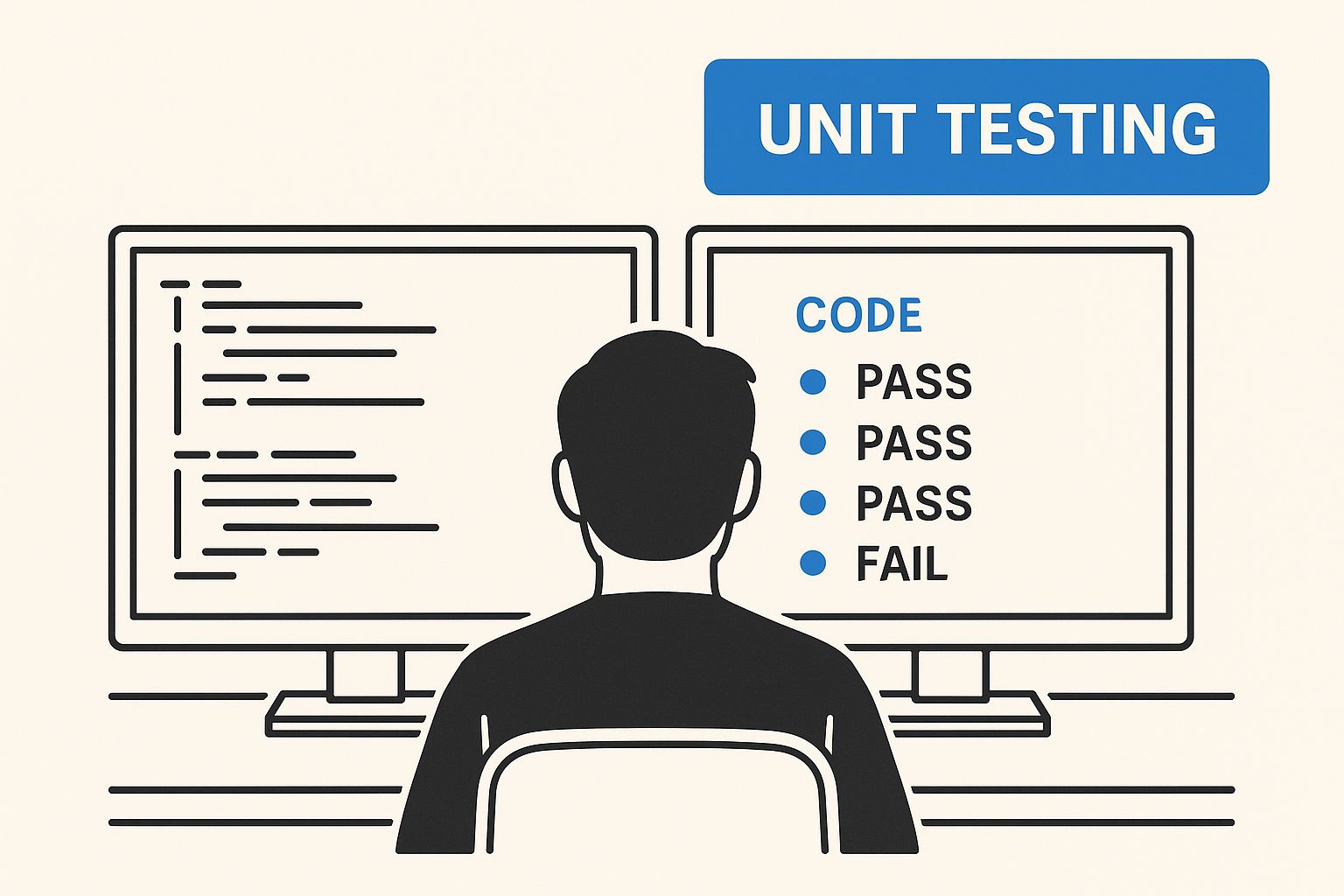
The image really drives home the point: the bulk of your effort should be focused on making sure each service’s internal logic is rock-solid on its own.
To really understand how these layers fit together, it helps to break them down. Each one serves a distinct purpose, has a specific scope, and relies on its own set of tools to get the job done.
Microservices Testing Layers Explained
| Testing Layer | Purpose | Scope | Common Tools |
|---|---|---|---|
| Unit Tests | Verify the logic of a single function or method in isolation. | One function/method within a single service. | JUnit, Go’s testing package, PyTest |
| Integration Tests | Confirm that different components or services work together correctly. | Interaction between 2+ services or a service and a database. | Testcontainers, Postman, RestAssured |
| Contract Tests | Ensure a service consumer and provider agree on an API contract. | API contract (schema, endpoints) between two services. | Pact, Spring Cloud Contract |
| End-to-End (E2E) Tests | Validate a complete user journey across multiple services. | An entire business workflow from start to finish. | Cypress, Selenium, Playwright |
This table gives a bird’s-eye view, but let’s zoom in on what makes each of these layers tick.
The Foundation: Unit Tests
At the wide base of the pyramid, you have unit tests. These are the absolute workhorses of your testing strategy. Each unit test checks a tiny piece of your service’s code—a single function or method—and does it in complete isolation. No network, no database, no other services.
Because they’re so self-contained, unit tests are lightning-fast. You can run a suite of thousands in just a few seconds, giving developers immediate feedback as they code. They are your first and best line of defense against bugs creeping into a service.
The Middle Layers: Integration and Contract Tests
Things get much more interesting in the middle of the pyramid, especially in a microservices world. This layer is all about making sure your services can actually play nice together. It generally breaks down into two crucial types of tests.
-
Integration Tests: These check the collaboration between a few services. For instance, you might spin up your
order-serviceand a mock of thepayment-serviceto confirm that creating an order correctly triggers a payment request. They’re more involved and slower than unit tests, but they’re essential for catching problems at the seams where services meet. -
Contract Tests: A faster, more targeted alternative is contract testing. Instead of running both services, this approach just validates that the service provider (the API) and the consumer (the client) agree on a shared “contract.” It’s a brilliant way to catch breaking API changes before they ever get deployed.
This shift toward distributed systems has a massive impact here. Industry data suggests that by 2025, about 85% of companies will be running on microservices, forcing testing to adapt. As you can read more about how microservices are shaping app design, you’ll see why validating these interactions is so critical.
The middle layers of the pyramid are where you’ll find the gnarliest microservice-specific bugs. This is where issues with data formats, API version mismatches, and network hiccups love to hide.
The Peak: End-to-End Tests
Finally, at the very top of the pyramid, sit the end-to-end (E2E) tests. These are the most expensive and brittle tests you’ll write, which is why you should have very few of them. An E2E test simulates a complete user journey that cuts across multiple services, just like a real person would.
A classic example is testing a full checkout flow: a user logs in, adds a product to their cart, and pays. This single journey would touch the user service, the product service, the cart service, and the payment service. While slow and often flaky, these tests provide the ultimate confirmation that the entire system is working in concert. You should reserve them only for your absolute most critical business flows.
Of course, here is the rewritten section with a more natural, human-written tone.
Navigating the Real-World Mess of Microservices Testing
While the microservices testing pyramid looks great on a whiteboard, things get messy the moment you try to apply it in the real world. Engineering teams quickly run into a whole new class of problems that simply don’t exist in a monolith. These aren’t just minor bumps in the road; they’re significant hurdles that can grind development to a halt and make quality assurance feel like a constant struggle.
To get testing in microservices right, you have to face these challenges head-on. And the biggest headache usually starts with the test environment itself.
The Test Environment Nightmare
Let’s say you need to test a small change in your user-profile-service. In the old monolithic world, you’d just run the application. Easy. But in a microservices ecosystem, that one service might depend on five, ten, or even fifty other services just to start up. This tangled web of dependencies creates a massive bottleneck.
So, what do you do? Do you spin up a full, production-like environment for every single integration test? That’s incredibly slow, expensive, and a nightmare to maintain. The other option is to mock everything, but creating and maintaining accurate mocks for dozens of services is a tedious, error-prone job that almost never behaves like the real system.
Systems orchestrated by Kubernetes add another layer of complexity to this problem. Getting a realistic, isolated, and affordable testing setup that can handle all these moving parts is a huge pain. Teams are often stuck between two bad choices: either write brittle mocks for isolated tests or run the entire, unwieldy dependency chain for integration tests. For a deeper look at this, the team at Signadot has some great insights on solving these challenges in Kubernetes.
Your test environment should be an asset, not your biggest blocker. If setting up a test takes longer than writing the code, your strategy needs a serious rethink.
This environmental chaos is just the first domino. It directly leads to another problem that haunts every distributed system.
Keeping Data Consistent Across Services
In a monolith, database transactions are your safety net. You can wrap multiple operations into a single transaction, ensuring everything either succeeds or fails together. Your data stays clean and consistent. Microservices completely shatter that safety net.
Think about a basic e-commerce order. The order-service creates the order, the payment-service takes the money, and the inventory-service updates the stock count. Each service has its own separate database. What happens if the payment goes through, but the inventory update fails? Suddenly, you have inconsistent data scattered across your system, and you’ve sold something you don’t have.
Testing for these edge cases is notoriously difficult. It means you have to simulate failures at precisely the right moment to verify that your compensating logic—like automatically refunding a payment if an item is out of stock—actually works. This requires a level of coordination and fault injection that most traditional testing tools just weren’t designed for.
Why You’re Flying Blind Without Observability
When a test fails in a monolith, the stack trace is usually a clear roadmap pointing straight to the bug. In a distributed system, a single failed end-to-end test is more like a needle-in-a-haystack problem. The error might have started in a service three or four hops away from where the test actually broke.
This is where observability stops being a nice-to-have and becomes an absolute necessity for your testing toolkit. Without it, you’re basically flying blind. To figure out what went wrong, you have to piece together the story from a few key sources:
- Logs: You need structured logs from every single service to trace the sequence of events.
- Metrics: Monitoring key metrics like latency and error rates helps you spot when and where things started to go wrong.
- Distributed Tracing: Traces are the real game-changer, letting you follow a single request as it jumps from one service to the next, giving you a complete picture of the entire journey.
Without a solid observability platform, debugging becomes a painful, time-consuming process of digging through logs and just guessing. Your ability to quickly find and fix bugs discovered during testing is directly tied to how well you can actually see what’s happening inside your system. Tackling these challenges is the first real step toward building a testing strategy that’s truly resilient and effective.
Implementing a Pragmatic End-to-End Testing Strategy
Let’s be honest: end-to-end (E2E) testing gets a bad rap in microservices circles, and for good reason. Too many teams fall into the trap of building a massive, slow, and flaky E2E suite that tries to test absolutely everything. This is a surefire recipe for frustration and bottlenecked CI/CD pipelines.
The real problem here is that when you treat E2E tests as a catch-all safety net, you accidentally turn your agile architecture into a “distributed monolith” every time you run a test. You’re left with tests so complex and tangled that a tiny change in one service can break dozens of them, killing developer productivity.
A smarter, more pragmatic strategy flips this idea on its head. Instead of aiming for maximum E2E coverage, your goal should be maximum confidence with minimum tests.
Avoiding the Distributed Monolith Test Suite
The secret is to be ruthless about what you test. Your E2E suite is not responsible for catching every single bug. That’s the job of your much faster and more reliable unit and integration tests.
E2E testing in microservices is a tricky balancing act. These tests are essential for proving that services actually work together to complete real user workflows. But if you rely on them too heavily, they can grind your deployment cycles to a halt, destroying the very agility you adopted microservices for in the first place. You can explore a 2025 guide to E2E testing in microservices for more on striking this balance.
This all comes down to carefully choosing which user journeys are critical enough to justify an E2E test.
An effective E2E test suite focuses only on the most critical, revenue-impacting business flows. Think “user signup,” “checkout,” and “submit payment”—not every single button click or form validation.
By narrowing your focus, you create a small, stable, and incredibly valuable set of tests that confirms your system works as a whole, without becoming a maintenance nightmare.
Leveraging Ephemeral Preview Environments
One of the best modern practices for improving the E2E experience is using ephemeral preview environments. Instead of testing against a shared, long-lived staging environment that’s always in flux, this technique spins up a temporary, isolated environment for every single pull request.
This gives each code change its own production-like sandbox. It includes the service being modified and its direct dependencies, which allows for clean, isolated E2E runs.
Here’s how this approach completely changes your workflow:
- Isolation: Tests run against a clean, predictable environment. This drastically cuts down on flaky tests caused by other teams’ changes or bad data.
- Speed: You only spin up the necessary services, making the environment much faster to create and tear down than a full-blown replica of staging.
- Confidence: Developers can validate their changes in a realistic setting before merging their code, catching integration bugs way earlier in the development cycle.
This lets you run targeted E2E tests as a routine part of your CI pipeline without bringing development to a standstill. It strikes the perfect balance, giving you the confidence that your most important user journeys are solid while preserving the speed your team depends on. This is what makes testing in microservices a manageable and truly effective practice.
Using GoReplay for Realistic Traffic Shadowing
Unit tests, integration tests, and even end-to-end tests are crucial, but they all share the same fundamental weakness: they’re based on assumptions. We assume we know how users will interact with our system, what kind of data they’ll send, and which edge cases matter most.
But let’s be honest, production traffic is messy. It’s far more unpredictable than any test script could ever hope to be.
This is exactly where a powerful technique called traffic shadowing comes in. It’s a way to battle-test your services against the chaos of real-world user behavior, all without affecting a single customer. The idea is simple but brilliant: what if you could safely replay a copy of your live production traffic against a new version of your service before it goes live?
What Is Traffic Shadowing?
Traffic shadowing, sometimes called traffic replay, is a testing method where you capture real user requests from your production environment and forward them to a test or staging environment. The live user gets their response from the production service just like always, completely unaware that their request is simultaneously testing a new deployment.
This creates the perfect, high-fidelity test bed. Instead of relying on mocked data or scripted scenarios, you’re validating your code against thousands of real, concurrent user requests. It’s the ultimate way to answer the critical question: “Will this new version break under real-world conditions?”
How GoReplay Makes Shadowing Practical
Trying to set up traffic shadowing manually can get complicated fast. This is where an open-source tool like GoReplay really shines. It acts as a listener, capturing live HTTP traffic without getting in the way of your production services. It then duplicates that traffic and sends it to a different environment, like a staging server or a preview deployment running your new code.
This process gives your testing in microservices strategy a massive upgrade. You can validate performance under authentic load, uncover bugs triggered by unexpected user inputs, and gain a huge amount of confidence that your deployment is ready for prime time.
The GoReplay dashboard offers a clean visual interface for managing and monitoring the whole process.
With this interface, you can see exactly how traffic is being captured and redirected, making a powerful testing strategy much easier to manage.
The Benefits of Replaying Production Traffic
Adding traffic shadowing to your workflow brings some key advantages that other testing methods just can’t match:
- Discover Unknown Edge Cases: Users will always find creative ways to interact with your services—ways you never anticipated. Shadowing exposes your code to these weird scenarios, helping you find and fix obscure bugs that would otherwise only show up in production.
- Validate Performance and Scalability: Most load tests use synthetic traffic, which rarely mimics real user patterns accurately. Replaying actual production traffic gives you a precise picture of how your service will perform under its true operational load, revealing performance regressions before they impact users.
- Safe and Realistic Validation: Because the shadowed traffic is fire-and-forget—meaning the responses from the test environment are simply discarded—there is zero risk to your live users. You get all the benefits of production-level testing without any of the danger.
Traffic shadowing is the closest you can get to a perfect dress rehearsal for your deployment. It’s like letting your new code practice against the final boss on an infinite number of lives before the real fight begins.
This technique is particularly useful when migrating from a legacy system to a new one or refactoring a critical service. By running both the old and new versions side-by-side and comparing their responses to the same live traffic, you can prove that the new implementation is truly production-ready.
For a deeper look into this approach, you can learn more about implementing shadow testing with GoReplay and see how it fits into a modern development lifecycle. It takes an advanced testing strategy and makes it practical and accessible for any team.
Integrating Automated Testing into Your CI/CD Pipeline
A brilliant testing strategy is only as good as its execution. If you have to kick off tests manually, you’re losing valuable time and introducing friction. The real power comes from weaving your testing in microservices directly into your Continuous Integration and Continuous Deployment (CI/CD) pipeline. The entire point is to create an automated, tight feedback loop that flags bugs instantly and lets your developers ship code with confidence.
Think of your CI/CD pipeline as an automated quality control line for your software. Every time new code enters, it moves through a series of checkpoints. If any check fails, the line stops, and the broken code is sent back before it can cause problems downstream. This approach makes quality an inherent part of the development process, not an afterthought.
Mapping Test Stages to the Pipeline
A smart pipeline for microservices is all about balancing speed and rigor. You want to run the fastest tests first to give developers immediate feedback, saving the more time-consuming, complex tests for later. This tiered strategy keeps developers in their flow and the pipeline moving smoothly.
Here’s a practical way to structure this:
-
On Every Commit: As soon as a developer pushes a change, the pipeline should spring to life. This is the perfect moment to run all the unit tests for the service that was just modified. They’re self-contained and lightning-fast, often finishing in seconds, giving the developer an almost instant thumbs-up or thumbs-down on their work.
-
On Pull Request Creation: When a pull request is opened, it’s a signal that the code is ready for a more serious look. This is where you run contract tests. You need to know—before merging—if these changes will break the promises your service has made to other services. This step catches API compatibility issues early, preventing a whole class of integration headaches.
-
After Merging to Main: The code is now part of the main branch, so it’s time for some real-world validation. At this stage, the pipeline builds a fresh container image and runs integration tests against live dependencies like a database or a message broker. Tools like Testcontainers are fantastic for this, as they spin up throwaway instances for your tests. This proves the service plays nicely with its direct infrastructure.
By layering your tests this way, you catch simple bugs on the spot and identify gnarlier integration problems before they ever pollute a shared environment. If you want to dive deeper into building efficient pipelines, our guide on CI/CD pipeline optimization is a great resource.
Intelligently Triggering Advanced Tests
What about the heavy hitters like end-to-end (E2E) tests or traffic shadowing? They are incredibly valuable but far too slow to run on every single commit. Doing so would bring your pipeline to a grinding halt. The key is to trigger them strategically.
A smart pipeline doesn’t run every test, every time. It runs the right test at the right time, balancing risk, speed, and cost to deliver fast, reliable feedback.
For example, you could configure the pipeline to run a targeted suite of E2E tests against a preview environment, but only when a pull request touches a critical business workflow. Or, you might automatically spin up a GoReplay traffic shadowing session for an hour right after a new version hits the staging environment.
This targeted approach gives you the deep validation you need, precisely when you need it, without creating a bottleneck. It completes the feedback loop and lets your team move fast without breaking things.
A Few Common Questions About Microservices Testing
Even with a solid strategy, teams often hit the same roadblocks when they first dive into testing microservices. The move from a monolith isn’t just a technical shift; it’s a mental one, and it brings a whole new set of questions. Let’s tackle some of the most common points of confusion head-on.
Getting these fundamentals straight from the start is a game-changer. It helps build a testing culture that actually speeds you up instead of getting in your way, saving you countless headaches down the road.
What’s the Difference Between Integration and Contract Testing?
This one comes up all the time, and the distinction is vital for keeping your test pipeline fast and effective.
Integration testing is about seeing if two or more live services play nicely together. You’d spin up the actual order-service and a real payment-service to see if they can truly communicate and process a transaction. It’s the ultimate reality check, but it can be slow and brittle.
Contract testing offers a faster, more focused approach. Instead of running services together, it just checks that each service honors an agreed-upon API “contract.” This is all about catching breaking changes early by making sure a service provider and its consumer are always on the same page about the API’s structure and expectations.
Here’s a simple analogy: Integration testing is like having two people hold a full conversation to see if they understand each other. Contract testing is more like just confirming they both speak fluent Spanish before they ever meet.
How Do You Test a Service with Tons of Dependencies?
Ah, the classic “it-depends-on-everything” dilemma. For focused unit testing, the traditional answer is to use mocks or stubs. These fake versions of downstream services let you isolate the service you’re testing, which is great for speed and simplicity.
But for a more faithful check, we have better tools today. Service virtualization and creating ephemeral preview environments for each pull request are fantastic modern solutions. These tools can spin up a lightweight, temporary stack with just the dependencies you need, giving you a realistic test environment without the baggage of a full-blown staging server.
Is End-to-End Testing Still Necessary for Microservices?
Yes, but its role has changed dramatically. You should be ruthless about shrinking your end-to-end (E2E) test suite, but a small number of these tests are still crucial for verifying critical user flows that touch multiple services.
Think of your E2E suite as a safety net for your most important business functions. Focus only on the core user journeys—the absolute ‘happy paths’ that make you money. This gives you high-value confidence without the maintenance nightmare of a huge, flaky E2E suite.
Use E2E tests to prove the whole system hangs together correctly, but leave the detailed testing of edge cases and error handling to your lower-level tests.
Ready to test your services against the real world? With GoReplay, you can shadow production traffic to find bugs and performance bottlenecks before your users do. Build confidence in every single release. Find out how it works at https://goreplay.org.