
Mastering Test Scope in Software Testing A Practical Guide

Think of test scope as the architectural blueprint for your entire testing process. It draws a clear line in the sand, defining exactly what you will test (in-scope) and, just as crucially, what you won’t (out-of-scope). This ensures your team focuses its firepower on the features that matter most.
Why Defining Test Scope Is Your Project’s Lifeline

Imagine building a house without a blueprint. The foundation gets poured in the wrong spot, walls go up for rooms that don’t exist, and the kitchen ends up with no electrical wiring. It’s chaotic, blows the budget, and creates an unstable, unusable mess.
Jumping into software development without a clear test scope is exactly the same—it’s a recipe for disaster.
Defining your scope isn’t just a checkbox for the QA team; it’s a core business strategy. It’s the process of getting developers, product managers, and stakeholders to agree on what’s critical before a single line of test code is written.
The High Cost of Poor Scoping
When the test scope is vague, projects spin out of control. The consequences aren’t theoretical—they’re expensive. A staggering 52.7% of software projects fly past their budgets by an average of 189%, and 31.1% get canceled before they ever see the light of day. A fuzzy test scope is a huge reason why, leading to wasted effort and features that completely miss the mark. You can dig deeper into these software testing statistics and their impact.
This is where a solid test scope becomes your project’s lifeline. It brings the clarity you need to put resources where they belong and deliver a product that’s reliable, functional, and actually meets user expectations.
A well-defined test scope transforms testing from a vague, endless task into a targeted, measurable, and achievable mission. It’s the difference between wandering aimlessly and executing a precise plan.
Core Benefits of a Strong Test Scope
Mastering the art of defining test scope delivers direct, tangible benefits that protect your project from start to finish. It’s about more than just squashing bugs; it’s about building the right product, the right way.
Here are the key advantages:
- Budget and Timeline Protection: A clear scope is your best defense against “scope creep,” where new, unplanned features sneak in, draining resources and pushing back deadlines.
- Enhanced Team Alignment: It gets everyone—from developers to business analysts—on the same page about the project’s boundaries and priorities.
- Improved Product Quality: By zeroing in on critical user paths and core functions, you make sure the most important parts of your application are rock-solid.
- Clearer Communication: It serves as the definitive guide whenever questions about testing priorities come up, cutting through confusion and debate.
To really nail down a solid testing strategy, everyone on your team needs to speak the same language. It’s surprisingly common for teams to get tripped up by terms like “scope” and “coverage,” leading to nasty gaps in testing or, just as bad, a ton of wasted effort.
Let’s clear things up. Imagine your entire project is a cross-country road trip.
Test scope is your high-level mission. It answers the big question: “What’s the point of this trip?” Maybe the scope is to “Drive from New York to Los Angeles to see major landmarks.” It sets the overall boundaries and defines what success looks like.
This big-picture goal is what you’ll break down into the nitty-gritty details.
Defining Your Route: In-Scope vs. Out-of-Scope
In-scope items are the specific highways you’ll take and the stops you’ve planned. These are the features, user stories, and application modules you’ve explicitly decided to test. For our road trip, this would include testing the drive through Chicago, making a stop at the Grand Canyon, and cruising down a stretch of Route 66.
On the flip side, out-of-scope items are the scenic detours you’ve consciously decided to skip. You’re on a mission, after all, and you need to save time and money. Maybe visiting Mount Rushmore or driving up through Canada is out of scope for this particular trip.
Defining what you won’t test is just as critical as defining what you will.
By clearly documenting what is out of scope, you create a powerful defense against scope creep. It provides an immediate, agreed-upon answer when stakeholders ask, “Can we just quickly test this one extra thing?”
This focus keeps your team from getting pulled into testing non-essential functions, which is key to protecting your timeline and budget. The goal is to pour your testing resources where they’ll make the biggest difference for your product and business goals.
Measuring Your Journey with Test Coverage
So, what’s test coverage? It’s the metric that tells you how much of your planned route you actually drove. If your in-scope plan was to test the login, search, and checkout features, test coverage answers: “What percentage of those functions did our test cases actually run through?” It’s a measurement, not a plan.
A classic mistake is thinking high test coverage automatically means you have a great testing strategy. It doesn’t. Hitting 95% coverage on an out-of-scope admin feature is completely useless, while having only 50% coverage on your critical, in-scope payment gateway is a huge red flag. When you’re defining what’s in scope, it pays to also lean on key unit testing best practices to make sure your efforts are actually effective.
This simple table should help make the distinction crystal clear.
Test Scope vs Test Coverage at a Glance
This table breaks down the difference between the strategic “what” (scope) and the tactical “how much” (coverage) of testing.
| Concept | Primary Question | Focus | Example |
|---|---|---|---|
| Test Scope | What are we testing? | Strategy & Planning | The destination (e.g., test the new payment system). |
| In-Scope Items | What specific parts will we test? | Execution & Focus | The planned route (e.g., credit card and PayPal payments). |
| Out-of-Scope Items | What will we not test? | Boundaries & Limits | Detours to skip (e.g., cryptocurrency and gift card payments). |
| Test Coverage | How much of the in-scope items did we test? | Measurement & Metrics | The percentage of the route driven (e.g., 85% of payment code paths were executed). |
Ultimately, scope gives you the map and the destination, while coverage tells you how much of the road you’ve actually traveled. You need both, but one always comes before the other.
Your Step-by-Step Guide to Defining Test Scope
Trying to define your test scope in software testing can feel like you’re mapping an uncharted wilderness. Without a clear process, it’s easy for teams to get lost in endless discussions, miss critical areas entirely, or just wing it.
This guide gives you a structured, repeatable framework to turn that chaos into a clear, actionable plan.
The relationship between your scope and your test coverage is fundamental. Think of it this way: your scope defines the boundaries of the map, and test coverage measures how much of that territory you’ve actually explored.
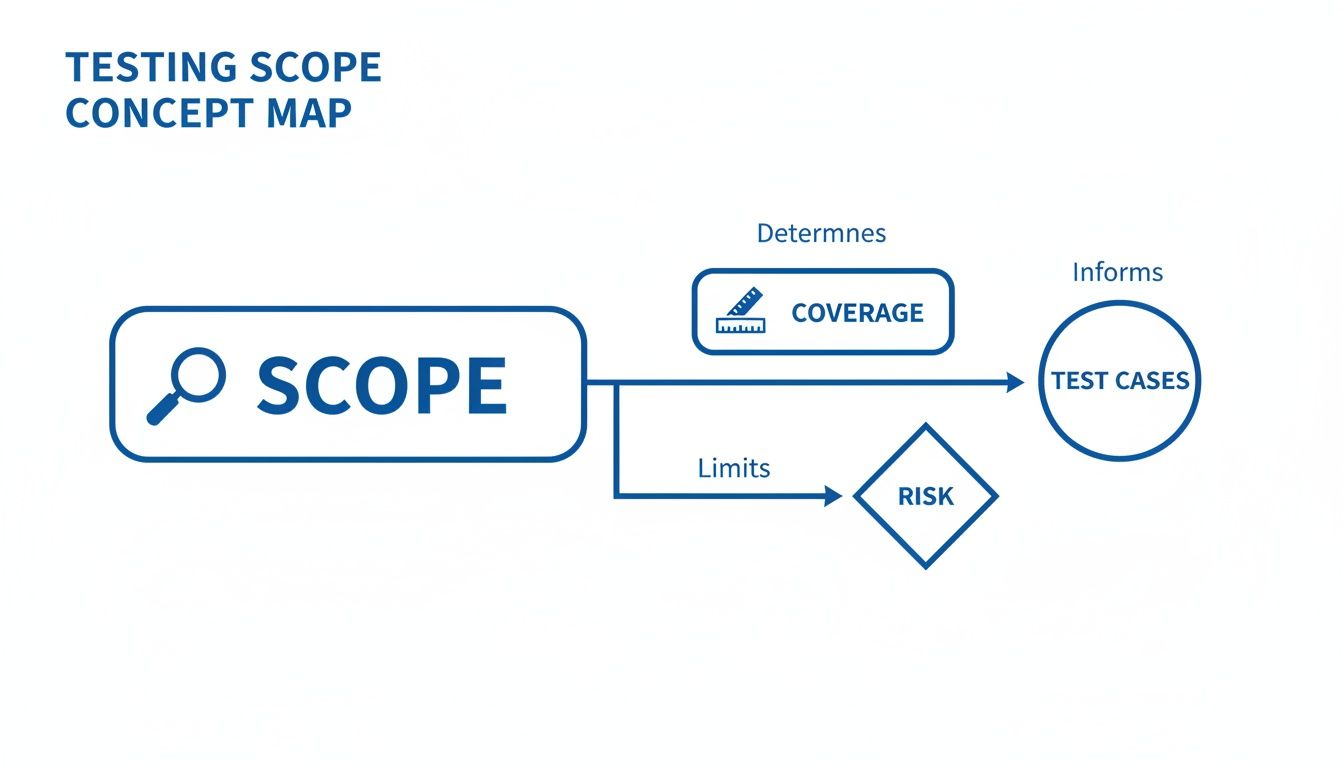
A well-defined scope is the foundation. It dictates the boundaries within which you’ll measure coverage, manage risk, and ultimately, build confidence in your release.
1. Gather and Analyze Requirements
First things first: you need to become an information sponge. Your goal is to get a deep understanding of what the software is supposed to do from every angle—business, technical, and user.
Start by digging into all the documentation you can find. This means business requirement documents (BRDs), functional specs, user stories, and architectural diagrams. These documents are your initial treasure map, pointing you toward the core functionalities that need to be validated.
But don’t stop there. Get in a room with the key stakeholders. Talk to product managers to understand the “why” behind each feature. Chat with developers to grasp the technical implementation. This is where you’ll uncover the hidden assumptions and dependencies that docs alone will never reveal.
2. Identify Key Features and Modules
Once you have a solid grasp of the requirements, it’s time to break the project down into testable chunks. Think of it as organizing that vast wilderness into distinct regions you can explore one by one.
Create a master list of every single feature, module, and function. Don’t worry about what’s important yet; just get it all down. For a typical e-commerce app, this list might include things like:
- User Registration and Login
- Product Search and Filtering
- Shopping Cart Management
- Checkout and Payment Processing
- Order History and Tracking
This simple act transforms a monolithic project into manageable pieces, making the next steps much, much easier.
3. Determine In-Scope and Out-of-Scope Items
This is where you draw the line in the sand. Using your feature list and the project’s real-world constraints (time, budget, resources), you’ll make deliberate decisions about what gets tested now and what has to wait.
For every item on your list, you need to ask some hard questions:
- Is this feature a must-have for the initial launch?
- What’s the business impact if this thing fails spectacularly in production?
- Are there major technical risks tied to this module?
- Does this feature rely on a third-party service that we have zero control over?
Based on the answers, you’ll sort each item into two buckets: in-scope (we must test this) or out-of-scope (we are not testing this in this cycle). Be ruthless. And document the out-of-scope items just as clearly—it’s your best defense against scope creep and mismatched expectations.
4. Define Test Environments and Data Needs
You can’t put on a great play without the right stage. A huge part of defining scope is planning for the environments you’ll need. Figuring out how to schedule stop and start EC2 instances, for example, can lead to massive cost savings for your dev, staging, and test environments.
Get specific about the hardware, software, and network configurations you’ll require. Will you need certain mobile devices? Specific OS or browser versions? Nailing this down early ensures your test environment actually mimics production, which means your results will be far more reliable.
Defining your test environment and data needs early prevents those last-minute scrambles for resources. A well-prepared test environment is the difference between a smooth testing cycle and one plagued by delays and invalid results.
5. Document and Validate the Scope
Finally, put it all in writing. This document becomes the single source of truth for the entire team, getting everyone aligned on the testing boundaries. It’s a critical piece of your overall strategy and fits right into your broader test plan in software testing.
Your test scope document should clearly lay out:
- A brief project overview
- A detailed list of in-scope features
- An explicit list of out-of-scope features
- Assumptions and constraints
- Required test environments and data
Once it’s drafted, pass it around to all key stakeholders for review and, most importantly, formal sign-off. This final step locks in everyone’s agreement and gives you a solid foundation to build your entire testing effort on.
Real-World Examples of Test Scope Documents
Theory is great, but nothing makes a concept click like seeing it in action. Let’s move past the abstract definitions and look at how real teams structure their scope documents for different kinds of projects.
Think of these as the blueprints that guide a project. They show how teams make smart, strategic decisions to focus their effort where it truly matters, ensuring everyone knows what’s being built and—just as importantly—what’s being left for later.
Example 1: E-commerce Wishlist Feature
Imagine a popular online store is launching a new “Wishlist” feature. The pressure is on to get it out the door quickly and successfully. To do that, the initial scope has to be laser-focused on the absolute core functions. Anything that isn’t essential for a solid minimum viable product gets pushed to a future release.
Here’s a snapshot of what that scope document might look like:
-
In-Scope Features
- Add Item: Users must be able to add any product to their personal wishlist from its detail page.
- View List: Users need a way to access and see all the items they’ve saved.
- Remove Item: Users can delete one or more items from their wishlist.
- Share List: A user can generate a public link to share their wishlist via email or social media.
-
Out-of-Scope Features
- Price Drop Alerts: Email notifications for when a wishlist item goes on sale are out.
- Multiple Wishlists: Users can’t create separate lists like “Birthday” or “Holiday” just yet.
- Stock Availability Notifications: Alerts for when an out-of-stock item is back won’t be in this version.
- Collaborative Wishlists: Functionality for multiple people to edit the same list is off the table for now.
This tight focus ensures the team can deliver a valuable, working feature fast, without getting bogged down by nice-to-have enhancements.
Example 2: Mobile Banking App Update
Now for something bigger: a major update to a mobile banking app. This release includes a brand-new peer-to-peer (P2P) payment system and a completely redesigned user dashboard. The scope here is much wider, but it still demands strict boundaries to manage the complexity and risk involved.
-
In-Scope Modules and Functions
- P2P Payments: All user flows for sending and receiving money are in, including contact list integration and viewing transaction history.
- New User Dashboard: All widgets showing account balances, recent transactions, and spending summaries must be tested.
- Biometric Login: We need to test fingerprint and Face ID authentication on all supported iOS and Android devices.
- Performance: App launch time and dashboard loading speed absolutely must meet a <2 second benchmark.
-
Out-of-Scope Items
- Bill Pay System: The existing bill pay feature isn’t changing, so it will only get a basic smoke test.
- Check Deposit Feature: No changes are planned for the mobile check deposit workflow. It’s out of scope.
- Desktop Web Application: This scope is strictly for the native mobile apps. The web platform is a separate project.
- International Transfers: The new P2P system will only support domestic transfers at launch.
By explicitly fencing off stable, untouched features, the team can pour all its energy into the high-risk, high-value additions that matter most for this release.
The power of a scope document lies not just in what it includes, but in the confidence it gives you to say “no.” It’s an agreed-upon contract that protects your timeline and your team’s focus.
This discipline is what stops scope creep—that gradual, uncontrolled expansion of work—from derailing even the most well-planned projects.
How to Validate Scope with Production Traffic

Defining your test scope is a great first step, but let’s be honest—it’s mostly built on assumptions. Teams huddle together, pore over user stories, and make their best-educated guesses about how people should use the application.
But users are famously unpredictable. They click things in weird orders, find bizarre edge cases, and generally behave in ways no one in a planning meeting could ever dream up.
This is the gap where critical bugs love to hide. Your carefully planned scope might cover 90% of the intended features, but it’s the other 10%—the chaotic, real-world user behavior—that causes the most painful production failures. Traditional testing just can’t predict this kind of chaos.
Moving Beyond Assumptions
So, how do you make sure your test scope in software testing is grounded in reality, not just theory? You use the one source of truth you can always count on: your production traffic.
By capturing what your actual users are doing right now and replaying it against your test environment, you can instantly validate your scope and expose the blind spots you never knew you had.
This technique, sometimes called traffic shadowing or replay testing, is like having thousands of your real users beta-test your new code before it ever goes live. All in a safe, controlled environment.
How Production Traffic Replay Works
Tools like GoReplay are built for exactly this. It listens to your live HTTP traffic, records every request, and then mirrors it to a staging or test server. The best part? It does this silently, without any performance hit to your live application.
The process gives you an immediate, powerful feedback loop.
- Discover Hidden Scenarios: You might find an API endpoint getting hit with bizarre payloads you never expected or see users navigating through features in a sequence your team never considered.
- Validate Real-World Performance: Replaying live traffic is far more accurate than any synthetic load test. You see exactly how your system holds up under the stress of a normal Tuesday morning.
- Catch Regressions Instantly: By comparing responses between your old and new code, you can immediately spot breaking changes or subtle bugs introduced in the latest update.
Using production traffic isn’t just for load testing; it’s one of the most powerful scope validation tools you can have. It proves that what you think is important actually is—and reveals the out-of-scope assumptions that were dangerously wrong.
By adding this reality check to your process, your test scope evolves from a static document into a living guide that reflects how your software is actually used. You can learn more about how to replay production traffic for realistic load testing and see firsthand how it strengthens your entire testing strategy. It’s about finding and fixing issues before they ever find your customers.
Common Questions About Defining Test Scope
Even with a solid plan, defining test scope in the real world throws a few curveballs. Getting these details right is what separates a smooth project from a chaotic one. Let’s tackle some of the most common questions that pop up.
How Do You Handle Scope Creep in Agile Projects?
In Agile, change is part of the deal—but that doesn’t mean it should be uncontrolled. When a new feature request or requirement pops up mid-sprint, it can’t just be thrown onto the pile. It needs a formal once-over.
The best way to manage this is with a transparent change request process. The new item gets added to the product backlog and prioritized. More often than not, this means swapping it out for a lower-priority task already in the sprint. This is a trade-off, and it requires constant, open communication with the product owner to keep the team from burning out and to protect the delivery timeline.
The secret to managing scope creep isn’t to prevent change—it’s to control it. A formal process ensures every adjustment is a conscious, strategic decision, not just another thing added to the list.
What Is the Difference Between a Test Plan and Test Scope?
It helps to think of the test scope as one crucial chapter inside the larger test plan. The scope is all about defining the “what.” It’s the document that draws the line in the sand, clearly listing what’s in-scope and what’s out-of-scope.
The test plan, on the other hand, is the full story. It’s the master document that lays out the “how,” “when,” and “who” for the entire testing effort. It takes the scope and builds around it with the test strategy, resource allocation, schedules, and risk assessments.
Who Is Responsible for Signing Off on the Scope?
While the QA Lead or Test Manager is usually the one drafting the scope document, getting it signed off is a group effort. You need buy-in from all the key players to make sure everyone is on the same page and working toward the same goal.
This group should always include:
- The Product Owner: To give the final word that the scope truly meets the business needs.
- The Development Lead: To confirm everything is technically feasible and to flag any constraints.
- The QA Lead: To officially approve the testing boundaries and the overall approach.
Getting this collaborative sign-off ensures everyone is committed to the same set of priorities before you start pouring serious time and resources into the project.
Validating your scope against real-world user behavior is the ultimate reality check. GoReplay helps you do just that by capturing and replaying production traffic, ensuring your tests cover what users actually do, not just what you assume they do. Discover how to eliminate blind spots and test with confidence at https://goreplay.org.