
Test Plan vs Test Strategy What’s the Difference?

The core difference boils down to this: a test strategy is your high-level, guiding philosophy for quality. It’s the document that answers why you test. In contrast, a test plan is a detailed, tactical document for a specific project, answering the what, when, and who of your testing activities.
Establishing Your Foundation For Quality

Before you can get into the nitty-gritty of software testing, it’s absolutely critical to understand the distinct roles these two documents play. The test strategy sets the long-term vision. Think of it as a constitution for all your QA efforts—it remains relatively static, providing consistent principles and guidelines across multiple projects.
On the other hand, the test plan is dynamic and lives at the project level. It takes the big ideas from the strategy and translates them into a concrete, actionable roadmap for a single feature release or development cycle. It’s the specific set of rules governing one initiative, detailing exactly how the strategic vision will be implemented on the ground.
Test Strategy vs Test Plan At a Glance
Even with clear definitions, plenty of teams get these two concepts tangled up. It’s a surprisingly common point of confusion. The 2022-23 World Quality Report highlighted that 47% of organizations still struggle to differentiate between their strategic and tactical testing documents. This can easily lead to inconsistent quality and messy, inefficient workflows. You can dig deeper into these industry findings over on TestGrid’s blog.
To cut through the noise, here’s a simple breakdown of the core distinctions.
| Attribute | Test Strategy | Test Plan |
|---|---|---|
| Purpose | Defines the guiding principles for testing across the entire organization. | Details the specific testing activities for a single project. |
| Scope | Broad and organizational; applies to multiple projects. | Narrow and project-specific; applies to one release. |
| Lifecycle | Long-term and mostly static; updated maybe once a year. | Short-term and dynamic; a new one for each project. |
| Focus | Answers why we test and how in general terms. | Answers what, when, who, and how in specific terms. |
| Ownership | Usually a QA Manager, Director of Quality, or someone in senior leadership. | Typically owned by the Test Lead or Project Manager. |
Diving Deep: How Test Strategy and Test Plan Really Differ
To settle the “test plan vs test strategy” debate once and for all, you have to look past the definitions and see how they operate in the real world. These two documents are not interchangeable. They serve completely different purposes at different altitudes within a QA organization. Their scope, level of detail, lifespan, and even who owns them tell you everything you need to know.
This image gives you a quick visual breakdown of the core distinctions—scope, timeframe, and how deep into the weeds each one goes.
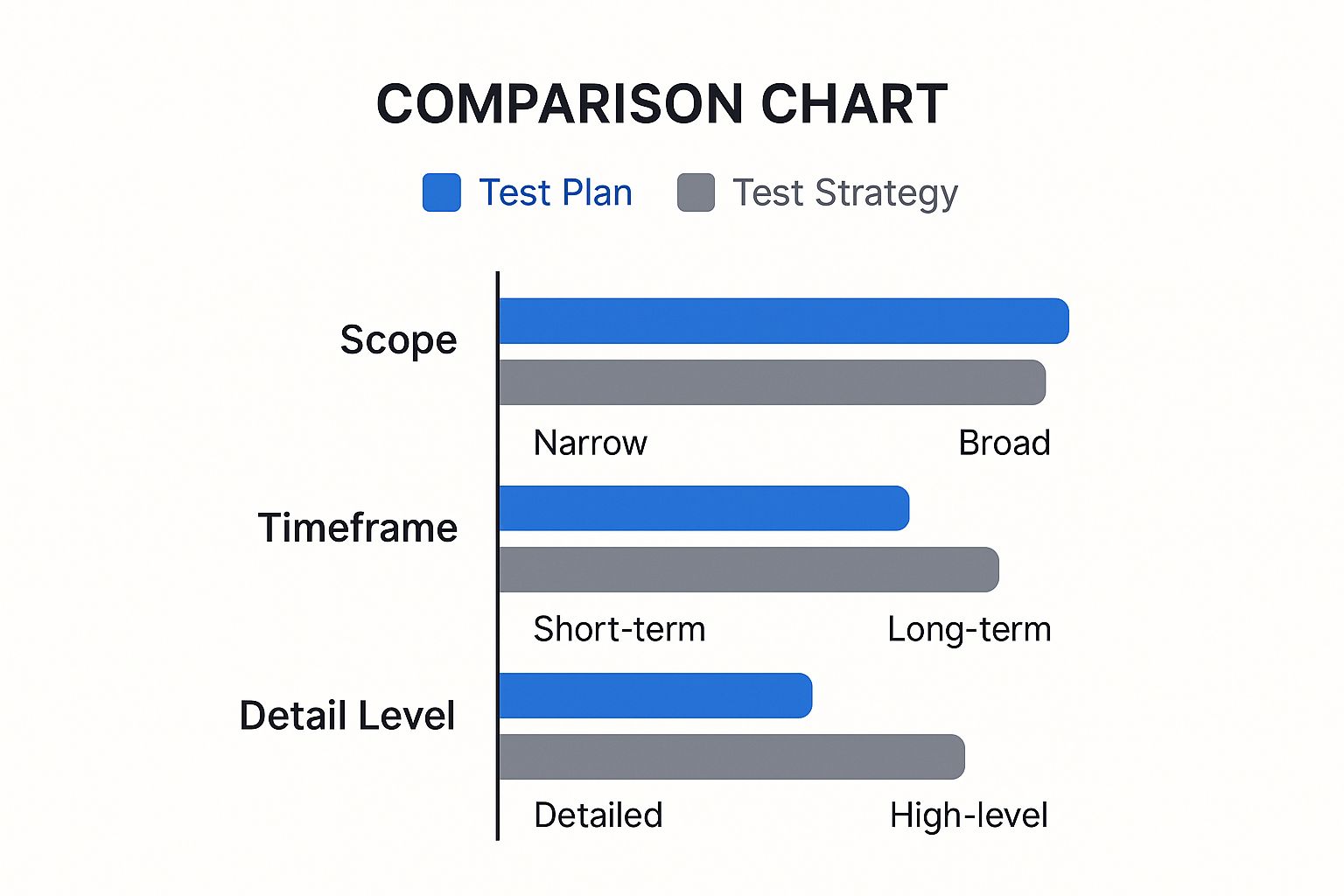
As you can see, they’re on opposite ends of the spectrum. The strategy is the 30,000-foot view, while the plan is boots on the ground.
H3: Scope and Focus
The biggest difference is scope. A test strategy is a high-level, guiding document for the entire organization or department. It’s the wide-angle lens, setting a consistent QA framework that applies to all projects, making sure everyone is playing by the same rules.
A test plan, on the other hand, is hyper-focused on a single project. It zooms right in on a specific application, a feature launch, or one development sprint. Its scope is locked down, covering only the features and requirements for that one initiative.
A test strategy sets the rules of the game for the entire league. A test plan is the specific playbook for a single match. One ensures fair play everywhere; the other is designed to win this game.
H3: Granularity and Detail
This massive difference in scope directly impacts the level of detail. A test strategy is intentionally broad. It talks about approaches, tools, and philosophies without getting lost in specifics. For instance, it might mandate that all regression testing will be automated, period.
The test plan is where the rubber meets the road. It’s all about granular details, answering the tactical questions: What features are we testing? Who is testing them? When does it need to be done? It takes the strategy’s high-level direction and turns it into a concrete, day-to-day checklist for the project team.
H3: Lifecycle and Permanence
Their lifecycles couldn’t be more different. A test strategy is a long-term artifact. It’s built to last and is only dusted off for review periodically—maybe once a year or if the company makes a huge shift, like moving from Waterfall to Agile.
A test plan, by its very nature, is temporary and dynamic. A brand new one is created for every single project or major release. It’s a “living document” that gets updated constantly as the project evolves. Once the project ships, the plan is archived, its job done.
H3: Ownership and Accountability
Finally, who owns each document says a lot about its place in the hierarchy.
- Test Strategy Ownership: This falls to senior QA leadership—think QA Directors or Test Managers. Creating it requires a deep understanding of business goals and the company’s long-term technology roadmap.
- Test Plan Ownership: The Test Lead or Project Manager for a specific project is responsible here. Their job is to translate the company-wide strategy into a practical execution guide for their team.
To make this crystal clear, here’s a quick side-by-side comparison that sums up the key differences.
Key Differentiators Between Test Strategy and Test Plan
| Attribute | Test Strategy | Test Plan |
|---|---|---|
| Scope | Organizational or departmental; applies to all projects. | Project-specific; applies to a single initiative. |
| Detail Level | High-level principles, approaches, and guidelines. | Granular details, specific tasks, schedules, and resources. |
| Lifecycle | Long-term and relatively static; updated infrequently. | Short-term and dynamic; created per project and updated often. |
| Ownership | Senior leadership (e.g., QA Director, Test Manager). | Project leadership (e.g., Test Lead, Project Manager). |
Getting these attributes straight is fundamental for anyone in software testing. It clarifies why you absolutely need both documents and shows how they work together, creating a seamless quality process from the highest strategic vision down to the daily grind of a project team.
Deconstructing Each Document’s Components

To really get the difference between a test plan and a test strategy, you have to look under the hood of each one. They aren’t just different in purpose—their entire anatomy is distinct. Think of it this way: the test strategy is the high-level constitution for quality, while a test plan is the specific, project-level law that follows it.
The test strategy is intentionally broad. Its job is to set the long-term vision for quality assurance across the entire organization, not just for one project. This ensures every team, no matter what they’re building, is aligned with the same quality standards.
The Anatomy of a Test Strategy
A test strategy is built from high-level, guiding components. It’s the rulebook, not the playbook for a single game. It dictates the overall approach to quality.
Key elements you’ll almost always find include:
- Quality Objectives: This defines what “quality” even means for the company. Is it measured by defect density, user satisfaction scores, or maybe system uptime?
- Testing Principles and Approaches: Here, you’ll find the core methodologies. It might mandate a “shift-left” approach or specify the required balance between manual and automated testing.
- Risk Mitigation: This section identifies broad, organization-wide risks (like security vulnerabilities or performance bottlenecks) and establishes standard procedures for how all projects should address them.
- Tooling and Environments: This specifies the approved, mandatory tools for test management, automation, and performance, ensuring everyone uses a consistent tech stack.
The Test Strategy is your organization’s North Star for quality. It ensures that even when project details change, the fundamental commitment to excellence remains constant and measurable.
The Anatomy of a Test Plan
The test plan, on the other hand, is granular and tactical. It takes the strategy’s high-level vision and translates it into concrete, actionable steps for a single project. Its components are all about execution—the who, what, when, and how of testing a specific feature or release.
For a deeper dive into what makes a great test plan, you can explore our comprehensive guide on the topic.
Here’s what you’ll find inside a typical test plan:
- Test Scope: It clearly defines what will be tested (e.g., the new user registration flow) and, just as crucially, what will not be tested (e.g., the legacy admin panel).
- Resource Allocation: This names names. It specifies which team members are responsible for which testing tasks and allocates their time.
- Timelines and Schedules: A detailed schedule with hard deadlines for test case creation, execution, bug reporting, and the final sign-off.
- Entry and Exit Criteria: These are the clear, measurable conditions that must be met before testing can begin (entry criteria) and before it can be considered complete (exit criteria).
How Testing Documents Evolve for Agile and DevOps

In fast-moving Agile and DevOps shops, those old, monolithic documents just don’t cut it. The whole “test plan vs. test strategy” conversation shifts because both have to support continuous delivery, not slow it down with red tape. It’s all about speed and flexibility.
This means we have to move away from rigid, exhaustive paperwork and toward lean, living artifacts. The real goal is to provide just enough direction to keep quality high without jamming up the development pipeline. This is where the test strategy shines, acting as the steady “guardrails” for everything QA.
The Strategy: A Stable Foundation for Quality
In an Agile world, your test strategy sets the high-level, consistent principles that guide every single sprint and release. It’s the document that makes sure quality standards don’t slip, even when features are flying out the door. It’s where you define your core approach to things like automation, risk, and tooling.
For example, a solid strategy might lay down the law on:
- A “shift-left” testing approach, pulling QA activities into the development cycle as early as possible.
- Specific performance testing benchmarks that all new features have to hit before they see the light of day.
- The primary automation framework everyone uses to keep things consistent across teams.
This strategic foundation gives individual teams the freedom to work autonomously while still hitting the organization’s broader quality goals. If you want to dig deeper into building a solid approach, check out our guide on creating a test strategy for performance testing.
In Agile, the test strategy isn’t some static document collecting dust. It’s the enduring philosophy that empowers teams to make smart, independent decisions about quality within a defined framework.
The Plan: A Dynamic Sprint-Level Tool
While the strategy holds steady, the test plan becomes incredibly dynamic and specific to each sprint. Instead of one massive document created at the project’s start, agile teams create lightweight test plans for every sprint or feature. These plans are focused, actionable, and tied directly to the user stories in the current work cycle.
The data backs this up. The 2023 State of Testing Report found that a whopping 73% of agile teams tweak their test plans at least once per sprint to keep up with changing requirements. What’s telling is that the same report noted only 41% of those teams review their overall test strategy annually, cementing its role as the more permanent guide.
Ultimately, a test plan in an Agile environment might be as simple as a checklist in your project management tool or a set of acceptance criteria on a user story. It contains just enough detail for the sprint—the scope, who’s doing what, and specific test scenarios—and is built to be updated or even thrown away as the project moves forward.
When to Use a Test Strategy vs a Test Plan
Knowing the definitions is one thing, but the real mark of an experienced QA leader is knowing exactly when to use each document. This isn’t an either/or situation—it’s about applying the right tool for the job.
The test strategy is for your big-picture, foundational decisions that affect the whole organization. The test plan, on the other hand, is all about the nitty-gritty of a single project.
Think of it like building a housing development. Your test strategy is the master architectural blueprint for the entire neighborhood. It defines the core principles—the approved building materials, the overall architectural style, and the quality standards every house must meet. The test plan is the detailed construction schedule for a single house on a specific lot, right down to room dimensions, wiring diagrams, and the daily work schedule.
When a Test Strategy is Non-Negotiable
You’ll want to reach for a test strategy during major shifts or when you’re laying down a new foundation for quality. It’s the high-level guide that keeps everyone aligned with the bigger business goals for the long haul.
You absolutely need a test strategy when you are:
- Building a QA team from scratch: A new QA function needs a mission. The strategy sets its guiding principles and defines how it will operate.
- Adopting a major new technology: Are you moving to a new company-wide automation framework or shifting to microservices? The strategy dictates the standards for testing across these new systems.
- Pivoting to new business goals: If the company is entering a new market or launching a radically different product, the test strategy ensures your quality efforts are directly supporting that new direction.
The maturity of an organization often dictates how seriously they take this. A 2021 Forrester Research survey of software firms found that 68% of companies in the United States require both a test strategy and a detailed test plan for any major project. Unsurprisingly, this practice is most common in regulated industries like finance and healthcare, where high-level quality governance isn’t just a good idea—it’s critical. You can get more details on these industry testing standards.
When a Test Plan Is Your Go-To Document
While the strategy sets the vision, the test plan is the workhorse of your day-to-day development cycle. It’s the tactical, on-the-ground instruction manual that gets a specific project over the finish line.
A test strategy answers the question, “How do we approach quality here?” A test plan answers, “How are we going to test this specific feature right now?” One sets the philosophy; the other directs the action.
You’ll need to create a test plan for:
- Kicking off a new project: Every development initiative is unique and needs its own plan to define the scope, resources, and timeline.
- Releasing a critical feature: Any significant new functionality needs a dedicated plan to make sure it’s put through its paces before it goes live.
- Managing a specific release cycle: Each sprint or release requires a plan detailing the exact testing activities, entry/exit criteria, and deliverables for that specific cycle.
Frequently Asked Questions
Even with a clear breakdown, some questions always pop up when you’re trying to draw the line between a test plan and a test strategy in your day-to-day work. Let’s get straight to the point and tackle the most common ones.
We’ll cover the tricky bits, like document dependencies, who owns what, and how often things should be updated, so you can walk away with zero confusion.
Can a Project Have a Test Plan Without a Test Strategy?
Sure, but it’s not a great idea. A project can absolutely have a test plan without a formal, company-wide test strategy. You see this a lot in smaller shops or on siloed projects where just getting it done is the top priority.
But working this way is risky. Without a strategy to guide them, every project team is left to invent its own rules. The result? Inconsistent quality, mismatched tools, and a ton of duplicated work across the company. It’s chaos waiting to happen.
A test strategy is the North Star. It ensures every single test plan aligns with the bigger picture—what the business actually cares about when it comes to quality, security, and performance. You can get by without one for a while, but you can’t scale quality effectively that way.
A test plan without a strategy is like a single ship sailing without a map or fleet coordinates. It might reach its destination, but the journey is inefficient, risky, and completely disconnected from the coordinated movements of the rest of the fleet.
Who Is Responsible for Creating These Documents?
Ownership really comes down to altitude—one is a 30,000-foot view, the other is on-the-ground execution. The roles are split to make sure the right people are focused on the right problems.
- Test Strategy: This is a leadership document, plain and simple. Think a QA Manager, Director of Engineering, or a seasoned Test Architect. They’re the ones responsible for creating and maintaining it. They have the high-level perspective needed to connect testing practices to broad business goals.
- Test Plan: This is a project-level document. The responsibility falls squarely on the Test Lead or Project Manager running that specific show. Their job is to take the high-level vision from the strategy and turn it into a concrete, day-to-day action plan for their team.
How Often Should a Test Strategy Be Updated?
A test strategy is built for the long haul, but it can’t be set in stone. It has to breathe and evolve right alongside the business, or it becomes irrelevant.
As a rule of thumb, review your test strategy annually. But you should also dust it off anytime there’s a major shift in the company. The big triggers for an update usually are:
- A new tech stack: Moving to microservices or bringing in AI-driven features? Your strategy needs to reflect that.
- Entering new markets: A new region might bring a whole new set of compliance rules or user expectations that your testing has to account for.
- A major business pivot: If the company suddenly changes its product focus, your test strategy better be right there with it.
Regular check-ins ensure your high-level approach to quality actually keeps up with reality.
At GoReplay, we understand the critical need for realistic testing that validates your application’s performance and stability. By capturing and replaying real production traffic, our open-source tool allows you to execute test plans with unmatched accuracy, ensuring your systems can handle real-world user behavior. Discover how you can build more resilient applications by visiting https://goreplay.org.