
Mastering Test Data Generation Strategies

Ever stared at a bug that somehow slipped past all your tests? It’s a developer’s nightmare. More often than not, the culprit isn’t bad code—it’s bad test data. This is where test data generation comes in. It’s the craft of creating data that’s realistic, varied, and safe enough to properly validate your software’s performance, functionality, and security.
Simply put, it’s the bedrock of reliable software engineering.
Why Quality Test Data Is Your Biggest Asset

Think of software testing like a crash test for a new car. You wouldn’t just use toy dummies or simulate a single, perfect head-on collision. To really find a vehicle’s weak points, you need realistic dummies in all sorts of scenarios—side impacts, rollovers, and different speeds. Your software is no different. It needs way more than just “happy path” data to be truly robust.
This analogy gets right to the heart of the challenge every engineering team faces. You need diverse, lifelike data to test applications effectively, but using real customer information is a dangerous—and often illegal—tightrope walk. This is precisely why a smart test data generation strategy is no longer a “nice-to-have,” but a mission-critical part of the development lifecycle.
The Dilemma of Realism Versus Risk
The most realistic data you can get is, by definition, your production data. It has all the messy, unpredictable, and sometimes bizarre patterns of real user behavior. But dropping it directly into a testing environment is just asking for trouble.
A single leak of production data into a non-secure test environment can trigger severe compliance penalties, torpedo your reputation, and shatter customer trust. It’s not a question of if a breach will happen, but when.
This forces a tough choice on development teams:
- Use simplistic, fake data: This is safe, but it often misses the complex bugs that only surface with real-world usage patterns.
- Use raw production data: This gives you perfect realism but comes with unacceptable security and compliance risks.
A proper test data generation strategy is the answer. It lets your teams create data that’s realistic enough to hunt down critical bugs without ever exposing sensitive information.
A Growing Market Underscores Its Importance
The need for high-quality, safe test data isn’t just some internal engineering debate; it’s a major force shaping the software industry. The global market for these tools was valued at around USD 1.29 billion and is on track to hit an estimated USD 1.5 billion. This isn’t just a random spike. It’s driven by the explosion of cloud-native architectures and the absolute necessity for rock-solid applications.
You can dig into more of the market trends at Data Insights Market. It’s clear the industry has made a major shift from seeing data generation as a chore to recognizing it as a strategic asset.
Synthetic Data Versus Production Replays

When it’s time to generate test data, engineering teams usually land on one of two philosophies: create data from scratch or borrow it from the real world. This isn’t just a minor technical choice—it fundamentally shapes how effective your testing will be.
Getting a handle on the tradeoffs between synthetic data and replaying production traffic is the first step toward building a testing strategy that actually makes your systems more resilient.
The Controlled World of Synthetic Data
The first path, synthetic data generation, is a lot like building a movie set. You get complete creative control, constructing a world that perfectly fits your script. This data is artificially created to meet very specific testing needs, and it comes in a few different flavors.
Simple rule-based generators are great for churning out predictable inputs. Think creating thousands of user accounts with valid email formats or generating product IDs that follow a specific numerical pattern. Perfect for unit tests and checking off basic functionality.
More advanced tools use sophisticated AI models to generate complex, context-aware datasets. You could, for instance, create entire customer profiles complete with realistic purchase histories and browsing behaviors. This level of control is a lifesaver for testing those tricky, hard-to-replicate edge cases, like a user with a corrupted account or a transaction that hits the exact moment a promotion expires.
The real power of synthetic data is its precision. It lets you surgically target specific scenarios, making sure even the most obscure bugs get squashed before they ever see the light of day.
This need for precision has kicked off a massive industry boom. The synthetic data generation market, valued at USD 310.5 million, is projected to grow at a blistering 35.2% CAGR, hitting a market size of around USD 6.6 billion. A huge driver is the need to train AI models where real data is either too scarce or locked down by privacy laws. You can dig into the growth of this market on market.us.
The Authentic Chaos of Production Replays
Synthetic data offers incredible control, but let’s be honest—it can feel a little too clean. It often misses the messy, unpredictable, and sometimes downright weird ways real humans interact with software.
This is where our second philosophy, replaying production data, comes into its own.
This technique is exactly what it sounds like: you capture real user traffic—every click, search, and transaction—and then replay that exact sequence of events in a test environment. It’s less like building a movie set and more like filming a live documentary. You get the raw, unscripted reality of how people actually use your application.
This is the core idea behind tools like GoReplay, an open-source tool designed specifically for capturing and replaying live traffic to validate system changes under realistic conditions. The authenticity is its greatest strength, making it the gold standard for any serious performance or load testing.
Making the Right Strategic Choice
To help you decide which approach fits your needs, here’s a quick breakdown of their strengths and weaknesses.
Comparison of Test Data Generation Methods
| Attribute | Synthetic Data Generation | Production Data Replay |
|---|---|---|
| Realism | Low to moderate. Can mimic patterns but often misses organic user behavior and “long-tail” complexity. | High. An exact replica of real-world user interactions, load, and timing. |
| Control | High. You can design any scenario you can imagine, no matter how obscure or rare. | Low. You’re limited to the traffic that actually occurred. You can’t test what hasn’t happened. |
| Use Cases | Edge case testing, unit tests, compliance-heavy environments, and pre-launch testing for new apps. | Load testing, performance benchmarking, regression testing, and validating complex user journeys. |
| Privacy & Compliance | Excellent. No PII is involved, making it ideal for regulated industries like finance and healthcare. | Requires careful data masking and scrubbing to remove PII and meet compliance standards. |
| Setup & Effort | Can be high. Designing and generating complex, stateful datasets is a significant undertaking. | Relatively low. Tools can capture and replay traffic with minimal initial configuration. |
Ultimately, choosing between synthetic data and production replays isn’t an “either/or” question. They solve different problems, and the best strategies often use both.
A smart approach uses synthetic data for its surgical precision in corner cases and leans on production replays for authentic, large-scale validation. This hybrid model empowers teams to cover all their bases, from the tiniest edge cases to the heaviest production loads.
Mastering Data Masking and Compliance
Using production-like data for testing gives you an incredible dose of realism, but it also comes with a heavy responsibility. Every piece of user data you hold is a promise of trust, and breaking that promise can have devastating consequences. This is exactly where data masking and compliance come in—they’re the essential guardrails for any serious test data generation strategy.
Think of your production dataset as a top-secret government file. You can’t just share it, even internally, without redacting all the classified bits first. Data masking works on the same principle: it neutralizes privacy risks by scrambling or replacing sensitive data while keeping the dataset’s structure and realism intact.
This isn’t just a technical best practice; it’s a legal and ethical must. Regulations like GDPR in Europe and HIPAA in the United States have strict rules about how personal data gets handled. A failure to comply isn’t a simple slap on the wrist—it can lead to staggering fines, painful legal battles, and permanent damage to your brand’s reputation.
Understanding Core Data Protection Techniques
You’ll often hear a few terms thrown around for protecting data, and while they sound similar, they have distinct meanings. Getting them straight is key to picking the right approach.
- Anonymization: This is the most thorough method. It completely and irreversibly strips all personally identifiable information (PII), making it impossible to link the data back to an individual.
- Pseudonymization: A slightly different take where sensitive data is replaced with consistent but fake identifiers, or “pseudonyms.” This lets you track data within a set without ever exposing the real identity.
- Data Masking: This is the umbrella term for the techniques used to achieve either anonymization or pseudonymization. It’s the practical “how-to” of data protection.
These techniques are the foundation of a compliance-first mindset, baking privacy right into your testing workflow from the start. And it’s a growing field—the global test data management market, valued at USD 1.34 billion, is projected to hit USD 3.84 billion, a jump driven almost entirely by the rising importance of data privacy. You can see the full market analysis from Spherical Insights for more details.
Common Data Masking Methods in Practice
So, how do you actually “redact” your digital data? There are several effective methods for transforming sensitive information into safe, usable test data. The goal is always the same: obscure the real data while keeping its format and type consistent so it doesn’t break your application’s logic.
Here are a few of the most common techniques you’ll see in the wild:
- Substitution: This involves swapping real data with realistic but fake values from a lookup table. Think replacing actual customer names like “John Smith” with “Alex Williams” from a pre-made list of fictional names.
- Shuffling: This technique scrambles data within a single column. For example, you could take all the phone numbers in a database and randomly reassign them to different user records, completely breaking the link between an individual and their real number.
- Encryption: Using an algorithm to convert data into an unreadable format. It’s highly secure, but the resulting data often loses its original format, making it less useful for certain testing scenarios unless you decrypt it.
- Nulling Out: A simpler but more blunt approach where sensitive fields are just replaced with a NULL value. This is extremely secure, but it can kill the data’s realism and cause issues when testing fields that require a value.
Choosing the right masking technique is a balancing act. You need to weigh the level of security required against the need for data that still behaves like the real thing in your test environment.
Getting these methods right is crucial for building a secure testing pipeline. For a deeper dive into how to apply them, check out our guide on data masking best practices to make sure your strategy is both effective and compliant from day one.
Building a Modern Test data Pipeline
Let’s move from theory to practice. A modern test data generation pipeline is the engine that actually drives an automated, scalable testing workflow. It’s the difference between treating data prep as a tedious, one-off chore and turning it into a repeatable, on-demand service for your entire engineering team. Think of it as building an aqueduct instead of hand-carrying buckets of water.
At its heart, this pipeline automates the entire journey of data, from its original source all the way to your test environments. The whole process relies on a few key architectural components working together, each with a specific job to do. This ensures the final data is fresh, relevant, and—most importantly—completely safe to use.
The Core Architectural Components
A solid pipeline isn’t just one tool; it’s a carefully orchestrated system. You need a clear blueprint that lays out how data is sourced, transformed, and delivered. The essential building blocks usually look something like this:
- Data Sources: This is where it all begins. Your source could be a production database, raw traffic logs from your servers, or even an existing data warehouse. The key is to tap into something that truly reflects real-world usage patterns.
- Generation or Masking Engine: This is the core of the whole operation. It takes the raw data and applies all the necessary transformations. That might mean generating brand-new synthetic data from a schema or applying sophisticated masking rules to sanitize real production data.
- Secure Storage: Once the test data is generated or masked, it needs a place to live. This is typically a dedicated, secure database or repository where datasets are versioned and stored, ready for your testing tools to grab them.
- Delivery Mechanism: The final piece is getting the data where it needs to go. This component plugs right into your CI/CD pipeline, letting automated tests pull the latest, most relevant dataset for every single test run.
This flow is all about transforming raw production data into something safe and usable for testing.
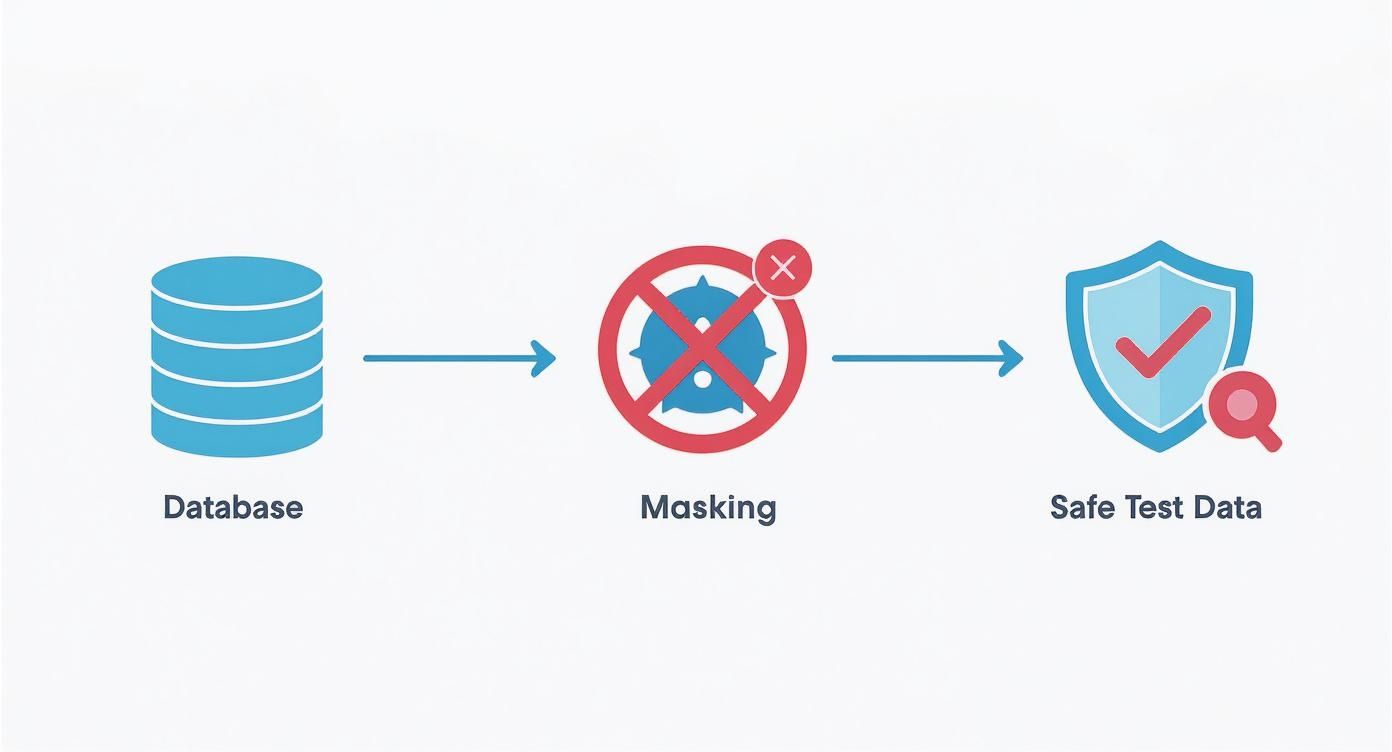
As you can see, sensitive production data gets processed through a masking engine, which produces a secure dataset that’s safe to use in any pre-production environment.
A Tangible Pipeline Workflow Example
Let’s make this feel more real. Imagine you’re about to ship a huge update to your e-commerce platform’s checkout service. You absolutely have to know it can handle real-world load and won’t break any of the countless user journeys.
Here’s how a pipeline would work:
-
Capture Production Traffic: First, the pipeline uses a tool to listen to the live HTTP traffic hitting your current checkout service. This captures the exact sequence of API calls, headers, and payloads from thousands of actual user sessions.
-
Sanitize the Captured Data: That raw traffic is immediately fed into the masking engine. The engine gets to work, automatically identifying and anonymizing all Personally Identifiable Information (PII) inside the request payloads—things like names, addresses, and credit card numbers—using techniques like substitution and shuffling.
-
Store the Anonymized Session Data: The now-safe traffic is saved as a “test session” file in a central spot, like an S3 bucket. Each file is a perfect, anonymized snapshot of a real user’s journey through the checkout.
-
Integrate with the CI/CD Pipeline: Now for the automation. When a developer pushes a code change, the CI/CD pipeline kicks off. A job in that pipeline automatically fetches the latest anonymized session file from the repository.
-
Replay and Validate: Finally, the test runner uses a traffic replay tool to fire those anonymized requests against the new version of the checkout service running in a staging environment. The tool checks that the responses match what’s expected, confirming that no regressions snuck in.
This automated loop creates a powerful, continuous feedback mechanism. Developers get instant confirmation that their changes didn’t just pass unit tests—they also survived complex, real-world scenarios. This drastically cuts down the risk of nasty surprises in production.
By orchestrating these components, you finally break free from the bottleneck of manual data prep. Your teams get on-demand access to high-quality, safe test data, which helps speed up development cycles and builds a ton of confidence in every single release. You can dig deeper into these strategies in our complete guide to test data management best practices.
Of course. Here’s the rewritten section, crafted to sound like a human expert and match the provided style examples.
How To Measure Test Data Quality
Churning out gigabytes of test data is easy. Knowing if it actually works? That’s a whole different ballgame. Let’s be clear: having a lot of data means nothing if it can’t realistically mimic your production environment, sniff out those nasty hidden bugs, and truly validate your system from end to end.
So, how do you get from just making data to making good data? You start by defining what “good” actually looks like. It’s about moving past raw volume and zeroing in on specific, actionable metrics that tell you whether your software is getting more reliable or not.
Key Metrics for Data Effectiveness
To figure out if your test data is pulling its weight, you need to track metrics that show its real impact. Think of them as the vital signs of your testing strategy. If a number looks weak, it’s a dead giveaway that your data isn’t realistic enough or isn’t covering the right ground.
Here are the essentials to keep an eye on:
- Code Coverage: This tells you what percentage of your codebase gets hit when your tests run. Low coverage is a massive red flag. It means your test data isn’t even touching huge parts of your application’s logic.
- Defect Detection Rate: This is the bottom line. How many bugs are you catching with this data compared to what slips through to production? A high detection rate is your proof that the data is successfully recreating the conditions that cause real-world failures.
- Data Distribution Analysis: Your test data needs to look and feel like your production data. Compare the statistical profiles. For example, if 80% of your real users are in the US, your test data should reflect that. If it doesn’t, your tests are based on a fantasy.
Measuring these metrics creates a feedback loop. It turns test data generation from a one-and-done task into a living process where you’re constantly refining your data to better reflect reality and—most importantly—find more bugs before your users do.
Essential Validation Techniques
Metrics are great, but you also need to get your hands dirty, especially after you’ve run a process like data masking. Just because data has been anonymized doesn’t mean it’s usable. In fact, without proper validation, masked data can completely break the business rules your application depends on.
Running a few sanity checks is non-negotiable. You have to confirm your data is both safe and functional.
Here are a few critical validation checks to run every time:
- Confirm Referential Integrity: This is a database 101 concept that’s easy to mess up. If a
user_idin yourorderstable is supposed to point to a real record in youruserstable, that link must survive the masking process. Broken references will cause your app to crash for reasons that have nothing to do with the code you’re trying to test. - Verify Business Logic: Your masked data still has to play by the rules. If your system requires an order’s shipping date to come after its purchase date, you better believe your masked dataset needs to maintain that same logic.
- Check Format Consistency: Data types and formats have to stay the same. A masked email needs to still look like an email (
[[email protected]](mailto:[email protected])), and a shuffled credit card number should still pass a basic format check.
When you combine these hard numbers with hands-on validation, you build a powerful framework for judging your test data. It ensures your test data generation efforts produce a real asset that helps you build higher-quality, more resilient software—not just a pile of useless noise.
Actionable Best Practices for Your Strategy
Knowing the theory is one thing, but turning it into a battle-tested strategy is what separates successful engineering teams from the rest. A powerful test data generation process isn’t about a single tool. It’s built on a foundation of smart, repeatable practices that deliver reliable, safe, and realistic data on demand.
By weaving these principles into your daily workflow, you can shift from constantly reacting to bugs to proactively building resilience into your software. Each practice here tackles a common failure point, helping you sidestep risks and speed up your development lifecycle.
Adopt a Compliance-First Mindset
Data privacy should never be an afterthought. Before you even think about touching production-like data, your very first question has to be: how do we make it safe? This means building data masking and anonymization directly into the earliest stages of your pipeline.
Skipping this step isn’t just a technical mistake; it’s a huge business risk. A compliance-first approach ensures you avoid massive regulatory fines and, just as importantly, protect your company’s reputation.
The most realistic data in the world is useless if using it violates user trust or breaks the law. Make security and compliance the non-negotiable foundation of your entire test data strategy.
Automate Everything in Your Pipeline
Manual data prep is a velocity-killer. Plain and simple. The end goal is to make high-quality test data a self-service resource, available on-demand for any developer or QA engineer who needs it. This can only happen by automating the entire workflow, from the original source all the way to the test environment.
Go a step further and integrate your test data generation tools directly into your CI/CD pipeline. This creates a powerful, immediate feedback loop. Now, every single code commit can be automatically validated against a fresh, relevant, and safe dataset, catching regressions the moment they happen.
Centralize Your Data Management
As teams scale, it’s all too easy for test data to become a chaotic mess of siloed, inconsistent datasets. One team might be using an outdated snapshot while another spins up their own, leading to conflicting test results and a ton of wasted effort.
A centralized repository for your test data cuts through that chaos. This single source of truth guarantees:
- Consistency: Everyone tests against the same versioned and validated datasets.
- Efficiency: Teams can share and reuse data instead of constantly reinventing the wheel.
- Governance: It becomes far easier to manage access, enforce masking rules, and track data lineage from a single place.
Combine Synthetic and Production Data
Don’t fall into the trap of thinking it’s an “either/or” choice. The most effective strategies use a hybrid approach to get the best of both worlds. It’s this layered technique that gives you the most comprehensive test coverage possible.
Use synthetic data for its surgical precision—it’s perfect for hitting specific edge cases and for scenarios where privacy is the absolute top priority. Then, complement it by using sanitized, replayed production data to validate performance and behavior under the messy, unpredictable conditions of real-world user traffic. This dual approach ensures all your bases are covered.
Frequently Asked Questions
Even with a solid strategy, you’re bound to run into a few practical questions. Let’s tackle some of the most common ones that come up when teams start building out a test data generation workflow.
What Is the Biggest Mistake Teams Make?
The single most dangerous mistake is using raw, unmasked production data directly in non-production environments. It might seem like the ultimate in realism, but it’s a massive security and compliance nightmare.
This move puts you at risk of huge fines under regulations like GDPR and HIPAA, and it can shatter customer trust in an instant. A close second is relying purely on simple, manually created data. This almost always misses the weird edge cases and unexpected user behaviors that let the most critical bugs sneak into production.
Can Synthetic Data Completely Replace Production Data?
Rarely. While synthetic data is incredibly powerful, it’s not a complete replacement for the real thing. Its strength is precision—letting you meticulously craft specific edge cases or test new features that don’t have any real-world usage patterns yet.
But it often falls short when trying to replicate the nuanced, unpredictable, and sometimes chaotic nature of genuine user behavior.
That’s why a hybrid approach almost always wins. Use synthetic data for targeted unit tests and compliance-heavy scenarios. Then, bring in masked or replayed production data to see how your system really behaves under realistic load.
This combo gives you the best of both worlds: surgical precision and real-world authenticity.
How Do I Get Started on a Small Team?
You don’t need a massive, all-encompassing system from day one. The trick is to start small. Focus on the part of your application with the highest risk or the most critical business function.
Here’s a simple path forward:
- Identify Critical Data: First, pinpoint the most sensitive data in your production database—think user credentials or personal info.
- Implement Basic Masking: Start with a simple script to substitute or shuffle that critical data before it ever hits a test environment.
- Explore Open-Source Replay Tools: To capture real-world traffic, look into open-source replay tools. Many are designed for a quick setup, letting you start capturing and replaying traffic with minimal fuss.
The goal is to automate one piece of the puzzle at a time. By building your test data generation strategy incrementally, you can make huge progress without a massive upfront investment.
Ready to see how replaying real user traffic can transform your testing? GoReplay provides an open-source tool to capture and replay live traffic, helping you find bugs before your customers do. Explore how it works at https://goreplay.org.