
The Evolution of Test Automation in Modern Development
Test automation has significantly changed. It’s no longer a supplementary practice but a core part of modern software development. This shift is due to the need for faster releases, higher quality software, and increasingly complex applications. Companies that plan ahead recognize test automation as crucial for staying competitive. This change isn’t just about new technology; it’s about how we build and ship software. Development teams can’t treat automation like an afterthought anymore.
Regional and Sectoral Adoption
Test automation adoption is growing worldwide. North America and Europe currently spend the most on test automation, showing they understand its value. The Asia Pacific region is quickly catching up, though, with a 16% Compound Annual Growth Rate (CAGR). This shows more markets are recognizing the benefits of automation.
Industries like finance, healthcare, and e-commerce depend on automated testing to keep their applications reliable and secure. The growth of mobile and cloud technologies also drives the need for strong and efficient test automation solutions.
Recent years have seen significant growth in test automation adoption. As of 2025, around 77% of companies use automated software testing, with 55% calling it essential for their QA process. Find more statistics here: Learn more about test automation adoption rates.
Automation Maturity and Market Performance
There’s a strong link between automation maturity and market success. Organizations with advanced test automation strategies usually have better product quality, faster time-to-market, and happier customers. Comprehensive automation finds and fixes bugs faster, leading to more stable releases.
This means businesses can adapt quicker to market changes and deliver value to customers more efficiently. The result is a better market position and higher profits.
Building a Scalable Framework
A successful test automation strategy needs a solid, scalable framework. This framework should include setting clear goals, picking the right tools, and creating consistent processes. Think of it like building a house: a good foundation is crucial for long-term stability.
A well-defined framework ensures your automation aligns with your business goals and adapts to changes. This means choosing tools and technologies that fit into your current systems.
A scalable framework also incorporates best practices for test design, execution, and maintenance. Using such a framework helps organizations get the most out of automation and achieve steady growth.
Building Your Automation Foundation: Essential Components
What makes a successful test automation strategy? And why do some automation efforts end up being costly failures? The difference comes down to a solid foundation. This foundation relies on key components working together, much like a well-oiled machine. You need to align your automation goals with your overall business objectives, select the right tools for the task, and create frameworks designed to scale. These are the essential building blocks of effective test automation.
Aligning Automation With Business Goals
Effective automation is not about automating every single test. It’s about automating strategically. Focus your automation efforts on achieving specific business outcomes. It’s like aiming an arrow: you want precision and a clear target. Identify the tests that deliver the greatest return on investment. This usually includes repetitive regression tests, time-consuming data-driven tests, and critical performance tests. Prioritizing these areas ensures your automation efforts directly contribute to business value. This targeted approach maximizes efficiency and minimizes wasted time and resources.
Selecting the Right Tools for the Job
Imagine a carpenter trying to drive a screw with a hammer – it’s not going to work very well. Similarly, selecting the right automation tools is paramount. Your tools must align with your technical environment, the skills of your team, and the specific requirements of your project. For instance, if your team primarily uses JavaScript, a tool like Cypress might be a better fit than one designed for Java. Consider factors like integration with your existing systems and the ability to scale for future growth. The right tools empower your team to build and maintain robust automated tests. For a deeper understanding of building a strong automation foundation, check out these best practices: automated testing best practices.
Building a Scalable Framework
A scalable framework provides the structure and consistency necessary for long-term success. It’s the blueprint for all your automation efforts. This framework should encompass clear coding standards, a suitable test automation framework (like Selenium or Playwright), and well-defined processes for test data management. A robust framework makes your tests reliable, easy to update, and adaptable to changing application requirements. This proactive approach prevents your tests from becoming a tangled mess as your project grows.

Ensuring Test Environment Stability
A stable test environment is just as important as a solid foundation for a house. Inconsistent environments result in unreliable tests, wasted time debugging false positives, and decreased confidence in the automation process. Standardize your test environments, including operating systems, browsers, and dependencies. Also, implement effective test data management techniques like data masking and database snapshots. This fosters trust and makes each test run more reliable, providing valuable insights instead of misleading results.
Prioritizing Test Automation Maintenance
Test automation isn’t a one-time setup. Like a garden, it needs constant tending to remain healthy and productive. Dedicate time to reviewing, updating, and refactoring your tests. This might involve addressing unreliable tests, removing unnecessary tests, or updating scripts to reflect changes in the application. Think of test automation as a living entity, requiring constant attention and adaptation. This ensures your automation investment continues to deliver value over the long run.
To further clarify the essential elements of a successful test automation strategy, let’s examine the following table:
Essential Elements of Test Automation Strategy: A breakdown of critical components that should be included in any robust test automation strategy with their relative importance and implementation complexity.
| Component | Business Impact | Implementation Complexity | Key Considerations |
|---|---|---|---|
| Aligning Automation With Business Goals | High | Medium | Define clear, measurable objectives tied to business value. Prioritize tests based on ROI. |
| Selecting the Right Tools for the Job | High | High | Evaluate tools based on team skills, project requirements, and scalability needs. Consider integration with existing systems. |
| Building a Scalable Framework | High | High | Establish clear coding standards, choose a suitable framework (Selenium, Playwright, etc.), and define processes for test data management. |
| Ensuring Test Environment Stability | Medium | Medium | Standardize environments, manage test data effectively, and minimize external dependencies. |
| Prioritizing Test Automation Maintenance | Medium | Low | Allocate time for regular review, updates, and refactoring of automated tests. Address flaky tests promptly. |
This table highlights the interplay between business impact and implementation complexity for each component. While aligning with business goals carries a high impact, its complexity is moderate. Tool selection and framework building, though complex, are crucial for long-term success. Maintaining a stable environment and prioritizing maintenance, while less complex, are still vital for reliable automation. By addressing each of these components, you can build a robust and effective test automation strategy.
Proving Test Automation ROI: Beyond Technical Benefits
Demonstrating the Return on Investment (ROI) of your test automation strategy is crucial for securing ongoing support and resources. While technical improvements are valuable, showcasing their impact on the business is essential for effective communication with stakeholders. This means speaking their language: financial impact and tangible results. We need to move beyond technical jargon and focus on metrics that resonate with business leaders.
Quantifying Time Savings and Efficiency Gains
One of the most compelling arguments for test automation is the significant time it saves. Automated tests can execute repetitive tasks much faster than manual testing, freeing up your team’s time for more complex and exploratory work. This boost in efficiency directly translates into cost savings and shorter delivery cycles.
Imagine a regression test suite that normally takes five testers two days to execute manually. With automation, this same suite could run in just a few hours. This allows testers to focus on more strategic activities, speeding up the testing process and improving the team’s overall productivity.
Measuring Quality Improvements and Reduced Risk
Test automation not only saves time but also significantly improves software quality. By identifying bugs earlier in the development lifecycle, automation minimizes the risk of expensive production failures and enhances the user experience. This risk reduction directly impacts the bottom line, minimizing potential financial losses from bug fixes, customer support, and damage to reputation.
Automated tests can also execute a broader range of test cases and data combinations than manual testers, increasing test coverage and creating more robust and reliable software.
Demonstrating Faster Time-to-Market and Competitive Advantage
In today’s competitive market, speed is of the essence. Test automation facilitates faster release cycles, allowing organizations to launch new features and products more quickly. This accelerated time-to-market can lead to increased revenue and a substantial competitive edge. A streamlined testing process provides the flexibility to respond to market shifts and customer feedback, fostering a more agile and adaptable organization.
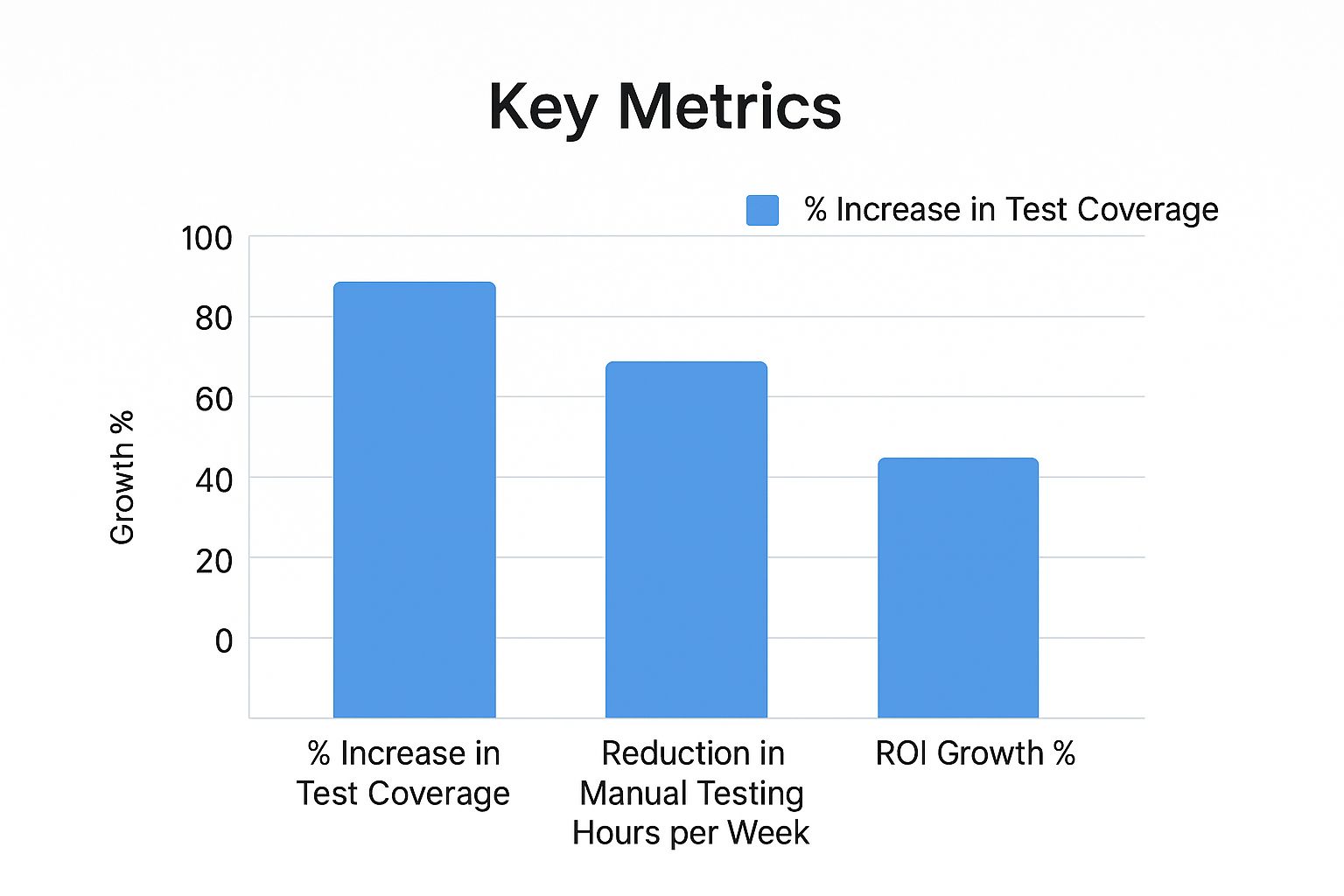
Global spending on test automation tools has increased by almost 30% in the past year. This demonstrates that businesses recognize the long-term advantages, such as fewer manual errors and faster time-to-market. In many organizations, manual effort has been reduced by over 40% by moving routine tests to automated systems. Find more detailed statistics here. This allows testers to concentrate on complex scenarios and exploratory testing, ultimately improving productivity and software quality. About 70% of development teams now incorporate automated tests into their Continuous Integration/Continuous Deployment (CI/CD) pipelines, leading to faster and more dependable deployments.
Communicating ROI to Stakeholders
Communicating the ROI of test automation effectively involves presenting clear, concise data that highlights the tangible benefits to stakeholders. This can be accomplished through dashboards, reports, and presentations showcasing key metrics such as time saved, defect reduction, and cost avoidance. Focus on quantifying the impact of automation in terms that resonate with business leaders, such as reduced development costs, increased revenue, and higher customer satisfaction. Check out our guide on Unleashing the power of automated testing.
Templates for ROI Calculation
To simplify ROI calculations, use readily available templates and tailor them to your organization’s specific needs. You might be interested in: How to master chaos engineering

These templates typically compare the costs of manual testing with the costs of implementing and maintaining automation, while accounting for the benefits realized through time savings and quality improvements. By presenting a clear and compelling ROI case, you can secure the long-term success of your test automation strategy.
Selecting Tools That Actually Work For Your Team
Choosing the right test automation tools can be tricky. Vendors often make big promises that don’t match reality, leaving teams with tools that aren’t a good fit. This section offers a practical way to evaluate tools, focusing on what truly matters for your team. For a solid foundation, consider these industry-standard test automation best practices.
Key Considerations For Tool Selection
Don’t get caught up in the latest trends. Concentrate on core functionalities that match your specific needs. Several important factors to consider include:
-
Integration Capabilities: Does the tool work smoothly with your current technology? If you use Jira for issue tracking, make sure the tool can share test results directly with Jira. This saves time and reduces manual work.
-
Language Compatibility: Choose a tool that aligns with your team’s coding skills. If your team mainly uses Python, a Python-based testing framework will shorten the learning curve and get things moving faster.
-
Scalability: Your automation needs will change as your project grows. Choose a tool that can handle larger test volumes, more complex situations, and new requirements without major revisions.
Comparing Commercial And Open-Source Solutions
Both commercial and open-source tools have pros and cons. Commercial tools usually offer comprehensive features, dedicated support, and detailed documentation. But they also come with licensing fees, which can be significant.
Open-source tools are flexible, cost-effective, and have an active community. You might find this helpful: How to master test automation tools. However, they may require more setup and maintenance, and community support isn’t always reliable. The best choice depends on your budget, technical skills, and project needs.
Conducting Effective Proof-Of-Concept Evaluations
Before committing to a tool, run a thorough proof-of-concept (POC). Test the tool in a real-world environment with typical test cases. A POC helps you evaluate capabilities, spot potential problems, and make sure it meets your needs before investing heavily.
This hands-on experience gives you valuable information that you can’t get from marketing materials or online demos. Think of it like test-driving a car before buying it—you need to try it yourself.
Negotiating Favorable Terms With Vendors
If you choose a commercial tool, negotiating licensing terms can significantly impact your cost. Don’t hesitate to discuss discounts, flexible payment options, and tailored support packages. A well-negotiated contract can save money and get you the support you need.
Tool Selection Data And Visualization
The data below shows results from a survey of 150 software development teams about their test automation tool preferences. The following data chart visualizes this information, showing the popularity of each tool.
The data chart clearly shows that Selenium is the most popular tool, used by 45% of the teams. Cypress is second at 25%, followed by Playwright at 15% and Appium at 10%. The remaining 5% use various other tools. This data highlights the importance of market share and community support.
The following table provides a more detailed comparison of these popular test automation tools.
Test Automation Tool Comparison Comprehensive comparison of popular test automation tools across key selection criteria
| Tool/Framework | Best For | Language Support | CI/CD Integration | Learning Curve | Cost | Community Support |
|---|---|---|---|---|---|---|
| Selenium | Web UI Testing | Java, Python, C#, Ruby, JavaScript, Kotlin | Jenkins, GitLab CI, Azure DevOps, CircleCI, Travis CI | Moderate | Open-Source | Large & Active |
| Cypress | End-to-end Testing, JavaScript Frameworks | JavaScript, TypeScript | Jenkins, GitLab CI, Azure DevOps, CircleCI, Travis CI | Easy | Open-Source, Paid for Enterprise | Growing |
| Playwright | Cross-browser Testing, Web Automation | JavaScript, TypeScript, Python, Java, .NET | Jenkins, GitLab CI, Azure DevOps, CircleCI, GitHub Actions | Easy | Open-Source | Growing |
| Appium | Mobile App Testing | Java, Python, Ruby, JavaScript, PHP | Jenkins, GitLab CI, Azure DevOps, CircleCI, Bitrise | Moderate | Open-Source | Large & Active |
This table summarizes the key features and considerations for each tool, helping teams make informed decisions based on their specific project requirements. Choosing the right tool means balancing its maturity with the team’s skills and the project’s needs.
The Future of Test Automation: Trends Reshaping Quality
The world of test automation is in constant motion. Emerging technologies are changing how teams approach and achieve quality. Keeping up requires a proactive and adaptable test automation strategy. Let’s delve into the significant trends influencing the future of quality assurance.
The Rise of Artificial Intelligence
Artificial Intelligence (AI) is reshaping software testing. AI-powered tools can generate test cases, analyze results, and even predict potential defects. This reduces manual effort in test creation and maintenance, freeing up teams to focus on more complex testing scenarios.
For instance, AI algorithms can learn from past test runs to suggest improvements to test coverage, resulting in smarter and more efficient automation.
The Importance of API Testing
With the rise of microservices and APIs, API testing has become a critical component of quality assurance. A robust test automation strategy needs comprehensive API tests to guarantee the seamless integration and functionality of different systems.
This includes directly testing APIs, verifying data exchange, and validating performance under a range of conditions. This proactive approach prevents expensive integration problems down the line.
The Growth of Codeless Testing Platforms
Codeless testing platforms are empowering non-technical users to participate in the test automation process. These platforms employ visual interfaces and drag-and-drop functionality, making automation accessible to a broader range of team members.
This democratization of testing encourages collaboration between developers, testers, and business analysts, ultimately improving the quality and expanding the scope of testing efforts.
The global automation testing market, valued at USD 25.43 billion in 2022, is expected to see substantial growth. Projections indicate a CAGR of 17.3% from 2023 to 2030, reaching USD 63.05 billion by 2032. This growth is driven by increased adoption of Agile and DevOps methodologies and the ongoing shift toward digital platforms. Learn more about this growing market.
Future-Proofing Your Test Automation Strategy
To navigate these trends, organizations need to prioritize continuous learning and adaptation. Invest in training and development to equip your team with the skills to use new tools and technologies effectively.
Equally important is a flexible and adaptable test automation strategy. Staying informed about industry developments and incorporating new best practices are crucial for maintaining an effective and efficient strategy. Treat your test automation strategy as a living document, constantly evolving alongside the industry.
Integrating Test Automation in Agile and DevOps Teams
Modern development approaches like Agile and DevOps emphasize speed and flexibility. This requires a test automation strategy that adapts to frequent changes. High-performing teams understand that automation isn’t just about faster tests, it’s about seamless integration with the development lifecycle.
Shift-Left Testing and Continuous Feedback
Shift-left testing means integrating testing earlier in development. This proactive approach finds bugs sooner, making them cheaper to fix. Think of finding a crack in a building’s foundation during construction, not after it’s finished. Shift-left testing provides continuous feedback, letting developers address issues immediately and reduce later rework.
This continuous feedback loop encourages collaboration between developers and testers, promoting shared responsibility for quality. It’s like an ongoing conversation throughout a construction project, instead of waiting for a final inspection.
Maintaining Automation Stability Amidst Change
Frequent code changes can destabilize automated tests. A robust automation strategy uses techniques like modular test design and robust locators. Modular design breaks tests into smaller, independent units, making them less vulnerable to code changes. Robust locators identify UI elements reliably, even with interface changes. Together, these keep tests reliable and informative.
Test Prioritization and Execution Speed
Balancing test coverage and execution speed is vital in Agile and DevOps. Not all tests are equal. Prioritize tests based on risk and business impact. Automate critical user flows and core functions first. This ensures thorough testing of the most important application aspects within short iteration cycles. It’s like a hospital triage system, addressing the most urgent cases first.
Embedding Automation in CI/CD Pipelines
Continuous Integration/Continuous Deployment (CI/CD) pipelines automate build, test, and deployment processes. Integrating automated tests into these pipelines ensures every code change is thoroughly tested before deployment. This minimizes bugs in production and speeds up new feature delivery, creating a reliable and efficient delivery process.
Creating Effective Feedback Loops
Effective feedback loops are essential for Agile and DevOps. Test automation provides valuable data on application quality and performance. But raw data isn’t enough. Teams need systems to turn this data into actionable insights. Dashboards, automated reports, and integrations with issue tracking systems (like Jira) make test results immediately visible and accessible to the entire team. This transparency allows for quick responses to issues and drives continuous improvement. It creates a system where data fuels action, improving both process and product. Consider using GoReplay to capture and replay live HTTP traffic for realistic testing environments, further enhancing your automation strategy.
Overcoming the Roadblocks to Automation Excellence

Even with a solid test automation strategy, organizations often face obstacles. These hurdles can slow down progress and impact the team’s confidence in the automation process. This section examines common roadblocks and provides practical solutions to keep your automation journey on the right path.
Managing Flaky Tests
Flaky tests, those that inconsistently pass and fail without code changes, are a major pain point. They undermine confidence in the test suite and lead to wasted time investigating false positives. Imagine a smoke detector going off randomly; you eventually start ignoring it, even when there’s a real fire. Likewise, flaky tests can cause real bugs to be missed.
Several techniques can help reduce flakiness. These include improving test isolation, using reliable locators, implementing appropriate wait strategies, and optimizing test data management. For example, ensuring tests don’t share state or depend on execution order minimizes unexpected interactions. This results in a more stable and trustworthy testing process.
Controlling Maintenance Overhead
As applications evolve, so must automated tests. The maintenance overhead of updating and adapting these tests can become unwieldy if not managed effectively. It’s like constantly patching a leaky roof instead of building a solid new one.
Modular test design, where tests are broken into smaller, reusable pieces, can significantly help. This way, updates to one area of the application don’t require rewriting entire test suites. Using a Page Object Model (POM) for UI tests can also encapsulate element locators, making tests more resilient to interface changes. This focused maintenance approach keeps your efforts streamlined and productive.
Handling Complex Test Environments and Data Dependencies
Managing complex test environments and data dependencies can be a significant challenge. Inconsistent environments and unreliable data lead to unpredictable test outcomes and wasted time debugging unrelated problems. It’s like trying to build a house on shifting sand – it’s bound to fall apart.
Standardizing environments with containerization technologies like Docker creates consistent and reproducible test environments. Tools like GoReplay can capture and replay live HTTP traffic, providing realistic testing with real production data. Implementing strong test data management techniques, such as data masking and database snapshots, further strengthens the reliability and stability of your tests. This creates a solid base for your testing efforts.
Securing Resources and Building Team Capabilities
Test automation requires investment in tools, infrastructure, and team skills. Securing the necessary resources and developing team capabilities are crucial for long-term success. This might mean allocating budget for automation tools, providing training, and establishing dedicated automation roles. Investing in your team and resources is like investing in the right equipment and training for a construction crew, enabling them to work efficiently and effectively.
Maintaining Momentum Through Challenges
The path to automation excellence is rarely smooth. Staying on track requires persistence, adaptability, and clear communication. Celebrate small victories, learn from setbacks, and frequently update stakeholders on progress and challenges. This fosters a culture of continuous improvement and keeps everyone engaged and motivated. Just like a construction project encounters unexpected delays, so too will your automation initiatives. A proactive approach to problem-solving and open communication will help you overcome these hurdles and succeed. This builds team resilience and reinforces the value of their work.
Ready to simplify testing and ensure your application can handle real-world traffic? Explore GoReplay and its powerful features today!