
7 Key Test Automation Advantages for Faster Releases in 2025

In the competitive software development lifecycle, speed and quality are not just goals; they are fundamental requirements for success. Manual testing, while essential for certain exploratory tasks, often becomes a significant bottleneck, slowing down releases and introducing the risk of human error. This is where a strategic implementation of test automation becomes a game-changer, transforming the quality assurance process from a gatekeeper into an accelerator. By automating repetitive, complex, and time-consuming tests, teams can reclaim valuable engineering hours, accelerate feedback loops, and deploy new features with greater confidence.
This article moves beyond the surface-level discussion to provide a detailed breakdown of the most critical test automation advantages. We will explore seven key benefits, from drastically reducing execution time and expanding test coverage to achieving significant long-term cost savings. Each point is designed to offer actionable insights and practical context, helping you understand not just what the benefits are, but how they directly impact your development pipeline, team productivity, and bottom line. Whether you are a developer, a QA engineer, or a technology leader, this guide will equip you with the knowledge to build a robust business case for adopting or expanding your automation strategy.
1. Faster Execution and Reduced Testing Time
One of the most immediate and impactful test automation advantages is the dramatic acceleration of the testing lifecycle. Manual testing is inherently limited by human speed, attention span, and working hours. In contrast, automated scripts execute tasks at a machine’s pace, operating continuously without fatigue or breaks. This allows teams to run complex and extensive test suites in a fraction of the time it would take a human tester.
Automated tests can run 24/7, including overnight and on weekends, transforming idle time into productive quality assurance cycles. A regression suite that might take a QA team several days to complete manually can be executed in just a few hours. This speed allows for more frequent testing within the development pipeline, enabling a true continuous integration and continuous delivery (CI/CD) workflow. Faster feedback loops mean developers can identify and fix bugs closer to the time of code commit, reducing the cost and complexity of remediation.
Real-World Impact and Implementation
Tech giants have leveraged this advantage to scale their operations effectively. For instance, Netflix executes thousands of automated tests in parallel to validate its streaming services before every deployment, while Google runs millions of tests daily across its vast product ecosystem. These companies prove that speed is not just about efficiency; it’s a strategic enabler for innovation and quality at scale.
To achieve these results, consider these actionable steps:
- Prioritize Wisely: Start by automating tests that are run frequently and are the most time-consuming to perform manually, such as regression tests or smoke tests.
- Embrace Parallelism: Implement frameworks like Selenium Grid or leverage cloud-based testing platforms to run multiple tests simultaneously, significantly cutting down execution time.
- Schedule Off-Peak Runs: Configure your CI/CD pipeline to trigger automated test suites during off-peak hours (e.g., overnight) to maximize resource utilization without disrupting development workflows.
The following bar chart visualizes the quantifiable speed and efficiency gains typically realized through test automation.
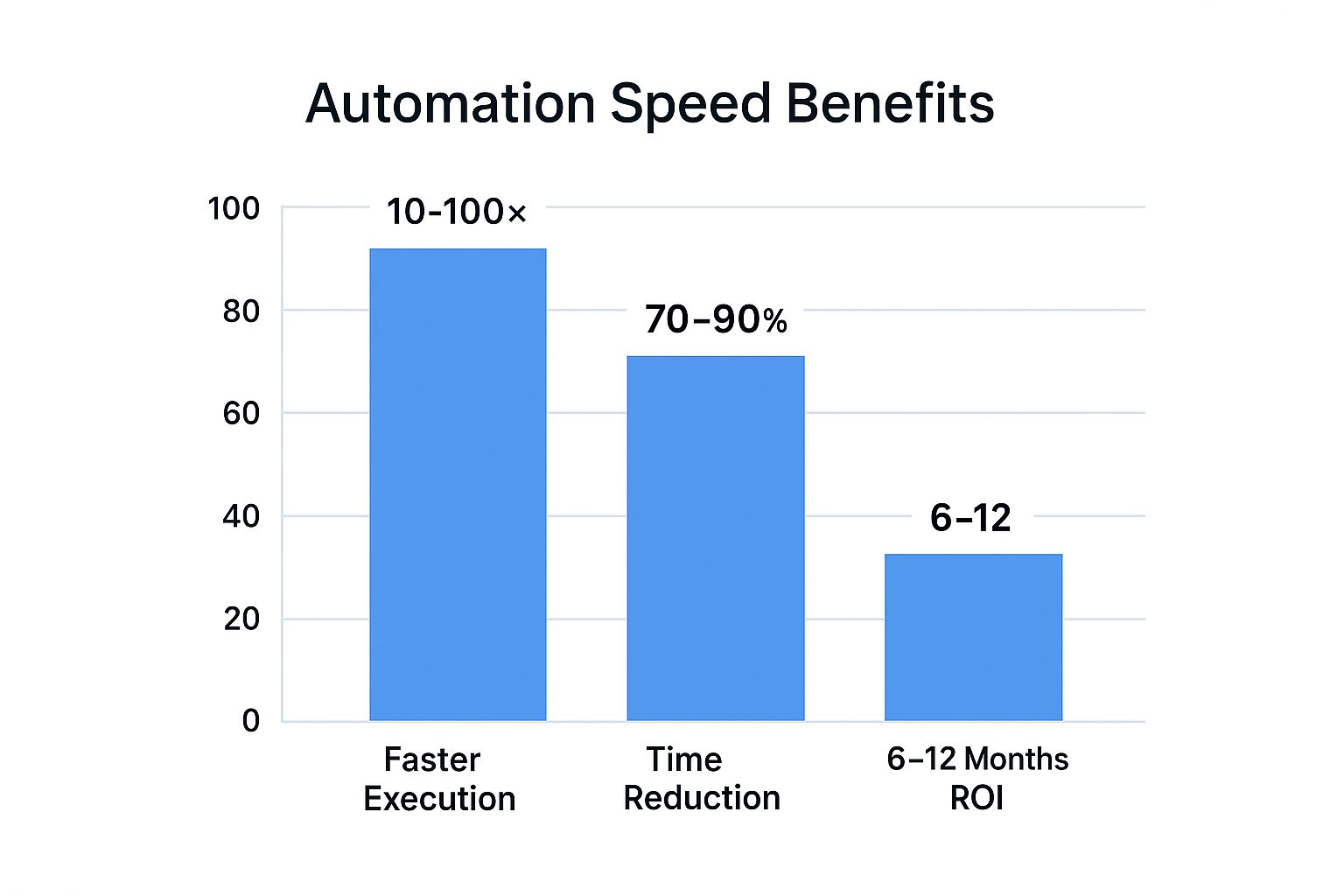
As the chart illustrates, organizations can achieve a powerful trifecta: executing tests up to 100 times faster, cutting overall testing time by as much as 90%, and realizing a return on their investment within a year.
2. Increased Test Coverage and Depth
Beyond speed, one of the most critical test automation advantages is the ability to dramatically broaden the scope and depth of testing. Manual testing is constrained by time and resources, often forcing teams to prioritize only the most critical paths. Automation shatters these limitations, enabling organizations to execute a far greater number of test cases across a vast matrix of configurations, features, and edge cases that would be impractical to cover manually.
This expansion of test coverage is crucial for delivering a robust and reliable user experience. Automated tests can systematically validate functionality across numerous browsers, operating systems, devices, and data combinations. This ensures that the application performs as expected for every user, regardless of their environment, a feat nearly impossible to achieve with manual testing alone within tight release cycles.

Real-World Impact and Implementation
Leading technology companies rely on extensive test coverage to maintain quality across diverse user bases. Amazon, for example, automates tests across more than 40 browser and device combinations to ensure a consistent shopping experience. Similarly, Salesforce maintains over 90% code coverage through extensive automated unit and integration tests, which is fundamental to the stability of its complex CRM platform. Booking.com takes this even further, executing automated tests across 43 languages and multiple currencies to validate its global service.
To achieve this level of comprehensive coverage, consider these actionable steps:
- Implement a Risk-Based Approach: Prioritize automating tests for high-risk features and complex functionalities first to ensure maximum impact on application quality.
- Leverage Cross-Browser Testing Tools: Integrate with platforms like BrowserStack or Sauce Labs to automate tests across a wide array of browsers and devices without maintaining a physical lab.
- Create Data-Driven Frameworks: Design tests that can pull from large datasets to simulate hundreds or thousands of user scenarios and input variations with a single script, maximizing scenario coverage efficiently.
- Measure Coverage Metrics: Actively monitor code coverage and feature coverage metrics to identify gaps in your testing strategy and make data-informed decisions about where to expand automation efforts.
3. Improved Accuracy and Consistency
Another of the key test automation advantages is the elimination of human error, leading to unparalleled accuracy and consistency. Manual testing, while valuable for exploratory scenarios, is susceptible to fatigue, oversight, and unintentional variation. A human tester may perform a sequence of steps slightly differently each time, potentially missing subtle bugs or introducing inconsistencies into the results.
Automated tests, however, are fundamentally different. They execute a predefined script with machine-level precision, performing the exact same steps in the exact same order, every single time. This robotic consistency ensures that any detected failure is a genuine issue with the application under test, not a byproduct of tester variability. This reliability is crucial for complex, repetitive tasks like regression testing, where even minor deviations could lead to false negatives or mask critical defects.

Real-World Impact and Implementation
This level of precision is non-negotiable in high-stakes industries. Banking institutions, for example, rely on automation to validate complex transaction flows consistently, ensuring regulatory compliance and financial integrity. Similarly, NASA employs rigorous automated testing to verify mission-critical software for its spacecraft, where even the smallest error could have catastrophic consequences. These examples highlight how consistency is not just about quality but about trust and risk mitigation.
To harness this advantage in your own projects, consider these actionable steps:
- Implement Robust Assertions: Go beyond simple pass/fail checks. Use detailed assertions in your scripts to validate specific data points, UI elements, and API responses, ensuring every aspect of a feature behaves as expected.
- Version Control Test Scripts: Treat your test code like application code. Store it in a version control system (e.g., Git) to track changes, maintain a history, and ensure the entire team is working with the same consistent set of tests.
- Standardize Test Environments: Create stable, repeatable test environments and data sets. Using tools like Docker or infrastructure-as-code ensures that tests run against a consistent baseline, removing environmental variables as a source of failure.
As the chart shows, the precision of automation dramatically reduces business risks, ensures 100% repeatable test execution, and can lead to a 70% decrease in human-induced errors.
4. Cost Reduction and Better ROI
While test automation requires an initial investment in tools, infrastructure, and training, one of its most compelling long-term advantages is the significant reduction in overall testing costs and a strong return on investment (ROI). Manual testing is labor-intensive and expensive, with costs scaling directly with the complexity and frequency of testing cycles. Automation breaks this linear cost model by creating reusable assets that deliver value release after release.
Automated tests, once created, can be run repeatedly at a marginal cost, effectively amortizing the initial development expense over time. This approach drastically reduces the hours required for manual regression testing, freeing up QA professionals to focus on more complex exploratory testing and quality strategy. Furthermore, by catching defects earlier in the development lifecycle, automation prevents expensive bugs from reaching production, where the cost of remediation can be up to 100 times higher. This proactive defect detection is a cornerstone of the financial benefits derived from test automation.
Real-World Impact and Implementation
The financial gains from automation are not merely theoretical; they are well-documented across industries. For example, IBM reported a staggering 90% reduction in testing costs after implementing a robust automation strategy, while retail giant Target cut its testing expenses by 40%. Similarly, Capgemini has noted that its clients typically achieve a 30% cost reduction in their testing budgets through strategic automation, demonstrating that these savings are attainable for a wide range of organizations.
To maximize ROI and realize these cost benefits, consider these actionable steps:
- Calculate Projected ROI: Before starting, estimate your ROI by comparing the upfront automation costs (tools, training, development) against the projected savings from reduced manual testing hours and earlier bug detection.
- Prioritize High-ROI Candidates: Begin by automating tests that are stable, time-consuming to perform manually, and run frequently, such as critical-path regression suites. These offer the quickest and most substantial returns.
- Leverage Open-Source Tools: Minimize initial investment by starting with powerful open-source tools like Selenium, Playwright, or Cypress. This allows your team to build expertise and prove value before committing to expensive enterprise licenses.
- Track Key Cost Metrics: Continuously monitor metrics such as the number of defects found pre-production, manual testing hours saved, and the cost per automated test execution to validate and report on the financial impact of your automation efforts.
5. Enhanced CI/CD Integration and Continuous Testing
Test automation is the engine that drives modern DevOps, making continuous integration and continuous delivery (CI/CD) pipelines possible. Manual testing creates a bottleneck that halts the flow of code, but automated tests integrate seamlessly into the development workflow. They can be configured to run automatically with every code commit, providing immediate, real-time feedback to developers. This rapid validation is a cornerstone of continuous testing, a practice where quality checks are embedded throughout the entire software development lifecycle.
This integration transforms testing from a separate, final stage into an ongoing, automated process. By catching defects moments after they are introduced, teams can prevent flawed code from ever progressing to staging or production environments. This “shift-left” approach not only improves software quality but also significantly accelerates the delivery cycle, enabling organizations to release features faster and more reliably. The ability to automate testing within the pipeline is one of the most strategic test automation advantages for any high-velocity engineering team.
Real-World Impact and Implementation
The world’s most innovative companies rely on this advantage to maintain their competitive edge. Etsy, for example, successfully executes over 50 deployments per day by embedding automated testing directly into its CI/CD pipeline. Similarly, Amazon’s legendary deployment frequency, sometimes as often as every 11.7 seconds, is built upon a foundation of extensive, sophisticated automated testing that validates every change. These examples demonstrate that robust CI/CD integration isn’t just a best practice; it’s a prerequisite for elite engineering performance.
To achieve these results, consider these actionable steps:
- Establish Tiered Test Suites: Create a multi-layered approach. Start with rapid unit and smoke tests for immediate feedback, followed by more comprehensive integration and end-to-end suites that run at later stages of the pipeline.
- Use Containerization: Implement technologies like Docker to create consistent, isolated, and reproducible environments for every test run, eliminating the “it works on my machine” problem. For a deeper look, you can learn more about CI/CD pipeline optimization here.
- Implement Clear Failure Criteria: Define strict rules for when a failed test should block a build from progressing. This ensures that quality standards are enforced automatically and prevents regressions from reaching users.
6. Better Resource Utilization and Team Productivity
One of the most profound test automation advantages is the strategic reallocation of your most valuable asset: human intellect. By automating repetitive and time-consuming manual checks, organizations liberate their skilled QA professionals from mundane tasks. This allows them to pivot their focus toward higher-value activities that require creativity, critical thinking, and domain expertise, such as exploratory testing, user experience evaluation, and complex scenario analysis.
This shift does more than just optimize workflows; it fundamentally elevates the role of the QA team. Instead of being bogged down by mind-numbing regression cycles, engineers can engage in more strategic initiatives that directly impact product quality and user satisfaction. This transition boosts team morale, increases job satisfaction, and ultimately drives greater overall productivity by ensuring human talent is applied where it matters most.
Real-World Impact and Implementation
Leading tech companies have successfully used automation to empower their QA teams. For instance, after automating its regression suites, Spotify reallocated a significant portion of its QA time from repetitive checks to innovative exploratory testing. Similarly, Adobe’s automation efforts allowed its QA professionals to concentrate on in-depth user experience testing, ensuring their creative tools were not just functional but also intuitive and delightful to use.
To effectively reallocate your team’s focus, consider these actionable steps:
- Provide Comprehensive Training: Equip your manual testers with the skills needed to contribute to automation. Offer training in relevant tools and programming languages to create a more versatile and empowered team.
- Create Clear Career Paths: Define career progression for engineers who specialize in test automation. This recognizes their value and provides a clear trajectory for growth, motivating team members to build expertise.
- Involve Manual Testers in Strategy: Engage your entire QA team in the automation strategy and script development process. Their deep product knowledge is invaluable for identifying critical test cases and ensuring the automation effort is effective.
- Balance Automation and Manual Testing: Use automation to augment, not replace, human testers. Maintain a healthy balance by dedicating resources to exploratory and usability testing, where human intuition is irreplaceable.
7. Comprehensive Reporting and Analytics
Beyond simply executing tests, a key test automation advantage lies in its ability to generate detailed, consistent, and actionable data. Automated testing frameworks produce comprehensive reports and logs for every execution, transforming raw pass/fail results into a rich source of insights. This data provides a clear view of application quality, test coverage, failure patterns, and overall testing effectiveness.
This wealth of information empowers teams to move beyond reactive bug-fixing and embrace data-driven decision-making. By analyzing trends over time, engineers can pinpoint flaky tests, identify high-risk areas of the codebase, and track performance degradation. These analytics are crucial for continuous improvement, enabling teams to refine both their application and their testing processes with empirical evidence rather than guesswork.
Real-World Impact and Implementation
Leading technology companies harness these analytics to maintain high-quality standards and inform strategic decisions. For example, PayPal uses detailed automated reports to demonstrate quality and compliance to auditors, while Airbnb tracks test execution trends to continuously optimize its testing strategy. Microsoft’s Azure DevOps platform provides powerful, built-in test analytics dashboards that help teams visualize quality metrics across the entire development lifecycle.
To leverage this advantage, consider these actionable steps:
- Define Key Metrics: Go beyond basic pass/fail rates. Track metrics aligned with business goals, such as test stability, execution time trends, and code coverage, to gain deeper insights.
- Visualize for Clarity: Implement tools like Allure Reports or use the dashboarding features in platforms like Jenkins or TestRail to create visual dashboards that make complex data easily understandable for all stakeholders.
- Integrate Your Toolchain: Connect your test reporting tools with project management systems (e.g., Jira) and defect trackers. This automatically creates tickets for failures and links test results directly to user stories, creating a seamless and traceable workflow.
- Analyze Failure Patterns: Use historical data to identify recurring failures or flaky tests. By understanding these patterns, you can address underlying instability in the application or the test suite itself. For more details on this, see our guide on automated testing best practices.
Test Automation Advantages Comparison Table
| Aspect | Faster Execution and Reduced Testing Time | Increased Test Coverage and Depth | Improved Accuracy and Consistency | Cost Reduction and Better ROI | Enhanced CI/CD Integration and Continuous Testing | Better Resource Utilization and Team Productivity | Comprehensive Reporting and Analytics |
|---|---|---|---|---|---|---|---|
| Implementation Complexity 🔄 | Medium - initial setup & parallel infra | High - planning for broad coverage needed | Medium - maintain stable scripts | Medium to High - tooling, training, strategy | High - requires stable fast tests & cultural shift | Medium - requires upskilling and process changes | Medium - effort to define & maintain meaningful reports |
| Resource Requirements ⚡ | Requires parallel execution environments | Extensive - tools for cross-platform & data-driven testing | Moderate - stable test data/environments | Investment in tools, engineers, and maintenance | Infrastructure for CI/CD and fast-executing tests | Training for QA in automation & ongoing support | Tools for reporting, dashboards, and defect integration |
| Expected Outcomes 📊 | 70-90% reduction in testing time, rapid feedback | 3-5× more coverage, multi-browser/device support | Consistent zero-variation execution | 200-300% ROI over 2-3 years, cost savings | Multiple daily releases, fast defect detection | 40-60% regression testing time saved, higher QA productivity | Objective quality metrics, predictive insights |
| Ideal Use Cases 💡 | Regression tests, frequent & long-running tests | Complex apps needing broad browser/device/config coverage | Repetitive, deterministic verification tasks | Cost-sensitive projects aiming long-term savings | DevOps pipelines, continuous integration/delivery | Teams needing to optimize QA efforts & creativity | Teams leveraging data-driven test management |
| Key Advantages ⭐ | 10-100× faster test runs, supports 24/7 testing | Identifies edge defects, ensures cross-platform consistency | Reliable defect detection, reduces false positives | Early defect detection, reduces manual effort | Immediate feedback on code changes, prevents broken builds | Frees testers for exploratory work, improves morale | Detailed analysis, stakeholder visibility, trend tracking |
Transforming Your Testing Strategy for the Future
The journey from manual to automated testing is not merely a technical upgrade; it’s a strategic business transformation. Throughout this article, we’ve explored the multifaceted test automation advantages that redefine how software is built, tested, and delivered. We’ve moved beyond the surface-level benefits to uncover a landscape where speed, accuracy, and efficiency converge to create superior digital products.
Recapping the core takeaways, we see a clear narrative: automation acts as a powerful catalyst for growth and quality. It shatters the limitations of manual testing, enabling faster execution cycles and dramatically reducing the time-to-market. By expanding test coverage and depth, it uncovers hidden defects and edge cases that human testers might miss, ensuring a more robust and reliable application. This systematic approach guarantees improved accuracy and consistency, eliminating the variable of human error from repetitive tasks.
From Theory to Actionable Strategy
Understanding these advantages is the first step. The real challenge, and where the most significant value lies, is in translating this knowledge into a coherent, actionable strategy. It’s about more than just writing scripts; it’s about fundamentally rethinking your quality assurance process. The integration of automation into your CI/CD pipeline is non-negotiable for modern DevOps, enabling a culture of continuous testing where quality is a shared responsibility, not a final-gate inspection.
This shift has a profound impact on your team. By automating the mundane and repetitive, you free your talented QA engineers and developers to focus on higher-value activities like exploratory testing, complex user-scenario analysis, and performance optimization. This not only boosts productivity but also enhances job satisfaction and innovation. Furthermore, the comprehensive reporting and analytics generated by automation tools provide the data-driven insights necessary to make informed decisions, track quality trends, and demonstrate a clear return on investment.
Your Next Steps in Automation
To harness the full spectrum of test automation advantages, your organization must commit to a culture of continuous improvement. Begin by identifying the most critical, repetitive, and high-risk areas of your application as prime candidates for automation.
- Start Small and Scale: Don’t try to automate everything at once. Select a pilot project to build expertise and demonstrate quick wins.
- Choose the Right Tools: Evaluate tools based on your technology stack, team skill set, and specific testing needs, such as simulating real-world traffic.
- Invest in Training: Equip your team with the skills and knowledge required to design, implement, and maintain a robust automation framework.
- Integrate and Iterate: Embed your automated tests directly into your development workflow and continuously refine your strategy based on feedback and results.
Embracing test automation is an investment in the future of your product and your business. It’s the engine that powers faster innovation, higher quality, and a more resilient development lifecycle, ensuring you can meet the ever-increasing demands of the digital marketplace with confidence.
Ready to experience the most powerful test automation advantages by testing with real user traffic? Discover how GoReplay can help you capture and replay live production traffic to uncover critical issues before they impact your customers. Visit GoReplay to see how you can de-risk your releases and build more resilient systems today.