
Unlocking the Power of Test Doubles
This listicle clarifies the distinctions between stubs vs mocks and explains how to leverage these powerful tools for robust software testing. You’ll learn how to isolate code units, simulate various scenarios, and employ interaction-based and state-based testing techniques. We’ll cover when to use stubs vs mocks, applying them with concepts like Behavior-Driven Development (BDD) and Outside-In TDD, ultimately improving the reliability and efficiency of your testing process. Understanding test doubles is essential for any developer writing robust and maintainable code.
1. Test Doubles with Mocks
In the realm of software testing, understanding the difference between stubs and mocks is crucial for writing effective and maintainable tests. Mocks are a specific type of test double that goes beyond simply providing canned responses like stubs. They focus on verifying how your code interacts with its dependencies, ensuring that the communication between objects happens as expected. Mocks work by registering the calls they receive, allowing you to assert on the interactions that took place during the test. Unlike stubs, which focus on state verification, mocks prioritize behavior verification. They are pre-programmed with expectations: which methods should be called, with what arguments, how many times, and even in what order. If these expectations aren’t met, the test will fail.
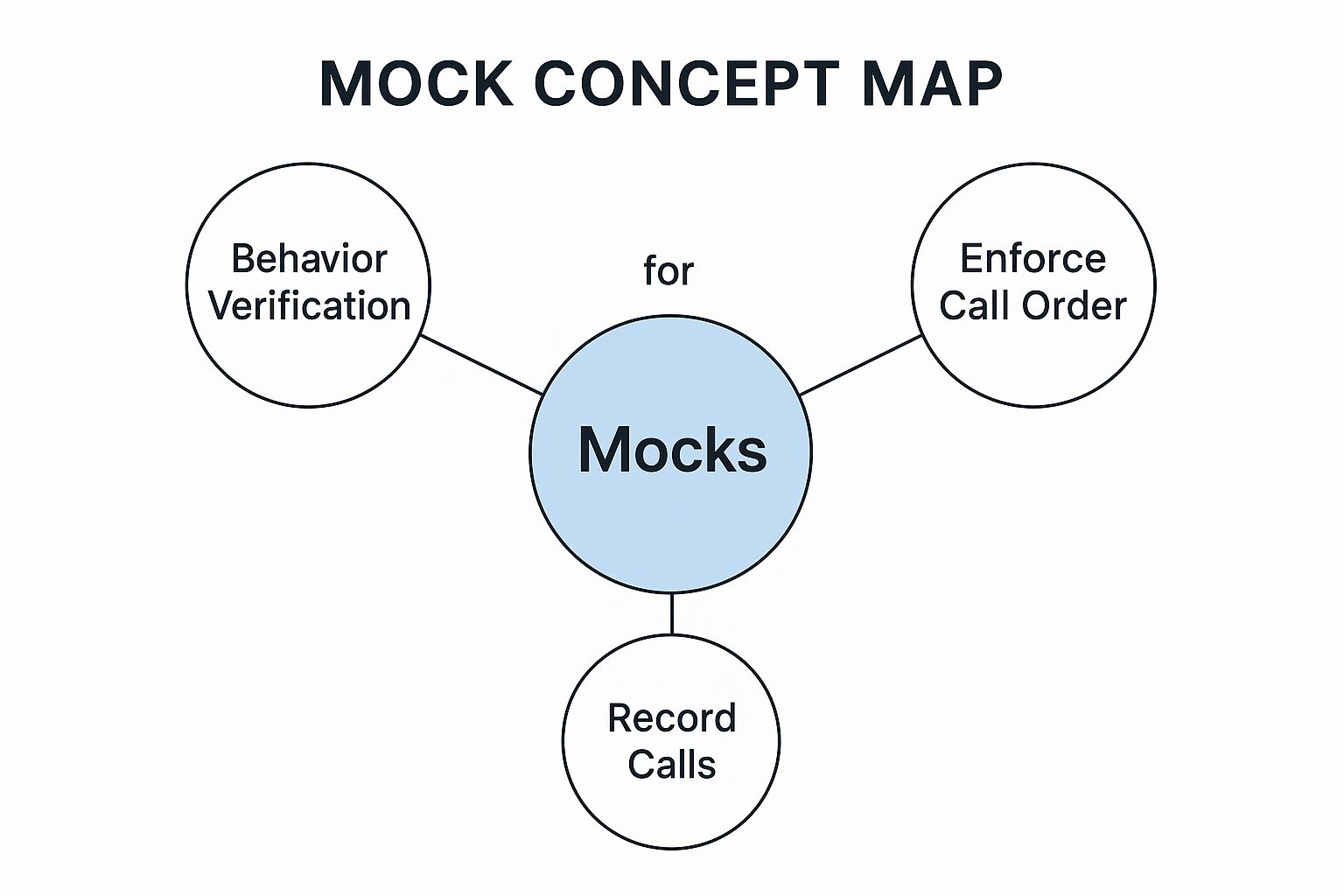
The infographic below visualizes the key concepts surrounding mocks and their relationship to other test doubles. The central concept, “Test Double,” branches out to different types including Mocks, Stubs, Dummies, Spies, and Fakes. The infographic highlights the core function of each double and its primary usage in testing.
As shown in the infographic, Mocks are primarily used for behavior verification, unlike Stubs that focus on state verification or Dummies that are simply placeholders. This visualization emphasizes the role of Mocks in focusing on the interactions and collaborations between objects under test.
Mocks offer several key features: they verify behavior and interactions, record method calls and parameters, can enforce call order, and are usually self-verifying, containing assertions within the mock itself. This makes them extremely powerful for testing complex interactions between components. For example, imagine testing a notification service. A mock can verify that the notification service’s sendNotification method was called with the correct recipient and message when a specific event occurs.
Pros of using Mocks:
- Excellent for testing complex interactions: Capture and verify intricate communication patterns between objects.
- Enforce design contracts: Help maintain clear boundaries and expectations between different parts of your system.
- Reveal excessive dependencies: Highlight areas where your code relies too heavily on external components.
- Ideal for notification/callback scenarios: Effectively test asynchronous operations and event-driven architectures.
- Enable interaction-based testing: Focus on the “how” of communication, rather than just the end result.
Cons of using Mocks:
- Brittle tests: Over-specification can lead to tests that break easily with minor implementation changes.
- Focus on implementation details: Can tie tests too closely to the internal workings of the code.
- Higher maintenance cost: More complex setup and configuration compared to simpler test doubles.
- Difficult refactoring: Changes to the codebase can require significant updates to mock setups.
Examples of Mocks in different languages:
- Mockito (Java):
verify(mockObject).methodName(arguments) - Jest (JavaScript):
expect(mockFn).toHaveBeenCalledWith(arg1, arg2) - Moq (C#):
mock.Verify(x => x.DoSomething(It.IsAny<string>()), Times.Once())
Tips for Effective Mocking:
- Mock only what you own: Avoid mocking third-party libraries or frameworks.
- Limit verification: Focus on the essential interactions for the test, avoiding over-specification.
- Prioritize interaction testing: Use mocks when the interaction itself is the primary focus of the test.
- Consider “London School” TDD: This approach emphasizes interaction testing and the use of mocks.
- Combine with other test doubles: Use a mix of stubs, mocks, and other doubles to create comprehensive tests.
The concepts surrounding mocks and their effective use have been popularized by influential figures in the software development community, including Martin Fowler (who defined Test Doubles), Gerard Meszaros (xUnit Test Patterns), and Steve Freeman and Nat Pryce (Growing Object-Oriented Software, Guided by Tests). The Mockito framework, created by Szczepan Faber, has also significantly contributed to the widespread adoption of mocking in Java.
This video provides a practical demonstration of using mocks in testing.
By understanding the strengths and weaknesses of mocks, and by following these tips, you can leverage their power to write effective tests that ensure the correct behavior and interaction between components in your software. This ultimately contributes to more robust, maintainable, and high-quality code.
2. Test Doubles with Stubs
In the realm of software testing, understanding the nuances of test doubles is crucial, particularly when comparing stubs vs mocks. Stubs are a specific type of test double that provide predetermined responses to method calls without actually executing the real underlying logic. Their primary purpose is to control the indirect inputs provided to the system under test, allowing you to set up specific scenarios and focus on verifying the outcome or state of your code, rather than the specific interactions that led to that state. They essentially act as stand-ins, offering canned responses and simplifying the testing environment. This makes them especially useful when dealing with external dependencies, complex systems, or operations that are time-consuming or resource-intensive.

Stubs are characterized by several key features: they return canned responses to specific method calls, they don’t respond to unspecified calls (effectively isolating the system under test), and they don’t track or verify how they were used. This last point is a key differentiator in the stubs vs mocks debate. While mocks focus on behavior verification, stubs are concerned with state verification. This means a stub won’t care how many times a method was called or the order of calls, but rather, it ensures the system under test receives the expected input and produces the expected output. You can program stubs to return different values for different calls, allowing for flexible test scenario setup.
Examples of Stub Implementation:
- Sinon.js:
sinon.stub(obj, 'method').returns(value)allows you to stub a method on an object and force it to return a specific value. - JUnit (Manual Stubs): You can create classes that implement interfaces, overriding methods with fixed return values to serve as stubs.
- RSpec (Ruby):
allow(object).to receive(:method).and_return(value)stubs the specified method on the given object.
Pros of Using Stubs:
- Simplicity: Stubs are generally easier to set up and understand than mocks.
- Resilience: They’re less brittle during refactoring, as they don’t rely on specific interaction patterns.
- Focus on State: They emphasize the ‘what’ (the outcome) over the ‘how’ (the interaction details).
- State-Based Testing: Ideal for testing state changes and the resulting output of your code.
- Loose Coupling: Less coupled to implementation details, promoting better test design.
Cons of Using Stubs:
- Limited Interaction Verification: Stubs don’t verify interactions, which can lead to missed bugs related to how dependencies are used.
- Potential for False Positives: Incorrectly implemented stubs can mask real issues and lead to false positives.
- Complexity Limitations: May not be suitable for simulating complex dependencies with intricate interaction patterns.
- Limited Feedback: Provide less detailed feedback compared to mocks when tests fail.
Tips for Effective Stub Usage:
- Targeted Application: Use stubs when you primarily need to control indirect inputs to your system under test, not when you need to verify interaction behavior.
- Simplicity is Key: Keep stub implementations simple and focused on the specific needs of the test.
- Leverage Frameworks: Consider using stubbing frameworks like Sinon.js or Mockito to simplify the process and improve maintainability.
- Stub Strategically: Stub only the necessary elements for a given test to avoid unnecessary complexity and improve test clarity.
- State-Focused Testing: Prioritize stubs when your testing objective is to verify state changes and outcomes rather than interactions.
Stubs deserve a place in any tester’s toolkit because they offer a powerful way to isolate and control the environment around the code under test. By focusing on state verification, they streamline the testing process and facilitate more robust, maintainable tests. Pioneered and popularized by influential figures in the software development world like Martin Fowler, Gerard Meszaros, Kent Beck, and Robert C. Martin, the concept of stubs represents a critical component of effective test-driven development and overall software quality assurance. Understanding the strengths and limitations of stubs – and how they differ from mocks – is essential for writing effective tests and building reliable software.
3. Interaction-Based Testing
Interaction-based testing, a key differentiator when comparing stubs vs mocks, focuses on how objects communicate with each other, rather than just the final outcome. It verifies that objects interact correctly with their collaborators, ensuring methods are called with the correct parameters, in the right order, and the expected number of times. This approach is particularly useful in complex systems where numerous components interact, allowing you to pinpoint communication breakdowns that might otherwise be obscured by seemingly correct end results.

Unlike stubs, which primarily provide canned responses to method calls, mocks actively verify these interactions. This makes mocks the primary tool for interaction-based testing. This style emphasizes the “tell, don’t ask” principle, promoting looser coupling and improved design. Features of interaction-based testing include a sharp focus on object interactions and message exchanges, verification of method calls (including arguments and sequences), and a deep dive into the coupling between components. This approach is invaluable for testing protocols and contracts between objects.
For example, imagine testing a user authentication flow. Interaction-based testing, using mocks, would verify that the user service correctly calls the authentication service with the provided credentials. Other examples include verifying that a controller dispatches the correct commands to a model, or ensuring a payment processor notifies the correct services upon successful completion. These examples highlight how interaction-based testing reveals potential issues in the communication flow between components.
While powerful, interaction-based testing has its drawbacks. Over-reliance on mocks can lead to overspecified, brittle tests tightly coupled to implementation details. This can make refactoring more difficult, shifting focus away from end-user behavior. Furthermore, there’s a steeper learning curve associated with effectively using mocks for interaction-based testing.
Pros:
- Detects subtle interaction failures that might not affect end results immediately.
- Reveals design issues, particularly in highly coupled systems.
- Useful for testing components with side effects.
- Provides detailed feedback on interaction failures, aiding debugging.
- Excellent for testing protocols and contracts between objects.
Cons:
- Can lead to brittle tests tightly coupled to implementation details.
- Can make refactoring more challenging.
- May not always reflect end-user behavior.
- Steeper learning curve compared to state-based testing.
Tips for Effective Interaction-Based Testing:
- Focus on essentials: Only verify interactions crucial to the functionality being tested.
- Public interface, not implementation: Target the public interface of the object under test, avoiding mocking internal details.
- Balance with state-based testing: Combine interaction-based testing with state-based testing for comprehensive coverage.
- Mock at boundaries: Mock at architectural boundaries to improve test isolation.
- Consider London School TDD: Explore the London School TDD approach for guidance on using mocks effectively.
This approach is invaluable for ensuring robust communication between components in complex systems. When choosing between stubs vs mocks, remember that mocks excel at interaction-based testing. For situations where detailed analysis of interactions within Kubernetes is needed, you might find this article useful: Learn more about Interaction-Based Testing. Popularized by figures like Steve Freeman, Nat Pryce (authors of “Growing Object-Oriented Software, Guided by Tests”), London School TDD practitioners, Mockito framework developers, and J.B. Rainsberger (“Integration Tests Are a Scam”), interaction-based testing has become a cornerstone of modern software development practices.
4. State-Based Testing
State-based testing is a powerful technique in the context of stubs vs mocks, focusing on verifying the outcome of an operation, rather than the specific process by which that outcome is achieved. It’s a “black box” approach where you’re concerned with the “what,” not the “how.” This makes state-based testing particularly useful when employing stubs, allowing you to isolate the unit under test and provide predetermined responses without delving into the intricacies of mock verification.
Instead of meticulously tracking interactions between objects like you would with mocks, state-based testing asserts on the end state of the system. This might involve checking return values of functions, examining the properties of objects after a method call, or verifying that the system transitioned to the expected state. This fundamental difference in approach significantly impacts how you design and write your tests, particularly when deciding between using stubs vs mocks.
How State-Based Testing Works
The core of state-based testing revolves around setting up preconditions, executing the code under test, and then asserting on the postconditions. Stubs play a crucial role in controlling the preconditions by simulating dependencies and providing canned responses. Let’s look at a concrete example:
Example:
Imagine you’re testing a UserRegistrationService. Instead of mocking the EmailService to verify that a welcome email was sent (an interaction-based approach), you’d use a stub for the EmailService. This stub would simply return a success status without actually sending an email. Your test would then focus on verifying the state of the User object after registration, such as checking if the isRegistered flag is set to true and the status is set to ‘pending confirmation’.
More Examples:
- Testing that a calculator returns 4 when adding 2+2.
- Verifying that a user object’s status changes to ‘active’ after confirmation.
- Checking that a shopping cart’s total price is correct after adding items.
Tips for Effective State-Based Testing:
- Focus on Business Requirements: Design tests that directly reflect the desired business outcomes. This ensures your tests are aligned with user needs and remain relevant even during significant code refactoring.
- Use Stubs to Isolate: Stubs are your primary tool for isolating the code under test from its dependencies. This allows you to control the inputs and focus solely on the unit’s behavior.
- Meaningful Assertions: Create clear and concise assertions that target the key state changes. This makes your tests easier to understand and maintain.
- Consider the Chicago School TDD Approach: This approach emphasizes state-based testing and mocks only at the boundaries of your application.
- Combine with Limited Interaction Testing: While primarily focusing on state, strategically introduce interaction testing at critical integration points to catch potential collaboration issues.
Pros:
- Less Brittle Tests: Refactoring internal implementation details is less likely to break state-based tests.
- Aligned with User Behavior: Tests focus on observable outcomes, mirroring how users interact with the system.
- Simpler Setup: Generally easier to set up and understand compared to interaction-based testing with mocks.
- Resilient to Implementation Changes: Internal changes don’t impact the tests as long as the end state remains consistent.
- Focus on Business Requirements: Directly reflects the desired business outcomes.
Cons:
- May Miss Interaction Bugs: Can overlook subtle errors in how components interact.
- Harder Debugging: Pinpointing the cause of failures can be challenging when only the end state is observed.
- Potential for Complex Setups: Some scenarios might require intricate stub configurations.
- Limited Coverage for Complex Collaborations: Might not sufficiently test intricate interactions between multiple components.
- Risk of Missing Edge Cases in Interactions: Overemphasis on state might lead to overlooking edge cases in the interactions.
Why State-Based Testing Deserves its Place:
In the discussion of stubs vs mocks, state-based testing offers a valuable alternative to interaction-based testing. By focusing on outcomes, it promotes more robust and maintainable tests, aligning closely with user needs and business requirements. When combined strategically with stubs and occasional interaction testing, state-based testing provides a pragmatic and effective approach to software verification, especially valuable for software developers, QA engineers, and DevOps professionals seeking a balance between test coverage and maintainability. It represents a key principle advocated by prominent figures like Kent Beck, Robert C. Martin, and practitioners of the Chicago School of TDD, solidifying its place as an important testing strategy.
5. Behavior-Driven Development (BDD) with Mocks and Stubs
Behavior-Driven Development (BDD) is an extension of Test-Driven Development (TDD) that emphasizes describing the desired behavior of a system from a user’s perspective, rather than focusing solely on implementation details. In BDD, tests are written in a natural language style, making them more accessible to non-technical stakeholders and fostering collaboration between developers, testers, and business analysts. This approach bridges the communication gap between technical and non-technical teams, ensuring everyone is on the same page regarding the expected system behavior. BDD effectively leverages both stubs and mocks: stubs set up the necessary context for scenarios, while mocks verify specific interactions, but are used carefully to avoid over-specifying tests and making them brittle.
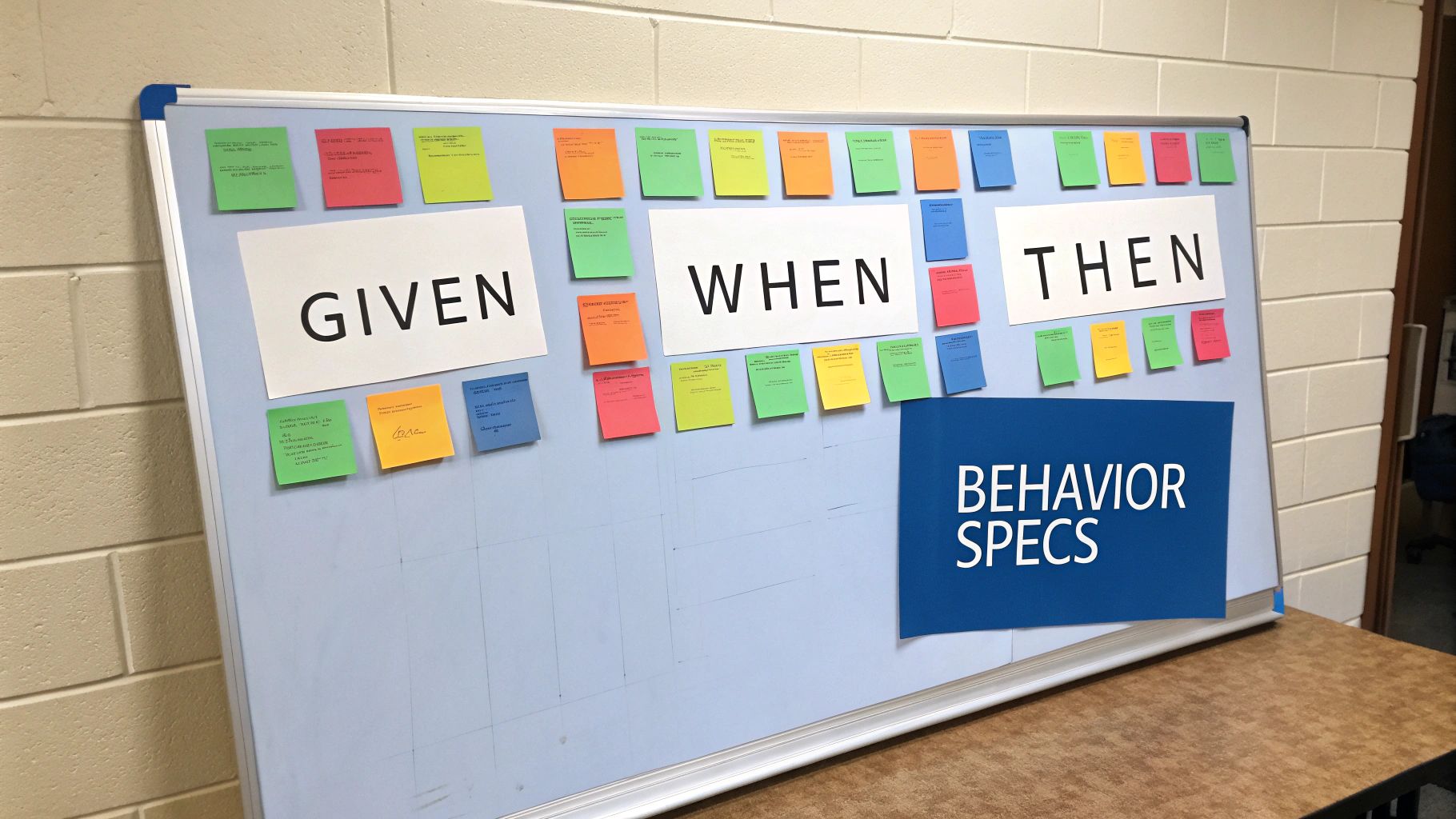
BDD scenarios typically follow a Given-When-Then structure. The “Given” step sets up the preconditions using stubs, creating the context for the scenario. The “When” step describes the action being performed, representing the user interaction or system event. The “Then” step asserts the expected outcome, potentially using mocks to verify specific interactions occurred as expected. This structured approach not only clarifies the test cases but also contributes to creating living documentation of the system’s behavior.
For instance, consider a scenario for an online shopping cart:
- Given a user has added an item to their cart
- When the user proceeds to checkout
- Then the system should calculate the total price and display the payment options
In this example, stubs could be used to populate the shopping cart with a specific item and price in the “Given” step. Mocks might be used in the “Then” step to verify that the payment gateway API was called with the correct total price. This judicious use of mocks and stubs within the BDD framework ensures that the tests focus on the desired behavior, rather than getting bogged down in implementation specifics.
Features of BDD:
- Uses natural language to describe expected behavior
- Follows Given-When-Then structure for scenarios
- Combines state verification with selective interaction testing
- Focuses on user-visible behavior rather than implementation
- Encourages collaboration between technical and non-technical stakeholders
Pros:
- Makes tests more accessible to non-developers
- Aligns testing with business requirements
- Balances the advantages of both mocks and stubs (as highlighted in our comparison of stubs vs mocks)
- Creates living documentation of system behavior
- Reduces focus on implementation details
Cons:
- Can introduce additional complexity in test setup
- May require additional frameworks and tools
- Steeper learning curve for teams new to BDD
- Can be misused to create overly verbose tests
- Requires discipline to maintain focus on behavior
Examples:
- Cucumber scenarios with RSpec mocks/stubs in Ruby
- SpecFlow with Moq in .NET
- JBehave with Mockito in Java
- Jest with Cucumber-JS in JavaScript
Tips for Effective BDD:
- Focus scenarios on business value and user behavior
- Use stubs for context setup in the ‘Given’ steps
- Use mocks sparingly, primarily to verify critical interactions
- Keep scenarios focused on one behavior at a time
- Involve product owners and business analysts in scenario creation
BDD’s strength lies in its ability to align technical implementation with business needs. By focusing on user-centric scenarios and utilizing both mocks and stubs effectively, BDD enhances communication, clarifies requirements, and promotes a shared understanding of the system’s intended behavior. Learn more about Behavior-Driven Development (BDD) with Mocks and Stubs This approach contributes to creating more robust and maintainable software that truly meets user expectations. BDD deserves its place in this list because it offers a powerful way to integrate the strengths of both stubs and mocks into a broader, more collaborative development process. Key figures who have popularized BDD include Dan North (originator of the BDD concept), Liz Keogh (JBehave creator), Aslak Hellesøy (Cucumber creator), and Matt Wynne and Seb Rose (BDD practitioners and authors).
6. Outside-In TDD (London School)
Outside-In Test-Driven Development (TDD), often referred to as the London School of TDD, offers a distinct approach to software development that leverages the interplay between stubs and mocks effectively. Unlike inside-out TDD, which begins with unit tests for individual components, Outside-In TDD starts with the outermost layer of your application – typically the user interface or API – and works its way inwards. This approach emphasizes designing for testability from the user’s perspective, leading to a well-defined network of collaborating objects. This methodology plays a crucial role in understanding the nuances of stubs vs mocks, as it heavily relies on mocks to drive the design process.
This approach begins by writing acceptance tests that describe the desired behavior of a complete feature from the user’s point of view. Instead of immediately diving into implementation, you use mocks to simulate the interactions between different components, effectively defining the expected behavior of dependencies that haven’t been built yet. As you progress inward, you replace these mocks with real implementations, driven by lower-level tests. This process of mocking dependencies before they exist is a key differentiator in the stubs vs mocks discussion, emphasizing the role of mocks in design.
How it Works:
-
Acceptance Test: Write an acceptance test that describes a user interaction with the system. This test will initially fail.
-
Mock Collaborators: Identify the objects the outer layer (e.g., a controller) needs to interact with. Since these inner layers (e.g., services, repositories) likely don’t exist yet, create mocks to stand in for them. Define the expected interactions with these mocks within the outer layer’s test.
-
Unit Test and Implement: Write unit tests for the mocked collaborators, focusing on the interfaces exposed by the mocks. Implement the real components to satisfy these unit tests.
-
Integration: Integrate the now-implemented collaborators with the outer layer. The original acceptance test should now pass, demonstrating that the components work together as designed.
-
Repeat: Continue this process, working inwards layer by layer, replacing mocks with real implementations until the entire feature is complete.
Examples of Successful Implementation:
- User Registration: Starting with an end-to-end test that verifies a user can register through a web form. Mock the user repository, email service, and other dependencies. Then, implement each of these mocked components, driven by unit tests.
- Data Retrieval: Test-driving a controller that retrieves data from a database. Mock the database repository interface initially. Then, implement the repository using the mocked interface as a guide.
Actionable Tips:
- Focus on Roles and Interfaces: Think in terms of the roles objects play and the interfaces they expose, rather than their concrete implementations. This facilitates better decoupling and testability.
- Use Mocks to Define Contracts: Mocks serve as clear contracts between components, specifying the expected interactions. This clarity is essential in understanding when to use mocks versus stubs.
- Don’t Mock Value Objects: Avoid mocking simple data structures or value objects. Focus on mocking behavioral dependencies.
- Walking Skeleton: Consider starting with a basic “walking skeleton” of the application to establish the main communication paths.
Pros:
- Drives better object-oriented design and clear interfaces
- Ensures components work together as expected
- Discovers design problems early
- Clear implementation roadmap
- Focus on user requirements
Cons:
- Potential for brittle, mock-heavy tests
- Requires more upfront design thinking
- More complex test setup
- Risk of test-induced design damage if overused
- Steeper learning curve
Why Outside-In TDD Deserves its Place in the Stubs vs Mocks Discussion:
Outside-In TDD highlights the strategic use of mocks to guide design and clarify interactions between components. It showcases a scenario where mocks are preferred over stubs because they actively define expectations. This approach clarifies the distinction between stubs (providing canned answers) and mocks (verifying interactions), which is crucial for developers navigating the complexities of test-driven development. By starting with the outside and using mocks to drive the inner implementation, you ensure that the components are designed to collaborate effectively, contributing to a more robust and maintainable system. This makes Outside-In TDD an invaluable tool for understanding and applying the principles of stubs vs mocks in real-world software development.
6 Techniques Comparison: Stubs vs Mocks
| Technique | Implementation Complexity 🔄 | Resource Requirements ⚡ | Expected Outcomes 📊 | Ideal Use Cases 💡 | Key Advantages ⭐ |
|---|---|---|---|---|---|
| Test Doubles with Mocks | High 🔄🔄 | Moderate ⚡⚡ | Verifies behavior and interactions 📊 | Complex component interactions, callbacks | Enforces design contracts, interaction testing ⭐⭐ |
| Test Doubles with Stubs | Low 🔄 | Low ⚡ | State verification, fixed responses 📊 | Simple input control, state-based tests | Simple setup, less brittle, focuses on outcomes ⭐ |
| Interaction-Based Testing | High 🔄🔄 | Moderate to High ⚡⚡ | Validates communication protocols 📊 | Highly coupled systems, protocol testing | Detects collaboration issues, detailed feedback ⭐⭐ |
| State-Based Testing | Low 🔄 | Low ⚡ | Verifies final state and outputs 📊 | Business requirements, user-visible behavior | Resilient to refactoring, clear results ⭐ |
| Behavior-Driven Development (BDD) | Medium to High 🔄🔄 | Moderate ⚡⚡ | Combines state and interaction verification 📊 | Business-focused scenarios, collaboration | Aligns with business, accessible, living docs ⭐⭐ |
| Outside-In TDD (London School) | High 🔄🔄🔄 | High ⚡⚡⚡ | Drives well-designed interactions 📊 | Designing object roles, test-driven design | Better OO design, early design discovery ⭐⭐ |
Choosing the Right Tool for the Job
Understanding the key differences between stubs vs mocks is crucial for effective software testing. This article explored various facets of test doubles, from the foundational concepts of stubs and mocks themselves to their application in interaction-based and state-based testing. We also touched upon how these tools play a vital role in behavior-driven development (BDD) and outside-in TDD (London School). The core takeaway is that neither stubs nor mocks are inherently superior; their effectiveness depends entirely on the specific testing scenario. Choosing the correct tool—stub, mock, or other—allows for more focused, maintainable tests, leading to quicker identification of defects and ultimately, more robust software.
Mastering the strategic implementation of stubs vs mocks empowers development teams to create a comprehensive and balanced testing strategy. This proficiency contributes to higher quality code, reduced debugging time, and increased confidence in releases. By understanding these nuances, developers can make more informed decisions about when to employ state verification with mocks or behavior verification with stubs, ensuring that the right tool is used for the job. This precision in testing contributes directly to building more reliable and maintainable software, leading to greater customer satisfaction and a stronger business overall. Remember, the goal is not just to test, but to test effectively.
Looking to further enhance your testing strategy and simulate real-world scenarios? GoReplay can help you capture and replay real HTTP traffic, offering another powerful layer to your testing arsenal and complementing your use of stubs and mocks for comprehensive test coverage. Learn more and explore GoReplay at GoReplay.