
Mastering Site Reliability: Key Principles for Resilient Systems
At its core, Site Reliability Engineering (SRE) treats operational challenges as software problems. Think of it as an elite pit crew for a high-performance digital service. Their job isn’t just to fix things when they break but to engineer the entire system for peak performance and unwavering resilience, especially under extreme stress.
Bridging Development and Operations
Site Reliability Engineering is the discipline that finally closes the old gap between development teams, who are pushing to build new features, and operations teams, who are trying to keep the lights on. It creates a single, unified approach where both sides share ownership of one critical goal: building scalable and exceptionally dependable software.
This practice forces teams to move away from the constant, reactive firefighting and adopt a proactive, engineering-first mindset.
Pioneered by Google in the early 2000s, this philosophy has since become absolutely vital for any modern tech company. It’s a powerful mix of software engineering skills and deep IT operations knowledge, all focused on building and running massive, distributed systems. As our world relies more and more on digital services, having a structured approach to reliability isn’t just a good idea—it’s essential. You can read more about the evolution of SRE and what the future holds for these practices.
Shifting the Operational Mindset
The biggest difference between SRE and old-school IT operations comes down to the core approach. Traditional operations often got stuck in a cycle of manual fixes and just trying to maintain the status quo. SRE, on the other hand, is all about automation, data analysis, and constant improvement.
The fundamental principle of SRE is that operations work is a software problem. Therefore, SRE should use software engineering principles and tooling to solve that problem. This means replacing manual, repetitive tasks (toil) with automated solutions.
SRE vs Traditional IT Operations
This change in perspective completely transforms how teams measure success, handle failure, and plan for what’s next. While both want a stable system, their paths to getting there are worlds apart.
The table below breaks down the key distinctions between these two very different operational models.
| Aspect | Site Reliability Engineering (SRE) | Traditional IT Operations |
|---|---|---|
| Primary Goal | Balance reliability with feature velocity using data-driven error budgets. | Maximize uptime and stability, often at the cost of change velocity. |
| Failure Handling | Views failures as system problems; conducts blameless post-mortems to learn. | Tends to focus on individual human error and preventing repeat mistakes. |
| Toil Management | Aggressively automates repetitive, manual tasks to eliminate them. | Often accepts manual tasks as a necessary part of the job. |
| Methodology | Employs software engineering practices to manage and automate infrastructure. | Relies on system administration, manual configurations, and runbooks. |
Ultimately, SRE isn’t just a new title for the operations team. It represents a fundamental cultural and practical shift toward building more robust, self-healing systems from the ground up.
The Foundational Pillars of SRE
To really get a handle on site reliability, you have to understand its data-driven core. SRE isn’t about guesswork or gut feelings; it’s about making precise, calculated decisions based on specific metrics. This whole framework rests on three key concepts that work together: Service Level Indicators (SLIs), Service Level Objectives (SLOs), and Error Budgets.
Think of it like managing a city’s power grid. You need a way to measure performance, set clear targets for your citizens, and have a plan for minor, controlled disruptions without causing a city-wide blackout. This is pretty much how SRE manages digital services.
Measuring What Matters With SLIs
A Service Level Indicator (SLI) is a direct, quantifiable measurement of your service’s performance. It’s the raw data—the blinking lights on your dashboard. In our power grid analogy, an SLI would be the real-time meter showing the voltage and current flowing to a neighborhood. It’s not a goal; it’s a fact.
In software, common SLIs usually boil down to a few key things:
- Availability: What percentage of the time is your service actually up and responding to requests?
- Latency: How long does it take to process a request and send back a response?
- Throughput: How many requests can your system handle per second?
- Error Rate: What percentage of requests are failing?
These indicators give you the objective truth about how your system is behaving at any given moment. Without them, you’re just flying blind.
The image below shows how these kinds of service targets are often visualized in a real server environment.
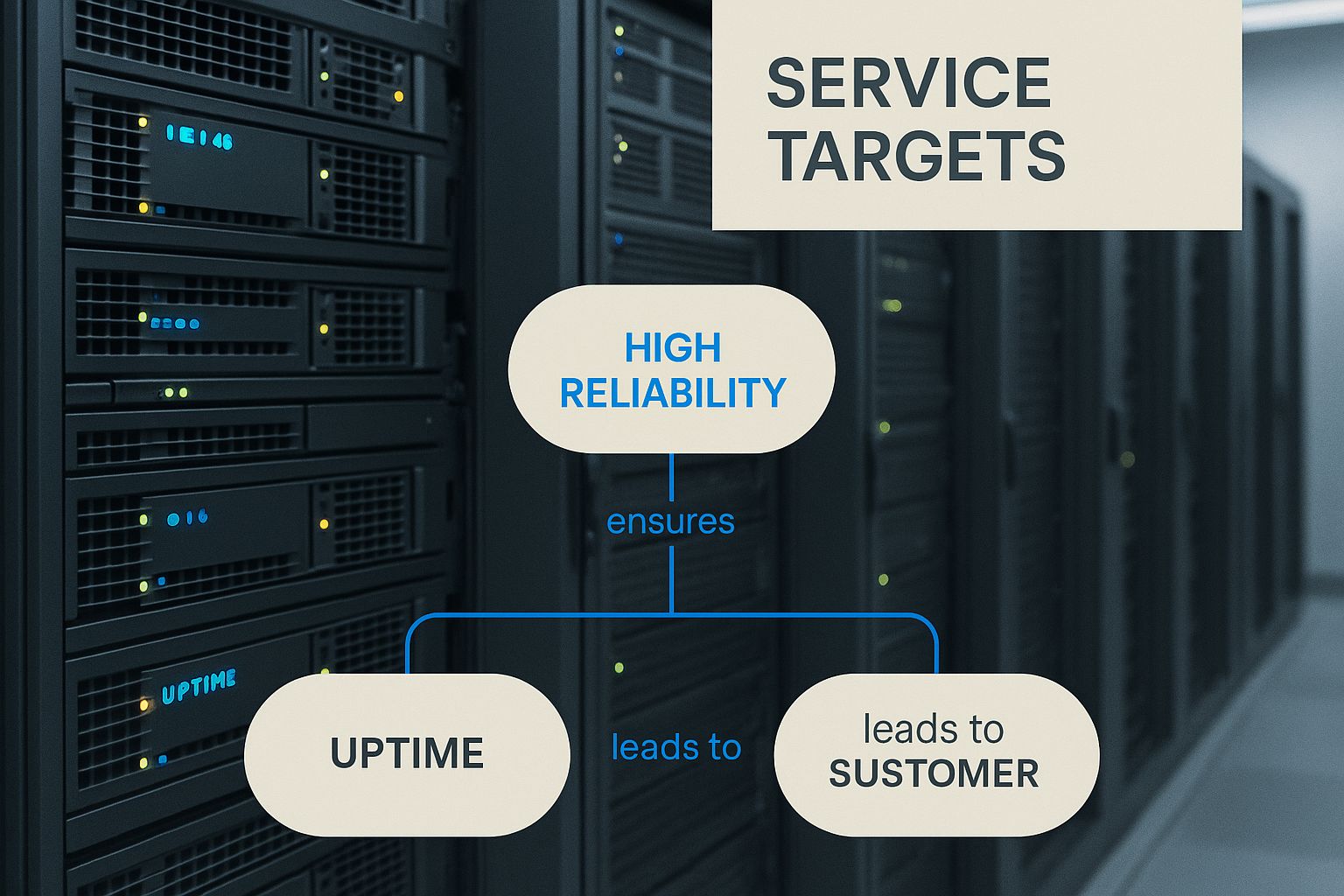
This really drives home the point that service targets aren’t just abstract ideas—they’re tied directly to the operational health of your infrastructure.
Setting Targets With SLOs
A Service Level Objective (SLO) is the specific target you set for an SLI. This is the promise you make to your users. If the SLI is the live power reading from the meter, the SLO is your official commitment to keep the lights on 99.9% of the time. An SLO takes a raw measurement and turns it into a concrete goal that both your development and operations teams can agree on.
An SLO is a precise numerical target for system reliability that the entire team—from developers to product managers—agrees to uphold. This creates a shared language for discussing performance and risk.
Spending Your Error Budget Wisely
This is where the real genius of SRE shines through. An Error Budget is simply the inverse of your SLO. If your SLO is 99.9% availability, then your error budget is the remaining 0.1% of the time. This is your calculated allowance for things to go wrong—be it downtime or poor performance—over a specific period.
But this budget isn’t just for accidental failures; it’s a resource you can spend strategically. Teams can “spend” their error budget on a risky new feature launch, planned maintenance, or running A/B tests. If that budget starts running low, it’s a crystal-clear signal to freeze new deployments and focus entirely on shoring up reliability.
This framework gives you a data-driven way to balance innovation with stability, a practice that’s driving huge adoption in the industry. The broader DevOps market, which aligns closely with these principles, is projected to grow from $10.4 billion in 2023 to $25.5 billion by 2028. You can dig deeper into this growth trend and what’s behind it in various detailed market analysis reports.
Putting SRE Principles Into Practice
Knowing the theory behind SLOs and error budgets is one thing. But turning those concepts into daily habits is what actually builds site reliability. Great SRE teams aren’t just defined by their goals; they’re defined by their actions.
At the heart of it all is a simple but powerful shift in mindset: treat operations like a software engineering problem. This means ditching the old manual, reactive approach and instead applying code, automation, and data to build systems that are resilient by design, not just patched when they break.
Eliminating Toil Through Automation
One of the biggest drags on any engineering team is toil. This isn’t just busywork—it’s the soul-crushing, repetitive, manual tasks that scale right along with your service. Think manually restarting servers, provisioning test environments by hand, or anxiously clicking through a rollback after a bad deploy.
This kind of work doesn’t just eat up time; it pulls engineers away from the strategic projects that actually move the needle. Catchpoint’s 2025 SRE Report nails this point, highlighting that aggressive automation is no longer a “nice-to-have.” It’s essential for balancing deployment speed with stability. You can dive deeper into their findings for more insights on critical SRE trends.
A core SRE mission is to hunt down and automate toil wherever it exists. Instead of having a human manually execute a rollback, an SRE team builds a system that detects an error spike and triggers the rollback on its own. This saves critical minutes during an outage and, more importantly, frees up engineers to build lasting solutions.
Proactive Monitoring and Incident Response
Automation is great for the predictable stuff, but you need a solid game plan for when things inevitably go wrong. SRE isn’t about preventing 100% of failures—that’s a fantasy. It’s about spotting them fast, containing the blast radius, and learning from every single event.
This boils down to two key activities:
- Proactive Monitoring: SRE teams build smart monitoring and alerting systems tied directly to their SLIs and SLOs. Alerts don’t just fire when a server is down. They fire when the error budget is burning too quickly, giving the team a heads-up before a small problem snowballs into a full-blown outage.
- Structured Incident Response: When an incident hits, there’s no panic. SREs follow a clear, rehearsed playbook. They establish roles, manage communication, and focus on one thing: getting the service back online as fast as possible.
Fostering a Blameless Culture
Maybe the most important practice of all is the blameless post-mortem. Once the fire is out and the incident is resolved, the team gathers to figure out what happened. The key here is that the focus is never on who messed up, but on why the system allowed that mistake to cause a failure.
A blameless post-mortem treats every failure as a system problem, not a human one. This builds psychological safety, encouraging engineers to be transparent about issues without fear of punishment, which is essential for genuine, continuous improvement.
This cultural pivot from blame to learning is the secret sauce for achieving sustainable site reliability.
Applying SRE Workflows with Traffic Replay
The principles behind Site Reliability Engineering give you the “why,” but it’s the tools that deliver the “how.” Real value appears when you stop talking about SRE theory and start embedding its practices into your daily workflows. The best way to do this? Ditch the guesswork and start using real-world data to validate changes before they ever touch a user.
This is where traffic replay completely changes the game for SRE teams. Forget about writing synthetic test scripts that only guess at user behavior. Instead, you can capture and replay actual production traffic in a safe, controlled environment. It’s the ultimate bridge between theoretical reliability and resilience you can actually engineer.
From Guessing to Knowing with Shadow Testing
Let’s walk through a real-world scenario. Imagine your team is about to deploy a critical update to your e-commerce platform’s checkout service. The change involves a new database query meant to speed things up. The old way? Run some generic load tests and cross your fingers.
With a tool like GoReplay, you can be much, much smarter.
Your team can set up GoReplay to capture live traffic from the production checkout service and “shadow” it over to a staging environment running the new code. This shadow testing happens in real time, throwing the messy, unpredictable patterns of actual user interactions at your new service—all without a single live customer ever knowing.
This screenshot shows just how straightforward it is to configure GoReplay for capturing and replaying traffic.
The tool acts as a high-fidelity mirror of your production environment’s stress, funneling live requests directly into your test environment. This lets you see exactly how your changes will behave when things get real.
Uncover Hidden Issues Before They Go Live
By replaying authentic traffic, you’ll uncover problems that simplistic, synthetic load tests almost always miss. For instance, your team might discover:
- Performance Regressions: That new query is fast under average load but slows to a crawl during specific peak traffic patterns you never thought to test for.
- Hidden Bottlenecks: The replayed traffic reveals your new service unexpectedly hammers a shared downstream dependency, a problem that would have triggered a major production outage.
- Edge Case Bugs: An unusual sequence of user requests, captured straight from production, exposes a nasty bug in the new code that your unit tests never covered.
By using actual user traffic, SRE teams shift from hoping for reliability to proactively engineering it. They can validate changes against the ultimate source of truth—real-world conditions—before they go live.
This approach transforms your entire pre-deployment process. It doesn’t just replace traditional load testing; it supercharges it with a far more accurate and realistic source of traffic. If you want to dive deeper into the nuts and bolts, you can learn more about how traffic replay improves load testing accuracy and its direct impact on reliability.
Ultimately, this practice gives your teams the confidence to innovate and ship features faster, all while holding the line on your most critical reliability goals.
Mastering Load Testing and Traffic Analysis
True site reliability isn’t just about putting out fires; it’s about making your system fireproof. A huge part of this proactive mindset is rigorous load testing. The problem is, most traditional load tests are built on synthetic scripts that just can’t replicate the chaotic, unpredictable nature of real human behavior.
Think of scripted tests like a driving simulator that only features perfect roads on sunny days. Sure, it can tell you if the car basically works, but it won’t prepare your system for the messy reality of a flash flood during rush hour. This is where testing with real, captured traffic completely changes the game for SRE teams.
You stop guessing what users might do and start testing with what they actually do. This approach turns your staging environment into a near-perfect mirror of production, throwing the very same curveballs at your new code that it will face in the wild.
Pinpointing Issues with Realistic Data
When you analyze the results from these high-fidelity tests, you uncover insights that synthetic scripts could never hope to find. You move way beyond simple “pass/fail” checks and get to ask much deeper, more meaningful questions about how your system really behaves under pressure.
By comparing performance metrics between your current and new application versions—under the exact same real-world traffic load—you can nail down problems long before they ever threaten your SLOs.
This kind of analysis helps you:
- Spot Performance Degradation: Is the new code just a few milliseconds slower under certain conditions? Replayed traffic exposes those subtle latency increases that add up to a frustrating user experience.
- Identify Resource Ceilings: You can discover the precise point where your system’s performance starts to degrade, which is crucial for capacity planning and preventing a complete meltdown.
- Fine-Tune Configurations: The results might reveal that a minor tweak to a database connection pool or a cache setting gives you a massive performance boost during peak load.
This data-driven validation transforms SREs from reactive firefighters into predictive system architects. You find and fix failures in a safe, controlled environment—not during a 3 a.m. production emergency.
To help you get started, here’s a quick look at how GoReplay’s capabilities directly support core SRE practices.
GoReplay Features for SRE Teams
| GoReplay Feature | SRE Application | Reliability Benefit |
|---|---|---|
| Traffic Shadowing | Shadowing production traffic to a new version or staging environment. | Safely validate changes with real user behavior without impacting the live system. Find bugs before they go live. |
| Load Testing | Replaying captured traffic at amplified speeds (e.g., 2x, 10x). | Stress-test infrastructure to find breaking points, verify autoscaling rules, and ensure capacity for future growth. |
| Response Comparison | Automatically comparing responses between old and new application versions. | Detect subtle bugs, data corruption, or unintended changes in API responses that simple error checks would miss. |
| Traffic Filtering/Rewriting | Modifying requests on the fly with custom middleware. | Anonymize sensitive data for compliance, or rewrite requests to work with staging environment configurations. |
| Detailed Analytics | Analyzing performance metrics like latency and error rates from replayed traffic. | Gain deep, data-driven insights into how new code performs under real-world conditions, directly tying changes to SLOs. |
Using a toolset like this builds a powerful feedback loop right into your development cycle.
From Reactive to Predictive Performance Management
This advanced approach to performance management fundamentally shifts how teams build and ship software. It embeds site reliability into the entire development lifecycle, making it a continuous, daily practice instead of a last-minute checkpoint. To dive deeper, check out this guide on boosting application performance with modern load testing.
By validating every single change against real-world conditions, your engineers can ship new features faster and with greater confidence. They know their work has already been battle-tested against the only benchmark that truly matters: reality.
Building a True Culture of Reliability
Let’s be clear: effective site reliability isn’t a single team’s job. It’s a complete cultural shift that has to spread through the entire organization. This means getting rid of the old, siloed mindset where developers just build things and operations teams are left to fix them when they break. Reliability needs to become a shared mission—one that everyone, from product managers to the newest engineer, feels responsible for.
This kind of cultural change is built on a few core ideas. It all starts with shared ownership, where developers feel just as accountable for uptime as the SREs. It grows with data-backed decisions, where SLOs and error budgets become the common language for talking about risk and new features. And finally, it depends on deep psychological safety, an environment where failures are seen as system problems, not individual mistakes.
The Power of Blamelessness
Of all the cultural pieces, the most important might be the blameless post-mortem. When something goes wrong, the goal isn’t to find out who messed up, but why the system failed. This simple change creates a space where engineers feel safe enough to be honest about mistakes, which is the only way to get to the real root causes of instability.
A blameless culture isn’t about being soft; it’s about being smart. It treats every incident as a priceless opportunity to make the whole system stronger, building trust and a collective drive to get better.
When you adopt this approach, every outage stops being a source of fear and finger-pointing and instead becomes a valuable lesson.
Making Reliability a Collective Goal
To make this cultural shift actually stick, you have to bake it right into your everyday processes. Here are a few practical ways to get started:
- Integrate SREs into Development: Don’t just keep your SREs on an island. Embed them directly with development teams, where they can act as mentors and ensure reliability is built in from the very first design document.
- Socialize Error Budgets: Put the error budget for your most important services somewhere everyone can see it. When that budget gets low, it’s a clear signal to the entire organization that it’s time to focus on stability over shipping the next new thing.
- Reward Reliability Work: Your company probably celebrates new product launches, right? Start celebrating the engineering work that improves stability, too. Acknowledge the effort that goes into making the system more resilient.
By weaving these habits into your daily work, reliability stops being some abstract concept on a whiteboard. It becomes a real, shared value that protects customer trust and lets you innovate for the long haul.
Frequently Asked Questions About SRE
As teams start looking at bringing an engineering mindset to their operations, a few common questions always pop up. Getting your head around these is the first step to really embracing site reliability.
What Is the Difference Between SRE and DevOps?
This one comes up a lot. While SRE and DevOps definitely share the same goals, they aren’t the same thing. Think of DevOps as the cultural philosophy—it’s all about breaking down the walls between developers and operations to ship software better and faster. It’s the “what” and the “why.”
SRE, then, is a very specific, opinionated way to do DevOps. It provides the “how.” It’s where the rubber meets the road, using software engineering principles to solve ops problems. SRE gives you the tools and rules, like SLOs and error budgets, to create a data-driven system for keeping things reliable.
Is SRE Only for Large Companies Like Google?
Not at all. The principles behind SRE are useful for any company, no matter the size. A startup probably won’t have a dedicated SRE team, but that doesn’t mean they can’t borrow from the playbook.
Even a small team can make a huge impact by:
- Defining a simple SLO for their most critical user-facing service.
- Automating their deployment pipeline to get rid of manual, error-prone steps.
- Running blameless post-mortems after an outage to learn from it, not point fingers.
The idea is to apply SRE thinking where it delivers the most bang for your buck. You can always scale up the practices as your company and systems grow. The goal is always the same: use data and automation to build systems people can depend on.
How Do We Start Implementing SRE?
Jumping into SRE shouldn’t feel like a massive, all-or-nothing project. The best way to start is small and build from there. Pick one user-facing service that’s critical to your business and define a clear SLI and SLO for it—something simple like request latency or error rate.
Once you have that, you can calculate your first error budget. This one small step immediately creates a shared language for talking about risk and stability, backed by actual data.
From there, find a repetitive, manual task that everyone hates (we call this toil) and figure out how to automate it. The next time something breaks, hold a blameless post-mortem that focuses on fixing the system, not blaming a person. These first few steps build momentum and show everyone the real-world value of site reliability engineering.
Ready to build unbreakable confidence in your deployments? GoReplay helps you use real production traffic to find and fix issues before they impact a single user. Test your systems with the ultimate source of truth—reality itself. Explore how at https://goreplay.org.