
Java Messaging Service: A Developer’s Guide to JMS
You’ve just shipped a payment endpoint, and now fulfillment, billing, and notifications all need to react to every successful charge. If you call them directly, your checkout is only as fast and reliable as the slowest one. That’s the exact trap Java Messaging Service helps Java teams escape, and it’s where most developers meet JMS for the first time, usually under pressure.
The Problem JMS Was Built to Solve
Your payment service confirms a charge in milliseconds. Then it calls fulfillment over HTTP, waits for billing, then waits again for notifications. If notifications are down, does the payment fail? If fulfillment is slow during a sale, does checkout time out for everyone?
Synchronous Calls Couple Failures Together
With direct calls, every downstream service becomes part of your request. A slow consumer creates a slow producer. A failed notification can look like a failed payment, even when money has already moved, and retries at each hop multiply load exactly when you’re least able to handle it.
Messaging breaks that chain. The payment service publishes one fact, payment confirmed, to a broker, then returns. Fulfillment, billing, and notifications each consume that fact at their own pace.
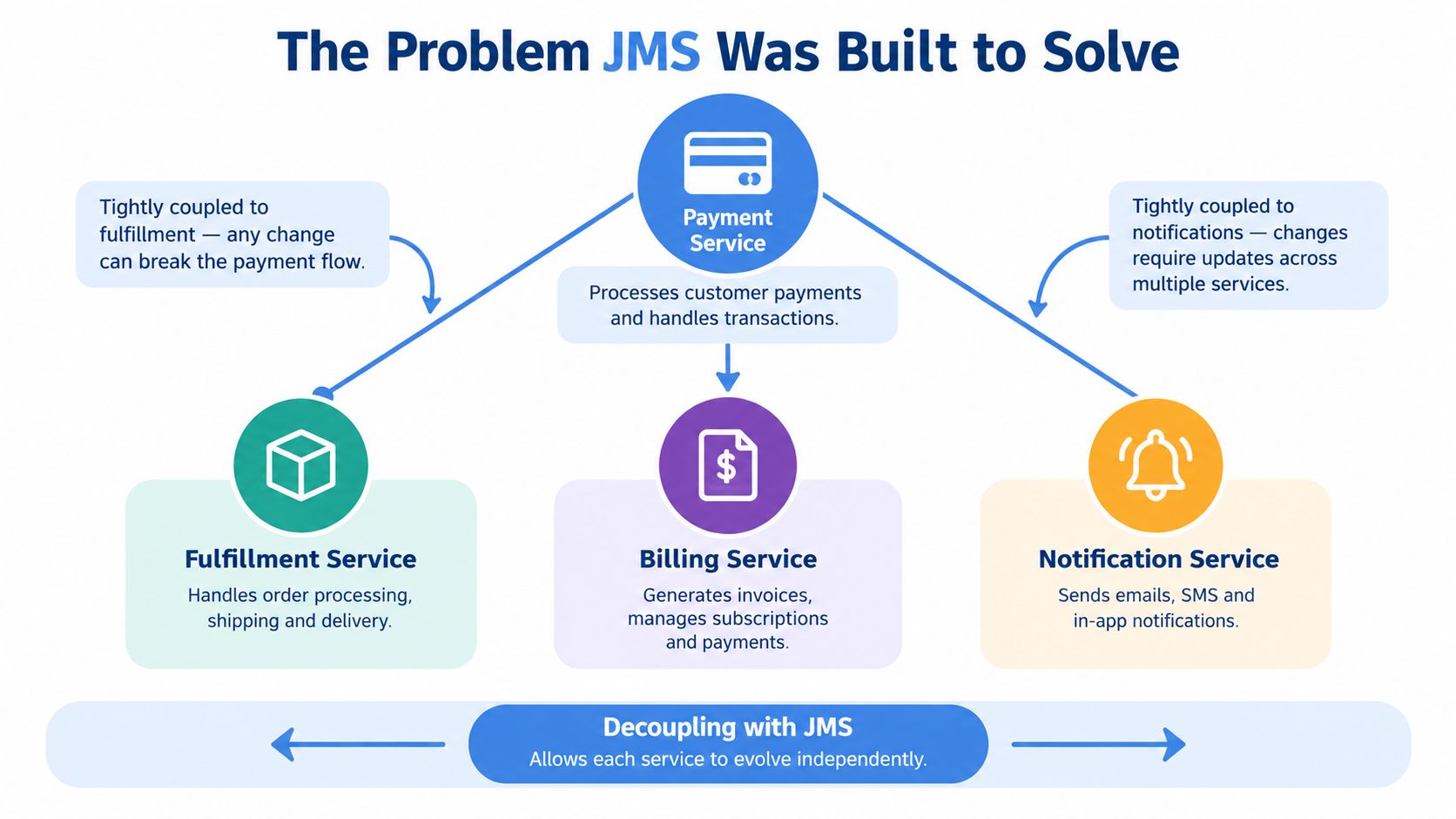
The broker absorbs the mismatch. If notifications are offline, messages wait safely instead of blocking checkout. If traffic spikes, the queue grows for a while and consumers catch up, rather than threads piling up inside the payment service.
Practical rule: Publish what happened, don’t orchestrate every reaction to it inside the original request.
Why a Standard API Mattered
Before a common API, Java code often tied itself to one vendor’s messaging product. Oracle’s Java EE history notes Java Message Service was introduced in 1998 to give Java applications a standard way to access messaging-oriented middleware, with its first major consolidation as JMS 1.1 arriving in April 2002.
That maturity is useful context. JMS isn’t a broker itself and it isn’t a wire protocol. It’s the Java API your code talks to, while a provider underneath moves the bytes. You get asynchronous, loosely coupled communication without rewriting producer and consumer code for every messaging product.
Point-to-Point Queues Versus Publish-Subscribe Topics
Most early confusion in Java Messaging Service comes from one choice. Should this destination be a queue or a topic? A postal analogy makes the difference stick.
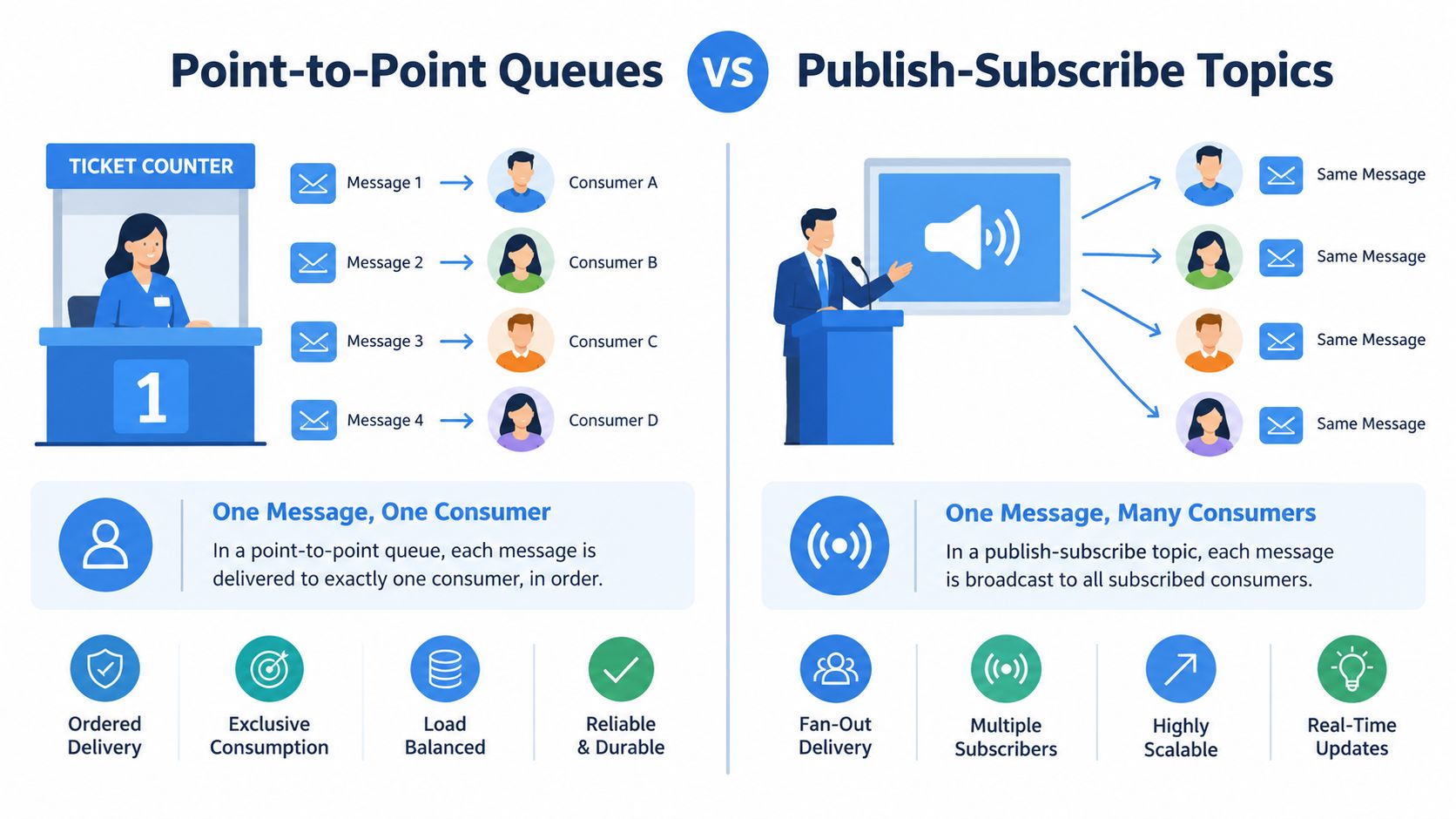
A queue is a numbered ticket counter. Each ticket is handed to exactly one clerk, processed, and discarded. A topic is a conference mailing list. Every active subscriber gets their own copy of the same announcement.
Queues Distribute Work
Use a queue when work must be done once, by one consumer. Order fulfillment is the classic case. You don’t want two warehouse workers packing the same order.
- Point-to-point delivery: One message goes to one consumer, even if several consumers compete for work.
- Offline tolerance: Messages wait in the queue while consumers restart or scale up.
- Load leveling: Adding consumers spreads work, provided downstream systems can keep up.
In sketch form, producer.send(queue, orderMessage) creates work, and one consumer.receive() claims it. Readers exploring adjacent streaming models can compare this with Kafka stream processing, where retention and replay change the trade-offs.
Topics Broadcast Facts
Use a topic when several independent systems care about the same event. A price change might matter to search, caching, recommendations, and audit at once. With producer.send(topic, priceMessage), each subscriber receives its own copy and decides what to do.
The catch is durability. A non-durable subscription only receives messages while it’s connected, like missing a live announcement because you left the room. A durable subscription asks the broker to retain messages for that subscriber while it’s offline, so it can catch up later, at extra storage and management cost.
This short walkthrough reinforces the visual difference before you read any provider documentation.
Choose a queue to divide work. Choose a topic to multiply awareness. Mixing those intentions is where duplicate fulfillment and missed events begin.
Inside a JMS Session Destinations and Message Types
Once you’ve picked a destination type, every JMS application assembles the same moving parts. Learn to recognize them and unfamiliar tutorials stop looking mysterious.

The Objects You Will See Everywhere
A ConnectionFactory knows how to reach the broker. It creates a Connection, which represents the network link and must usually be started before messages flow. From the connection you create a Session, and that’s where the interesting semantics live.
- Destination: The queue or topic, often looked up or created by name.
- MessageProducer: Sends messages to a destination.
- MessageConsumer: Receives synchronously with
receive()or asynchronously through a MessageListener. - Message: The payload plus headers and properties that consumers can inspect or filter on.
The session matters because it groups sends and receives into a unit. That grouping controls transactions and acknowledgement, so session setup isn’t boilerplate you can copy blindly.
Picking a Message Body
JMS defines several body types. TextMessage suits JSON or XML and is the easiest to debug across languages. BytesMessage carries raw bytes when you’re integrating with non-Java systems. MapMessage holds name and value pairs, StreamMessage holds a sequence of primitive values, and ObjectMessage carries a serialized Java object.
Be careful with that last one. ObjectMessage couples producer and consumer to the same Java classes and classpaths. In mixed fleets, text payloads with an explicit schema usually age better.
Classic Style Versus Simplified Style
Classic JMS 1.1 code builds each object explicitly, connection, session, producer, and message. It’s verbose, but you’ll see it throughout older enterprise codebases.
The JMS specification history records that JMS 2.0, released on May 21, 2013 through JSR 343, simplified the API with fewer interfaces while retaining compatibility with the classic JMS 1.1 programming model. Newer code can use a JMSContext and fluent producer calls, so context.createProducer().send(queue, "text") replaces several setup lines. The broker behavior underneath doesn’t change, only the ergonomics do.
Transactions Acknowledgements and Idempotency
Sending a message is easy. Figuring out what happens when processing fails halfway through is the design work, and JMS puts that decision in your session configuration.
Transacted Sessions Draw an Atomic Boundary
In a transacted session, produced and consumed messages form one atomic unit. Calling commit() sends what you produced and acknowledges what you consumed together. Calling rollback() discards the produced messages and makes the consumed ones eligible for redelivery.
Return to payments. Your consumer reads a payment event, writes a ledger entry, and publishes a fulfillment message. If the ledger write fails, rollback means the fulfillment message never escapes and the payment event can be tried again. That’s a clean failure boundary.
Acknowledgement Modes When You Do Not Transact
Non-transacted sessions still need a rule for telling the broker you’re done.
- AUTO_ACKNOWLEDGE: The session acknowledges after a synchronous receive returns or a listener completes successfully. Simple, and fine when occasional redelivery is harmless.
- CLIENT_ACKNOWLEDGE: Your code calls
acknowledge()explicitly. Remember that acknowledging one message also acknowledges every earlier message delivered by that session, which surprises many newcomers. - DUPS_OK_ACKNOWLEDGE: Acknowledgement is lazy, reducing overhead while accepting that duplicates may arrive.
Idempotency Is Not Optional
Idempotent means processing the same message twice produces the same business result as processing it once. Store the message identifier or a natural business key, check it before acting, and make the write conditional.
If a duplicate payment event can create a duplicate charge, you don’t have a messaging problem. You have a consumer design problem.
Every mode trades throughput, safety, and code complexity. Transactions coordinate more work but cost coordination effort. Lazy acknowledgement is cheaper per message but pushes duplicate handling into your service. Choose consciously, then test by failing consumers before commit and confirming repeated delivery creates no duplicate effects.
Choosing a JMS Provider for Production Workloads
JMS standardizes your code, not your operations. The provider, the broker and client library underneath the API, decides persistence, clustering, protocols, and most of your performance behavior.
The Usual Shortlist
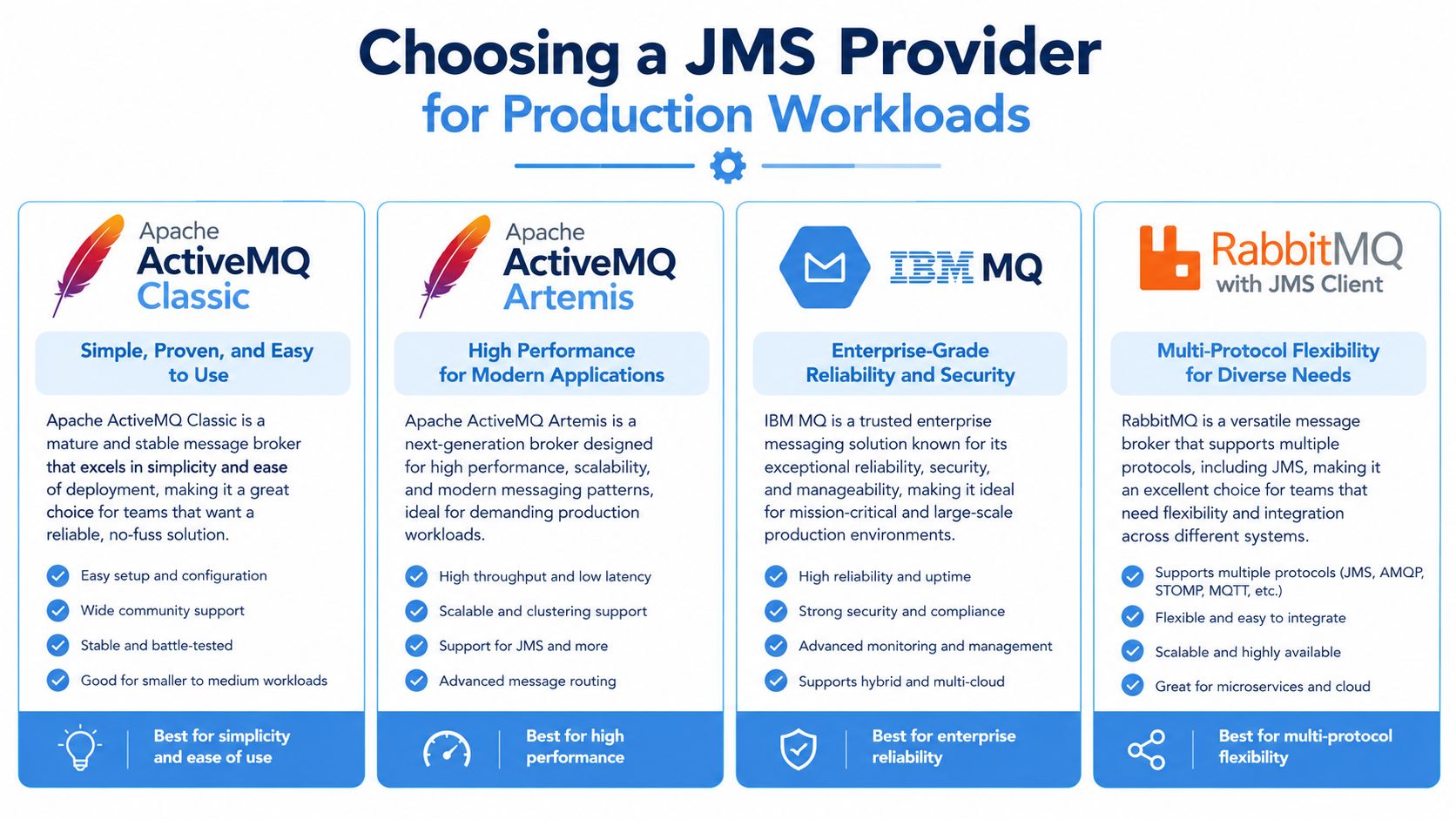
Apache ActiveMQ Classic is the long-standing choice many Java teams already know, with a familiar model and broad integrations. Apache ActiveMQ Artemis is the newer Apache broker, built for higher concurrency and multiple protocols. IBM MQ anchors many transactional enterprise and mainframe environments where vendor support and established operations matter enormously. RabbitMQ through its JMS client lets Java applications keep JMS APIs while the broker speaks AMQP underneath, which also opens the door to non-Java consumers.
Don’t treat provider swaps as drop-in replacements just because imports compile. Wire protocols, management tooling, destination behavior, and failure modes differ. Your business logic may survive untouched while your deployment and runbooks change completely.
Benchmarks Depend on Workload Shape
Generic throughput claims mislead buyers quickly. A reported benchmark found Apache Artemis delivered nearly 14 times the throughput of ActiveMQ in a durable, 1 KB, high-concurrency JMS workload with batch size one, while ActiveMQ exceeded 34,000 durable messages per second when batching increased to 1,000 messages. In that same comparison, ActiveMQ also achieved the lowest request-reply latency in the tested larger payload workload.
Read that carefully. The ranking flipped with batch size and payload shape. Small, individually acknowledged messages stress per-message coordination. Large batches amortize protocol and persistence costs.
- Match durability settings: Persistent and non-persistent delivery are different products in practice.
- Match acknowledgement and transactions: They change broker work per message.
- Match concurrency: Producer and consumer counts reshape contention.
Throughput isn’t a property of Java Messaging Service. It’s a property of your broker running your workload with your settings.
Shortlist providers on operational fit, team experience, clustering story, and support. Then benchmark finalists with production-like payloads before committing.
Migrating from javax.jms to jakarta.jms Without Breaking Production
Many teams meet modern Java Messaging Service through a forced upgrade, not a greenfield project. The application server moves to Jakarta EE, and suddenly imports that worked for years stop compiling.
This Is Not a Search and Replace
That last point deserves emphasis. Renaming imports in your code doesn’t help if a framework, shared library, application server, or provider client on the classpath still expects the old packages. Failures often appear at deployment or connection time, before any business message runs.
Inventory the Dependency Graph First
List every moving part before touching code. Include the JDK, application server, framework versions, provider client, broker version, and transitive dependencies that reference either namespace. Shared enterprise libraries deserve special suspicion because one stale artifact can break several applications.
- Branch and compile: Move one application to
jakarta.jmsand resolve the full dependency tree. - Test connectivity: Connect that build to a production-style broker and exercise real queues, topics, listeners, and transactions.
- Check mixed traffic: Confirm old and new applications can exchange messages during a phased rollout.
- Prepare rollback: Keep the previous deployable, configuration, and client libraries ready, not merely the previous source tag.
When Side by Side Beats Direct Replacement
If many applications share destinations or libraries, a direct cutover concentrates risk. Running old and new versions side by side, sometimes with a bridge between environments, lets you migrate consumers gradually and prove behavior with real flows.
Honest trade-off: Side-by-side migration costs more infrastructure for a while. A failed big-bang cutover costs you a weekend.
Treat the migration as a dependency-graph and deployment-topology problem. The import rename is the smallest task on the checklist.
Troubleshooting and Capacity Testing with Real Traffic
A JMS system can look healthy while messages age. Producers return success, consumers report no exceptions, yet customers wait. Operating Java Messaging Service means measuring where time goes.
Metrics That Reveal Trouble Early
Start with queue age and oldest-message age, because depth alone doesn’t tell you whether work is flowing. Add receive-to-ack latency to see how long processing takes after delivery. Track redelivery rate, consumer utilization, connection counts, and dead-letter queue growth.
Jakarta’s messaging tutorial confirms that acknowledgement occurs after message processing, making the boundary between business failure and message-delivery failure operationally significant and a primary source of redelivery storms. If your code throws after doing partial work, the broker may correctly deliver that message again.
Match Failure Modes to Signals
- Slow consumer: Oldest-message age climbs while consumers stay busy. Profile processing and downstream calls before adding more consumers.
- Redelivery storm: Redelivery rate spikes after rollbacks or listener exceptions. Fix the failing code path and confirm idempotency.
- Poison message: One message repeatedly fails while others pass. Bound redeliveries and route failures to a dead-letter destination for inspection.
- Connection churn: Connections open and close constantly. Pool connections and check keep-alive and client lifecycle settings.
Adding concurrency isn’t a universal remedy. More consumers can drain a queue faster while overwhelming the database behind them, trading broker latency for downstream failure.
Replay Realistic Bursts Before Release
Synthetic tests often send uniform messages at a steady rate. Production sends bursts, mixed payload sizes, and awkward timing. Captured traffic replayed against a staging broker exposes queue growth, latency degradation, and duplicate side effects under recognizable pressure.
For the reasoning behind that approach, see how traffic replay improves load testing accuracy. Pair replay with deliberate consumer failures before commit, then measure redelivery counts and confirm no duplicate business effects appear.
Building Your Next JMS Service With Confidence
Start with the delivery question. Pick a queue to divide work and a topic to broadcast facts. Settle the session decision next, choosing transactions or an acknowledgement mode that matches how much duplicate handling your consumers can safely absorb.
Design every consumer to be idempotent, because redelivery is a normal outcome, not an exotic accident. Choose the provider by benchmarking your payload sizes, durability settings, and batching behavior, not by comparing headline throughput.
If you’re modernizing, validate the whole jakarta.jms dependency graph against a production-style broker before cutover. Finally, watch queue age, receive-to-ack latency, redelivery, and dead-letter growth from the first staging deployment. A JMS service you can observe and replay is one you can ship calmly.
Capture real production HTTP traffic and replay it safely into staging with GoReplay, so the services feeding your JMS producers face realistic bursts, timing, and payloads before release. Use those replays to watch queue growth, consumer latency, and duplicate handling under pressure you recognize, then fix the weak points while they are still in test.