
HIPAA Compliance Testing: A Practical Playbook for 2026

A release is ready to go. The staging environment looks clean, the annual penetration test is filed, and the compliance folder contains a polished risk assessment. Then a developer changes an authorization middleware rule, a vendor updates an API integration, or a logging configuration drifts. The application still works, but nobody can demonstrate that the safeguards protecting electronic protected health information, or ePHI, still work after the change.
That’s the practical problem with HIPAA compliance testing in modern healthcare environments. A point-in-time assessment can identify weaknesses, but it can’t prove that controls remain effective across releases, migrations, cloud changes, vendor updates, and operational incidents. The workable model is continuous validation, using safe data, production-like environments, automated gates, human review, and evidence that an OCR reviewer can follow.
Why HIPAA Compliance Testing Is an Ongoing Validation Problem
A release passes staging, the annual penetration-test report is filed, and the compliance folder looks complete. Then an authorization rule changes, a vendor modifies an API, or logging drifts in production. The application may keep working while nobody can show that its safeguards still protect ePHI.
That gap defines HIPAA compliance testing. The work is a repeatable validation process for administrative, physical, and technical safeguards, not a certification ceremony. Testing must follow releases, migrations, cloud changes, vendor updates, and incidents. In a modern CI/CD pipeline, that means safe traffic replay, production-like environments, controlled test data, automated checks, and human review. The 2025 proposed Security Rule also points toward mandatory cadence-based testing, making evidence quality part of the operating model.
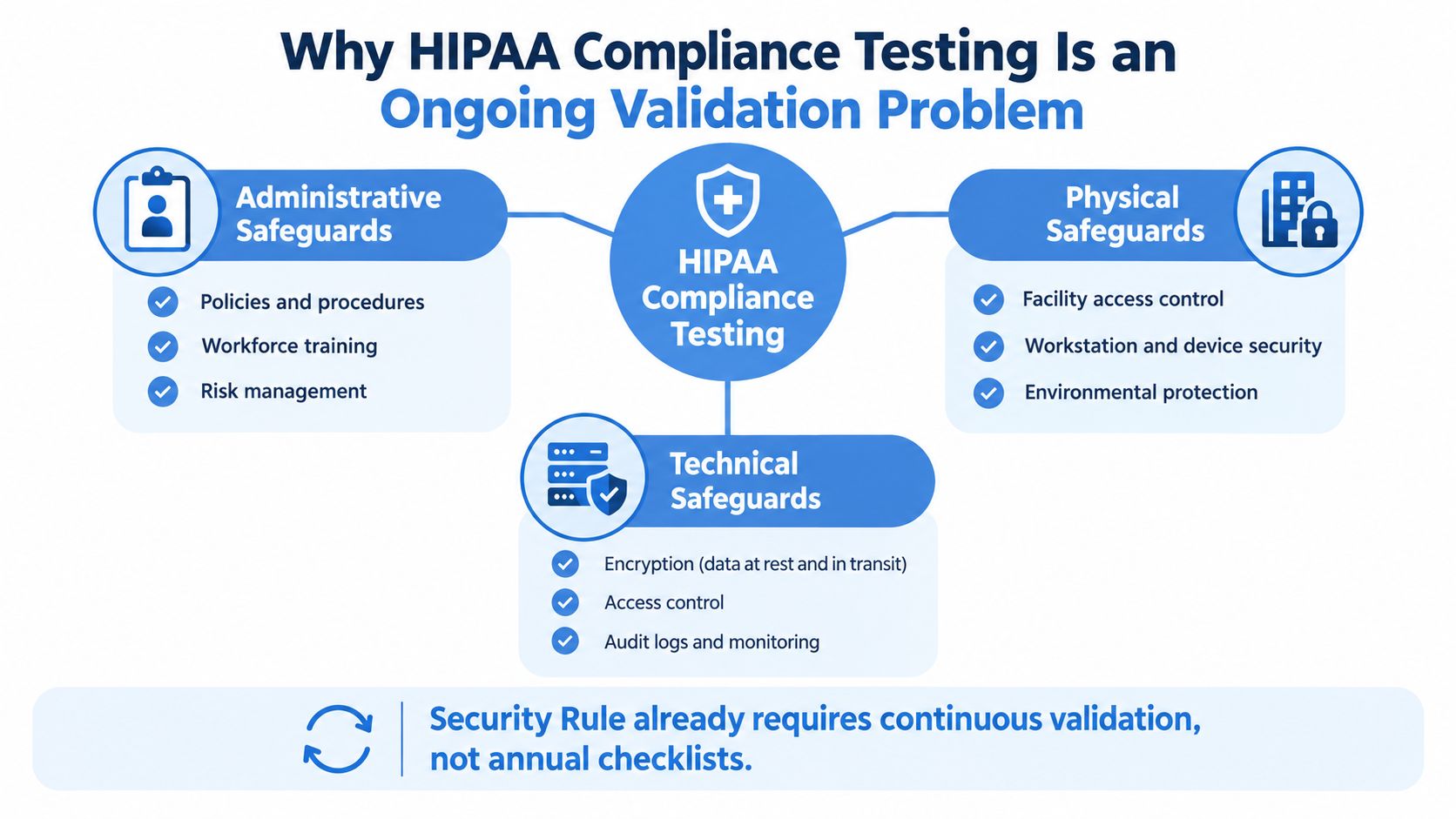
OCR’s enforcement record reinforces the point. By October 2024, HHS reported that OCR had received over 374,321 HIPAA complaints, initiated over 1,193 compliance reviews, and resolved 99% of cases. The Privacy Rule’s compliance date was April 2003, and the HITECH Act of 2009 required HHS to periodically audit covered entities and business associates. HIPAA therefore demands evidence that controls operate over time, not only a report produced once a year. (HHS enforcement highlights)
What continuous validation actually checks
Assign clear ownership to each testing lane:
- Security and engineering test access control, encryption, vulnerability exposure, logging, and application behavior.
- IT operations test backups, restoration, endpoint security, facility controls, and configuration changes.
- Privacy and compliance review policies, training, business associate oversight, risk acceptance, and corrective actions.
- Clinical and business owners verify that safeguards fit real workflows without encouraging unsafe workarounds.
- Internal audit or independent assessors challenge evidence and retest significant findings.
Each test record should identify the safeguard or risk, trigger or cadence, reviewer, result, owner, and evidence location. Useful artifacts include policies, data-flow diagrams, configurations, scan outputs, test scripts, replay logs, training records, tickets, approvals, and retest results.
Practical rule: OCR reviewers need to see what was tested, what failed, who responded, and how the fix was proven.
Screenshots without context and final reports without underlying results rarely establish that chain. Use these audit-ready documentation tips to retain the test, decision trail, and supporting artifacts.
Defining Scope and Running the Risk Analysis
A deployment can pass its application tests while an overlooked vendor export, service account, or backup environment still exposes ePHI. Scope errors weaken the program before the first scanner runs. Define every environment where ePHI is created, received, maintained, or transmitted. Then identify the assets, threats, vulnerabilities, safeguards, likelihood, impact, and documented risk. The analysis must cover the organization, not only the application that is easiest to inventory.
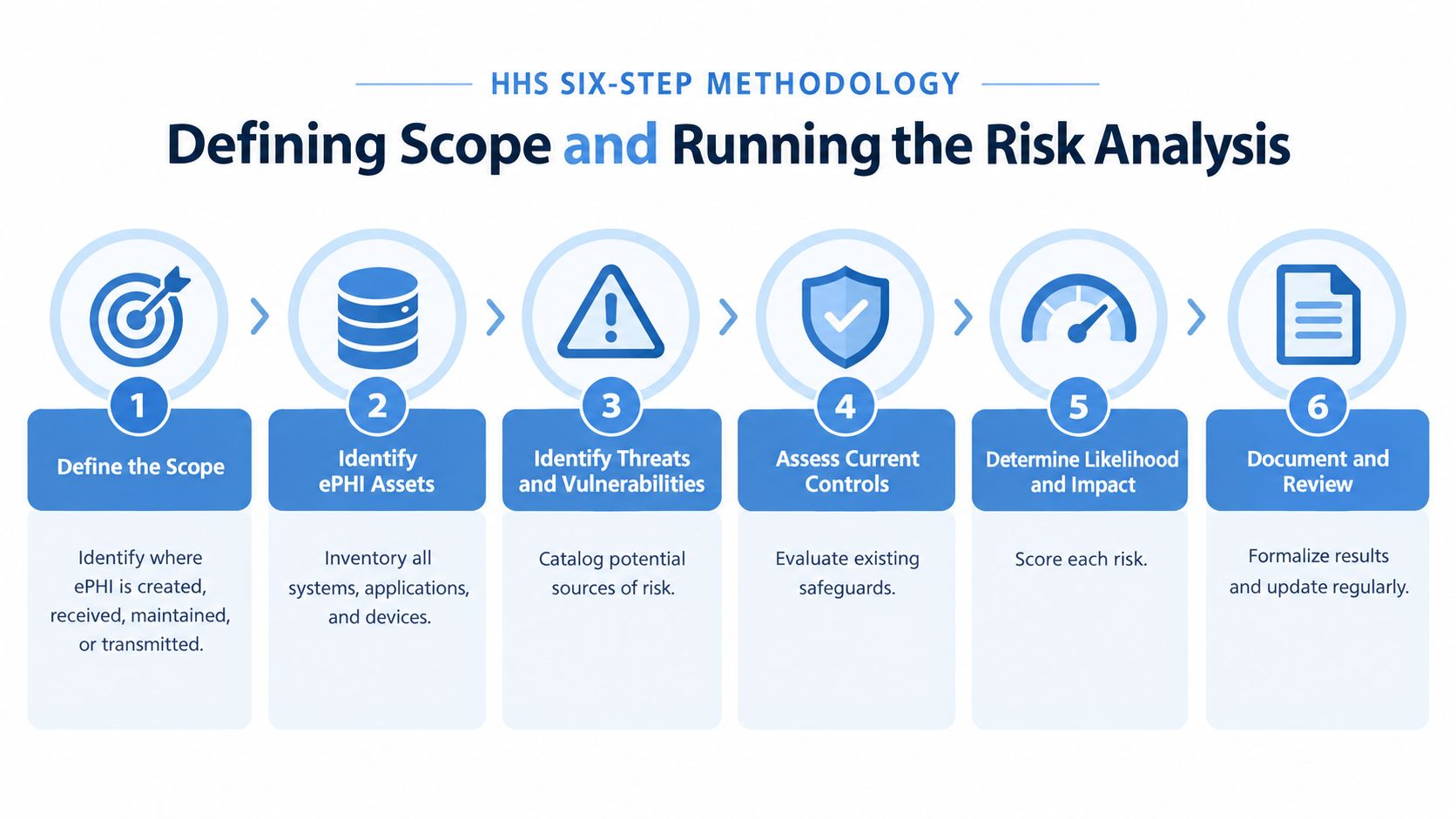
Start with an asset and flow inventory
Build the inventory around data movement rather than department names. For every asset, record the ePHI it handles, owner, environment, trust boundary, connected services, safeguards, and evidence location.
Include at least:
- Clinical systems: EHR platforms, patient portals, scheduling applications, clinical messaging, and decision-support services.
- Revenue systems: Billing platforms, claims workflows, payment integrations, and clearinghouse connections.
- Transfer points: SFTP endpoints, FHIR APIs, interface engines, email gateways, and vendor file exchanges.
- Archives and research systems: On-premises Synthea archives, analytics stores, data lakes, and reporting environments. Check whether supposedly de-identified flows could be re-identified through joins or auxiliary data.
- Infrastructure: Cloud accounts, databases, containers, endpoints, mobile devices, backup targets, identity providers, and administrative consoles.
- Third parties: Business associates, cloud providers, subprocessors, support tools, observability platforms, and managed service providers.
Shadow IT remains a common blind spot. A team may export records to a collaboration platform, send a diagnostic file through an unapproved transfer service, or connect an analytics tool without updating the central inventory. Capture those workflows. An official architecture diagram is evidence, not proof that the inventory is complete.
Turn the inventory into testable risk
For each asset, identify plausible threats and vulnerabilities, assess the administrative, physical, and technical safeguards already in place, and document likelihood and impact. Record residual risk with a remediation decision, named owner, due path, and evidence required for closure.
Ask questions that expose missing scope:
- Can the team identify every service account that can reach ePHI?
- Can it trace an API request from the originating user through downstream vendors?
- Can it show which logs record access, modification, export, and deletion?
- Can it distinguish synthetic, masked, de-identified, and live ePHI?
- Can it prove that a safeguard was reassessed after a major workflow or architecture change?
The methodology can be adapted to organizational size and complexity. The assessment still needs to be accurate, thorough, and updated. A CI/CD pipeline should trigger scope and control review when a release changes data flows, permissions, integrations, or deployment boundaries. Safe traffic replay in a production-like environment can test those changes without sending live ePHI through an uncontrolled test path.
Make the risk analysis the index for the test program. Each test case should map to an asset, threat, safeguard, owner, expected result, and remediation path. Store the mapping with the test output so an OCR reviewer can follow the relationship from identified risk to validation and closure.
The Seven Test Types That Actually Map to HIPAA Safeguards
A release can pass its unit tests while an ordinary support workflow exposes ePHI to the wrong role. That failure is an authorization defect, not something an annual penetration test reliably catches. HIPAA compliance testing needs separate tests for governance, application behavior, operations, recovery, and evidence, with each safeguard assigned to an owner.
Use these seven test types as a control map:
| Test Type | Security Rule Citation | Evidence Artifact | Recommended Cadence |
|---|---|---|---|
| Risk analysis and control review | §164.308(a)(1) and §164.308(a)(8) | Approved risk analysis, asset inventory, control mapping, residual-risk register | At least when systems or workflows change, with formal periodic review |
| Vulnerability scanning | §164.308(a)(8), §164.312(a), and §164.312(e) | Signed scan output, scope record, false-positive decisions, remediation tickets | Recurring scans, plus scans after material changes |
| Penetration testing | §164.308(a)(8), §164.312(a), and §164.312(e) | Rules of engagement, tester qualifications, findings, retest report | Periodic independent testing and after meaningful architecture changes |
| Access-control testing | §164.312(a) | Role matrix, authorization test results, MFA and session evidence, approvals | On role or workflow changes, with recurring access review |
| Audit-log validation | §164.312(b) | Event assertions, sample logs, retention settings, monitoring evidence | During releases and recurring operational checks |
| Encryption verification | §164.312(a)(2)(iv) and §164.312(e)(2)(ii) | Configuration exports, certificate records, key-management evidence, negative tests | On infrastructure changes and recurring configuration review |
| Backup, restoration, and incident-response exercises | §164.308(a)(7) and §164.308(a)(6) | Restoration record, exercise timeline, participant list, lessons learned | Recurring exercises and after major recovery or response changes |
Do not merge these categories in the test plan. A vulnerability scan identifies exposure patterns. A penetration test examines exploitability and business impact. An access review confirms who should have access, while an authorization test verifies what the application permits. Audit-log validation checks whether an event was recorded, tied to an actor, retained, and usable during investigation.
The risk analysis should drive the mapping. Store each test with its asset, threat, safeguard, owner, expected result, and remediation path. In CI/CD, run relevant checks when a change affects permissions, data flows, integrations, or deployment boundaries. Safe traffic replay in a production-like environment can exercise those paths without routing live ePHI through an uncontrolled test system. Preserve the request scope, scrubbed inputs, environment details, test result, and reviewer decision as one evidence record.
Cadence matters as proposed requirements develop. HHS OCR audit information describes attention to Security Rule provisions related to hacking and ransomware. The January 2025 proposed Security Rule discusses more prescriptive testing expectations, including annual penetration testing and vulnerability scanning on a six-month cycle. Those provisions are proposed rather than effective, so records should distinguish current requirements from preparation for a possible future rule. (HHS OCR audit information)
For survey, feedback, and intake tools, review privacy-first security features alongside your own access, logging, retention, and vendor-review tests. A vendor security page can support third-party evidence, but it does not replace your risk analysis or validation results.
Building Test Cases With Safe Data and Real Traffic
The safest test dataset is one that behaves like production without containing production records. Copying a patient database into staging creates a second environment to protect, a larger access surface, and an evidence problem that becomes difficult to explain during review.
Choose the right data strategy
Use a deliberate hierarchy rather than treating “anonymized” as a universal answer.
| Strategy | PHI Exposure Risk | Realism | Best Fit | Common Tools |
|---|---|---|---|---|
| Synthetic data | Lowest when generated and controlled properly | Good for structure and known edge cases | Unit, integration, and repeatable regression tests | Synthea, custom generators, factory libraries |
| Masked data | Depends on masking quality and residual identifiers | High for schemas, joins, and workflow shape | Staging and performance tests requiring realistic relationships | Deterministic tokenization, database masking tools |
| Sanitized traffic replay | Depends on capture, scrubbing, storage, and access controls | High for request sequences and timing patterns | Regression, load, and compatibility testing | GoReplay, sanitized proxy captures, replay harnesses |
Synthetic data should cover ordinary and adversarial cases: unusual names, missing fields, malformed identifiers, unexpected ordering, expired sessions, and incomplete workflows. Masking must cover direct identifiers and quasi-identifiers. For example, replace SSNs and MRNs with deterministic tokens so related records still join, and shift dates consistently within a dataset so chronology remains usable without preserving actual dates.
Traffic replay adds realism, but it introduces capture risk. Capture only the fields and routes needed for the test, scrub identifiers before storage, encrypt the capture repository, restrict access, define retention, and log every export. Teams using replay should document whether the source was synthetic, masked, or sanitized, and preserve the transformation logic with the test evidence. A practical reference for this workflow is data anonymization for traffic replay.
Write assertions for safeguard behavior
A test case should state the request, the actor, the expected safeguard, and the evidence produced. Consider a negative authorization scenario:
- A user with a scheduling role requests a restricted clinical record.
- The service denies the request.
- The response doesn’t disclose sensitive fields.
- The denial generates an attributable audit event.
- The test stores the request identifier, actor role, timestamp, response status, and matching log record.
A logging assertion can require that an access event produce a §164.312(b) audit record within a defined operational threshold, such as five seconds, provided the threshold is justified by the system’s design and consistently measured. The exact threshold should be an approved engineering requirement, not an invented compliance rule.
BDD-style scenarios keep the intent visible:
Given a masked patient record and a user without the required role, when the user requests the record, then the API denies access, returns no restricted fields, and emits a traceable audit event.
Don’t test only successful paths. Include broken authentication, missing audit headers, replayed tokens, expired sessions, altered role claims, encryption-disabled payloads, vendor timeout behavior, and partial downstream failures. Those cases reveal whether the system fails safely instead of merely proving that its happy path works.
Automating HIPAA Tests Inside CI/CD Pipelines
A control that runs only after deployment is a report, not a release gate. Put HIPAA-related checks at the point where developers can still correct the change, and make bypasses visible, approved, and reviewable.
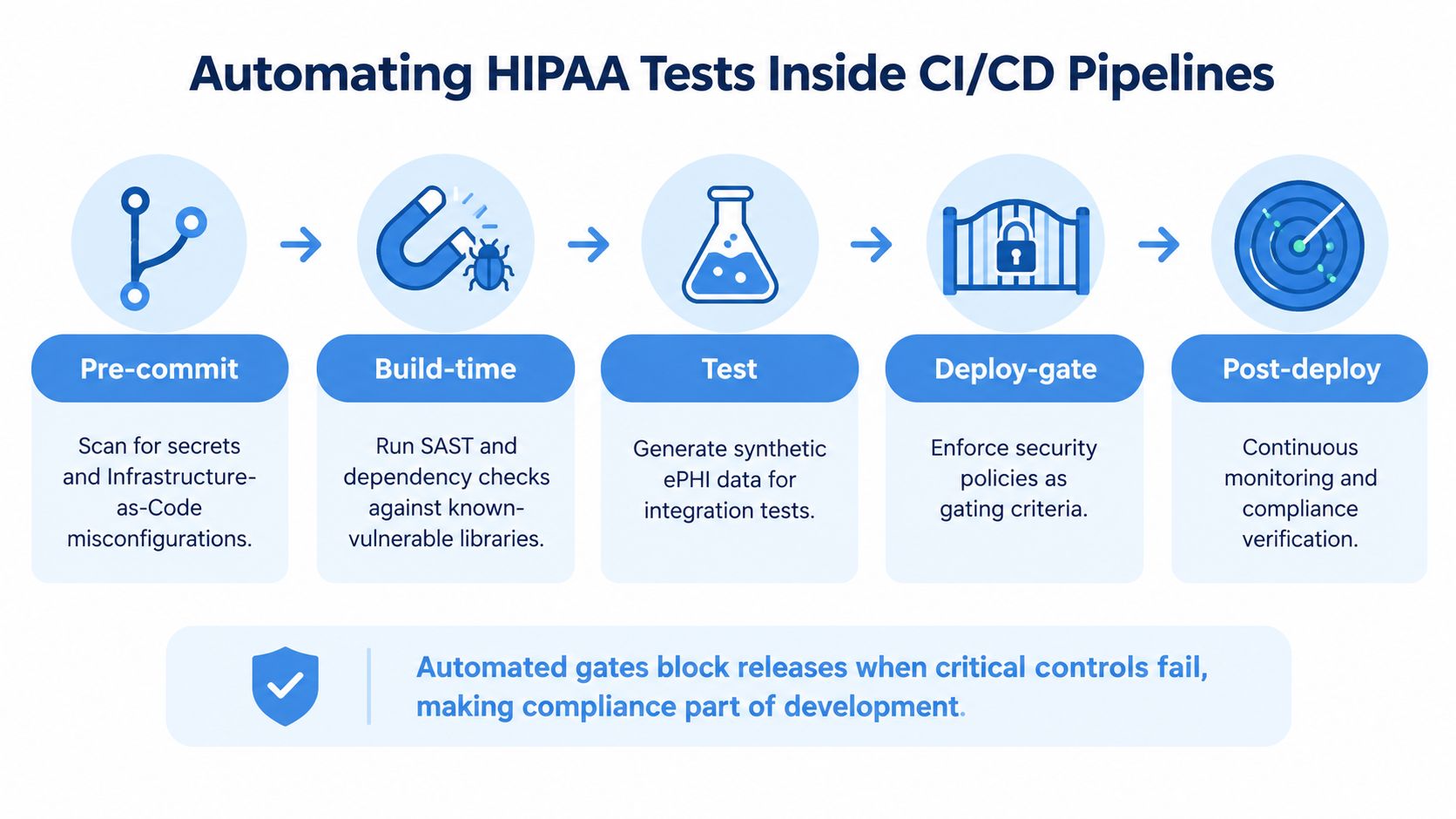
Build the pipeline in control-aware stages
Pre-commit checks should detect secrets, unsafe logging statements, and Infrastructure as Code patterns that expose data or weaken boundaries. Semgrep can enforce custom rules for sensitive field handling, while Checkov can inspect cloud configuration. These checks should return machine-readable findings rather than relying on a developer’s terminal output.
Build-time checks should run SAST and dependency analysis. Semgrep can flag application-specific patterns, and Trivy can scan container images and dependencies for known vulnerabilities. A finding needs a severity, rule identifier, affected component, suppression reason if applicable, and owner.
Test-time checks should exercise authentication, authorization, audit-log emission, encryption behavior, and data-flow restrictions against synthetic or sanitized data. Dynamic scans belong here, but so do functional assertions. A scanner may identify a broad class of issue, while a targeted test confirms whether a restricted role can retrieve a protected resource.
Deploy gates should use policy as code. Open Policy Agent, or OPA, can block a release when a service lacks required logging, an approved encryption setting is absent, an image contains an unacceptable finding, or a production deployment has no linked risk decision. Tie each rule to the relevant safeguard or internal control identifier.
Preserve evidence through every run
A defensible pipeline stores the commit hash, build identity, environment, test-data classification, tool version, ruleset version, result, approval, and artifact hash. SARIF works well for code and configuration findings. JUnit captures test outcomes. Signed attestation bundles connect the release to the checks that allowed it to proceed.
The common failures are operational:
- Flaky TLS tests create noisy exceptions, so teams start ignoring real failures.
- Tokenization false positives cause developers to suppress rules broadly instead of narrowing the pattern.
- Branch bypasses let a change reach the main branch without the same checks.
- Environment mismatch makes staging pass while production uses different identity, encryption, or logging settings.
- Unreviewed suppressions remove the evidence that explains why a control was waived.
Pipeline designs that need HTTP traffic replay should document capture boundaries, masking, environment isolation, and replay results. This overview of CI/CD pipeline testing provides useful implementation context for teams adding replay to automated validation.
The gate should fail for a meaningful reason, not because a tool is unreliable. Start with a small set of high-confidence controls, measure false positives, add ownership, and expand only when the team can support the resulting evidence and remediation workload.
Prioritizing Remediation and Collecting Audit-Ready Evidence
CVSS is useful, but it doesn’t capture the whole HIPAA decision. A vulnerability in an internet-facing service with no ePHI access may deserve a different response from the same vulnerability in a log bucket containing user identifiers, request payloads, and clinical context.
Use a transparent internal score that combines likelihood, impact, and audit exposure:
Priority Score = Likelihood × Impact + Audit Exposure
The scale must be defined in your risk methodology. For example, likelihood and impact can use an approved ordinal scale, while audit exposure can represent whether the issue contradicts a documented safeguard, a tested control, or a known review focus. Don’t present the formula as an OCR-mandated calculation. It’s an internal prioritization method that makes decisions explainable.
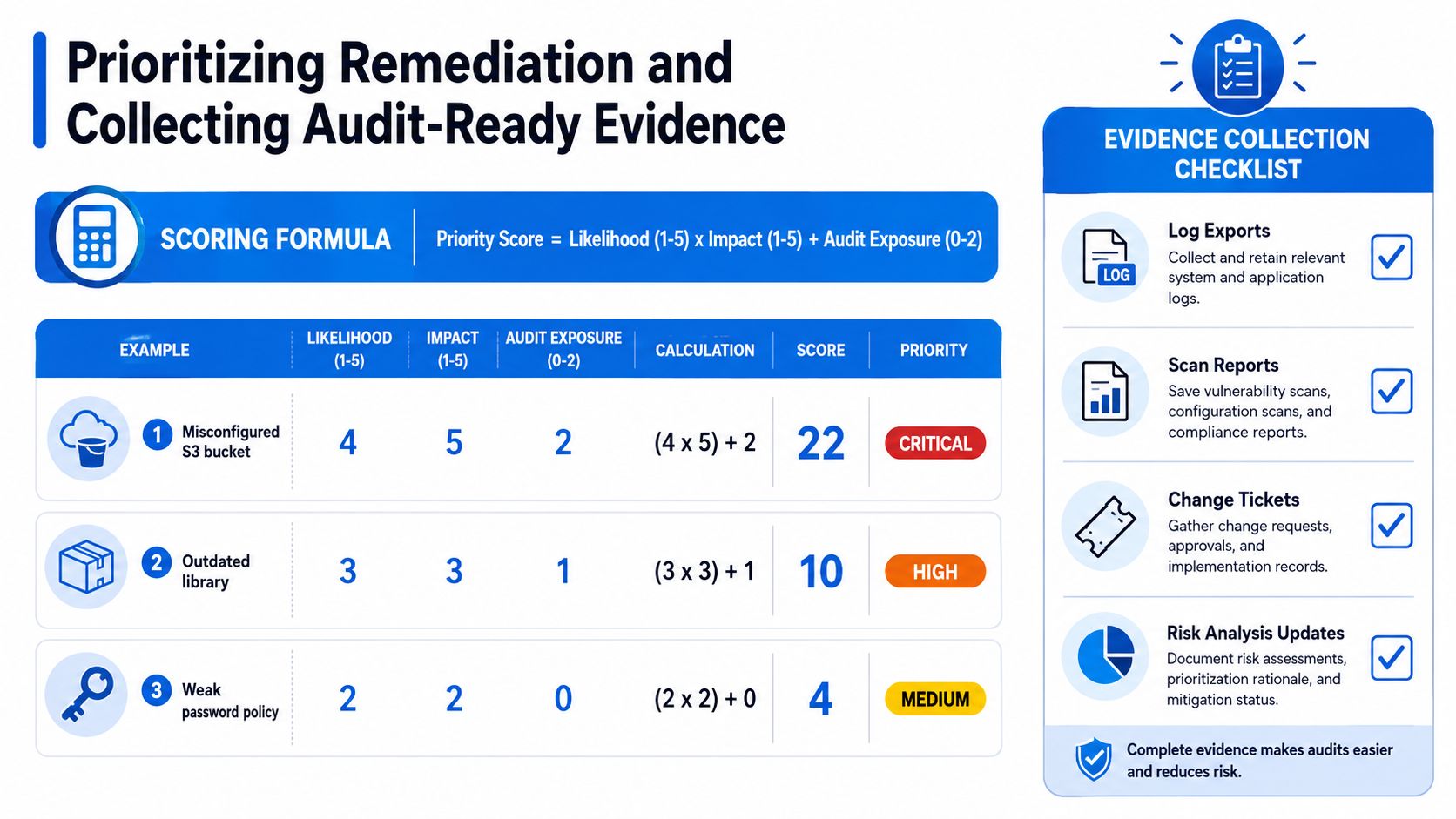
Compare findings in context
A misconfigured S3 bucket holding application logs may have higher impact and audit exposure than the same configuration on a bucket containing public marketing assets. The technical defect is similar. The ePHI path, accessibility, monitoring, and documented safeguards change the decision.
An outdated library may be urgent when it affects an internet-facing API, but less urgent when it is unreachable, isolated, and covered by compensating controls. A weak password policy may affect many accounts, yet its priority changes if MFA is enforced, privileged access is separated, and the policy gap is already tracked with an approved corrective action.
Build the evidence packet as you work
OCR reviewers need the test, the result, and proof of the fix. A slide deck summarizing “compliant” status is weaker than a linked record that shows the failed test, decision, change, retest, and approval.
For each finding, preserve:
- Test identity: Scope, date, tester, method, tool and ruleset versions.
- Observed result: Raw output, affected asset, request or control identifier, and relevant logs.
- Risk decision: Likelihood, impact, audit exposure, compensating controls, and residual risk.
- Remediation record: Ticket, owner, change approval, implementation details, and completion date.
- Retest proof: Repeated test output, before-and-after configuration diff, and reviewer sign-off.
- Governance link: Updated risk analysis, policy exception, business owner acceptance, or incident record.
A tracker can use fields such as finding_id, asset, safeguard, source_test, severity, owner, decision, due_date, ticket, evidence_uri, retest_status, and risk_acceptance. Retain the original failure. Deleting it after the fix removes the story an auditor needs to evaluate.
Audit evidence is a chain, not a screenshot. Preserve enough context for another person to reproduce the conclusion without relying on the tester’s memory.
Remediation timelines should follow risk and operational reality. Teams may choose tighter targets for technical weaknesses affecting ePHI and longer, documented plans for governance or documentation gaps. The important part is consistency, rationale, ownership, and retesting.
The Continuous Validation Loop and What Changes in 2026
A useful operating rhythm separates fast checks from tests that require judgment. Nightly synthetic health checks can verify authentication, authorization, encryption behavior, and logging. Weekly policy-as-code scans can expose configuration drift, while monthly access reviews examine role changes and service-account permissions. Quarterly tabletop exercises test response coordination. Annual independent penetration testing adds adversarial coverage, but it cannot replace checks triggered by releases, infrastructure changes, or new integrations.
Run sanitized traffic replay against production-like environments after material changes. This catches failures that static checks miss, including authorization decisions across service boundaries, logging gaps, and workflow regressions involving realistic request sequences.
Store each result in a centralized evidence vault linked to the safeguard, asset, tester, timestamp, environment, release or change identifier, and artifact hash. OCR reviewers need to follow the decision from test execution through remediation and retest. A dashboard showing “compliant” status does not provide that history.
The January 2025 proposed Security Rule would make the cadence more prescriptive. The proposal discusses annual technical risk analysis, defined encryption expectations for ePHI at rest and in transit, additional testing after significant changes, vulnerability scanning on a six-month cycle, and more explicit contingency-plan restoration testing. These are proposed requirements, not automatically effective requirements. Prepare with documented risk decisions and label future-rule work clearly, rather than presenting the NPRM as current law.
Practical questions teams ask
How often should penetration testing happen? Current HIPAA requirements should be applied through risk analysis and periodic evaluation. The proposed rule would establish a clearer cadence. Document the rationale for the current schedule, add change-triggered testing, and keep the plan ready for regulatory changes.
Can synthetic data support realistic testing? Synthetic data can validate structure, permissions, error handling, and repeatable workflows. Sanitized traffic or masked datasets may be needed to test sequence and integration behavior. Do not copy live patient records into an uncontrolled environment.
How should teams defend evidence while the rule is pending? Separate current requirements, internal policies, and proposed-rule preparation. Label every artifact, preserve the decision authorizing its cadence, and retest after material changes. Evidence should show what was tested, what failed, who accepted the risk, and whether the fix worked.
GoReplay can capture and replay sanitized HTTP traffic against production-like environments for regression and performance testing without sending live requests to production. Visit GoReplay to evaluate traffic masking and repeatable evidence in a HIPAA validation workflow.