
A Guide to Data Management Testing
Data management testing is the process of verifying the accuracy, integrity, security, and performance of your data throughout its entire lifecycle. Think of it as a comprehensive quality control system for your organization’s most valuable asset—its data—ensuring it stays trustworthy and secure from creation to archival.
Why Data Management Testing Is Non-Negotiable

Imagine your company’s data is the foundation of a skyscraper. If that foundation has cracks—inaccurate records, security vulnerabilities, or performance bottlenecks—the entire structure is at risk.
Data management testing is the architectural inspection that finds these flaws before they can cause a catastrophic failure. This isn’t just a technical task; it’s a critical business function essential for survival and growth.
Without a formal testing strategy, you’re exposing the business to huge risks like flawed business intelligence, steep regulatory penalties, and a complete erosion of customer trust. Effective data management testing acts as a crucial risk mitigation strategy, confirming that data is correct, secure, and handled efficiently across every system.
The Business Imperative for Reliable Data
In a world where nearly every decision is data-driven, the cost of bad data is staggering. This isn’t about developers finding minor bugs. It’s about the business making sound judgments based on information it can actually trust. Testing ensures the data fueling your analytics and powering your applications is fundamentally sound.
This necessity is driving serious market growth. The Test Data Management (TDM) market, valued at $1.34 billion in 2023, is projected to hit $3.84 billion by 2033—a compound annual growth rate of 11.10%. This rapid expansion sends a clear message: organizations now see robust testing as indispensable. You can explore a full analysis of these test data management trends on sphericalinsights.com.
Data is the lifeblood of modern business. Without rigorous testing, you’re essentially navigating blind, making mission-critical decisions based on information that could be incomplete, inaccurate, or compromised.
Contrasting Business Outcomes
The difference between organizations that prioritize data testing and those that don’t is stark. One builds resilience and agility, while the other constantly fights fires caused by data-related issues. From operational efficiency to market reputation, the impact is felt across every part of the business.
Comparing the outcomes side-by-side makes the choice obvious. Organizations with strong testing practices make confident, strategic moves. Those without face constant uncertainty and operational friction.
Here’s how the two approaches stack up in the real world:
Business Outcomes of Data Management Testing
| Business Aspect | Effective Testing | Ineffective Testing |
|---|---|---|
| Decision-Making | Strategic decisions are based on accurate, reliable data, leading to higher confidence and better outcomes. | Business intelligence is unreliable, leading to poor strategic choices and missed opportunities. |
| Customer Trust | Customer data is handled securely, building and maintaining strong brand loyalty and trust. | Data breaches and inaccuracies erode customer confidence, leading to churn and reputational damage. |
| Regulatory Compliance | Proactively meets compliance standards (like GDPR, CCPA), avoiding fines and legal issues. | Fails to meet regulatory requirements, resulting in costly penalties and operational disruptions. |
| Operational Efficiency | Automated and streamlined processes reduce errors, minimize rework, and accelerate project timelines. | Manual data fixes and constant bug hunting create bottlenecks, slowing down development and increasing costs. |
Ultimately, effective testing transforms data from a potential liability into a strategic advantage, paving the way for sustainable growth and innovation.
Exploring Core Data Testing Disciplines

Solid data management testing isn’t a single, monolithic task. It’s a suite of specialized disciplines, each designed to catch a different kind of failure. Think of a master chef who knows when to sauté, braise, or bake—each technique serves a specific purpose. In the same way, data pros use distinct testing methods to lock down data quality and security.
Each discipline has a unique mission, from spotting inaccuracies in a report to making sure sensitive information stays locked down when it’s moved or copied for development. Getting a handle on these core types is the first step toward building a data ecosystem that you can actually trust.
Let’s break down the three fundamental pillars.
Ensuring Accuracy with Data Integrity Testing
Data integrity testing is the absolute bedrock of data quality. Its goal is brutally simple but non-negotiable: make sure the data in your systems is accurate, consistent, and reliable. Think of it as a relentless fact-checker for your database, constantly confirming that your information holds together logically.
This is where you verify that data follows the rules you’ve set. Does an order total actually match the sum of its line items? Is a customer record linked to a real zip code, or a phantom one? This type of testing protects you from the slow-burn disaster of data corruption and inconsistencies that poison every business decision.
Key validation checks in data integrity testing often include:
- Referential Integrity: Making sure relationships between tables are valid. For example, does every order in the
Orderstable point to a real customer in theCustomerstable? - Constraint Validation: Checking that data values are sane. Is a product rating between 1 and 5, or is it 99?
- Duplicate Checks: Hunting down and flagging redundant records that can throw off analytics and cause major operational headaches.
Without data integrity testing, you’re just guessing. This is the discipline that ensures the numbers you see on a dashboard reflect reality, not a collection of subtle, compounding errors.
Securing Data Migration Processes
A data migration is like moving your entire house to a new city. You pack everything, label the boxes, and cross your fingers that the movers don’t break your grandmother’s china. Data migration testing is the process of opening every single box on arrival to make sure nothing was lost, broken, or dropped in the wrong room.
This is absolutely essential when you’re shifting data between systems—upgrading a database, consolidating platforms, or making the leap to the cloud. You have to validate that every last byte made it from the source to the target system completely and accurately, with its structure and relationships intact. A botched migration can lead to catastrophic data loss, application downtime, and a total collapse of user trust.
A good data migration test plan always verifies:
- Record Counts: Do the number of records in the source and target databases match to the last digit?
- Data Completeness: Did any fields get truncated or left empty during the trip?
- Schema Verification: Does the structure of the new database actually match the data that was moved into it?
- Data Transformation: If you applied business rules during the move (like converting date formats), did they execute correctly?
Protecting Information with Data Masking
In today’s world, you can’t just copy-paste production data into your test environments. That’s where data masking comes in. It’s like putting a digital disguise on your sensitive information—you redact the names and social security numbers, but the document’s structure remains perfectly readable.
Data masking testing validates that your masking process actually works. Does it properly anonymize sensitive data while keeping it realistic enough for testing? This is mission-critical for complying with regulations like GDPR and CCPA, which come with terrifyingly large fines. The goal is to give your developers and QA teams a rich, secure dataset to work with, without ever exposing real customer information.
Successful data masking validation ensures:
- Anonymization: Are all sensitive fields—social security numbers, credit card details, names—actually replaced with fake (but structurally identical) data?
- Format Preservation: Does a masked email still look like a real email (
[email protected]), or is it just a jumble of random characters? - Referential Integrity: Do relationships between masked data points still hold up? If “John Smith” becomes “Fake User 123,” does his order history follow him?
Navigating Data Privacy and Compliance Risks
In data management testing, the line between a smart shortcut and a massive liability is drawn by data privacy regulations. Simply copying production data to a test environment isn’t just a technical decision anymore; it’s a direct route to crippling fines and a PR nightmare. This is where testing stops being just about code and starts being about legal survival.
Regulations like GDPR and CCPA have completely changed the game. They don’t just protect data on live servers—their rules extend to every single place that data lives, including your development, QA, and staging environments. A data breach in a test environment is just as bad as one in production.
And the penalties are no joke. GDPR fines can hit 4% of annual global turnover. But the financial hit is only part of the story. The long-term brand damage from a data breach, especially one that happened in a “safe” testing environment, can shatter customer trust for good.
The Widespread Compliance Gap in Testing
The real problem isn’t that companies are unaware of the rules. It’s that they fail to put them into practice where it counts—in their day-to-day testing workflows. This creates a dangerous gap where the need for speed trumps security, leaving sensitive customer data completely exposed.
This isn’t a small-time issue. It’s a systemic vulnerability across almost every industry. The numbers are frankly startling: only 7% of companies report that they are fully compliant with data privacy regulations in their software testing. That means a jaw-dropping 93% of organizations are operating with known risks, just waiting for a slip-up. You can dig into more of these key findings on test data management on k2view.com.
This massive gap usually comes down to a few common, and totally avoidable, mistakes:
- Incomplete Data Discovery: Teams simply don’t know where all the personally identifiable information (PII) is hidden across their databases and apps.
- Weak Masking Techniques: Anonymization is done poorly, making it trivial for someone to re-identify the data with a little effort.
- Unrealistic Synthetic Data: The fake data they generate is so bad that it’s useless for real testing, tempting developers to just grab a copy of the real thing.
Privacy and compliance testing isn’t just another box to check before you ship. It’s a proactive shield that needs to be built into every single stage of your development lifecycle to protect you from preventable disasters.
Building a Compliant Testing Framework
To close this compliance gap for good, you have to start treating test data management like a core part of your security strategy. This means building a solid framework that protects sensitive information without slowing down your developers. The goal is to make secure data the default, not the exception.
A huge piece of this puzzle is mastering data masking. Good masking replaces real data with realistic but fake alternatives, keeping the format and structure intact so your tests are still accurate. To get this right, check out our guide on data masking best practices.
An effective framework really boils down to three key areas:
- Automated Data Discovery and Classification: Use tools that automatically scan your databases and flag sensitive data like names, addresses, or credit card numbers. Automation eliminates human error and ensures nothing gets missed.
- Secure Data Provisioning: Build a central, automated pipeline for developers to request and receive compliant test data. Whether you use masking, subsetting, or synthetic generation, the data they get should be secure from the start.
- Continuous Compliance Monitoring: Constantly audit your test environments to make sure no unprotected production data has snuck in. This creates a tight feedback loop that keeps your security policies front and center.
By looking at data management testing through the lens of risk, you can shift from a reactive, check-the-box mindset to a proactive, security-first culture. It’s a fundamental change needed to stay safe in today’s complex regulatory world.
Building Practical Test Cases That Work
Knowing the theory behind data management testing is one thing, but turning that knowledge into real-world test cases is where you actually start protecting your data. Think of it this way: effective test cases are the bridge between a concept like “data integrity” and proving it works flawlessly in your application. They have to be specific, measurable, and built to find weaknesses before your users do.
The best way to build them is to move from the big picture to the small details. You start by identifying a specific risk—say, the chance that customer records could be duplicated during an import. From there, you design a test to deliberately create that exact scenario, then check the outcome against what should have happened.
This structured approach changes testing from a fuzzy, exploratory exercise into a precise, engineering-driven discipline. Each test case becomes a tiny, repeatable experiment that confirms one piece of your data puzzle fits exactly where it should.
Key Methodologies for Creating Test Cases
Test cases can be designed using all sorts of methods, from a simple manual spot-check to a complex automated script. Manual testing is still incredibly useful for exploratory checks or for scenarios that are just too tricky to automate, like verifying the visual layout of a data-heavy report. An analyst might manually check if a customer’s address looks right after being updated in the CRM, for example.
But for consistency and scale, automation is king. Automated test scripts can run thousands of checks in minutes, validating everything from complex business rules and referential integrity to data transformations across massive datasets. For instance, a script can be written to automatically check that every single order in a database has a matching, valid customer ID, instantly flagging any orphaned records that could cause chaos down the line.
A great test case is like a sharp question you ask your system. It’s not just asking, “Does it work?” but rather, “Does it break under this very specific, plausible condition?” The answers you get are what build a truly resilient application.
Examples of Tangible Test Cases
To make this more concrete, let’s look at some practical examples from different testing types. These are great starting points you can adapt for your own systems and business logic. Notice how each one has a clear objective and a simple “pass/fail” outcome.
This level of detail is what makes a test case so valuable. It eliminates any ambiguity and gives your development team clear, actionable feedback. Vague goals like “test the data” are replaced with precise instructions like “confirm the masked SSN field contains no original characters.”
Here’s a table with a few sample test cases to get you started. Use these as a template for your own, making sure each one is built to validate a specific business rule or technical requirement in your data management workflow.
Sample Test Cases for Data Management
| Test Type | Test Case ID | Test Objective | Expected Result |
|---|---|---|---|
| Data Integrity | DI-001 | Verify that the order_total in the Orders table correctly sums the line_item_price for all related items in the OrderItems table. | The calculated sum of line items must exactly match the value stored in the order_total field for every order checked. |
| Data Migration | DM-001 | Confirm that the total number of customer records in the source database matches the total number of records in the target database after migration. | The record count in the source and target databases must be identical. There should be zero discrepancy. |
| Data Masking | MASK-001 | Validate that the Social Security Number (SSN) field in the test environment’s Users table is properly masked and does not contain real data. | The SSN field displays a format-preserved but fictional number (e.g., XXX-XX-XXXX), and no real SSN from production is present. |
| Data Transformation | DT-001 | Check that all date fields were correctly converted from MM/DD/YYYY format in the legacy system to YYYY-MM-DD format in the new system. | All date fields in the target system must adhere to the YYYY-MM-DD format without exception. |
These examples show how to turn broad testing goals into specific, verifiable actions. By creating a suite of similar test cases, you build a safety net that catches data errors before they can cause real damage.
Implementing Best Practices for Testing
Let’s be honest: moving your data management testing from a reactive bottleneck to a proactive, strategic part of your workflow doesn’t happen by accident. It takes a deliberate roadmap. Following a few key best practices won’t just improve test accuracy; it will speed up your development cycles and make compliance a whole lot easier. Think of this as your blueprint for building a mature, efficient testing process.
This flow breaks down the core steps in a secure data testing lifecycle: you verify accuracy, migrate it safely, and mask anything sensitive.
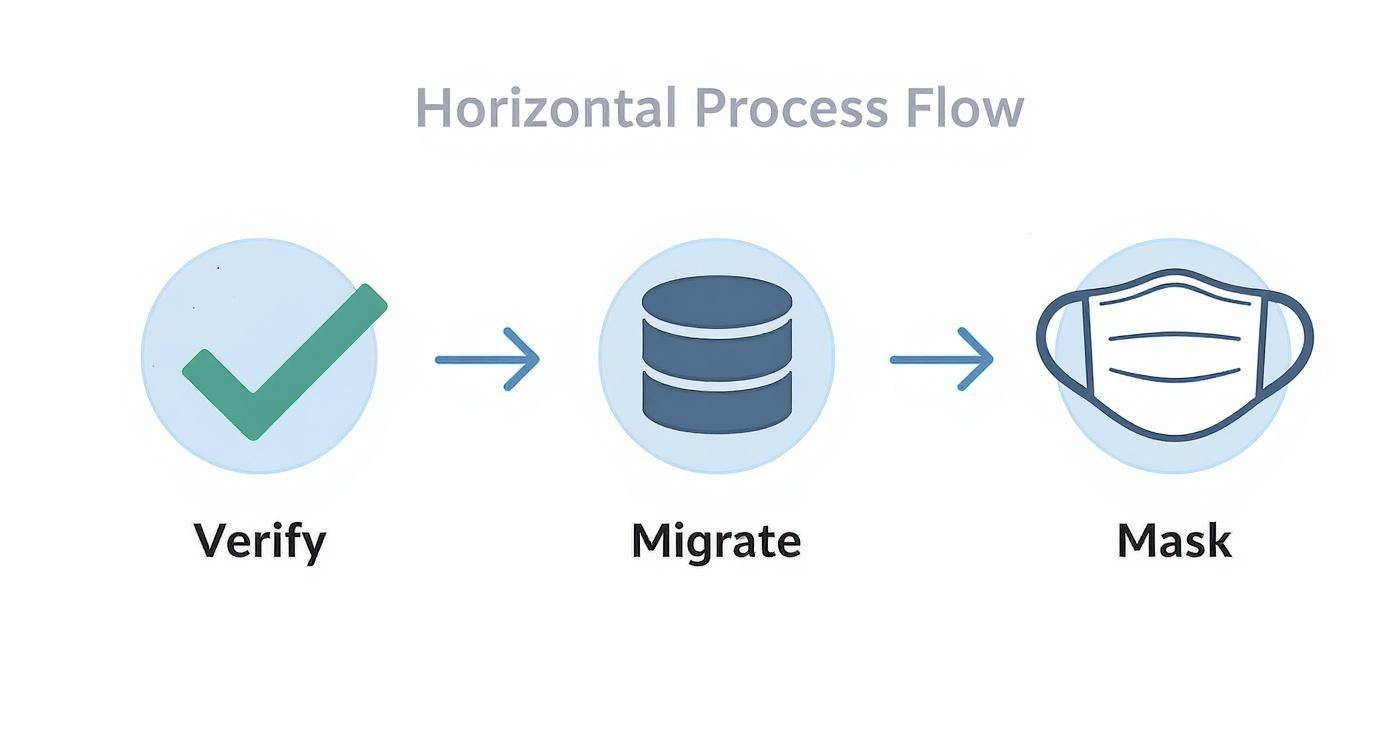
What this really shows is that robust testing isn’t a single event. It’s a sequence of actions that work together, ensuring your data stays secure and reliable every step of the way.
Establish a Centralized Test Data Strategy
First things first: get away from scattered, ad-hoc data requests. A centralized Test Data Management (TDM) strategy is the only way to guarantee consistency, security, and reusability. This means creating a single source of truth for all your test data, governed by clear policies on who can access it, how it’s masked, and when it gets provisioned.
By centralizing, you kill the data silos where different teams are using conflicting or stale datasets. This unified approach gives developers and QA engineers on-demand access to the right data, right when they need it—a non-negotiable for any team trying to be agile.
Automate Data Masking and Provisioning
Manually cleaning up data is slow, tedious, and a recipe for human error, leaving sensitive information exposed. If you’re serious about compliance, automating data masking is not optional. Use tools that can automatically find and mask PII across all of your non-production environments.
This automation needs to extend to provisioning, too. When you integrate your TDM tools into your CI/CD pipelines, you can automatically spin up fresh, secure test environments for every single build. This “shift-left” mindset helps you catch data-related bugs much earlier and slashes the manual workload.
An effective TDM strategy does more than just find bugs; it builds a foundation of trust in your data. By automating security and ensuring realism, you empower teams to build better software, faster, without compromising on privacy.
Implement Data Subsetting and Synthetic Data
Copying your entire production database for testing is a massive waste of resources. It drives up storage costs and makes creating new environments painfully slow. Data subsetting—the practice of creating smaller, referentially intact slices of production data—is a much smarter solution for most day-to-day development and QA work.
And for those times when real data is just too sensitive, or you need to cover edge cases your production data doesn’t have, synthetic data generation is a lifesaver. It lets you create realistic, statistically accurate data from scratch. You can test new features or stress-test your system without ever touching a single piece of real customer information. Embracing these core test data management best practices is essential for a modern, cost-effective strategy.
Use Replay-Based Tools for Ultimate Realism
Synthetic data is great, but nothing truly replicates the chaos and unpredictability of real user traffic. This is where tools like GoReplay come in. They capture production traffic and replay it in a safe, isolated test environment, letting you test your systems against how users actually behave, without exposing any production data.
This replay-based approach is perfect for performance testing and regression checks because it validates how your application handles real-world concurrency and complex user journeys. It gives you a level of confidence that purely synthetic data just can’t match, making sure your updates are truly ready for primetime. In fact, a good TDM solution can save 5-10% of average software testing costs by cutting down on these inefficiencies. Fortune Business Insights has more on the financial impact of TDM solutions.
Frequently Asked Questions
Even the best data testing plan runs into questions. Let’s tackle some of the most common ones that come up when teams start getting serious about data quality.
What Is the Difference Between Data Testing and Database Testing?
It’s easy to get these two mixed up, but they focus on completely different things. Think of it like a warehouse: one person checks the building’s foundation and shelving, while another inspects the inventory on those shelves.
Database testing is about the structure—the warehouse itself. It checks the database engine, schema, triggers, and stored procedures. It answers questions like: Are the tables set up correctly? or Is the server responding efficiently? The goal is to make sure the container for your data is solid and reliable.
Data management testing, on the other hand, is all about the inventory. It validates the accuracy, integrity, and security of the actual information flowing through your system. It asks: Is this customer’s order total correct? or Is this user’s PII properly masked in the test environment? It ensures the information on the shelves is correct, secure, and in the right place.
How Do We Integrate Data Testing Into an Agile Workflow?
The key is to “shift left” and treat test data as a first-class citizen in your development process, not an afterthought that gums up the works right before a release. Good data should be as easy for developers to get as good code.
Automation is your best friend here. You need to automate the creation and provisioning of fresh, secure, and relevant test data, plugging it directly into your CI/CD pipeline. Every time a new build hits a test environment, it should automatically get populated with compliant data, ready to go.
In an agile world, developers can’t wait days for a database refresh. The objective is to make data provisioning a self-service, on-demand process. This smashes bottlenecks and enables the rapid feedback loops that are the heart of agile development.
This approach ensures testing is never held up waiting for the right data. It aligns perfectly with agile principles of speed and continuous delivery, making data a seamless part of every sprint.
What Are the Main Benefits of Using Synthetic Data?
Synthetic data—artificially generated information that mimics the statistical properties of real data—is a game-changer. It solves some massive testing problems that simply masking or subsetting production data can’t touch.
First and foremost, it guarantees privacy and compliance. Since you create the data from scratch, you completely remove real customer information from your dev and test environments. This eliminates the risk of a data breach during testing and keeps you aligned with strict regulations like GDPR and CCPA.
Second, synthetic data lets you test for edge cases and future scenarios. Your production data only shows what’s already happened. Synthetic generation lets you build datasets for conditions that don’t exist yet, like preparing for a new market you plan to enter or simulating extreme user loads. It makes your application much more robust.
Finally, it solves the “no data” problem. When you’re building a brand-new application, you have no historical data to test with. Synthetic data lets you run thorough performance, load, and functional tests long before your first real user ever shows up.
When Should We Use Data Subsetting Instead of Full Copies?
This decision comes down to a classic tradeoff: realism versus efficiency. For the vast majority of day-to-day testing, data subsetting is the clear winner.
Data subsetting creates a smaller, referentially intact slice of your production database. It’s the perfect fit for most dev and QA environments because it’s so much faster and cheaper. You dramatically reduce storage costs and cut the time it takes to provision a fresh test environment from hours or days down to just minutes.
Full production copies are slow, expensive, and hog resources. You should only pull that trigger for a few specific, late-stage scenarios where you need an exact mirror of production.
- Final User Acceptance Testing (UAT): When business users need to validate workflows against a perfect replica of the live environment.
- Staging Environments: The last stop before production, where a final verification on a matched environment is non-negotiable.
- Comprehensive Performance Testing: When you absolutely must simulate the exact load and data volume of your production servers.
For all the everyday work inside an agile sprint—functional tests, unit tests, and regression checks—a smart, targeted data subset gives you the perfect mix of speed and accuracy.
Ready to test your applications against real-world traffic without compromising data security? GoReplay is an open-source tool that captures and replays live user traffic in your test environments, allowing you to validate performance and stability with ultimate realism. Ensure your updates are bulletproof before they ever reach production. Learn more and get started with GoReplay today!