
What Continuous Testing DevOps Actually Means in Real Teams
Let’s ditch the buzzwords and talk about what continuous testing in DevOps really looks like in the real world. Think of it like this: imagine the difference between a yearly physical at the doctor and wearing a fitness tracker 24/7. Continuous testing is like that fitness tracker, constantly monitoring your application’s health. Instead of waiting for a big release to find problems, you’re getting real-time feedback, catching and fixing small issues before they turn into major emergencies. This makes deployments way less stressful, allowing for frequent and confident releases.
Continuous testing isn’t just about automating every single test you can think of. It’s a fundamental shift in how developers, QA, and operations teams work together. Picture an e-commerce team building a new platform. With continuous testing, developers integrate tests as they write code, catching bugs early in the process. QA then focuses on exploratory testing and fine-tuning those automated tests, working hand-in-hand with the developers. And operations? They gain confidence in deployments because of the rigorous testing that’s been happening throughout.
This collaborative spirit is key. The image below shows how interconnected DevOps practices really are. Notice how testing (represented by “Continuous Testing”) is woven together with other crucial elements like continuous integration and continuous delivery. This integration creates tight feedback loops, speeding up the entire delivery process.
This visual emphasizes the “continuous” part of DevOps, showing how testing isn’t a separate phase, but a constant throughout the entire software lifecycle. This shift is a big reason why the DevOps market is growing so rapidly. By 2025, it’s projected to hit $15.06 billion, underscoring the increasing importance of continuous testing within a broader DevOps strategy. Continuous testing leads to faster feedback and more reliable software releases. For example, reports show that teams using DevOps, including continuous testing, deploy code 46 times more often than lower-performing teams. Learn more about the future of DevOps here.
But shifting to continuous testing requires a change in mindset. Teams need to break down silos and embrace shared responsibility for quality. This also means re-evaluating how we measure testing success. Instead of just counting the number of tests, we should focus on metrics that reflect the impact of testing on the overall delivery process. Think deployment frequency and how quickly you can recover from problems. In the end, continuous testing is about building a culture of quality that permeates every step of the software development lifecycle. This empowers teams to deliver better software, faster, and with much more confidence.
Building Testing Pipelines That Actually Work
Building a successful continuous testing pipeline in DevOps isn’t about throwing every tool at the problem. It’s about creating a system that gives you confidence in your code, every single time it changes. Think of it like constructing a house: you wouldn’t start with the roof, would you? You need a solid foundation first. In software, that foundation is unit tests, checking each individual component in isolation.
Next comes the framing and wiring – making sure the different parts work together. This is where integration tests come in. They verify that different modules interact correctly, like ensuring your plumbing and electrical systems don’t clash. Finally, you walk through the finished house to make sure everything works as expected – the lights turn on, the faucets run, the doors open and close. This is the role of end-to-end tests, confirming the entire system functions harmoniously.
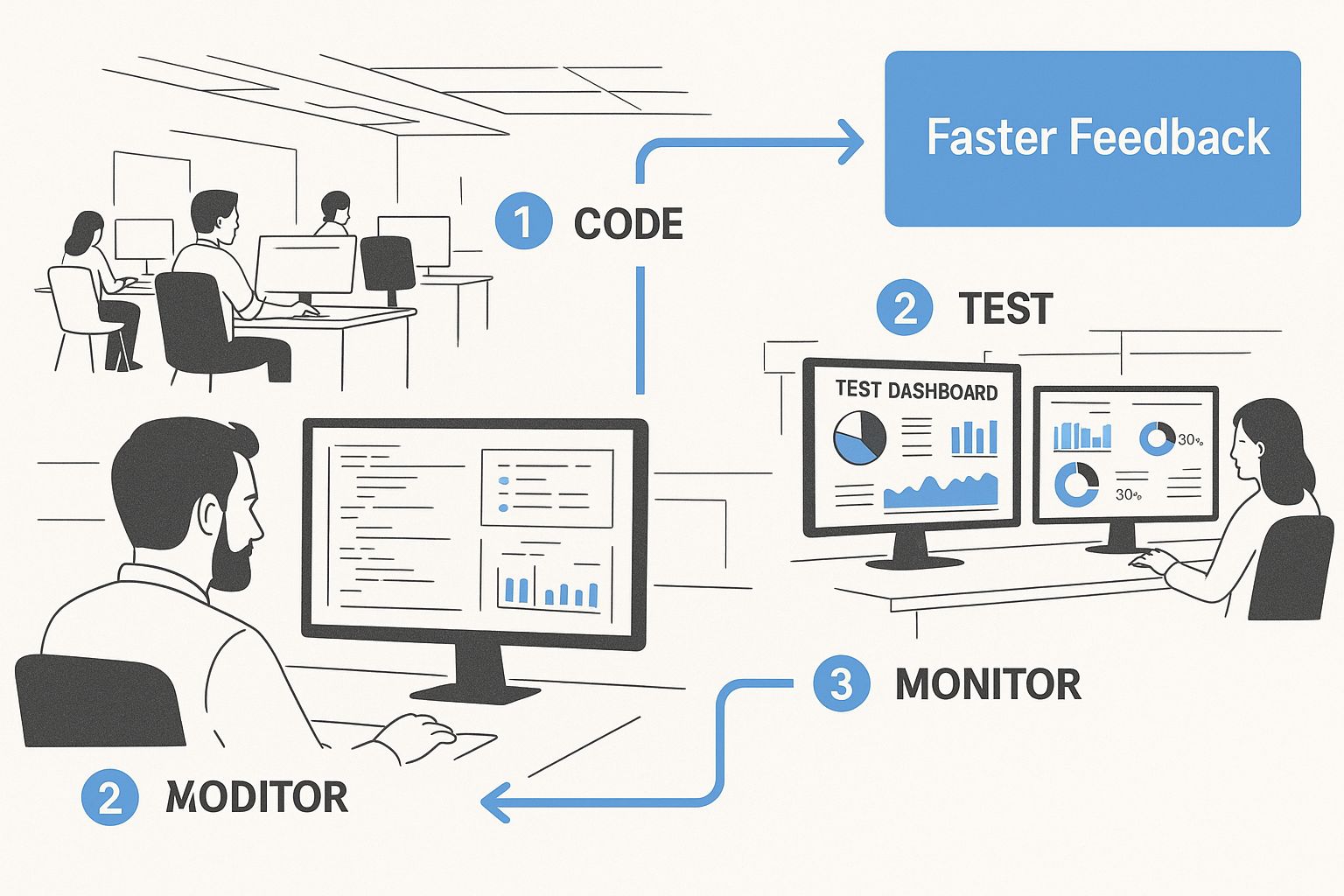
This infographic shows continuous testing in action. Imagine a bustling construction site, with constant activity and real-time updates. That’s what a good continuous testing setup looks like. Teams monitor dashboards, getting instant feedback on the “health” of their application. This rapid feedback is crucial, allowing teams to react quickly to any issues and maintain a high level of quality throughout the development process.
Connecting Continuous Testing to DevOps
This real-time monitoring and rapid response ties into the bigger picture of DevOps. Continuous testing isn’t an isolated island; it’s deeply connected to practices like continuous integration and continuous delivery. Think of them as different stages of the same construction project. Continuous integration is like constantly adding new materials and checking they fit. Continuous delivery is like scheduling regular inspections to ensure the build is on track. According to Mabl, 53% of organizations use continuous integration, and 38% use continuous delivery. Continuous testing supports these practices by verifying every change before it goes live. For more DevOps insights, check out these DevOps statistics.
Structuring Your Testing Phases
So, how do high-performing teams structure their testing? They avoid overcomplicating things. Instead of building massive, unwieldy pipelines that become bottlenecks, they prioritize speed and efficiency without compromising thoroughness. One common approach is the testing pyramid. Imagine a pyramid with unit tests forming the broad base, integration tests in the middle, and a smaller peak of end-to-end tests. This structure ensures a balanced strategy, catching most bugs early on with quick, focused unit tests.
This screenshot shows Jenkins, a popular open-source automation server. Think of Jenkins as the project manager for your software pipeline. It helps automate the different stages, from building and testing to deployment. This automation is crucial for continuous testing, ensuring tests run consistently and quickly, freeing up your team to focus on fixing issues, not manually running tests.
To understand the different stages of a testing pipeline better, let’s look at a comparison table.
Testing Pipeline Stages Comparison
| Testing Stage | Primary Purpose | Execution Time | Feedback Type | Automation Level |
|---|---|---|---|---|
| Unit Tests | Verify individual components | Very Fast | Immediate, focused | Highly Automated |
| Integration Tests | Verify interactions between components | Fast | Relatively quick, identifies integration issues | Highly Automated |
| End-to-End Tests | Verify complete system functionality | Slower | Comprehensive, user-focused | Automated, but can involve manual steps |
This table summarizes the key characteristics of different testing stages. As you can see, unit tests offer rapid feedback, while end-to-end tests provide broader system validation. The balance of these tests within your pipeline is crucial for efficient and effective continuous testing.
Building a solid pipeline also means choosing the right tools for the job. Don’t just grab the most popular option – select tools that fit your specific needs. For example, GoReplay lets you replay real production traffic, uncovering issues that traditional tests might miss. This real-world simulation is invaluable in complex environments, allowing you to test how your system performs under actual user behavior.
How Different Industries Master Continuous Testing DevOps
Different industries tackle continuous testing in DevOps in their own unique ways, and learning from their specific challenges offers valuable lessons for everyone. Take the financial services world, for example. A tiny software bug can have enormous repercussions, potentially inviting regulatory scrutiny and costing millions. This means banks and fintech companies absolutely require robust testing to ensure they can deploy quickly and maintain rock-solid security. Their strategies offer great insights into balancing speed and safety.
Technology companies, while facing perhaps fewer regulatory hurdles, have their own set of complexities. Managing intricate microservices and cloud-native architectures demands testing strategies that older methods simply can’t touch. Imagine trying to test a vast network of interconnected services – traditional testing would quickly become overwhelmed.
This screenshot shows the different stages of the DevOps lifecycle. Notice how “Verify” occupies a central role, highlighting the importance of testing throughout the entire process, not just at the end. Integrating testing at every stage, just as this visual demonstrates, is key for true continuous testing in DevOps.
The adoption of these practices isn’t uniform across all industries. Leading the charge are the technology and finance sectors, where about 90% of Fortune 500 companies have embraced DevOps, including continuous testing. This high adoption rate shows just how crucial rapid and secure software delivery is in these fast-paced and high-stakes industries. Learn more about DevOps adoption rates here.
Learning From Success Stories
We can gain a lot of practical knowledge from companies that have successfully implemented continuous testing in DevOps. Many Fortune 500 companies, initially hesitant, overcame implementation hurdles and regulatory requirements to achieve impressive improvements in how often they deploy and how reliably their systems run. For instance, some companies have gone from stressful monthly deployments to smooth, confident daily releases. This represents a huge shift, not just in technical processes but in the entire organizational culture.
Applying Lessons Across Industries
These success stories offer practical wisdom applicable across all sorts of industries. They showcase the importance of managing change effectively, getting buy-in from all stakeholders, and clearly defining what success looks like. By looking closely at these examples, organizations can learn how to build internal excitement, address any concerns about the investment in testing, and demonstrate the very real benefits of continuous testing. The end goal? To cultivate a culture of quality that drives continuous improvement and enables teams to deliver better software, faster, and with greater confidence.
Tools That Transform Your Continuous Testing Strategy
Finding the right tools for continuous testing can feel like navigating a dense jungle. Successful DevOps teams, however, focus on tools that solve their particular challenges, not just the shiny new ones. Let’s explore the core tools that create a strong continuous testing foundation: automation frameworks that adapt to code changes, monitoring solutions that offer real insights, and orchestration platforms that tie it all together. This combination is essential for a robust and efficient continuous testing strategy within DevOps.
Essential Tool Categories
Building a house requires different tools for different jobs. Continuous testing in DevOps is similar – it relies on a variety of tools working together. Automation frameworks, like your hammers and saws, build the tests. These frameworks must be sturdy enough to handle codebase changes without needing constant rewrites. Monitoring tools act as your blueprints, giving you visibility into your application’s health. They need to provide actionable data and prevent “alert fatigue,” where teams start ignoring constant notifications. Orchestration platforms are the project managers, scheduling and coordinating testing activities. They ensure the right tests run at the right time, streamlining the whole process.
Choosing the Right Tools
Choosing the right tool depends entirely on your needs. Why do some teams excel with certain frameworks while others struggle? It comes down to carefully evaluating tools based on specific requirements, not marketing buzz. Take Selenium, a popular open-source framework for automating web browsers, as an example.

This screenshot from Selenium’s website highlights its focus on web browser automation. It’s a powerful tool for testing web applications, allowing automated interaction with different browsers to ensure consistent performance. But it might not be the best choice for other testing needs, like API or performance testing. If you’re building a web application, Selenium could be a perfect fit for automating UI tests. But if you’re working with microservices, you’ll need tools that can handle API testing and service virtualization.
If you’re dealing with microservices, tools like GoReplay that replicate real production traffic become critical. They help identify real-world issues that traditional testing might miss. For a broader view of software testing tools, check out this complete guide for modern teams.
The Power of Traffic Replication
Traditional testing often uses simulated user behavior. Imagine building a bridge and only testing it with toy cars. It might seem fine, but what happens with real traffic? GoReplay solves this by capturing and replaying actual user interactions. Think of it as stress-testing that bridge with real vehicles, making sure it can handle real-world conditions. This helps find hidden bottlenecks and vulnerabilities that simulated tests might miss.
Scaling Your Tool Stack
As your organization grows, so do your testing needs. A scalable tool stack means choosing tools that can grow with you. This might involve integrating with cloud-based testing platforms or using solutions with advanced reporting and analytics. The goal is to build a foundation that adapts to your evolving needs, ensuring your continuous testing strategy remains effective as your application and team expand. This adaptability is essential for long-term success in a dynamic development environment.
To help you choose the right tools, let’s look at a comparison of some popular options. The following table provides a quick overview of their key features, pricing models, and ideal use cases.
Continuous Testing Tools Comparison Comprehensive comparison of popular continuous testing tools showing features, pricing, and best use cases
| Tool Name | Primary Function | Integration Capabilities | Learning Curve | Best For |
|---|---|---|---|---|
| Selenium | Web UI Testing | Wide range of browsers and testing frameworks | Moderate | Web Applications |
| GoReplay | Traffic Replication & Shadow Testing | Integrates with existing infrastructure | Moderate | Microservices, Performance Testing |
| JMeter | Performance Testing | Plugins for various protocols and reporting | Moderate | Load Testing, Stress Testing |
| Postman | API Testing | API documentation, mocking, and monitoring | Easy | API Development and Testing |
This table provides a starting point for your research. Remember to carefully consider your specific needs and context when selecting tools for your continuous testing strategy. Don’t just choose a tool because it’s popular – choose the one that best fits your team and your goals.
Conquering Common Implementation Roadblocks

Let’s face it, integrating continuous testing into your DevOps workflow isn’t always a walk in the park. It’s a bit like trying to remodel your kitchen while still cooking three meals a day in it – there are bound to be a few bumps along the way. Developers might be concerned about testing slowing them down. Operations teams may worry about system stability. And, of course, management might question the initial investment. These are all legitimate concerns, and addressing them proactively is crucial for a successful transition.
Addressing Cultural Resistance
One of the biggest challenges is the shift in mindset that continuous testing requires. Imagine switching from a flip phone to a smartphone – there’s a learning curve. Developers used to handing off testing to a separate QA team might resist integrating it into their daily workflow. The key here is to highlight the advantages: faster feedback, fewer production bugs, and ultimately, more time for building exciting new features. Demonstrate how continuous testing, when done effectively, actually accelerates development.
This isn’t about adding more work; it’s about working smarter.
Managing Test Maintenance Overhead
Another valid point is the effort needed to maintain tests. A fragile test suite that breaks with every minor code change can quickly become a major headache. This is where solid test design principles come in. Invest in robust automation frameworks like Selenium and prioritize tests that provide the most value. Think of it like regularly decluttering your closet – periodically review and refine your test suite to eliminate redundancy and keep it manageable.
Demonstrating Value to Stakeholders
Management often sees testing as a cost, not an investment. To get their buy-in, speak their language. Instead of focusing on technical details, show how continuous testing impacts the bottom line. Explain how it reduces the expense of fixing production bugs, improves customer satisfaction, and leads to a faster time to market. Put these benefits into concrete terms. For example, showing that continuous testing has reduced customer support tickets by 20% is a powerful message.
Avoiding Common Pitfalls
Many continuous testing implementations stumble because they fall into common traps. One is over-automation. Trying to automate every single test can lead to a complicated, brittle system that’s hard to maintain. Focus on automating the right things – repetitive tasks, critical user flows, and areas prone to errors. Another pitfall is testing theater, where fancy dashboards hide underlying issues. Metrics like test coverage percentage can be misleading. Focus on metrics that truly reflect software quality, such as defect escape rate and mean time to recovery.
Building a Sustainable Strategy
Successful continuous testing in DevOps requires a long-term approach. It’s not a one-time project but a continuous journey of improvement. Just like maintaining a healthy lifestyle, continuous testing requires regular attention and refinement. By addressing cultural resistance, managing test maintenance, demonstrating value to stakeholders, and avoiding common pitfalls, you can create a testing strategy that is sustainable and delivers real value to your organization. This means fostering a culture of quality where everyone, from developers to executives, understands the importance of testing and actively participates in its evolution.
Measuring Success Beyond Vanity Metrics
Imagine a ship, meticulously crafted, gleaming in the harbor. It looks perfect, right? But what if it sinks the moment it hits open water? That’s what can happen with software testing if you focus solely on vanity metrics like test coverage percentages. They look great on a dashboard, but they don’t tell the whole story about the quality of your software or its real-world performance. Smart teams dig deeper, focusing on metrics that reveal the true impact of their continuous testing DevOps strategy.
Key Metrics That Matter
So, what should you be measuring? Think about metrics that directly reflect how your testing impacts your ability to deliver value.
- Deployment Frequency: How often are you shipping new code?
- Lead Time: How long does it take from code commit to production release?
If your continuous testing is working well, you should see these numbers improve over time. Faster deployments and shorter lead times are strong signals that your testing process is streamlining your delivery pipeline.
Mean Time to Recovery (MTTR) is another vital metric. It tells you how long it takes to fix a problem once it’s discovered. Think of it like a fire alarm – you want it to alert you quickly so you can put out the fire before it spreads. Effective testing should lead to a lower MTTR, meaning you’re catching and fixing issues quickly.
Finally, keep an eye on your defect escape rate. This measures how many bugs slip through your testing net and make it into production. A low escape rate means your testing is effectively catching those bugs before they impact your users. A high escape rate, on the other hand, signals gaps in your testing strategy.
Building a Measurement Framework
To truly optimize your testing, you need a solid measurement framework – like a map guiding you to your destination. This framework should align with your business goals and provide actionable insights. It involves choosing the right metrics, setting clear benchmarks, and regularly reviewing your progress. This consistent monitoring helps you identify bottlenecks before they become major roadblocks and shows the value of testing in a way that business leaders understand.
You might be interested in: Essential Metrics for Software Testing: A Comprehensive Guide
Avoiding Vanity Metrics
Be wary of vanity metrics. High test coverage can be deceiving, creating a false sense of security while masking underlying problems. It’s like having a beautifully organized toolbox but not knowing how to use the tools. Simply counting the number of tests doesn’t tell you if those tests are actually effective in preventing real-world issues.
Continuous Improvement Through Feedback Loops
Finally, just like a gardener tends to their plants, you need to nurture your testing strategy. Establish feedback loops that help it evolve alongside your application and team. Adapting to changes in your application architecture, team structure, and business goals is essential. This continuous feedback and adaptation builds a resilient and effective continuous testing process within your DevOps environment, ensuring your testing stays relevant and valuable over time.
Your Continuous Testing DevOps Action Plan
So, we’ve covered a lot about continuous testing. Now, how do we put it all into practice? Think of it like planning a road trip. You need a starting point, a destination, and a route to get there. This roadmap will guide you through implementing continuous testing, starting with a simple assessment and gradually progressing to more advanced strategies.
Assessing Your Current Testing Maturity
Before hitting the road, you need to know where you’re starting. Evaluate your current testing practices. Are you mostly doing manual testing? Do you have any automated tests? How well do your testing and development teams work together? Use a checklist like this:
- Level of Test Automation: What percentage of your tests are automated?
- Testing Frequency: How often do you run tests?
- Team Collaboration: How closely do your development, QA, and operations teams collaborate?
- Test Environment: Do you have dedicated test environments?
- Metrics: What metrics are you currently tracking?
This assessment helps identify areas for improvement and set realistic goals for your continuous testing journey.
Implementing Quick Wins
Start with small, achievable wins. Think of these as the first few milestones on your road trip. Identify a few key areas where you can introduce continuous testing without disrupting your current workflow. Maybe start by automating your most critical regression tests or integrating basic unit tests into your development process. These early successes build momentum and show your team and stakeholders the value of continuous testing.
Building Momentum and Scaling Up
Once you have a basic continuous testing foundation in place, you can start scaling up. This might involve using more advanced automation techniques, expanding your test coverage, or integrating continuous testing into your CI/CD pipeline. Like any worthwhile trip, continuous testing requires adjustments along the way. Regularly track your progress and reassess your strategy.
Securing Buy-In and Resources
Continuous testing in DevOps often means investing in new tools, training, and infrastructure. To get the resources you need, you’ll need buy-in from key stakeholders. Clearly communicate the benefits of continuous testing, highlighting how it improves software quality, reduces costs, and speeds up delivery. Use data and real-world examples to support your case. Showing the value of continuous testing in terms of business outcomes is key to securing ongoing support and resources.
Maintaining Momentum Through Challenges
Implementing continuous testing isn’t always a smooth ride. You’ll probably encounter roadblocks and setbacks. Be prepared for resistance to change, technical difficulties, and unexpected delays. Having a clear plan, along with strong leadership and team support, helps you navigate these challenges and stay on course. It’s like anticipating detours on your road trip.
By following this action plan and adapting it to your specific situation, you can successfully implement continuous testing within your DevOps practices and enjoy its many benefits. Remember, the journey is just as important as the destination, so stay persistent and embrace the iterative nature of continuous improvement.
Ready to boost your testing strategy with real-world traffic replication? Check out GoReplay and see how it can transform your continuous testing DevOps approach.